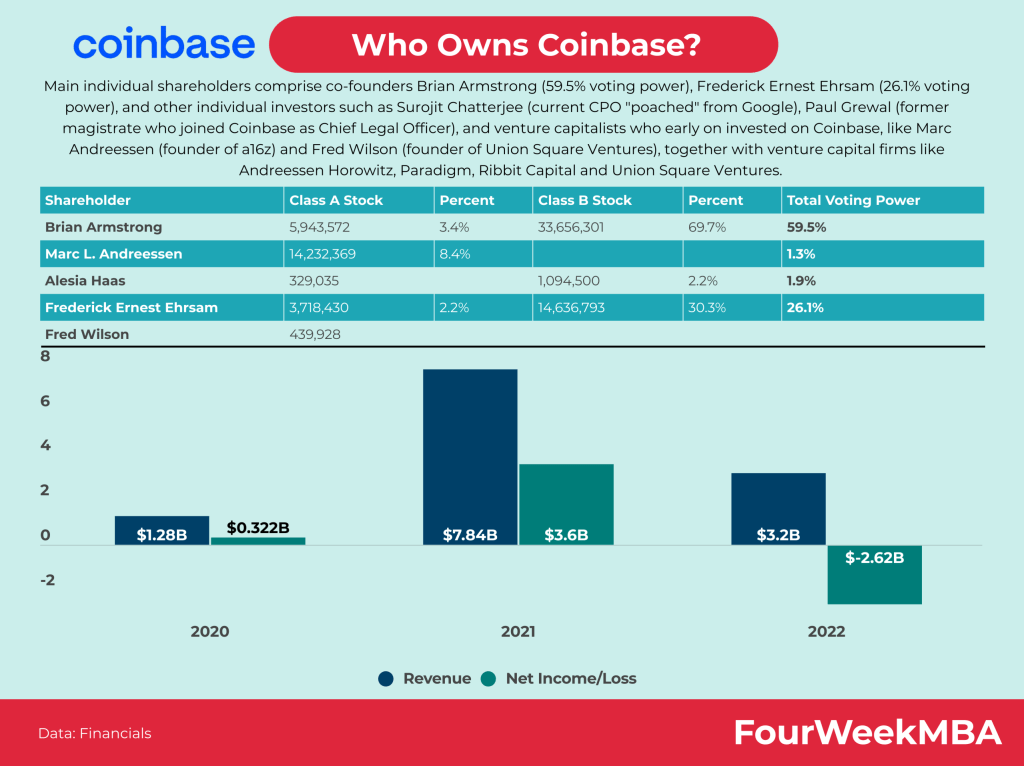
Main individual shareholders comprise co-founders Brian Armstrong (58.5% voting power), Frederick Ernest Ehrsam (25.4% voting power), and other individual investors such as Surojit Chatterjee (current CPO “poached” from Google), Paul Grewal (former magistrate who joined Coinbase as Chief Legal Officer), and venture capitalists who early on invested on Coinbase, like Marc Andreessen (founder of a16z) and Fred Wilson (founder of Union Square Ventures), together with venture capital firms like Andreessen Horowitz, Paradigm, Ribbit Capital and Union Square Ventures.
Detail
Description
Company
Coinbase Global, Inc.
Ownership Structure
Publicly traded company with major shareholders
Major Shareholders
Institutional investors like Vanguard Group, BlackRock, ARK Investment Management, Fidelity Investments, as well as founders and insiders
Founding Date
June 2012
Founders
Brian Armstrong and Fred Ehrsam
Headquarters
San Francisco, California, USA
Primary Business
Providing a platform for buying, selling, and managing cryptocurrency assets
Corporate Structure and Ownership: Coinbase Global, Inc. is publicly traded on the NASDAQ under the ticker symbol COIN. The company went public through a direct listing in April 2021. Coinbase’s ownership structure includes significant stakes held by institutional investors such as Vanguard Group, BlackRock, ARK Investment Management, and Fidelity Investments. Founders Brian Armstrong and Fred Ehrsam, along with other insiders, also maintain considerable ownership, influencing strategic decisions and company direction.
Corporate Strategy and Business Model: Coinbase’s business model revolves around providing a secure and user-friendly platform for individuals and institutions to buy, sell, and manage cryptocurrency assets. The company earns revenue through transaction fees, subscription services, and other financial products. Coinbase aims to be a key player in the broader adoption of cryptocurrencies by offering educational resources, expanding its product offerings, and building trust within the crypto community.
Product Innovation and Technology: Coinbase invests in technology to enhance its platform’s capabilities and user experience. The company offers a variety of products, including Coinbase Pro for advanced traders, Coinbase Wallet for secure storage, and Coinbase Custody for institutional clients. Additionally, Coinbase supports a wide range of cryptocurrencies and regularly adds new tokens to its platform, focusing on security, compliance, and ease of use.
Market Expansion and Growth: Coinbase seeks to expand its global presence by entering new markets and enhancing its offerings for retail and institutional clients. The company targets both individual users looking for straightforward crypto transactions and institutional investors seeking comprehensive crypto management solutions. Coinbase’s growthstrategy includes strategic partnerships, acquisitions, and investments in blockchain technology to support its mission of creating an open financial system for the world.
User Engagement and Community: Coinbase prioritizes user engagement and education by offering resources that help users understand cryptocurrencies and blockchain technology. The company provides tools like Coinbase Earn, where users can learn about specific cryptocurrencies and earn tokens. Coinbase’s commitment to user education and transparency is designed to build trust and encourage broader adoption of digital assets.
Aspect
Description
Analysis
Examples
Products and Services
Coinbase offers a range of cryptocurrency-related products and services, including cryptocurrency exchange services (e.g., Bitcoin, Ethereum), a secure digital wallet for storing cryptocurrencies, Coinbase Pro for professional traders, Coinbase Earn for educational purposes, and APIs for developers to integrate cryptocurrency functionality into their applications. Coinbase also provides resources on cryptocurrency research, market data, and more.
Coinbase’s core offerings encompass cryptocurrency exchange services, secure digital wallet storage, professional trading through Coinbase Pro, educational resources via Coinbase Earn, and APIs for developers. The platform caters to both novice users and professional traders while providing valuable information and data resources. Coinbase’s diverse portfolio serves as an entry point for individuals and businesses into the cryptocurrency space.
Cryptocurrency exchange services (e.g., Bitcoin, Ethereum), secure digital wallet storage, professional trading via Coinbase Pro, educational resources through Coinbase Earn, APIs for developers, diverse portfolio for entry into the cryptocurrency market, appeals to novice users and professional traders, valuable information and data resources.
Revenue Streams
Coinbase generates revenue primarily through transaction fees, which are levied on cryptocurrency trades conducted on the platform. The fees vary based on transaction size and type. Additionally, Coinbase earns income from the spread (the difference between buying and selling prices), Coinbase Pro trading fees, staking services, interest on cryptocurrency holdings, and subscription services like Coinbase Premium.
The primary source of revenue for Coinbase is transaction fees charged on cryptocurrency trades. The platform’s revenue is further augmented by spreads, Coinbase Pro trading fees, income from staking services, interest earned on cryptocurrency holdings, and subscription fees from services like Coinbase Premium. Coinbase diversifies its revenue streams within the cryptocurrency ecosystem.
Revenue from transaction fees on cryptocurrency trades, spreads from buying and selling prices, Coinbase Pro trading fees, income from staking services, interest earned on cryptocurrency holdings, subscription fees for services like Coinbase Premium, diversified revenue streams within the cryptocurrency ecosystem.
Customer Segments
Coinbase serves a diverse customer base that includes individual retail investors, institutional investors, cryptocurrency traders, businesses, developers, and educational institutions. The platform caters to users with varying levels of experience in the cryptocurrency space, from beginners to advanced traders. Coinbase’s educational resources also attract those looking to learn about cryptocurrencies.
Customer segments for Coinbase encompass individual retail investors, institutional investors, cryptocurrency traders, businesses, developers, and educational institutions. The platform accommodates users with different levels of experience, from cryptocurrency novices to advanced traders. Coinbase’s educational offerings make it an attractive destination for those seeking to understand cryptocurrencies better.
Individual retail investors, institutional investors, cryptocurrency traders, businesses, developers, educational institutions, diverse user base with varying levels of cryptocurrency experience, appeal to novices and advanced traders, educational resources for cryptocurrency learning.
Distribution Channels
Coinbase primarily operates as an online platform, accessible through web and mobile applications. Users can create accounts, complete identity verification, and perform cryptocurrency transactions entirely online. Coinbase also offers APIs for developers to integrate cryptocurrency functionality into their applications. The platform leverages online accessibility for user engagement.
Distribution channels for Coinbase primarily revolve around its online platform, accessible through web browsers and mobile applications. Users can easily create accounts, undergo identity verification, and execute cryptocurrency transactions online. Additionally, Coinbase provides APIs for developers to integrate cryptocurrency functionality into their own applications. The platform’s online presence facilitates user convenience and engagement.
Online platform accessible through web and mobile applications, user account creation, identity verification, and cryptocurrency transactions conducted online, APIs for developers to integrate cryptocurrency functionality, user convenience and engagement through online accessibility.
Key Partnerships
Coinbase collaborates with various partners to enhance its services and reach. These partnerships may involve collaborations with blockchain projects to list new cryptocurrencies on the platform, financial institutions for banking and payment services, regulators for compliance, and educational institutions for cryptocurrency courses. Coinbase also forms alliances with companies for marketing and promotional campaigns.
Collaborations with blockchain projects facilitate the listing of new cryptocurrencies on Coinbase. Partnerships with financial institutions enhance banking and payment services. Cooperation with regulators ensures compliance. Educational partnerships promote cryptocurrency courses. Marketing and promotional campaigns with other companies expand brand reach. Coinbase’s partnerships strengthen its position in the cryptocurrency ecosystem.
Collaborations with blockchain projects for listing new cryptocurrencies, partnerships with financial institutions for banking and payment services, cooperation with regulators for compliance, educational partnerships for cryptocurrency courses, marketing and promotional campaigns with other companies, strengthened position in the cryptocurrency ecosystem.
Key Resources
Coinbase’s key resources include its cryptocurrency exchange platform, secure digital wallets, trading infrastructure (e.g., Coinbase Pro), educational content and resources, APIs for developers, regulatory compliance capabilities, a large user base, and the trust and reputation it has built over the years. These resources collectively enable Coinbase to provide a reliable and secure cryptocurrency trading experience.
Key resources for Coinbase encompass its cryptocurrency exchange platform, secure digital wallets, trading infrastructure like Coinbase Pro, educational content and resources, developer-friendly APIs, regulatory compliance capabilities, a substantial user base, and its established trust and reputation. These resources empower Coinbase to offer a dependable and secure environment for cryptocurrency trading and related services.
Cryptocurrency exchange platform, secure digital wallets, trading infrastructure (e.g., Coinbase Pro), educational content and resources, developer-friendly APIs, regulatory compliance capabilities, large user base, established trust and reputation, provision of a reliable and secure cryptocurrency trading experience.
Cost Structure
Coinbase incurs costs related to transaction processing, security and cybersecurity measures, regulatory compliance efforts, customer support and service, marketing and advertising campaigns, employee salaries and benefits, technological infrastructure maintenance, and collaborations and partnerships. Costs can vary based on regulatory requirements and marketing investments.
Costs associated with Coinbase’s operations include expenses for transaction processing, security and cybersecurity measures to protect user assets, regulatory compliance efforts to meet legal requirements, customer support and service, marketing and advertising initiatives, employee salaries and benefits, technological infrastructure maintenance, and expenditures related to collaborations and partnerships. The complexity of regulatory compliance and the scale of marketing campaigns influence operational costs. Coinbase manages its costs to provide a secure and compliant trading platform.
Costs related to transaction processing, security and cybersecurity measures, regulatory compliance efforts to meet legal requirements, customer support and service, marketing and advertising campaigns, employee salaries and benefits, technological infrastructure maintenance, expenditures for collaborations and partnerships, cost management for a secure and compliant trading platform.
Competitive Advantage
Coinbase’s competitive advantage is founded on its reputation for being a user-friendly and secure platform for cryptocurrency trading. It has gained the trust of a large user base and complies with regulatory requirements. Coinbase’s diverse offerings cater to both beginners and experienced traders. Collaborations and partnerships expand its cryptocurrency listings and services. The platform’s educational resources make it a valuable resource for those new to the cryptocurrency space.
Coinbase’s competitive advantage stems from its reputation as a user-friendly and secure cryptocurrency trading platform. It has established trust among a substantial user base and demonstrates commitment to regulatory compliance. Coinbase’s wide range of offerings appeals to both novice and experienced traders. Collaborations and partnerships extend its cryptocurrency listings and service offerings. The educational content positions it as a valuable resource for cryptocurrency beginners.
Reputation for user-friendliness and security in cryptocurrency trading, trust of a large user base, regulatory compliance commitment, diverse offerings for novice and experienced traders, collaborations and partnerships for expanded cryptocurrency listings and services, valuable educational resources for cryptocurrency beginners.
From the ashes of Mt. Gox
It is worth exploring, in a nutshell, the story of Mt. Gox.
When Jed McCaleb, back in 2010, had read about Bitcoin on a PR release over Slashdot, he was convinced that an exchange would have helped Bitcoin grow, so he set it up on a website he had bought years before for an online magic game called “Magic: The Gathering Online” which would be reused as the domain for Mt. Gox.
Once set up, the exchange quickly picked up, and it became the most successful Bitcoin exchange platform in a short time frame.
However, it has been shown since the beginning one of the significant drawbacks of exchange platforms: is security, where the Blockchain protocol had been designed for security and privacy.
Once people started to exchange Bitcoins via Mt. Gox, two issues came up quickly: one, the identity of Bitcoin holders that, through the Blockchain, was kept private, would be quickly revealed via Mt. Gox.
Second, as more people referred to Mt. Gox to store their Bitcoins, security problems became a major issue. Indeed, by 2014 Mt. Gox had to file for bankruptcy as a massive number of Bitcoin had been stolen by hackers, thus exposing Mt. Gox to substantial financial liability.
That lesson, costly for Mt. Gox, would become a valuable lesson for all the other crypto platforms that survived.
Coinbase’s services have been modeled around the main customers. Perhaps, retail users can trade multiple crypto assets.
While institutional clients have access to an advanced platform for both trading and securing crypto assets.
Image Source: Coinbase S-1
Customer Composition
Retail users: Coinbase offers a “safe, trusted, and easy-to-use platform to invest, store, spend, earn, and use crypto assets.”
Institutions: Coinbase offers a “one-stop shop for accessing crypto markets through advanced trading and custody technology, built on top of a robust security infrastructure.”
Ecosystem partners: developers, and merchants can build applications on top of the platform, and participate actively in the protocols part of the Coinbase offering.
Ownership Structure of Coinbase
The ownership of Coinbase is mainly concentrated among its co-founders and other individual investors, along with support from prominent venture capitalists and venture capital firms.
Main Individual Shareholders
Brian Armstrong: As a co-founder of Coinbase, Brian Armstrong holds significant voting power in the company, with 59.5% of the voting rights.
Frederick Ernest Ehrsam: Another co-founder, Frederick Ernest Ehrsam, also holds a substantial portion of the voting power, accounting for 26.1% of the total.
Surojit Chatterjee: Surojit Chatterjee, the current Chief Product Officer, was “poached” from Google and is a notable individual investor in Coinbase.
Paul Grewal: Paul Grewal, former magistrate who joined Coinbase as Chief Legal Officer, is also a key individual investor.
Venture Capital Investors
Coinbase has garnered support from renowned venture capitalists and venture capital firms in the crypto and tech industry:
Marc Andreessen: Marc Andreessen, the founder of a16z (Andreessen Horowitz), is an early investor in Coinbase.
Fred Wilson: Fred Wilson, founder of Union Square Ventures, also participated as an early investor in Coinbase.
Andreessen Horowitz: The venture capital firm Andreessen Horowitz is a significant investor in Coinbase.
Paradigm: Paradigm, another venture capital firm, has invested in Coinbase.
Ribbit Capital: Ribbit Capital is also among the venture capital firms that support Coinbase.
Union Square Ventures: In addition to Fred Wilson’s individual investment, Union Square Ventures, the venture capital firm itself, is also an investor in Coinbase.
From the Ashes of Mt. Gox
The story of Coinbase is linked to the infamous Mt. Gox, a Bitcoin exchange platform that faced security issues and eventually filed for bankruptcy in 2014. The lessons learned from Mt. Gox’s security breaches became valuable insights for Coinbase and other surviving crypto platforms.
Coinbase’s Customer Composition
Coinbase caters to a diverse customer base, providing tailored services for different segments:
Retail Users: Coinbase offers a safe, trusted, and user-friendly platform for retail investors to invest, store, spend, earn, and use various crypto assets.
Institutional Clients: Institutional investors have access to an advanced platform for both trading and securing crypto assets, built on a robust security infrastructure.
Ecosystem Partners: Developers and merchants can build applications on top of the Coinbase platform and actively participate in the protocols offered by Coinbase.
The ownership structure of Coinbase reflects a strong backing from its co-founders and early individual investors, along with support from prominent venture capitalists and venture capital firms, solidifying its position as a leading player in the crypto industry.
Key Highlights
Coinbase’s Leadership and Investors:
Paul Grewal joined Coinbase as Chief Legal Officer.
Notable venture capitalists invested early in Coinbase: Marc Andreessen (founder of a16z) and Fred Wilson (founder of Union Square Ventures).
Major venture capital firms supporting Coinbase: Andreessen Horowitz, Paradigm, Ribbit Capital, and Union Square Ventures.
The Mt. Gox Saga:
Founded by Jed McCaleb in 2010 after learning about Bitcoin.
Initially set up on a website previously used for “Magic: The Gathering Online”.
Quickly became a leading Bitcoin exchange but faced security challenges.
By 2014, Mt. Gox filed for bankruptcy due to a large-scale Bitcoin theft.
Coinbase’s Services:
Retail Users: A platform to invest, store, spend, earn, and use crypto assets.
Institutions: Access to advanced trading and custody technology with robust security.
Ecosystem Partners: Developers and merchants can build applications on the platform and engage actively in the protocols.
Ownership Structure:
Concentrated among co-founders, individual investors, and venture capital firms.
Brian Armstrong: Co-founder with 59.5% of voting rights.
Frederick Ernest Ehrsam: Co-founder with 26.1% of voting rights.
Surojit Chatterjee: Notable individual investor and the current Chief Product Officer.
Paul Grewal: Key individual investor and Chief Legal Officer.
Venture Capital Backing: Notable firms include Andreessen Horowitz, Paradigm, Ribbit Capital, and Union Square Ventures.
Lessons from Mt. Gox:
The security failures of Mt. Gox served as important lessons for Coinbase and other crypto platforms.
Diverse Customer Base:
Coinbase caters to retail users, institutional clients, and ecosystem partners with tailored services.
Coinbase’s Position:
Backed by influential co-founders, individual investors, and prominent venture capital firms, making it a dominant force in the crypto world.
Main individual shareholders comprise co-founders Brian Armstrong (58.5% voting power), Frederick Ernest Ehrsam (25.4% voting power), and other individual investors such as Surojit Chatterjee (current CPO “poached” from Google), Paul Grewal (former magistrate who joined Coinbase as Chief Legal Officer), and venture capitalists who early on invested on Coinbase, like Marc Andreessen (founder of a16z) and Fred Wilson (founder of Union Square Ventures), together with venture capital firms like Andreessen Horowitz, Paradigm, Ribbit Capital and Union Square Ventures.
Coinbase is among the most popular platforms for trading and storing crypto-assets, whose mission is “to create an open financial system for the world” by enabling customers to trade cryptocurrencies. Its platform serves both as a search and discovery engine for crypto assets. The company makes money primarily through fees earned for the transactions processed through the platform, custodial services offered, interest, and subscriptions.
Coinbase generated $3.108 billion in revenue in 2023, compared to $3.2 billion in revenue in 2022, compared to $7.84 billion in 2021 and $1.28 billion in 2020.
Coinbase generated $1.52B in transaction revenue, $1.4B in subscriptions and services, and $182 million in other revenue for 2023. In 2023, transaction revenue represented 49% of Coinbase’s total revenue, while subscriptions and services represented 45%.
Acorns is a fintech platform providing services related to Robo-investing and micro-investing. The company makes money primarily through three subscription tiers: Lite – ($1/month), which gives users access to Acorns Invest, Personal ($3/month) that includes Invest plus the Later (retirement) and Spend (personal checking account) suite of products, Family ($5/month) with features from both the Lite and Personal plans with the addition of Early.
Started as a pay-later solution integrated to merchants’ checkouts, Affirm makes money from merchants’ fees as consumers pick up the pay-later solution. Affirm also makes money through interests earned from the consumer loans, when those are repurchased from the originating bank. In 2020 Affirm made 50% of its revenues from merchants’ fees, about 37% from interests, and the remaining from virtual cards and servicing fees.
Alipay is a Chinese mobile and online payment platform created in 2004 by entrepreneur Jack Ma as the payment arm of Taobao, a major Chinese eCommerce site. Alipay, therefore, is the B2C component of Alibaba Group. Alipay makes money via escrows transaction fees, a range of value-added ancillary services, and through its Credit Pay Instalment fees.
Betterment is an American financial advisory company founded in 2008 by MBA graduate Jon Stein and lawyer Eli Broverman. Betterment makes money via investment plans, financial advice packages, betterment for advisors, betterment for business, cash reserve, and checking accounts.
Braintree
Venmo is a peer-to-peer payments app enabling users to share and make payments with friends for a variety of services. The service is free, but a 3% fee applies to credit cards. Venmo also launched a debit card in partnership with Mastercard. Venmo got acquired in 2012 by Braintree, and Braintree got acquired in 2013 by PayPal.
Chime is an American neobank (internet-only bank) company, providing fee-free financial services through its mobile banking app, thus providing personal finance services free of charge while making the majority of its money via interchange fees (paid by merchants when consumers use their debit cards) and ATM fees.
Coinbase is among the most popular platforms for trading and storing crypto-assets, whose mission is “to create an open financial system for the world” by enabling customers to trade cryptocurrencies. Its platform serves both as a search and discovery engine for crypto assets. The company makes money primarily through fees earned for the transactions processed through the platform, custodial services offered, interest, and subscriptions.
Compass is a licensed American real-estate broker incorporating online real estate technology as a marketing medium. The company makes money via sales commissions (collected whenever a sale is facilitated or tenants are found for a rental property) and bridge loans (a service allowing the seller to purchase a home before the revenue from the sale of their previous home is available).
Dosh is a Fintech platform that enables automatic cash backs for consumers. Its business model connects major card providers with online and offline local businesses to develop automatic cash back programs. The company makes money by earning an affiliate commission on each eligible sale from consumers.
E-Trade is a trading platform, allowing investors to trade common and preferred stocks, exchange-traded funds (ETFs), options, bonds, mutual funds, and futures contracts, acquired by Morgan Stanley in 2020 for $13 billion. E-Trade makes money through interest income, order flow, margin interests, options, future and bonds trading, and through other fees and service charges.
Klarna is a financial technology company allowing consumers to shop with a temporary Visa card. Thus it then performs a soft credit check and pays the merchant. Klarna makes money by charging merchants. Klarna also earns a percentage of interchange fees as a commission and for interests earned on customers’ accounts.
Lemonade is an insurance tech company using behavioral economics and artificial intelligence to process claims efficiently. The company leverages technology to streamline onboarding customers while also applying a financialmodel to reduce conflicts of interest with customers (perhaps by donating the variable premiums to charity). The company makes money by selling its core insurance products, and via its tech platform, it tries to enhance its sales.
Monzo is an English neobank offering a mobile app and a prepaid debit card for consumers and businesses. It was one of the first app-based banks to enter the UK market, founded by Gary Dolman, Jason Bates, Jonas Huckestein, Paul Rippon, and Tom Blomfield in 2015. All were employees of Starling Bank, a similar neobank challenging the dominance of established financial institutions in England. The company enjoys many revenue streams: business and consumer subscriptions, interchange and overdraft fees, personal loans, and more.
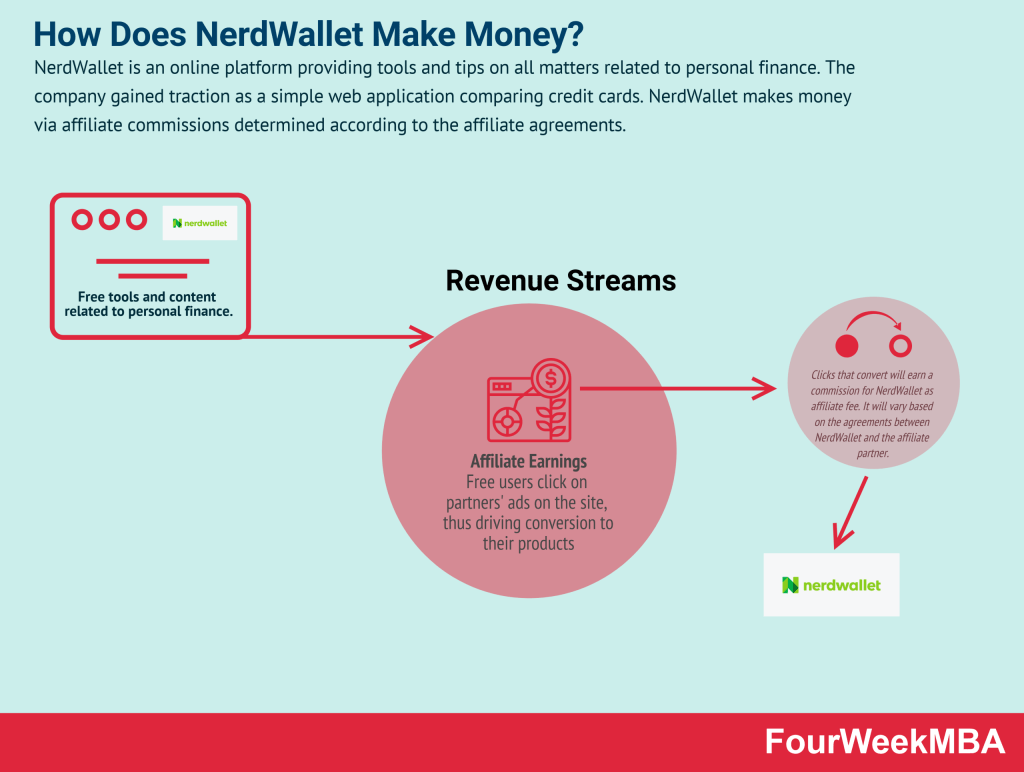
NerdWallet is an online platform providing tools and tips on all matters related to personal finance. The company gained traction as a simple web application comparing credit cards. NerdWallet makes money via affiliate commissions determined according to the affiliate agreements.
Quadpay was an American fintech company founded by Adam Ezra and Brad Lindenberg in 2017. Ezra and Lindenberg witnessed the rising popularity of buy-now-pay-later service Afterpay in Australia and similar service Klarna in Europe. Quadpay collects a range of fees from both the merchant and the consumer via merchandise fees, convenience fees, late payment, and interchange fees.
Revolut an English fintech company offering banking and investment services to consumers. Founded in 2015 by Nikolay Storonsky and Vlad Yatsenko, the company initially produced a low-rate travel card. Storonsky in particular was an avid traveler who became tired of spending hundreds of pounds on currency exchange and foreign transaction fees. The Revolut app and core banking account are free to use. Instead, money is made through a combination of subscription fees, transaction fees, perks, and ancillary services.
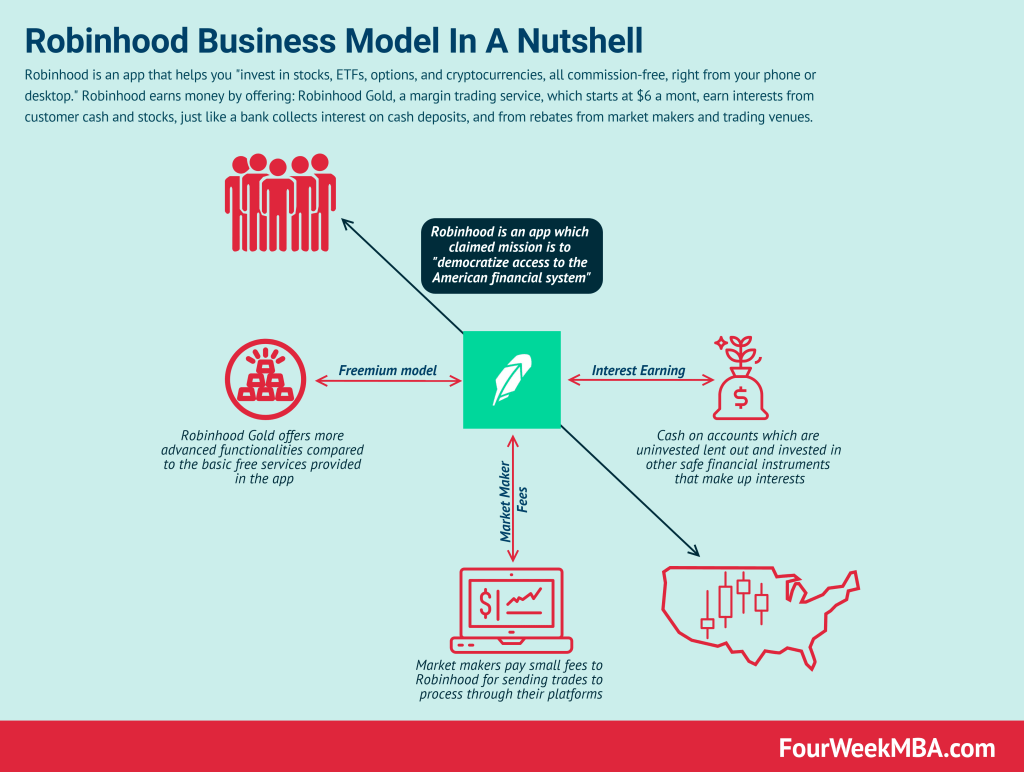
Robinhood is an app that helps to invest in stocks, ETFs, options, and cryptocurrencies, all commission-free. Robinhood earns money by offering: Robinhood Gold, a margin trading service, which starts at $6 a month, earn interests from customer cash and stocks, and rebates from market makers and trading venues.
SoFi is an online lending platform that provides affordable education loans to students, and it expanded into financial services, including loans, credit cards, investment services, and insurance. It makes money primarily via payment processing fees and loan securitization.
Squarespace is a North American hosting and website building company. Founded in 2004 by college student Anthony Casalena as a blog hosting service, it grew to become among the most successful website building companies. The company mostly makes money via its subscription plans. It also makes money via customizations on top of its subscription plans. And in part also as transaction fees for the website where it processes the sales.
Stash is a FinTech platform offering a suite of financial tools for young investors, coupled with personalized investment advice and life insurance. The company primarily makes money via subscriptions, cashback, payment for order flows, and interest for cash sitting on members’ accounts.
Venmo is a peer-to-peer payments app enabling users to share and make payments with friends for a variety of services. The service is free, but a 3% fee applies to credit cards. Venmo also launched a debit card in partnership with Mastercard. Venmo got acquired in 2012 by Braintree, and Braintree got acquired in 2013 by PayPal.
Wealthfront is an automated Fintech investment platform providing investment, retirement, and cashmanagement products to retail investors, mostly making money on the annual 0.25% advisory fee the company charges for assets under management. It also makes money via a line of credits and interests on the cash accounts.
Zelle is a peer-to-peer payment network that indirectly benefits the banks’ consortium that backs it. Zelle also enables users to pay businesses for goods and services, free for users. Merchants pay a 1% fee to Visa or Mastercard, who share it with the bank that issued the card.
OpenAI is an artificial intelligence research laboratory that transitioned into a for-profit organization in 2019, which comprised an entity called OpenAI LP and the non-profit parent foundation OpenAI. The lab, which was founded in 2015 by Elon Musk, Sam Altman, and various others, has a core focus on the development of friendly AI that benefits society as a whole. Yet now has primarily evolved as a capped-for-profit entity with an exclusive commercial license to Microsoft.
Its co-founders primarily own Airbnb: Brian Chesky, with 76,407,686 Class B shares, which gives him 29.1% of ownership; Nathan Blecharczyk, with 232,306 Class A and 64,646,713 Class B, which give him 25.3%; and Joe Gebbia, which has 5,113,865 Class A and 58,023,452 Class B, which give him 22.9% ownership.
Google is primarily owned by its founders, Larry Page and Sergey Brin, who have more than 51% voting power. Other individual shareholders comprise John Doerr (1.5%), a venture capitalist and early investor in Google, and CEO, Sundar Pichai. Former Google CEO Eric Schmidt has 4.2% voting power. The most prominent institutional shareholders are mutual funds BlackRock and The Vanguard Group, with 2.7% and 3.1%, respectively.
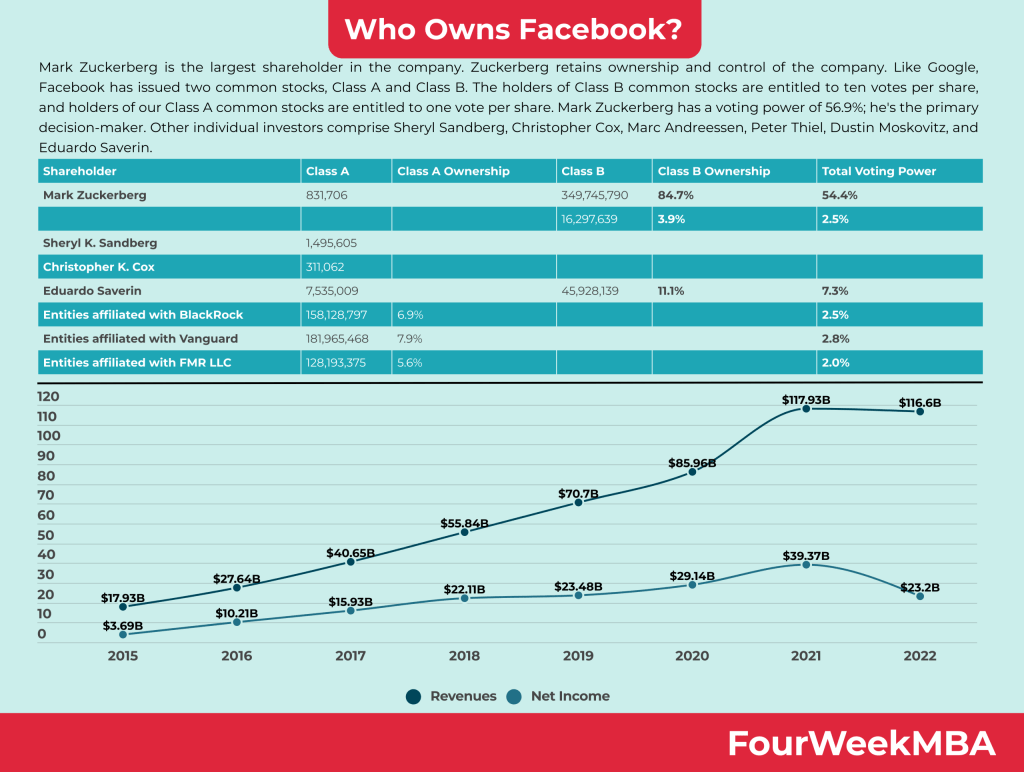
Mark Zuckerberg is the largest shareholder in the company. Zuckerberg retains ownership and control of the company. Like Google, Facebook has issued two common stocks, Class A and Class B. The holders of Class B common stocks are entitled to ten votes per share, and holders of our Class A common stocks are entitled to one vote per share. Mark Zuckerberg has a voting power of 56.9%; he’s the primary decision-maker. Other individual investors comprise Sheryl Sandberg, Christopher Cox, Marc Andreessen, Peter Thiel, Dustin Moskovitz, and Eduardo Saverin.
As of 2023, major Apple shareholders comprised Warren Buffet’s Berkshire Hathaway with 5.73% of the company’s stock (valued at over $130 billion). Followed by other individual shareholders like Tim Cook, CEO of Apple, with about 3.3 million shares, Artur Levinson, chairman of Apple, with over 4.5 million shares, and others.
With 64,588,418 shares, Jeff Bezos is the major individual investor. Owning 12.7% of the company. Other top individual investors comprise Amazon’s CEO Andy Jessy, with 94,729 shares. Top institutional investors include mutual funds like The Vanguard Group (6.6% ownership) and BlackRock (5.7% ownership).
Major shareholders comprise co-founder Bill Gates, who stepped down from the company’s board in 2020, which is why these shares are no longer publicly reported. In 2019, Gates still owned a stake of 103 million stocks, which accounted for 1.34% of the company’s ownership (worth over $23 billion in January 2023). Other individual shareholders comprise Satya Nadella, the company’s CEO, Brad Smith (former president), Jean-Philippe Courtois (EVP), and Amy Hood (former CFO).
By 2022, most of Tesla’s shares are still owned by Elon Musk, among the company’s co-founders and the CEO. Elon Musk is the top individual investor, with a 23.5% stake in the company, equivalent to over 244 million shares. Musk is followed by Lawrence Ellison (founder of Oracle), with a 1.5% company stake. Ellison also sits on Tesla’s board. And Antonio Gracias, among the company’s first investors, has over 1.6 million shares. Other institutional investors and mutual funds like The Vanguard Group (6%), Blackrock (5.1%), and Capital Ventures International also have a good chunk of the company’s stocks.
PayPal was first founded in 1998; it was called Confinity (among its founders was Peter Thiel); later, it merged with X.com, its major competitor, founded by Elon Musk (which would become known for other companies like Tesla and SpaceX). From this merger, PayPal was born. In 2002, PayPal was bought by eBay for $1.5 billion. eBay spun off PayPal in 2015, which would be listed as an independent entity. Today PayPal owns brands like Braintree, Venmo, Xoom, and iZettle.
Netflix’s largest individual shareholder is Reed Hastings, co-founder, and former CEO of the company, now Chairperson of Netflix, with a 1.7% stake, valued at over $2.4 billion in February 2023. Other significant individual shareholders comprise Jay C. Hoag, the company’s directors since 1999, and Ted Sarandos, former chief content officer and now Chief Executive Officer of Netflix. Major institutional shareholders comprise The Vanguard Group (7.55% ownership), BlackRock (6.58% ownership), and Capital Research Global Investments (5.84% ownership).
TikTok is owned by ByteDance, a Chinese internet technology company owning several content platforms worldwide (Douyin, Toutiao, Xigua Video, Helo, Lark, Babe). Bytedance passed the $300 billion private market valuation by 2022, making around $58 billion in revenue in 2022, over $4 billion from TikTok.
Acquired by Google, in 2006, for $1.65 billion, YouTube is now worth many times over. In 2022, YouTube generated over $29 billion in revenue from advertising alone. YouTube is part of Google (now named Alphabet), and as such, it is owned by main Google’s Alphabet shareholders and is one of the fastest-growing segments for the company.
As of April 25th, 2022, Elon Musk tried to take over Twitter. Musk tried to purchase the company at $54.20 per share, or about $44 billion. The deal finally closed by October 27th, 2022, and Elon Musk became the largest shareholder.
The multi-billion music streaming company Spotify is primarily owned by its founders, Daniel Ek and Martin Lorentzon. As of 2023, Daniel Ek has 16.5% ownership of ordinary shares and 31.7% of the voting power. Martin Lorentzon has 10.9% of ordinary shares and 42.6% of the voting power. Another key shareholder is Baillie Gifford & Co, a Scottish-based money management firm, followed by Morgan Stanley, T. Rowe Price, and Tencent.
The top individual shareholder of NVIDIA is Jen-Hsun Huang, founder, and CEO of the company, with 87,521,722 shares giving him 3.50% ownership. Followed by Mark A. Stevens, venture capitalist and a partner at S-Cubed Capital, who was part of the NVIDIA board in 2008 and previously served as a director from 1993 to 2006, with 6,258,803 shares. Institutional investors comprise The Vanguard Group, Inc, with 196,015,550, owning 7.83%. BlackRock, Inc., with 177,858,484, owns 7.10%. And FMR LLC (Fidelity Institutional Asset Management) with 158,039,922, owning 6.31%.
Uber’s principal individual shareholders comprise Yasir Al-Rumayyan (3.73%), the Governor of the Public Investment Fund, the sovereign wealth fund of the Kingdom of Saudi Arabia, and Dara Khosrowshahi, the founder and CEO of Uber. There is Morgan Stanley, with 5.12% ownership among the top institutional investors.
The founder and CEO of Shopify, Tobias Lütke, owned or controlled 7,891,852 Class B multiple voting shares and 5,250 Class A subordinate voting shares, representing approximately 33.8% of the aggregate voting power attached to all of the Company’s outstanding voting shares. Another key stakeholder is John H. Phillips, an angel investor who placed an early bet on Shopify.
Roblox is owned by David Baszucki and Gregory Baszucki, with a 2.3% and 2.6% stake, respectively. Anthony lee, managing partner at Altos Ventures, with a 15.3% stake.
In 2014, Twitch was bought by Amazon for $970 million. Therefore Twitch is part of Amazon, comprising other subsidiaries bought over the years, like Audible, Whole Foods, and Zappos (in total, Amazon has 12 subsidiaries). Therefore, as of 2020, Twitch is a multi-billion dollar company, making money primarily via advertising through its video streaming platform (creators use Twitch today across many other verticals).
Zoom’s principal private shareholders comprise Eric S. Yuan, a Chinese-American billionaire businessman that founded Zoom. Dan Scheinman, board member and angel investor in Zoom since the start, and Santiago Subotovsky, also an early investor in Zoom. Zoom follows a freeterprise business model where free accounts are channeled into enterprise customers.
In one of the largest deals in the business world, Microsoft acquired Activision Blizzard in a $68.7 billion transaction. Making Microsoft the world’s third-largest gaming company by revenue, behind Tencent and Sony. However, given the size of the deal, this is still under the scrutiny of regulators who need to approve it. If the deal goes through, Microsoft will become among the largest gaming companies in the world.
Pixar is owned by The Walt Disney Company, which acquired it in 2006 in a $7.4 billion deal. Today Pixar is part of the Disney Empire. The principal shareholders of Disney comprise Robert Iger, CEO of the company, and institutional investors like The Vanguard Group and Blackrock.
Marc Benioff, Co-CEO of Salesforce, is the primary individual shareholder, with 3% of the company’s stock. Other main individual shareholders comprise Parker Harris, Co-Founder and Chief Technology Officer, and Bret Taylor, former co-CEO. Major institutional shareholders include The Vanguard Group, Fidelity, and BlackRock.
In a $27.7 billion deal in 2021, Salesforce’s finalized the acquisition of Slack, which was integrated into Salesforce. Today Slack is still a product mostly independently managed by Salesforce, which incorporated some of its features within its platform. Entrepreneur Marc Benioff primarily owns salesforce.
Evan Spiegel and Robert Cornelius Murphy are the co-founders and, respectively, CEO and CTO of Snapchat. Evan Spiegel owns 3% of Class A stocks, 25.7% of Class B stocks, and 53.4% of Class C stocks for a 53.2% voting power, whereas Robert Murphy owns 6% of Class A stocks, 25.7% of Class B stocks, and 46.6% of Class C stocks for a 46.6% voting power. Snapchat runs an advertising-based businessmodel.
Main individual shareholders comprise co-founders Brian Armstrong (59.5% voting power), Frederick Ernest Ehrsam (26.1% voting power), and other individual investors such as Surojit Chatterjee (current CPO “poached” from Google), Paul Grewal (former magistrate who joined Coinbase as Chief Legal Officer), and venture capitalists who early on invested on Coinbase, like Marc Andreessen (founder of a16z) and Fred Wilson (founder of Union Square Ventures), together with venture capital firms like Andreessen Horowitz, Paradigm, Ribbit Capital and Union Square Ventures.
Gennaro is the creator of FourWeekMBA, which reached about four million business people, comprising C-level executives, investors, analysts, product managers, and aspiring digital entrepreneurs in 2022 alone | He is also Director of Sales for a high-tech scaleup in the AI Industry | In 2012, Gennaro earned an International MBA with emphasis on Corporate Finance and Business Strategy.