PayPal makes money mainly from a fee on each payment it completes. In fiscal 2025, transaction revenues were $29.8 billion of $33.2 billion in net revenues, earned on $1.79 trillion of total payment volume; the other $3.4 billion came from value added services such as interest and fees on its loans, partner-bank revenue and interest on customer balances. PayPal separated from eBay in 2015 and runs PayPal, Venmo, Braintree, Xoom, Hyperwallet, Honey and Paidy.
Merchants and consumers pay a fee when PayPal completes a payment, mostly based on volume, plus fees for currency conversion, instant transfers to a bank or card and crypto trades. This was $29.8 billion in fiscal 2025.
02
Value added services
Interest and fees on PayPal's merchant and consumer loans, revenue from a partner bank, partnerships, referral, subscription and gateway fees, and interest on assets behind customer balances. This was $3.4 billion in fiscal 2025, up 14%.
03
The cost of moving money
PayPal pays card networks, banks and processors to draw customers' funds. Transaction expense was $16.0 billion in fiscal 2025, or 0.89% of payment volume, and transaction and credit losses were $1.7 billion.
04
What is left
Operating income was $6.1 billion in fiscal 2025, an 18% operating margin, and net income was $5.2 billion, up 26%.
What changed in 2025-26
Volume grew faster than fees
In fiscal 2025 payment volume rose 7% but transaction revenues rose 3%, which PayPal put down to product and merchant mix and hedging losses. Payment transactions fell 4% to 25.4 billion, while active accounts rose 1% to 439 million.
A new chief executive
On 2 February 2026 the board appointed Enrique Lores, chair of PayPal and then chief executive of HP Inc., as President and CEO from 1 March 2026. Alex Chriss left the role and the board; CFO Jamie Miller served as interim CEO in between.
Slower quarter, fewer layers
In the third quarter of 2026 net revenues rose 2% to $8.58 billion and payment volume grew 6%, but net income fell 14% to $1.07 billion. PayPal booked $152 million of restructuring charges for a global workforce reduction tied to a reorganisation announced in April 2026.
Building for AI agents
In October 2025 Alex Chriss, then CEO, said PayPal was building for an agentic future, partnering with Google, OpenAI and Perplexity. Its fiscal 2025 annual report lists agentic commerce, the PayPal USD stablecoin and cross-wallet links through PayPal World among its new products.
PayPal in its own filings
Fiscal 2025
MeasureNet revenues
Figure$33.2 billion, up 4%
Fiscal 2025
MeasureTransaction revenues / value added services
Read PayPal by its volume and its take: compare transaction revenue growth with payment volume growth each quarter.
Watch the transaction expense rate: a shift from bank funding to cards raises what PayPal pays per dollar moved.
Treat interest on customer balances and loan income as rate-sensitive: lower rates cut part of value added services.
If you sell online, test branded wallet checkout against card-only checkout on your own conversion data before choosing.
If you build AI shopping agents, plan for payment by wallet providers; PayPal says it is partnering with Google, OpenAI and Perplexity.
The Business Engineer lens
PayPal’s business is a toll on money in motion, so its value depends on staying in the checkout flow wherever it moves. As AI agents start to place orders, the contest shifts to which wallet the agent is allowed to use, and PayPal is building partnerships to stay in that path.
Mostly from fees on payments it completes: transaction revenues were $29.8 billion of $33.2 billion in net revenues in fiscal 2025. The rest came from value added services such as loans, partner-bank revenue and interest on customer balances.
How does PayPal make money if it is free for consumers?
PayPal generally does not charge customers to fund or withdraw from their accounts; it charges merchants per payment and charges consumers for services such as currency conversion, instant transfers and crypto trades.
Is PayPal profitable?
Yes. In fiscal 2025 operating income was $6.1 billion, an 18% operating margin, and net income was $5.2 billion.
Who runs PayPal?
Enrique Lores has been President and CEO since 1 March 2026, appointed by the board on 2 February 2026 to replace Alex Chriss.
The complete explainer, cleaned up and reformatted for mobile.
Correction (10 Oct 2026): an earlier section on this page showed unsourced figures; it has been removed.
How we source: figures on this page come from the company’s own filings (SEC 10-K, 10-Q and earnings releases, or its annual report), with the period stated next to each number. Last refreshed October 2026. Our methodology.
In short
PayPal makes most of its money from a fee on each payment it completes. In fiscal 2025, transaction revenues were $29.8 billion of $33.2 billion in net revenue, earned on $1.79 trillion of total payment volume. The rest came from credit, partnerships, interest on customer balances and other services.
How PayPal Holdings makes money, FY2025: the income statement as a flow, to scale. PayPal keeps about $1.66 of every $100 it moves. Source: PayPal Holdings, Inc. (NASDAQ: PYPL) Form 10-K for fiscal 2025 (filed 2026-02-03). Gross profit, margins and shares calculated.Drawing by The Business Engineer.
Watch (60 seconds): PayPal: where the money comes from, step by step, with captions. Figures from the filing named at the end.
What drives PayPal’s revenue
PayPal charges merchants and consumers a fee when it completes a payment, and the fee is mostly based on volume. Total payment volume (TPV) was $1.79 trillion in fiscal 2025, up 7%. Transaction revenues were $29.8 billion, or 89.8% of net revenue. That is about 1.66% of TPV, down from 1.72% in 2024 (our calculation).
PayPal revenue by fiscal year, FY2021 to FY2025, from the company's filings. Chart: The Business Engineer.
PayPal also charges for currency conversion, cross-border payments, instant transfers to a bank account and crypto trades. The company says it generally does not charge customers to fund or withdraw from their accounts.
Revenues from other value added services were $3.4 billion. They come from partnerships, referral and subscription fees, gateway fees, interest and fees on PayPal’s loans, and interest earned on assets that back customer balances.
The largest cost is paying card networks, banks and processors to draw customers’ funds. Transaction expense was $16.0 billion, or 0.89% of TPV. Transaction and credit losses added $1.7 billion. Together they took 53% of revenue (our calculation), leaving $15.5 billion of what PayPal calls transaction margin dollars.
How PayPal compares
Measured against its own history, net revenue rose from $25.4 billion in fiscal 2021 to $33.2 billion in fiscal 2025, about 7% a year compounded (our calculation). Growth slowed to 4% in 2025, from 7% in 2024.
Across its two revenue categories, other value added services grew 14% in 2025 and transaction revenues grew 3% (our calculation). By region, the U.S. produced $18.9 billion and other countries $14.3 billion. PayPal reports a single segment, so it does not disclose profit by business.
Volume grew faster than revenue. TPV rose 7%, but transaction revenues rose 3%. PayPal blames product and merchant mix and about $210 million of hedging losses. Payment transactions fell 4% to 25.4 billion as PayPal cut back unbranded Braintree processing, which it says was part of a focus on profitable growth. Excluding unbranded card processing (PSP), transactions rose 6% to 16.1 billion.
PayPal revenue by line, prior year against FY2025, as reported. Chart: The Business Engineer.
Margins improved. The transaction expense rate fell from 0.93% to 0.89%, operating income rose 14% to $6.1 billion, and net income rose 26% to $5.2 billion.
In February 2026, the board appointed Enrique Lores as chief executive, replacing Alex Chriss. It said the pace of change and execution had not met its expectations.
What to watch
The first thing to watch is branded checkout. The company says its execution has not been where it needs to be, particularly in branded checkout, and in February 2026 it guided to a mid-single-digit decline in fiscal 2026 GAAP EPS.
The second is interest rates. Lower rates reduce the interest PayPal earns on customer balances. Revenue from its partner bank can fall to zero in any quarter in which the credit programme misses a minimum return.
The third is cost. Two payment processors accounted for 56% of transaction expense in 2025, and a shift in funding mix towards cards would raise the transaction expense rate.
Frequently asked questions
How does PayPal make money?
Mostly from fees on payments. Transaction revenues were $29.8 billion of $33.2 billion in net revenue in fiscal 2025. The other $3.4 billion came from value added services such as credit, partnerships and interest on customer balances.
What is PayPal's take rate?
Transaction revenues divided by total payment volume came to about 1.66% in fiscal 2025 ($29.8 billion on $1.79 trillion), down from about 1.72% in 2024. This is our calculation from reported figures.
How many active accounts does PayPal have?
439 million as of 31 December 2025, up 1% from 434 million a year earlier.
Is PayPal profitable?
Yes. In fiscal 2025, operating income was $6.1 billion, an 18% operating margin, and net income was $5.2 billion.
PayPal makes money primarily by processing customer transactions on the Payments Platform and other value-added services. Thus, the revenue streams are divided into transaction revenues based on the volume of activity or total payments volume—and value-added services, such as interest and fees earned on loans and interest receivable. In 2023, PayPal generated nearly $30 billion in revenues and $4.25 billion in net income.
Who owns PayPal?
How does PayPal make its profits?
PayPal makes money primarily by processing customer transactions. Therefore most of its money comes from transactions revenues. In fiscal 2025 PayPal reported net revenues of $33.2 billion and operating income of $6.1 billion, an 18% operating margin.
How does PayPal make money if it's free?
PayPal is a free service, but it makes money via transaction revenues. Indeed, as the company offers an end-to-end transaction platform when transactions go through the company collects a fee on top of each transaction.
What is PayPal's biggest competitor?
PayPal competitors are those offering end-to-end payment services for either consumers or merchants. Among these competitors, we have Google with Google Pay, Square with Cash App, and Apple with Apple Pay.
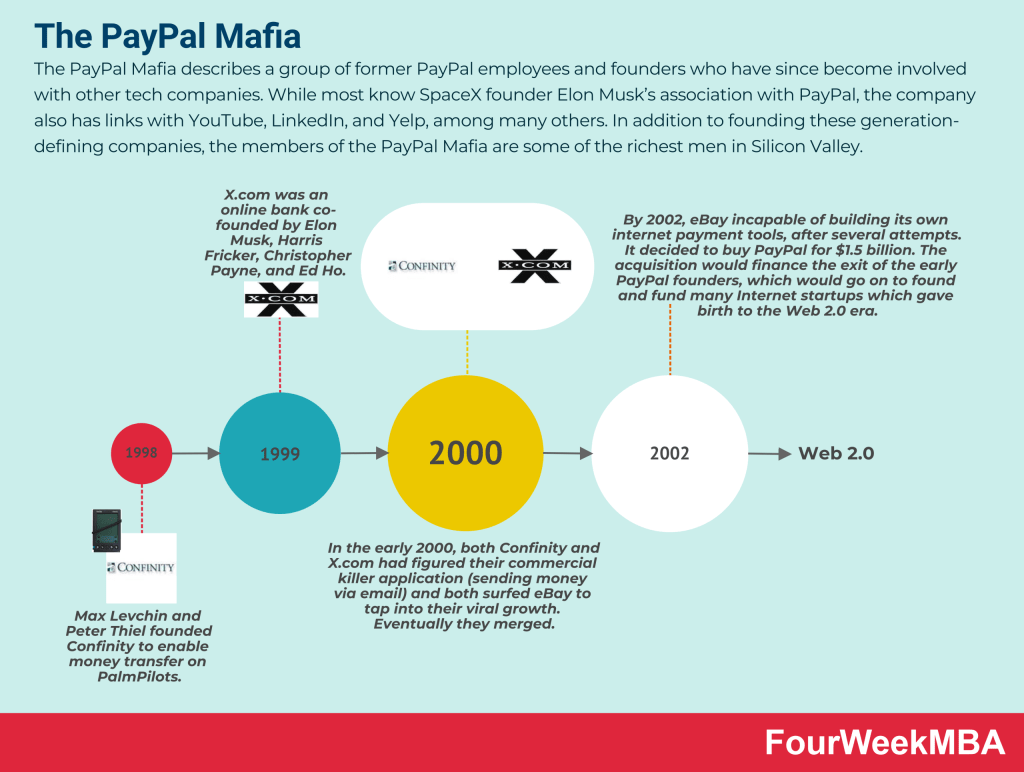
PayPal was first founded in 1998; it was called Confinity (among its founders was Peter Thiel); later, it merged with X.com, its major competitor, founded by Elon Musk (which would become known for other companies like Tesla and SpaceX). From this merger, PayPal was born. In 2002, PayPal was bought by eBay for $1.5 billion. eBay spun off PayPal in 2015, which would be listed as an independent entity. Today, PayPal owns brands like Braintree, Venmo, Xoom, and iZettle. Today, PayPal is mostly owned by institutional investors; its 2026 proxy statement listed The Vanguard Group (10.05%) and BlackRock (8.06%) as holders of more than 5% as of 31 December 2025
PayPal makes money primarily by processing customer transactions on the Payments Platform and other value-added services. Thus, the revenue streams are divided into transaction revenues based on the volume of activity or total payments volume—and value-added services, such as interest and fees earned on loans and interest receivable. In 2023, PayPal generated nearly $30 billion in revenues and $4.25 billion in net income.
PayPal is a two-sided marketplace which collects a transaction fee for each payment that happens via the platform. PayPal’s flywheel is based on creating a stronger and stronger network, where the company provides a suite of services to merchants, and consumers are given affordable digital payment solutions. In 2022, PayPal processed over $1.35 trillion in global payments.
PayPal processed $1.53 trillion in payment volume in 2023, $1.36 trillion in payment volume in 2022, and $1.25 trillion in 2021; 2023 volume was up 13% on 2022, per the 10-K. In 2020, PayPal passed a trillion-dollar in payment volume, with $936 billion processed via the platform.
In 2023, PayPal generated nearly $30 billion in revenue compared to $4.25 billion in net income, compared to $27.5 billion in revenue and $2.4 billion in net income in 2022.
In 2023, of nearly $30 billion in revenue, nearly $27 billion came from transaction revenues. Thus, transaction revenue represented over 90% of total revenue, while revenues from other value-added services (primarily comprising revenue earned through partnerships, interest and fees from merchants and consumer credit products, interest earned on certain assets underlying customer balances, referral fees, subscription fees, and gateway services) were over $2.91 billion, representing about 10% of PayPal’s total revenue.
PayPal had 426 million active accounts in 2023, down 2% from 435 million active accounts (users) in 2022, back to the 2021 level, when PayPal had 426 million active accounts.
The PayPal transaction per active account/user is a critical metric to measure the level of usage of PayPal. In 2023, the transaction per active account grew to 58.7, compared to 51.4 in 2022 and 45.4 in 2021. Thus, each active account has performed (on average) nearly 59 transactions via PayPal in 2023.
The PayPal Mafia describes a group of former PayPal employees and founders who have since become involved with other tech companies. While most know SpaceX founder Elon Musk’s association with PayPal, the company also has links with YouTube, LinkedIn, and Yelp, among many others. In addition to founding these generation-defining companies, the members of the PayPal Mafia are some of the richest men in Silicon Valley.
Gennaro Cuofano is a CRO and tech executive who has worked in AI since late 2015, starting with bringing NLP, natural-language generation, voice and chatbot products to the marketing industry. His background is in law and finance: he holds a Master's degree in Law and an International MBA with an emphasis on corporate finance (LUISS Business School and the University of San Diego, 2012), and worked as a financial analyst at a real-estate investment firm in San Diego and as an assistant controller. His work focuses on business model strategy, business engineering and, more broadly, structural analysis: how companies make money, read from their own filings. He created FourWeekMBA and leads research there and at The Business Engineer, his newsletter on AI and business strategy, with over 95,000 subscribers and more than 1,000 published analyses. His writing has also appeared on Entrepreneur (for example, How to Digitize a Family Business in Europe) and HackerNoon. Find him on LinkedIn and Substack. See how we source.
2 thoughts on “How Does PayPal Make Money? PayPal Business Model (2026)”





Great information. Thanks
Thank you Devin!