The theory was developed by psychologist Edwin Locke who also has a background in motivation and leadership research. Locke's goal-setting theory of motivation provides a framework for setting effective and motivating goals. Locke was able to demonstrate that goal setting was linked to performance.
Key Components
Understanding Locke's goal-setting theory of motivation
When an individual set challenging goals and received feedback on their progress, productivity and motivation increased.
Strengths
✓Task prioritization. Employees who have mastered the skill of effective goal setting spend time on the most important…
✓Self-awareness. Since Locke's model advocates continuous constructive feedback, the individual receives important…
✓Direction. Meaningful goal setting involves creating a plan for the future.
✓Time-consuming and expensive. Some goals require a high degree of planning to ensure that the level of challenge and…
✓Performance pressure. Irrespective of whether a goal is achievable, some employees will not be able to perform under…
Limitations
—
Real-World Examples
AmazonGoogleIntelSpotifyTargetToyota
Key Takeaways
●When an individual set challenging goals and received feedback on their progress, productivity and motivation…
●Understanding Locke's goal-setting theory of motivation: When an individual set challenging goals and received feedback on their…
Key Insight
Related Strategy Concepts: Go-To-Market Strategy , Marketing Strategy , Business Models , Tech Business Models , Jobs-To-Be Done , Design Thinking , Lean Startup Canvas , Value Chain , Value Proposition Canvas , Balanced Scorecard , Business Model Canvas , SWOT Analysis , Growth Hacking , Bundling , Unbundling , Bootstrapping , Venture Capital ,…
Exec Package + Claude OS Master Skill | Business Engineer Founding Plan
FourWeekMBA x Business Engineer | Updated 2026
The theory was developed by psychologist Edwin Locke who also has a background in motivation and leadership research. Locke’s goal-setting theory of motivation provides a framework for setting effective and motivating goals. Locke was able to demonstrate that goal setting was linked to performance.
Aspect
Explanation
Concept Overview
– Locke’s Goal-Setting Theory of Motivation is a psychological framework that suggests that setting clear and specific goals can significantly enhance an individual’s motivation, performance, and productivity. The theory was developed by psychologist Edwin A. Locke and is based on the idea that individuals are more motivated when they have specific, challenging, and achievable goals to pursue. Locke’s theory has been widely applied in various fields, including business, education, and personal development. It serves as a foundation for understanding how goals drive human behavior.
Key Principles
– Locke’s theory is built on several key principles: 1. Clarity: Goals should be clearly defined and unambiguous. 2. Specificity: Goals should be specific rather than vague. 3. Challenge: Goals should present a challenge or level of difficulty. 4. Feedback: Regular feedback on progress towards goals is essential for motivation. 5. Commitment: Individuals must be committed to achieving their goals. 6. Task Complexity: The effect of goal-setting varies with task complexity.
Goal Types
– Locke identified two primary types of goals: 1. Performance Goals: These focus on achieving a specific level of performance or outcome. 2. Learning Goals: These emphasize acquiring new skills and improving competence. The choice of goal type depends on the context and individual preferences, but both types can drive motivation.
Goal Setting Process
– The process of goal setting involves several steps: 1. Goal Establishment: Setting clear and specific goals. 2. Goal Acceptance: Gaining the individual’s commitment to pursue the goals. 3. Goal Monitoring: Regularly tracking progress towards the goals. 4. Feedback: Providing feedback on performance and adjustments as needed.
Effect on Motivation
– According to Locke, the process of setting and pursuing specific goals leads to increased motivation through several mechanisms: 1. Focus: Clear goals direct an individual’s attention and efforts toward the desired outcome. 2. Effort: Challenging goals encourage greater effort and persistence. 3. Persistence: Individuals are more likely to persevere when they have clear objectives. 4. Task Strategies: Goal setting prompts individuals to develop effective strategies for task accomplishment.
SMART Goals
– Locke’s theory aligns with the concept of SMART goals, which are Specific, Measurable, Achievable, Relevant, and Time-bound. SMART goals provide a structured framework for effective goal setting, ensuring that goals are clear, realistic, and aligned with broader objectives.
Applications
– Locke’s Goal-Setting Theory has practical applications in various domains, including employee performance management, academic settings, sports coaching, and personal development. It is widely used in business environments to set performance targets, improve employee motivation, and enhance organizational productivity. The theory’s versatility makes it applicable to numerous contexts.
Limitations
– While Locke’s theory has been influential, it is not without limitations: 1. Overemphasis on Goals: An excessive focus on goals may lead to neglect of other important factors, such as creativity and innovation. 2. Unrealistic Goals: Setting overly ambitious or unattainable goals can be demotivating. 3. Lack of Flexibility: Rigid adherence to goals may hinder adaptability to changing circumstances. It’s crucial to strike a balance. 4. Individual Differences: Not all individuals respond the same way to goal setting; personality, culture, and individual preferences play a role.
Feedback and Adjustment
– Continuous feedback and adjustment are crucial elements of Locke’s theory. Feedback helps individuals stay on track, make necessary corrections, and maintain motivation. Adjustments to goals may be required based on changing circumstances or insights gained during the pursuit of goals. Effective goal setting involves a dynamic and adaptive process.
Long-Term Perspective
– Locke’s theory emphasizes that goal setting should be viewed as a long-term strategy for motivation and performance improvement. Consistent goal setting and achievement contribute to personal and professional growth over time, making it an essential component of lifelong development and success. Goal setting can help individuals maintain focus and motivation throughout their journey.
Integration with Rewards
– In organizational contexts, the integration of goal setting with rewards and recognition systems can further enhance motivation. When individuals achieve their goals, they are often rewarded, reinforcing the connection between goal accomplishment and positive outcomes. Properly structured reward systems can support and sustain the motivation derived from goal setting.
Understanding Locke’s goal-setting theory of motivation
When an individual set challenging goals and received feedback on their progress, productivity and motivation increased. Locke also discovered that high performance was reliant on goals being specific. Indeed, the setting of more simple, general, or vague goals decreased motivation.
To guide goal-setting, Locke created five principles. In the next section, we will take a look at each.
The five principles of goal setting
Clarity. Motivating goals are clear and concise goals. A lack of clarity means ambiguity which makes goals harder to understand. Most individuals utilize the SMART system of specific, measurable, achievable, relevant, and time-bound goal setting.
Challenge. Defining the right level of challenge is a balancing act. Goals must be challenging enough that reaching them feels like a genuine achievement. However, they must not be so challenging that the individual becomes daunted at the prospect of achieving them and quits.
Commitment. This can be created by sharing the goal with someone else to increase accountability. Employee commitment can also be increased through early buy-in where rewards are offered for hitting milestones. Visualization of the benefits of achieving the goal can also foster commitment.
Feedback. As we noted earlier, feedback is critical to Locke’s goal-setting theory. Both positive and negative feedback should be received regularly. To this end, periodic meetings should be scheduled to monitor progress and provide guidance where necessary.
Task-complexity. Ensure that the task is as uncomplicated as possible. If this is not feasible, then complex goals should be broken down into smaller parts. It is also important that individuals be realistic and give themselves enough time to learn complex concepts.
Advantages and disadvantages of Locke’s goal-setting theory of motivation
Advantages
Task prioritization. Employees who have mastered the skill of effective goal setting spend time on the most important tasks first. Employees who do not squander time on meaningless tasks drive the business forward with purpose and momentum.
Self-awareness. Since Locke’s model advocates continuous constructive feedback, the individual receives important insights on their particular strengths and weaknesses.
Direction. Meaningful goal setting involves creating a plan for the future. Without direction, the individual or the business has no clear idea of what constitutes success.
Disadvantages
Time-consuming and expensive. Some goals require a high degree of planning to ensure that the level of challenge and complexity is demanding, but not too demanding. Some businesses will inevitably choose to set simpler, more general goals instead.
Performance pressure. Irrespective of whether a goal is achievable, some employees will not be able to perform under pressure. Conversely, others may become so obsessed with high performance that they develop tunnel vision. They may miss new opportunities or fail to identify threats ahead of time.
Key takeaways
Locke’s goal-setting theory of motivation explains how individuals can set meaningful goals and be motivated enough to achieve them.
Locke’s goal-setting theory of motivation demonstrates that specific goal setting is related to high performance. Conversely, non-specific goal setting is related to low performance.
Locke’s goal-setting theory of motivation allows employees to prioritize tasks and increase self-awareness. However, some businesses will not be prepared to spend money ensuring that goals have the right mix of ingredients.
Key Highlights
Origin and Developer: The theory was developed by psychologist Edwin Locke, who has a background in motivation and leadership research. Locke’s theory provides a framework for setting effective and motivating goals, and he demonstrated a link between goal setting and performance.
Challenging Goals and Feedback: Locke found that setting challenging goals and receiving feedback on progress lead to increased productivity and motivation. High performance is tied to specific goals; vague or general goals decrease motivation.
Five Principles of Goal Setting:
Clarity: Goals should be clear and concise, following the SMART criteria (Specific, Measurable, Achievable, Relevant, Time-bound).
Challenge: Goals should be challenging enough to feel like a significant accomplishment but not so difficult that they lead to discouragement.
Commitment: Sharing goals with others for accountability, offering rewards for milestones, and visualizing benefits foster commitment.
Feedback: Regular feedback, both positive and negative, is crucial for goal achievement. Periodic meetings help monitor progress and provide guidance.
Task-Complexity: Tasks should be as uncomplicated as possible; complex goals can be broken down into smaller parts. Realistic timeframes for learning complex concepts are important.
Advantages:
Task Prioritization: Effective goal setting helps individuals focus on important tasks, driving purposeful and productive work.
Self-awareness: Continuous feedback enhances self-awareness, highlighting strengths and weaknesses.
Direction: Goal setting provides a clear plan for success, guiding individuals and businesses.
Disadvantages:
Time and Cost: Some goals require extensive planning for the right balance of challenge and complexity, making the process time-consuming and costly.
Performance Pressure: Employees may struggle under pressure, impacting their ability to perform. Overemphasis on high performance might lead to tunnel vision and missed opportunities.
Key Takeaways:
Locke’s theory explains how meaningful goal setting can lead to motivation and achievement.
Specific goal setting is linked to high performance, while vague goals are associated with low performance.
The theory enables task prioritization and self-awareness, but some businesses might hesitate due to the costs of setting appropriately challenging goals.
Related Concepts
Description
When to Apply
Locke’s Goal-Setting Theory
Locke’s Goal-Setting Theory of Motivation posits that setting specific, challenging goals can enhance motivation and performance. It emphasizes the importance of clear objectives, feedback, and commitment to achieving goals to drive individuals and teams toward success.
– When aiming to motivate individuals or teams to achieve higher levels of performance – When seeking to improve employee engagement, productivity, and job satisfaction – When developing performance management systems or incentive programs – When setting personal or organizational goals to drive progress and achievement
SMART Goals
SMART Goals are specific, measurable, achievable, relevant, and time-bound objectives that align with Locke’s Goal-Setting Theory. They provide a framework for setting clear and actionable goals that increase motivation, focus efforts, and track progress effectively.
– When setting goals that are specific, measurable, achievable, relevant, and time-bound – When clarifying expectations and objectives for individuals, teams, or projects – When developing personal development plans or performance improvement goals – When aligning organizational goals with departmental or individual objectives to drive success and accountability
Feedback Mechanisms
Feedback mechanisms play a crucial role in Locke’s Goal-Setting Theory by providing individuals with information about their progress toward goal attainment. Timely and constructive feedback helps individuals adjust their efforts, behaviors, and strategies to stay on track and overcome obstacles.
– When implementing performance feedback systems to provide regular updates on goal progress – When offering constructive feedback and coaching to support individuals in achieving their goals – When creating a culture of continuous improvement and learning through feedback loops – When soliciting feedback from peers, managers, or stakeholders to enhance goal clarity and effectiveness
Performance Incentives
Performance incentives, such as bonuses, rewards, or recognition, can reinforce goal commitment and motivate individuals to strive for excellence. By linking rewards to goal achievement, organizations can create a culture of performance excellence and drive desired behaviors and outcomes.
– When designing incentive programs aligned with specific, challenging goals to drive performance – When recognizing and rewarding individuals or teams for reaching or exceeding their goals – When aligning incentive structures with organizational objectives and strategic priorities – When promoting a performance-driven culture that values goal attainment and excellence
Self-Efficacy
Self-efficacy, as proposed by Albert Bandura, refers to individuals’ belief in their ability to succeed in specific tasks or challenges. In the context of Locke’s Goal-Setting Theory, fostering self-efficacy through mastery experiences, modeling, social persuasion, and psychological responses can enhance goal pursuit and performance.
– When building confidence and competence in individuals by providing opportunities for skill development and mastery experiences – When offering positive reinforcement and encouragement to boost self-belief and motivation – When leveraging role models and mentors to inspire and guide individuals toward goal attainment – When creating a supportive environment that nurtures self-efficacy and resilience
Goal Alignment
Goal alignment involves ensuring that individual, team, and organizational goals are interconnected and mutually supportive. By aligning goals across different levels of the organization, leaders can create synergy, enhance collaboration, and drive collective efforts toward common objectives and strategic priorities.
– When cascading organizational objectives into departmental or team-level goals to ensure alignment – When communicating the rationale, importance, and expectations associated with shared goals and objectives – When fostering collaboration and teamwork by clarifying roles, responsibilities, and interdependencies – When monitoring progress and adjusting goals to adapt to changing circumstances or priorities
Autonomy and Empowerment
Providing individuals with autonomy and empowerment empowers them to set and pursue meaningful goals that align with their interests, strengths, and values. By giving employees ownership over their goals and decision-making processes, organizations can foster intrinsic motivation and commitment to excellence.
– When delegating authority and decision-making responsibilities to individuals or teams to set their own goals – When encouraging employees to pursue personal or professional development goals aligned with organizational objectives – When fostering a culture of trust, autonomy, and empowerment that values initiative and innovation – When providing resources, support, and autonomy to enable individuals to achieve their goals effectively and autonomously
Continuous Learning and Development
Continuous learning and development are essential for goal attainment and personal growth. By investing in training, skill development, and educational opportunities, organizations can equip individuals with the knowledge, capabilities, and competencies needed to achieve their goals and excel in their roles.
– When offering training and development programs to enhance skills and competencies relevant to goal achievement – When providing access to resources, mentors, or coaching to support continuous learning and professional growth – When fostering a culture of curiosity, experimentation, and continuous improvement – When aligning learning and development initiatives with strategic goals and organizational priorities to drive performance and innovation
Goal Revision and Adaptation
Goal revision and adaptation involve reviewing and adjusting goals in response to changing circumstances, feedback, or priorities. Flexibility and agility in goal setting enable individuals and organizations to adapt to new challenges, seize opportunities, and stay focused on the most relevant objectives.
– When reassessing goals periodically to ensure alignment with evolving priorities and strategic objectives – When responding to feedback, setbacks, or unexpected obstacles by revising goals and action plans accordingly – When seizing new opportunities or changing market conditions by adjusting goals and strategies proactively – When promoting resilience, adaptability, and agility in goal pursuit to navigate uncertainty and drive success
Leadership and Role Modeling
Leadership and role modeling play a crucial role in fostering goal commitment, accountability, and performance excellence. By setting a clear vision, providing guidance, and demonstrating commitment to goals, leaders can inspire and motivate individuals and teams to achieve their highest potential.
– When setting a compelling vision and direction that aligns with organizational goals and values – When leading by example and demonstrating commitment to goal achievement through actions and behaviors – When providing guidance, support, and coaching to help individuals overcome challenges and succeed – When fostering a culture of accountability, ownership, and excellence through effective leadership and role modeling
Agile leadership is the embodiment of agile manifesto principles by a manager or management team. Agile leadership impacts two important levels of a business. The structural level defines the roles, responsibilities, and key performance indicators. The behavioral level describes the actions leaders exhibit to others based on agile principles.
Adaptive leadership is a model used by leaders to help individuals adapt to complex or rapidly changing environments. Adaptive leadership is defined by three core components (precious or expendable, experimentation and smart risks, disciplined assessment). Growth occurs when an organization discards ineffective ways of operating. Then, active leaders implement new initiatives and monitor their impact.
Developed by business consultants Kenneth Blanchard and Paul Hersey in the 1960s, delegative leadership is a leadership style where authority figures empower subordinates to exercise autonomy. For this reason, it is also called laissez-faire leadership. In some cases, this type of leadership can lead to increases in work quality and decision-making. In a few other cases, this type of leadershipneeds to be balanced out to prevent a lack of direction and cohesiveness of the team.
Distributed leadership is based on the premise that leadership responsibilities and accountability are shared by those with the relevant skills or expertise so that the shared responsibility and accountability of multiple individuals within a workplace, bulds up as a fluid and emergent property (not controlled or held by one individual). Distributed leadership is based on eight hallmarks, or principles: shared responsibility, shared power, synergy, leadership capacity, organizational learning, equitable and ethical climate, democratic and investigative culture, and macro-community engagement.
Micromanagement is about tightly controlling or observing employees’ work. Although in some cases, this management style might be understood, especially for small-scale projects, generally speaking, micromanagement has a negative connotation mainly because it shows a lack of trust and freedom in the workplace, which leads to adverse outcomes.
Maslow’s Hierarchy of Needs was developed by American psychologist Abraham Maslow. His hierarchy, often depicted in the shape of a pyramid, helped explain his research on basic human needs and desires. In marketing, the hierarchy (and its basis in psychology) can be used to market to specific groups of people based on their similarly specific needs, desires, and resultant actions.
The Eisenhower Matrix is a tool that helps businesses prioritize tasks based on their urgency and importance, named after Dwight D. Eisenhower, President of the United States from 1953 to 1961, the matrix helps businesses and individuals differentiate between the urgent and important to prevent urgent things (seemingly useful in the short-term) cannibalize important things (critical for long-term success).
Moonshot thinking is an approach to innovation, and it can be applied to business or any other discipline where you target at least 10X goals. That shifts the mindset, and it empowers a team of people to look for unconventional solutions, thus starting from first principles, by leveraging on fast-paced experimentation.
The theory was developed by psychologist Edwin Locke who also has a background in motivation and leadership research. Locke’s goal-setting theory of motivation provides a framework for setting effective and motivating goals. Locke was able to demonstrate that goal setting was linked to performance.
Herzberg’s two-factor theory argues that certain workplace factors cause job satisfaction while others cause job dissatisfaction. The theory was developed by American psychologist and business management analyst Frederick Herzberg. Until his death in 2000, Herzberg was widely regarded as a pioneering thinker in motivational theory.
The term lessons learned refers to the various experiences project team members have while participating in a project. Lessons are shared in a review session which usually occurs once the project has been completed, with any improvements or best practices incorporated into subsequent projects.
Growth engineering is a systematic, technical approach to the improvement of conversion and the user experience. Combined with business engineering it helps business people build valuable companies from scratch.
Retrospective analyses are held after a project to determine what worked well and what did not. They are also conducted at the end of an iteration in Agile project management. Agile practitioners call these meetings retrospectives or retros. They are an effective way to check the pulse of a project team, reflect on the work performed to date, and reach a consensus on how to tackle the next sprint cycle.
Andy Grove, helped Intel become among the most valuable companies by 1997. In his years at Intel, he conceived a management and goal-setting system, called OKR, standing for “objectives and key results.” Venture capitalist and early investor in Google, John Doerr, systematized in the book “Measure What Matters.”
Cog’s ladder is a model of group development. The ladder was created in 1972 by Procter & Gamble employee George Charrier to help management at the company understand how teams worked to make them more efficient. Cog’s ladder is a model of group formation and behavior that is used to help businesses understand how a team can work to achieve its goals.
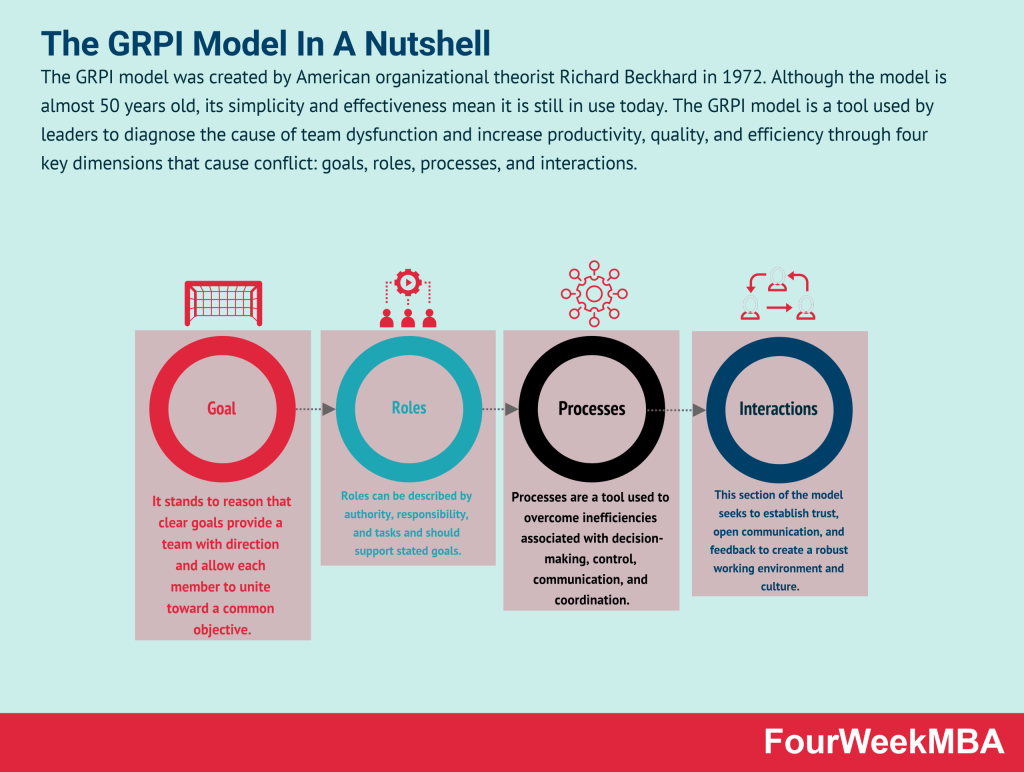
The GRPI model was created by American organizational theorist Richard Beckhard in 1972. Although the model is almost 50 years old, its simplicity and effectiveness mean it is still in use today. The GRPI model is a tool used by leaders to diagnose the cause of team dysfunction and increase productivity, quality, and efficiency through four key dimensions that cause conflict: goals, roles, processes, and interactions.
High-performance coaches work with individuals in personal and professional contexts to enable them to reach their full potential. While these sorts of coaches are commonly associated with sports, it should be noted that the act of coaching is a specific type of behavior that is also useful in business and leadership.
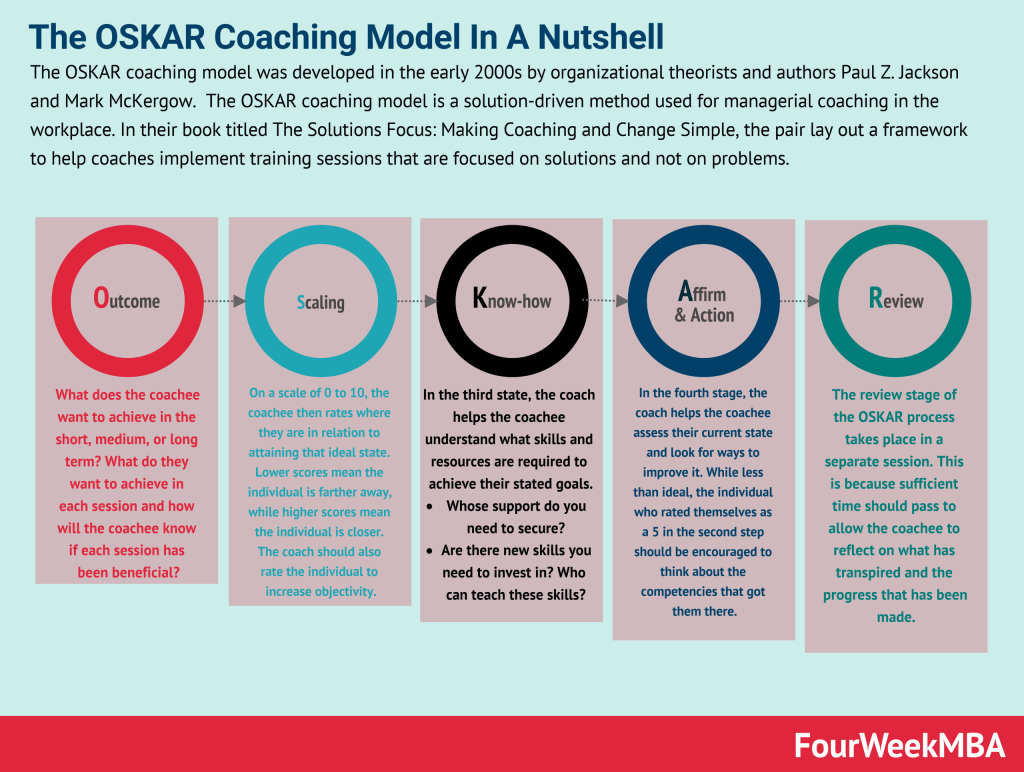
The OSKAR coaching model was developed in the early 2000s by organizational theorists and authors Paul Z. Jackson and Mark McKergow. The OSKAR coaching model is a solution-driven method used for managerial coaching in the workplace. In their book titled The Solutions Focus: Making Coaching and Change Simple, the pair layout a framework to help coaches implement training sessions that are focused on solutions and not on problems.
The training of trainers model seeks to engage master instructors in coaching new, less experienced instructors with a particular topic or skill. The training of trainers (ToT) model is a framework used by master instructors to train new instructors, enabling them to subsequently train other people in their organization.
Though no single individual can claim to have created the GROW model, writers Graham Alexander and Alan Fine together with racing car champion John Whitmore played a significant part in developing the framework during the 80s and 90s. The GROW model is a simple way to set goals and solve problems during coaching sessions through four stages: goal, reality, options, and will (way forward).
The Ulrich model helps large or complex organizations with many business units organize their human resource function. The Ulrich model was named for management coach David Ulrich after the release of his 1996 book Human Resource Champions: The Next Agenda for Adding Value and Delivering Results.
AIOps is the application of artificial intelligence to IT operations. It has become particularly useful for modern IT management in hybridized, distributed, and dynamic environments. AIOps has become a key operational component of modern digital-based organizations, built around software and algorithms.
Agile started as a lightweight development method compared to heavyweight software development, which is the core paradigm of the previous decades of software development. By 2001 the Manifesto for Agile Software Development was born as a set of principles that defined the new paradigm for software development as a continuous iteration. This would also influence the way of doing business.
Agile project management (APM) is a strategy that breaks large projects into smaller, more manageable tasks. In the APM methodology, each project is completed in small sections – often referred to as iterations. Each iteration is completed according to its project life cycle, beginning with the initial design and progressing to testing and then quality assurance.
Agile Modeling (AM) is a methodology for modeling and documenting software-based systems. Agile Modeling is critical to the rapid and continuous delivery of software. It is a collection of values, principles, and practices that guide effective, lightweight software modeling.
Agile Business Analysis (AgileBA) is certification in the form of guidance and training for business analysts seeking to work in agile environments. To support this shift, AgileBA also helps the business analyst relate Agile projects to a wider organizational mission or strategy. To ensure that analysts have the necessary skills and expertise, AgileBA certification was developed.
Business modelinnovation is about increasing the success of an organization with existing products and technologies by crafting a compelling value proposition able to propel a new business model to scale up customers and create a lasting competitive advantage. And it all starts by mastering the key customers.
That is a process that requires a continuous feedback loop to develop a valuable product and build a viable business model. Continuous innovation is a mindset where products and services are designed and delivered to tune them around the customers’ problem and not the technical solution of its founders.
A design sprint is a proven five-day process where critical business questions are answered through speedy design and prototyping, focusing on the end-user. A design sprint starts with a weekly challenge that should finish with a prototype, test at the end, and therefore a lesson learned to be iterated.
Tim Brown, Executive Chair of IDEO, defined design thinking as “a human-centered approach to innovation that draws from the designer’s toolkit to integrate the needs of people, the possibilities of technology, and the requirements for business success.” Therefore, desirability, feasibility, and viability are balanced to solve critical problems.
DevOps refers to a series of practices performed to perform automated software development processes. It is a conjugation of the term “development” and “operations” to emphasize how functions integrate across IT teams. DevOps strategies promote seamless building, testing, and deployment of products. It aims to bridge a gap between development and operations teams to streamline the development altogether.
Product discovery is a critical part of agile methodologies, as its aim is to ensure that products customers love are built. Product discovery involves learning through a raft of methods, including design thinking, lean start-up, and A/B testing to name a few. Dual Track Agile is an agile methodology containing two separate tracks: the “discovery” track and the “delivery” track.
Feature-Driven Development is a pragmatic software process that is client and architecture-centric. Feature-Driven Development (FDD) is an agile software development model that organizes workflow according to which features need to be developed next.
eXtreme Programming was developed in the late 1990s by Ken Beck, Ron Jeffries, and Ward Cunningham. During this time, the trio was working on the Chrysler Comprehensive Compensation System (C3) to help manage the company payroll system. eXtreme Programming (XP) is a software development methodology. It is designed to improve software quality and the ability of software to adapt to changing customer needs.
The Agile methodology has been primarily thought of for software development (and other business disciplines have also adopted it). Lean thinking is a process improvement technique where teams prioritize the value streams to improve it continuously. Both methodologies look at the customer as the key driver to improvement and waste reduction. Both methodologies look at improvement as something continuous.
A startup company is a high-tech business that tries to build a scalable business model in tech-driven industries. A startup company usually follows a lean methodology, where continuous innovation, driven by built-in viral loops is the rule. Thus, driving growth and building network effects as a consequence of this strategy.
Kanban is a lean manufacturing framework first developed by Toyota in the late 1940s. The Kanban framework is a means of visualizing work as it moves through identifying potential bottlenecks. It does that through a process called just-in-time (JIT) manufacturing to optimize engineering processes, speed up manufacturing products, and improve the go-to-market strategy.
RAD was first introduced by author and consultant James Martin in 1991. Martin recognized and then took advantage of the endless malleability of software in designing development models. Rapid Application Development (RAD) is a methodology focusing on delivering rapidly through continuous feedback and frequent iterations.
Scaled Agile Lean Development (ScALeD) helps businesses discover a balanced approach to agile transition and scaling questions. The ScALed approach helps businesses successfully respond to change. Inspired by a combination of lean and agile values, ScALed is practitioner-based and can be completed through various agile frameworks and practices.
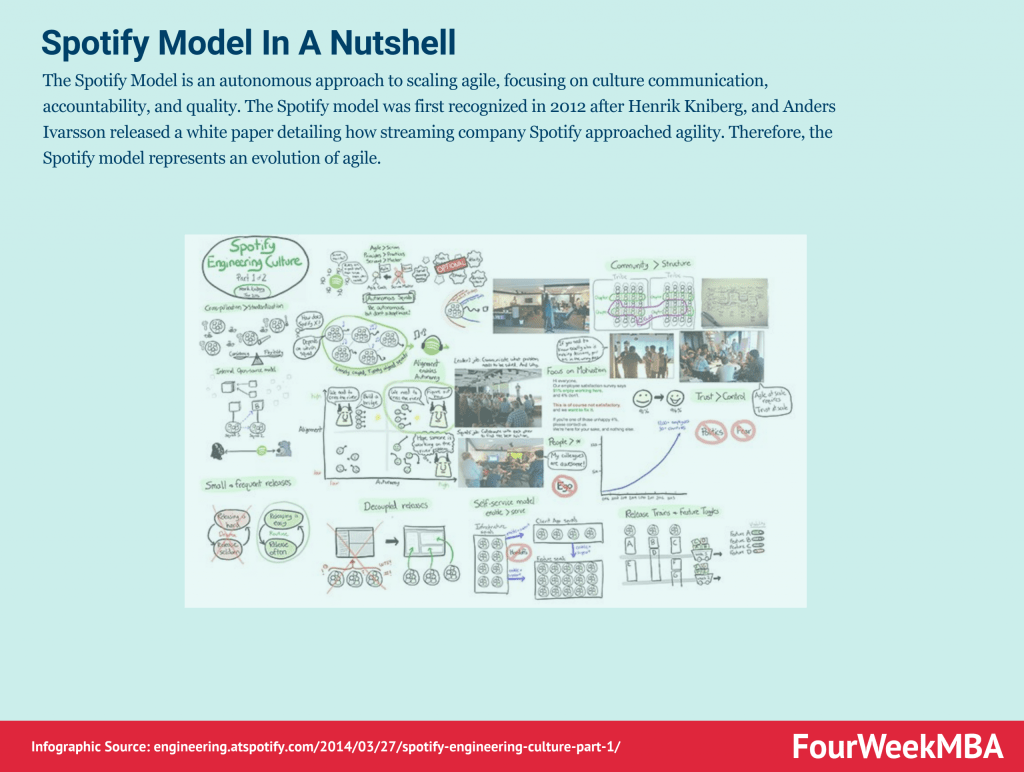
The Spotify Model is an autonomous approach to scaling agile, focusing on culture communication, accountability, and quality. The Spotify model was first recognized in 2012 after Henrik Kniberg, and Anders Ivarsson released a white paper detailing how streaming company Spotify approached agility. Therefore, the Spotify model represents an evolution of agile.
As the name suggests, TDD is a test-driven technique for delivering high-quality software rapidly and sustainably. It is an iterative approach based on the idea that a failing test should be written before any code for a feature or function is written. Test-Driven Development (TDD) is an approach to software development that relies on very short development cycles.
Timeboxing is a simple yet powerful time-management technique for improving productivity. Timeboxing describes the process of proactively scheduling a block of time to spend on a task in the future. It was first described by author James Martin in a book about agile software development.
Scrum is a methodology co-created by Ken Schwaber and Jeff Sutherland for effective team collaboration on complex products. Scrum was primarily thought for software development projects to deliver new software capability every 2-4 weeks. It is a sub-group of agile also used in project management to improve startups’ productivity.
Scrum anti-patterns describe any attractive, easy-to-implement solution that ultimately makes a problem worse. Therefore, these are the practice not to follow to prevent issues from emerging. Some classic examples of scrum anti-patterns comprise absent product owners, pre-assigned tickets (making individuals work in isolation), and discounting retrospectives (where review meetings are not useful to really make improvements).
Scrum at Scale (Scrum@Scale) is a framework that Scrum teams use to address complex problems and deliver high-value products. Scrum at Scale was created through a joint venture between the Scrum Alliance and Scrum Inc. The joint venture was overseen by Jeff Sutherland, a co-creator of Scrum and one of the principal authors of the Agile Manifesto.
What are the key components of Locke’s goal-setting theory of motivation?
The key components of Locke’s goal-setting theory of motivation include Concept Overview, Key Principles, Goal Types, Goal Setting Process, Effect on Motivation. Concept Overview: – Locke’s Goal-Setting Theory of Motivation is a psychological framework that suggests that setting clear and specific… Key Principles: – Locke’s theory is built on several key principles: 1. Clarity: Goals should be clearly defined and unambiguous. 2….
Why is Locke’s goal-setting theory of motivation important for business strategy?
When an individual set challenging goals and received feedback on their progress, productivity and motivation increased. Locke also discovered that high performance was reliant on goals being specific. Indeed, the setting of more simple, general, or vague goals decreased motivation.
How do you apply Locke’s goal-setting theory of motivation in practice?
To guide goal-setting, Locke created five principles. In the next section, we will take a look at each.
Frequently Asked Questions
What is Locke's goal-setting theory of motivation?
The theory was developed by psychologist Edwin Locke who also has a background in motivation and leadership research. Locke's goal-setting theory of motivation provides a framework for setting effective and motivating goals. Locke was able to demonstrate that goal setting was linked to performance.
What is the five principles of goal setting?
Clarity . Motivating goals are clear and concise goals. A lack of clarity means ambiguity which makes goals harder to understand. Most individuals utilize the SMART system of specific, measurable, achievable, relevant, and time-bound goal setting.. Challenge . Defining the right level of challenge is a balancing act.
What are the key components of Locke's goal-setting theory of motivation?
The key components of Locke's goal-setting theory of motivation include Understanding Locke's goal-setting theory of motivation. Understanding Locke's goal-setting theory of motivation: When an individual set challenging goals and received feedback on their progress, productivity and motivation increased.
Gennaro is the creator of FourWeekMBA, which reached about four million business people, comprising C-level executives, investors, analysts, product managers, and aspiring digital entrepreneurs in 2022 alone | He is also Director of Sales for a high-tech scaleup in the AI Industry | In 2012, Gennaro earned an International MBA with emphasis on Corporate Finance and Business Strategy.