McDonaldization is a sociological concept that refers to the process of rationalization, where principles of efficiency, calculability, predictability, and control, inspired by fast-food restaurant chain McDonald’s, are applied to various aspects of society. The term was coined by sociologist George Ritzer in his 1993 book “The McDonaldization of Society,” which explores how this phenomenon has profoundly transformed the way we live, work, and interact with the world around us.
McDonaldization is characterized by the following four key components:
Efficiency: Efficiency is achieved by minimizing the time and effort required to accomplish a task. In the context of McDonaldization, this often involves streamlining processes and eliminating unnecessary steps. For example, in a fast-food restaurant, standardized procedures and equipment are used to ensure that every burger is prepared quickly and consistently.
Calculability: Calculability emphasizes quantifiable and measurable outcomes. It prioritizes quantity over quality, often leading to an emphasis on portion size and numerical goals. In fast food, calculability is evident in practices like “supersizing” meals to increase the quantity of food offered to customers.
Predictability: Predictability means that products and services are standardized and follow a set formula, resulting in a consistent experience for consumers. In the case of McDonald’s, customers can expect the same menu items, taste, and service quality regardless of location.
Control: Control involves maintaining strict oversight and minimizing variation. In McDonaldization, control is exercised through a hierarchical structure, clearly defined roles and responsibilities, and the use of technology to monitor and regulate employees’ actions.
McDonaldization in Various Sectors
1. Food Industry:
The most obvious example of McDonaldization is the fast-food industry, where the principles of efficiency, calculability, predictability, and control are most visibly applied. Fast-food chains, inspired by McDonald’s, have expanded globally and offer standardized menus and service experiences.
2. Education:
McDonaldization has influenced the field of education through standardized testing, curriculum design, and the emphasis on measurable outcomes. The goal is to produce graduates with quantifiable skills and knowledge, often at the expense of creativity and critical thinking.
3. Healthcare:
In healthcare, McDonaldization can be observed in the push for standardization of medical procedures and the use of electronic health records to streamline patient care. While these measures can improve efficiency, they may also reduce the personalized aspect of healthcare.
4. Retail:
Large retail chains use McDonaldization principles to optimize inventorymanagement, checkout processes, and customer service. The focus is on speed and convenience, sometimes at the expense of personalized shopping experiences.
5. Workplaces:
McDonaldization has affected workplaces by emphasizing efficiency and control. Companies implement standardized processes and employ technology to monitor employee performance, often leading to a more routinized and less creative work environment.
The Impact of McDonaldization
Positive Impacts:
Efficiency and Convenience: McDonaldization has made many processes more efficient and convenient, saving time and effort for individuals and organizations.
Predictable Quality: Consumers often appreciate the predictability of McDonaldized products and services, knowing what to expect regardless of location.
Globalization: McDonaldization has contributed to the globalization of certain industries and brands, enabling people around the world to access familiar products and experiences.
Cost Reduction: Standardization and efficiency measures can lead to cost reductions in production and service delivery.
Negative Impacts:
Loss of Creativity: The focus on efficiency and predictability can stifle creativity and innovation, particularly in education and workplaces.
Dehumanization: The rigid control and standardization associated with McDonaldization can lead to dehumanization, with individuals reduced to roles and processes.
Erosion of Local Culture: Globalized and standardized products and services can erode local culture and traditions, leading to cultural homogenization.
Health Concerns: In the food industry, McDonaldization has been criticized for contributing to unhealthy eating habits and the obesity epidemic through the emphasis on large portion sizes and convenience.
Debates Surrounding McDonaldization
McDonaldization has sparked numerous debates and discussions in sociology and beyond:
Cultural Homogenization: Some argue that McDonaldization contributes to cultural homogenization by promoting a global, standardized culture at the expense of local traditions and diversity.
Consumer Choice vs. Standardization: The convenience of standardized products and services is often contrasted with the value of consumer choice and diversity.
Efficiency vs. Quality: The pursuit of efficiency may come at the cost of quality and individualization, raising questions about the balance between the two.
Workplace Satisfaction: The impact of McDonaldization on employee satisfaction and well-being is a subject of debate, with concerns about monotonous work and loss of autonomy.
Health and Nutrition: In the food industry, McDonaldization has been criticized for contributing to unhealthy diets and the overconsumption of processed foods.
Managing the Effects of McDonaldization
Efforts to manage the effects of McDonaldization include:
Balancing Efficiency and Quality: Organizations can strive to strike a balance between efficiency and quality, recognizing that some processes may benefit from standardization while others require creativity and flexibility.
Promoting Cultural Diversity: Efforts to preserve and promote local cultures and traditions can help counter the homogenizing effects of McDonaldization.
Consumer Awareness: Encouraging consumers to make informed choices and supporting local businesses can promote diversity and sustainability.
Education for Critical Thinking: Educational institutions can emphasize critical thinking, creativity, and problem-solving skills to counter the dehumanizing aspects of McDonaldization.
Employee Empowerment: In workplaces, empowering employees and involving them in decision-making processes can enhance job satisfaction and creativity.
Conclusion
McDonaldization, as a concept rooted in the principles of efficiency, calculability, predictability, and control, has left a profound mark on various aspects of society. While it has brought about increased convenience and efficiency in many areas, it has also raised concerns about the loss of creativity, dehumanization, and cultural homogenization. The ongoing debates surrounding McDonaldization reflect the complex and multifaceted nature of this phenomenon. As society continues to evolve, finding ways to harness the benefits of efficiency while preserving individuality and cultural diversity remains a significant challenge.
The major institutional shareholders comprise The Vanguard Group (8.83%) and BlackRock (7.1%). Major individual shareholders include Kevin Ozan (Executive Vice President and Chief Financial Officer), Stephen Easterbrook (President and CEO), and John Rogers, Jr., an investor, philanthropist, and Ariel Capital Management founder. And a few other individual shareholders.
McDonald’s is a heavily franchised businessmodel. In 2023, 61% of the total revenues came from franchised restaurants. The company’s long-term goal is to transition toward 95% of franchised restaurants (by 2023, franchised restaurants were 94.9% of the total restaurants). The company generated over $25 billion in revenues in 2023, of which $9.74 billion was from owned restaurants and $15.43 billion from franchised restaurants.
Of over $25 billion in revenues for 2023, $9.74 billion came from company-operated stores, while $15.43 billion came from franchised restaurants compared to $23 billion in revenue in 2022, of which $8.74 came from company-operated stores, while $14.1 billion came from franchised restaurants. And over $23 billion in revenue in 2021, McDonald’s generated almost ten billion dollars from company-operated restaurants, while it generated $13 billion from franchised restaurants.
In 2023, McDonald’s generated $8.47 billion in net profits compared to $6.18 billion in net profits for 2022, and $7.54 billion in 2021. The company runs a heavily franchised businessmodel, where it has reached its target of nearly 95% franchised restaurants worldwide.
In 2023, McDonald’s generated $8.47 billion in net profits compared to $6.18 billion in net profits for 2022, and $7.54 billion in 2021. The company runs a heavily franchised businessmodel, where it has reached its target of nearly 95% franchised restaurants worldwide.
McDonald’s had 150,000 employees in 2023, compared to 150,000 employees in 2022, 200,000 employees in 2021, and the same in 2020. The company runs a heavily franchised businessmodel, where most stores are franchised restaurants vs. owned ones. In 2022, McDonald’s franchised locations employed over two million individuals.
McDonald’s runs a heavy franchise businessmodel, where it has been substantially increasing its franchised restaurants while reducing its company-operated ones. For instance, by 2023, McDonald’s had 39,680 franchised restaurants vs. 2,142 owned and operated ones.
McDonald’s runs a heavily franchised businessmodel, where most of its margins come from franchised restaurants vs. operated ones. For instance, in 2023, $1.52 billion came from owned restaurants whereas $12.96 came from franchised restaurants.
Burger King is an American multinational chain of fast-food restaurants that is headquartered in Miami, Florida. The first Burger King restaurant, then known as Insta-Burger King, was opened in Jacksonville, Florida, in 1953 by Keith Cramer and his stepfather Matthew Burns. Burger King Worldwide merged with the Canadian coffee chain Tim Hortons in 2014. This precipitated the formation of parent company Restaurant Brands International, which is part-owned by former Burger King owner 3G Capital.
McDonald’s has a divisional organizational structure where each division – based on geographical location – is assigned operational responsibilities and strategic objectives. The main geographical divisions are the US, internationally operated markets, and international developmental licensed markets. And on the other hand, the hierarchical leadership structure is organized around regional and functional divisions.
Franchising is a business model where the owner (franchisor) of a product, service, or method utilizes the distribution services of an affiliated dealer (franchisee). Usually, the franchisee pays a royalty to the franchisor to be using the brand, process, and product. And the franchisor instead supports the franchisee in starting up the activity and providing a set of services as part of the franchising agreement. Franchising models can be heavy-franchised, heavy-chained, or hybrid (franchained).
Coca-Cola follows a business strategy (implemented since 2006) where through its operating arm – the Bottling Investment Group – it invests initially in bottling partners operations. As they take off, Coca-Cola divests its equity stakes, and it establishes a franchising model, as long-term growth and distributionstrategy.
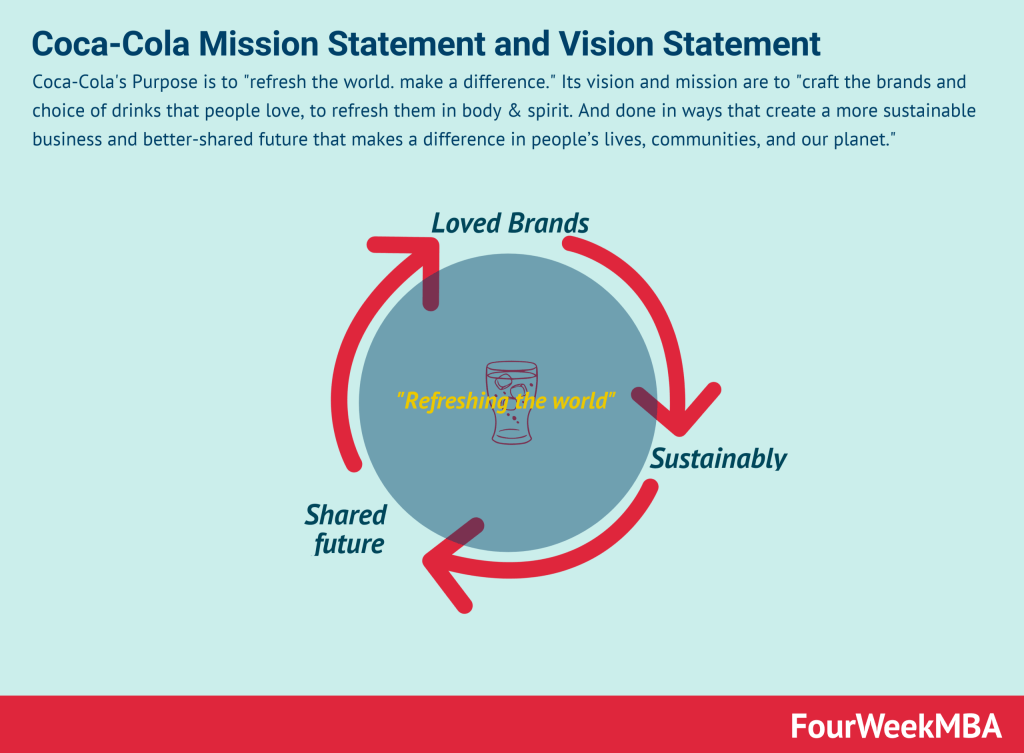
Coca-Cola’s Purpose is to “refresh the world. make a difference.” Its vision and mission are to “craft the brands and choice of drinks that people love, to refresh them in body & spirit. And done in ways that create a more sustainable business and better-shared future that makes a difference in people’s lives, communities, and our planet.”
Convergent thinking occurs when the solution to a problem can be found by applying established rules and logical reasoning. Whereas divergent thinking is an unstructured problem-solving method where participants are encouraged to develop many innovative ideas or solutions to a given problem. Where convergent thinking might work for larger, mature organizations where divergent thinking is more suited for startups and innovative companies.
The concept of cognitive biases was introduced and popularized by the work of Amos Tversky and Daniel Kahneman in 1972. Biases are seen as systematic errors and flaws that make humans deviate from the standards of rationality, thus making us inept at making good decisions under uncertainty.
Second-order thinking is a means of assessing the implications of our decisions by considering future consequences. Second-order thinking is a mental model that considers all future possibilities. It encourages individuals to think outside of the box so that they can prepare for every and eventuality. It also discourages the tendency for individuals to default to the most obvious choice.
Lateral thinking is a business strategy that involves approaching a problem from a different direction. The strategy attempts to remove traditionally formulaic and routine approaches to problem-solving by advocating creative thinking, therefore finding unconventional ways to solve a known problem. This sort of non-linear approach to problem-solving, can at times, create a big impact.
Bounded rationality is a concept attributed to Herbert Simon, an economist and political scientist interested in decision-making and how we make decisions in the real world. In fact, he believed that rather than optimizing (which was the mainstream view in the past decades) humans follow what he called satisficing.
The Dunning-Kruger effect describes a cognitive bias where people with low ability in a task overestimate their ability to perform that task well. Consumers or businesses that do not possess the requisite knowledge make bad decisions. What’s more, knowledge gaps prevent the person or business from seeing their mistakes.
Occam’s Razor states that one should not increase (beyond reason) the number of entities required to explain anything. All things being equal, the simplest solution is often the best one. The principle is attributed to 14th-century English theologian William of Ockham.
The Lindy Effect is a theory about the ageing of non-perishable things, like technology or ideas. Popularized by author Nicholas Nassim Taleb, the Lindy Effect states that non-perishable things like technology age – linearly – in reverse. Therefore, the older an idea or a technology, the same will be its life expectancy.
Antifragility was first coined as a term by author, and options trader Nassim Nicholas Taleb. Antifragility is a characteristic of systems that thrive as a result of stressors, volatility, and randomness. Therefore, Antifragile is the opposite of fragile. Where a fragile thing breaks up to volatility; a robust thing resists volatility. An antifragile thing gets stronger from volatility (provided the level of stressors and randomness doesn’t pass a certain threshold).
Systems thinking is a holistic means of investigating the factors and interactions that could contribute to a potential outcome. It is about thinking non-linearly, and understanding the second-order consequences of actions and input into the system.
Vertical thinking, on the other hand, is a problem-solving approach that favors a selective, analytical, structured, and sequential mindset. The focus of vertical thinking is to arrive at a reasoned, defined solution.
Maslow’s Hammer, otherwise known as the law of the instrument or the Einstellung effect, is a cognitive bias causing an over-reliance on a familiar tool. This can be expressed as the tendency to overuse a known tool (perhaps a hammer) to solve issues that might require a different tool. This problem is persistent in the business world where perhaps known tools or frameworks might be used in the wrong context (like business plans used as planning tools instead of only investors’ pitches).
The Peter Principle was first described by Canadian sociologist Lawrence J. Peter in his 1969 book The Peter Principle. The Peter Principle states that people are continually promoted within an organization until they reach their level of incompetence.
The straw man fallacy describes an argument that misrepresents an opponent’s stance to make rebuttal more convenient. The straw man fallacy is a type of informal logical fallacy, defined as a flaw in the structure of an argument that renders it invalid.
The Streisand Effect is a paradoxical phenomenon where the act of suppressing information to reduce visibility causes it to become more visible. In 2003, Streisand attempted to suppress aerial photographs of her Californian home by suing photographer Kenneth Adelman for an invasion of privacy. Adelman, who Streisand assumed was paparazzi, was instead taking photographs to document and study coastal erosion. In her quest for more privacy, Streisand’s efforts had the opposite effect.
As highlighted by German psychologist Gerd Gigerenzer in the paper “Heuristic Decision Making,” the term heuristic is of Greek origin, meaning “serving to find out or discover.” More precisely, a heuristic is a fast and accurate way to make decisions in the real world, which is driven by uncertainty.
The recognition heuristic is a psychological model of judgment and decision making. It is part of a suite of simple and economical heuristics proposed by psychologists Daniel Goldstein and Gerd Gigerenzer. The recognition heuristic argues that inferences are made about an object based on whether it is recognized or not.
The representativeness heuristic was first described by psychologists Daniel Kahneman and Amos Tversky. The representativeness heuristic judges the probability of an event according to the degree to which that event resembles a broader class. When queried, most will choose the first option because the description of John matches the stereotype we may hold for an archaeologist.
The take-the-best heuristic is a decision-making shortcut that helps an individual choose between several alternatives. The take-the-best (TTB) heuristic decides between two or more alternatives based on a single good attribute, otherwise known as a cue. In the process, less desirable attributes are ignored.
The bundling bias is a cognitive bias in e-commerce where a consumer tends not to use all of the products bought as a group, or bundle. Bundling occurs when individual products or services are sold together as a bundle. Common examples are tickets and experiences. The bundling bias dictates that consumers are less likely to use each item in the bundle. This means that the value of the bundle and indeed the value of each item in the bundle is decreased.
The Barnum Effect is a cognitive bias where individuals believe that generic information – which applies to most people – is specifically tailored for themselves.
First-principles thinking – sometimes called reasoning from first principles – is used to reverse-engineer complex problems and encourage creativity. It involves breaking down problems into basic elements and reassembling them from the ground up. Elon Musk is among the strongest proponents of this way of thinking.
The ladder of inference is a conscious or subconscious thinking process where an individual moves from a fact to a decision or action. The ladder of inference was created by academic Chris Argyris to illustrate how people form and then use mental models to make decisions.
Goodhart’s Law is named after British monetary policy theorist and economist Charles Goodhart. Speaking at a conference in Sydney in 1975, Goodhart said that “any observed statistical regularity will tend to collapse once pressure is placed upon it for control purposes.” Goodhart’s Law states that when a measure becomes a target, it ceases to be a good measure.
The Six Thinking Hats model was created by psychologist Edward de Bono in 1986, who noted that personality type was a key driver of how people approached problem-solving. For example, optimists view situations differently from pessimists. Analytical individuals may generate ideas that a more emotional person would not, and vice versa.
The Mandela effect is a phenomenon where a large group of people remembers an event differently from how it occurred. The Mandela effect was first described in relation to Fiona Broome, who believed that former South African President Nelson Mandela died in prison during the 1980s. While Mandela was released from prison in 1990 and died 23 years later, Broome remembered news coverage of his death in prison and even a speech from his widow. Of course, neither event occurred in reality. But Broome was later to discover that she was not the only one with the same recollection of events.
The bandwagon effect tells us that the more a belief or idea has been adopted by more people within a group, the more the individual adoption of that idea might increase within the same group. This is the psychological effect that leads to herd mentality. What in marketing can be associated with social proof.
Moore’s law states that the number of transistors on a microchip doubles approximately every two years. This observation was made by Intel co-founder Gordon Moore in 1965 and it become a guiding principle for the semiconductor industry and has had far-reaching implications for technology as a whole.
Disruptive innovation as a term was first described by Clayton M. Christensen, an American academic and business consultant whom The Economist called “the most influential management thinker of his time.” Disruptive innovation describes the process by which a product or service takes hold at the bottom of a market and eventually displaces established competitors, products, firms, or alliances.
Value migration was first described by author Adrian Slywotzky in his 1996 book Value Migration – How to Think Several Moves Ahead of the Competition. Value migration is the transferal of value-creating forces from outdated business models to something better able to satisfy consumer demands.
The bye-now effect describes the tendency for consumers to think of the word “buy” when they read the word “bye”. In a study that tracked diners at a name-your-own-price restaurant, each diner was asked to read one of two phrases before ordering their meal. The first phrase, “so long”, resulted in diners paying an average of $32 per meal. But when diners recited the phrase “bye bye” before ordering, the average price per meal rose to $45.
Groupthink occurs when well-intentioned individuals make non-optimal or irrational decisions based on a belief that dissent is impossible or on a motivation to conform. Groupthink occurs when members of a group reach a consensus without critical reasoning or evaluation of the alternatives and their consequences.
A stereotype is a fixed and over-generalized belief about a particular group or class of people. These beliefs are based on the false assumption that certain characteristics are common to every individual residing in that group. Many stereotypes have a long and sometimes controversial history and are a direct consequence of various political, social, or economic events. Stereotyping is the process of making assumptions about a person or group of people based on various attributes, including gender, race, religion, or physical traits.
Murphy’s Law states that if anything can go wrong, it will go wrong. Murphy’s Law was named after aerospace engineer Edward A. Murphy. During his time working at Edwards Air Force Base in 1949, Murphy cursed a technician who had improperly wired an electrical component and said, “If there is any way to do it wrong, he’ll find it.”
The law of unintended consequences was first mentioned by British philosopher John Locke when writing to parliament about the unintended effects of interest rate rises. However, it was popularized in 1936 by American sociologist Robert K. Merton who looked at unexpected, unanticipated, and unintended consequences and their impact on society.
Fundamental attribution error is a bias people display when judging the behavior of others. The tendency is to over-emphasize personal characteristics and under-emphasize environmental and situational factors.
Outcome bias describes a tendency to evaluate a decision based on its outcome and not on the process by which the decision was reached. In other words, the quality of a decision is only determined once the outcome is known. Outcome bias occurs when a decision is based on the outcome of previous events without regard for how those events developed.
Hindsight bias is the tendency for people to perceive past events as more predictable than they actually were. The result of a presidential election, for example, seems more obvious when the winner is announced. The same can also be said for the avid sports fan who predicted the correct outcome of a match regardless of whether their team won or lost. Hindsight bias, therefore, is the tendency for an individual to convince themselves that they accurately predicted an event before it happened.
Gennaro is the creator of FourWeekMBA, which reached about four million business people, comprising C-level executives, investors, analysts, product managers, and aspiring digital entrepreneurs in 2022 alone | He is also Director of Sales for a high-tech scaleup in the AI Industry | In 2012, Gennaro earned an International MBA with emphasis on Corporate Finance and Business Strategy.