McDonald’s Corporation is owned by its public shareholders and has no controlling holder. Its 2026 proxy statement lists three owners of more than 5% as of 31 December 2025: The Vanguard Group (10.03%), BlackRock (7.3%) and State Street (5.1%). The restaurants are a different story: about 95% of the 45,356 McDonald’s restaurants at the end of 2025 were franchised, owned and run by independent operators who pay McDonald’s rent and royalties.
The 2026 proxy lists The Vanguard Group with 71,635,329 shares (10.03%), BlackRock with 51,974,467 (7.3%) and State Street with 35,988,736 (5.1%) as of 31 December 2025. These are asset managers holding largely on behalf of fund clients; Vanguard's filing says the shares are not held to influence control.
02
Insiders hold little
Directors and executive officers as a group (23 people) owned less than 1% of the common stock as of 1 March 2026, according to the proxy. Chris Kempczinski is Chairman, President and CEO.
03
Three ways to franchise
Franchised restaurants operate as conventional franchises, developmental licenses or affiliates. Under a conventional franchise McDonald's generally owns or leases the land and building and the franchisee pays for equipment, signs, seating and decor; licensees provide their own capital, including the real estate.
04
Where the money comes from
In 2025 revenues from franchised restaurants were $16,548 million out of total revenues of $26,885 million; company-operated restaurant sales were $9,690 million.
Restaurants rose from 43,477 at the end of 2024 to 45,356 at the end of 2025, and the 10-K describes progress toward a targeted 50,000 restaurants by the end of 2027.
The same owners at the top
The 2026 proxy shows the same three index-fund managers as the only 5% holders; there is still no controlling shareholder.
Digital and AI in the restaurants
In December 2023 McDonald’s and Google Cloud announced a multi-year partnership to connect Google Cloud hardware, data and AI technology across thousands of restaurants. The 10-K also flags AI-driven tools as a source of intellectual-property risk.
Delivery and loyalty
The 10-K says delivery is offered from nearly 41,000 restaurants across about 100 markets, and sets a goal for systemwide sales to loyalty members of $45.0 billion by the end of 2027.
McDonald's ownership at a glance
The Vanguard Group
What they own10.03% of common stock
Source and date2026 proxy, as of 31 Dec 2025
BlackRock
What they own7.3% of common stock
Source and date2026 proxy, as of 31 Dec 2025
State Street
What they own5.1% of common stock
Source and date2026 proxy, as of 31 Dec 2025
Directors and executive officers
What they ownLess than 1% as a group
Source and date2026 proxy, as of 1 Mar 2026
Franchisees and licensees
What they ownAbout 95% of the 45,356 restaurants
Source and dateFiscal 2025 10-K, at 31 Dec 2025
What it means for you
Separate the two questions: who owns the company (shareholders) and who owns the restaurant you walk into (usually a franchisee).
Read the proxy statement, not old blog lists, for current holders; the 5% table is dated and sourced to 13G filings.
If you study franchising, note the mechanism: owning the real estate gives the franchisor rent as well as royalties.
Investors: index funds hold large stakes in most US blue chips, so their presence says little about a view on McDonald's.
Operators: digital, delivery and loyalty are now system-wide programmes; check what they cost and return at store level.
The Business Engineer lens
McDonald’s splits capital from operations: franchisees fund and run the restaurants, the company owns the brand, much of the real estate and the technology platform. The Business Engineer reads that split as the template AI platforms are copying: keep the scarce asset and the data layer, let others carry the operating capital.
Public shareholders. The 2026 proxy lists The Vanguard Group (10.03%), BlackRock (7.3%) and State Street (5.1%) as the only holders above 5% as of 31 December 2025.
Who is the largest shareholder of McDonald's?
The Vanguard Group, with 71,635,329 shares or 10.03% as of 31 December 2025, according to the 2026 proxy statement.
Does McDonald's own its restaurants?
Mostly not: about 95% of the 45,356 restaurants at the end of 2025 were franchised. Under conventional franchises the company generally owns or leases the land and building.
Who runs McDonald's?
Chris Kempczinski, Chairman, President and Chief Executive Officer; he has been CEO since November 2019 and Chairman since May 2024.
The complete explainer, cleaned up and reformatted for mobile.
In short
McDonald’s is widely held: its 2026 proxy lists Vanguard (10.03%), BlackRock (7.3%) and State Street (5.1%) as the only holders above 5%. Most McDonald’s restaurants, though, are owned and run by independent franchisees, who pay McDonald’s rent and royalties.
Correction (10 Oct 2026): the data card at the top of this page showed undated, unsourced figures, and the page title mentioned hospitals, which has nothing to do with McDonald’s ownership. Both are fixed; the rest of the article is kept as it was.
How we source: figures on this page come from the company’s own filings (SEC 10-K, 10-Q, prospectus and earnings releases, or its annual report), with the period stated next to each number; outside estimates appear only labelled, with their source and date. Last refreshed October 2026. Our methodology.
McDonald’s Corporation is a public company with no controlling shareholder. Its 2026 proxy statement lists three holders of more than 5% at the end of 2025: The Vanguard Group (71.6 million shares, 10.03%), BlackRock (52.0 million, 7.3%) and State Street (36.0 million, 5.1%), all mainly on behalf of index funds.
Who owns the restaurants?
Most McDonald’s restaurants are owned and operated by franchisees, independent business owners who pay McDonald’s rent and royalties based on sales. McDonald’s itself owns the brand and much of the land and buildings, which is why it is often described as a real-estate company as much as a burger company.
The Business Engineer view
The ownership split is the business model: shareholders own a company whose income is rent and royalties, while franchisees carry most of the operating costs and risks. That makes McDonald’s revenue smaller but its margins and cash flow far steadier than a company that ran all its own restaurants.
The full story
Last Updated: April 2026
Detail
Description
Company
McDonald’s Corporation
Ownership Structure
Publicly traded company with diverse shareholders
Major Shareholders
Institutional investors such as Vanguard Group, BlackRock, State Street Corporation, and individual shareholders
Founding Date
April 15, 1955
Founders
Richard McDonald, Maurice McDonald, and Ray Kroc
Headquarters
Chicago, Illinois, USA
Primary Business
Operating fast-food restaurants offering a wide variety of menu items, including burgers, fries, breakfast items, beverages, and more
Strategic Goals
Enhancing customer experience, expanding digital and delivery services, promoting sustainable practices, and growing global market presence
Additional Ownership Details
Corporate Structure and Ownership: McDonald’s Corporation is publicly traded on the New York Stock Exchange under the ticker symbol MCD. The company’s ownership is widely distributed among institutional investors, individual shareholders, and company insiders. Prominent institutional shareholders include Vanguard Group, BlackRock, and State Street Corporation, which hold substantial stakes and influence the company’s strategic direction through shareholder voting and engagement.
Corporate Strategy and Business Model: McDonald’s operates on a franchise business model, where the majority of its restaurants are owned and operated by independent franchisees. This model allows McDonald’s to expand rapidly while maintaining consistent brand standards. The company generates revenue through franchise fees, rent, and royalties from its franchisees, as well as sales from company-owned restaurants. McDonald’s focuses on delivering a consistent and high-quality dining experience, with a strategic emphasis on menu innovation, value pricing, and customer convenience.
Product Innovation and Technology: McDonald’s invests in product innovation to meet evolving consumer preferences and dietary trends. The company regularly updates its menu to include healthier options, plant-based offerings, and limited-time promotions. Additionally, McDonald’s leverages technology to enhance customer experience through mobile ordering, self-service kiosks, and loyalty programs. The company’s emphasis on digital transformation is evident in its global app, which offers personalized promotions and a seamless ordering process.
Market Expansion and Growth: McDonald’s is the largest fast-food chain globally, with over 38,000 locations in more than 100 countries. The company continues to expand its international footprint by adapting its offerings to local tastes and preferences while maintaining its core brand identity. McDonald’s growthstrategy includes opening new restaurants in key markets, optimizing existing locations, and expanding delivery services through partnerships with third-party delivery platforms like Uber Eats and DoorDash.
Sustainability and Corporate Responsibility: McDonald’s is committed to sustainability and social responsibility, with initiatives focused on reducing its environmental impact, supporting local communities, and promoting employee welfare. The company has set ambitious goals for sustainable sourcing, waste reduction, and renewable energy usage. McDonald’s also invests in community programs, education, and health initiatives, reinforcing its role as a socially responsible corporate citizen.
Community Engagement and Cultural Impact: McDonald’s has a significant cultural and economic impact, with its brand recognized worldwide. The company engages with communities through local sponsorships, charitable donations, and initiatives like Ronald McDonald House Charities, which provides support to families with sick children. McDonald’s influence extends beyond food, shaping popular culture and serving as a symbol of globalization.
Aspect · Description · Analysis · Examples
Products and Services
Description. McDonald’s offers a menu of fast-food items, including burgers, fries, chicken sandwiches, salads, breakfast items, desserts, and beverages. The company is known for its consistency in product quality and taste across its locations worldwide. McDonald’s also provides drive-thru, takeout, and delivery services.
Analysis. McDonald’s generates revenue primarily through the sale of its fast-food menu items. The company’s focus on consistency and standardized preparation processes ensures a uniform customer experience across its vast network of restaurants. Drive-thru, takeout, and delivery options cater to customers seeking convenience.
Description. McDonald’s revenue primarily comes from company-operated restaurants and franchise fees. Company-operated restaurants earn revenue from food sales, while franchisees pay fees for the right to operate under the McDonald’s brand and system. Rental income from real estate properties owned by the company is another revenue source.
Analysis. McDonald’s dual revenue model, combining company-operated restaurants and franchise fees, provides a stable income stream. Franchise fees, which include rent and royalties, offer consistent revenue without direct operational costs. Real estate holdings generate rental income, adding to the company’s financial stability.
Examples. Revenue from company-operated restaurants, franchise fees (rent and royalties), rental income from real estate properties, dual revenue model, financial stability, consistent income streams.
Customer Segments
Description. McDonald’s serves a diverse customer base, including families, children, teenagers, working professionals, and travelers. The brand’s affordability, convenience, and menu variety make it appealing to a wide demographic. McDonald’s also targets health-conscious consumers with menu options like salads and healthier beverage choices.
Analysis. McDonald’s caters to a broad customer base seeking affordable, convenient, and familiar fast-food options. Its menu variety accommodates different preferences, including those of health-conscious consumers. The brand’s worldwide presence makes it a convenient choice for travelers and tourists.
Examples. Families, children, teenagers, working professionals, travelers, affordability seekers, convenience seekers, health-conscious consumers, menu variety, global presence.
Distribution Channels
Description. McDonald’s distributes its products through its vast network of restaurants, which includes company-operated and franchised locations. The company embraces various service models, including dine-in, drive-thru, takeout, and delivery, to cater to customer preferences. McDonald’s also leverages digital platforms and mobile apps for online orders and payments.
Analysis. McDonald’s extensive network of restaurants serves as the primary distribution channel for its products. The company adapts to evolving consumer habits by offering multiple service models. Digital platforms and mobile apps enhance convenience and customer engagement, facilitating online orders and payments.
Examples. Company-operated and franchised restaurant locations, dine-in, drive-thru, takeout, delivery services, digital platforms, mobile apps, online orders, payment convenience, customer engagement.
Key Partnerships
Description. McDonald’s partnerships include relationships with franchisees who operate its restaurants worldwide. The company collaborates with suppliers to ensure a consistent supply of ingredients and products. McDonald’s also forms promotional partnerships with brands and sponsors events to drive marketing and sales. Delivery service providers are essential partners for expanding the reach of delivery options.
Analysis. Franchisees are integral partners in expanding McDonald’s presence globally. Supplier partnerships are crucial to maintaining consistent product quality. Promotional collaborations and event sponsorships bolster marketing efforts and drive sales. Partnerships with delivery service providers extend the reach of delivery options, aligning with changing consumer preferences.
Examples. Franchisee partnerships, supplier collaborations, promotional partnerships, event sponsorships, delivery service provider partnerships, global expansion initiatives.
Key Resources
Description. Key resources for McDonald’s include its brand recognition and reputation, menu development and product quality standards, supply chain and distribution networks, real estate holdings, restaurant infrastructure, and digital technology infrastructure. McDonald’s iconic brand is a significant asset.
Analysis. McDonald’s relies on its brand recognition and reputation, menu development expertise, and product quality standards to maintain customer loyalty. The company’s supply chain and distribution networks ensure consistent ingredient availability. Real estate holdings provide long-term revenue streams, and restaurant infrastructure supports operations. Investment in digital technology enhances customer engagement and convenience.
Examples. Brand recognition, menu development expertise, product quality standards, supply chain and distribution networks, real estate holdings, restaurant infrastructure, digital technology infrastructure, customer loyalty, operational support.
Cost Structure
Description. McDonald’s incurs various costs, including expenses related to food and beverage ingredients, labor (staff salaries and benefits), rent and maintenance of restaurant properties, marketing and advertising campaigns, technology investments, franchise support, and administrative overhead. Food costs and labor are significant operational expenses.
Analysis. Costs associated with McDonald’s operations encompass food and beverage ingredient expenses, labor costs (staff compensation), rent and maintenance of restaurant properties, marketing and advertising campaign expenditures, technology investments, franchise support, and administrative overhead. Food costs and labor represent substantial operational expenses in the fast-food industry.
Examples. Food ingredient costs, labor expenses, rent and maintenance costs, marketing and advertising campaign expenditures, technology investments, franchise support costs, administrative overhead, operational expenses, fast-food industry cost structure.
Competitive Advantage
Description. McDonald’s competitive advantage lies in its strong brand recognition, global presence, and standardized menu offerings. The company’s ability to maintain consistency in product quality and taste across locations enhances customer trust. McDonald’s adaptability to changing consumer preferences, such as healthier menu options and digital ordering, ensures its continued relevance in the fast-food industry.
Analysis. McDonald’s stands out with its powerful brand recognition, extensive global reach, and menu consistency. Consistency in product quality and taste builds customer trust and loyalty. The company’s agility in responding to shifting consumer preferences, including healthier menu choices and digital convenience, secures its position in the competitive fast-food landscape.
Examples. Strong brand recognition, global presence, standardized menu offerings, product quality consistency, customer trust, adaptability to consumer preferences, fast-food industry competitiveness.
McDonald’s Board of Directors
McDonald’s Board of Directors.
McDonald’s compensation structure
As for most listed companies, the executive team is primarily rewarded via a performance-based compensation structure.
For some context, in 2021, most of the CEO’s compensation was performance-based.
Of course, to make the performance-based compensation as much as possible, tied to the company’s actual growth, to align short and long-term, the company looks at various metrics.
Some of these key performance indicators, which make up performance-based compensation, are:
Operating Income Growth.
Systemwide Sales Growth.
Human Capital Metrics.
EPS Growth.
ROIC.
And Share Price Increase.
Origin Story
The American institution that is McDonald’s needs no introduction.
Let’s take a look at some of the key moments in this celebrated multinational’s history.
The McDonald brothers
In 1926, Brothers Dick and Maurice McDonald left their home in New Hampshire in search of more lucrative employment in California’s emerging motion picture industry. The brothers landed a job at Columbia Movie Studios but found it difficult to make ends meet on a salary of just $25 per week.
When the Great Depression hit, Dick and Maurice observed that the only business making any money was a root beer stand called Wiley’s. In 1937, they shifted into the food service industry and constructed an open-air food stand made from borrowed lumber.
The stand – known as the Airdrome – was near an airport whose sandy expanses also doubled as a film set. This attracted onlookers hoping to spot their favorite film star, with many of these individuals then quenching their thirst at the Airdrome with a glass of orange juice.
The brothers’ venture was successful and, after moving their parents out from New Hampshire, opened two more stands.
The first McDonald’s restaurant
Sensing that the automobile would afford people more leisure time and mobility, the brothers dismantled their juice stands and moved operations to the desert city of San Bernardino. After enduring many rejections, they eventually secured a $5,000 loan to open their first restaurant.
Known as McDonald’s Barbeque, the drive-in restaurant opened in 1940 and employed women carhops who would jump onto the sideboard of a car to serve customers. The restaurant prospered over the 1940s – particularly after the war – with a team of 20 carhops and a parking lot with room for 125 vehicles.
Despite this success, however, the McDonald’s brothers were not satisfied and wondered how they could prepare menu items as efficiently as possible to maximize profit.
The Speedee Service System
Taking inspiration from the Model T assembly line and prefab homes constructed to fill rapidly expanding suburbs, the brothers introduced the Speedee Service System in around 1948.
The system featured a scaled-back menu of best sellers and a self-service counter that reduced the number of wait staff. To ensure customers received their food quickly, hamburgers were cooked ahead of time and warmed under heat lamps.
These and various other innovations enabled the McDonald’s brothers to charge 15 cents for a hamburger – about 50% less than the competition. After initial hesitation, consumers who were willing to trade choice for speed and price flocked to the restaurant in droves.
Ray Kroc
Ray Kroc – who initially supplied McDonald’s with milkshake machines – was intrigued by the company’s success and wondered whether the brothers’ formula for success could be sold to others in the form of a franchise.
Kroc soon became a franchise agent for the company and established McDonald’s Systems Inc. (now McDonald’s Corporation) in 1955. The first franchises east of the Mississippi were opened soon after, with Kroc also establishing Hamburger University as a way to standardize operations across all stores.
By the 1960s, Kroc’s vision for the company conflicted with the McDonald’s brothers, and he subsequently bought them out for the equivalent of around $23.4 million.
Iconic elements and expansion
The company passed 1000 franchises in the 1960s with the first international outlet opening in Canada in 1967. The 60s also saw the debut of it the golden arches, Ronald McDonald, and the iconic Big Mac which rapidly became the company’s best-selling product
Growth continued unabated over subsequent decades, and at one point in the 1990s, it was said that a new McDonald’s restaurant opened every five hours. Over this period, the company invested more in culturally sensitive menu times and popular Western products such as the Egg McMuffin, Happy Meal, and Chicken McNuggets, among others.
McDonald’s embarked on a brief period of acquisitions in the late 1990s and early 2000s, acquiring Chip — as explored in the economics of AI compute infrastructure — otle in 1998 and sandwich chain Pret-A-Manger in 2001. But the company had sold these and others by 2008 to concentrate on its own brand.
Key takeaways:
The American institution that is McDonald’s needs no introduction. It was also a pioneer of the fast food and franchise business model.
When the Great Depression hit, Dick and Maurice McDonald observed that the only business making money was a root beer stand called Wiley’s. In 1937, they shifted into the food service industry and constructed an open-air food stand that sold orange juice to travelers and celebrity spotters.
Sensing that the automobile would afford people more leisure time and mobility, the brothers dismantled their juice stand business and opened a restaurant in San Bernardino. They eventually sold the business to Ray Kroc, who introduced the successful franchise model on which the company is still based.
McDonald’s is a heavily franchised business model. In 2023, 61% of the total revenues came from franchised restaurants. The company’s long-term goal is to transition toward 95% of franchised restaurants (by 2023, franchised restaurants were 94.9% of the total restaurants). The company generated over $25 billion in revenues in 2023, of which $9.74 billion was from owned restaurants and $15.43 billion from franchised restaurants.
Of over $25 billion in revenues for 2023, $9.74 billion came from company-operated stores, while $15.43 billion came from franchised restaurants compared to $23 billion in revenue in 2022, of which $8.74 came from company-operated stores, while $14.1 billion came from franchised restaurants. And over $23 billion in revenue in 2021, McDonald’s generated almost ten billion dollars from company-operated restaurants, while it generated $13 billion from franchised restaurants.
In 2023, McDonald’s generated $8.47 billion in net profits compared to $6.18 billion in net profits for 2022, and $7.54 billion in 2021. The company runs a heavily franchised business model, where it has reached its target of nearly 95% franchised restaurants worldwide.
In 2023, McDonald’s generated $8.47 billion in net profits compared to $6.18 billion in net profits for 2022, and $7.54 billion in 2021. The company runs a heavily franchised business model, where it has reached its target of nearly 95% franchised restaurants worldwide.
McDonald’s had 150,000 employees in 2023, compared to 150,000 employees in 2022, 200,000 employees in 2021, and the same in 2020. The company runs a heavily franchised business model, where most stores are franchised restaurants vs. owned ones. In 2022, McDonald’s franchised locations employed over two million individuals.
McDonald’s runs a heavy franchise business model, where it has been substantially increasing its franchised restaurants while reducing its company-operated ones. For instance, by 2023, McDonald’s had 39,680 franchised restaurants vs. 2,142 owned and operated ones.
McDonald’s runs a heavily franchised business model, where most of its margins come from franchised restaurants vs. operated ones. For instance, in 2023, $1.52 billion came from owned restaurants whereas $12.96 came from franchised restaurants.
Burger King is an American multinational chain of fast-food restaurants that is headquartered in Miami, Florida. The first Burger King restaurant, then known as Insta-Burger King, was opened in Jacksonville, Florida, in 1953 by Keith Cramer and his stepfather Matthew Burns. Burger King Worldwide merged with the Canadian coffee chain Tim Hortons in 2014. This precipitated the formation of parent company Restaurant Brands International, which is part-owned by former Burger King owner 3G Capital.
McDonald’s has a divisional organizational structure where each division – based on geographical location – is assigned operational responsibilities and strategic objectives. The main geographical divisions are the US, internationally operated markets, and international developmental licensed markets. And on the other hand, the hierarchical leadership structure is organized around regional and functional divisions.
Franchising is a business model where the owner (franchisor) of a product, service, or method utilizes the distribution services of an affiliated dealer (franchisee). Usually, the franchisee pays a royalty to the franchisor to be using the brand, process, and product. And the franchisor instead supports the franchisee in starting up the activity and providing a set of services as part of the franchising agreement. Franchising models can be heavy-franchised, heavy-chained, or hybrid (franchained).
Coca-Cola follows a business strategy (implemented since 2006) where through its operating arm – the Bottling Investment Group – it invests initially in bottling partners operations. As they take off, Coca-Cola divests its equity stakes, and it establishes a franchising model, as long-term growth and distributionstrategy.
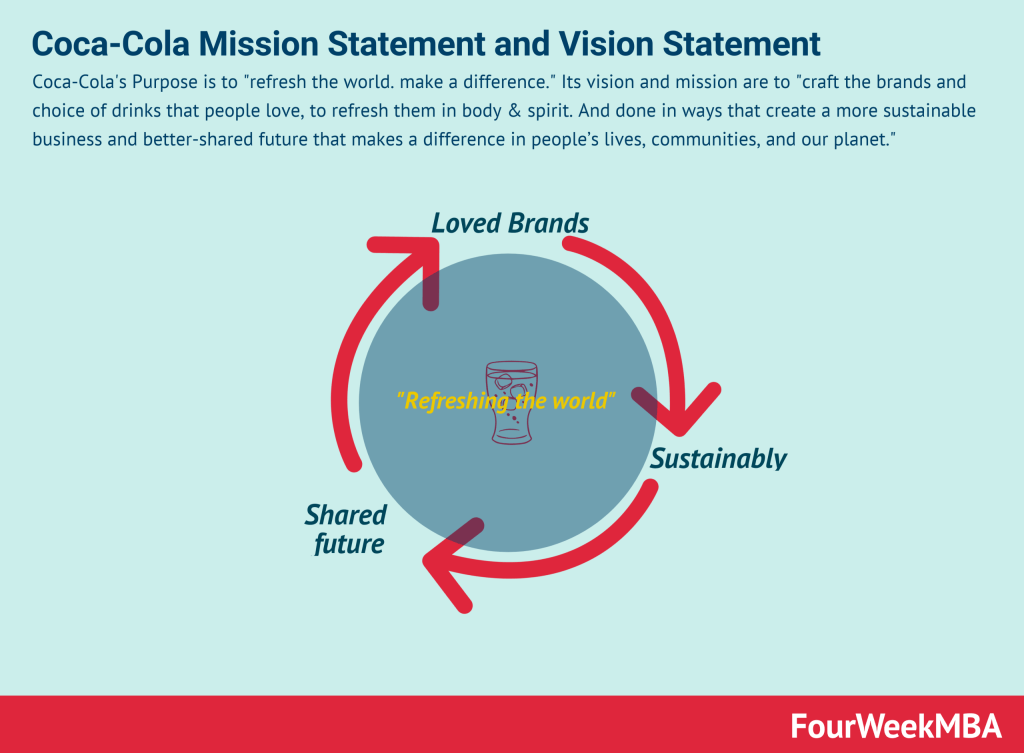
Coca-Cola’s Purpose is to “refresh the world. make a difference.” Its vision and mission are to “craft the brands and choice of drinks that people love, to refresh them in body & spirit. And done in ways that create a more sustainable business and better-shared future that makes a difference in people’s lives, communities, and our planet.”
Google is primarily owned by its founders, Larry Page and Sergey Brin, who have more than 51% voting power. Other individual shareholders comprise John Doerr (1.5%), a venture capitalist and early investor in Google, and CEO, Sundar Pichai. Former Google CEO Eric Schmidt has 4.2% voting power. The most prominent institutional shareholders are mutual funds BlackRock and The Vanguard Group, with 2.7% and 3.1%, respectively.
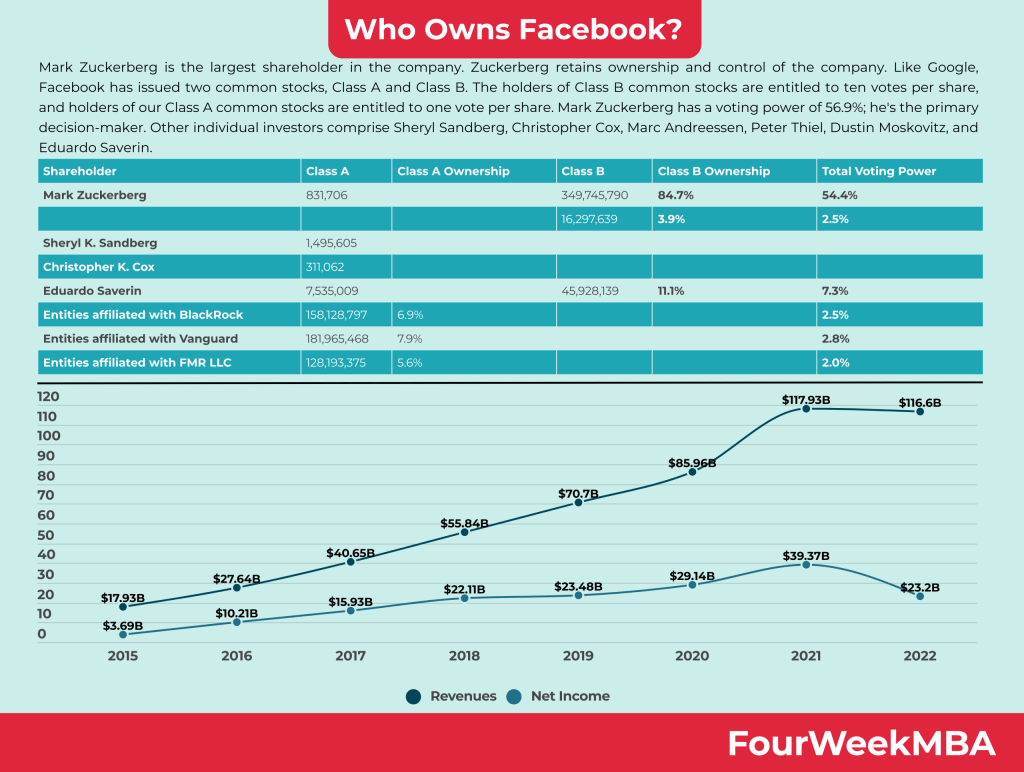
Mark Zuckerberg is the largest shareholder in the company. Zuckerberg retains ownership and control of the company. Like Google, Facebook has issued two common stocks, Class A and Class B. The holders of Class B common stocks are entitled to ten votes per share, and holders of our Class A common stocks are entitled to one vote per share. Mark Zuckerberg has a voting power of 56.9%; he’s the primary decision-maker. Other individual investors comprise Sheryl Sandberg, Christopher Cox, Marc Andreessen, Peter Thiel, Dustin Moskovitz, and Eduardo Saverin.
As of 2023, major Apple shareholders comprised Warren Buffet’s Berkshire Hathaway with 5.73% of the company’s stock (valued at over $130 billion). Followed by other individual shareholders like Tim Cook, CEO of Apple, with about 3.3 million shares, Artur Levinson, chairman of Apple, with over 4.5 million shares, and others.
With 64,588,418 shares, Jeff Bezos is the major individual investor. Owning 12.7% of the company. Other top individual investors comprise Amazon’s CEO Andy Jessy, with 94,729 shares. Top institutional investors include mutual funds like The Vanguard Group (6.6% ownership) and BlackRock (5.7% ownership).
Major shareholders comprise co-founder Bill Gates, who stepped down from the company’s board in 2020, which is why these shares are no longer publicly reported. In 2019, Gates still owned a stake of 103 million stocks, which accounted for 1.34% of the company’s ownership (worth over $23 billion in September 2022). Other individual shareholders comprise Satya Nadella, the company’s CEO, Brad Smith (former president), Jean-Philippe Courtois (EVP), and Amy Hood (former CFO).
By 2022, most of Tesla’s shares are still owned by Elon Musk, among the company’s co-founders and the CEO. Elon Musk is the top individual investor, with a 23.5% stake in the company, equivalent to over 244 million shares. Musk is followed by Lawrence Ellison (founder of Oracle), with a 1.5% company stake. Ellison also sits on Tesla’s board. And Antonio Gracias, among the company’s first investors, has over 1.6 million shares. Other institutional investors and mutual funds like The Vanguard Group (6%), Blackrock (5.1%), and Capital Ventures International also have a good chunk of the company’s stocks.
PayPal was first founded in 1998; it was called Confinity (among its founders was Peter Thiel); later, it merged with X.com, its major competitor, founded by Elon Musk (which would become known for other companies like Tesla and SpaceX). From this merger, PayPal was born. In 2002, PayPal was bought by eBay for $1.5 billion. eBay spun off PayPal in 2015, which would be listed as an independent entity. Today PayPal owns brands like Braintree, Venmo, Xoom, and iZettle.
Netflix’s largest individual shareholder is Reed Hastings, co-founder, and former CEO of the company, now Chairperson of Netflix, with a 1.7% stake, valued at over $2.4 billion in February 2023. Other significant individual shareholders comprise Jay C. Hoag, the company’s directors since 1999, and Ted Sarandos, former chief content officer and now Chief Executive Officer of Netflix. Major institutional shareholders comprise The Vanguard Group (7.55% ownership), BlackRock (6.58% ownership), and Capital Research Global Investments (5.84% ownership).
TikTok is owned by ByteDance, a Chinese internet technology company owning several content platforms worldwide (Douyin, Toutiao, Xigua Video, Helo, Lark, Babe). Bytedance passed the $300 billion private market valuation by 2022, making around $58 billion in revenue in 2022, over $4 billion from TikTok.
Gennaro Cuofano is a CRO and tech executive who has worked in AI since late 2015, starting with bringing NLP, natural-language generation, voice and chatbot products to the marketing industry. His background is in law and finance: he holds a Master's degree in Law and an International MBA with an emphasis on corporate finance (LUISS Business School and the University of San Diego, 2012), and worked as a financial analyst at a real-estate investment firm in San Diego and as an assistant controller. His work focuses on business model strategy, business engineering and, more broadly, structural analysis: how companies make money, read from their own filings. He created FourWeekMBA and leads research there and at The Business Engineer, his newsletter on AI and business strategy, with over 95,000 subscribers and more than 1,000 published analyses. His writing has also appeared on Entrepreneur (for example, How to Digitize a Family Business in Europe) and HackerNoon. Find him on LinkedIn and Substack. See how we source.