A free-to-play is a model that became particularly popular in gaming. Free-to-play is also commonly referred to as free-to-start. For instance, companies like Epic Games have launched popular games like Fortnite 's Battle Royale, which had ingrained a free-to-play model. This is a model that become extremely popular in the digital age of gaming. The free-to-play model isn't new, and it came from another model, made popular in gaming, throughout the 1980s: shareware.
Key Components
When did this all start?
The free-to-play model isn't new, and it came from another model, made popular in gaming, throughout the 1980s: shareware.
While free-to-play in itself is a distribution model, rather than a business model . In reality, the way the game gets distributed influences the whole business model for the company.
Real-World Examples
AmazonAppleCostcoFacebookGoogleMicrosoft
Quick Answers
When did this all start?
The free-to-play model isn't new, and it came from another model, made popular in gaming, throughout the 1980s: shareware.
While free-to-play in itself is a distribution model, rather than a business model . In reality, the way the game gets distributed influences the whole business model for the company.
What are the examples?
Fortnite: Developed by Epic Games, Fortnite's Battle Royale mode is free to play. Players can purchase in-game currency (V-Bucks) to buy cosmetic items, battle passes, and other virtual goods..
Key Insight
Therefore, Epic Games came up with the V-Bucks digital currency, which could be used only on Fortnite to enable several level of aesthetic customization to characters (or to buy ancillary things within the game). Given the massive adoption of Fortnite, this strategy has proved quite lucrative. The free-to-play model, executed in this way can be extremely powerful to gain traction, quickly.
Exec Package + Claude OS Master Skill | Business Engineer Founding Plan
FourWeekMBA x Business Engineer | Updated 2026
Last Updated: April 2026
A free-to-play is a model that became particularly popular in gaming. Free-to-play is also commonly referred to as free-to-start. For instance, companies like Epic Games have launched popular games like Fortnite‘s Battle Royale, which had ingrained a free-to-play model. This is a model that become extremely popular in the digital age of gaming.
Aspect
Explanation
Definition of Free-to-Play Business Model
The Free-to-Play (F2P) Business Model is a strategy employed by businesses, particularly in the digital gaming and mobile app industries, where consumers can access and use a product or service without an initial purchase cost. Instead of charging upfront fees, the business generates revenue through optional in-app purchases, microtransactions, advertising, or premium content. This model aims to attract a large user base by eliminating barriers to entry and then monetize a portion of those users through various revenue streams.
Key Concepts
Several key concepts define the Free-to-Play Business Model:
– Zero Entry Cost
The hallmark of this model is that users can start using the product or service at no cost. This zero-entry barrier encourages a large number of users to try it out.
– In-App Purchases
Free-to-Play models typically include in-app purchases (IAPs) or microtransactions that allow users to buy virtual items, currency, or premium content within the app or game. Monetization occurs as users make optional purchases during or after using the free product.
– Ads and Sponsorships
Advertising revenue is often a significant component of this model. Free apps and games display ads to users, generating income from advertisers. Sponsorships and partnerships with brands may also contribute to revenue.
– Virtual Currency
Virtual currencies are commonly used in F2P models. Users may acquire virtual currency through gameplay, daily rewards, or in-app purchases. This currency can then be spent on virtual items or enhancing the in-game experience.
– Premium Content
Some free products offer premium content or features that can be unlocked through one-time purchases or subscriptions. These premium offerings provide additional value and customization options to users who opt to pay.
Characteristics
The Free-to-Play Business Model is characterized by the following attributes:
– Mass User Acquisition
The primary goal is to acquire a large user base quickly by eliminating initial costs. A substantial user base provides opportunities for monetization through a smaller percentage of users who make purchases or engage with ads.
– Continuous Engagement
F2P models emphasize ongoing user engagement to keep players or users returning to the product or service. Regular content updates, events, and challenges encourage continued interaction.
– Monetization Strategies
Multiple monetization strategies are employed simultaneously, such as in-app purchases, ads, and premium content. Diversifying revenue streams reduces dependency on a single source and enhances financial stability.
– Data-Driven Optimization
Data analytics play a crucial role in optimizing F2P models. Businesses analyze user behavior, spending patterns, and engagement metrics to refine their offerings and pricing strategies continuously.
Examples of Free-to-Play Business Models
Free-to-Play models are prevalent in various industries:
– Mobile Games
Many mobile games follow the F2P model, allowing players to download and play for free. Revenue is generated through in-app purchases of virtual items, cosmetics, or currency that enhance gameplay or provide customization options.
– Freemium Apps
Freemium apps, such as productivity tools or photo editing software, offer basic features for free and provide premium versions or additional functionality through subscription plans or one-time purchases.
– Social Media Platforms
Social media platforms like Facebook and Twitter are free to use and generate revenue through advertising. Sponsored posts, promoted content, and targeted ads are common ways these platforms monetize user engagement.
Benefits and Considerations
Implementing a Free-to-Play Business Model offers several benefits and considerations:
– Massive User Base
The model can attract a massive user base, increasing the potential for monetization. A free initial offering is more likely to engage a broad audience.
– Flexible Monetization
Multiple revenue streams provide flexibility and the ability to cater to various user preferences. Users can choose to spend money based on their interests and needs.
– Market Competition
The F2P market can be highly competitive, with many free offerings vying for user attention and spending. Businesses must stand out and continually innovate to succeed in this landscape.
– User Trust and Fairness
Maintaining user trust is crucial. Transparency in pricing, fairness in gameplay (for games), and responsible ad practices are vital for building and retaining a loyal user base. Users should feel that optional purchases are genuinely valuable and enhance their experience.
When did this all start?
The free-to-play model isn’t new, and it came from another model, made popular in gaming, throughout the 1980s: shareware.
The shareware model was officially born (at least its official name) in 1982, when Andrew Fluegelman created a communications program called PC-TALK. Fluegelman released the software by asking users to pay for it, only if they thought it was worth it.
For the nascent software industry, that way of doing business seemed a shared idea. Indeed, at the same time, in Washington State, another programmer, named Jim Button, created EASY-FILE. Button, similarly to Fluegelman released the software for free. And he asked users to either share the program or give a donation if they liked it.
By 1982, Fluegelman and Button met each other (through another user who noticed how they used a similar marketing and distributionmodel) and they agreed upon a set of joined actions to standardize their business models (like referencing each other’s program and by setting a voluntary donation at $25).
Though, they slightly changed the name for each model. Fluegelman called its model “Freeware,” Button, instead called it “user supported software.”
The concept of shareware still at the embryonic stage, would become a standard in a few years. As other programmers and entrepreneurs started to adopt this model, it consolidated. Perhaps, Bob Wallace, a former Microsoft employee, founded QuickSoft, and it offered it with a similar model.
In an in-depth article of IntoWorld in the 1980s, entitled “Software For A Donation” the protagonists of the shareware (then popularized as freeware) model were proposed as alternatives to large players, who were not interested in that sort of model.
While those companies never turned into multi-billion-dollar companies, they did show an alternative model for gaming. It would still take a few decades for this model to fully become viable.
Some major games like Fortnite, and companies like Epic Games have used it as their core model.
Fortnite: free-to-play business model case study
Fortnite developed by Epic Games is available in three modes. Save the World follows a premium model, where the game is sold, starting at $14.99- Battle Royale follows a free-to-play model, available for free. Still, gamers can buy things or customize characters with its digital currency (V-Bucks), and Creative Mode. As reported by Variety, Fortnite made $1.8 billion in 2019 and $2.4 billion in 2018.
While free-to-play in itself is a distribution model, rather than a business model. In reality, the way the game gets distributed influences the whole business model for the company. In fact, as a company like Epic Games, distributed Fortnite’s Battle Royale in a free-to-play mode it had to monetize the game at some other level.
Therefore, Epic Games came up with the V-Bucks digital currency, which could be used only on Fortnite to enable several level of aesthetic customization to characters (or to buy ancillary things within the game). Given the massive adoption of Fortnite, this strategy has proved quite lucrative. The free-to-play model, executed in this way can be extremely powerful to gain traction, quickly.
However, to make enough money to sustain the operations, and be also profitable, it will require to be distributed to a large number of people, to become a hit. When it does, chances that gamers will want to customize their characters will improve dramatically, thus enhancing monetization. That’s become the game itself becomes a cultural hit.
Examples
Fortnite: Developed by Epic Games, Fortnite’s Battle Royale mode is free to play. Players can purchase in-game currency (V-Bucks) to buy cosmetic items, battle passes, and other virtual goods.
League of Legends: Riot Games’ League of Legends is a popular free-to-play multiplayer online battle arena (MOBA) game. Players can buy in-game currency (Riot Points) to purchase champions, skins, and other cosmetic items.
Warframe: Warframe, developed by Digital Extremes, is a free-to-play online game where players control members of the Tenno, a race of ancient warriors. The game monetizes through the sale of premium currency (Platinum) for cosmetics and other items.
Path of Exile: Path of Exile, an action RPG by Grinding Gear Games, is free to play. It offers cosmetic microtransactions and quality-of-life items for purchase, such as additional stash tabs.
Apex Legends: Respawn Entertainment’s battle royale game, Apex Legends, is free to play. Players can spend real money on in-game currency (Apex Coins) to buy cosmetic items and battle passes.
Dota 2: Valve Corporation’s Dota 2 is a free-to-play MOBA game. It generates revenue through the sale of cosmetic items, battle passes, and compendiums.
Hearthstone: Blizzard Entertainment’s digital card game, Hearthstone, is free to play. Players can buy card packs and cosmetics using in-game gold or real money.
World of Tanks: Wargaming’s World of Tanks offers free gameplay with the option to purchase premium tanks, premium accounts, and in-game currency (Gold) for convenience and customization.
Smite: Hi-Rez Studios’ Smite is a free-to-play MOBA-style game with in-game purchases for cosmetics, gods, and skins.
Paladins: Paladins, also by Hi-Rez Studios, is a free-to-play hero-based shooter. It monetizes through microtransactions for character skins, emotes, and other cosmetics.
Genshin Impact: miHoYo’s Genshin Impact is a free-to-play action RPG with gacha mechanics. Players can purchase in-game currency (Primogems) for character wishes and cosmetics.
PUBG Mobile: PUBG Mobile offers a free battle royale experience with in-game purchases for cosmetic items and seasonal passes.
Fortnite Battle Royale: Beyond Fortnite’s Battle Royale mode, the Save the World mode originally had a purchase price. However, Epic Games later transitioned it to a free-to-play model with in-game purchases.
War Thunder: Gaijin Entertainment’s War Thunder is a free-to-play vehicular combat game with in-game purchases for premium vehicles and cosmetic items.
Key Highlights:
Free Basic Version: Freemium businesses provide a free, limited version of their product or service to attract a broad user base. This free version typically includes essential features or content.
Premium Features: To generate revenue, freemium models offer premium features or content that users can access by paying a fee. These premium elements enhance the user experience or provide additional functionality.
User Conversion: The success of the freemium model depends on converting free users into paying customers. Businesses aim to entice users with the value of premium features, making the upgrade worthwhile.
Monetization Strategies: Freemium businesses employ various strategies to monetize their user base, including monthly or annual subscriptions, one-time purchases, in-app purchases, or microtransactions.
Common in Software: The freemium model is prevalent in software applications, mobile apps, and digital services. Examples include free-to-play games with in-game purchases, software with limited free trials, and streaming platforms offering free and premium subscription tiers.
Sample-Based Model: Freemium often serves as a sample-based model, allowing users to experience a product’s core functionality for free before committing to a paid version.
Upselling and Cross-selling: Freemium businesses use upselling and cross-selling techniques to encourage users to upgrade to premium plans or purchase related products or services.
Customer Segmentation: Freemium models allow businesses to segment their customer base, distinguishing between free users and paying customers. This segmentation helps tailor marketing efforts and product development.
Customer Retention: Keeping free users engaged and satisfied with the basic version is essential to retaining them as potential future paying customers.
Scaling Revenue: Successful freemium models can scale revenue significantly by attracting a large user base and converting a percentage of those users into paying customers.
Examples: Common examples of freemium models include Dropbox, which offers free storage with premium plans for additional space, and Spotify, which provides free music streaming with ads and offers premium ad-free subscriptions.
Related Framework
Description
When to Apply
Freemium Model
The Freemium Model is a business model that offers basic services or a product for free while charging for premium features or additional content. It aims to attract a large user base with free offerings and then convert a portion of those users into paying customers by providing enhanced features or value-added services. This model is commonly used in software, gaming, and digital services industries to acquire users and generate revenue through upselling or subscription models.
When launching a new digital product or service, applying the Freemium Model to attract a wide user base with free offerings and then monetize the user base through premium features or subscriptions, thus maximizing user acquisition and revenue generation in the digital marketplace.
In-App Purchases
In-App Purchases refer to the sale of digital content, goods, or services within a mobile application. Users can make purchases to unlock additional features, access premium content, or enhance their experience within the app. This monetization strategy is commonly used in mobile gaming, productivity apps, and multimedia platforms to generate revenue from users after the initial app download. In-App Purchases allow developers to offer a free app while monetizing engaged users through microtransactions or one-time purchases.
When developing mobile applications or games, applying the In-App Purchases model to offer free app downloads and generate revenue through the sale of virtual goods, premium content, or additional features within the app, thus monetizing user engagement and maximizing revenue potential from mobile app users.
Subscription-Based Model
The Subscription-Based Model involves charging customers a recurring fee at regular intervals (e.g., monthly, annually) in exchange for access to a product or service. Subscriptions can offer various levels of access, features, or benefits based on different pricing tiers. This model is prevalent in streaming services, software-as-a-service (SaaS) platforms, and subscription boxes, allowing businesses to generate predictable recurring revenue and build long-term relationships with customers. Subscription-based businesses focus on providing ongoing value to subscribers to retain them over time and reduce churn.
When offering digital services, content platforms, or software solutions, applying the Subscription-Based Model to generate recurring revenue streams and establish long-term relationships with customers, thus providing ongoing value and maintaining customer loyalty over time.
Ad-Supported Model
The Ad-Supported Model relies on advertising revenue to monetize digital content or services. Businesses offer free access to content or services and generate revenue by displaying ads to users. This model is prevalent in online platforms, social media networks, and free mobile apps, where advertisers pay to reach a large audience of users. Ad-supported businesses focus on maximizing user engagement and ad impressions to attract advertisers and generate revenue through ad placements, such as display ads, sponsored content, or in-stream ads.
When offering free digital content, online services, or mobile apps, applying the Ad-Supported Model to monetize user traffic and engagement through advertising revenue, thus providing free access to users while generating revenue from advertisers based on impressions, clicks, or other ad metrics.
Pay-Per-Use Model
The Pay-Per-Use Model charges customers based on their usage or consumption of a product or service. Instead of paying a flat fee or subscription, customers are billed for the specific resources or features they use. This model is common in utility services, cloud computing, and pay-as-you-go software licensing, allowing customers to pay only for what they consume. Pay-per-use pricing offers flexibility and cost control for customers while enabling businesses to monetize usage-based services and scale pricing based on usage volume or intensity.
When offering on-demand services, cloud-based solutions, or resource-intensive products, applying the Pay-Per-Use Model to charge customers based on their actual usage or consumption, thus providing cost-effective pricing and scalability while aligning revenue with customer value and usage patterns.
Crowdfunding Model
The Crowdfunding Model involves raising funds from a large number of individuals or backers to finance projects, products, or ventures. Crowdfunding platforms facilitate the solicitation of contributions from individuals, often in exchange for rewards, equity, or pre-purchase of products or services. This model is used by startups, entrepreneurs, and creatives to validate ideas, generate capital, and engage with potential customers or supporters. Crowdfunding campaigns leverage social networks and online communities to attract backers and fund projects through collective support.
When launching new products, creative projects, or startup ventures, applying the Crowdfunding Model to raise capital, validate ideas, and engage with potential customers or backers, thus leveraging collective support and community engagement to fund projects and bring innovative ideas to market.
Cross-Selling and Upselling
Cross-Selling and Upselling are sales techniques aimed at increasing the average transaction value by offering additional products, upgrades, or complementary items to customers. Cross-selling involves recommending related or supplementary products to enhance the customer’s purchase, while upselling encourages customers to upgrade to a higher-priced or premium version of the product or service. These techniques are commonly used in e-commerce, retail, and service industries to increase revenue per customer transaction and maximize the lifetime value of customers.
When operating e-commerce platforms, retail stores, or service businesses, applying Cross-Selling and Upselling techniques to increase revenue by offering additional products or upgrades to customers during the purchasing process, thus maximizing the value of each transaction and enhancing customer satisfaction through personalized recommendations and value-added offerings.
Affiliate Marketing
Affiliate Marketing is a performance-based marketing strategy where businesses reward affiliates for driving traffic or sales to their website or product through referral links or promotional efforts. Affiliates earn a commission or referral fee for each successful sale, lead, or action generated through their marketing efforts. This model is prevalent in e-commerce, digital marketing, and online retail, allowing businesses to leverage the marketing reach and networks of affiliates to acquire customers and drive sales on a pay-for-performance basis. Affiliate marketing programs provide incentives for affiliates to promote products or services through various channels, including websites, blogs, and social media.
When seeking to expand reach and acquire customers through online channels, applying Affiliate Marketing programs to partner with affiliates and influencers who promote products or services to their audiences, thus leveraging external marketing networks and paying for performance-based results in driving website traffic, generating leads, and increasing sales conversions through affiliate referrals and promotional efforts.
Dynamic Pricing
Dynamic Pricing involves adjusting the price of a product or service in real-time based on various factors such as demand, supply, competitor pricing, or customer segmentation. This pricing strategy allows businesses to optimize revenue by charging different prices to different customers or at different times, reflecting changes in market conditions or customer preferences. Dynamic pricing is common in industries such as travel, hospitality, and e-commerce, where pricing flexibility and responsiveness to market dynamics are critical for maximizing revenue and profitability.
When operating in competitive markets or industries with fluctuating demand, applying Dynamic Pricing strategies to optimize revenue by adjusting prices based on real-time market conditions, customer behavior, or competitor pricing, thus maximizing revenue potential and profitability while remaining responsive to changes in demand, supply, or market trends.
Direct-to-Consumer (DTC) Model
The Direct-to-Consumer (DTC) Model involves selling products or services directly to customers through online channels, bypassing traditional retail intermediaries or distribution channels. DTC brands manage their e-commerce platforms or online storefronts to interact directly with consumers, control the customer experience, and gather valuable data and insights. This model is popular among digitally native brands, startups, and manufacturers seeking to establish a direct relationship with consumers, gain market share, and differentiate their offerings in competitive markets. DTC brands focus on delivering personalized experiences, building brand loyalty, and maximizing customer lifetime value through direct sales and engagement.
When launching new brands or products, applying the Direct-to-Consumer (DTC) Model to sell products directly to customers through online channels, thus bypassing retail intermediaries and gaining control over the customer experience, brand positioning, and data insights, ultimately building brand loyalty, maximizing customer lifetime value, and optimizing the distribution of products in the digital marketplace.
EA Sports is among the largest gaming publishers, with a hybrid strategy of fully-owned games and licensed games distributed with a cross-platform approach. FIFA is the game that most contributes to its revenues and live services (Ultimate Team in particular) are the largest revenue contributors to EA revenues.
The gaming industry, part of the entertainment industry, is comprised of three main types of players. From game engines, which help developers build their games. To publishing gaming houses. And gaming consoles. While the prevailing business model for decades has been that of selling the console at cost, and make money on games. Digital games changed the way games are distributed and sold, and it opened up the way to free-to-play models.
Roblox is an online gaming platform where users can create avatars and explore various gaming experiences. Each experience will be monetized based on how its developer has structured the game. For instance, free games allow users to spend the platform’s currency, called Robux, to get specific enhancements or purchase items like clothing accessories for the avatars, simulated gestures from the Roblox Avatar Marketplace. Therefore, Roblox makes money by earning a commission on each transaction and through its internal ad network.
Tencent is a Chinese multinational conglomerate founded in 1998 by Ma Huateng, Zhang Zhidong, and Xu Chenye. Among its various global subsidiaries are companies in the online services, music, and artificial intelligence industries. But it is perhaps best known for its interest in the video game sector – both as a game developer for the Chinese market and the acquirer of several established gaming companies. Tencent is a vast company with a stake in more than 600 companies. Following is a look at some of the companies and subsidiaries it has a majority stake in.
Epic Games is a gaming company, that develops, publishes, and distributes games. It comprises the Unreal Engine, making money through licensing agreements with developers and creators. Its games (like Fortnite) mostly follow a free-to-play model on PC and an in-app purchase model on the digital marketplace. And its storefront Epic Games Store, taking a 12% cut on games’ sales.
A free-to-play is a model that became particularly popular in gaming. Free-to-play is also commonly referred to as free-to-start. For instance, companies like Epic Games have launched popular games like Fortnite’s Battle Royale, which had ingrained a free-to-play model. This is a model that become extremely popular in the digital age of gaming.
The play-to-earn model is a business model allowing gamers to farm or collect cryptocurrency and NFTs that can be sold on the market. This model has become a standard already in the “crypto gaming industry,” where the blockchain-based games enable token economics to kick in as an incentives mechanism at scale for users to play and be engaged.
Candy Crush Saga is a match-three puzzle video game developed and published by King, a company specializing in social network-based games. Businessman Riccardo Zacconi co-founded King in 2003 after selling a subscription dating service he had also founded several years previous. The initial source of income for King was advertising revenue, but this strategy was abandoned in 2013. Today, Candy Crush Saga uses the freemium model (free to play) of revenue generation.
An effective business model has to focus on two dimensions: the people dimension and the financial dimension. The people dimension will allow you to build a product or service that is 10X better than existing ones and a solid brand. The financial dimension will help you develop proper distribution channels by identifying the people that are willing to pay for your product or service and make it financially sustainable in the long run.
Business model innovation is about increasing the success of an organization with existing products and technologies by crafting a compelling value proposition able to propel a new business model to scale up customers and create a lasting competitive advantage. And it all starts by mastering the key customers.
Digital and tech business models can be classified according to four levels of transformation into digitally-enabled, digitally-enhanced, tech or platform business models, and business platforms/ecosystems.
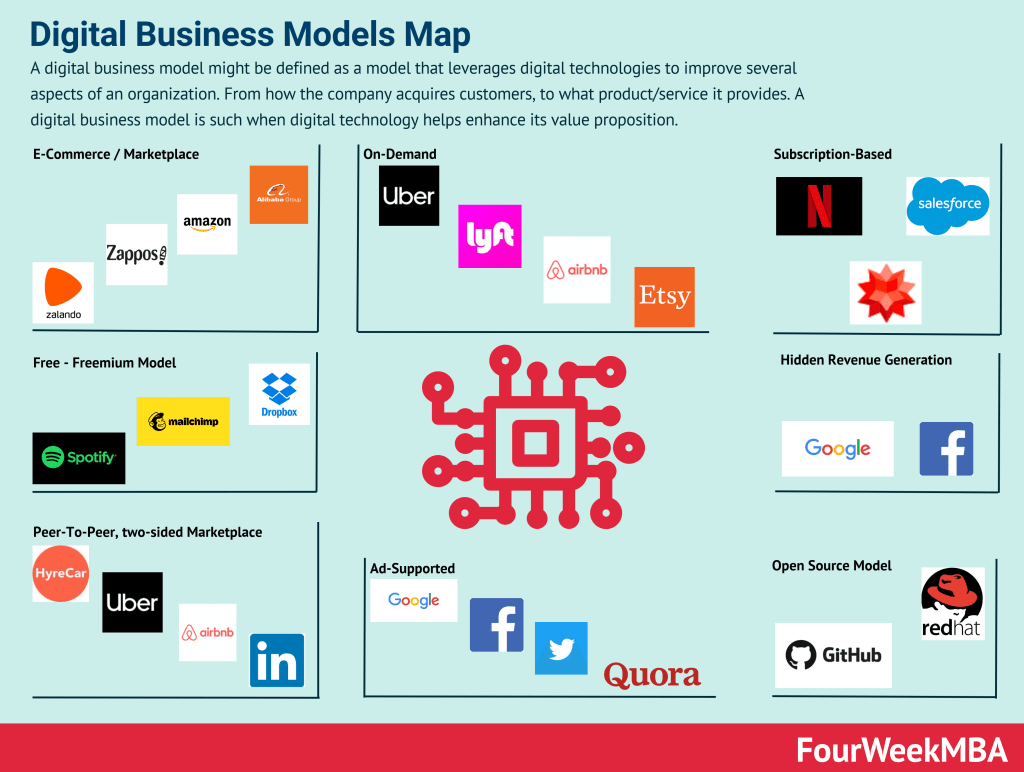
A digital business model might be defined as a model that leverages digital technologies to improve several aspects of an organization. From how the company acquires customers, to what product/service it provides. A digital business model is such when digital technology helps enhance its value proposition.
A tech business model is made of four main components: value model (value propositions, mission, vision), technological model (R&D management), distribution model (sales and marketing organizational structure), and financial model (revenue modeling, cost structure, profitability and cash generation/management). Those elements coming together can serve as the basis to build a solid tech business model.
A platform business model generates value by enabling interactions between people, groups, and users by leveraging network effects. Platform business models usually comprise two sides: supply and demand. Kicking off the interactions between those two sides is one of the crucial elements for a platform business model success.
A Blockchain Business Model is made of four main components: Value Model (Core Philosophy, Core Value and Value Propositions for the key stakeholders), Blockchain Model (Protocol Rules, Network Shape and Applications Layer/Ecosystem), Distribution Model (the key channels amplifying the protocol and its communities), and the Economic Model (the dynamics through which protocol players make money). Those elements coming together can serve as the basis to build and analyze a solid Blockchain Business Model.
In an asymmetric businessmodel, the organization doesn’t monetize the user directly, but it leverages the data users provide coupled with technology, thus have a key customer pay to sustain the core asset. For example, Google makes money by leveraging users’ data, combined with its algorithms sold to advertisers for visibility.
In an asymmetric businessmodel, the organization doesn’t monetize the user directly, but it leverages the data users provide coupled with technology, thus having a key customer pay to sustain the core asset. For example, Google makes money by leveraging users’ data, combined with its algorithms sold to advertisers for visibility. This is how attention merchants make monetize their business models.
While the term has been coined by Andrew Lampitt, open-core is an evolution of open-source. Where a core part of the software/platform is offered for free, while on top of it are built premium features or add-ons, which get monetized by the corporation who developed the software/platform. An example of the GitLab open core model, where the hosted service is free and open, while the software is closed.
Cloud business models are all built on top of cloud computing, a concept that took over around 2006 when former Google’s CEO Eric Schmit mentioned it. Most cloud-based business models can be classified as IaaS (Infrastructure as a Service), PaaS (Platform as a Service), or SaaS (Software as a Service). While those models are primarily monetized via subscriptions, they are monetized via pay-as-you-go revenue models and hybrid models (subscriptions + pay-as-you-go).
Open source is licensed and usually developed and maintained by a community of independent developers. While the freemium is developed in-house. Thus the freemium give the company that developed it, full control over its distribution. In an open-source model, the for-profit company has to distribute its premium version per its open-source licensing model.
The freemium – unless the whole organization is aligned around it – is a growth strategy rather than a business model. A free service is provided to a majority of users, while a small percentage of those users convert into paying customers through the sales funnel. Free users will help spread the brand through word of mouth.
A freeterprise is a combination of free and enterprise where free professional accounts are driven into the funnel through the free product. As the opportunity is identified the company assigns the free account to a salesperson within the organization (inside sales or fields sales) to convert that into a B2B/enterprise account.
A marketplace is a platform where buyers and sellers interact and transact. The platform acts as a marketplace that will generate revenues in fees from one or all the parties involved in the transaction. Usually, marketplaces can be classified in several ways, like those selling services vs. products or those connecting buyers and sellers at B2B, B2C, or C2C level. And those marketplaces connecting two core players, or more.
B2B, which stands for business-to-business, is a process for selling products or services to other businesses. On the other hand, a B2C sells directly to its consumers.
A B2B2C is a particular kind of business model where a company, rather than accessing the consumer market directly, it does that via another business. Yet the final consumers will recognize the brand or the service provided by the B2B2C. The company offering the service might gain direct access to consumers over time.
Direct-to-consumer (D2C) is a business model where companies sell their products directly to the consumer without the assistance of a third-party wholesaler or retailer. In this way, the company can cut through intermediaries and increase its margins. However, to be successful the direct-to-consumers company needs to build its own distribution, which in the short term can be more expensive. Yet in the long-term creates a competitive advantage.
The C2C business model describes a market environment where one customer purchases from another on a third-party platform that may also handle the transaction. Under the C2C model, both the seller and the buyer are considered consumers. Customer to customer (C2C) is, therefore, a business model where consumers buy and sell directly between themselves. Consumer-to-consumer has become a prevalent business model especially as the web helped disintermediate various industries.
A retail business model follows a direct-to-consumer approach, also called B2C, where the company sells directly to final customers a processed/finished product. This implies a business model that is mostly local-based, it carries higher margins, but also higher costs and distribution risks.
The wholesale model is a selling model where wholesalers sell their products in bulk to a retailer at a discounted price. The retailer then on-sells the products to consumers at a higher price. In the wholesale model, a wholesaler sells products in bulk to retail outlets for onward sale. Occasionally, the wholesaler sells direct to the consumer, with supermarket giant Costco the most obvious example.
The term “crowdsourcing” was first coined by Wired Magazine editor Jeff Howe in a 2006 article titled Rise of Crowdsourcing. Though the practice has existed in some form or another for centuries, it rose to prominence when eCommerce, social media, and smartphone culture began to emerge. Crowdsourcing is the act of obtaining knowledge, goods, services, or opinions from a group of people. These people submit information via social media, smartphone apps, or dedicated crowdsourcing platforms.
In a franchained business model (a short-term chain, long-term franchise) model, the company deliberately launched its operations by keeping tight ownership on the main assets, while those are established, thus choosing a chain model. Once operations are running and established, the company divests its ownership and opts instead for a franchising model.
Businesses employing the brokerage business model make money via brokerage services. This means they are involved with the facilitation, negotiation, or arbitration of a transaction between a buyer and a seller. The brokerage business model involves a business connecting buyers with sellers to collect a commission on the resultant transaction. Therefore, acting as a middleman within a transaction.
Dropshipping is a retail business model where the dropshipper externalizes the manufacturing and logistics and focuses only on distribution and customer acquisition. Therefore, the dropshipper collects final customers’ sales orders, sending them over to third-party suppliers, who ship directly to those customers. In this way, through dropshipping, it is possible to run a business without operational costs and logistics management.
A free-to-play is a model that became particularly popular in gaming. Free-to-play is also commonly referred to as free-to-start. For instance, companies like Epic Games have launched popular games like Fortnite 's Battle Royale, which had ingrained a free-to-play model. This is a model that become extremely popular in the digital age of gaming.
When did this all start?
The free-to-play model isn't new, and it came from another model, made popular in gaming, throughout the 1980s: shareware.
While free-to-play in itself is a distribution model, rather than a business model . In reality, the way the game gets distributed influences the whole business model for the company. In fact, as a company like Epic Games, distributed Fortnite's Battle Royale in a free-to-play mode it had to monetize the game at some other level.
What are the examples?
Fortnite: Developed by Epic Games, Fortnite's Battle Royale mode is free to play. Players can purchase in-game currency (V-Bucks) to buy cosmetic items, battle passes, and other virtual goods.. League of Legends: Riot Games' League of Legends is a popular free-to-play multiplayer online battle arena (MOBA) game. Players can buy in-game currency (Riot Points) to purchase champions, skins, and other cosmetic items..
Gennaro is the creator of FourWeekMBA, which reached about four million business people, comprising C-level executives, investors, analysts, product managers, and aspiring digital entrepreneurs in 2022 alone | He is also Director of Sales for a high-tech scaleup in the AI Industry | In 2012, Gennaro earned an International MBA with emphasis on Corporate Finance and Business Strategy.
Scroll to Top
Discover more from FourWeekMBA
Subscribe now to keep reading and get access to the full archive.