Wealthsimple is an online investment management service founded in 2014 in Toronto by Michael Katchen, Rudy Adler, and Brett Huneycutt. Katchen got the idea for the company after realizing that some people desired a truly passive approach to investing.
Wealthsimple charges management fees for various investment account types, with the exact fee depending on the amount invested.
Wealthsimple charges a currency conversion fee for Canadian residents dealing in United States assets. The company also charges for broker-assisted phone trades and makes money on interchange fees during Visa debit card purchases. Lastly, Wealthsimple lends the cash in user accounts to other institutions, receiving interest in return.
Business Model Element
Analysis
Implications
Examples
Value Proposition
Wealthsimple’s value proposition includes: – Robo-Advisory Services: Automated investment management using algorithms and technology. – Low Fees: Competitive pricing compared to traditional financial advisors. – Diversified Portfolios: Portfolio options that align with users’ financial goals and risk tolerance. – User-Friendly Platform: A simple and easy-to-use interface for investors. – Responsible Investing: Options for socially responsible and sustainable investing. – Financial Planning: Access to financial planning tools and advice.
Offers automated investment management for convenience and efficiency. Attracts cost-conscious users with competitive pricing. Provides tailored investment options for different risk profiles. Appeals to novice investors with a user-friendly platform. Aligns with users’ values through responsible investing choices. Enhances user engagement by offering financial planning resources.
– Users relying on Wealthsimple’s robo-advisors to manage their investments. – Investors benefiting from lower fees compared to traditional advisors. – Individuals with diversified portfolios that match their risk tolerance. – Novice investors using the platform’s user-friendly interface. – Users who prioritize responsible investing and sustainability. – Accessing financial planning tools and advice through Wealthsimple.
Customer Segments
Wealthsimple primarily serves the following customer segments: 1. Individual Investors: Individuals looking to invest and grow their wealth. 2. Millennial Investors: Younger investors seeking digital and user-friendly investment options. 3. Ethical Investors: Those interested in socially responsible and sustainable investing. 4. Novice Investors: Beginners in the world of investing who appreciate guidance. Wealthsimple caters to a diverse range of investors.
Attracts individuals and millennials interested in investing. Appeals to ethical investors who prioritize responsible investments. Helps novice investors navigate the investment landscape. Serves a broad user base with varying financial goals and preferences.
– Individual investors using Wealthsimple to grow their wealth. – Millennials choosing digital investment options for convenience. – Ethical investors aligning their investments with their values. – Novice investors seeking guidance in their investment journey. – A diverse group of users with different financial goals and preferences.
Distribution Strategy
Wealthsimple’s distribution strategy includes: – Online Platform: Providing an online platform and mobile app for users to create and manage their investment accounts. – Marketing and Partnerships: Utilizing digital marketing and partnerships to attract and onboard users. – Referral Program: Encouraging existing users to refer friends and family. Wealthsimple relies on its online presence, marketing efforts, partnerships, and referrals to reach investors.
Offers a convenient online platform for users to access investment services. Attracts users through digital marketing and strategic partnerships. Stimulates user growth by incentivizing referrals. Utilizes a multi-channel approach to acquire and engage users.
– Users accessing Wealthsimple’s online platform and mobile app for investments. – Discovering Wealthsimple through digital marketing and partnerships. – Existing users referring friends and family to join Wealthsimple.
Revenue Streams
Wealthsimple generates revenue through the following channels: 1. Management Fees: Charging a fee based on the assets under management (AUM) for its robo-advisory services. 2. Premium Services: Offering premium tiers with additional features and higher fees. 3. Referral Program: Earning income through referrals by rewarding existing users. Wealthsimple diversifies its revenue streams through management fees, premium services, and referrals.
Generates revenue by charging management fees on AUM. Increases revenue through premium services with added features. Expands its user base and income through a referral program. Diversifies its revenue sources within the financial services industry.
– Users paying management fees based on their AUM with Wealthsimple. – Subscribers to premium services accessing additional features. – Existing users referring friends and family and earning referral rewards.
Marketing Strategy
Wealthsimple’s marketing strategy involves: – Digital Advertising: Running online ads to attract potential investors. – Content Marketing: Providing educational content on finance and investing topics. – Partnerships: Collaborating with financial institutions and influencers to expand reach. – Referral Program: Incentivizing users to refer others to Wealthsimple. Wealthsimple combines digital advertising, content marketing, partnerships, and referrals to acquire and retain users.
Attracts potential investors through digital advertising campaigns. Educates users with valuable content on finance and investing. Expands its reach through partnerships and collaborations. Stimulates user growth by incentivizing referrals. Implements a comprehensive marketing strategy for user acquisition and engagement.
– Encountering Wealthsimple’s online ads promoting its investment services. – Accessing educational content on finance and investing topics. – Discovering Wealthsimple through partnerships with financial institutions and influencers. – Referring friends and family to join Wealthsimple and earn rewards.
Competitive Advantage
Wealthsimple’s competitive advantage is derived from: – Robo-Advisory Technology: Utilizing advanced algorithms for automated and efficient investment management. – Low Fees: Offering competitive pricing compared to traditional financial advisors. – Responsible Investing Options: Attracting ethical investors with socially responsible choices. – User-Friendly Platform: Providing a simple and intuitive interface for investors. – Strong Online Presence: Leveraging digital marketing and partnerships for growth. Wealthsimple’s strengths lie in its technology, pricing, responsible investing options, user-friendly platform, and online marketing efforts.
Provides efficient and automated investment management through advanced technology. Appeals to cost-conscious users with competitive pricing. Attracts ethical investors with responsible investment choices. Enhances user experience with a user-friendly interface. Utilizes a strong online presence for user acquisition and engagement.
– Users benefiting from automated investment management with advanced technology. – Investors appreciating lower fees compared to traditional advisors. – Ethical investors choosing responsible investment options. – Investors finding the platform user-friendly. – Discovering Wealthsimple through its strong online presence and marketing efforts.
Wealthsimple is an online investment management service targeted at millennial consumers. The company was founded in 2014 in Toronto by Michael Katchen, Rudy Adler, and Brett Huneycutt.
Before establishing Wealthsimple, Katchen was obsessed with stock investing and once helped Adler and Huneycutt track their investments using basic spreadsheets.
However, Katchen soon discovered that not everyone shared his passion for spreadsheets or indeed investing. Many believed it was too complex or laborious and as a result, wanted someone else to invest on their behalf.
In response to this feedback, the trio built a web app that would send push notifications to users telling them to buy specific exchange-traded funds.
This system was an improvement on the original spreadsheet, but investors still desired a less complex and more passive service.
Katchen then decided to bring the first robo-advisor to Canada, which formed the basis of the Wealthsimple platform.
Wealthsimple was launched in September 2014 as a technology-enabled investment manager investing in various low-index funds across multiple asset classes.
Three months later, an Android and iOS app resulted in accelerated growth amongst millennial investors. By the end of the following year, the company had $400 million in assets under management spread across 10,000 clients.
Multiple partnerships followed. In May 2016, Wealthsimple partnered with Mint to enable clients to sync their accounts with Mint’s budgeting software.
The company also partnered with TurboTax to allow Wealthsimple customers to access their taxes within the platform.
New features were also progressively added, including a mobile trading app, fractional share trading, and a savings account for bill payments, electronic transfers, and cheque deposits.
Thanks in part to its product offering, Wealthsimple has a somewhat diverse revenue generation strategy.
Let’s take a look at the strategy in the following paragraphs.
Management fees
Management fees were the earliest form of monetization on the platform at a time when Wealthsimple was exclusively a passive investment service.
Today, the company charges management fees in a diverse range of scenarios. Wealthsimple will manage retirement, savings, child education, business, and multiple-owner accounts, among others.
Here, there are three options based on the amount invested:
Basic – for amounts up to $100,000, the management fee is 0.5%.
Black – for amounts over $100,000, the management fee is 0.4%.
Generation – for amounts exceeding $500,000, the management fee is also 0.4%. However, there is also access to a team of dedicated financial advisors, asset location, financial reporting, and health plan discounts.
Currency conversion fees
Wealthsimple also collects a 1.5% currency conversion fee whenever a Canadian account holder invests in a US-denominated asset.
It should be noted that the company does not earn revenue by selling order flow volume because the practice is illegal in Canada.
Broker assisted trades
If a Wealthsimple user prefers to perform trades outside of the app, the company charges $45 for a broker-assisted phone trade.
A paper account statement is also available for $20.
Interest on cash
Wealthsimple introduced Wealthsimple Save in April 2018, high-interest savings account with an interest rate perpetually above those offered by traditional banks.
The company makes money by lending out the cash in its user accounts to other institutions and then collecting interest on the repayments.
Interchange fees
Wealthsimple customers can also access a physical debit card linked with their account in cooperation with Visa.
When the debit card is used to pay for goods or services, the merchant pays an interchange fee to Visa of around 1%.
A portion of the interchange fee is then shared with Wealthsimple, with the exact percentage undisclosed.
Key highlights
Founding and Purpose: Wealthsimple, an online investment management service, was founded in 2014 in Toronto by Michael Katchen, Rudy Adler, and Brett Huneycutt. It was created to provide a passive and user-friendly approach to investing, particularly targeting millennial consumers.
Robo-Advisor Concept: Wealthsimple started as a robo-advisor, offering a technology-enabled investment manager that invested in low-index funds across multiple asset classes. It provided push notifications to users to guide their investments.
Rapid Growth: Within three months of its launch, Wealthsimple’s mobile app for Android and iOS contributed to accelerated growth among millennial investors. By the end of the following year, the platform had $400 million in assets under management with 10,000 clients.
Diverse Partnerships: Wealthsimple formed partnerships with Mint and TurboTax, enabling clients to sync their accounts with budgeting software and access tax-related features within the platform.
Expanded Features: Over time, Wealthsimple introduced new features, including a mobile trading app, fractional share trading, and a high-interest savings account called Wealthsimple Save.
Assets Under Management: As of the most recent data, Wealthsimple manages approximately $9.7 billion in assets.
Revenue Generation Model: Wealthsimple employs a diverse revenue generation strategy, including management fees, currency conversion fees, broker-assisted trades, interest on cash, and interchange fees.
Management Fees: Wealthsimple charges management fees for various account types based on the amount invested. Different tiers have different fee structures, such as Basic (up to $100,000), Black (over $100,000), and Generation (over $500,000).
Currency Conversion Fees: Canadian account holders are charged a 1.5% currency conversion fee when investing in US-denominated assets.
Broker-Assisted Trades: For users who prefer to perform trades outside the app, Wealthsimple charges a fee of $45 for a broker-assisted phone trade.
Interest on Cash: Wealthsimple earns money by lending out the cash in user accounts to other institutions and collecting interest on the repayments.
Interchange Fees: Wealthsimple receives a share of interchange fees from Visa when customers use their physical debit card linked to their accounts for payments. The exact percentage is undisclosed.
Acorns is a fintech platform providing services related to Robo-investing and micro-investing. The company makes money primarily through three subscription tiers: Lite – ($1/month), which gives users access to Acorns Invest, Personal ($3/month) that includes Invest plus the Later (retirement) and Spend (personal checking account) suite of products, Family ($5/month) with features from both the Lite and Personal plans with the addition of Early.
Started as a pay-later solution integrated to merchants’ checkouts, Affirm makes money from merchants’ fees as consumers pick up the pay-later solution. Affirm also makes money through interests earned from the consumer loans, when those are repurchased from the originating bank. In 2020 Affirm made 50% of its revenues from merchants’ fees, about 37% from interests, and the remaining from virtual cards and servicing fees.
Alipay is a Chinese mobile and online payment platform created in 2004 by entrepreneur Jack Ma as the payment arm of Taobao, a major Chinese eCommerce site. Alipay, therefore, is the B2C component of Alibaba Group. Alipay makes money via escrows transaction fees, a range of value-added ancillary services, and through its Credit Pay Instalment fees.
Betterment is an American financial advisory company founded in 2008 by MBA graduate Jon Stein and lawyer Eli Broverman. Betterment makes money via investment plans, financial advice packages, betterment for advisors, betterment for business, cash reserve, and checking accounts.
Braintree
Venmo is a peer-to-peer payments app enabling users to share and make payments with friends for a variety of services. The service is free, but a 3% fee applies to credit cards. Venmo also launched a debit card in partnership with Mastercard. Venmo got acquired in 2012 by Braintree, and Braintree got acquired in 2013 by PayPal.
Chime is an American neobank (internet-only bank) company, providing fee-free financial services through its mobile banking app, thus providing personal finance services free of charge while making the majority of its money via interchange fees (paid by merchants when consumers use their debit cards) and ATM fees.
Coinbase is among the most popular platforms for trading and storing crypto-assets, whose mission is “to create an open financial system for the world” by enabling customers to trade cryptocurrencies. Its platform serves both as a search and discovery engine for crypto assets. The company makes money primarily through fees earned for the transactions processed through the platform, custodial services offered, interest, and subscriptions.
Compass is a licensed American real-estate broker incorporating online real estate technology as a marketing medium. The company makes money via sales commissions (collected whenever a sale is facilitated or tenants are found for a rental property) and bridge loans (a service allowing the seller to purchase a home before the revenue from the sale of their previous home is available).
Dosh is a Fintech platform that enables automatic cash backs for consumers. Its business model connects major card providers with online and offline local businesses to develop automatic cash back programs. The company makes money by earning an affiliate commission on each eligible sale from consumers.
E-Trade is a trading platform, allowing investors to trade common and preferred stocks, exchange-traded funds (ETFs), options, bonds, mutual funds, and futures contracts, acquired by Morgan Stanley in 2020 for $13 billion. E-Trade makes money through interest income, order flow, margin interests, options, future and bonds trading, and through other fees and service charges.
Klarna is a financial technology company allowing consumers to shop with a temporary Visa card. Thus it then performs a soft credit check and pays the merchant. Klarna makes money by charging merchants. Klarna also earns a percentage of interchange fees as a commission and for interests earned on customers’ accounts.
Lemonade is an insurance tech company using behavioral economics and artificial intelligence to process claims efficiently. The company leverages technology to streamline onboarding customers while also applying a financialmodel to reduce conflicts of interest with customers (perhaps by donating the variable premiums to charity). The company makes money by selling its core insurance products, and via its tech platform, it tries to enhance its sales.
Monzo is an English neobank offering a mobile app and a prepaid debit card for consumers and businesses. It was one of the first app-based banks to enter the UK market, founded by Gary Dolman, Jason Bates, Jonas Huckestein, Paul Rippon, and Tom Blomfield in 2015. All were employees of Starling Bank, a similar neobank challenging the dominance of established financial institutions in England. The company enjoys many revenue streams: business and consumer subscriptions, interchange and overdraft fees, personal loans, and more.
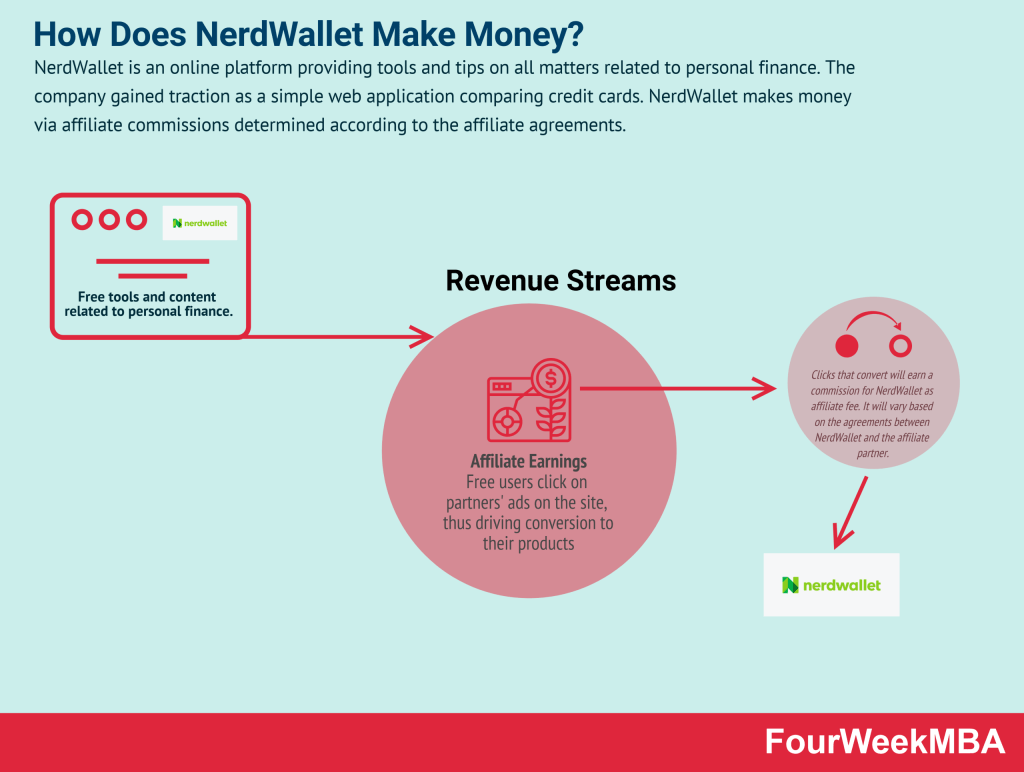
NerdWallet is an online platform providing tools and tips on all matters related to personal finance. The company gained traction as a simple web application comparing credit cards. NerdWallet makes money via affiliate commissions determined according to the affiliate agreements.
Quadpay was an American fintech company founded by Adam Ezra and Brad Lindenberg in 2017. Ezra and Lindenberg witnessed the rising popularity of buy-now-pay-later service Afterpay in Australia and similar service Klarna in Europe. Quadpay collects a range of fees from both the merchant and the consumer via merchandise fees, convenience fees, late payment, and interchange fees.
Revolut an English fintech company offering banking and investment services to consumers. Founded in 2015 by Nikolay Storonsky and Vlad Yatsenko, the company initially produced a low-rate travel card. Storonsky in particular was an avid traveler who became tired of spending hundreds of pounds on currency exchange and foreign transaction fees. The Revolut app and core banking account are free to use. Instead, money is made through a combination of subscription fees, transaction fees, perks, and ancillary services.
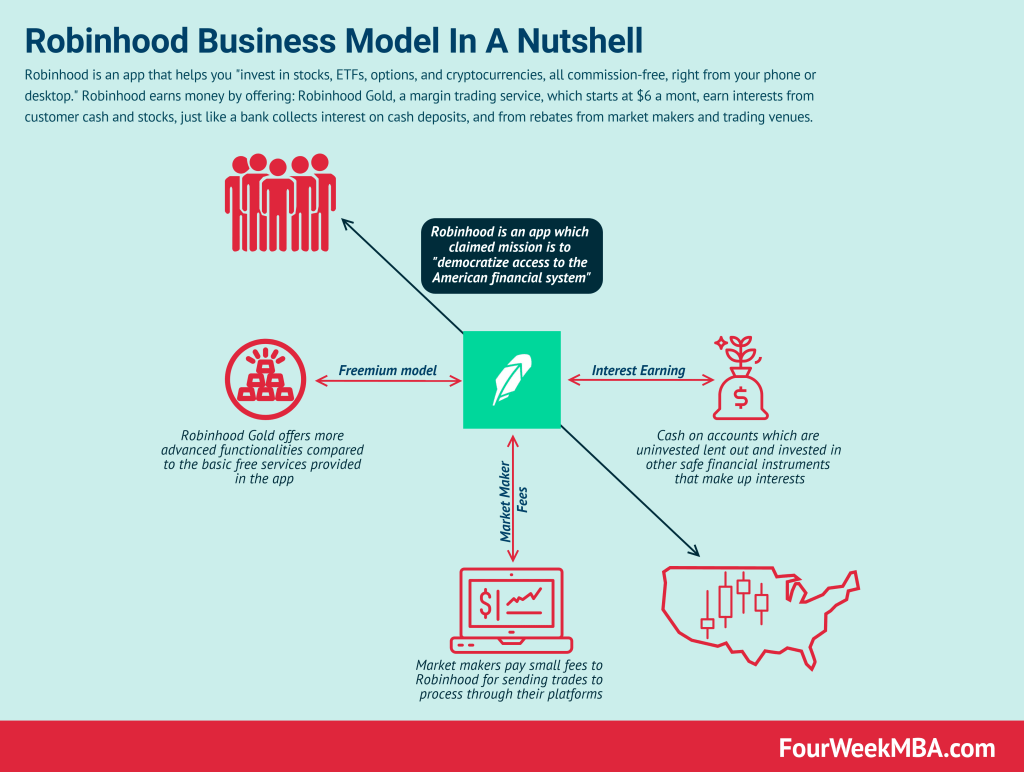
Robinhood is an app that helps to invest in stocks, ETFs, options, and cryptocurrencies, all commission-free. Robinhood earns money by offering: Robinhood Gold, a margin trading service, which starts at $6 a month, earn interests from customer cash and stocks, and rebates from market makers and trading venues.
SoFi is an online lending platform that provides affordable education loans to students, and it expanded into financial services, including loans, credit cards, investment services, and insurance. It makes money primarily via payment processing fees and loan securitization.
Squarespace is a North American hosting and website building company. Founded in 2004 by college student Anthony Casalena as a blog hosting service, it grew to become among the most successful website building companies. The company mostly makes money via its subscription plans. It also makes money via customizations on top of its subscription plans. And in part also as transaction fees for the website where it processes the sales.
Stash is a FinTech platform offering a suite of financial tools for young investors, coupled with personalized investment advice and life insurance. The company primarily makes money via subscriptions, cashback, payment for order flows, and interest for cash sitting on members’ accounts.
Venmo is a peer-to-peer payments app enabling users to share and make payments with friends for a variety of services. The service is free, but a 3% fee applies to credit cards. Venmo also launched a debit card in partnership with Mastercard. Venmo got acquired in 2012 by Braintree, and Braintree got acquired in 2013 by PayPal.
Wealthfront is an automated Fintech investment platform providing investment, retirement, and cashmanagement products to retail investors, mostly making money on the annual 0.25% advisory fee the company charges for assets under management. It also makes money via a line of credits and interests on the cash accounts.
Zelle is a peer-to-peer payment network that indirectly benefits the banks’ consortium that backs it. Zelle also enables users to pay businesses for goods and services, free for users. Merchants pay a 1% fee to Visa or Mastercard, who share it with the bank that issued the card.
Gennaro is the creator of FourWeekMBA, which reached about four million business people, comprising C-level executives, investors, analysts, product managers, and aspiring digital entrepreneurs in 2022 alone | He is also Director of Sales for a high-tech scaleup in the AI Industry | In 2012, Gennaro earned an International MBA with emphasis on Corporate Finance and Business Strategy.