Sezzle’s value proposition includes: – Flexible Payment Options: Allowing users to split their purchases into interest-free installment payments. – No Credit Check: Providing access to BNPL services without traditional credit checks. – Transparency: Offering transparent pricing with no hidden fees. – Convenience: Making online shopping more affordable and accessible. Sezzle appeals to consumers seeking a flexible and budget-friendly way to shop online.
Attracts users looking for installment payment options. Addresses the needs of individuals with limited or no credit history. Builds trust through transparent pricing. Enhances the online shopping experience by offering convenience. Offers a unique value proposition in the BNPL industry.
– Splitting purchases into interest-free installments. – Access to BNPL services without traditional credit checks. – Transparent pricing with no hidden fees. – Convenient and budget-friendly online shopping.
Customer Segments
Sezzle serves the following customer segments: 1. Online Shoppers: Targeting consumers who shop online and prefer flexible payment options. 2. Young Adults: Attracting millennials and Gen Z consumers looking for alternative payment methods. 3. E-commerce Retailers: Partnering with online retailers to offer Sezzle as a payment option. Sezzle focuses on both consumers and e-commerce businesses to expand its user base.
Targets online shoppers seeking flexible payment solutions. Appeals to younger demographics familiar with digital payments. Partners with e-commerce retailers to broaden its reach. Serves a diverse range of customers and businesses in the e-commerce space.
– Online shoppers looking for flexible payment options. – Young adults, including millennials and Gen Z consumers. – E-commerce retailers offering Sezzle as a payment method.
Distribution Strategy
Sezzle’s distribution strategy includes: – Integration with E-commerce Platforms: Partnering with online retailers to integrate Sezzle as a payment option on their websites. – Mobile App: Offering a user-friendly mobile app for consumers to shop and manage their Sezzle payments. – Marketing and Promotion: Running marketing campaigns to promote Sezzle as a payment choice. – Merchant Services: Providing merchant services and support to e-commerce partners. Sezzle utilizes integrations, a mobile app, marketing, and merchant services to distribute its BNPL solution.
Expands its reach by integrating with e-commerce platforms. Offers a convenient mobile app for users. Promotes Sezzle through marketing efforts. Provides merchant services to support partner retailers. Utilizes a multi-faceted distribution strategy in the BNPL industry.
– Integration with e-commerce websites as a payment option. – A user-friendly mobile app for consumers. – Marketing campaigns to promote Sezzle. – Merchant services for e-commerce partners.
Revenue Streams
Sezzle generates revenue through the following channels: 1. Merchant Fees: Charging e-commerce retailers a transaction fee for offering Sezzle as a payment method. 2. Consumer Fees: Earning income from late fees and processing fees on installment payments. 3. Interest: Charging interest on delayed or missed payments. Sezzle diversifies its revenue streams through merchant fees, consumer fees, and interest charges.
Collects fees from e-commerce retailers for providing Sezzle. Generates income from late fees and processing fees. Earns interest income on delayed or missed payments. Diversifies revenue sources within the BNPL sector.
– Transaction fees from e-commerce retailers. – Late fees and processing fees from consumers. – Interest charges on delayed payments.
Marketing Strategy
Sezzle’s marketing strategy involves: – Merchant Partnerships: Partnering with e-commerce businesses to expand its presence and offer Sezzle as a payment option. – Consumer Engagement: Engaging with consumers through marketing campaigns and promotions. – Social Media Presence: Maintaining an active presence on social media platforms to reach potential users. – User Referral Program: Encouraging users to refer friends and family to Sezzle. Sezzle focuses on partnerships, consumer engagement, social media, and referrals to market its BNPL platform.
Expands its user base through partnerships with e-commerce retailers. Attracts consumers through marketing and promotions. Utilizes social media for brand awareness and engagement. Encourages user growth through a referral program. Implements a comprehensive marketing strategy in the BNPL industry.
– Partnerships with e-commerce businesses. – Marketing campaigns and promotions. – Active presence on social media platforms. – User referral program for organic growth.
Organization Structure
Sezzle’s organizational structure includes: – Executive Leadership: Comprising executives responsible for strategic direction and decision-making. – Technology and Development Teams: Managing the development and maintenance of Sezzle’s technology platform. – Sales and Business Development Teams: Handling partnerships with e-commerce retailers. – Customer Support: Providing customer support and assistance. Sezzle maintains an organized structure to support platform development, partnerships, and customer service.
Led by executive leadership for strategic guidance. Manages technology development and platform maintenance. Collaborates with e-commerce retailers for business expansion. Provides customer support for user assistance. Maintains an organized structure aligned with its mission in the BNPL industry.
– Executive leadership for strategic direction. – Technology and development teams. – Sales and business development teams. – Customer support for user assistance.
Sezzle is a fintech company operating in the United States and Canada. It was founded by Charlie Youakim, Paul Paradis, and Killian Brackey in 2016.
Youakim and Paradis, who met while studying their MBAs in Minnesota, created Sezzle as a payment platform that would compete with the likes of PayPal.
The pair even went as far as calling the platform PayPal 2.0 for merchant processing, envisioning a service where merchants were charged 50% less and consumers could earn cashback rewards on their purchases. Unfortunately, the service failed to gain any traction.
While Youakim’s wife was scrolling through Instagram one day, she noticed Afterpay being offered as an option for merchants in Australia.
In May 2017, Sezzle pivoted to offering interest-free credit to young people who preferred to make purchases with their debit cards.
The founders then sought funding in the United States, but the buy-now-pay-later movement was still in its infancy there. As a result, Youakim and Paradis decided to hold an IPO on the Australian Stock Exchange.
Sezzle has a relatively simple revenue generation strategy. The service is essentially free to consumers, provided they pay on time.
With that said, below is an overview of how the company makes its money.
Merchant fees
Like most buy-now-pay-late providers, Sezzle derives most of its income from merchant fees.
The merchant fee is charged at a flat rate of $0.30 plus 6% of the total transaction amount.
Merchants who enjoy higher order volumes may be able to negotiate a custom rate with Sezzle.
The merchant fee may also be negotiable for non-profits and businesses operating in certain industries.
Rescheduled payment fee
Consumers who want to reschedule the payments on a purchase for the second or third time are also charged a fee.
It should be noted that the first reschedule is free, enabling the consumer to push a payment date out by up to a fortnight.
The exact rescheduling fee depends on individual state regulations and the region where the purchase was made. Generally speaking, the rescheduling fee is around $5.
Failed payment fee
If Sezzle is unable to process a payment, a $10 failed payment fee is added to the total amount owed.
However, this fee is waived if the individual manages to make the payment within 48 hours of the due date.
Key takeaways
Sezzle is a fintech company founded by Charlie Youakim, Paul Paradis, and Killian Brackey in 2016. Co-founders Youakim and Paradis created Sezzle to compete with PayPal but later pivoted after seeing the value in buy-now-pay-later.
Sezzle derives much of its income from merchant fees, with merchants charged $0.30 plus 6% of the total transaction amount.
Sezzle is essentially free to consumers provided they make payments by the due date. For late or failed payments the fee is $10. There are also fees associated with rescheduling payment dates.
Acorns is a fintech platform providing services related to Robo-investing and micro-investing. The company makes money primarily through three subscription tiers: Lite – ($1/month), which gives users access to Acorns Invest, Personal ($3/month) that includes Invest plus the Later (retirement) and Spend (personal checking account) suite of products, Family ($5/month) with features from both the Lite and Personal plans with the addition of Early.
Started as a pay-later solution integrated to merchants’ checkouts, Affirm makes money from merchants’ fees as consumers pick up the pay-later solution. Affirm also makes money through interests earned from the consumer loans, when those are repurchased from the originating bank. In 2020 Affirm made 50% of its revenues from merchants’ fees, about 37% from interests, and the remaining from virtual cards and servicing fees.
Alipay is a Chinese mobile and online payment platform created in 2004 by entrepreneur Jack Ma as the payment arm of Taobao, a major Chinese eCommerce site. Alipay, therefore, is the B2C component of Alibaba Group. Alipay makes money via escrows transaction fees, a range of value-added ancillary services, and through its Credit Pay Instalment fees.
Betterment is an American financial advisory company founded in 2008 by MBA graduate Jon Stein and lawyer Eli Broverman. Betterment makes money via investment plans, financial advice packages, betterment for advisors, betterment for business, cash reserve, and checking accounts.
Braintree
Venmo is a peer-to-peer payments app enabling users to share and make payments with friends for a variety of services. The service is free, but a 3% fee applies to credit cards. Venmo also launched a debit card in partnership with Mastercard. Venmo got acquired in 2012 by Braintree, and Braintree got acquired in 2013 by PayPal.
Chime is an American neobank (internet-only bank) company, providing fee-free financial services through its mobile banking app, thus providing personal finance services free of charge while making the majority of its money via interchange fees (paid by merchants when consumers use their debit cards) and ATM fees.
Coinbase is among the most popular platforms for trading and storing crypto-assets, whose mission is “to create an open financial system for the world” by enabling customers to trade cryptocurrencies. Its platform serves both as a search and discovery engine for crypto assets. The company makes money primarily through fees earned for the transactions processed through the platform, custodial services offered, interest, and subscriptions.
Compass is a licensed American real-estate broker incorporating online real estate technology as a marketing medium. The company makes money via sales commissions (collected whenever a sale is facilitated or tenants are found for a rental property) and bridge loans (a service allowing the seller to purchase a home before the revenue from the sale of their previous home is available).
Dosh is a Fintech platform that enables automatic cash backs for consumers. Its business model connects major card providers with online and offline local businesses to develop automatic cash back programs. The company makes money by earning an affiliate commission on each eligible sale from consumers.
E-Trade is a trading platform, allowing investors to trade common and preferred stocks, exchange-traded funds (ETFs), options, bonds, mutual funds, and futures contracts, acquired by Morgan Stanley in 2020 for $13 billion. E-Trade makes money through interest income, order flow, margin interests, options, future and bonds trading, and through other fees and service charges.
Klarna is a financial technology company allowing consumers to shop with a temporary Visa card. Thus it then performs a soft credit check and pays the merchant. Klarna makes money by charging merchants. Klarna also earns a percentage of interchange fees as a commission and for interests earned on customers’ accounts.
Lemonade is an insurance tech company using behavioral economics and artificial intelligence to process claims efficiently. The company leverages technology to streamline onboarding customers while also applying a financialmodel to reduce conflicts of interest with customers (perhaps by donating the variable premiums to charity). The company makes money by selling its core insurance products, and via its tech platform, it tries to enhance its sales.
Monzo is an English neobank offering a mobile app and a prepaid debit card for consumers and businesses. It was one of the first app-based banks to enter the UK market, founded by Gary Dolman, Jason Bates, Jonas Huckestein, Paul Rippon, and Tom Blomfield in 2015. All were employees of Starling Bank, a similar neobank challenging the dominance of established financial institutions in England. The company enjoys many revenue streams: business and consumer subscriptions, interchange and overdraft fees, personal loans, and more.
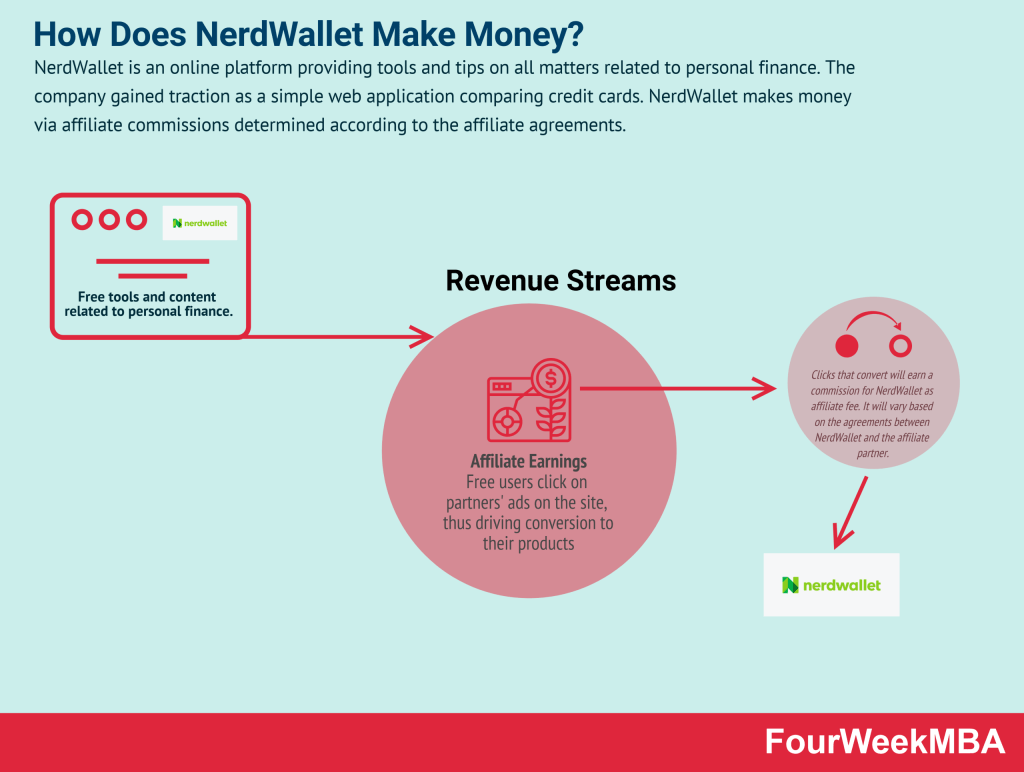
NerdWallet is an online platform providing tools and tips on all matters related to personal finance. The company gained traction as a simple web application comparing credit cards. NerdWallet makes money via affiliate commissions determined according to the affiliate agreements.
Quadpay was an American fintech company founded by Adam Ezra and Brad Lindenberg in 2017. Ezra and Lindenberg witnessed the rising popularity of buy-now-pay-later service Afterpay in Australia and similar service Klarna in Europe. Quadpay collects a range of fees from both the merchant and the consumer via merchandise fees, convenience fees, late payment, and interchange fees.
Revolut an English fintech company offering banking and investment services to consumers. Founded in 2015 by Nikolay Storonsky and Vlad Yatsenko, the company initially produced a low-rate travel card. Storonsky in particular was an avid traveler who became tired of spending hundreds of pounds on currency exchange and foreign transaction fees. The Revolut app and core banking account are free to use. Instead, money is made through a combination of subscription fees, transaction fees, perks, and ancillary services.
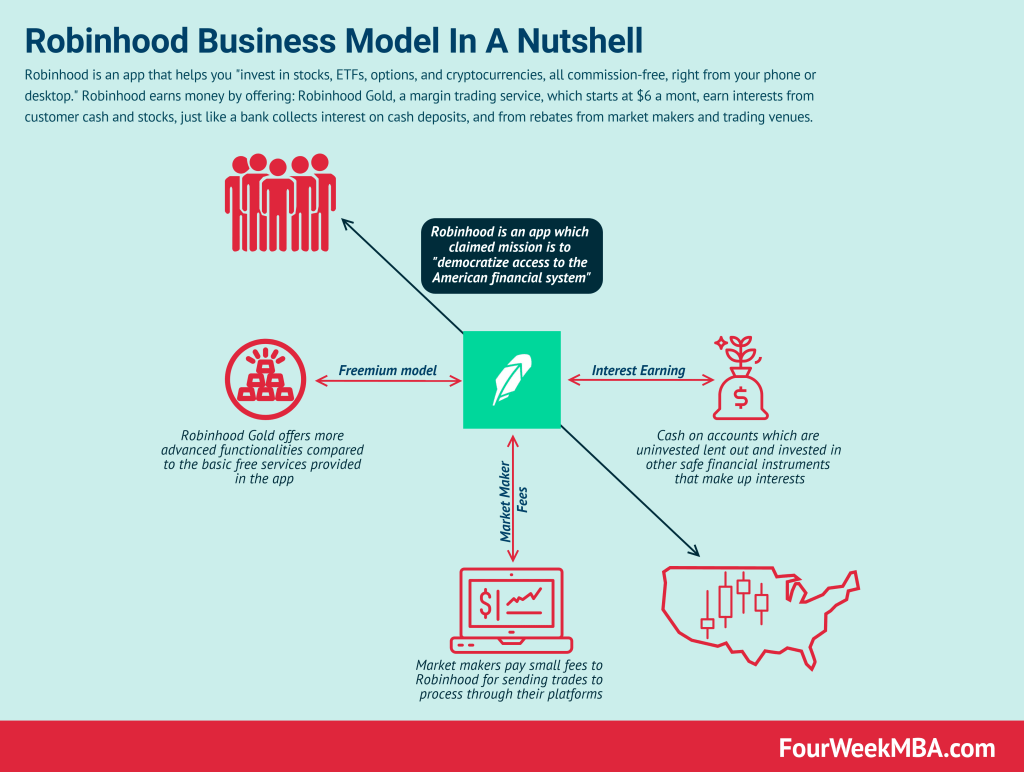
Robinhood is an app that helps to invest in stocks, ETFs, options, and cryptocurrencies, all commission-free. Robinhood earns money by offering: Robinhood Gold, a margin trading service, which starts at $6 a month, earn interests from customer cash and stocks, and rebates from market makers and trading venues.
SoFi is an online lending platform that provides affordable education loans to students, and it expanded into financial services, including loans, credit cards, investment services, and insurance. It makes money primarily via payment processing fees and loan securitization.
Squarespace is a North American hosting and website building company. Founded in 2004 by college student Anthony Casalena as a blog hosting service, it grew to become among the most successful website building companies. The company mostly makes money via its subscription plans. It also makes money via customizations on top of its subscription plans. And in part also as transaction fees for the website where it processes the sales.
Stash is a FinTech platform offering a suite of financial tools for young investors, coupled with personalized investment advice and life insurance. The company primarily makes money via subscriptions, cashback, payment for order flows, and interest for cash sitting on members’ accounts.
Venmo is a peer-to-peer payments app enabling users to share and make payments with friends for a variety of services. The service is free, but a 3% fee applies to credit cards. Venmo also launched a debit card in partnership with Mastercard. Venmo got acquired in 2012 by Braintree, and Braintree got acquired in 2013 by PayPal.
Wealthfront is an automated Fintech investment platform providing investment, retirement, and cashmanagement products to retail investors, mostly making money on the annual 0.25% advisory fee the company charges for assets under management. It also makes money via a line of credits and interests on the cash accounts.
Zelle is a peer-to-peer payment network that indirectly benefits the banks’ consortium that backs it. Zelle also enables users to pay businesses for goods and services, free for users. Merchants pay a 1% fee to Visa or Mastercard, who share it with the bank that issued the card.
Gennaro is the creator of FourWeekMBA, which reached about four million business people, comprising C-level executives, investors, analysts, product managers, and aspiring digital entrepreneurs in 2022 alone | He is also Director of Sales for a high-tech scaleup in the AI Industry | In 2012, Gennaro earned an International MBA with emphasis on Corporate Finance and Business Strategy.