Uber’s principal individual shareholders are Yasir Al-Rumayyan (3.64%), the Governor of the Public Investment Fund, the sovereign wealth fund of the Kingdom of Saudi Arabia, and Dara Khosrowshahi, Uber’s CEO. Institutional investors are Morgan Stanley, with 7.32% ownership, Fidelity, with 6.34%, and The Vanguard Group, with 5.85% ownership.
Detail
Description
Company
Uber Technologies, Inc.
Ownership Structure
Publicly traded company with major shareholders
Major Shareholders
Institutional investors such as Vanguard Group, BlackRock, FMR LLC, Morgan Stanley, individual shareholders, and company insiders
Founding Date
March 2009
Founders
Travis Kalanick and Garrett Camp
Headquarters
San Francisco, California, USA
Primary Business
Providing ride-hailing services, food delivery, freight transportation, and autonomous vehicle research
Strategic Goals
Expanding mobility services, enhancing platform safety, integrating autonomous and electric vehicles, and growing international market presence
Corporate Structure and Ownership: Uber Technologies, Inc. is publicly traded on the New York Stock Exchange under the ticker symbol UBER. The company went public in May 2019, and its ownership is distributed among institutional investors, company insiders, and individual shareholders. Notable institutional shareholders include Vanguard Group, BlackRock, and FMR LLC. These investors provide strategic input and financial stability, influencing Uber’s long-term vision and operational strategies.
Corporate Strategy and Business Model: Uber’s business model is based on a multi-sided platform that connects drivers and riders through a mobile app. This model extends to other verticals, such as Uber Eats for food delivery and Uber Freight for logistics. Uber takes a commission from each transaction, generating revenue while providing flexibility and earning opportunities for drivers. The company aims to diversify its offerings by expanding into autonomous driving and electric vehicles, enhancing its transportation ecosystem.
Product Innovation and Technology: Uber invests heavily in technology to enhance its platform and service offerings. The company is at the forefront of developing autonomous vehicle technology through its Advanced Technologies Group, focusing on safety and efficiency. Uber also invests in AI and data analytics to optimize routing, improve user experiences, and enhance safety features for both drivers and passengers.
Market Expansion and Growth: Uber operates in over 70 countries and continues to expand its market presence by entering new regions and cities. The company’s international growthstrategy involves adapting to local regulations, forming strategic partnerships, and leveraging technology to meet diverse transportation needs. Uber’s focus on expanding Uber Eats and Uber Freight complements its core ride-hailing business, diversifying its revenue streams.
Community and Safety Commitment: Uber emphasizes safety and community engagement, implementing features like driver background checks, real-time ride tracking, and in-app emergency support. The company is committed to creating a safer platform for users and drivers while actively participating in community programs and partnerships that promote social responsibility and environmental sustainability.
Sustainability and Environmental Goals: Uber is dedicated to reducing its environmental impact by promoting electric vehicle adoption and setting a goal to become a zero-emission platform by 2040. The company encourages drivers to switch to electric vehicles through partnerships, incentives, and the development of charging infrastructure.
Cultural and Economic Impact: Uber has significantly impacted the gig economy, providing flexible work opportunities for millions of drivers worldwide. The company’s influence extends beyond transportation, affecting how people view work, technology, and urban mobility. Uber’s role in transforming urban transportation makes it a key player in shaping the future of mobility and smart cities.
Aspect
Description
Analysis
Examples
Products and Services
Uber offers several services, including ride-sharing (UberX, UberPool, UberXL), premium ride options (Uber Black, Uber Comfort), food delivery (Uber Eats), and freight and logistics services (Uber Freight). Users can request rides, order food, or arrange freight transportation through the Uber mobile application or website.
Uber’s product and service lineup caters to different transportation needs, from everyday rides to premium options and food delivery. The platform’s convenience and accessibility through the mobile app have contributed to its widespread adoption. Expanding into logistics with Uber Freight diversifies its offerings.
Ride-sharing, premium rides, food delivery, freight and logistics, mobile application, convenience, accessibility, diversified offerings.
Revenue Streams
Uber generates revenue primarily through service fees and commissions. For ride-sharing, the company charges passengers a fare, from which it deducts a commission. Drivers pay Uber a portion of their earnings as well. Uber also earns from delivery fees in the case of Uber Eats. Additionally, Uber Freight generates revenue by connecting shippers and carriers.
The core revenue stream for Uber comes from service fees and commissions for ride-sharing and food delivery. Uber Freight adds a new source of revenue through its brokerage service. The company’s platform connects service providers (drivers, restaurants, carriers) with consumers and businesses, earning a share of the transaction.
Revenue from service fees, commissions, ride-sharing fares, delivery fees, Uber Freight brokerage service, diversified revenue sources.
Customer Segments
Uber serves a diverse range of customer segments, including passengers seeking convenient transportation, drivers looking to earn income, restaurants and food delivery customers, and businesses in need of logistics solutions. The platform addresses the needs of individuals and organizations across various sectors.
Uber’s customer segments encompass passengers, drivers, restaurants, food delivery customers, and businesses requiring logistics services. The platform’s versatility and convenience cater to a broad range of transportation and delivery needs.
Passengers, drivers, restaurants, food delivery customers, businesses, diverse customer segments, transportation and delivery needs, versatility, convenience.
Distribution Channels
Uber primarily distributes its services through its mobile application, available on app stores (iOS, Android) and through its website. Users can download the app or access the platform via web browsers. The mobile app’s accessibility and user-friendly interface have been key to Uber’s success.
Distribution channels for Uber include mobile applications (iOS, Android) and web access. The mobile app’s accessibility, user-friendly design, and features like GPS-based location services make it a convenient and widely used platform for ride requests and food delivery.
Uber forms partnerships to enhance its services and expand its reach. These partnerships may include collaborations with vehicle manufacturers to provide drivers with vehicle rental options, agreements with restaurants to offer food delivery, and partnerships with businesses for corporate travel solutions. Uber also partners with financial institutions for payment processing and offers various promotions and loyalty programs.
Partnerships with vehicle manufacturers provide drivers with rental options, expanding Uber’s driver base. Collaborations with restaurants enhance the food delivery service. Partnerships with businesses offer corporate travel solutions, and financial institution partnerships ensure smooth payment processing. Promotions and loyalty programs attract and retain customers.
Key resources for Uber include its mobile application and website, user base, network of drivers, restaurant partnerships, logistical infrastructure for Uber Freight, and technical team for app development and maintenance. Uber’s vast user base and extensive driver network are critical resources.
Uber’s resources encompass its technology infrastructure, extensive user base, large network of drivers, partnerships with restaurants, logistical infrastructure for Uber Freight, and a dedicated technical team for app development and maintenance. These resources are essential for ensuring smooth operations and expansion.
Mobile application, website, user base, driver network, restaurant partnerships, logistical infrastructure, technical team, crucial resources for smooth operations and expansion.
Cost Structure
Uber incurs various costs related to its operations, including expenses for driver incentives and earnings, marketing and advertising to attract passengers and drivers, platform development and maintenance, employee salaries and benefits, insurance costs, legal and regulatory compliance, and administrative overhead. Driver incentives and earnings are typically the most significant expenses.
Costs associated with Uber’s operations include driver incentives, marketing and advertising expenses, platform development and maintenance, employee salaries and benefits, insurance costs, legal and regulatory compliance, and administrative overhead. Driver incentives and earnings constitute a substantial operational cost.
Driver incentives, marketing and advertising expenses, platform development and maintenance, employee salaries and benefits, insurance costs, legal and regulatory compliance, administrative overhead, substantial driver incentive and earnings expenses.
Competitive Advantage
Uber’s competitive advantage lies in its extensive user base, driver network, and a wide range of service offerings. The platform’s convenience and user-friendly app have contributed to its popularity. Uber’s ability to adapt to changing market dynamics and regulatory challenges has allowed it to maintain a leading position in the ride-sharing and food delivery sectors.
Uber’s strengths include its vast user base, extensive driver network, diverse service offerings, convenience, and a user-friendly app. The company’s adaptability to market changes and regulatory hurdles has enabled it to remain a dominant player in the ride-sharing and food delivery markets.
Extensive user base, driver network, diverse service offerings, convenience, user-friendly app, adaptability, leading position in ride-sharing and food delivery markets.
How did Uber’s ownership change over the last years?
Shareholders’ ownership in Uber completely changed in 2022, when Softbank, the main shareholder, liquidated its stake to keep up with the mounting losses of its portfolio.
Uber Financial Statements.
The history of Uber
As Dara Khosrowshahi, CEO of Uber, pointed out in its financial prospectus.
Uber started at a specific moment in the business world.
The “rise of smartphones, the advent of app stores, and the desire for on-demand work supercharged Uber’s growth and created an entirely new standard of consumer convenience.”
Some context below:
Uber is the very definition of a disruptor. The company, which at one point was the most valuable private startup in the world, has revolutionized the way consumers hail a ride, order takeout from their favorite restaurant, and even earn a living.
With its various transportation and delivery services now available in more than 10,500 cities across 72 countries, it is sometimes easy to forget that Uber started as a humble startup selling limousine rides.
One simple idea
It is December 2008, and friends Travis Kalanick and Garrett Camp are attending the LeWeb technology conference in Paris.
Both men were entrepreneurs cashed up after recently selling their respective startups.
One night during the conference, the two could not find a cab in the middle of a snowstorm.
Kalanick credits Camp with the idea for Uber, which at that time consisted of a rideshare limousine service that could be requested from a smartphone app.
UberCab
Kalanick and Camp went their separate ways after the conference, but the latter remained interested in the idea and started work on a prototype with friends Conrad Whelan and Oscar Salazar while he was still CEO of StumbleUpon.
Camp purchased the domain name UberCab.com and convinced Kalanick to come on board as a chief incubator.
In early 2010, the app was tested in New York City with three vehicles, and an official launch was held in San Francisco a few months later.
The service, which was initially more expensive than a traditional taxi, was nevertheless popular in the city among tech employees.
UberCab then became known as Uber after the founders realized that it was not a cab company in the traditional sense.
Around this time, Uber hired its first employee Ryan Graves with a now-infamous tweet from Kalanick explaining that he was looking for a product manager.
Expansion and funding
In May 2011, Uber expanded into New York City and was met with resistance and criticism from the city’s established taxi industry.
Uber then became available in Paris in December as an almost ceremonious nod to the place where it had all started three years earlier.
The company launched UberX in July 2012 to open up the platform to non-limousine vehicles such as the Cadillac Escalade and Toyota Prius Hybrid.
This would mark the first time the company would seek out drivers using their own vehicles as transportation.
Perhaps more significantly, UberX would eventually expand into other vehicle models and other forms of transportation, such as scooters and bikes.
In August 2013, Uber expanded into Africa and India with a Series C funding round worth $258 million.
The following year, the first Uber ride was hailed in China – which may prove to be Uber’s largest market in the future.
Recapping the Uber history
Uber was, at one point, the most valuable startup in the world and has now revolutionized how consumers hail a ride, order takeout, and even earn a living.
The idea for the company came after co-founders Garrett Camp, and Travis Kalanick struggled to hail a cab in a snowstorm during a tech conference in Paris. Camp and two friends developed a prototype app for a service that would be known as UberCab.
Uber gained early traction with tech employees after officially launching in San Francisco in 2010. Uber became available in New York City and Paris in 2011 and then in other countries in 2012 and 2013. The launch of UberX signaled a turning point for Uber as it allowed drivers to use their non-luxury vehicles.
Uber companies
Uber Freight
Uber Freight is a platform that connects carriers with shippers, which generated $5.24 billion in revenue in 2023, slowing down from $6.95 billion in revenue in 2022, and it’s now one of the three core segments (Mobility, Delivery, and Freight) within the Uber Business Model.
Uber Freight is a subsidiary that provides a digital freight brokerage platform. The platform connects shippers with carriers and helps them manage their transportation needs.
By digitizing the freight industry, Uber Freight aims to make it more efficient, reliable, and affordable.
The platform uses real-time data and machine learning algorithms to match shippers with carriers and optimize routes, resulting in faster and more cost-effective delivery of goods.
Uber Freight is also committed to sustainable transportation practices and has implemented initiatives to reduce carbon emissions.
Uber Health is a subsidiary that provides transportation for healthcare organizations and their patients.
Primarily, the platform aims to provide a reliable and efficient transportation solution for patients who face barriers to accessing healthcare.
Healthcare providers can schedule rides for their patients through the Uber Health dashboard, and patients receive trip information and reminders via text message.
Uber Health also provides a higher level of privacy and security for healthcare-related trips, ensuring that a patient’s personal information is protected.
Jump Bikes
Jump Bikes is a dockless electric bike-sharing system.
The bikes are equipped with electric motors and GPS trackers that enable customers to find and unlock them using the Uber app.
Jump Bikes provides a convenient and affordable transportation option for short trips, reducing congestion and emissions in urban areas.
The bikes are also designed with safety in mind and feature bright colors, front and rear lights, and a sturdy frame. Jump Bikes has expanded rapidly since its launch and is now available in over 30 cities worldwide.
The company later transferred the business to Lime in May 2020, but as part of the deal, Uber led a $170 million investment in Lime and Jump Bikes itself is still available in both the Uber and Lime apps.
Careem
Careem is a transportation network company based in Dubai, United Arab Emirates.
The company was founded in 2012 and has since expanded to over 100 cities in 14 countries in the Middle East, Africa, and South Asia.
Careem offers a variety of transportation services, including ride-hailing, bike-sharing, and food delivery.
The company also provides employment opportunities for thousands of drivers in the regions it serves.
What’s more, Careem has a strong commitment to social responsibility and has implemented various initiatives to support the communities in which it operates.
These include providing free rides for healthcare workers during the COVID-19 pandemic and partnering with local organizations to support refugees and vulnerable populations.
Nowadays, Uber is a platform business that spans through mobility, delivery, and freight.
Uber’s mobility platform generated nearly $20 billion in 2023, followed by the delivery platform (Uber Eats), with $12.2 billion in revenue, and the freight platform, with $5.24 billion in revenue. The mobility platform represents the core business model of Uber, and it has accelerated again after the end of the Covid-19 pandemic. On the other hand, thanks to the company restructuring in the last few years, Uber has built two multi-billion dollar segments from delivery and freight on top of the core platform.
During the pandemic, the delivery segment played a key role in Uber’s business growth, as the lockdown measures constrained the mobility platform.
Yet by 2022, the mobility platform was back on track.
After the pandemic hit, the Uber core platform (mobility) slowed down substantially, and its volume in gross bookings was replaced by the incredible growth of the delivery business (Uber Eats). However, by the end of 2023, the mobility platform’s volume was larger than the volume of gross bookings on the delivery platform. Indeed, in Q4 2023, Uber Mobility reported a volume of $19.28 billion, compared to the $17.01 billion in gross bookings for the delivery platform.
Indeed, by 2022, gross bookings on the mobility platform passed the delivery platform again, and Uber’s core mobility platform generated $8.36 billion in revenue, compared to Uber Eats’s $6.95 billion in revenue.
In 2023, the Uber mobility platform nearly generated $20 billion in revenue, compared to $12.2 billion from the delivery platform.
The delivery platform had become instrumental during the pandemic years. Yet, by 2023, the mobility platform is again the core of the Uber Business Model.
Indeed, in 2021, driven by the COVID-19 pandemic, Uber Eats accelerated as the mobility platform slowed down. However, in 2022, the mobility platform is again the leading segment, which generated $14 billion, compared to $10.9 billion from Uber Eats.
The revenue growth of the mobility platform was driven by massive growth in gross bookings post-pandemic and an increased take rate of the core platform vs. the delivery platform.
Uber fees, or take rates, can vary between 20% and 30%. For instance, in 2023, Uber took from drivers around nearly 29%, while it took 28% in 2022, in fees through its ride-sharing platform. At the same time, it took around 20% of riders through its delivery platform (Uber Eats).
The main focus of Uber is on the mobility and delivery platform.
Uber’s principal individual shareholders comprise Yasir Al-Rumayyan (3.64%), the Governor of the Public Investment Fund, the sovereign wealth fund of the Kingdom of Saudi Arabia, and Dara Khosrowshahi, CEO of Uber. Institutional investors comprise Morgan Stanley, with 7.32% ownership, Fidelity, with 6.34%, and The Vanguard Group, with 5.85% ownership.
Uber is a two-sided marketplace, a platform business model that connects drivers and riders, with an interface with gamification elements that make it easy for two sides to connect and transact. Uber makes money by collecting fees from the platform’s gross bookings.
For the first time in its history, in 2023, Uber became profitable, with nearly $1.9 billion in net profits. Indeed on net revenues of over $37 billion, Uber posted a net profit of $1.88 billion, compared with a net loss of $9.14 billion in 2022. In 2021, Uber posted a lower net loss ($496 million), primarily thanks to the business divestitures of various assets. Throughout its history, on an annual basis, Uber has never made a profit except for 2023, when it finally reached profitability, thanks to a shifted focus toward operational efficiency.
Uber Mobility, which is the core platform of Uber, had a 28.8% take rate in 2023, and a 19.15% take rate for the delivery platform (Uber Eats) in the same period. In 2022, Uber mobility took 27% of each booking on the platform. At the same time, Uber Eats took 20% of each booking on the delivery platform. The take rate varies according to demand and supply but also market dynamics. In short, in periods of increased competition, the service might charge lower take rates to keep up with it. In 2022, Uber pushed on efficiency, thus raising its take rates, to move toward profitability.
Uber Platform Users
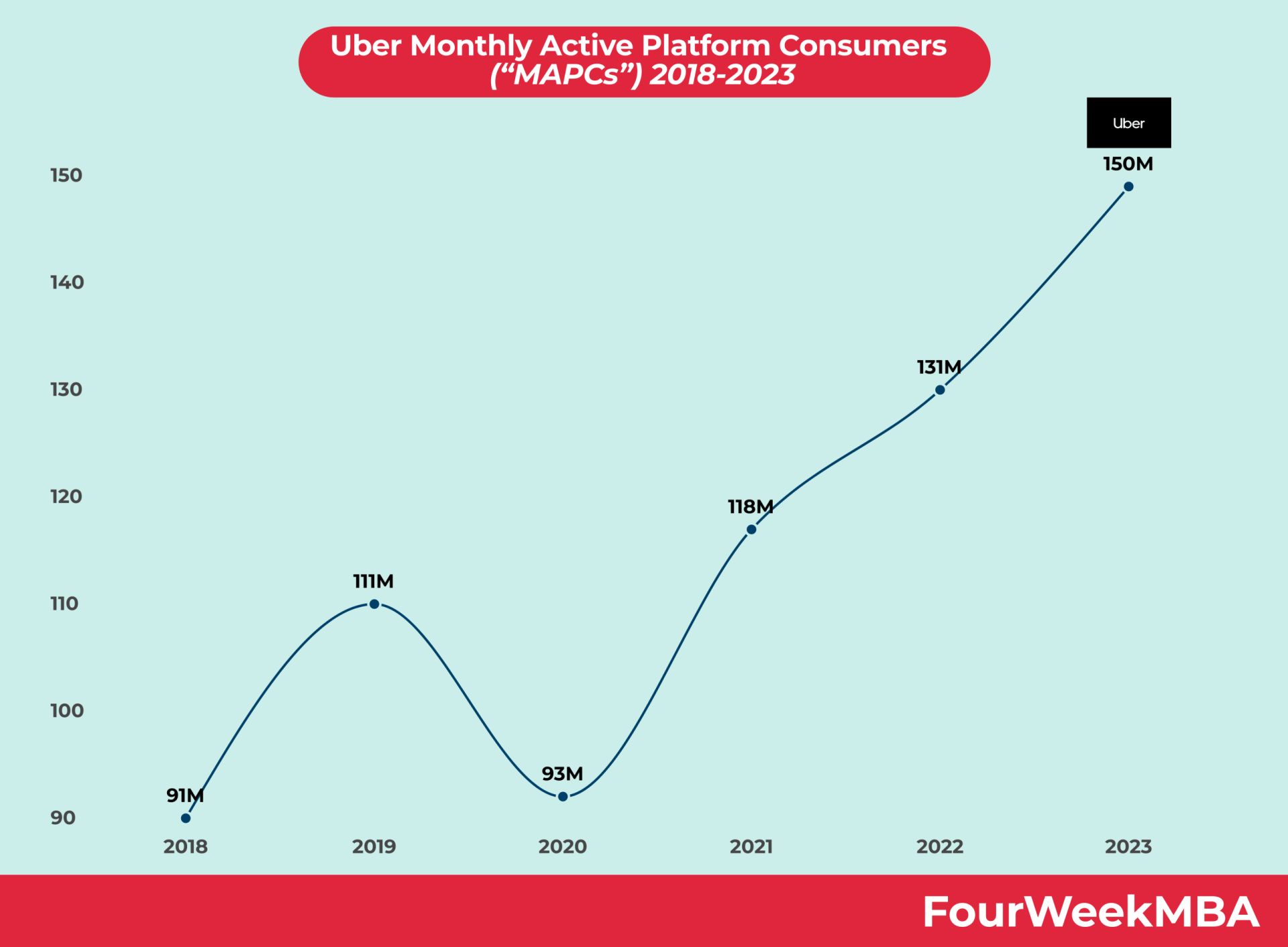
Uber had 150 million Monthly Active Platform Consumers in 2023. In 2022, Uber had 131 million Monthly Active Platform Consumers, compared to 118 million in 2021, and 93 million in 2020.
Uber Eats is a three-sided marketplace connecting a driver, a restaurant owner, and a customer with the Uber Eats platform at the center. The three-sided marketplace moves around three players: Restaurants pay commission on the orders to Uber Eats; Customers pay small delivery charges, and at times, cancellation fees; Drivers earn through making reliable deliveries on time.
In 2023 Uber Eats generated $12.2 billion in revenue, compared to nearly $11 billion in 2022, $8.3 billion in revenue in 2021, and $3.9 billion in revenue in 2020.
If we look at EBITDA, Uber Eats was a profitable segment, generating $1.5 billion in EBITDA in 2023. For the first time since its inception, Uber Eats’ EBITDA (Earnings Before Interest, Taxes, Depreciation, and Amortization) – which measures a company’s operational efficiency – turned positive for $551 million in 2022, compared to negative $348 million in 2021; negative $870 million in negative EBIDTA in 2020; and over $1.3 billion negative EBIDTA in 2019.
Uber Freight is a platform that connects carriers with shippers, which generated $5.24 billion in revenue in 2023, slowing down from $6.95 billion in revenue in 2022, and it’s now one of the three core segments (Mobility, Delivery, and Freight) within the Uber Business Model.
In 2023, Uber generated nearly $20 billion from its core platform (mobility), followed by delivery (Uber Eats) with $12.2 billion and freight, with $5.24 billion in revenue.
In 2022 Uber launched its advertising segment, which comprises revenue from sponsored listing fees paid by merchants and brands in exchange for advertising on the platform. By the end of the year, Uber advertising had generated $500 million in revenue from 315K merchants. By 2023, the advertising business of Uber generated a billion dollars in revenue!
Uber and Lyft are both mobility ride-sharing apps. Uber generated $37.28 billion in revenue in 2023, compared with Lyft, which generated $4.4B billion in the same year. A key difference is that while Lyft has primarily stayed in the mobility industry, Uber’s business model today spans various categories beyond mobility, such as delivery (Uber Eats) and freight.
In the food delivery business model companies leverage technology to build platforms that enable users to have the food delivered at home. This business model usually is set up as a platform and multi-sided marketplace, where the food delivery company makes money by charging commissions to the restaurant and to the customer.
DoorDash is a platform business model that enables restaurants to set up no-cost delivery operations. At the same time, customers get their food at home, and dashers (delivery people) earn some extra money. DoorDash makes money by markup prices through delivery fees, memberships, and advertising for restaurants on the marketplace.
Glovo is a Spanish on-demand courier service that purchases and delivers products ordered through a mobile app. Founded in 2015 by Oscar Pierre and Sacha Michaud as a way to “uberize” local services. Glovo makes money via delivery fees, mini-supermarkets (fulfillment centers that Glovo operates in partnership with grocery store chains), and dark kitchens (enabling restaurants to increase their capacity).
Instacart’s business model relies on enabling an easy set up for grocery stores, the comfort for customers to get their shopping delivered at home, and an additional income stream for personal shoppers. Instacart makes money by charging service fees, via memberships, and by running performance advertising on its platform.
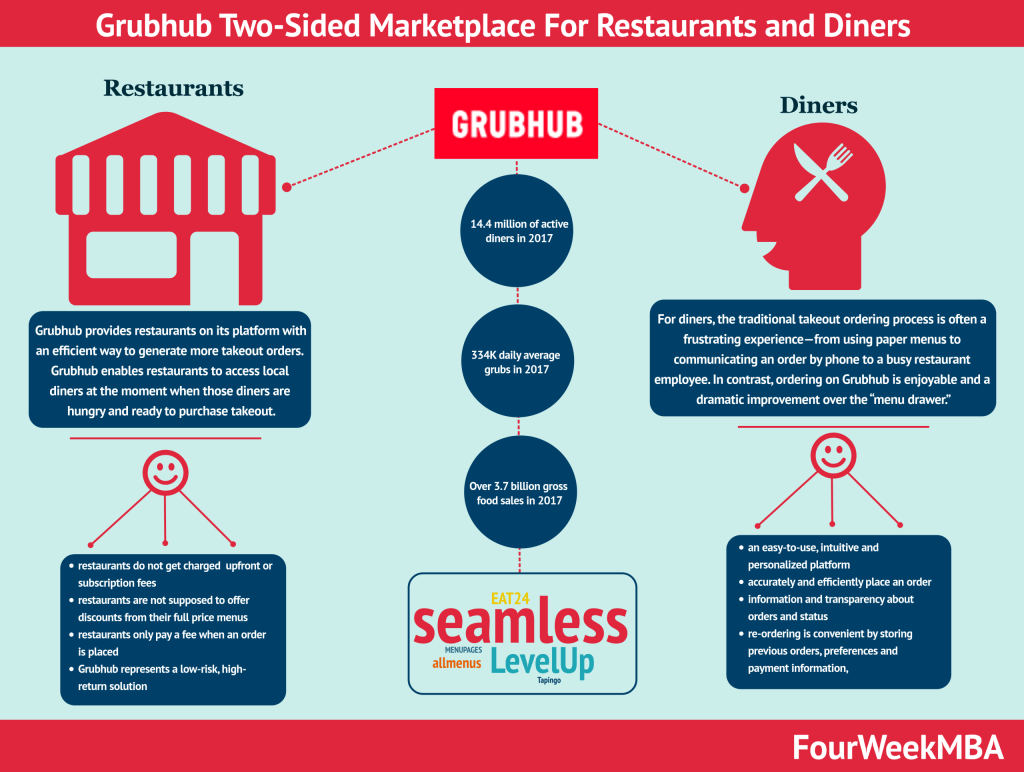
Grubhub is an online and mobile platform for restaurant pick-up and delivery orders. In 2018 the company connected 95,000 takeout restaurants in over 1,700 U.S. cities and London. The Grubhub portfolio of brands like Seamless, LevelUp, Eat24, AllMenus, MenuPages, andTapingo. The company makes money primarily by charging restaurants a pre-order commission and it generates revenues when diners place an order on its platform. Also, it charges restaurants that use Grubhub delivery services and when diners pay for those services.
Shipt is a North American integrated delivery service for groceries, home products, and electronics initially funded by Bill Smith, a highly experienced entrepreneur with a history of creating successful start-ups; in 2014, Smith used $3 million of his own money to create the first iteration of Shipt, the company was acquired by Target in 2017 in a cash deal worth $550 million. Membership fees predominantly drive Shipt revenue generation.
OpenAI is an artificial intelligence research laboratory that transitioned into a for-profit organization in 2019, which comprised an entity called OpenAI LP and the non-profit parent foundation OpenAI. The lab, which was founded in 2015 by Elon Musk, Sam Altman, and various others, has a core focus on the development of friendly AI that benefits society as a whole. Yet now has primarily evolved as a capped-for-profit entity with an exclusive commercial license to Microsoft.
Its co-founders primarily own Airbnb: Brian Chesky, with 76,407,686 Class B shares, which gives him 29.1% of ownership; Nathan Blecharczyk, with 232,306 Class A and 64,646,713 Class B, which give him 25.3%; and Joe Gebbia, which has 5,113,865 Class A and 58,023,452 Class B, which give him 22.9% ownership.
Google is primarily owned by its founders, Larry Page and Sergey Brin, who have more than 51% voting power. Other individual shareholders comprise John Doerr (1.5%), a venture capitalist and early investor in Google, and CEO, Sundar Pichai. Former Google CEO Eric Schmidt has 4.2% voting power. The most prominent institutional shareholders are mutual funds BlackRock and The Vanguard Group, with 2.7% and 3.1%, respectively.
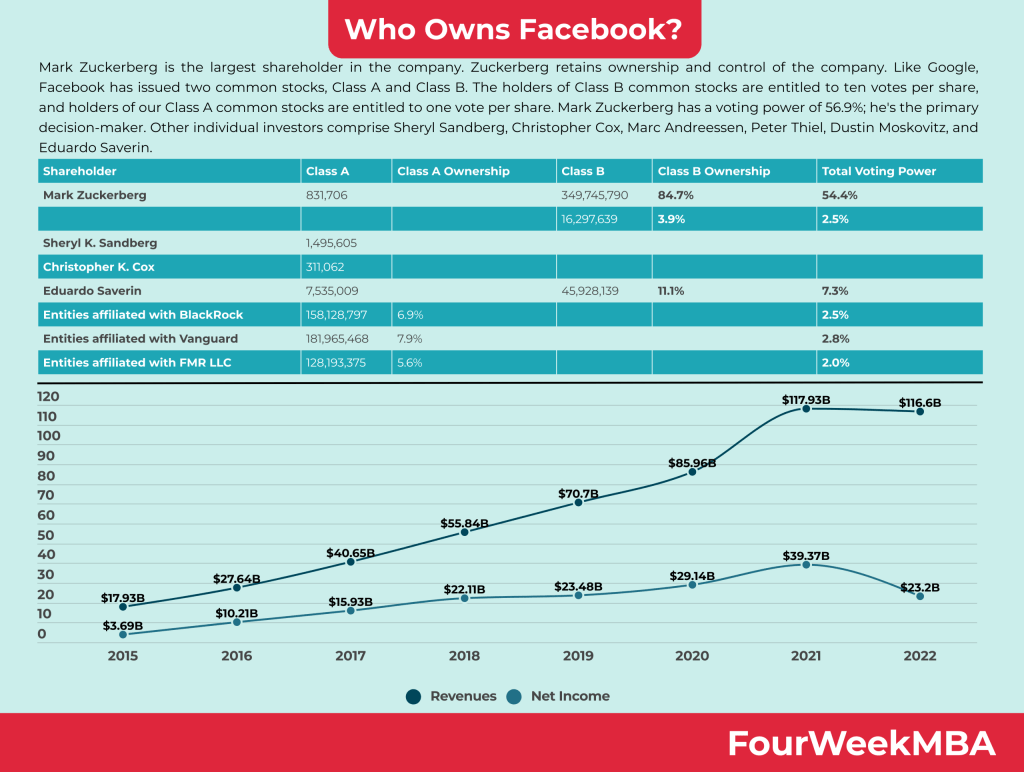
Mark Zuckerberg is the largest shareholder in the company. Zuckerberg retains ownership and control of the company. Like Google, Facebook has issued two common stocks, Class A and Class B. The holders of Class B common stocks are entitled to ten votes per share, and holders of our Class A common stocks are entitled to one vote per share. Mark Zuckerberg has a voting power of 56.9%; he’s the primary decision-maker. Other individual investors comprise Sheryl Sandberg, Christopher Cox, Marc Andreessen, Peter Thiel, Dustin Moskovitz, and Eduardo Saverin.
As of 2023, major Apple shareholders comprised Warren Buffet’s Berkshire Hathaway with 5.73% of the company’s stock (valued at over $130 billion). Followed by other individual shareholders like Tim Cook, CEO of Apple, with about 3.3 million shares, Artur Levinson, chairman of Apple, with over 4.5 million shares, and others.
With 64,588,418 shares, Jeff Bezos is the major individual investor. Owning 12.7% of the company. Other top individual investors comprise Amazon’s CEO Andy Jessy, with 94,729 shares. Top institutional investors include mutual funds like The Vanguard Group (6.6% ownership) and BlackRock (5.7% ownership).
Major shareholders comprise co-founder Bill Gates, who stepped down from the company’s board in 2020, which is why these shares are no longer publicly reported. In 2019, Gates still owned a stake of 103 million stocks, which accounted for 1.34% of the company’s ownership (worth over $23 billion in January 2023). Other individual shareholders comprise Satya Nadella, the company’s CEO, Brad Smith (former president), Jean-Philippe Courtois (EVP), and Amy Hood (former CFO).
By 2022, most of Tesla’s shares are still owned by Elon Musk, among the company’s co-founders and the CEO. Elon Musk is the top individual investor, with a 23.5% stake in the company, equivalent to over 244 million shares. Musk is followed by Lawrence Ellison (founder of Oracle), with a 1.5% company stake. Ellison also sits on Tesla’s board. And Antonio Gracias, among the company’s first investors, has over 1.6 million shares. Other institutional investors and mutual funds like The Vanguard Group (6%), Blackrock (5.1%), and Capital Ventures International also have a good chunk of the company’s stocks.
PayPal was first founded in 1998; it was called Confinity (among its founders was Peter Thiel); later, it merged with X.com, its major competitor, founded by Elon Musk (which would become known for other companies like Tesla and SpaceX). From this merger, PayPal was born. In 2002, PayPal was bought by eBay for $1.5 billion. eBay spun off PayPal in 2015, which would be listed as an independent entity. Today PayPal owns brands like Braintree, Venmo, Xoom, and iZettle.
Netflix’s largest individual shareholder is Reed Hastings, co-founder, and former CEO of the company, now Chairperson of Netflix, with a 1.7% stake, valued at over $2.4 billion in February 2023. Other significant individual shareholders comprise Jay C. Hoag, the company’s directors since 1999, and Ted Sarandos, former chief content officer and now Chief Executive Officer of Netflix. Major institutional shareholders comprise The Vanguard Group (7.55% ownership), BlackRock (6.58% ownership), and Capital Research Global Investments (5.84% ownership).
TikTok is owned by ByteDance, a Chinese internet technology company owning several content platforms worldwide (Douyin, Toutiao, Xigua Video, Helo, Lark, Babe). Bytedance passed the $300 billion private market valuation by 2022, making around $58 billion in revenue in 2022, over $4 billion from TikTok.
Acquired by Google, in 2006, for $1.65 billion, YouTube is now worth many times over. In 2022, YouTube generated over $29 billion in revenue from advertising alone. YouTube is part of Google (now named Alphabet), and as such, it is owned by main Google’s Alphabet shareholders and is one of the fastest-growing segments for the company.
As of April 25th, 2022, Elon Musk tried to take over Twitter. Musk tried to purchase the company at $54.20 per share, or about $44 billion. The deal finally closed by October 27th, 2022, and Elon Musk became the largest shareholder.
The multi-billion music streaming company Spotify is primarily owned by its founders, Daniel Ek and Martin Lorentzon. As of 2023, Daniel Ek has 16.5% ownership of ordinary shares and 31.7% of the voting power. Martin Lorentzon has 10.9% of ordinary shares and 42.6% of the voting power. Another key shareholder is Baillie Gifford & Co, a Scottish-based money management firm, followed by Morgan Stanley, T. Rowe Price, and Tencent.
The top individual shareholder of NVIDIA is Jen-Hsun Huang, founder, and CEO of the company, with 87,521,722 shares giving him 3.50% ownership. Followed by Mark A. Stevens, venture capitalist and a partner at S-Cubed Capital, who was part of the NVIDIA board in 2008 and previously served as a director from 1993 to 2006, with 6,258,803 shares. Institutional investors comprise The Vanguard Group, Inc, with 196,015,550, owning 7.83%. BlackRock, Inc., with 177,858,484, owns 7.10%. And FMR LLC (Fidelity Institutional Asset Management) with 158,039,922, owning 6.31%.
Uber’s principal individual shareholders comprise Yasir Al-Rumayyan (3.73%), the Governor of the Public Investment Fund, the sovereign wealth fund of the Kingdom of Saudi Arabia, and Dara Khosrowshahi, the founder and CEO of Uber. There is Morgan Stanley, with 5.12% ownership among the top institutional investors.
The founder and CEO of Shopify, Tobias Lütke, owned or controlled 7,891,852 Class B multiple voting shares and 5,250 Class A subordinate voting shares, representing approximately 33.8% of the aggregate voting power attached to all of the Company’s outstanding voting shares. Another key stakeholder is John H. Phillips, an angel investor who placed an early bet on Shopify.
Roblox is owned by David Baszucki and Gregory Baszucki, with a 2.3% and 2.6% stake, respectively. Anthony lee, managing partner at Altos Ventures, with a 15.3% stake.
In 2014, Twitch was bought by Amazon for $970 million. Therefore Twitch is part of Amazon, comprising other subsidiaries bought over the years, like Audible, Whole Foods, and Zappos (in total, Amazon has 12 subsidiaries). Therefore, as of 2020, Twitch is a multi-billion dollar company, making money primarily via advertising through its video streaming platform (creators use Twitch today across many other verticals).
Zoom’s principal private shareholders comprise Eric S. Yuan, a Chinese-American billionaire businessman that founded Zoom. Dan Scheinman, board member and angel investor in Zoom since the start, and Santiago Subotovsky, also an early investor in Zoom. Zoom follows a freeterprise business model where free accounts are channeled into enterprise customers.
In one of the largest deals in the business world, Microsoft acquired Activision Blizzard in a $68.7 billion transaction. Making Microsoft the world’s third-largest gaming company by revenue, behind Tencent and Sony. However, given the size of the deal, this is still under the scrutiny of regulators who need to approve it. If the deal goes through, Microsoft will become among the largest gaming companies in the world.
Pixar is owned by The Walt Disney Company, which acquired it in 2006 in a $7.4 billion deal. Today Pixar is part of the Disney Empire. The principal shareholders of Disney comprise Robert Iger, CEO of the company, and institutional investors like The Vanguard Group and Blackrock.
Marc Benioff, Co-CEO of Salesforce, is the primary individual shareholder, with 3% of the company’s stock. Other main individual shareholders comprise Parker Harris, Co-Founder and Chief Technology Officer, and Bret Taylor, former co-CEO. Major institutional shareholders include The Vanguard Group, Fidelity, and BlackRock.
In a $27.7 billion deal in 2021, Salesforce’s finalized the acquisition of Slack, which was integrated into Salesforce. Today Slack is still a product mostly independently managed by Salesforce, which incorporated some of its features within its platform. Entrepreneur Marc Benioff primarily owns salesforce.
Evan Spiegel and Robert Cornelius Murphy are the co-founders and, respectively, CEO and CTO of Snapchat. Evan Spiegel owns 3% of Class A stocks, 25.7% of Class B stocks, and 53.4% of Class C stocks for a 53.2% voting power, whereas Robert Murphy owns 6% of Class A stocks, 25.7% of Class B stocks, and 46.6% of Class C stocks for a 46.6% voting power. Snapchat runs an advertising-based business model.
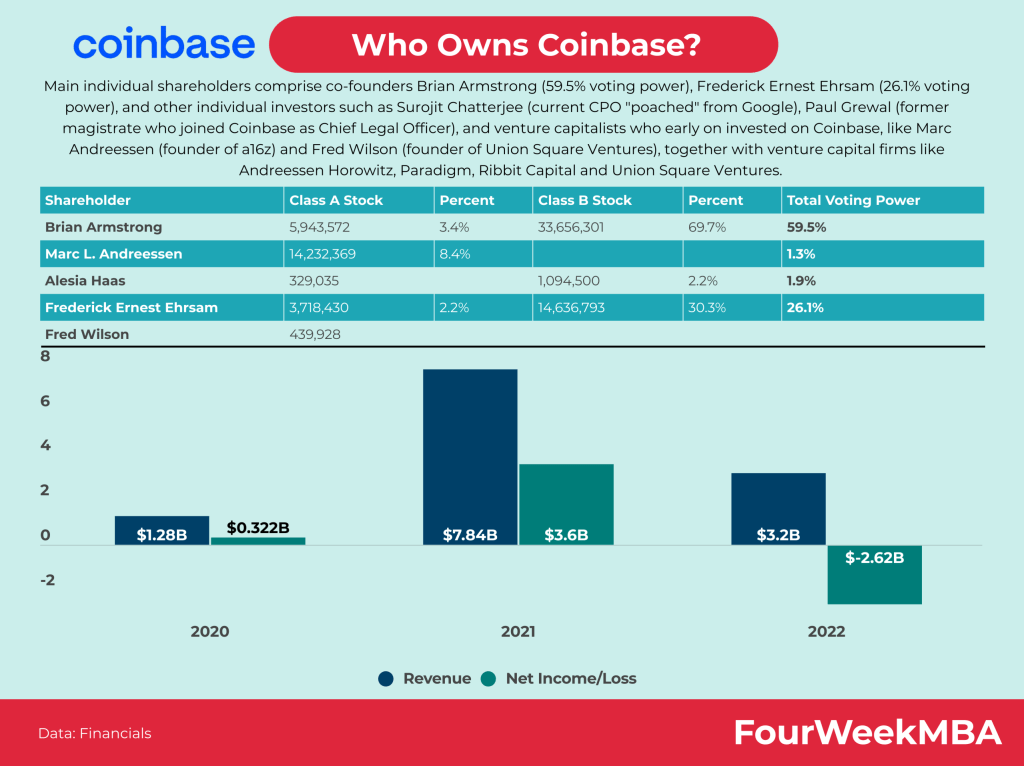
Main individual shareholders comprise co-founders Brian Armstrong (59.5% voting power), Frederick Ernest Ehrsam (26.1% voting power), and other individual investors such as Surojit Chatterjee (current CPO “poached” from Google), Paul Grewal (former magistrate who joined Coinbase as Chief Legal Officer), and venture capitalists who early on invested on Coinbase, like Marc Andreessen (founder of a16z) and Fred Wilson (founder of Union Square Ventures), together with venture capital firms like Andreessen Horowitz, Paradigm, Ribbit Capital and Union Square Ventures.
Gennaro is the creator of FourWeekMBA, which reached about four million business people, comprising C-level executives, investors, analysts, product managers, and aspiring digital entrepreneurs in 2022 alone | He is also Director of Sales for a high-tech scaleup in the AI Industry | In 2012, Gennaro earned an International MBA with emphasis on Corporate Finance and Business Strategy.