Affirm is led and largely controlled by founder and CEO Max Levchin, a PayPal co-founder, who holds 44.41% of the voting power. Shopify is the second-largest voter with 18.05%, according to Affirm’s 2025 proxy statement.
Update (11 Oct 2026): the ownership figures at the top of this page now come from Affirm’s 2025 proxy statement. The original article below is kept as it was; where its older figures differ, the dated filing figures above apply.
How we source: figures on this page come from the company’s own filings (SEC 10-K, 10-Q, prospectus and earnings releases, or its annual report), with the period stated next to each number; outside estimates appear only labelled, with their source and date. Last refreshed October 2026. Our methodology.
Affirm’s 2025 proxy statement shows Max Levchin with 26,485,472 Class B shares (65.04% of the class) and 3,401,962 Class A shares, for 44.41% of total voting power. Shopify holds 10,148,797 Class B shares (24.92% of the class, 18.05% of votes), received as part of their commercial partnership. Large Class A holders include Morgan Stanley (7.66%), Capital Research Global Investors (7.02%), Vanguard (6.76%) and Capital World Investors (6.33%).
The Business Engineer view
Affirm’s cap table mirrors its strategy: a founder with near-control and a major merchant platform, Shopify, as a top shareholder. That alignment with its biggest distribution partner is as important as the voting math.
The main shareholder is Max Levchin, founder and CEO of Affirm, which with over 44% of Class B shares has also over 35% in voting power, giving him tight control over the company. Institutional investors comprise Baillie Gifford & C, Capital Research Global Investor, Khosla Ventures, GIC Private Limited, Morgan Stanley, Shopify, and The Vanguard Group.
Detail
Description
Company
Affirm Holdings, Inc.
Ownership Structure
Publicly traded company with major shareholders
Major Shareholders
Institutional investors like BlackRock, Vanguard Group, Fidelity Investments, and individual shareholders
Founding Date
2012
Founders
Max Levchin, Nathan Gettings, Jeffrey Kaditz, and Alex Rampell
Headquarters
San Francisco, California, USA
Primary Business
Providing financial technology services, specifically “buy now, pay later” solutions for consumers and merchants
Strategic Goals
Expanding merchant partnerships, enhancing product offerings, integrating AI for risk management, and growing international market presence
Additional Ownership Details
Corporate Structure and Ownership: Affirm Holdings, Inc. is publicly traded on the NASDAQ under the ticker symbol AFRM. The company went public in January 2021. Major institutional investors, including BlackRock, Vanguard Group, and Fidelity Investments, hold significant stakes in Affirm, offering financial support and strategic guidance.
Corporate Strategy and Business Model: Affirm’s business model focuses on providing “buy now, pay later” (BNPL) solutions that allow consumers to make purchases and pay for them over time with transparent, simple terms. Affirm partners with merchants to offer flexible payment options at the point of sale, which helps increase conversion rates and average order values. The company generates revenue through merchant fees and interest payments on installment loans.
Product Innovation and Technology: Affirm invests heavily in technology to enhance its product offerings and improve user experience. The company utilizes advanced data analytics and machine learning algorithms to assess creditworthiness, manage risk, and personalize lending terms. Affirm is committed to innovation by offering new features like a savings account and virtual cards for seamless payments.
Market Expansion and Growth: Affirm aims to expand its market presence by forming partnerships with more merchants across various sectors, including retail, travel, and services. The company is actively pursuing international expansion to tap into growing demand for BNPL solutions in markets outside the United States. Affirm’s strategic focus includes adapting its products to meet the regulatory and consumer preferences in new regions.
Customer-Centric Approach: Affirm prioritizes transparency and fairness in its lending practices, offering customers clear and upfront terms without hidden fees or penalties. The company’s focus on building trust and providing financial flexibility resonates with consumers who seek alternatives to traditional credit cards.
Sustainability and Social Responsibility: Affirm is committed to ethical practices and social responsibility, emphasizing responsible lending and financial inclusion. The company supports initiatives that promote financial literacy and empower consumers to make informed financial decisions.
Acorns is a fintech platform providing services related to Robo-investing and micro-investing. The company makes money primarily through three subscription tiers: Lite – ($1/month), which gives users access to Acorns Invest, Personal ($3/month) that includes Invest plus the Later (retirement) and Spend (personal checking account) suite of products, Family ($5/month) with features from both the Lite and Personal plans with the addition of Early.
Started as a pay-later solution integrated to merchants’ checkouts, Affirm makes money from merchants’ fees as consumers pick up the pay-later solution. Affirm also makes money through interests earned from the consumer loans, when those are repurchased from the originating bank. In 2020 Affirm made 50% of its revenues from merchants’ fees, about 37% from interests, and the remaining from virtual cards and servicing fees.
Alipay is a Chinese mobile and online payment platform created in 2004 by entrepreneur Jack Ma as the payment arm of Taobao, a major Chinese eCommerce site. Alipay, therefore, is the B2C component of Alibaba Group. Alipay makes money via escrows transaction fees, a range of value-added ancillary services, and through its Credit Pay Instalment fees.
Betterment is an American financial advisory company founded in 2008 by MBA graduate Jon Stein and lawyer Eli Broverman. Betterment makes money via investment plans, financial advice packages, betterment for advisors, betterment for business, cash reserve, and checking accounts.
Braintree
Venmo is a peer-to-peer payments app enabling users to share and make payments with friends for a variety of services. The service is free, but a 3% fee applies to credit cards. Venmo also launched a debit card in partnership with Mastercard. Venmo got acquired in 2012 by Braintree, and Braintree got acquired in 2013 by PayPal.
Chime is an American neobank (internet-only bank) company, providing fee-free financial services through its mobile banking app, thus providing personal finance services free of charge while making the majority of its money via interchange fees (paid by merchants when consumers use their debit cards) and ATM fees.
Coinbase is among the most popular platforms for trading and storing crypto-assets, whose mission is “to create an open financial system for the world” by enabling customers to trade cryptocurrencies. Its platform serves both as a search and discovery engine for crypto assets. The company makes money primarily through fees earned for the transactions processed through the platform, custodial services offered, interest, and subscriptions.
Compass is a licensed American real-estate broker incorporating online real estate technology as a marketing medium. The company makes money via sales commissions (collected whenever a sale is facilitated or tenants are found for a rental property) and bridge loans (a service allowing the seller to purchase a home before the revenue from the sale of their previous home is available).
Dosh is a Fintech platform that enables automatic cash backs for consumers. Its business model connects major card providers with online and offline local businesses to develop automatic cash back programs. The company makes money by earning an affiliate commission on each eligible sale from consumers.
E-Trade is a trading platform, allowing investors to trade common and preferred stocks, exchange-traded funds (ETFs), options, bonds, mutual funds, and futures contracts, acquired by Morgan Stanley in 2020 for $13 billion. E-Trade makes money through interest income, order flow, margin interests, options, future and bonds trading, and through other fees and service charges.
Klarna is a financial technology company allowing consumers to shop with a temporary Visa card. Thus it then performs a soft credit check and pays the merchant. Klarna makes money by charging merchants. Klarna also earns a percentage of interchange fees as a commission and for interests earned on customers’ accounts.
Lemonade is an insurance tech company using behavioral economics and artificial intelligence to process claims efficiently. The company leverages technology to streamline onboarding customers while also applying a financialmodel to reduce conflicts of interest with customers (perhaps by donating the variable premiums to charity). The company makes money by selling its core insurance products, and via its tech platform, it tries to enhance its sales.
Monzo is an English neobank offering a mobile app and a prepaid debit card for consumers and businesses. It was one of the first app-based banks to enter the UK market, founded by Gary Dolman, Jason Bates, Jonas Huckestein, Paul Rippon, and Tom Blomfield in 2015. All were employees of Starling Bank, a similar neobank challenging the dominance of established financial institutions in England. The company enjoys many revenue streams: business and consumer subscriptions, interchange and overdraft fees, personal loans, and more.
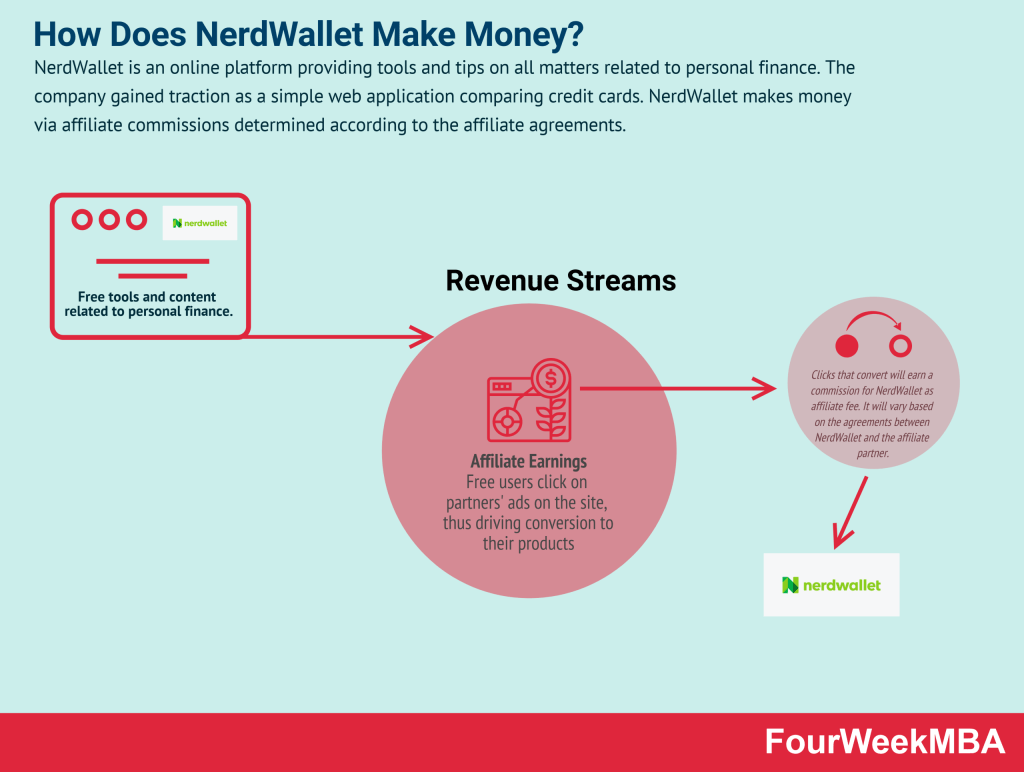
NerdWallet is an online platform providing tools and tips on all matters related to personal finance. The company gained traction as a simple web application comparing credit cards. NerdWallet makes money via affiliate commissions determined according to the affiliate agreements.
Quadpay was an American fintech company founded by Adam Ezra and Brad Lindenberg in 2017. Ezra and Lindenberg witnessed the rising popularity of buy-now-pay-later service Afterpay in Australia and similar service Klarna in Europe. Quadpay collects a range of fees from both the merchant and the consumer via merchandise fees, convenience fees, late payment, and interchange fees.
Revolut an English fintech company offering banking and investment services to consumers. Founded in 2015 by Nikolay Storonsky and Vlad Yatsenko, the company initially produced a low-rate travel card. Storonsky in particular was an avid traveler who became tired of spending hundreds of pounds on currency exchange and foreign transaction fees. The Revolut app and core banking account are free to use. Instead, money is made through a combination of subscription fees, transaction fees, perks, and ancillary services.
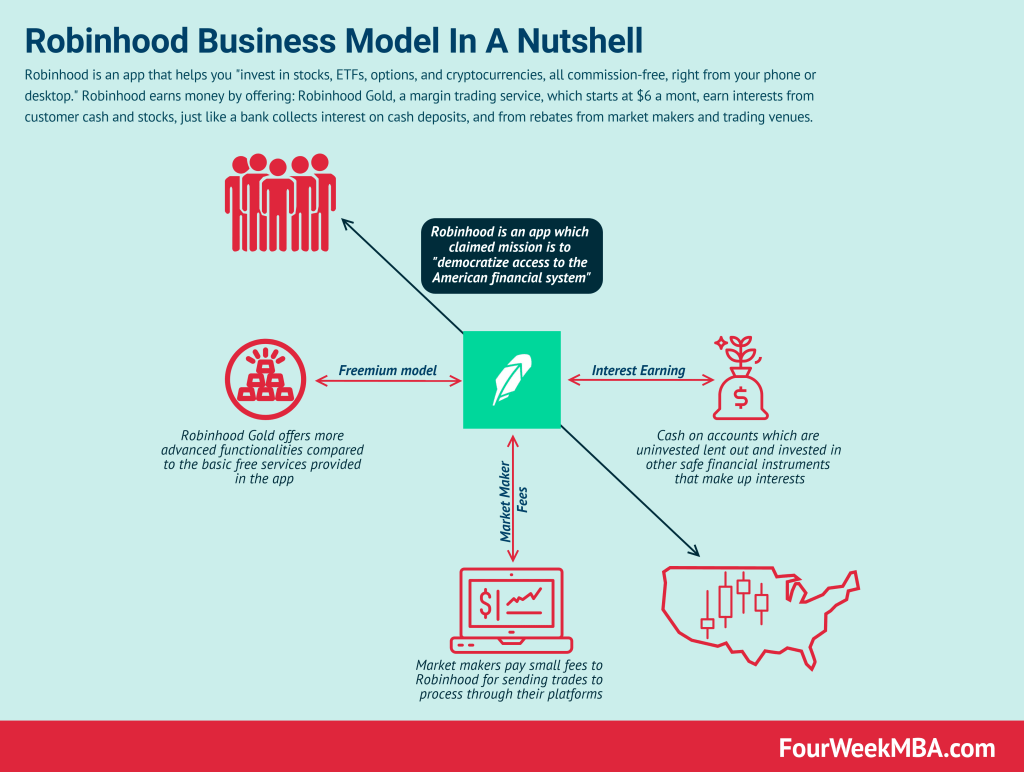
Robinhood is an app that helps to invest in stocks, ETFs, options, and cryptocurrencies, all commission-free. Robinhood earns money by offering: Robinhood Gold, a margin trading service, which starts at $6 a month, earn interests from customer cash and stocks, and rebates from market makers and trading venues.
SoFi is an online lending platform that provides affordable education loans to students, and it expanded into financial services, including loans, credit cards, investment services, and insurance. It makes money primarily via payment processing fees and loan securitization.
Squarespace is a North American hosting and website building company. Founded in 2004 by college student Anthony Casalena as a blog hosting service, it grew to become among the most successful website building companies. The company mostly makes money via its subscription plans. It also makes money via customizations on top of its subscription plans. And in part also as transaction fees for the website where it processes the sales.
Stash is a FinTech platform offering a suite of financial tools for young investors, coupled with personalized investment advice and life insurance. The company primarily makes money via subscriptions, cashback, payment for order flows, and interest for cash sitting on members’ accounts.
Venmo is a peer-to-peer payments app enabling users to share and make payments with friends for a variety of services. The service is free, but a 3% fee applies to credit cards. Venmo also launched a debit card in partnership with Mastercard. Venmo got acquired in 2012 by Braintree, and Braintree got acquired in 2013 by PayPal.
Wealthfront is an automated Fintech investment platform providing investment, retirement, and cashmanagement products to retail investors, mostly making money on the annual 0.25% advisory fee the company charges for assets under management. It also makes money via a line of credits and interests on the cash accounts.
Zelle is a peer-to-peer payment network that indirectly benefits the banks’ consortium that backs it. Zelle also enables users to pay businesses for goods and services, free for users. Merchants pay a 1% fee to Visa or Mastercard, who share it with the bank that issued the card.
Gennaro Cuofano is a CRO and tech executive who has worked in AI since late 2015, starting with bringing NLP, natural-language generation, voice and chatbot products to the marketing industry. His background is in law and finance: he holds a Master's degree in Law and an International MBA with an emphasis on corporate finance (LUISS Business School and the University of San Diego, 2012), and worked as a financial analyst at a real-estate investment firm in San Diego and as an assistant controller. His work focuses on business model strategy, business engineering and, more broadly, structural analysis: how companies make money, read from their own filings. He created FourWeekMBA and leads research there and at The Business Engineer, his newsletter on AI and business strategy, with over 95,000 subscribers and more than 1,000 published analyses. His writing has also appeared on Entrepreneur (for example, How to Digitize a Family Business in Europe) and HackerNoon. Find him on LinkedIn and Substack. See how we source.