Zip is an Australian fintech company founded in 2013 by Larry Diamond and Peter Gray.
The year prior, former investment banker Diamond had been pitching to investors a new idea that would change the face of consumer finance.
Diamond wanted to leverage technology to provide a quick and easy interest-free line of credit to consumers, but his pitches always fell flat because he lacked experience.
To help him refine his business case, Diamond hired credit specialist Peter Gray. For the next six months, the pair met in the bar of a Sydney hotel to create a businessplan.
The company, then known as ZipMoney Limited, was incorporated in June 2013 with the financial backing of friends and family. During this time, Diamond and Gray worked hard to convince retailers to join their platform.
After launching to the public around six months later, Zip debuted on the ASX via a reverse takeover.
This strategy was considered more preferable since venture capital funding in Australia is more difficult to secure than in other parts of the world.
Over the next few years, Zip successfully raised capital from an American asset manager and two Australian banks.
In May 2019, Zip became a $1 billion company and in the process, one of Australia’s most valuable fintech companies.
Aggressive growth and expansion have occurred since, with the company acquiring rival service Quadpay and entering the lucrative U.S. market soon after.
Zip generates revenue primarily through its core business model of providing buy now, pay later (BNPL) services to consumers. BNPL allows customers to make purchases from partnered retailers and pay for them in multiple installments over time, often interest-free or with minimal fees. Zip earns money by charging fees to both customers and merchants for facilitating these transactions.
Merchant Fees
One of Zip’s primary sources of revenue is merchant fees. When consumers use Zip’s BNPL services to make purchases from partner retailers, the merchants pay a fee to Zip. This fee is usually a percentage of the transaction value. Merchants find value in offering BNPL options to customers as it can increase sales and customer loyalty.
Late Fees and Interest Charges
While Zip offers interest-free payment options, it also provides longer-term payment plans that may carry interest charges. Customers who choose these plans may incur interest fees if they don’t pay off their balances within the specified interest-free period. Zip generates revenue from these interest charges, particularly when customers carry balances forward. Additionally, Zip may charge late fees to customers who miss payment deadlines.
Monthly Account Fees
Zip may charge customers monthly account fees for access to certain premium features or benefits. These fees can provide a steady source of income for the company, especially from customers who choose to subscribe to premium services.
Transaction Processing Fees
Zip may earn money from transaction processing fees. This can include fees for processing credit and debit card transactions, bank transfers, and other payment methods used by customers to repay their BNPL purchases.
Cross-Selling and Upselling
To diversify its revenue streams, Zip may engage in cross-selling and upselling. This involves offering customers additional financial products and services, such as personal loans, insurance, or budgeting tools. The company may earn commissions or fees when customers opt for these supplementary offerings.
Partnership and Data Insights
Zip may enter into partnerships with various companies to expand its reach and offer its BNPL services to a broader customer base. These partnerships can involve revenue-sharing agreements, referral fees, or other financial arrangements. Additionally, Zip can derive value from data insights generated through customer transactions, allowing it to optimize its services and potentially monetize data through partnerships or analytics services.
International Expansion
As Zip expands its services to international markets, it may earn revenue by replicating its successful BNPL model in these regions. Revenue generation methods in international markets may be similar to those in its home market, including merchant fees, interest charges, and subscription fees.
As a fintech company, Zip makes money from merchant fees, loan interest, repayment fees, account establishment fees, and penalty fees.
Let’s take a look at each of these in more detail below.
Merchant service fees
Merchant service fees are charged on a per-transaction basis and represent the largest source of revenue for Zip.
When consumers purchase and select Zip as the payment option, merchants are charged $0.30 plus 5% of the total transaction.
Loan interest
Consumers who use Zip are charged interest for any purchases that remain outstanding after three months.
In Australia, for example, the monthly interest fee is $6.
Repayment fees
Repayment fees are also charged in the Zip Business Trade Plus service, which offers a buy-now-pay-later solution for businesses.
Each account has a repayment fee of 3% if the business chooses to pay its statement balance in installments.
Account establishment fees
Zip also charges an account establishment fee to new applicants. This fee covers the cost of performing a background credit check.
Penalty fees
In most cases, monthly repayments on purchases are direct-debited from a consumer’s bank account.
In markets such as the United Kingdom, however, customers are charged a £6 penalty (late) fee if they fail to make a payment before the specified date.
Key takeaways
Zip is an Australian fintech company founded in 2013 by Larry Diamond and Peter Gray. Diamond had an idea to revolutionize consumer finance by giving shoppers quick and convenient access to credit.
Zip makes the bulk of its revenue from merchant fees, which comprise a fixed amount plus a percentage of the total transaction. The company also charges interest on outstanding purchases and repayment fees as part of its business lending service.
Zip charges an account establishment fee to cover the cost of performing a creditworthiness check. In some markets, it also charges a late fee.
Acorns is a fintech platform providing services related to Robo-investing and micro-investing. The company makes money primarily through three subscription tiers: Lite – ($1/month), which gives users access to Acorns Invest, Personal ($3/month) that includes Invest plus the Later (retirement) and Spend (personal checking account) suite of products, Family ($5/month) with features from both the Lite and Personal plans with the addition of Early.
Started as a pay-later solution integrated to merchants’ checkouts, Affirm makes money from merchants’ fees as consumers pick up the pay-later solution. Affirm also makes money through interests earned from the consumer loans, when those are repurchased from the originating bank. In 2020 Affirm made 50% of its revenues from merchants’ fees, about 37% from interests, and the remaining from virtual cards and servicing fees.
Alipay is a Chinese mobile and online payment platform created in 2004 by entrepreneur Jack Ma as the payment arm of Taobao, a major Chinese eCommerce site. Alipay, therefore, is the B2C component of Alibaba Group. Alipay makes money via escrows transaction fees, a range of value-added ancillary services, and through its Credit Pay Instalment fees.
Betterment is an American financial advisory company founded in 2008 by MBA graduate Jon Stein and lawyer Eli Broverman. Betterment makes money via investment plans, financial advice packages, betterment for advisors, betterment for business, cash reserve, and checking accounts.
Braintree
Venmo is a peer-to-peer payments app enabling users to share and make payments with friends for a variety of services. The service is free, but a 3% fee applies to credit cards. Venmo also launched a debit card in partnership with Mastercard. Venmo got acquired in 2012 by Braintree, and Braintree got acquired in 2013 by PayPal.
Chime is an American neobank (internet-only bank) company, providing fee-free financial services through its mobile banking app, thus providing personal finance services free of charge while making the majority of its money via interchange fees (paid by merchants when consumers use their debit cards) and ATM fees.
Coinbase is among the most popular platforms for trading and storing crypto-assets, whose mission is “to create an open financial system for the world” by enabling customers to trade cryptocurrencies. Its platform serves both as a search and discovery engine for crypto assets. The company makes money primarily through fees earned for the transactions processed through the platform, custodial services offered, interest, and subscriptions.
Compass is a licensed American real-estate broker incorporating online real estate technology as a marketing medium. The company makes money via sales commissions (collected whenever a sale is facilitated or tenants are found for a rental property) and bridge loans (a service allowing the seller to purchase a home before the revenue from the sale of their previous home is available).
Dosh is a Fintech platform that enables automatic cash backs for consumers. Its business model connects major card providers with online and offline local businesses to develop automatic cash back programs. The company makes money by earning an affiliate commission on each eligible sale from consumers.
E-Trade is a trading platform, allowing investors to trade common and preferred stocks, exchange-traded funds (ETFs), options, bonds, mutual funds, and futures contracts, acquired by Morgan Stanley in 2020 for $13 billion. E-Trade makes money through interest income, order flow, margin interests, options, future and bonds trading, and through other fees and service charges.
Klarna is a financial technology company allowing consumers to shop with a temporary Visa card. Thus it then performs a soft credit check and pays the merchant. Klarna makes money by charging merchants. Klarna also earns a percentage of interchange fees as a commission and for interests earned on customers’ accounts.
Lemonade is an insurance tech company using behavioral economics and artificial intelligence to process claims efficiently. The company leverages technology to streamline onboarding customers while also applying a financialmodel to reduce conflicts of interest with customers (perhaps by donating the variable premiums to charity). The company makes money by selling its core insurance products, and via its tech platform, it tries to enhance its sales.
Monzo is an English neobank offering a mobile app and a prepaid debit card for consumers and businesses. It was one of the first app-based banks to enter the UK market, founded by Gary Dolman, Jason Bates, Jonas Huckestein, Paul Rippon, and Tom Blomfield in 2015. All were employees of Starling Bank, a similar neobank challenging the dominance of established financial institutions in England. The company enjoys many revenue streams: business and consumer subscriptions, interchange and overdraft fees, personal loans, and more.
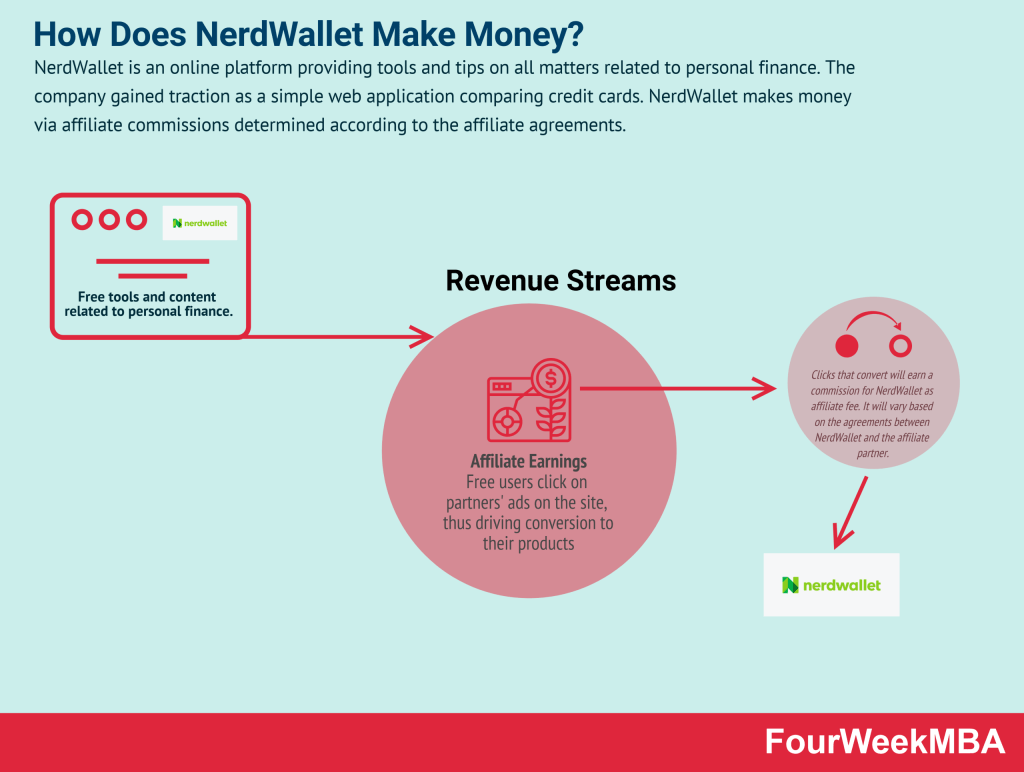
NerdWallet is an online platform providing tools and tips on all matters related to personal finance. The company gained traction as a simple web application comparing credit cards. NerdWallet makes money via affiliate commissions determined according to the affiliate agreements.
Quadpay was an American fintech company founded by Adam Ezra and Brad Lindenberg in 2017. Ezra and Lindenberg witnessed the rising popularity of buy-now-pay-later service Afterpay in Australia and similar service Klarna in Europe. Quadpay collects a range of fees from both the merchant and the consumer via merchandise fees, convenience fees, late payment, and interchange fees.
Revolut an English fintech company offering banking and investment services to consumers. Founded in 2015 by Nikolay Storonsky and Vlad Yatsenko, the company initially produced a low-rate travel card. Storonsky in particular was an avid traveler who became tired of spending hundreds of pounds on currency exchange and foreign transaction fees. The Revolut app and core banking account are free to use. Instead, money is made through a combination of subscription fees, transaction fees, perks, and ancillary services.
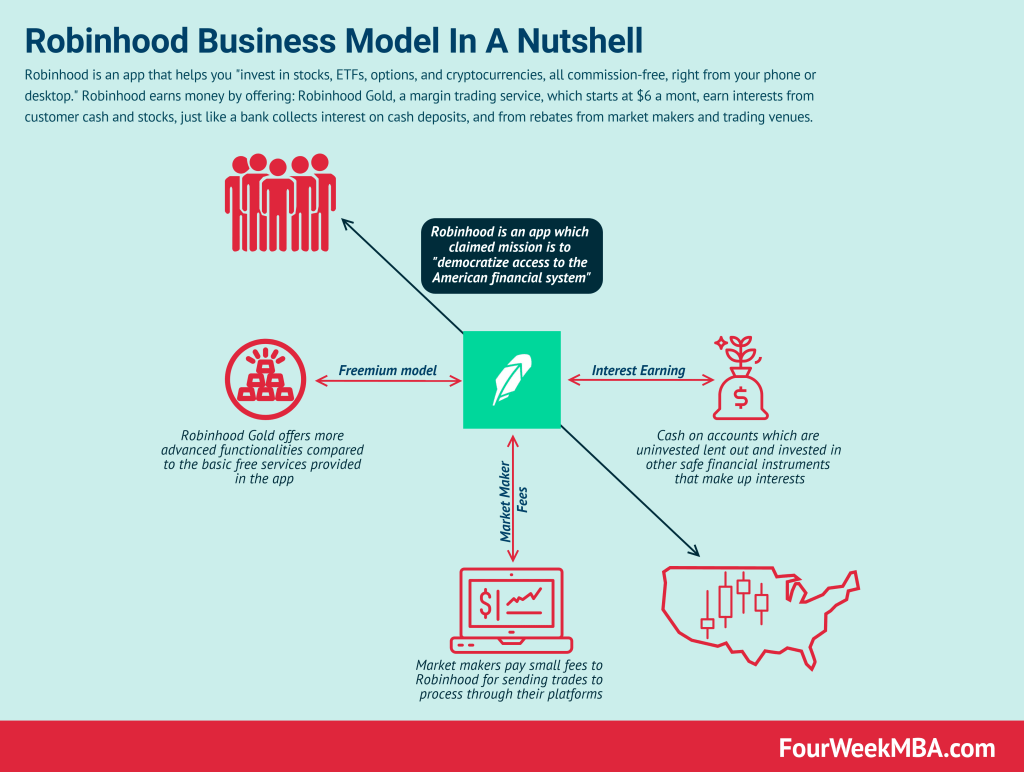
Robinhood is an app that helps to invest in stocks, ETFs, options, and cryptocurrencies, all commission-free. Robinhood earns money by offering: Robinhood Gold, a margin trading service, which starts at $6 a month, earn interests from customer cash and stocks, and rebates from market makers and trading venues.
SoFi is an online lending platform that provides affordable education loans to students, and it expanded into financial services, including loans, credit cards, investment services, and insurance. It makes money primarily via payment processing fees and loan securitization.
Squarespace is a North American hosting and website building company. Founded in 2004 by college student Anthony Casalena as a blog hosting service, it grew to become among the most successful website building companies. The company mostly makes money via its subscription plans. It also makes money via customizations on top of its subscription plans. And in part also as transaction fees for the website where it processes the sales.
Stash is a FinTech platform offering a suite of financial tools for young investors, coupled with personalized investment advice and life insurance. The company primarily makes money via subscriptions, cashback, payment for order flows, and interest for cash sitting on members’ accounts.
Venmo is a peer-to-peer payments app enabling users to share and make payments with friends for a variety of services. The service is free, but a 3% fee applies to credit cards. Venmo also launched a debit card in partnership with Mastercard. Venmo got acquired in 2012 by Braintree, and Braintree got acquired in 2013 by PayPal.
Wealthfront is an automated Fintech investment platform providing investment, retirement, and cashmanagement products to retail investors, mostly making money on the annual 0.25% advisory fee the company charges for assets under management. It also makes money via a line of credits and interests on the cash accounts.
Zelle is a peer-to-peer payment network that indirectly benefits the banks’ consortium that backs it. Zelle also enables users to pay businesses for goods and services, free for users. Merchants pay a 1% fee to Visa or Mastercard, who share it with the bank that issued the card.
Gennaro is the creator of FourWeekMBA, which reached about four million business people, comprising C-level executives, investors, analysts, product managers, and aspiring digital entrepreneurs in 2022 alone | He is also Director of Sales for a high-tech scaleup in the AI Industry | In 2012, Gennaro earned an International MBA with emphasis on Corporate Finance and Business Strategy.