Zelle is a peer-to-peer payment network that indirectly benefits the banks’ consortium that backs it. Zelle also enables users to pay businesses for goods and services, free for users. Merchants pay a 1% fee to Visa or Mastercard, who share it with the bank that issued the card.
Business Model Element
Analysis
Implications
Examples
Value Proposition
Zelle’s value proposition centers around convenient, real-time, and secure P2P payments. Key elements of its value proposition include: – Real-Time Transactions: Facilitates instant money transfers between users. – Simplicity and Ease of Use: Offers a straightforward and user-friendly platform. – Bank Integration: Enables seamless transactions through participating banks’ mobile apps and websites. – Security: Prioritizes the safety and security of user financial information. Zelle empowers users with a quick and hassle-free solution for sending and receiving money.
Offers a convenient and efficient platform for real-time P2P payments. Simplifies the payment process through user-friendly interfaces. Leverages bank partnerships to enhance accessibility and reach. Prioritizes the security and privacy of user financial data. Attracts users seeking an easy, secure, and rapid money transfer solution. Enhances user trust through bank integration.
– Real-time P2P transactions. – User-friendly platform. – Seamless transactions via bank partnerships. – Prioritizes security and privacy. – Appeals to users seeking easy and secure money transfers. – Builds trust through bank integration.
Customer Segments
Zelle serves various customer segments, including: 1. Individual Consumers: Individuals who use P2P payments for personal transactions. 2. Small Businesses: Small business owners and freelancers for business-related payments. 3. Banks and Financial Institutions: Partner banks and financial institutions offering Zelle to their customers. Zelle caters to both individual consumers and businesses, and its partnerships with banks expand its reach.
Focuses on individual consumers and small businesses seeking efficient P2P payment solutions. Collaborates with banks and financial institutions to reach a broader audience. Customizes features to meet the needs of different customer segments. Enhances accessibility and adoption through partnerships.
– Serving individual consumers and small businesses. – Collaborating with banks and financial institutions. – Customizing features for various customer needs. – Expanding reach and accessibility through partnerships.
Distribution Strategy
Zelle’s distribution strategy relies on partnerships with banks and financial institutions. Users can access Zelle through their participating bank’s mobile app or website. This strategy leverages the existing customer base and infrastructure of these institutions. Zelle also offers a standalone mobile app for users who do not have access through their bank.
Utilizes partnerships with banks and financial institutions to reach a wide audience. Provides users with access to Zelle through their trusted banking channels. Offers a standalone mobile app to cater to users without bank integration. Prioritizes ease of access and convenience for users. Leverages existing banking relationships and infrastructure.
– Partnerships with banks and financial institutions for access. – Integration within trusted banking channels. – Standalone mobile app for broader user reach. – Focus on ease of access and convenience. – Leveraging existing banking relationships and infrastructure.
Revenue Streams
Zelle generates revenue primarily through partnerships with participating banks. Its primary revenue stream includes transaction fees charged to banks for facilitating P2P transfers through the Zelle network. Banks may choose to pass these fees on to customers or offer Zelle as a value-added service. Zelle may also generate income through data analytics and insights derived from its transactions.
Relies on transaction fees charged to participating banks for facilitating P2P transfers. May indirectly generate income through fees passed on to customers by banks. Potential revenue stream from data analytics and insights. Focuses on providing value to partner banks and financial institutions.
– Revenue from transaction fees charged to banks. – Potential income from fees passed on to customers by banks. – Possibility of generating revenue from data analytics and insights. – Prioritizes providing value to partner banks and financial institutions.
Marketing Strategy
Zelle’s marketing strategy focuses on brand recognition through its partner banks and financial institutions. It promotes Zelle as a seamless and secure P2P payment solution through co-branded marketing campaigns and materials. Additionally, Zelle collaborates with its partner banks to educate customers about the platform’s features and benefits. The platform’s marketing efforts emphasize convenience and real-time transactions.
Relies on partner banks and financial institutions for co-branded marketing campaigns. Collaborates with partners to educate customers about Zelle’s features and advantages. Emphasizes convenience and real-time transactions in marketing messages. Prioritizes aligning marketing efforts with partner institutions.
– Co-branded marketing campaigns with partner banks. – Collaboration with partners for customer education. – Emphasis on convenience and real-time transactions in marketing. – Alignment of marketing efforts with partner institutions.
Organization Structure
Zelle operates as a financial technology company with a focus on P2P payments. Its organizational structure includes teams dedicated to technology development, partnerships, customer support, and security. Technology teams work on platform enhancements and security measures. Partnership teams collaborate with banks and financial institutions. Customer support ensures a positive user experience. Security teams focus on safeguarding financial data.
Employs specialized teams for technology development, partnerships, customer support, and security. Prioritizes platform enhancements and security measures. Collaborates closely with banks and financial institutions to expand the user base. Ensures a positive user experience through robust customer support. Upholds the security and privacy of financial data.
– Specialized teams for technology development and security. – Collaboration with banks and financial institutions for growth. – Robust customer support for a positive user experience. – Emphasis on security and privacy of financial data.
Competitive Advantage
Zelle’s competitive advantage lies in its real-time, bank-integrated P2P payment platform, simplicity, and security. Real-Time Transactions: Offers instant money transfers, setting it apart from slower alternatives. Bank Integration: Provides seamless transactions through trusted bank channels. Simplicity: Offers an intuitive and user-friendly platform for hassle-free payments. Security: Prioritizes the safety and security of financial data, building trust with users. Zelle stands out as a convenient, secure, and real-time P2P payment solution.
Derives a competitive advantage from: – Real-time P2P transactions for instant transfers. – Integration with trusted banks for seamless transactions. – User-friendly and intuitive platform for ease of use. – Prioritizing security and privacy to build user trust. Stands out as a convenient, secure, and real-time P2P payment solution.
– Real-time P2P transactions for instant transfers. – Integration with trusted banks for seamless transactions. – User-friendly and intuitive platform for ease of use. – Prioritizing security and privacy to build user trust. – Stands out as a convenient, secure, and real-time P2P payment solution.
Zelle’s instant payment service and mobile app was launched in June 2017 and accompanied by an announcement that clearXchange P2P services would be suspended by the end of the year.
While some governmental services would remain on the old platform, clearXchange users were encouraged to migrate to Zelle.
Rather than existing as a standalone app like competitor Venmo, Zelle was initially available within the mobile banking interfaces of participating institutions.
The app moves money from one bank account to another in a matter of minutes, with only the recipient’s email address and phone number required.
This made Zelle a more efficient option than a traditional bank transfer which can take several days and requires users to input bank account details.
For this reason, Zelle’s creators intended the service to be for quick, personal payments such as splitting the cost of a restaurant meal or collecting rent from roommates.
Like its predecessor in clearXchange, users are identified on the Zelle platform by a unique association between their bank account and phone number or email address.
Since these details are easier to remember than bank account numbers, funds will likely be sent to the intended recipient.
According to EWS, this represented a 49% increase in the number of payments from 2020.
Much of the increase was attributed to businesses such as property managers, health and beauty providers, and contractors, whose usage increased by 162% over the same period.
Universities, non-profits, and some Fortune 500 companies sent payments over Zelle as an alternative to writing checks.
While it was acknowledged that the market had seen tremendous growth because of COVID-19, the pace of Zelle’s growth had enabled it to become the largest P2P payment network in the USA by total payments value sent.
The platform’s dominance is more than twice the size of the nearest standalone competitor.
This growth has also been facilitated via several company initiatives:
Consumer education around the security risks associated with digital transactions.
Collaboration with the non-profit Cybercrime Support Network to educate small businesses on common instances of financial fraud.
Investment in tools to help consumers avoid being scammed, and
In-app notifications remind users to stop and re-confirm the recipient’s details before hitting the send button.
Zelle has moved almost $1.5 trillion across its network since 2017, with more than 99.99% of those non-fraudulent.
Zelle is not a fee-based platform, so it does not generate revenue directly. It was created to save banks money.
Competitor P2P offerings such as PayPal, Venmo, and Square charge banks a fee for every transaction, so keeping these transactions in-house reduces costs.
This also allows the banking institutions to capitalize on a general shift toward a cashless society and avoid maintaining ATMs and branch offices.
Importantly, the app also generates indirect revenue for the consortium of banks that collectively have access to 100 million users in the United States.
This encompasses a host of the add-on and complementary services such as credit cards, mortgages, loans, and insurance.
Generation X and Baby Boomer users have also become a significant growth area for Zelle, many of whom were previously unfamiliar with the P2P concept.
After just two years, the app has become the largest P2P service in the U.S, with users completing around 743 million transactions worth $187 billion.
Although not explicitly stated, Zelle owner Early Warning Services LLC likely receives a payment from participating banks to maintain the integrity of the Zelle network.
B2C and other potential revenue generation models
In 2018, Zelle launched a feature enabling users to pay businesses for goods and services.
For the consumer, Zelle offers this service free of charge. But the merchant must pay a 1% fee to Visa or Mastercard, who then share the resultant revenue with the card issuing bank.
Looking forward, it would not be unreasonable to suggest that other financial products be recommended within the Zelle app.
This would allow partnering institutions to generate revenue through affiliate commissions and referrals.
Zelle vs. Venmo
PayPal owns Venmo. Indeed, since 2002, PayPal has acquired several brands. In 2013, as PayPal bought Braintree indirectly, it also bought Venmo. Braintree acquired Venmo in 2012 for $26.2 million. Therefore, by 2013, Venmo entered into the PayPal family of brands comprising payment solutions like Braintree, Venmo, Xoom, and iZettle products.
Venmo is another P2P platform that makes sending and receiving money easier for consumers.
While Zelle and Venmo have more or less the same functionality, there are a few key differences.
Zelle enables users to transfer funds between the accounts of participating banks for free.
Funds used in these transfers do not reside in a holding account.
Instead, they are withdrawn from (or deposited into) the bank account of a sender or receiver.
Venmo, on the other hand, more closely resembles a digital wallet. In other words, funds are held within Venmo with a balance that can be spent, sent to others, or reloaded.
Transfers are normally completed in 1-3 business days, but there is a 1.5% fee for those who desire instant transfers.
Note also that Venmo offers a branded debit and credit card that can be used to purchase products and services from approved merchants.
With the above in mind, let’s look at other comparisons between the two platforms.
Fees
As noted earlier, Zelle is free to use for funds transferred between a linked bank or credit union account.
Venmo is more expensive to use and charges more fees, mostly because it offers more features.
For example, there is a 3% fee for credit card transactions up to a total value of $15. There is also a $2.50 fee for out-of-network ATM withdrawals.
Security
Both platforms have built-in security features that make them relatively safe to use.
Both monitor transactions for instances of fraud, with Venmo using data encryption to protect sensitive information.
Venmo also offers consumers the ability to add a PIN for multifactor authentication.
Availability
At the time of writing, Zelle and Venmo are only available for residents of the United States. This means that both are unable to send or receive money internationally.
However, it should be noted that there are various workarounds for users who like to travel, such as using a VPN.
Speed and ease of use
Zelle offers free instant delivery of funds, though many users will find that their particular bank restricts the amount they can transfer.
In many cases, transfers are capped at $500.
In scenarios where transfer limits are not in place, Zelle users may experience delays as the platform works to ensure the transaction is not fraudulent.
Others have also noted that in the case of money that is sent to the wrong account, Zelle cannot reverse the transaction.
Venmo, as we noted earlier, charges a fee for instant money transfers.
Credit cards give users more flexibility to make payments if they are willing to pay a premium for the privilege.
Since the funds in a Venmo account must be sent to a bank account to make purchases, one could argue that the company’s app is slightly less user-friendly than the Venmo app.
Key takeaways
Zelle is a P2P network allowing users to transfer money to their friends and family seamlessly. It was created by a consortium of 30 North American banking institutions.
Zelle is a free platform that does not generate revenue directly. However, the app was likely developed to maintain market share in the P2P industry and reduce third-party fees from competitors. There is also scope to suggest that Zelle causes increased consumer uptake of add-on financial services.
In the B2C space, Zelle shares a 1% merchant fee with Visa and Mastercard. As the service becomes more mainstream, affiliated financial products may be recommended in the app itself.
Acorns is a fintech platform providing services related to Robo-investing and micro-investing. The company makes money primarily through three subscription tiers: Lite – ($1/month), which gives users access to Acorns Invest, Personal ($3/month) that includes Invest plus the Later (retirement) and Spend (personal checking account) suite of products, Family ($5/month) with features from both the Lite and Personal plans with the addition of Early.
Started as a pay-later solution integrated to merchants’ checkouts, Affirm makes money from merchants’ fees as consumers pick up the pay-later solution. Affirm also makes money through interests earned from the consumer loans, when those are repurchased from the originating bank. In 2020 Affirm made 50% of its revenues from merchants’ fees, about 37% from interests, and the remaining from virtual cards and servicing fees.
Alipay is a Chinese mobile and online payment platform created in 2004 by entrepreneur Jack Ma as the payment arm of Taobao, a major Chinese eCommerce site. Alipay, therefore, is the B2C component of Alibaba Group. Alipay makes money via escrows transaction fees, a range of value-added ancillary services, and through its Credit Pay Instalment fees.
Betterment is an American financial advisory company founded in 2008 by MBA graduate Jon Stein and lawyer Eli Broverman. Betterment makes money via investment plans, financial advice packages, betterment for advisors, betterment for business, cash reserve, and checking accounts.
Braintree
Venmo is a peer-to-peer payments app enabling users to share and make payments with friends for a variety of services. The service is free, but a 3% fee applies to credit cards. Venmo also launched a debit card in partnership with Mastercard. Venmo got acquired in 2012 by Braintree, and Braintree got acquired in 2013 by PayPal.
Chime is an American neobank (internet-only bank) company, providing fee-free financial services through its mobile banking app, thus providing personal finance services free of charge while making the majority of its money via interchange fees (paid by merchants when consumers use their debit cards) and ATM fees.
Coinbase is among the most popular platforms for trading and storing crypto-assets, whose mission is “to create an open financial system for the world” by enabling customers to trade cryptocurrencies. Its platform serves both as a search and discovery engine for crypto assets. The company makes money primarily through fees earned for the transactions processed through the platform, custodial services offered, interest, and subscriptions.
Compass is a licensed American real-estate broker incorporating online real estate technology as a marketing medium. The company makes money via sales commissions (collected whenever a sale is facilitated or tenants are found for a rental property) and bridge loans (a service allowing the seller to purchase a home before the revenue from the sale of their previous home is available).
Dosh is a Fintech platform that enables automatic cash backs for consumers. Its business model connects major card providers with online and offline local businesses to develop automatic cash back programs. The company makes money by earning an affiliate commission on each eligible sale from consumers.
E-Trade is a trading platform, allowing investors to trade common and preferred stocks, exchange-traded funds (ETFs), options, bonds, mutual funds, and futures contracts, acquired by Morgan Stanley in 2020 for $13 billion. E-Trade makes money through interest income, order flow, margin interests, options, future and bonds trading, and through other fees and service charges.
Klarna is a financial technology company allowing consumers to shop with a temporary Visa card. Thus it then performs a soft credit check and pays the merchant. Klarna makes money by charging merchants. Klarna also earns a percentage of interchange fees as a commission and for interests earned on customers’ accounts.
Lemonade is an insurance tech company using behavioral economics and artificial intelligence to process claims efficiently. The company leverages technology to streamline onboarding customers while also applying a financialmodel to reduce conflicts of interest with customers (perhaps by donating the variable premiums to charity). The company makes money by selling its core insurance products, and via its tech platform, it tries to enhance its sales.
Monzo is an English neobank offering a mobile app and a prepaid debit card for consumers and businesses. It was one of the first app-based banks to enter the UK market, founded by Gary Dolman, Jason Bates, Jonas Huckestein, Paul Rippon, and Tom Blomfield in 2015. All were employees of Starling Bank, a similar neobank challenging the dominance of established financial institutions in England. The company enjoys many revenue streams: business and consumer subscriptions, interchange and overdraft fees, personal loans, and more.
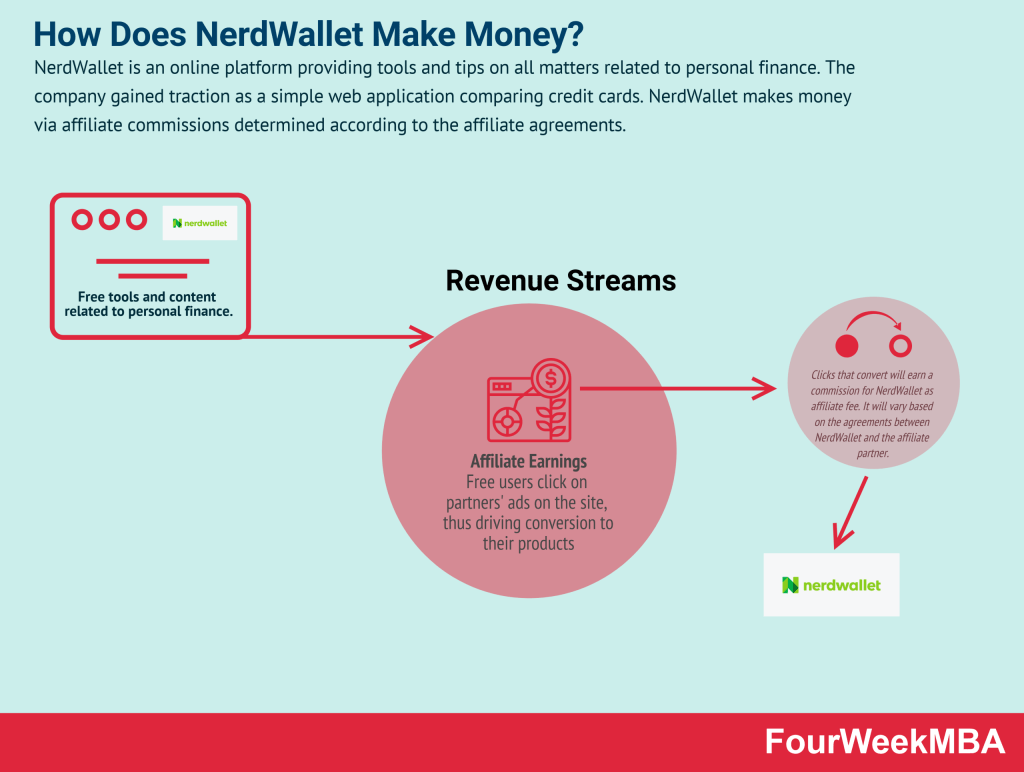
NerdWallet is an online platform providing tools and tips on all matters related to personal finance. The company gained traction as a simple web application comparing credit cards. NerdWallet makes money via affiliate commissions determined according to the affiliate agreements.
Quadpay was an American fintech company founded by Adam Ezra and Brad Lindenberg in 2017. Ezra and Lindenberg witnessed the rising popularity of buy-now-pay-later service Afterpay in Australia and similar service Klarna in Europe. Quadpay collects a range of fees from both the merchant and the consumer via merchandise fees, convenience fees, late payment, and interchange fees.
Revolut an English fintech company offering banking and investment services to consumers. Founded in 2015 by Nikolay Storonsky and Vlad Yatsenko, the company initially produced a low-rate travel card. Storonsky in particular was an avid traveler who became tired of spending hundreds of pounds on currency exchange and foreign transaction fees. The Revolut app and core banking account are free to use. Instead, money is made through a combination of subscription fees, transaction fees, perks, and ancillary services.
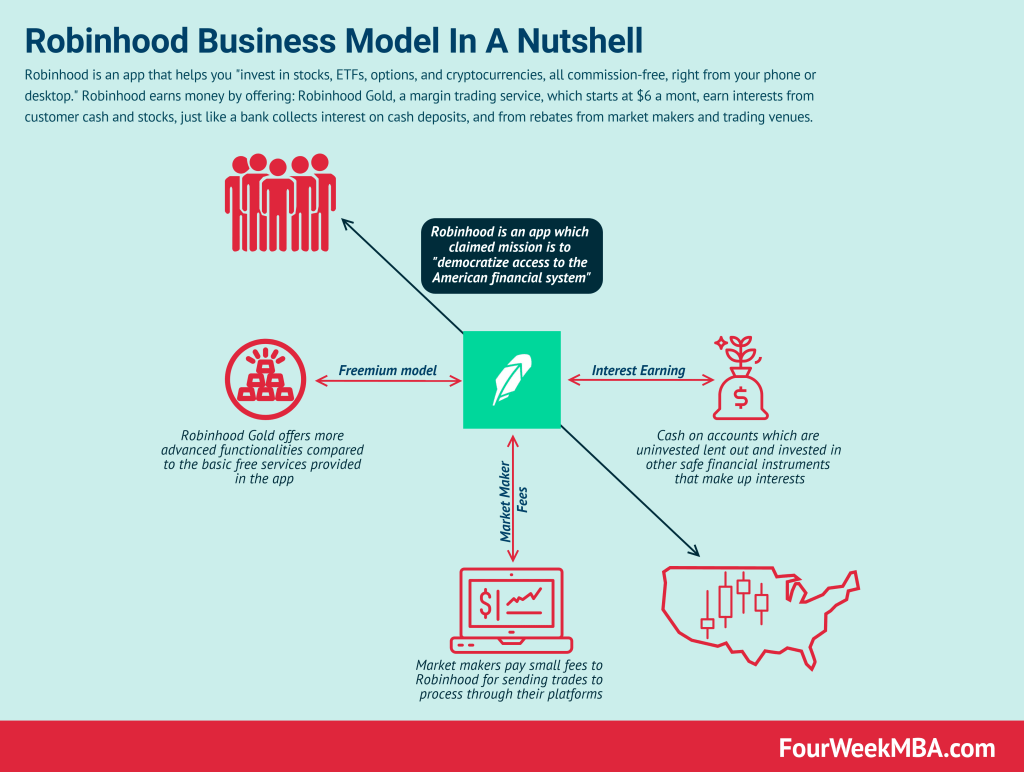
Robinhood is an app that helps to invest in stocks, ETFs, options, and cryptocurrencies, all commission-free. Robinhood earns money by offering: Robinhood Gold, a margin trading service, which starts at $6 a month, earn interests from customer cash and stocks, and rebates from market makers and trading venues.
SoFi is an online lending platform that provides affordable education loans to students, and it expanded into financial services, including loans, credit cards, investment services, and insurance. It makes money primarily via payment processing fees and loan securitization.
Squarespace is a North American hosting and website building company. Founded in 2004 by college student Anthony Casalena as a blog hosting service, it grew to become among the most successful website building companies. The company mostly makes money via its subscription plans. It also makes money via customizations on top of its subscription plans. And in part also as transaction fees for the website where it processes the sales.
Stash is a FinTech platform offering a suite of financial tools for young investors, coupled with personalized investment advice and life insurance. The company primarily makes money via subscriptions, cashback, payment for order flows, and interest for cash sitting on members’ accounts.
Venmo is a peer-to-peer payments app enabling users to share and make payments with friends for a variety of services. The service is free, but a 3% fee applies to credit cards. Venmo also launched a debit card in partnership with Mastercard. Venmo got acquired in 2012 by Braintree, and Braintree got acquired in 2013 by PayPal.
Wealthfront is an automated Fintech investment platform providing investment, retirement, and cashmanagement products to retail investors, mostly making money on the annual 0.25% advisory fee the company charges for assets under management. It also makes money via a line of credits and interests on the cash accounts.
Zelle is a peer-to-peer payment network that indirectly benefits the banks’ consortium that backs it. Zelle also enables users to pay businesses for goods and services, free for users. Merchants pay a 1% fee to Visa or Mastercard, who share it with the bank that issued the card.
Gennaro is the creator of FourWeekMBA, which reached about four million business people, comprising C-level executives, investors, analysts, product managers, and aspiring digital entrepreneurs in 2022 alone | He is also Director of Sales for a high-tech scaleup in the AI Industry | In 2012, Gennaro earned an International MBA with emphasis on Corporate Finance and Business Strategy.