Swagbucks' value proposition includes: – Rewards for Online Activities: Users can earn SB by shopping online, taking surveys, watching videos, playing games, an
Customer Segments
Swagbucks primarily serves the following customer segments: 1. Online Shoppers: Users looking to earn cashback and discounts while shopping online. 2. Survey Ta
Distribution Strategy
Swagbucks' distributionstrategy includes: – Online Platform: Operating a user-friendly website and mobile app where users can access and participate in various
Revenue Streams
Swagbucks generates revenue through the following channels: 1. Affiliate Commissions: Earning commissions from online retailers for driving sales through affili
Marketing Strategy
Swagbucks' marketingstrategy involves: – Online Advertising: Running digital ad campaigns to attract new users to the platform. – Referral Program: Encouraging
Competitive Advantage
Swagbucks' competitive advantage is derived from: – Extensive Partner Network: Collaborating with a wide range of online retailers and advertisers to offer lucr
Swagbucks is an American reward and loyalty program platform founded in 2008 by Scott Dudelson, Josef Gorowitz, and Eron Zehavi. The company began as a search engine that donated a portion of advertising revenue to charity.
Swagbucks acts as a two-sided network by connecting consumers who are willing to perform actions with businesses that benefit from those actions.
Swagbucks earns money through affiliate commissions whenever a member purchases from more than 1,500 eligible partners. The company also sells valuable consumer demographic data retailers use to guide product development and marketingstrategy.
Business Model Element
Analysis
Implications
Examples
Value Proposition
Swagbucks’ value proposition includes: – Rewards for Online Activities: Users can earn SB by shopping online, taking surveys, watching videos, playing games, and more. – Wide Range of Redemption Options: SB can be redeemed for gift cards, PayPal cash, and other rewards. – Convenience: Offers a single platform for users to earn rewards from various online activities. – Free to Join: Swagbucks is free to join, making it accessible to a broad audience. – Loyalty Program: Encourages user engagement and loyalty through consistent earning opportunities.
Provides incentives for users to engage in various online activities. Offers a variety of rewards, increasing the platform’s appeal. Simplifies the process of earning rewards by centralizing multiple earning opportunities. Removes financial barriers with a free membership model. Fosters long-term user relationships through a loyalty program.
– Users earning SB by shopping online through Swagbucks’ affiliate links. – Redeeming SB for gift cards or cashback. – Engaging in surveys, watching videos, and playing games to earn SB. – A broad user base enjoying the convenience and rewards of the platform.
Customer Segments
Swagbucks primarily serves the following customer segments: 1. Online Shoppers: Users looking to earn cashback and discounts while shopping online. 2. Survey Takers: Individuals interested in sharing their opinions in exchange for rewards. 3. Gamers: Players who earn SB by playing games. 4. Deal Seekers: Consumers searching for discounts and deals. Swagbucks caters to a diverse range of users seeking rewards for their online activities.
Attracts online shoppers seeking cashback and discounts. Engages survey takers by offering incentives for sharing opinions. Appeals to gamers with opportunities to earn rewards through gaming. Attracts deal seekers looking for discounts and special offers. Serves a broad user base interested in earning rewards online.
– Online shoppers using Swagbucks to earn cashback. – Survey participants earning SB for sharing their opinions. – Gamers playing games on the platform to accumulate SB. – Deal seekers looking for discounts and deals through Swagbucks. – A diverse group of users benefiting from Swagbucks’ rewards system.
Distribution Strategy
Swagbucks’ distribution strategy includes: – Online Platform: Operating a user-friendly website and mobile app where users can access and participate in various earning activities. – Browser Extension: Offering a browser extension that notifies users of cashback opportunities while shopping online. – Partner Network: Collaborating with retailers, advertisers, and survey providers to offer earning opportunities. – Referral Program: Encouraging users to refer others to join Swagbucks. Swagbucks leverages its online platform, browser extension, partnerships, and referrals to reach users.
Provides a user-friendly online platform for easy access to earning opportunities. Enhances the shopping experience with a browser extension that notifies users of cashback opportunities. Expands its reach by partnering with retailers and survey providers. Drives user growth through a referral program that incentivizes users to invite others. Utilizes multiple channels for user acquisition and engagement.
– Users accessing Swagbucks’ website and mobile app to earn rewards. – Installing the SwagButton browser extension for online shopping. – Partnerships with retailers and advertisers offering cashback opportunities. – Users referring friends and family to join Swagbucks.
Revenue Streams
Swagbucks generates revenue through the following channels: 1. Affiliate Commissions: Earning commissions from online retailers for driving sales through affiliate links. 2. Advertising: Displaying advertisements to users while they engage in various activities on the platform. 3. Market Research: Partnering with market research firms to conduct surveys and gather consumer insights. 4. Data Insights: Analyzing user data and providing insights to businesses. Swagbucks diversifies its revenue streams through affiliate marketing, advertising, market research, and data analytics.
Generates revenue by earning commissions from affiliate marketing. Monetizes the platform through display advertising. Partners with market research firms to generate income from survey participation. Leverages user data for insights and analysis, offering additional revenue streams. Diversifies its revenue sources within the rewards and market research industries.
– Earning affiliate commissions from online sales generated through Swagbucks. – Displaying ads to users while they participate in activities. – Conducting market research and surveys in partnership with research firms. – Analyzing user data and providing insights to businesses for a fee.
Marketing Strategy
Swagbucks’ marketing strategy involves: – Online Advertising: Running digital ad campaigns to attract new users to the platform. – Referral Program: Encouraging existing users to refer friends and family in exchange for SB rewards. – Social Media Presence: Maintaining an active presence on social media platforms to engage with the user community and promote earning opportunities. – Promotions and Deals: Offering special promotions and deals to incentivize user participation. Swagbucks combines online advertising, referrals, social media engagement, and promotions to attract and retain users.
Attracts new users through online advertising campaigns. Stimulates user growth through a referral program. Engages with the user community on social media platforms. Motivates user participation with promotions and deals. Implements a comprehensive marketing strategy to increase platform adoption.
– Encountering Swagbucks’ digital ads promoting the rewards platform. – Inviting friends and family to join Swagbucks through the referral program. – Following Swagbucks on social media for updates and earning opportunities. – Participating in special promotions and deals to earn more SB.
Competitive Advantage
Swagbucks’ competitive advantage is derived from: – Extensive Partner Network: Collaborating with a wide range of online retailers and advertisers to offer lucrative cashback opportunities. – Diverse Earning Opportunities: Providing users with a variety of ways to earn SB, including shopping, surveys, games, and more. – Strong User Community: Fostering an engaged user community through a referral program, social media, and promotions. – User Data and Insights: Leveraging user data for targeted marketing and offering data insights to businesses. Swagbucks’ competitive advantage lies in its extensive partner network, diverse earning options, engaged user community, and data-driven approach.
Offers a broad range of cashback opportunities through its extensive partner network. Provides users with diverse and engaging ways to earn SB. Fosters user loyalty and growth through a strong community and referral program. Utilizes user data for targeted marketing and generates additional revenue through data insights. Maintains a strong position in the rewards and market research industries.
– Users benefiting from a wide array of cashback opportunities. – Engaging in various activities to earn SB, including shopping, surveys, and games. – Referring friends and family to join Swagbucks and earn rewards. – Businesses leveraging Swagbucks’ data insights for targeted marketing. – Swagbucks’ prominent presence in the rewards and market research sectors.
History of Swagbucks
Swagbucks is an American reward and loyalty program platform founded in 2008 by Scott Dudelson, Josef Gorowitz, and Eron Zehavi.
The Swagbucks story began three years earlier as a private-label search engine making money through keyword-based advertising.
Unlike competitors, however, a percentage of advertising revenue was donated to charity.
The service also allowed celebrities, brands, and sports teams to engage with their fans through branded rewards programs and merchandise.
When Google started to become the dominant search engine player, the service was forced to pivot. Swagbucks gained early traction as one of the first businesses to have both a Facebook and Twitter page.
Traction was also helped by the referral program which increased word-of-mouth advertising among users.
By 2010, the company had already amassed 3.3 million users. Soon after, it introduced shopping pages where members receive cashback points for shopping at selected retailers.
The company continued to experience rapid growth and became profitable in 2013.
Fundamentally, Swagbucks allows members to earn points simply by doing everyday activities, such as watching videos, surfing the web, playing games, answering surveys, and shopping.
These points are then redeemable for gift cards from retailers such as Amazon and Walmart. Alternatively, Swagbucks members can opt to receive cash back from PayPal.
For Swagbucks to distribute cash and gift cards to its members, the company has a relatively simple revenue generation model.
Swagbucks acts as a two-sided network, connecting consumers who are willing to perform actions with businesses that benefit from those actions.
When a member performs an action for Swagbucks points, the company sets aside a portion of the revenue it receives from partners to fund the reward the member is working towards.
It’s important to mention that one Swagbucks point is quite small in dollar terms. For example, a $15 Amazon gift card is worth approximately 1500 points while $50 cashback from PayPal will require 5,000 points.
For the company to make a profit, the value of the actions required to accrue the necessary points must be higher than the value of the gift earned by the consumer.
This begs the question, how does Swagbucks earn money from the actions of its members?
Affiliate commissions
Swagbucks collects affiliate commissions from the brands it partners with whenever a member makes an eligible purchase.
Considering the company partners with more than 1,500 online retailers, this is likely to be a significant source of income. The exact affiliate commission is based on the contractual arrangement held with each partner.
Aside from the purchase of physical products, some partners also pay Swagbucks whenever a member completes a survey or watches a video. Ostensibly, Swagbucks is collecting and then selling valuable consumer data to retailers who then use it in product development and marketing.
Key highlights:
Founding and Early Years: Swagbucks was founded in 2008 by Scott Dudelson, Josef Gorowitz, and Eron Zehavi as a search engine that donated a portion of advertising revenue to charity.
Pivot and Growth: Initially a private-label search engine, Swagbucks pivoted when Google became dominant. It gained traction by being one of the first businesses to have Facebook and Twitter pages, and a referral program helped increase word-of-mouth advertising among users.
Reward and Loyalty Program: Swagbucks allows members to earn points by performing everyday activities like watching videos, surfing the web, playing games, answering surveys, and shopping. These points can be redeemed for gift cards or cashback from PayPal.
Revenue Generation Model: Swagbucks acts as a two-sided network, connecting consumers willing to perform actions with businesses benefiting from those actions. The company sets aside a portion of revenue received from partners to fund the rewards for members.
Affiliate Commissions: Swagbucks earns money through affiliate commissions from more than 1,500 online retailers whenever a member makes an eligible purchase. It also receives payments from partners when members complete surveys or watch videos, likely related to the sale of valuable consumer data for product development and marketing purposes.
Profitability: Swagbucks became profitable in 2013 and has since paid out almost $600 million in rewards to its members, with thousands of gift cards distributed daily.
User Base: By 2010, the company had already amassed 3.3 million users, and it continues to experience rapid growth.
Wide Range of Reward Options: Swagbucks offers various reward options, including gift cards from popular retailers like Amazon and Walmart, providing flexibility to its members.
Social Engagement: Swagbucks allowed celebrities, brands, and sports teams to engage with their fans through branded rewards programs and merchandise, enhancing its social presence and appeal.
Impact on Charitable Causes: In its early days, Swagbucks donated a percentage of advertising revenue to charity, reflecting its commitment to social responsibility.
Data Collection and Monetization: Swagbucks collects and sells valuable consumer demographic data to retailers, contributing to its revenue streams and helping businesses refine their product development and marketing strategies.
Acorns is a fintech platform providing services related to Robo-investing and micro-investing. The company makes money primarily through three subscription tiers: Lite – ($1/month), which gives users access to Acorns Invest, Personal ($3/month) that includes Invest plus the Later (retirement) and Spend (personal checking account) suite of products, Family ($5/month) with features from both the Lite and Personal plans with the addition of Early.
Started as a pay-later solution integrated to merchants’ checkouts, Affirm makes money from merchants’ fees as consumers pick up the pay-later solution. Affirm also makes money through interests earned from the consumer loans, when those are repurchased from the originating bank. In 2020 Affirm made 50% of its revenues from merchants’ fees, about 37% from interests, and the remaining from virtual cards and servicing fees.
Alipay is a Chinese mobile and online payment platform created in 2004 by entrepreneur Jack Ma as the payment arm of Taobao, a major Chinese eCommerce site. Alipay, therefore, is the B2C component of Alibaba Group. Alipay makes money via escrows transaction fees, a range of value-added ancillary services, and through its Credit Pay Instalment fees.
Betterment is an American financial advisory company founded in 2008 by MBA graduate Jon Stein and lawyer Eli Broverman. Betterment makes money via investment plans, financial advice packages, betterment for advisors, betterment for business, cash reserve, and checking accounts.
Braintree
Venmo is a peer-to-peer payments app enabling users to share and make payments with friends for a variety of services. The service is free, but a 3% fee applies to credit cards. Venmo also launched a debit card in partnership with Mastercard. Venmo got acquired in 2012 by Braintree, and Braintree got acquired in 2013 by PayPal.
Chime is an American neobank (internet-only bank) company, providing fee-free financial services through its mobile banking app, thus providing personal finance services free of charge while making the majority of its money via interchange fees (paid by merchants when consumers use their debit cards) and ATM fees.
Coinbase is among the most popular platforms for trading and storing crypto-assets, whose mission is “to create an open financial system for the world” by enabling customers to trade cryptocurrencies. Its platform serves both as a search and discovery engine for crypto assets. The company makes money primarily through fees earned for the transactions processed through the platform, custodial services offered, interest, and subscriptions.
Compass is a licensed American real-estate broker incorporating online real estate technology as a marketing medium. The company makes money via sales commissions (collected whenever a sale is facilitated or tenants are found for a rental property) and bridge loans (a service allowing the seller to purchase a home before the revenue from the sale of their previous home is available).
Dosh is a Fintech platform that enables automatic cash backs for consumers. Its business model connects major card providers with online and offline local businesses to develop automatic cash back programs. The company makes money by earning an affiliate commission on each eligible sale from consumers.
E-Trade is a trading platform, allowing investors to trade common and preferred stocks, exchange-traded funds (ETFs), options, bonds, mutual funds, and futures contracts, acquired by Morgan Stanley in 2020 for $13 billion. E-Trade makes money through interest income, order flow, margin interests, options, future and bonds trading, and through other fees and service charges.
Klarna is a financial technology company allowing consumers to shop with a temporary Visa card. Thus it then performs a soft credit check and pays the merchant. Klarna makes money by charging merchants. Klarna also earns a percentage of interchange fees as a commission and for interests earned on customers’ accounts.
Lemonade is an insurance tech company using behavioral economics and artificial intelligence to process claims efficiently. The company leverages technology to streamline onboarding customers while also applying a financialmodel to reduce conflicts of interest with customers (perhaps by donating the variable premiums to charity). The company makes money by selling its core insurance products, and via its tech platform, it tries to enhance its sales.
Monzo is an English neobank offering a mobile app and a prepaid debit card for consumers and businesses. It was one of the first app-based banks to enter the UK market, founded by Gary Dolman, Jason Bates, Jonas Huckestein, Paul Rippon, and Tom Blomfield in 2015. All were employees of Starling Bank, a similar neobank challenging the dominance of established financial institutions in England. The company enjoys many revenue streams: business and consumer subscriptions, interchange and overdraft fees, personal loans, and more.
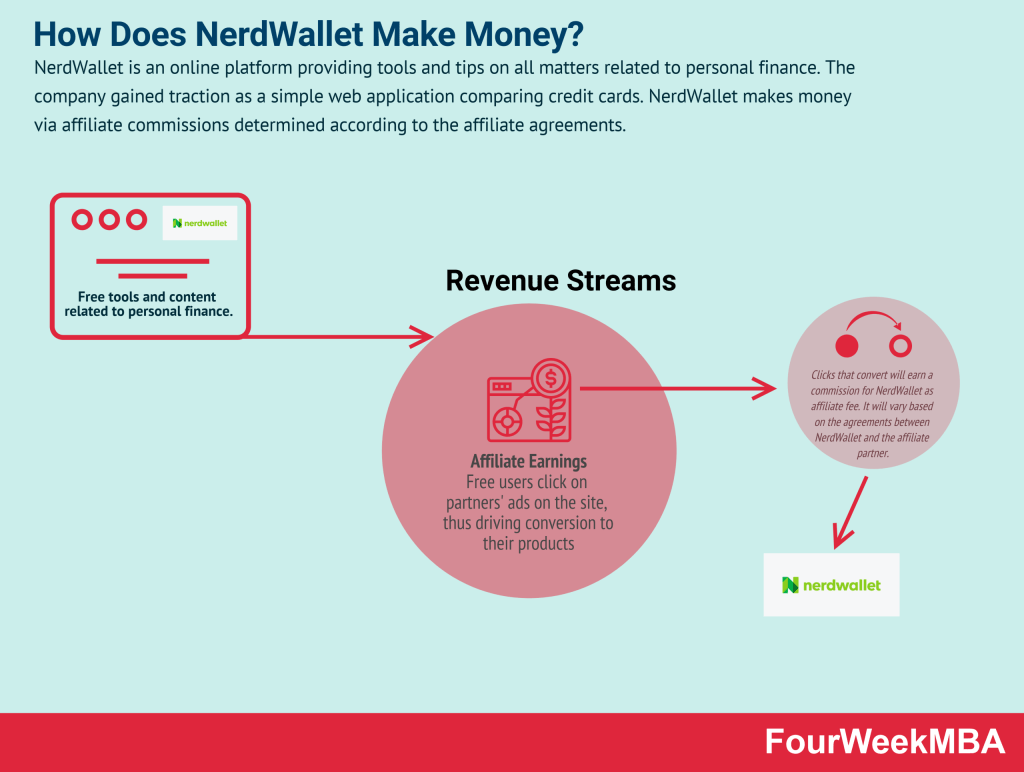
NerdWallet is an online platform providing tools and tips on all matters related to personal finance. The company gained traction as a simple web application comparing credit cards. NerdWallet makes money via affiliate commissions determined according to the affiliate agreements.
Quadpay was an American fintech company founded by Adam Ezra and Brad Lindenberg in 2017. Ezra and Lindenberg witnessed the rising popularity of buy-now-pay-later service Afterpay in Australia and similar service Klarna in Europe. Quadpay collects a range of fees from both the merchant and the consumer via merchandise fees, convenience fees, late payment, and interchange fees.
Revolut an English fintech company offering banking and investment services to consumers. Founded in 2015 by Nikolay Storonsky and Vlad Yatsenko, the company initially produced a low-rate travel card. Storonsky in particular was an avid traveler who became tired of spending hundreds of pounds on currency exchange and foreign transaction fees. The Revolut app and core banking account are free to use. Instead, money is made through a combination of subscription fees, transaction fees, perks, and ancillary services.
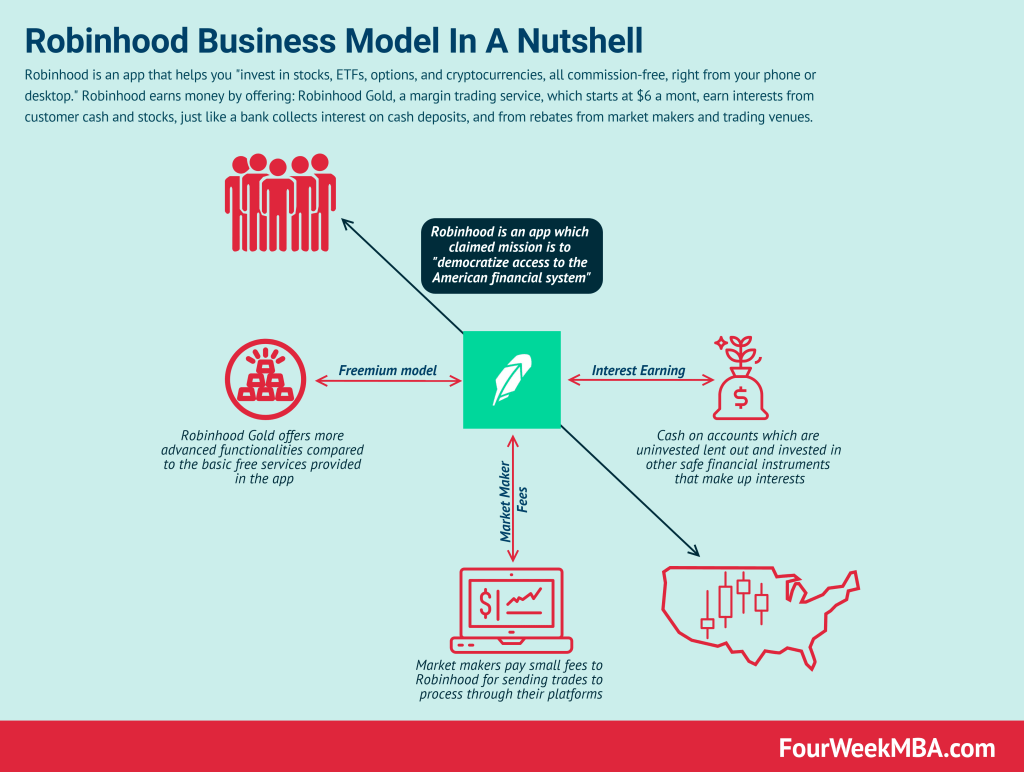
Robinhood is an app that helps to invest in stocks, ETFs, options, and cryptocurrencies, all commission-free. Robinhood earns money by offering: Robinhood Gold, a margin trading service, which starts at $6 a month, earn interests from customer cash and stocks, and rebates from market makers and trading venues.
SoFi is an online lending platform that provides affordable education loans to students, and it expanded into financial services, including loans, credit cards, investment services, and insurance. It makes money primarily via payment processing fees and loan securitization.
Squarespace is a North American hosting and website building company. Founded in 2004 by college student Anthony Casalena as a blog hosting service, it grew to become among the most successful website building companies. The company mostly makes money via its subscription plans. It also makes money via customizations on top of its subscription plans. And in part also as transaction fees for the website where it processes the sales.
Stash is a FinTech platform offering a suite of financial tools for young investors, coupled with personalized investment advice and life insurance. The company primarily makes money via subscriptions, cashback, payment for order flows, and interest for cash sitting on members’ accounts.
Venmo is a peer-to-peer payments app enabling users to share and make payments with friends for a variety of services. The service is free, but a 3% fee applies to credit cards. Venmo also launched a debit card in partnership with Mastercard. Venmo got acquired in 2012 by Braintree, and Braintree got acquired in 2013 by PayPal.
Wealthfront is an automated Fintech investment platform providing investment, retirement, and cashmanagement products to retail investors, mostly making money on the annual 0.25% advisory fee the company charges for assets under management. It also makes money via a line of credits and interests on the cash accounts.
Zelle is a peer-to-peer payment network that indirectly benefits the banks’ consortium that backs it. Zelle also enables users to pay businesses for goods and services, free for users. Merchants pay a 1% fee to Visa or Mastercard, who share it with the bank that issued the card.
Gennaro is the creator of FourWeekMBA, which reached about four million business people, comprising C-level executives, investors, analysts, product managers, and aspiring digital entrepreneurs in 2022 alone | He is also Director of Sales for a high-tech scaleup in the AI Industry | In 2012, Gennaro earned an International MBA with emphasis on Corporate Finance and Business Strategy.