Splitit is a fintech company founded by Israeli entrepreneurs Gil Don and Alon Feit in 2009. The platform was initially created to allow consumers to use existing credit to make BNPL purchases.
Splitit relies on transaction fees to make money, with the exact fee depending on how and when the merchant chooses to be paid.
Splitit does not charge consumers for late or missed payments. Nor does it charge interest on purchases. Instead, the company relies on transaction value and mass consumer uptake to make money.
Aspect
Description
Overview
Splitit operates on a buy now, pay later (BNPL) business model that enables consumers to make purchases and divide payments into smaller, interest-free installments. Unlike traditional BNPL solutions, Splitit focuses on leveraging existing credit cards and doesn’t require consumers to apply for new credit lines or undergo credit checks. This approach aims to provide consumers with financial flexibility and convenience while driving sales for merchants.
Core Value Proposition
– Interest-Free Installments: Splitit allows consumers to split their purchases into smaller, interest-free installments, reducing the financial burden of large transactions. – No New Credit: Consumers can use their existing credit cards, eliminating the need for new credit applications or credit checks. – Merchant Sales Boost: By offering Splitit as a payment option, merchants can potentially increase their sales and average transaction values.
How It Works
1. Checkout: Consumers select Splitit as the payment option during the online checkout process. 2. Credit Card Authorization: Splitit verifies the consumer’s available credit on their existing credit card but does not charge the full amount upfront. 3. Installment Plan: The total purchase amount is divided into equal monthly installments. Consumers pay each installment on their regular credit card billing cycle. 4. Completion: Once all installments are paid, the purchase is complete.
Merchant Integration
Splitit integrates with e-commerce platforms and payment gateways, making it accessible to online merchants. Integration is straightforward, and Splitit offers plugins and APIs to facilitate seamless implementation.
Global Presence
Splitit serves a global market, allowing consumers and merchants worldwide to benefit from its BNPL solution. Its reach extends to numerous countries, making it available for cross-border transactions and international e-commerce.
Revenue Model
Splitit generates revenue primarily through merchant fees. Merchants pay a fee for each transaction processed through Splitit. This fee covers the cost of Splitit’s service, including installment plan management, credit card authorization, and customer support.
Consumer Benefits
– Financial Flexibility: Splitit offers consumers a flexible payment solution, making high-value purchases more manageable. – No Interest Charges: Since Splitit doesn’t charge interest, consumers avoid the costs associated with traditional credit financing. – Credit Card Rewards: Consumers can still earn rewards and benefits from their existing credit cards when using Splitit.
Merchant Benefits
– Sales Increase: Merchants can potentially boost sales and conversion rates by offering Splitit as a payment option, especially for higher-priced items. – Reduced Cart Abandonment: Splitit may help reduce cart abandonment rates, as consumers are more likely to proceed with a purchase when installment payments are available. – Larger Basket Sizes: By making larger purchases more accessible, Splitit can increase the average transaction value for merchants.
Challenges and Risks
Splitit faces challenges related to competition in the BNPL industry, especially from established players. Regulatory scrutiny and changes in the financial industry’s landscape can also pose risks. Ensuring secure payment processing and addressing consumer concerns about credit card authorizations are ongoing challenges.
Future Growth Strategies
To sustain its growth, Splitit is likely to focus on: – Expanding Merchant Partnerships: Forming partnerships with more online retailers to increase its acceptance and availability. – Innovation: Developing new features and services that enhance the BNPL experience. – Geographic Expansion: Entering new markets and regions to broaden its global footprint. – Adoption of Mobile Payments: Integrating with mobile wallets and platforms to cater to changing consumer preferences.
Flexible Payment Options: Splitit offers consumers the flexibility to pay for purchases using installment payments without incurring interest charges or undergoing a credit check. This allows shoppers to spread the cost of their purchases over time, making expensive items more affordable and accessible.
Convenient Checkout Experience: Splitit seamlessly integrates with online retailers’ checkout processes, allowing customers to select Splitit as a payment option and split their payments at the point of purchase. This eliminates the need for additional sign-ups or applications, streamlining the checkout experience for shoppers.
No Additional Debt: Unlike traditional credit cards or loans, Splitit does not require customers to take on additional debt to make purchases. Instead, Splitit leverages customers’ existing credit lines, such as their credit card limits, to facilitate installment payments, ensuring that customers remain debt-free.
Increased Conversion Rates: By offering installment payment options, Splitit helps online merchants increase their conversion rates and average order values. By providing customers with a more flexible and affordable way to pay, merchants can attract more shoppers and drive higher sales volumes.
Origin Story
Splitit is a fintech company founded by Israeli entrepreneurs Gil Don and Alon Feit in 2009.
Don and Feit used their extensive experience in finance and information technology to create a somewhat unique platform in the buy-now-pay-later (BNPL) space. The pair envisioned Splitit to be a service enabling consumers to use their existing credit to break a purchase into smaller, interest-free purchases.
To that end, they filed a patent for “a system and method for facilitating credit transactions, which may allow for the division of a given purchase or cash-withdrawal transaction amount, into periodical installments by enabling the financing of said transaction.”
After five years of hard graft, Splitit was launched as PayItSimple in the United States in 2015. The launch coincided with the company moving its headquarters from Tel Aviv to New York City. At the time, very few companies in North America were offering similar services.
In May 2015, the company secured a $10 million round of funding. PayItSimple then expanded into the British market and rebranded as Splitit two months later. In 2018, the platform added debit card payments and became integrated with platforms such as Magento and Salesforce. Emulating the path of many other BNPL players, the company held a $12 million IPO on the Australian Stock Exchange in January 2019.
Since 2019, Splitit has expanded rapidly as larger competitors such as PayPal look to establish themselves in the BNPL market. The company secured millions in successive rounds of funding and established additional presences in Japan and the Middle East, among other initiatives.
Splitit’s primary source of revenue is transaction fees, which are paid by the merchant when a customer selects Splitit as a payment option either online or in-store.
Transactions fees vary according to how quickly the merchant wants to receive their money and the country they operate in.
Generally speaking, there are two transaction fee structures:
Standard – where the merchant is paid as the consumer pays their monthly installments. The transaction fee is 1.5% plus $1.50 per installment.
Funded – where the merchant receives the full amount of the purchase up front. Here, the transaction fee is 3% plus $1.00 per installment.
In addition to offering credit as a BNPL option, Splitit differentiates itself from other providers by not charging fees to consumers for late or missed payments. What’s more, Splitit does not charge interest on purchases.
To maximize revenue, the company instead focuses on increasing the total transaction value and the number of shoppers utilizing its platform.
Revenue Model
Merchant Fees: Splitit generates revenue by charging online merchants a fee for processing installment payments on their platforms. This fee is typically calculated as a percentage of the transaction value and may vary depending on the merchant’s pricingplan and transaction volume.
Interest-Free Financing: While Splitit does not charge customers interest on their installment payments, it may earn revenue through other means, such as transaction fees or partnerships with financial institutions. For example, Splitit may receive a portion of the interchange fees collected by credit card networks on transactions processed through its platform.
Premium Services: Splitit may offer premium services or features to merchants for an additional fee. These services may include advanced analytics and reporting tools, customized payment plans, or dedicated account management support, providing merchants with additional value and generating recurring revenue for Splitit.
Partnerships and Integrations: Splitit may form partnerships with payment processors, e-commerce platforms, and financial institutions to expand its reach and offer its services to a wider audience. These partnerships may involve revenue-sharing agreements or referral fees for referring customers to partner platforms.
Marketing Strategy
E-commerce Partnerships: Splitit collaborates with e-commerce platforms and online marketplaces to integrate its installment payment solution into their checkout processes. By partnering with popular online retailers, Splitit can reach a broader audience of potential customers and increase brand visibility.
Digital Advertising: Splitit invests in digital advertising channels such as search engine marketing (SEM), social media advertising, and display advertising to raise awareness and drive traffic to its platform. Digital advertising efforts target both consumers and merchants interested in flexible payment solutions.
Content Marketing: Splitit creates and shares educational content, blog posts, case studies, and whitepapers to inform and engage its target audience. Content marketing efforts focus on topics related to e-commerce trends, consumer spending habits, and the benefits of installment payments, positioning Splitit as a thought leader in the industry.
Merchant Outreach and Events: Splitit conducts outreach efforts to onboard new merchants and partners with industry events, conferences, and webinars to showcase its payment solution. By engaging directly with merchants and participating in industry events, Splitit can demonstrate the value of its platform and attract new business opportunities.
Distribution Channels
Online Platform Integration: The primary distributionchannel for Splitit is its integration with online retailers’ e-commerce platforms. Splitit’s payment solution is seamlessly integrated into the checkout processes of partner merchants, allowing customers to select Splitit as a payment option when making purchases online.
E-commerce Partnerships: Splitit forms partnerships with e-commerce platforms, payment processors, and online marketplaces to expand its reach and offer its services to a wider audience. These partnerships enable Splitit to reach potential customers shopping on partner platforms and increase adoption of its installment payment solution.
Direct Sales and Marketing: Splitit employs a direct sales and marketing approach to onboard new merchants and promote its payment solution. Sales representatives reach out to potential merchants to demonstrate the benefits of Splitit’s platform and facilitate partnerships through direct negotiations and presentations.
Digital Marketing Channels: Splitit utilizes digitalmarketing channels such as search engine optimization (SEO), pay-per-click (PPC) advertising, and social media marketing to promote its services and attract both merchants and consumers to its platform. Digital marketing efforts target keywords related to installment payments, e-commerce trends, and online shopping behavior to drive traffic and conversions.
Key Highlights
Founding and Origin: Splitit is a fintech company founded by Israeli entrepreneurs Gil Don and Alon Feit in 2009. The platform was created to allow consumers to use existing credit for buy-now-pay-later (BNPL) purchases.
Unique Concept: Splitit’s platform enables consumers to break a purchase into interest-free, smaller installments, using their existing credit, rather than providing new credit or loans.
Global Expansion: After its launch as PayItSimple in the United States in 2015, the company rebranded as Splitit and expanded into the British market. It later established a presence in Japan and the Middle East, among other initiatives.
Funding Rounds: Splitit secured multiple rounds of funding, including a $10 million round in May 2015 and a $12 million IPO on the Australian Stock Exchange in January 2019.
Rapid Growth: Splitit experienced significant growth in its merchant sales volume, with a 180% year-over-year increase in March 2021, reaching an annualized merchant sales volume of $345 million.
Revenue Model: Splitit primarily generates revenue through transaction fees paid by merchants. There are two fee structures: Standard, with a fee of 1.5% plus $1.50 per installment, and Funded, with a fee of 3% plus $1.00 per installment.
Consumer-Friendly Approach: Unlike some competitors, Splitit does not charge consumers for late or missed payments, nor does it charge interest on purchases. Instead, the company focuses on increasing transaction value and consumer uptake to drive revenue.
Integration and Partnerships: The platform integrated with popular e-commerce platforms like Magento and Salesforce, making it more accessible to merchants and consumers alike.
Competition: As larger competitors, such as PayPal, entered the BNPL market, Splitit faced increasing competition but continued to expand and establish its presence globally.
Innovation: Splitit’s approach to BNPL stands out by leveraging existing credit lines and offering interest-free installment options, attracting consumers looking for flexible payment solutions.
Acorns is a fintech platform providing services related to Robo-investing and micro-investing. The company makes money primarily through three subscription tiers: Lite – ($1/month), which gives users access to Acorns Invest, Personal ($3/month) that includes Invest plus the Later (retirement) and Spend (personal checking account) suite of products, Family ($5/month) with features from both the Lite and Personal plans with the addition of Early.
Started as a pay-later solution integrated to merchants’ checkouts, Affirm makes money from merchants’ fees as consumers pick up the pay-later solution. Affirm also makes money through interests earned from the consumer loans, when those are repurchased from the originating bank. In 2020 Affirm made 50% of its revenues from merchants’ fees, about 37% from interests, and the remaining from virtual cards and servicing fees.
Alipay is a Chinese mobile and online payment platform created in 2004 by entrepreneur Jack Ma as the payment arm of Taobao, a major Chinese eCommerce site. Alipay, therefore, is the B2C component of Alibaba Group. Alipay makes money via escrows transaction fees, a range of value-added ancillary services, and through its Credit Pay Instalment fees.
Betterment is an American financial advisory company founded in 2008 by MBA graduate Jon Stein and lawyer Eli Broverman. Betterment makes money via investment plans, financial advice packages, betterment for advisors, betterment for business, cash reserve, and checking accounts.
Braintree
Venmo is a peer-to-peer payments app enabling users to share and make payments with friends for a variety of services. The service is free, but a 3% fee applies to credit cards. Venmo also launched a debit card in partnership with Mastercard. Venmo got acquired in 2012 by Braintree, and Braintree got acquired in 2013 by PayPal.
Chime is an American neobank (internet-only bank) company, providing fee-free financial services through its mobile banking app, thus providing personal finance services free of charge while making the majority of its money via interchange fees (paid by merchants when consumers use their debit cards) and ATM fees.
Coinbase is among the most popular platforms for trading and storing crypto-assets, whose mission is “to create an open financial system for the world” by enabling customers to trade cryptocurrencies. Its platform serves both as a search and discovery engine for crypto assets. The company makes money primarily through fees earned for the transactions processed through the platform, custodial services offered, interest, and subscriptions.
Compass is a licensed American real-estate broker incorporating online real estate technology as a marketing medium. The company makes money via sales commissions (collected whenever a sale is facilitated or tenants are found for a rental property) and bridge loans (a service allowing the seller to purchase a home before the revenue from the sale of their previous home is available).
Dosh is a Fintech platform that enables automatic cash backs for consumers. Its business model connects major card providers with online and offline local businesses to develop automatic cash back programs. The company makes money by earning an affiliate commission on each eligible sale from consumers.
E-Trade is a trading platform, allowing investors to trade common and preferred stocks, exchange-traded funds (ETFs), options, bonds, mutual funds, and futures contracts, acquired by Morgan Stanley in 2020 for $13 billion. E-Trade makes money through interest income, order flow, margin interests, options, future and bonds trading, and through other fees and service charges.
Klarna is a financial technology company allowing consumers to shop with a temporary Visa card. Thus it then performs a soft credit check and pays the merchant. Klarna makes money by charging merchants. Klarna also earns a percentage of interchange fees as a commission and for interests earned on customers’ accounts.
Lemonade is an insurance tech company using behavioral economics and artificial intelligence to process claims efficiently. The company leverages technology to streamline onboarding customers while also applying a financialmodel to reduce conflicts of interest with customers (perhaps by donating the variable premiums to charity). The company makes money by selling its core insurance products, and via its tech platform, it tries to enhance its sales.
Monzo is an English neobank offering a mobile app and a prepaid debit card for consumers and businesses. It was one of the first app-based banks to enter the UK market, founded by Gary Dolman, Jason Bates, Jonas Huckestein, Paul Rippon, and Tom Blomfield in 2015. All were employees of Starling Bank, a similar neobank challenging the dominance of established financial institutions in England. The company enjoys many revenue streams: business and consumer subscriptions, interchange and overdraft fees, personal loans, and more.
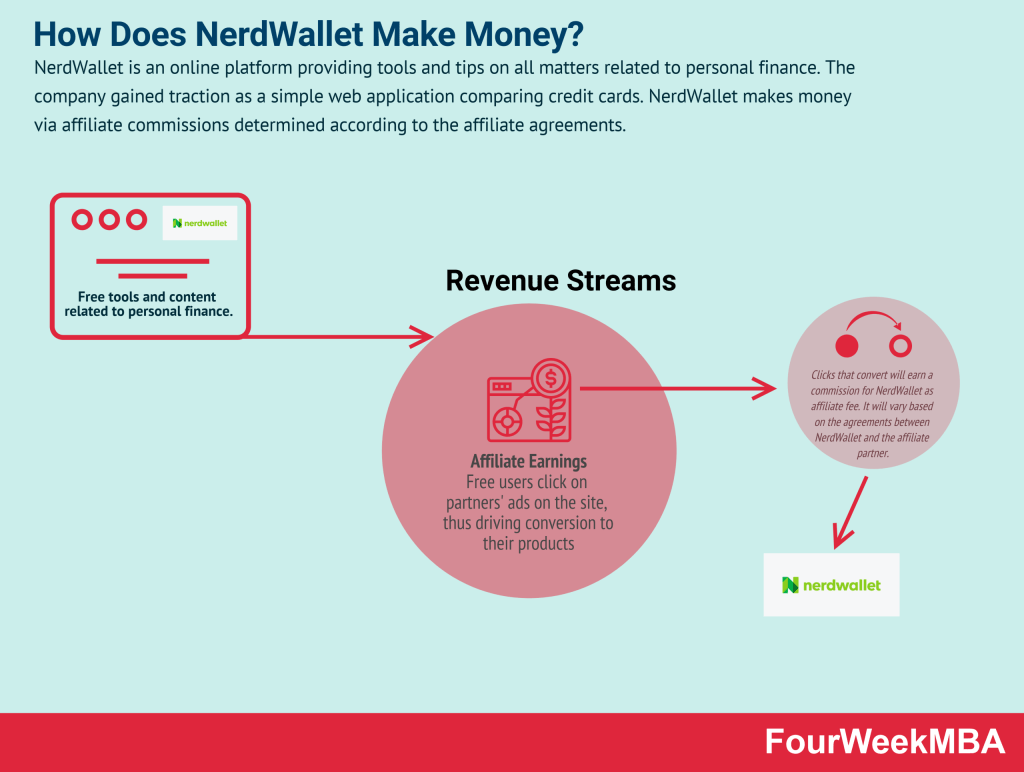
NerdWallet is an online platform providing tools and tips on all matters related to personal finance. The company gained traction as a simple web application comparing credit cards. NerdWallet makes money via affiliate commissions determined according to the affiliate agreements.
Quadpay was an American fintech company founded by Adam Ezra and Brad Lindenberg in 2017. Ezra and Lindenberg witnessed the rising popularity of buy-now-pay-later service Afterpay in Australia and similar service Klarna in Europe. Quadpay collects a range of fees from both the merchant and the consumer via merchandise fees, convenience fees, late payment, and interchange fees.
Revolut an English fintech company offering banking and investment services to consumers. Founded in 2015 by Nikolay Storonsky and Vlad Yatsenko, the company initially produced a low-rate travel card. Storonsky in particular was an avid traveler who became tired of spending hundreds of pounds on currency exchange and foreign transaction fees. The Revolut app and core banking account are free to use. Instead, money is made through a combination of subscription fees, transaction fees, perks, and ancillary services.
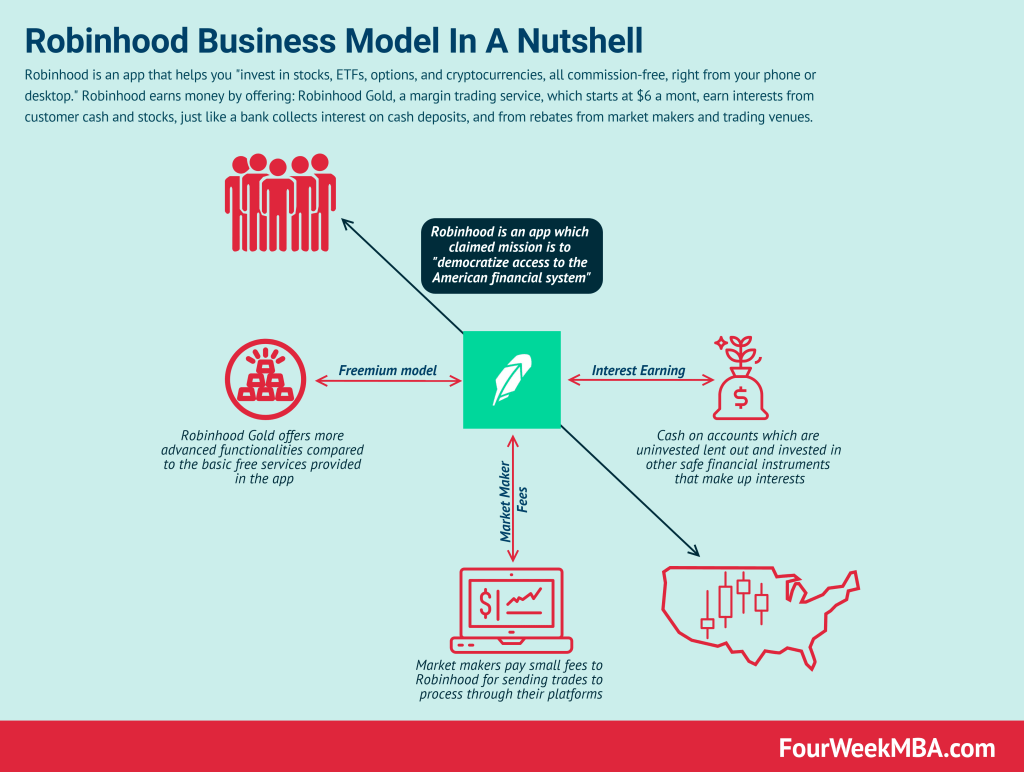
Robinhood is an app that helps to invest in stocks, ETFs, options, and cryptocurrencies, all commission-free. Robinhood earns money by offering: Robinhood Gold, a margin trading service, which starts at $6 a month, earn interests from customer cash and stocks, and rebates from market makers and trading venues.
SoFi is an online lending platform that provides affordable education loans to students, and it expanded into financial services, including loans, credit cards, investment services, and insurance. It makes money primarily via payment processing fees and loan securitization.
Squarespace is a North American hosting and website building company. Founded in 2004 by college student Anthony Casalena as a blog hosting service, it grew to become among the most successful website building companies. The company mostly makes money via its subscription plans. It also makes money via customizations on top of its subscription plans. And in part also as transaction fees for the website where it processes the sales.
Stash is a FinTech platform offering a suite of financial tools for young investors, coupled with personalized investment advice and life insurance. The company primarily makes money via subscriptions, cashback, payment for order flows, and interest for cash sitting on members’ accounts.
Venmo is a peer-to-peer payments app enabling users to share and make payments with friends for a variety of services. The service is free, but a 3% fee applies to credit cards. Venmo also launched a debit card in partnership with Mastercard. Venmo got acquired in 2012 by Braintree, and Braintree got acquired in 2013 by PayPal.
Wealthfront is an automated Fintech investment platform providing investment, retirement, and cashmanagement products to retail investors, mostly making money on the annual 0.25% advisory fee the company charges for assets under management. It also makes money via a line of credits and interests on the cash accounts.
Zelle is a peer-to-peer payment network that indirectly benefits the banks’ consortium that backs it. Zelle also enables users to pay businesses for goods and services, free for users. Merchants pay a 1% fee to Visa or Mastercard, who share it with the bank that issued the card.
Gennaro is the creator of FourWeekMBA, which reached about four million business people, comprising C-level executives, investors, analysts, product managers, and aspiring digital entrepreneurs in 2022 alone | He is also Director of Sales for a high-tech scaleup in the AI Industry | In 2012, Gennaro earned an International MBA with emphasis on Corporate Finance and Business Strategy.