eBay was, until recently, a multi-divisional (M-form) organization with semi-autonomous units grouped according to the services they provided. Today, eBay has a single division called Marketplace, which includes eBay and its international iterations.
Department
Type
Details
Advantages
Drawbacks
Marketplace Operations
Divisional
– Divisional structure with separate units for various regions or countries, each led by dedicated managers.
– Localized management and decision-making. – Adaptation to regional market dynamics. – Focus on customer preferences.
– Potential variations in strategies and operations across regions. – Challenges in maintaining consistent global standards.
Product and Technology
Functional
– Functional departments for product development, engineering, and technology. Functional managers oversee these areas.
– Specialization and expertise in product and technology development. – Efficient innovation and technological advancements.
– Potential silos between functional departments. – Challenges in cross-functional collaboration and coordination.
Marketing and Advertising
Functional
– Functional department responsible for marketing and advertising activities. Functional managers oversee marketing efforts.
– Specialization in marketing strategies and campaigns. – Effective promotion of eBay’s brand and products.
– Limited integration between marketing and other operational functions. – Challenges in aligning marketing strategies with broader goals.
Customer Support
Functional
– Functional department responsible for customer support and service operations. Functional managers oversee customer service.
– Efficient handling of customer inquiries and concerns. – Specialized expertise in customer service.
– Limited integration between customer service and other operational functions. – Challenges in ensuring consistent customer experiences.
Finance and Administration
Functional
– Functional departments for financial management and administrative functions. Functional managers oversee financial operations.
– Effective financial planning and management. – Compliance with regulatory requirements.
– Limited integration between financial and other operational functions. – Challenges in aligning financial strategies with business goals.
Founded in 1995 as AuctionWeb, the online marketplace now known as eBay became one of the earliest success stories on the internet. Two years after it launched, the platform sold its millionth item and an IPO soon followed in 1998.
While eBay’s premier online marketplace is now available in 180 countries, it’s important to mention that the company has also acquired various ancillary products and services over the years. These were once reflected in eBay’s organizational structure and served to streamline processes and management between the company and its subsidiaries. However, in recent times, the company has returned to its roots and its composition has changed accordingly.
Multi-divisional operations
eBay was until recently a multi-divisional (M-form) organization. This meant that the company was split into several semi-autonomous units that were ultimately guided and controlled by headquarters.
eBay’s divisional units were grouped according to the services they provided and consisted of Marketplace, StubHub, Payments, and Classifieds.
Today, it is thought that a sole divisional unit remains:
Marketplace – the most profitable division for the company which includes eBay.com and its various international sites.
As part of a move to focus on its C2C and B2C business, eBay either sold or spun-out companies across its other divisions between 2015 and 2020.
Perhaps the most high-profile of these was PayPal, which became an independent company in 2015 after thirteen years as an eBay subsidiary. StubHub was also sold for $4.05 billion in 2019 and the entire Classifieds unit – which once included Craiglist and Kijiji – was divested in 2020.
Geographic divisions
In 2019, eBay announced it would be placing the company’s geographic divisions in a new structure under the leadership of Jay Lee, Senior Vice President and General Manager of Markets.
This new structure consists of the following regions:
Americas.
APAC (Asia-Pacific).
UK.
Central and Southern Europe, and
Cross-Border Trade.
Leadership of function-based units
eBay has a hierarchical leadership structure with the current President and Chief Executive Officer Jamie Iannone at the helm.
Before eBay divested most of its divisions, it was noted there that was a duplication of many management, administration, and staff activities.
Today, the company is smaller and arguably more efficient. Senior vice presidents manage the following functional areas for the company’s Marketplace division:
People.
eBay Europe.
Legal.
Growth.
Business and Strategy.
International.
Financial.
Technology, and
Product.
Board of Directors
eBay’s Board of Directors consists of 13 individuals who comprise four different committees:
Audit Committee.
Compensation & Human Capital Committee.
Corporate Governance & Nominating Committee.
Risk Committee.
Comparison with Top Related Companies
Amazon: Amazon utilizes a hybrid divisional structure, where each major business unit operates almost like a separate company (Amazon Web Services, Amazon Retail, and Amazon Devices). This approach differs from eBay’s which is more centralized and focused mainly on its marketplace without the diversification of services that Amazon has. Amazon’s structure allows it to pursue many different business strategies simultaneously, whereas eBay’s structure is more streamlined, focusing primarily on e-commerce.
Alibaba: Similar to eBay, Alibaba operates primarily in the e-commerce space but has a divisional organizational structure that supports a range of related services, including cloud computing, digital media, and entertainment. Alibaba’s structure is more expansive compared to eBay’s, which remains largely centered on its core marketplace operations. Alibaba’s broader scope allows for synergies across different types of businesses but also requires more complex coordination.
Etsy: Etsy’s structure is somewhat similar to eBay’s in that it focuses on a niche market—handmade and vintage items. Etsy uses a functional organizational structure, which is effective for a smaller, more focused company. This structure contrasts with eBay’s approach, which includes a mix of both functional and divisional aspects to manage its broader marketplace.
Similarities and Differences
Similarities: All these companies utilize an organizational structure that supports e-commerce operations. There is a common emphasis on functional departments such as marketing, customer service, and technology to support their online platforms.
Differences: eBay’s approach is less diversified compared to Amazon and Alibaba, which have invested in a wide array of product offerings and services. Etsy, being smaller, operates more functionally which allows for tighter control and quicker responses within its niche market, compared to eBay’s broader and more varied marketplace.
Implications
Scalability and Flexibility: eBay’s more centralized focus on its marketplace allows for streamlined operations and decision-making, which can be advantageous in rapidly changing market conditions. However, this might limit opportunities for diversification and risk management compared to Amazon or Alibaba.
Innovation and Market Adaptation: Alibaba and Amazon’s broader diversification allows for cross-promotion and innovation synergies that eBay’s structure might not as easily support. This can lead to more robust growth opportunities but also introduces complexity in management.
Customer Engagement and Specialization: Etsy’s structure allows it to focus deeply on customer engagement and specialized market segments, providing a competitive edge in its niche that eBay’s broader marketplace model might not replicate as effectively.
In conclusion, eBay’s organizational structure, while more streamlined and focused compared to Amazon or Alibaba, provides certain efficiencies but may also limit its ability to diversify and innovate across as broad a spectrum. Comparing these structures helps highlight how each company’s organizational choices align with its business strategy and market positioning.
Key takeaways:
eBay was until recently a multi-divisional (M-form) organization with semi-autonomous units grouped according to the services they provided. Today, eBay has a single division called Marketplace, which includes eBay and its international iterations.
In 2019, eBay announced it would be placing the company’s geographic divisions in a new structure under the command of SVP Jay Lee.
eBay has a hierarchical leadership structure with various senior vice presidents in charge of function-based groups. There is also a 13-member Board of Directors responsible for audits, compensation, human capital, corporate governance, and risk.
Key Highlights
eBay’s Origin and Evolution: Founded in 1995 as AuctionWeb, eBay quickly became a notable online marketplace. Over time, the company expanded its services, acquiring various ancillary products and services and organizing them into a multi-divisional structure.
Multi-Divisional Operations: eBay operated as a multi-divisional (M-form) organization, with semi-autonomous units categorized based on the services they offered. These divisions included Marketplace, StubHub, Payments, and Classifieds.
Transition to Single Division: In more recent times, eBay has undergone a structural transformation. The company has shifted to having a single division called Marketplace, which encompasses eBay’s primary online marketplace and its international versions.
Strategic Divestitures: To focus on its core business and streamline its operations, eBay has divested or sold several of its acquired divisions, including PayPal, StubHub, and Classifieds.
Geographic Divisions: In 2019, eBay reorganized its geographic divisions under the leadership of Jay Lee, Senior Vice President and General Manager of Markets. These divisions are structured around regions like the Americas, APAC, UK, Central and Southern Europe, and Cross-Border Trade.
Function-Based Leadership: eBay’s hierarchical leadership structure is led by the President and CEO Jamie Iannone. Various senior vice presidents oversee function-based areas within the Marketplace division, such as People, Legal, Growth, Business and Strategy, International, Financial, Technology, and Product.
Efficiency and Simplification: eBay’s recent structural changes have led to a smaller and arguably more efficient organization, as it divested non-core divisions and focused on its core marketplace business.
Board of Directors: eBay’s Board of Directors consists of 13 members who serve on different committees, including Audit, Compensation & Human Capital, Corporate Governance & Nominating, and Risk.
eBay’s main shareholder is its founder, the billionaire Omidyar, who stepped down from the board of eBay. By 2020, he owned (and might still own 4.69% of the company’s stock) followed by other institutional investors, such as Vanguard (11.41%) and Blackrock (8.51%).
eBay’s core business is a platform business model that makes money from transaction fees through its marketplaces. In short, eBay primarily makes money by charging fees on successfully closed transactions. For instance, in 2021, on an $87 billion worth of gross merchandise value sold on eBay, the company generated $9.77 billion in transaction revenues at an 11.19% take rate (fee).
eBay reported $73.2 billion in gross merchandise volume in 2023, compared to $73.9 billion in gross merchandise volume in 2022 and $87.36 billion in 2021.
eBay was profitable in 2023, as it reported a profit of $2.77 billion. Compared to a net loss of $1.27 billion in 2022, a net income of $13.6 billion in 2021, and a net income of $5.67 billion in 2020.
eBay bidding is a way for buyers to bid on a product whose sale price is decided by auction. The bidding process itself is automated, with eBay acting on the buyer’s behalf.
eBay was until recently a multi-divisional (M-form) organization with semi-autonomous units grouped according to the services they provided. Today, eBay has a single division called Marketplace, which includes eBay and its international iterations.
In 2023, eBay generated $10.11 billion in revenue, compared to nearly $574.78 billion from Amazon in the same period. Whereas in 2022, Amazon generated $513.98 billion in revenue, vs. eBay’s over $9.79 billion. In comparison, looking at revenues, Amazon was over 57 times larger than eBay in 2023.
Amazon has a diversified business model. In 2023, Amazon generated nearly $575 billion in revenues while it posted a net profit of over $30 billion. Online stores contributed over 40% of Amazon revenues. Third-party Seller Services and Physical Stores generated the remaining. Amazon AWS, Subscription Services, and Advertising revenues play a significant role within Amazon as fast-growing segments.
Amazon’s mission statement is to “serve consumers through online and physical stores and focus on selection, price, and convenience.” Amazon’s vision statement is “to be Earth’s most customer-centric company, where customers can find and discover anything they might want to buy online, and endeavors to offer its customers the lowest possible prices.”
In the Amazon Shareholders’ Letter for 2018, Jeff Bezos analyzed the Amazon business model, and it also focused on a few key lessons that Amazon as a company has learned over the years. These lessons are fundamental for any entrepreneur, of small or large organization to understand the pitfalls to avoid to run a successful company!
With 64,588,418 shares, Jeff Bezos is the primary individual investor. Owning 12.7% of the company. Other top individual investors include Amazon’s CEO Andy Jessy, who has 94,729 shares. Top institutional investors include mutual funds like The Vanguard Group (6.6% ownership) and BlackRock (5.7% ownership).
Amazon generated over half a trillion dollars in revenue in 2023, of which $231.87B from online stores, over $140.05B from third-party seller services, $90.76B from AWS, $46.9B from advertising, $40.21B from subscription services, $20.03B billion in physical stores, and $4.96B from other sources.
Amazon was profitable in 2023. On nearly $575 billion in revenue for 2023, Amazon generated a net profit of over $30 billion. Since 2014, Amazon hasn’t recorded a net loss, but it did record a net loss of over $2.7 billion in 2022, while it recouped that in 2023. Indeed, in 2014, Amazon reported a net loss of $241 million, and it would be profitable until 2021. In 2022, Amazon turned unprofitable again and highly profitable again in 2023.
Amazon AWS follows a platform business model that gains traction by tapping into network effects. Born as an infrastructure built on top of Amazon’s infrastructure, AWS has become a company offering cloud services to thousands of clients from the enterprise level, to startups. And its marketplace enables companies to connect to other service providers to build integrated solutions for their organizations.
Amazon subscription revenue in 2023 was over $40 billion, compared to over $35 billion in 2022 and nearly $32 billion in 2021. Amazon Prime grew from a $4.5 billion revenue segment in 2015 to an over $40 billion segment in 2023.
The Amazon Working Backwards Method is a product development methodology that advocates building a product based on customer needs. The Amazon Working Backwards Method gained traction after notable Amazon employee Ian McAllister shared the company’s product development approach on Quora. McAllister noted that the method seeks “to work backwards from the customer, rather than starting with an idea for a product and trying to bolt customers onto it.”
The Amazon Flywheel or Amazon Virtuous Cycle is a strategy that leverages on customer experience to drive traffic to the platform and third-party sellers. That improves the selections of goods, and Amazon further improves its cost structure so it can decrease prices which spins the flywheel.
In the letter to shareholders in 2016, Jeff Bezos addressed a topic he had been thinking quite profoundly in the last decades as he led Amazon: Day 1. As Jeff Bezos put it “Day 2 is stasis. Followed by irrelevance. Followed by excruciating, painful decline. Followed by death. And that is why it is always Day 1.”
A regret minimization framework is a business heuristic that enables you to make a decision, by projecting yourself in the future, at an old age, and visualize whether the regrets of missing an opportunity would hunt you down, vs. having taken the opportunity and failed. In short, if taking action and failing feels much better than regretting it, in the long run, that is when you’re ready to go!
A network effect is a phenomenon in which as more people or users join a platform, the more the value of the service offered by the platform improves for those joining afterward.
A platform business model generates value by enabling interactions between people, groups, and users by leveraging network effects. Platform business models usually comprise two sides: supply and demand. Kicking off the interactions between those two sides is one of the crucial elements for a platform business model’s success.
Jeff Bezos was best known for founding eCommerce giant Amazon in 1994. However, the entrepreneur owns companies in several industries, including health care, retail, robotics, real estate, and media. Many of these companies have been acquired by Amazon over the years, but some have been the result of direct investment from Bezos himself (through his investment arm is called Bezos Expeditions).
Amazon is a consumer e-commerce platform with a diversified business model spanning across e-commerce, cloud, advertising, streaming, and more. Over the years Amazon acquired several companies. Among its 12 subsidiaries, Amazon has AbeBooks.com, Audible, CamiXology, Fabric.com, IMDb, PillPack, Shopbop, Souq.com, Twitch, Whole Foods Market, Woot! and Zappos.
In a functional organizational structure, groups and teams are organized based on function. Therefore, this organization follows a top-down structure, where most decision flows from top management to bottom. Thus, the bottom of the organization mostly follows the strategy detailed by the top of the organization.
In a flat organizational structure, there is little to no middle management between employees and executives. Therefore it reduces the space between employees and executives to enable an effective communication flow within the organization, thus being faster and leaner.
Project portfolio management (PPM) is a systematic approach to selecting and managing a collection of projects aligned with organizational objectives. That is a business process of managing multiple projects which can be identified, prioritized, and managed within the organization. PPM helps organizations optimize their investments by allocating resources efficiently across all initiatives.
Harvard Business School professor Dr. John Kotter has been a thought-leader on organizational change, and he developed Kotter’s 8-step change model, which helps business managers deal with organizational change. Kotter created the 8-step model to drive organizational transformation.
The Nadler-Tushman Congruence Model was created by David Nadler and Michael Tushman at Columbia University. The Nadler-Tushman Congruence Model is a diagnostic tool that identifies problem areas within a company. In the context of business, congruence occurs when the goals of different people or interest groups coincide.
McKinsey’s Seven Degrees of Freedom for Growth is a strategy tool. Developed by partners at McKinsey and Company, the tool helps businesses understand which opportunities will contribute to expansion, and therefore it helps to prioritize those initiatives.
Mintzberg’s 5Ps of Strategy is a strategy development model that examines five different perspectives (plan, ploy, pattern, position, perspective) to develop a successful business strategy. A sixth perspective has been developed over the years, called Practice, which was created to help businesses execute their strategies.
The COSO framework is a means of designing, implementing, and evaluating control within an organization. The COSO framework’s five components are control environment, risk assessment, control activities, information and communication, and monitoring activities. As a fraud risk management tool, businesses can design, implement, and evaluate internal control procedures.
The TOWS Matrix is an acronym for Threats, Opportunities, Weaknesses, and Strengths. The matrix is a variation on the SWOT Analysis, and it seeks to address criticisms of the SWOT Analysis regarding its inability to show relationships between the various categories.
Lewin’s change management model helps businesses manage the uncertainty and resistance associated with change. Kurt Lewin, one of the first academics to focus his research on group dynamics, developed a three-stage model. He proposed that the behavior of individuals happened as a function of group behavior.
OpenAI is an artificial intelligence research laboratory that transitioned into a for-profit organization in 2019. The corporate structure is organized around two entities: OpenAI, Inc., which is a single-member Delaware LLC controlled by OpenAI non-profit, And OpenAI LP, which is a capped, for-profit organization. The OpenAI LP is governed by the board of OpenAI, Inc (the foundation), which acts as a General Partner. At the same time, Limited Partners comprise employees of the LP, some of the board members, and other investors like Reid Hoffman’s charitable foundation, Khosla Ventures, and Microsoft, the leading investor in the LP.
Airbnb follows a holacracy model, or a sort of flat organizational structure, where teams are organized for projects, to move quickly and iterate fast, thus keeping a lean and flexible approach. Airbnb also moved to a hybrid model where employees can work from anywhere and meet on a quarterly basis to plan ahead, and connect to each other.
The Amazon organizational structure is predominantly hierarchical with elements of function-based structure and geographic divisions. While Amazon started as a lean, flat organization in its early years, it transitioned into a hierarchical organization with its jobs and functions clearly defined as it scaled.
The Coca-Cola Company has a somewhat complex matrix organizational structure with geographic divisions, product divisions, business-type units, and functional groups.
Costco has a matrix organizational structure, which can simply be defined as any structure that combines two or more different types. In this case, a predominant functional structure exists with a more secondary divisional structure.
Costco’s geographic divisions reflect its strong presence in the United States combined with its expanding global presence. There are six divisions in the country alone to reflect its standing as the source of most company revenue.
Compared to competitor Walmart, for example, Costco takes more a decentralized approach to management, decision-making, and autonomy. This allows the company’s stores and divisions to more flexibly respond to local market conditions.
Dell has a functional organizational structure with some degree of decentralization. This means functional departments share information, contribute ideas to the success of the organization and have some degree of decision-making power.
eBay was until recently a multi-divisional (M-form) organization with semi-autonomous units grouped according to the services they provided. Today, eBay has a single division called Marketplace, which includes eBay and its international iterations.
Facebook is characterized by a multi-faceted matrix organizational structure. The company utilizes a flat organizational structure in combination with corporate function-based teams and product-based or geographic divisions. The flat organization structure is organized around the leadership of Mark Zuckerberg, and the key executives around him. On the other hand, the function-based teams are based on the main corporate functions (like HR, product management, investor relations, and so on).
Goldman Sachs has a hierarchical structure with a clear chain of command and defined career advancement process. The structure is also underpinned by business-type divisions and function-based groups.
Google (Alphabet) has a cross-functional (team-based) organizational structure known as a matrix structure with some degree of flatness. Over the years, as the company scaled and it became a tech giant, its organizational structure is morphing more into a centralized organization.
IBM has an organizational structure characterized by product-based divisions, enabling its strategy to develop innovative and competitive products in multiple markets. IBM is also characterized by function-based segments that support product development and innovation for each product-based division, which include Global Markets, Integrated Supply Chain, Research, Development, and Intellectual Property.
McDonald’s has a divisional organizational structure where each division – based on geographical location – is assigned operational responsibilities and strategic objectives. The main geographical divisions are the US, internationally operated markets, and international developmental licensed markets. And on the other hand, the hierarchical leadership structure is organized around regional and functional divisions.
McKinsey & Company has a decentralized organizational structure with mostly self-managing offices, committees, and employees. There are also functional groups and geographic divisions with proprietary names.
Microsoft has a product-type divisional organizational structure based on functions and engineering groups. As the company scaled over time it also became more hierarchical, however still keeping its hybrid approach between functions, engineering groups, and management.
Nestlé has a geographical divisional structure with operations segmented into five key regions. For many years, Swiss multinational food and drink company Nestlé had a complex and decentralized matrix organizational structure where its numerous brands and subsidiaries were free to operate autonomously.
Nike has a matrix organizational structure incorporating geographic divisions. Nike’s matrix structure is also present at the regional and sub-regional levels. Managerial responsibility is segmented according to business unit (apparel, footwear, and equipment) and function (human resources, finance, marketing, sales, and operations).
Patagonia has a particular organizational structure, where its founder, Chouinard, disposed of the company’s ownership in the hands of two non-profits. The Patagonia Purpose Trust, holding 100% of the voting stocks, is in charge of defining the company’s strategic direction. And the Holdfast Collective, a non-profit, holds 100% of non-voting stocks, aiming to re-invest the brand’s dividends into environmental causes.
Samsung has a product-type divisional organizational structure where products determine how resources and business operations are categorized. The main resources around which Samsung’s corporate structure is organized are consumer electronics, IT, and device solutions. In addition, Samsung leadership functions are organized around a few career levels grades, based on experience (assistant, professional, senior professional, and principal professional).
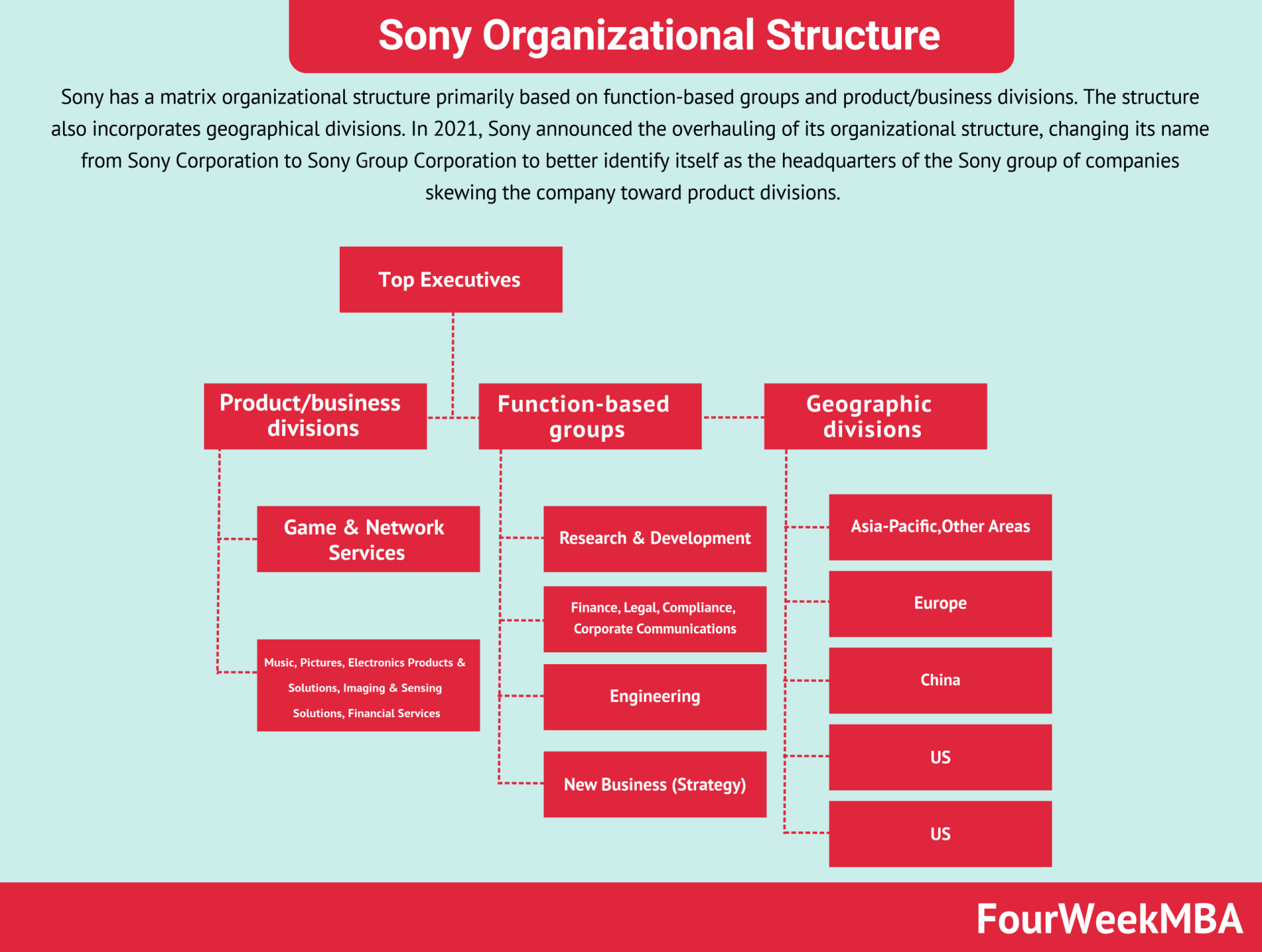
Sony has a matrix organizational structure primarily based on function-based groups and product/business divisions. The structure also incorporates geographical divisions. In 2021, Sony announced the overhauling of its organizational structure, changing its name from Sony Corporation to Sony Group Corporation to better identify itself as the headquarters of the Sony group of companies skewing the company toward product divisions.
Starbucks follows a matrix organizational structure with a combination of vertical and horizontal structures. It is characterized by multiple, overlapping chains of command and divisions.
Tesla is characterized by a functional organizational structure with aspects of a hierarchical structure. Tesla does employ functional centers that cover all business activities, including finance, sales, marketing, technology, engineering, design, and the offices of the CEO and chairperson. Tesla’s headquarters in Austin, Texas, decide the strategic direction of the company, with international operations given little autonomy.
Toyota has a divisional organizational structure where business operations are centered around the market, product, and geographic groups. Therefore, Toyota organizes its corporate structure around global hierarchies (most strategic decisions come from Japan’s headquarter), product-based divisions (where the organization is broken down, based on each product line), and geographical divisions (according to the geographical areas under management).
Walmart has a hybrid hierarchical-functional organizational structure, otherwise referred to as a matrix structure that combines multiple approaches. On the one hand, Walmart follows a hierarchical structure, where the current CEO Doug McMillon is the only employee without a direct superior, and directives are sent from top-level management. On the other hand, the function-based structure of Walmart is used to categorize employees according to their particular skills and experience.
Gennaro is the creator of FourWeekMBA, which reached about four million business people, comprising C-level executives, investors, analysts, product managers, and aspiring digital entrepreneurs in 2022 alone | He is also Director of Sales for a high-tech scaleup in the AI Industry | In 2012, Gennaro earned an International MBA with emphasis on Corporate Finance and Business Strategy.
Scroll to Top
Discover more from FourWeekMBA
Subscribe now to keep reading and get access to the full archive.