Building up a business from scratch is not an easy fit. And there are many reasons why a business fails. In this research we’ll look at a few common reaons:
Lack of a Solid Business Plan
Lack of Emotional Attachment to the Project
Lack of funds
Lack of customer focus
Failure to Get the Pricing and Discounts Right
Lack of an HR Strategy
Lacking a Solid Business Plan
A one-page business plan is a simple tool to clear your mind. It focuses on three questions: What core problem am I solving? Who are my potential key customers? Where do I find them? It helps define the problem, profile the key customer, and find the key distribution channel.
As the cliché goes, “you don’t plan to fail, but you just fail to plan,” many ventures are founded without a firm business model in place to start with.
Experts point out that one does not have to have a set-in-stone plan running into several pages. But since the business itself is expected to be online and adaptable by nature, one has to put down some framework of the primary objectives and execute on them. In that respect, the OKR framework is very helpful:
Andy Grove, helped Intel become among the most valuable companies by 1997. In his years at Intel, he conceived a management and goal-setting system, called OKR, standing for “objectives and key results.” Venture capitalist and early investor in Google, John Doerr, systematized in the book “Measure What Matters.”
It could start by saying what the product or service the business plans to make or offer, and the current scenario in the market it is preparing to enter. The top cited reason, why startups fail, is because their idea falls short of filling a market need. Business owners should outline the need for the product or the service and in what manner the business to be started will cater to that need/demand.
Finally, there can be a brief mention of how much money will be needed, when would the company start making profits and how many people may have to be recruited to accomplish the tasks. If you ask around, very few new businesses will be able to spell these out clearly.
Lack of Emotional Attachment to the Project
Any new business is a project, and many try and compare it to a new-born baby. As much as attention and focus need to be directed towards the business, the entrepreneur has to be quite possessive about the project, a kind of emotional attachment and the inner urge to see it beyond the standard ways of looking at a business.
This is being mentioned because a new business goes through many trials and challenges in the early days; arranging to fund could be a monumental task, getting the right people for critical functions and getting the marketingstrategy right are all challenges that can affect any individual.
The owner of the online business has to have the determination and perseverance to survive through such turbulent times. The passion will only get them through. Those who do not possess these qualities often fail.
Lack of funds: “It’s About Money Honey”
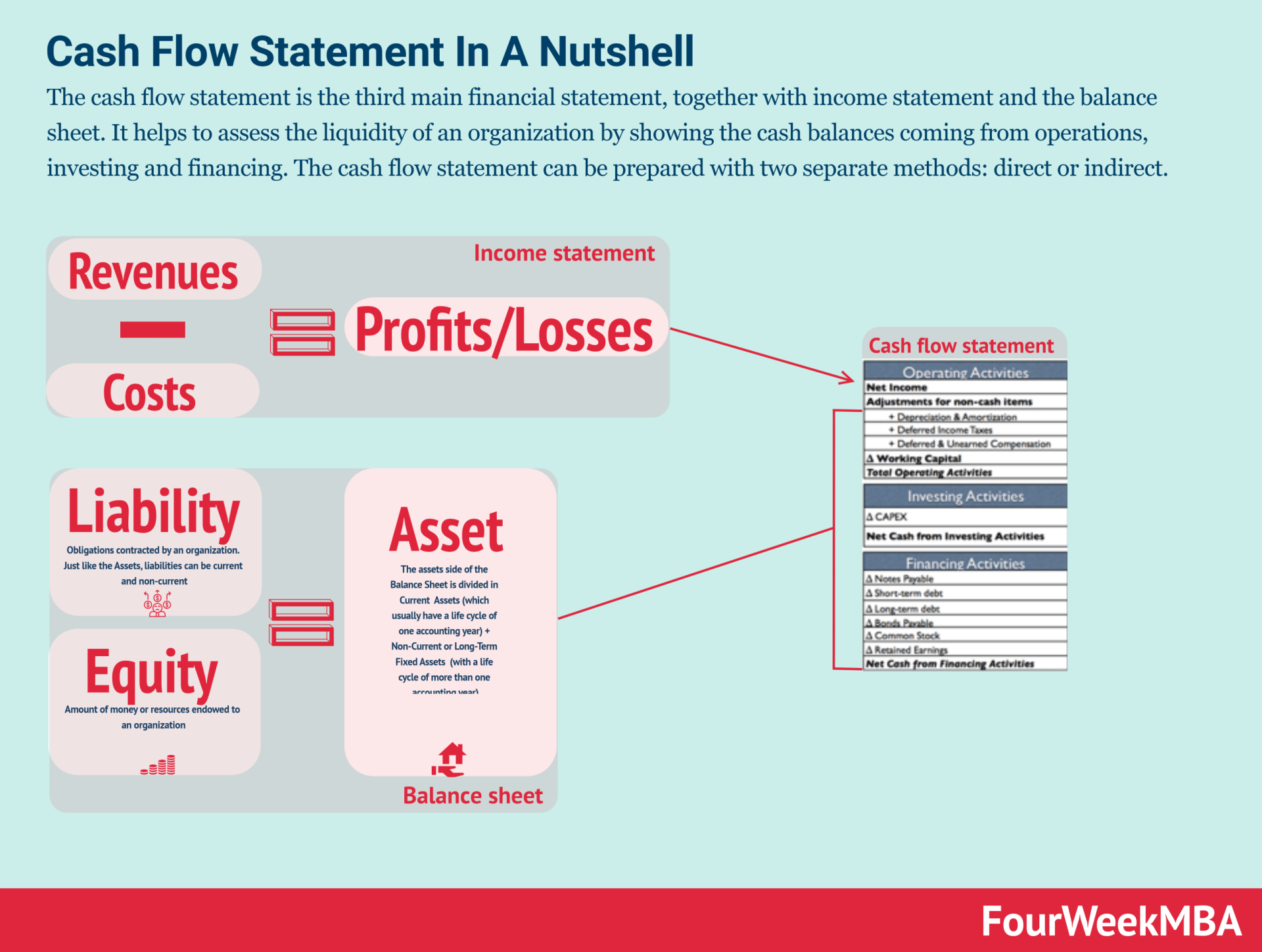
The cash flow statement is the third main financial statement, together with income statement and the balance sheet. It helps to assess the liquidity of an organization by showing the cash balances coming from operations, investing and financing. The cash flow statement can be prepared with two separate methods: direct or indirect.
Again, an oft-repeated cliché. The fact is that when a new business is started, it sucks the maximum amount of funds.
Depending on the kind of business you have planned online, the revenue inflow may start after several months. Have you worked out your full financial needs and the sources they will be raised from and how the funds will be structured?
You can bet many businesses get it wrong. If this is allowed to go out of hand, it can rapidly slide down and take the venture to failure before you know it. Your financial management ought to be perfect. The ones who make the mistake of not taking this seriously will find it hard to succeed.
Lack of customer focus: Mind Your Customer
Customer obsession goes beyond quantitative and qualitative data about customers, and it moves around customers’ feedback to gather valuable insights. Those insights start by the entrepreneur’s wandering process, driven by hunch, gut, intuition, curiosity, and a builder mindset. The product discovery moves around a building, reworking, experimenting, and iterating loop.
While the traditional businesses learned the hard way how important it is to keep the customers’ interests the top-most priority, the challenge is even more critical for the online businesses since the customer is unseen and, on many occasions, unheard.
It is essential that you build within your site a platform for your customers to let you know what they feel about your business, your products, and your service. If you are the business owner, you may not know that your product was delivered late to a customer or that they received the wrong product unless you encourage your customers to get back to you and inform you.
Online businesses make this mistake frequently and may realize very late that their customers have switched to other sites to do their transactions.
Failure to Get the Pricing and Discounts Right
A pricing strategy or model helps companies find the pricing formula in fit with their business models. Thus aligning the customer needs with the product type while trying to enable profitability for the company. A good pricing strategy aligns the customer with the company’s long term financial sustainability to build a solid business model.
This is a very frequently observed blunder by new businesses; either they are misguided by someone, or the business owner himself/herself has these pre-conceived notions of doling out too much to attract the customers and grow the revenue.
While as a strategy per se, this may not be wrong, it ought to be calibrated and executed based on in-depth research and knowing the consequences fully. The mistake businesses often commit is to give away too much too soon and then they are left with nothing to give. As a result, the customer could drop you like a hot brick.
But many online businesses make the mistake of either over-hiring, then finding difficult to pay employees their salaries when things get tough, or under-hiring, leaving out critical functions which can have a negative impact on specific processes. It can even end up being the reason for the downfall of the organization.
That’s why it’s crucial for business owners to establish an effective strategy for managing their teams. It’s also necessary for entrepreneurs to follow recommended guidelines for how to pay employees during the startup stage.
There may be many other mistakes that online businesses commit that lead to their failure.
In any eventuality, lessons are learned and some of the mistakes may not be made again. The need is definitely for the businesses to learn from the mistakes of others and not their own. There are enough recorded case studies of why an online business failed, and it takes some effort to learn how to avoid them to embrace success.
Key takeaway
As we’ve seen throughout this article when starting an online business, there are several things you can do and several ways to make it work.
Lack of a Solid Business Plan
Lack of Emotional Attachment to the Project
Lack of funds
Lack of customer focus
Failure to Get the Pricing and Discounts Right
Lack of an HR Strategy
If you take the time to focus on avoiding these six critical pitfalls that can break your online business from the start you’re already half the way to build a successful venture!
Key highlights
Lack of a Solid Business Plan: Many startups fail to create a clear and concise business plan outlining their product or service, target market, financial projections, and key objectives. Having a well-defined business plan helps provide direction and focus for the business.
Lack of Emotional Attachment to the Project: Successful entrepreneurs often have a strong emotional attachment to their projects. A new business requires determination, perseverance, and passion to overcome challenges and setbacks. Lack of emotional investment can lead to a lack of resilience when facing difficulties.
Lack of Funds: Insufficient funds or improper financial management can quickly lead to business failure. New businesses typically require a substantial amount of capital to cover operational expenses before revenue starts flowing in. Having a clear understanding of financial needs and sources of funding is crucial.
Lack of Customer Focus: Online businesses need to prioritize customer satisfaction and feedback. Failing to engage with customers, gather insights, and address their needs can result in customer attrition and a negative reputation. Building a platform for customer communication is essential.
Failure to Get Pricing and Discounts Right: Incorrect pricing strategies, such as offering excessive discounts too soon, can erode profits and devalue the product or service. A well-researched pricing strategy aligned with the business model is necessary to ensure profitability.
Lack of an HR Strategy: Human resources play a critical role in the success of any startup. Over-hiring or under-hiring can disrupt operations and impact processes. Establishing a well-defined HR strategy and team management approach is essential.
Learning from Mistakes: Online businesses should learn from the mistakes of others to avoid common pitfalls. Studying case studies and adopting best practices can help prevent errors that lead to failure.
Now that you know what mistakes to avoid, do you need some ideas to get started? Below a list of 12 ideas that require little investment and carry a high profit-margin:
A Blockchain Business Model according to the FourWeekMBA framework is made of four main components: Value Model (Core Philosophy, Core Values and Value Propositions for the key stakeholders), Blockchain Model (Protocol Rules, Network Shape and Applications Layer/Ecosystem), Distribution Model (the key channels amplifying the protocol and its communities), and the Economic Model (the dynamics/incentives through which protocol players make money). Those elements coming together can serve as the basis to build and analyze a solid Blockchain Business Model.
In an asymmetric business model, the organization doesn’t monetize the user directly, but it leverages the data users provide coupled with technology, thus have a key customer pay to sustain the core asset. For example, Google makes money by leveraging users’ data, combined with its algorithms sold to advertisers for visibility.
In a business world driven by technology and digitalization, competition is much more fluid, as innovation becomes a bottom-up approach that can come from anywhere. Thus, making it much harder to define the boundaries of existing markets. Therefore, a proper business competition analysis looks at customer, technology, distribution, and financial model overlaps. While at the same time looking at future potential intersections among industries that in the short-term seem unrelated.
Technological modeling is a discipline to provide the basis for companies to sustain innovation, thus developing incremental products. While also looking at breakthrough innovative products that can pave the way for long-term success. In a sort of Barbell Strategy, technological modeling suggests having a two-sided approach, on the one hand, to keep sustaining continuous innovation as a core part of the business model. On the other hand, it places bets on future developments that have the potential to break through and take a leap forward.
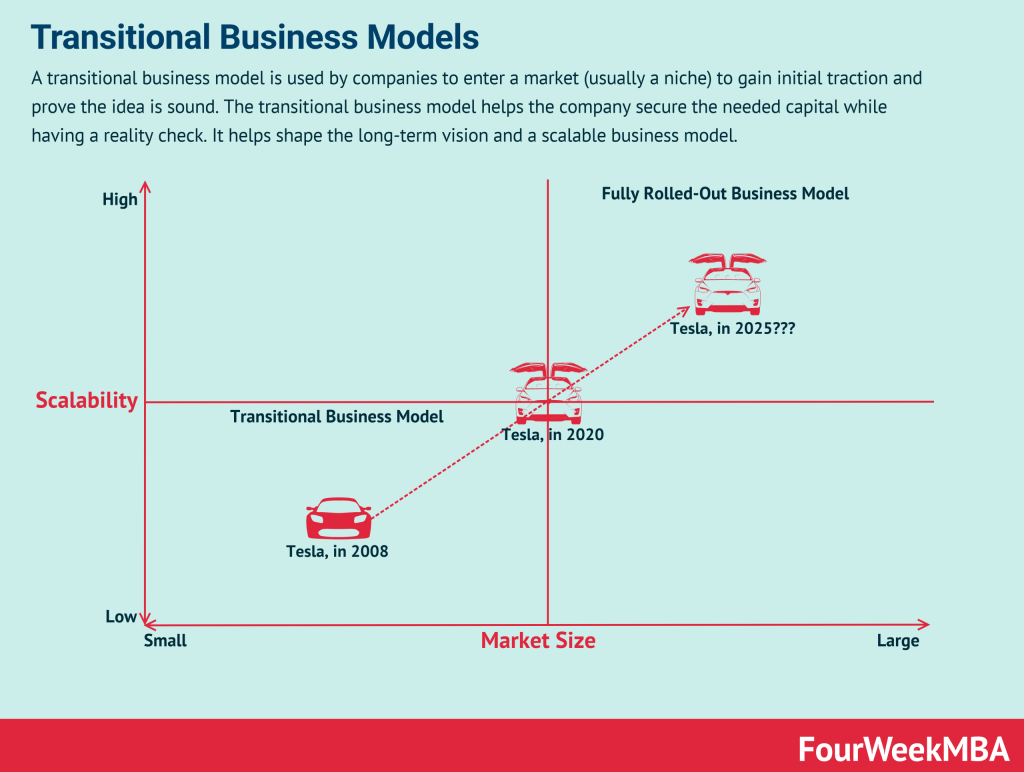
A transitional business model is used by companies to enter a market (usually a niche) to gain initial traction and prove the idea is sound. The transitional business model helps the company secure the needed capital while having a reality check. It helps shape the long-term vision and a scalable business model.
The minimum viable audience (MVA) represents the smallest possible audience that can sustain your business as you get it started from a microniche (the smallest subset of a market). The main aspect of the MVA is to zoom into existing markets to find those people which needs are unmet by existing players.
Business scaling is the process of transformation of a business as the product is validated by wider and wider market segments. Business scaling is about creating traction for a product that fits a small market segment. As the product is validated it becomes critical to build a viable business model. And as the product is offered at wider and wider market segments, it’s important to align product, business model, and organizational design, to enable wider and wider scale.
The market expansion consists in providing a product or service to a broader portion of an existing market or perhaps expanding that market. Or yet, market expansions can be about creating a whole new market. At each step, as a result, a company scales together with the market covered.
In the FourWeekMBA growth matrix, you can apply growth for existing customers by tackling the same problems (gain mode). Or by tackling existing problems, for new customers (expand mode). Or by tackling new problems for existing customers (extend mode). Or perhaps by tackling whole new problems for new customers (reinvent mode).
In the FourWeekMBA Revenue Streams Matrix, revenue streams are classified according to the kind of interactions the business has with its key customers. The first dimension is the “Frequency” of interaction with the key customer. As the second dimension, there is the “Ownership” of the interaction with the key customer.
Revenue model patterns are a way for companies to monetize their business models. A revenue model pattern is a crucial building block of a business model because it informs how the company will generate short-term financial resources to invest back into the business. Thus, the way a company makes money will also influence its overall business model.
A pricing strategy or model helps companies find the pricing formula in fit with their business models. Thus aligning the customer needs with the product type while trying to enable profitability for the company. A good pricing strategy aligns the customer with the company’s long term financial sustainability to build a solid business model.
The Cynefin Framework gives context to decision making and problem-solving by providing context and guiding an appropriate response. The five domains of the Cynefin Framework comprise obvious, complicated, complex, chaotic domains and disorder if a domain has not been determined at all.
A SWOT Analysis is a framework used for evaluating the business’s Strengths, Weaknesses, Opportunities, and Threats. It can aid in identifying the problematic areas of your business so that you can maximize your opportunities. It will also alert you to the challenges your organization might face in the future.
The SWOT analysis is commonly used as a strategic planning tool in business. However, it is also well suited for personal use in addressing a specific goal or problem. A personal SWOT analysis helps individuals identify their strengths, weaknesses, opportunities, and threats.
The Pareto Analysis is a statistical analysis used in business decision making that identifies a certain number of input factors that have the greatest impact on income. It is based on the similarly named Pareto Principle, which states that 80% of the effect of something can be attributed to just 20% of the drivers.
A failure mode and effects analysis (FMEA) is a structured approach to identifying design failures in a product or process. Developed in the 1950s, the failure mode and effects analysis is one the earliest methodologies of its kind. It enables organizations to anticipate a range of potential failures during the design stage.
A Blindspot Analysis is a means of unearthing incorrect or outdated assumptions that can harm decision making in an organization. The term “blindspot analysis” was first coined by American economist Michael Porter. Porter argued that in business, outdated ideas or strategies had the potential to stifle modern ideas and prevent them from succeeding. Furthermore, decisions a business thought were made with care caused projects to fail because major factors had not been duly considered.
A comparable company analysis is a process that enables the identification of similar organizations to be used as a comparison to understand the business and financial performance of the target company. To find comparables you can look at two key profiles: the business and financial profile. From the comparable company analysis it is possible to understand the competitive landscape of the target organization.
A cost-benefit analysis is a process a business can use to analyze decisions according to the costs associated with making that decision. For a cost analysis to be effective it’s important to articulate the project in the simplest terms possible, identify the costs, determine the benefits of project implementation, assess the alternatives.
Agile Business Analysis (AgileBA) is certification in the form of guidance and training for business analysts seeking to work in agile environments. To support this shift, AgileBA also helps the business analyst relate Agile projects to a wider organizational mission or strategy. To ensure that analysts have the necessary skills and expertise, AgileBA certification was developed.
A SOAR analysis is a technique that helps businesses at a strategic planning level to:
Focus on what they are doing right.
Determine which skills could be enhanced.
Understand the desires and motivations of their stakeholders.
The STEEPLE analysis is a variation of the STEEP analysis. Where the step analysis comprises socio-cultural, technological, economic, environmental/ecological, and political factors as the base of the analysis. The STEEPLE analysis adds other two factors such as Legal and Ethical.
The PESTEL analysis is a framework that can help marketers assess whether macro-economic factors are affecting an organization. This is a critical step that helps organizations identify potential threats and weaknesses that can be used in other frameworks such as SWOT or to gain a broader and better understanding of the overall marketing environment.
A DESTEP analysis is a framework used by businesses to understand their external environment and the issues which may impact them. The DESTEP analysis is an extension of the popular PEST analysis created by Harvard Business School professor Francis J. Aguilar. The DESTEP analysis groups external factors into six categories: demographic, economic, socio-cultural, technological, ecological, and political.
A paired comparison analysis is used to rate or rank options where evaluation criteria are subjective by nature. The analysis is particularly useful when there is a lack of clear priorities or objective data to base decisions on. A paired comparison analysis evaluates a range of options by comparing them against each other.
Gennaro is the creator of FourWeekMBA, which reached about four million business people, comprising C-level executives, investors, analysts, product managers, and aspiring digital entrepreneurs in 2022 alone | He is also Director of Sales for a high-tech scaleup in the AI Industry | In 2012, Gennaro earned an International MBA with emphasis on Corporate Finance and Business Strategy.
2 thoughts on “6 Mistakes To Avoid To Build A Successful Online Business”
divjangid
Great article! I think the most important think in the business is emotional attachment. If you don’t have feeling for your business than it won’t work.









Great article! I think the most important think in the business is emotional attachment. If you don’t have feeling for your business than it won’t work.
thank you! And great point. Emotional attachment is critical!