Problem-solving techniques in business need to leverage simple decision-making models that can help solve problems quickly and effectively, without getting stuck.
The seven steps to problem-solving are a disciplined and methodical approach to identifying and addressing the root cause of problems. Instead, a more robust approach involves working through a problem using the hypothesis-driven framework of the scientific method. Each viable hypothesis is tested using a range of specific diagnostics, and recommendations are made.
The Feynman Technique is a mental model and strategy for learning something new and committing it to memory. It is often used in exam preparation and for understanding difficult concepts. Physicist Richard Feynman elaborated on this powerful technique to explain anything.
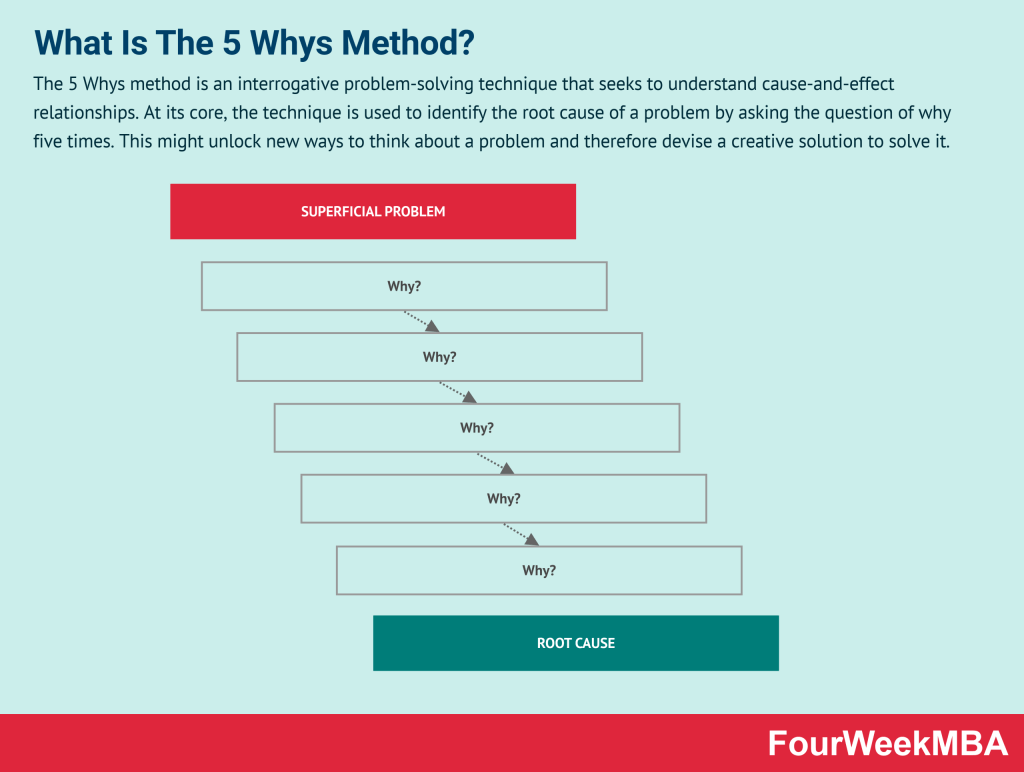
The 5 Whys method is an interrogative problem-solving technique that seeks to understand cause-and-effect relationships. At its core, the technique is used to identify the root cause of a problem by asking the question of why five times. This might unlock new ways to think about a problem and therefore devise a creative solution to solve it.
The Fishbone Diagram is a diagram-based technique used in brainstorming to identify potential causes for a problem. Thus, it is a visual representation of cause and effect. The problem or effect serves as the head of the fish. Possible causes of the problem are listed on the individual “bones” of the fish. This encourages problem-solving teams to consider a wide range of alternatives.
The Lightning Decision Jam (LDJ) is a means of making fast decisions that provide quick direction. The Lightning Decision Jam was developed by design agency AJ&Smart in response to the inefficiency of business meetings. Borrowing ideas from the core principles of design sprints, AJ&Smart created the Lightning Decision Jam.
The less-is-better effect was first proposed by behavioral scientist Christopher Hsee in a 1998 study. He noted in the experiment that a person giving a $45 scarf as a gift was perceived to be more generous than someone giving a $55 coat. The less-is-better effect describes the consumer tendency to choose the worse of two options – provided that each option is presented separately.
The Eisenhower Matrix is a tool that helps businesses prioritize tasks based on their urgency and importance; named after Dwight D. Eisenhower, President of the United States from 1953 to 1961, the matrix helps businesses and individuals differentiate between the urgent and important to prevent urgent things (seemingly useful in the short-term) cannibalize important things (critical for long-term success).
The Cynefin Framework gives context to decision-making and problem-solving by providing context and guiding an appropriate response. The five domains of the Cynefin Framework comprise obvious, complicated, complex, chaotic domains, and disorder if a domain has not been determined.
Starbursting is a structured brainstorming technique with a focus on question generation. Starbursting is a structured form of brainstorming allowing product teams to cover all bases during the ideation process. It utilizes a series of questions to systematically work through various aspects of product development, forcing teams to evaluate ideas based on viability.
Appreciate Inquiry (AI) is an organizational change methodology that focuses on strengths and not on weaknesses. Appreciate Inquiry was created by management professors David Cooperrider and Suresh Srivastva in the 1980s. The Appreciate Inquiry is also known as the 5-D Cycle, an iterative cycle describing five distinct phases, made of define, discover, dream, design, and destiny.
Round-robin brainstorming is a collective and iterative approach to brainstorming. Brainstorming is an effective way of generating fresh ideas for an organization. Round-robin brainstorming is a balanced approach, employing an iterative, circular process that builds on the previous contribution of each participant.
Constructive controversy is a theory arguing that controversial discussions create a good starting point for understanding complex problems. A constructive controversy discussion is performed by following six steps: organize information and derive conclusions; presenting and advocating decisions; being challenged by opposing views; conceptual conflict and uncertainty; epistemic curiosity and perspective-taking; and reconceptualization, synthesis, and integration.
Affinity grouping is a collaborative prioritization process where group participants brainstorm ideas and opportunities according to their similarities. Affinity grouping is a broad and versatile process based on simple but highly effective ideas. It helps teams generate and then organize teams according to their similarity or likeness.
The Fishbone Diagram is a diagram-based technique used in brainstorming to identify potential causes for a problem, thus it is a visual representation of cause and effect. The problem or effect serves as the head of the fish. Possible causes of the problem are listed on the individual “bones” of the fish. This encourages problem-solving teams to consider a wide range of alternatives.
Rolestorming as a term was first mentioned by personal development guru Rick Griggs in the 1980s. Rolestorming is a brainstorming technique where participants pretend they are other people when sharing their thoughts and ideas.
Reverse brainstorming takes advantage of the natural human tendency to more easily see problems than solutions. What’s more, many individuals when placed in a traditional brainstorming environment will find it difficult to become creative on command. Reverse brainstorming is an approach where individuals brainstorm the various ways a plan could fail.
A lotus diagram is a creative tool for ideation and brainstorming. The diagram identifies the key concepts from a broad topic for simple analysis or prioritization.
The futures wheel was invented in 1971 by Jerome C. Glenn while he was studying at the Antioch Graduate School of Education. The futures wheel is a brainstorming framework for visualizing the future consequences of a particular trend or event.
Key highlights of problem-solving techniques in business:
Seven Steps to Problem-Solving: A disciplined and methodical approach to identifying and addressing the root cause of problems, using the hypothesis-driven framework of the scientific method.
Feynman Technique: A mental model and strategy for learning and understanding new concepts, often used in exam preparation.
5 Whys Method: An interrogative problem-solving technique to identify the root cause of a problem by asking “why” five times.
Fishbone Diagram: A diagram-based technique used in brainstorming to identify potential causes for a problem, representing cause and effect visually.
Lightning Decision Jam: A fast decision-making process that provides quick direction, developed by design agency AJ&Smart.
Less-Is-Better Effect: The consumer tendency to choose the worse of two options when presented separately.
Eisenhower Matrix: A tool to prioritize tasks based on urgency and importance.
Cynefin Framework: A decision-making and problem-solving framework that provides context and guides an appropriate response.
Starbursting: A structured brainstorming technique focused on question generation.
Appreciative Inquiry: An organizational change methodology that focuses on strengths rather than weaknesses.
Round-robin Brainstorming: A collective and iterative approach to brainstorming.
Constructive Controversy: A theory arguing that controversial discussions aid in understanding complex problems.
Affinity Grouping: A collaborative prioritization process where participants brainstorm and organize ideas based on similarities.
Rolestorming: A brainstorming technique where participants pretend to be other people when sharing their thoughts and ideas.
Reverse Brainstorming: An approach where individuals brainstorm ways a plan could fail instead of finding solutions.
Lotus Diagram: A creative tool for ideation and brainstorming, identifying key concepts for analysis or prioritization.
Futures Wheel: A framework for visualizing the future consequences of a trend or event.
User Manual to Problem-Solving Techniques
Problem-Solving Technique/Concept
Description
When to Use
Advantages
Drawbacks
7 Steps To Problem-Solving
A disciplined approach to identifying and addressing root causes.
When tackling complex problems that require systematic analysis.
Provides a structured and methodical problem-solving process.
May be time-consuming for simple problems.
Feynman Technique
A learning strategy for understanding and memorizing new concepts.
When studying challenging subjects or preparing for exams.
Promotes deep understanding and retention of complex topics.
Requires effort and discipline to implement.
5 Whys Method
An interrogative technique for uncovering root causes by asking “why” five times.
To investigate the underlying causes of recurring issues or problems.
Simplicity and effectiveness in identifying root causes. Encourages critical thinking.
May not address multifaceted issues adequately.
Fishbone Diagram
A visual tool for brainstorming potential causes of a problem.
In brainstorming sessions to identify and explore possible causes of complex problems.
Encourages collaboration and comprehensive exploration of causes.
Diagram creation can be time-consuming.
Lightning Decision Jam (LDJ)
A rapid decision-making method for efficient meetings.
When quick direction is needed in meetings or brainstorming sessions.
Speeds up decision-making and promotes collaboration.
May not suit all decision scenarios.
Less-Is-Better Effect
A phenomenon where less valuable options are perceived as more generous.
When presenting choices individually to influence perceptions.
Can lead to cost savings and favorable perceptions.
Limited applicability to all decisions.
Eisenhower Matrix
A tool for prioritizing tasks based on urgency and importance.
When managing time and tasks to enhance productivity.
Helps differentiate between urgent and important tasks.
May not address task complexity or resource constraints.
Cynefin Framework
A decision-making framework that provides context and guides responses.
When addressing problems or making decisions in various contexts.
Tailors decision-making approaches to different situations.
May require subjective interpretation.
Starbusting
A structured brainstorming technique with a focus on question generation.
In the ideation phase of product development to evaluate ideas systematically.
Forces teams to evaluate ideas based on viability and comprehensiveness.
May be time-intensive in large brainstorming sessions.
Appreciative Inquiry (AI)
An organizational change methodology focusing on strengths.
When organizations want to drive positive change and innovation.
Promotes a positive organizational culture and collaboration.
Limited in addressing weaknesses or crisis situations.
Round-robin Brainstorming
A collective and iterative approach to brainstorming.
In group brainstorming sessions to ensure equal participation.
Balances contributions from all participants and builds on previous ideas.
May slow down the ideation process.
Constructive Controversy
A theory that controversial discussions aid understanding complex problems.
When seeking deeper insights and solutions to complex issues.
Encourages diverse perspectives and critical thinking.
Requires a structured approach and open-minded participants.
Affinity Grouping
A collaborative prioritization process based on similarities.
When organizing ideas or opportunities into categories.
Simplifies complex information and organizes ideas effectively.
May require clear criteria for grouping.
Rolestorming
A brainstorming technique where participants pretend to be other people.
When seeking alternative perspectives and fresh ideas.
Encourages creative thinking and diverse viewpoints.
Participants may need guidance to stay in character.
Reverse Brainstorming
An approach to brainstorming focused on identifying potential problems.
When seeking to uncover potential issues in a plan or concept.
Highlights potential challenges and weaknesses early in the process.
May initially discourage positive ideation.
Lotus Diagram
A creative tool for ideation and brainstorming to identify key concepts.
In brainstorming sessions to simplify complex topics and generate ideas.
Organizes ideas effectively and facilitates idea prioritization.
Diagram creation can be time-consuming.
Futures Wheel
A framework for visualizing future consequences of trends or events.
When analyzing the potential outcomes of specific trends or events.
Helps anticipate and prepare for future developments.
Gennaro is the creator of FourWeekMBA, which reached about four million business people, comprising C-level executives, investors, analysts, product managers, and aspiring digital entrepreneurs in 2022 alone | He is also Director of Sales for a high-tech scaleup in the AI Industry | In 2012, Gennaro earned an International MBA with emphasis on Corporate Finance and Business Strategy.