A Decacorn is a company valued at over $10 billion. The top ten Decacorn Companies in 2022, comprise Bytedance , SpaceX , Stripe , Klarna , Epic Games , Cana, Checkout.com, Instacart , and Databricks. With the rise of consumer technologies able to have worldwide traction, unicorns seem to be no longer the rule.
Key Components
Understanding decacorns
As we saw, a decacorn is a private, venture-backed company with a value exceeding $10 billion.
Examples of decacorn companies
Let’s take a look at five examples of decacorns operating today.
Real-World Examples
AlibabaAmazonAppleFacebookMetaGoogle
Key Takeaways
●As we saw, a decacorn is a private, venture-backed company with a value exceeding $10 billion.
●Let’s take a look at five examples of decacorns operating today.
●Understanding decacorns: As we saw, a decacorn is a private, venture-backed company with a value…
●Examples of decacorn companies: Let’s take a look at five examples of decacorns operating today.
Key Insight
A Decacorn is a company valued at over $10 billion. The top ten Decacorn Companies in 2022, comprise Bytedance , SpaceX , Stripe , Klarna , Epic Games , Cana, Checkout.com, Instacart , and Databricks. With the rise of consumer technologies able to have worldwide traction, unicorns seem to be no longer the rule.
Exec Package + Claude OS Master Skill | Business Engineer Founding Plan
FourWeekMBA x Business Engineer | Updated 2026
A Decacorn is a company valued at over $10 billion. The top ten Decacorn Companies in 2022, comprise Bytedance, SpaceX, Stripe, Klarna, Epic Games, Cana, Checkout.com, Instacart, and Databricks. With the rise of consumer technologies able to have worldwide traction, unicorns seem to be no longer the rule. In other words, a decade ago a billion-dollar valuation was a strong position to be which allowed the company in that position to create a long-lasting advantage.
Company – Credit: CB Insights
Valuation (Billions)
Bytedance
$140
SpaceX
$100.30
Stripe
$95
Klarna
$45.60
Epic Games
$42
Canva
$40
Checkout.com
$40
Instacart
$39
Databricks
$38
Revolut
$33
Chime
$25
FTX
$25
BYJU’s
$21
Xiaohongshu
$20
J&T Express
$20
Fanatics
$18
Miro
$17.50
Yuanfudao
$15.50
DJI Innovations
$15
SHEIN
$15
Understanding decacorns
As we saw, a decacorn is a private, venture-backed company with a value exceeding $10 billion.
The first company to achieve decacorn status was Facebook, now Meta, which achieved a valuation of $10 billion in 2007 after a $240 million investment from Microsoft. Chinese giant Alibaba became the second to achieve the feat two years later.
Note that decacorns are startup companies that tend to be valued on their potential for growth and not on their previous financial performance. When a decacorn is acquired or goes public, it can no longer be called a decacorn.
Since Facebook, a further 84 decacorns have been created with 33 of those losing their status for whatever reason. This leaves a total of 51 companies – some of which we will discuss in the following section.
Examples of decacorn companies
Let’s take a look at five examples of decacorns operating today.
ByteDance
ByteDance is a Chinese mobile app developer with a portfolio of social media and content discovery apps such as TikTok and Douyin.
TikTok is the Chinese creative social media platform primarily driven by short-form video content. It launches challenges of various types to tap into the creativity of its users and generate engaging (if not addicting content) accessible via an infinite feed. TikTok primarily makes money through advertising, thus making it an attention-based businessmodel.
Canva is a graphic designplatform renown for its simplicity and the fact that it is freely accessible to users. The platform follows a freemium model, where users are prompted to subscribe (Canva Pro) to get more features at $12.99/month. Other plans comprise Canva Enterprise ($30/month). Other services are Canva Print (allowing consumers to print a chosen design on physical material) and the Marketplace, where designs are sold at one-time, and Canva takes a cut of the sales.
Canva has over 500,000 paying customers, many of those corporate clients such as PayPal, Zoom, and American Airlines.
Uber
Uber became a unicorn ($1 billion valuation) in 2009 and then a decacorn just five years later.
Uber is a is two-sided marketplace, a platform business model that connects drivers and riders, with an interface that has elements of gamification, that makes it easy for two sides to connect and transact. Uber makes money by collecting fees from the platform’s gross bookings.
Didi Chuxing
Didi Chuxing is a Chinese provider of app-based transportation services, including social ride-sharing, taxi-hailing, chauffeuring, and bike-sharing. The company also allows consumers to rent or lease vehicles.
Didi Chuxing became a decacorn in 2014 after just two years in operation. At the peak of the COVID-19 pandemic, the company was still able to facilitate 60 million daily trips globally.
Revolut
Revolut an English fintech company offering banking and investment services to consumers. Founded in 2015 by Nikolay Storonsky and Vlad Yatsenko, the company initially produced a low-rate travel card. Storonsky in particular was an avid traveler who became tired of spending hundreds of pounds on currency exchange and foreign transaction fees. The Revolut app and core banking account are free to use. Instead, money is made through a combination of subscription fees, transaction fees, perks, and ancillary services.
Revolut is a British fintech company that offers a range of banking products and services.
Like Canva, Revolut became a decacorn in 2021 with an impressive funding round worth $800 million. Valued at $33 billion, this made Revolut the most valuable startup in the United Kingdom at the time.
Key takeaways:
A decacorn is a private, venture-backed company with a value exceeding $10 billion. Facebook, now Meta, was the first company to achieve this status in 2007.
Most decacorns are startup companies that tend to be valued on their potential for growth and not on their previous financial performance. When a decacorn is acquired or goes public, it relinquishes decacorn status.
At the time of writing, there are 51 decacorn companies around the world. Some examples include Canva, Revolut, Didi Chuxing, Uber, and ByteDance.
A Blockchain Business Model according to the FourWeekMBA framework is made of four main components: Value Model (Core Philosophy, Core Values and Value Propositions for the key stakeholders), Blockchain Model (Protocol Rules, Network Shape and Applications Layer/Ecosystem), Distribution Model (the key channels amplifying the protocol and its communities), and the Economic Model (the dynamics/incentives through which protocol players make money). Those elements coming together can serve as the basis to build and analyze a solid Blockchain Business Model.
In an asymmetric businessmodel, the organization doesn’t monetize the user directly, but it leverages the data users provide coupled with technology, thus have a key customer pay to sustain the core asset. For example, Google makes money by leveraging users’ data, combined with its algorithms sold to advertisers for visibility.
In a business world driven by technology and digitalization, competition is much more fluid, as innovation becomes a bottom-up approach that can come from anywhere. Thus, making it much harder to define the boundaries of existing markets. Therefore, a proper business competition analysis looks at customer, technology, distribution, and financial model overlaps. While at the same time looking at future potential intersections among industries that in the short-term seem unrelated.
Technological modeling is a discipline to provide the basis for companies to sustain innovation, thus developing incremental products. While also looking at breakthrough innovative products that can pave the way for long-term success. In a sort of Barbell Strategy, technological modeling suggests having a two-sided approach, on the one hand, to keep sustaining continuous innovation as a core part of the businessmodel. On the other hand, it places bets on future developments that have the potential to break through and take a leap forward.
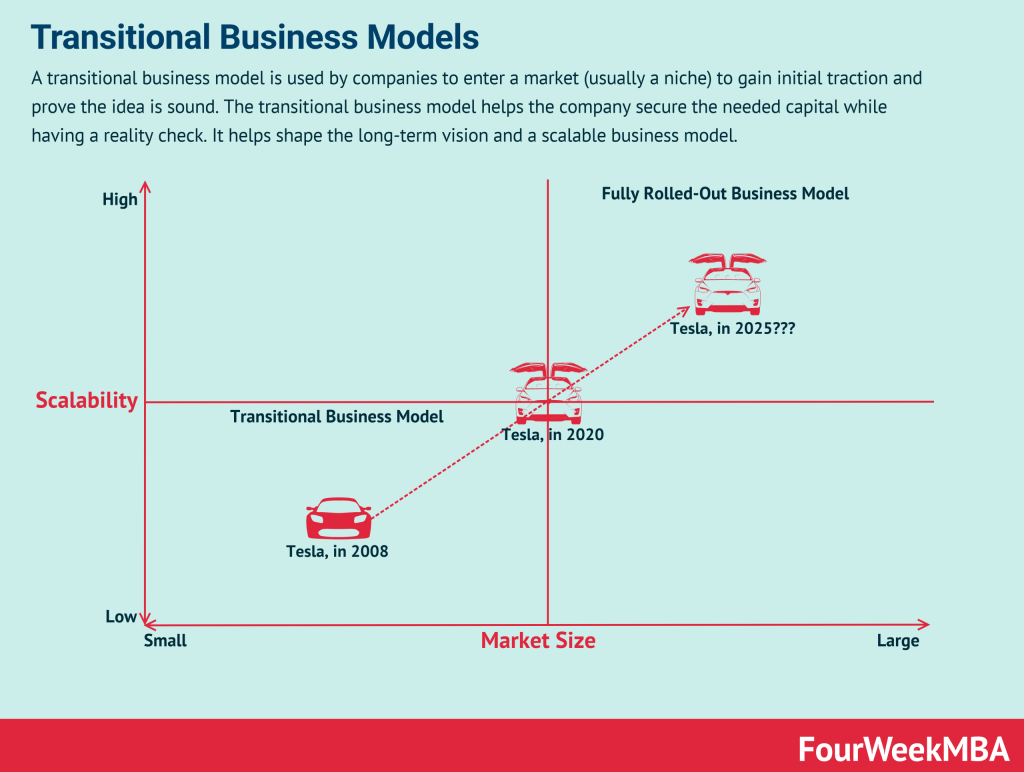
A transitional business model is used by companies to enter a market (usually a niche) to gain initial traction and prove the idea is sound. The transitional business model helps the company secure the needed capital while having a reality check. It helps shape the long-term vision and a scalable businessmodel.
The minimum viable audience (MVA) represents the smallest possible audience that can sustain your business as you get it started from a microniche (the smallest subset of a market). The main aspect of the MVA is to zoom into existing markets to find those people which needs are unmet by existing players.
Business scaling is the process of transformation of a business as the product is validated by wider and wider market segments. Business scaling is about creating traction for a product that fits a small market segment. As the product is validated it becomes critical to build a viable businessmodel. And as the product is offered at wider and wider market segments, it’s important to align product, businessmodel, and organizational design, to enable wider and wider scale.
The market expansion consists in providing a product or service to a broader portion of an existing market or perhaps expanding that market. Or yet, market expansions can be about creating a whole new market. At each step, as a result, a company scales together with the market covered.
In the FourWeekMBA growth matrix, you can apply growth for existing customers by tackling the same problems (gain mode). Or by tackling existing problems, for new customers (expand mode). Or by tackling new problems for existing customers (extend mode). Or perhaps by tackling whole new problems for new customers (reinvent mode).
In the FourWeekMBA Revenue Streams Matrix, revenue streams are classified according to the kind of interactions the business has with its key customers. The first dimension is the “Frequency” of interaction with the key customer. As the second dimension, there is the “Ownership” of the interaction with the key customer.
Revenue model patterns are a way for companies to monetize their business models. A revenue model pattern is a crucial building block of a business model because it informs how the company will generate short-term financial resources to invest back into the business. Thus, the way a company makes money will also influence its overall businessmodel.
A pricingstrategy or model helps companies find the pricing formula in fit with their business models. Thus aligning the customer needs with the product type while trying to enable profitability for the company. A good pricingstrategy aligns the customer with the company’s long term financial sustainability to build a solid businessmodel.
As we saw, a decacorn is a private, venture-backed company with a value exceeding $10 billion.
What is FourWeekMBA Business Toolbox?
What Is Business Model Innovation And Why It Matters. Successful Types of Business Models You Need to Know. What Is a Business Model Canvas? Business Model Canvas Explained
Frequently Asked Questions
What Is A Decacorn? The Era Of Decacorn Companies?
A Decacorn is a company valued at over $10 billion. The top ten Decacorn Companies in 2022, comprise Bytedance , SpaceX , Stripe , Klarna , Epic Games , Cana, Checkout.com, Instacart , and Databricks. With the rise of consumer technologies able to have worldwide traction, unicorns seem to be no longer the rule.
What is decacorns?
As we saw, a decacorn is a private, venture-backed company with a value exceeding $10 billion.
What are the key components of What Is A Decacorn? The Era Of Decacorn Companies?
The key components of What Is A Decacorn? The Era Of Decacorn Companies include Understanding decacorns, Examples of decacorn companies. Understanding decacorns: As we saw, a decacorn is a private, venture-backed company with a value exceeding $10 billion.
Gennaro is the creator of FourWeekMBA, which reached about four million business people, comprising C-level executives, investors, analysts, product managers, and aspiring digital entrepreneurs in 2022 alone | He is also Director of Sales for a high-tech scaleup in the AI Industry | In 2012, Gennaro earned an International MBA with emphasis on Corporate Finance and Business Strategy.