Warren Buffett is an American investor, business tycoon, and philanthropist. Known as the “Oracle of Omaha,” Buffett is best known for his strict adherence to value investing and frugality despite his immense wealth. Warren Buffet owns an investment firm, Berkshire Hathaway, which owns 5.92% of Apple, valued at nearly $170 billion.
Warren Buffett: An American investor, business magnate, and philanthropist known as the “Oracle of Omaha.”
Value Investing: Buffett is renowned for his value investing philosophy, which involves identifying undervalued stocks and holding them for the long term.
Frugality: Despite his vast wealth, Buffett is known for his frugal lifestyle and modest spending habits.
Berkshire Hathaway: Buffett is the chairman and CEO of Berkshire Hathaway, a multinational conglomerate holding company based in Omaha, Nebraska.
Apple Investment: Berkshire Hathaway owns a significant stake in Apple, amounting to 5.73% of the company. This stake is valued at over $130 billion.
Value investing is a strategy advocating the purchase of stocks that are underappreciated by other investors or the broader market. Value investing was popularised by investor Warren Buffett, but the approach was pioneered by Benjamin Graham and David Dodd at Columbia Business School in the early 1920s. Graham would later go on to release the seminal book The Intelligent Investor in 1949.
The Buffet Indicator is a measure of the total value of all publicly-traded stocks in a country divided by that country’s GDP. It’s a measure and ratio to evaluate whether a market is undervalued or overvalued. It’s one of Warren Buffet’s favorite measures as a warning that financial markets might be overvalued and riskier.
The circle of competence describes a person’s natural competence in an area that matches their skills and abilities. Beyond this imaginary circle are skills and abilities that a person is naturally less competent at. The concept was popularised by Warren Buffett, who argued that investors should only invest in companies they know and understand. However, the circle of competence applies to any topic and indeed any individual.
Economic or market moats represent long-term business defensibility. Or how long a business can retain its competitive advantage in the marketplace over the years. Warren Buffet who popularized the term “moat” referred to it as a share of mind, opposite to market share, as such it is the characteristic that all valuable brands have.
The Golden Circle attempts to explain how certain businesses can inspire others and differentiate themselves in the market. Originally developed by author Simon Sinek, the concept helps businesses identify their purpose and then communicate that purpose to consumers in a meaningful way so that the brand can be highly differentiated in the marketplace.
The 5 Whys method is an interrogative problem-solving technique that seeks to understand cause-and-effect relationships. At its core, the technique is used to identify the root cause of a problem by asking the question of why five times. This might unlock new ways to think about a problem and therefore devise a creative solution to solve it.
First-principles thinking – sometimes called reasoning from first principles – is used to reverse-engineer complex problems and encourage creativity. It involves breaking down problems into basic elements and reassembling them from the ground up. Elon Musk is among the strongest proponents of this way of thinking.
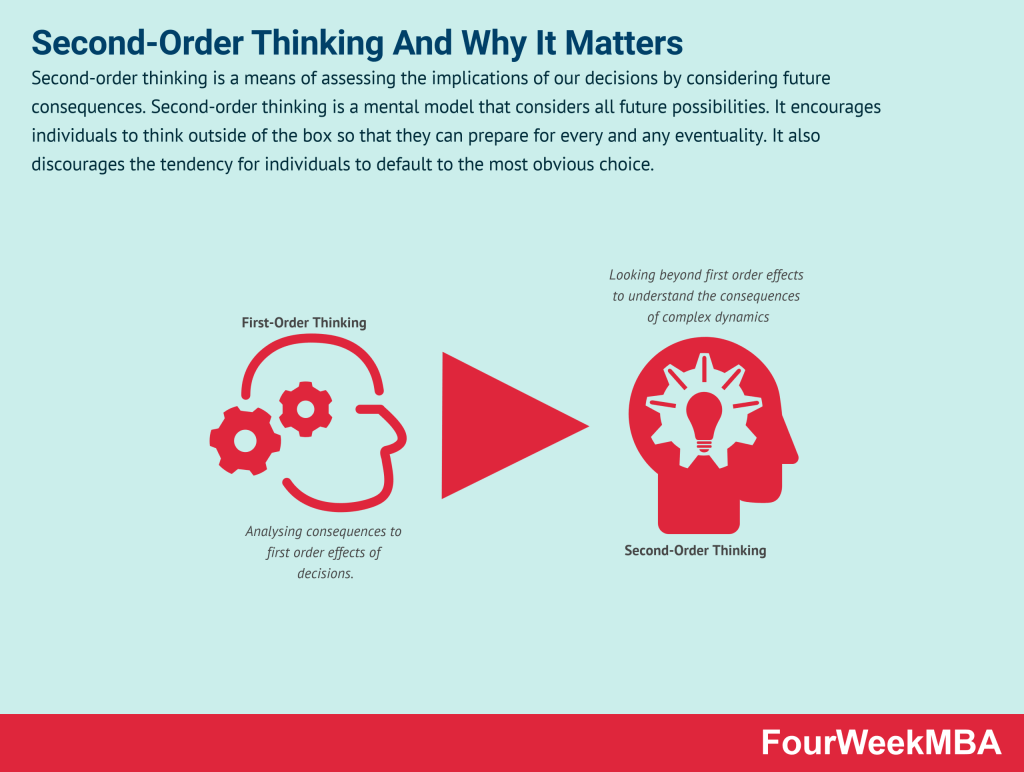
Second-order thinking is a means of assessing the implications of our decisions by considering future consequences. Second-order thinking is a mental model that considers all future possibilities. It encourages individuals to think outside of the box so that they can prepare for every and any eventuality. It also discourages the tendency for individuals to default to the most obvious choice.
Warren Buffett is an American investor, business tycoon, and philanthropist. Known as the “Oracle of Omaha”, Buffett is best known for his strict adherence to value investing and frugality despite his immense wealth. He is among the wealthiest people in the world. Most of his wealth is tied up in Berkshire-Hathaway and its 65 subsidiaries.
Jeff Bezos was best known for founding eCommerce giant Amazon in 1994. However, the entrepreneur owns companies in several industries, including health care, retail, robotics, real estate, and media. Many of these companies have been acquired by Amazon over the years, but some have been the result of direct investment from Bezos himself (through his investment arm is called Bezos Expeditions).
Elon Musk is one of the richest people in the world, with his main ownership in Tesla, making him worth more than a hundred billion dollars. The companies founded by Elon Musk range from electric vehicles and renewable energies, with Tesla, rockets, with SpaceX, infrastructure with The Boring Company, and neurotechnology with Neuralink.
Bill Gates is an American business tycoon, software developer, investor, and more recently, philanthropist. After dropping out of Harvard University and founding Microsoft in 1975, Gates has at times been the richest man in the world with an estimated net worth of $129 billion. He founded Cascade Investment in 1995 to manage his investments outside of Microsoft. The firm employs over 100 people and has significant stakes in hotel, rail transport, beverage, and waste management companies. To further his philanthropic causes, he founded the Bill and Melinda Gates Foundation in 2000. The foundation holds almost $47 billion in assets and tackles entrenched global issues around poverty, healthcare, and climate change. The foundation also has several trust investments in companies such as Berkshire Hathaway, Caterpillar, FedEx, Walmart, and UPS.
Mark Zuckerberg is the largest shareholder of the company. Zuckerberg retains ownership and control of the company. Like Google, Facebook has issued two common stocks, Class A and Class B. The holders of Class B common stocks are entitled to ten votes per share, and holders of our Class A common stocks are entitled to one vote per share. Mark Zuckerberg has a voting power of 56.9%; he’s the main decision-maker.
Gennaro is the creator of FourWeekMBA, which reached about four million business people, comprising C-level executives, investors, analysts, product managers, and aspiring digital entrepreneurs in 2022 alone | He is also Director of Sales for a high-tech scaleup in the AI Industry | In 2012, Gennaro earned an International MBA with emphasis on Corporate Finance and Business Strategy.