A revenue stream is one of the foundational building blocks of a business model, and the economic value customers are willing to pay for the products and services offered. While a revenue stream is not a business model, it does influence how a business model works and delivers value.
How Airbnb described its revenue streams as a business model.
One of the greatest misconceptions is about revenue streams and business models. In short, for most entrepreneurs how you make money is also your business model.
While this simplification does work out (especially in pitch decks where investors might want to have a simplified story of a business model) it might be limiting if you’re an entrepreneur trying to grow or dissect competitors’ businesses.
Therefore, revenue streams affect a business model, and a revenue stream is an essential building block of any business. But that is only part of the story.
Missing this point means limiting your business around the bottom line alone.
Why does understanding revenue streams matter?
In a digitally-driven business world, it’s easy to fall into the trap of focusing on aspects that are too far from monetization.
In contrast, monetization and revenue streams are not all that is.
They are critical building blocks that need to be figured out, tested, and iterated quickly.
From them, it depends on the survival of your company.
There is another element that makes the action of having your customers pay for a service or product you offer, which is tied to the so-called “revealed preference.”
That is a theory offered by the American economist Paul Samuelson in 1938.
The theory asserts that consumers’ behavior – assuming a constant income and an item’s price – is the best indicator of their hidden preferences. In short, that is how people reveal what they really want.
So skin in the game data means not people telling you, “Oh yeah, if you build it, I will buy it,” they need to give you something. So the smallest amount of steering the game somebody can give you is a valid email address with a clear understanding you will use that address to let them know if the app is ready. So you have this video, you either buy some ads or you put it on some forums, you say, “okay, here’s an app I am trying to build, if you are interested, please give me your email address, and once I launch it, I will let you know.”
While complex businesses make money in many different ways.
Looking at revenue streams and where the key customer is can help us assess the nature of an organization.
Of course, this is in theory, as many digital platforms are very complex.
At times who and those who can’t be deemed as customers are often the most valuable assets for a digital organization.
This is true for media businesses and in some cases for digital platforms.
For instance, Google is free for its users.
Yet users are the most important “returning customers” for the search engine.
As users’ data is the monetizable asset Google sells to companies on its search results page.
Let’s draw a line here.
The bottom line is highly tied to its key customers for simple, more linear business models.
For more complex business models, things get trickier.
In short, platforms, super platforms, and non-linear businesses where there is a more complex interaction between the bottom line and the key players’ revenue streams are only a tiny part of the story.
For other, simpler business models, revenue streams reveal business facts that can’t be ignored.
Branding vs. revenue streams
Focusing on revenue streams doesn’t mean ignoring the rest.
In the business world, companies often praise themselves for being extremely focused on the bottom line and their key customers.
However, thinking in terms of the bottom line alone might give us the appearance of being rational business people, but it doesn’t leave space for nonlinear growth, which can be achieved through branding efforts.
Brand building is the set of activities that help companies to build an identity that can be recognized by its audience. Thus, it works as a mechanism of identification through core values that signal trust and that help build long-term relationships between the brand and its key stakeholders.
When we focus on revenue streams and the bottom-line, we can work on direct actions intended to bring more customers in.
However, we might end up ignoring marketing and branding activities – that, while harder to track and explain from a logical standpoint – can bring our business to the next level.
Instead, a freemium model is, in many cases, a marketing and growth tool that helps the company leverage virality to make its brand go to places where customers alone can’t bring you.
You can still build a revenue stream or a whole business model around a freemium (take the case of DropBox).
Still, in many other cases, as a business person, you need to accept there is no linear connection between your free offering and the bottom-line.
What is a revenue stream in the business model canvas?
The business model canvas is a framework proposed by Alexander Osterwalder and Yves Pigneur in Busines Model Generation enabling the design of business models through nine building blocks comprising: key partners, key activities, value propositions, customer relationships, customer segments, critical resources, channels, cost structure, and revenue streams.
For what value are your customers willing to pay?
What and how do they recently pay? How would they prefer to pay?
How much does every revenue stream contribute to the overall revenues?
When you build a business model, it might – at times – all start by identifying a problem or perhaps creating the perception that a problem exists (which is the whole point of demand generation activities).
From there, a product or service which entails an identified value proposition is launched or tested in the marketplace.
What you think is valuable might not be so for your potential customers.
For instance, at the launch stage, you need to find what some might call product-market fit.
Or finetune the value proposition (which provides a solution to a problem or a set of problems) with a group of people willing to pay for it.
When you reach that stage, you have a revenue stream and thus an essential building block of your business model.
Revenue streams and value propositions
The Value Proposition Canvas, part of the Business Model Canvas, is a tool used to ensure a product or service is positioned around customer values and needs.
Oftentimes, mainly when a company has scaled up, there isn’t a single value proposition that is aligned with the value demand.
That is because there are multiple vital customers, thus making the way the company delivers value more complex.
A company like Amazon has multiple value propositions, serving several target customers in different markets. With its mission “to be Earth’s most customer-centric company, where customers can find and discover anything they might want to buy online and endeavors to offer its customers the lowest possible prices,” Amazon’s value propositions range from “Easy to read on the go” for a device like Kindle, to “sell better, sell more” to its marketplace.
Apple is a tech giant, and as such, it encompasses a set of value propositions that make Apple’s brand recognized among consumers. The three fundamental value propositions of Apple’s brand leverage the “Think Different” motto; reliable tech devices for mass markets; in 2019, Apple also started to emphasize more and more privacy to differentiate from other tech giants.
Why testing your revenue streams early on makes sense
On a business modeling side, we have the way we deliver value, so that would be the solution you build. Yes, we can make it as efficient as possible in the early days, but that is again chasing pennies and letting dollars slip through the cracks.
What we instead should be doing is focusing more on the revenue streamside, trying to maximize things like pricing, for instance. Trying to identify the right customers, for instance.
In the digital world, it’s easy to focus on parts of your business model that have nothing to do with the bottom line.
Thus, postponing the experimentation of the revenue stream early on. In the end, if you got venture capital money, why spend that on experimenting with pricing, and potential revenue streams, when you can burn it all on growth?
Income Statement and Cash flow statement from WeWork Financial Prospectus.
Suppose you take a case like WeWork, the office-sharing startup that went from Decacorn to Unicorn, up to touch the ground.
The company did grow its revenues, but it didn’t create a sustainable revenue stream.
Therefore, the only cash at the bank came from venture capital funds or financing activities.
Bootstrapped companies have a different approach in their DNA, as they need to master their key customers very quickly before going out of business.
The general concept of Bootstrapping connects to “a self-starting process that is supposed to proceed without external input.” Bootstrapping means financing the company’s growth from the available cash flows produced by a viable business model.
To build a sustainable business model early on, it’s important to start experimenting with the revenue stream building block as soon as possible.
How to choose the right revenue stream?
Building a business is about identifying an opportunity and going with it. Thus, an entrepreneur is a hard-wired opportunist.
However, business is also a matter of choice. And how you make money is part of that choice.
For instance, if you build a website that generates traffic.
That traffic can be monetized in many different ways. You can simply sell those page views to others, thus acting as a publisher.
You can sell other people’s products or services, thus acting as an intermediary on commission.
Or you can develop your own offerings.
You can do it in all these ways.
And there isn’t one which is better than the other. It all depends on what you’re passionate about and whether the market values your skills so that you can find a niche and build a business on top of it.
That sounds easy, yet it’s not. Often entrepreneurs follow every single opportunity that presents itself without evaluating whether it’s in their frame of reference.
The minimum viable audience (MVA) represents the smallest possible audience that can sustain your business as you get it started from a microniche (the smallest subset of a market). The main aspect of the MVA is to zoom into existing markets to find those people which needs are unmet by existing players.
Revenue streams types
In the FourWeekMBA Revenue Streams Matrix, revenue streams are classified according to the kind of interactions the business has with its key customers. The first dimension is the “Frequency” of interaction with the key customer. As the second dimension, there is the “Ownership” of the interaction with the key customer.
There are many ways in which we can classify revenue streams.
For the sake of this guide, we’ll look at revenue streams by looking at the interactions with the key customer.
This classification isn’t flawless; quite the opposite.
And you can argue that it’s not complete, and you would be right.
Therefore, rather than a final or complete representation of the revenue stream types, it’s just a starting point.
Let’s classify the possible revenue model types based on the kind of interaction we can have with the key customers.
The relationship with the key customer doesn’t end after the transaction but continues.
In a subscription-based model, like SaaS, the software vendor will have to provide support and continuous updates of the software to keep the value of the service worth the subscription.
Other businesses based on a repeated relationship, like Netflix, have to advance and invest massive amounts of capital to keep their platforms interesting enough for subscribers to avoid churn.
Companies like Amazon and Costco also introduced a component of repeated transactions (via Amazon Prime Membership or Costco Memberships) within their business model.
While many analysts look at the additional revenues generated by this revenue model, this revenue stream has more holistic and dynamic importance.
When Amazon introduced Prime, it did so because the service enabled repeat customers to eliminate the cost of shipping, which for repeat customers is the most burdening expense.
Thus, a Prime Membership isn’t just an additional revenue stream but a business model enabler.
Transactional interaction
In a transactional interaction, the company mainly engages with its key customers on a product or project basis.
Usually, a product company has this kind of approach.
For instance, Apple came up with the new iPhone, which gets sold to millions of customers as a one-time transaction.
In a transactional revenue model, the whole business model needs to be organized so that the product can be distributed at its best at its launch.
Usually, the critical customer is engaged on a one-time basis, and even if she buys multiple products in the long run, the kind of interaction doesn’t necessarily call for continuous interaction with the key customer.
Intermediated interaction
When a company doesn’t have direct access to its key customers, we can call this an intermediated interaction.
In short, the company can’t directly access a customer base but will do that via a third-party platform or distributor.
Think of the case of a company offering its product white labeled. Final customers won’t know its brand.
Distributors will relabel the product with their own brand. Thus, the maker doesn’t have access to its key customers.
In that scenario, the distributor acts as the key customer.
The maker will have to adapt its business model to the requests and policies that the distributor demands.
A B2B2C is a particular kind of business model where a company, rather than accessing the consumer market directly, it does that via another business. Yet the final consumers will recognize the brand or the service provided by the B2B2C. The company offering the service might gain direct access to consumers over time.
Direct interaction
The company has access to its customer base and key customers in a direct interaction revenue model.
It can deliver the product via its own channels, and it can control the perception those customers have.
Distribution doesn’t come for free. Instead, it requires maintenance, massive investments, and a strongly recognized brand.
A hidden revenue business model is a pattern for revenues generation that keeps users out of the equation so they don’t pay for the service or product offered. For instance, Google’s users don’t pay for the search engine. Instead, the revenue streams come from advertising money spent by businesses bidding on keywords.
In short, the freeplatform,in a way, “hides” to its users the way it gets monetized.
Of course, business people and marketers know howFacebookmakes money, as it has been a proper advertising channel for many businesses.
However, the average user doesn’t have a clue.
Things are changing now that privacy issues and new regulations have brought attention to theFacebookbusiness model.
Yet for a decade,Facebookhas benefited from a vast stream of revenues and high profitability without most users ever noticing it.
Each of those revenue models can influence the overall business model. In many cases, companies rely on several revenue streams.
For instance, publishers like The NY Times run on advertising, sponsorship, and subscription revenues.
The New York Times generated 68% of its revenue from subscriptions in 2023. Indeed, of over $2.4 billion in revenues in 2023, $1.65 billion came from subscriptions (both printed and digital), $505 million from advertising (printed and digital), and $264 million in other revenues. Of the subscription revenues, nearly $1.1 billion were generated by digital subscriptions, while printed subscriptions generated $556 million.
Key takeaways
Revenue streams affect a business model, and a revenue stream is an essential building block of any business. But that is only part of the story.
While complex businesses make money in many different ways. Looking at revenue streams and where the key customer is can help us assess the nature of an organization.
Focusing on revenue streams doesn’t mean ignoring the rest. In the business world, companies often praise themselves for being extremely focused on the bottom line and their key customers.
There isn’t a single way to generate revenues. You might choose a subscription business model, afreemium, a fee ormembership model. That also depends upon the industry, product, and service you offer.
Picking a revenue stream is also a matter of choosing the kind of business you want to build.
Case Studies
Subscription Model
Hulu: Offers ad-supported and ad-free subscription plans for streaming TV shows and movies.
Adobe Creative Cloud: Charges a monthly or annual subscription fee for access to its suite of creative software tools.
The New York Times: Provides digital content behind a paywall with subscription options for readers.
Blue Apron: Delivers meal kit subscriptions to customers for cooking at home.
Advertising Model
YouTube: Earns revenue through ads displayed on user-generated videos.
Twitter: Displays sponsored tweets and ads in users’ timelines.
Instagram: Features sponsored posts and ads in users’ feeds and stories.
BuzzFeed: Generates ad revenue from sponsored content and native advertising.
E-commerce Model
Walmart: Sells a wide range of products through its online store.
Alibaba: Operates online marketplaces connecting buyers and sellers globally.
Zappos: Specializes in online shoe and clothing retail.
Etsy: Provides a platform for artisans and crafters to sell handmade and vintage items.
Freemium Model
Evernote: Offers basic note-taking services for free and charges for premium features.
LinkedIn Premium: Provides enhanced features, networking tools, and job insights for paying subscribers.
Mailchimp: Offers free email marketing services with premium plans for advanced features.
Zoom: Provides video conferencing services with a free plan and premium options for businesses.
Pay-per-Use Model
Airbnb: Charges hosts and guests fees for booking accommodations.
Amazon Kindle Store: Sells e-books and charges per book download.
ZipRecruiter: Charges employers based on the number of job postings and candidates contacted.
Lime: Offers electric scooters and bikes for rent on a per-minute basis.
Licensing Model
Pixar: Licenses its characters and content for use in merchandise, theme parks, and more.
Marvel: Licenses its superhero characters for use in movies, toys, and video games.
National Football League (NFL): Licenses its brand for merchandise, video games, and broadcasting rights.
Coca-Cola: Licenses its beverage formulas to bottlers and distributors worldwide.
Affiliate Marketing Model
Amazon Associates: Allows website owners to earn a commission on sales of Amazon products.
TripAdvisor: Earns commissions for referring travelers to hotels, flights, and restaurants.
Booking.com Affiliate Partner Program: Offers commissions to partners who drive hotel bookings through their websites.
Rakuten Advertising: Connects advertisers with affiliate publishers to promote products and earn commissions.
Rental Model
Hertz: Provides car rentals for individuals and businesses on a daily or weekly basis.
HomeAway: Allows property owners to rent vacation homes and properties to travelers.
Rent the Runway: Offers clothing and accessory rentals for special occasions or everyday wear.
GameFly: Rents video games to subscribers for gaming consoles.
Crowdsourcing Model
GoFundMe: Allows individuals and organizations to raise funds for various personal and charitable causes.
Kickstarter: Helps creators fund creative projects and products through contributions from backers.
Indiegogo: Supports crowdfunding campaigns for tech gadgets, films, and other projects.
Kiva: Facilitates microloans to entrepreneurs in developing countries through crowdsourced lending.
Franchise Model
Subway: Offers franchise opportunities for individuals to open and operate sandwich shops.
McDonald’s: Grants franchisees the right to operate McDonald’s restaurants using its brand and systems.
7-Eleven: Allows franchisees to operate convenience stores under the 7-Eleven brand.
UPS Store: Offers franchise ownership for local shipping and printing businesses.
Consulting and Services Model
McKinsey & Company: Provides management consulting services to businesses, governments, and organizations.
Deloitte: Offers a wide range of consulting, auditing, and advisory services.
Accenture: Specializes in strategy, consulting, digital, technology, and operations services.
Boston Consulting Group (BCG): Delivers management and business strategy consulting to clients.
Data Monetization Model
Nielsen: Collects TV viewership data and consumer insights, selling reports to media companies and advertisers.
Palantir: Develops data analytics software for government and corporate clients.
Experian: Offers credit reporting and consumer data services to businesses for marketing and risk management.
Acxiom: Provides data-driven marketing and advertising solutions to brands and marketers.
Event Ticketing Model
Ticketmaster: Sells tickets for live events, concerts, sports, and theater performances.
StubHub: Facilitates the resale of tickets for sports, music, and entertainment events.
Eventim: Offers ticket sales, marketing, and distribution services for events and concerts.
Ticketfly: Provides ticketing and marketing solutions for live events and music venues.
Gaming Model
Epic Games: Develops and monetizes video games like Fortnite through in-game purchases.
Roblox Corporation: Offers a platform for user-generated games and virtual items with in-game currency.
Electronic Arts (EA): Sells game titles and offers in-game purchases for additional content.
Supercell: Monetizes mobile games like Clash of Clans through in-app purchases.
Education Model
Coursera: Offers online courses and degrees, charging students for certificates and premium content.
Duolingo Plus: Provides language learning courses with an ad-free experience for paying users.
MasterClass: Features online courses taught by experts in various fields, available through a subscription.
Khan Academy Kids: Offers a subscription-based app for educational activities and games for children.
Healthcare Model
UnitedHealth Group: Provides health insurance plans to individuals and employers, collecting premiums.
Teladoc Health: Charges for telehealth consultations and virtual healthcare services.
Ro (formerly Roman): Offers online healthcare services and subscriptions for medications.
Healthgrades: Generates revenue from healthcare providers and advertisers for premium listings and ads.
Content Licensing Model
Getty Images: Licenses stock photos, videos, and music to media organizations, advertisers, and creatives.
Shutterstock: Offers licenses for stock photos, illustrations, and videos for various creative projects.
Adobe Stock: Provides stock assets for use in creative projects, available to Adobe Creative Cloud subscribers.
Pond5: Sells licenses for stock footage, music, and sound effects to content creators and businesses.
Key Insights
1. Revenue streams are foundational building blocks Revenue streams represent the economic value that customers are willing to pay for products and services. They play a vital role in a business model’s success and influence how a company delivers value to its customers.
2. Revenue streams vs. business models While revenue streams are crucial components of a business model, they do not fully define the entire business model. Understanding this distinction is essential for entrepreneurs looking to grow their businesses and analyze competitors effectively.
3. Importance of understanding revenue streams In the digital business world, it’s easy to focus on aspects beyond monetization. However, revenue streams are critical building blocks that require quick testing and iteration, as they ultimately determine a company’s survival and success.
4. Revealed preferences and “Skin in The Game Data” The theory of “revealed preferences” suggests that customers’ actual behavior and actions are the best indicators of their true preferences. Collecting “Skin in The Game Data,” such as valid email addresses or other valuable interactions, helps businesses gain real insights into customer preferences.
5. Complex revenue streams in digital platforms In digital platforms, revenue streams can be more complex, as key players might not be direct paying customers but still provide significant value to the organization. Understanding the dynamics of such revenue streams is essential for success.
6. Balancing bottom line focus and branding efforts While focusing on revenue streams and the bottom line is essential, neglecting branding and marketing efforts can hinder non-linear growth opportunities and long-term success.
7. Early testing of revenue streams To build a sustainable business model, entrepreneurs should start experimenting with revenue streams early on. Understanding the value customers are willing to pay for helps refine the business model and product-market fit.
8. Diverse forms of revenue streams Revenue streams can take various forms, including advertising, sponsorships, subscriptions, commissions, white labeling, and more. Companies can choose the most suitable revenue stream based on their industry and product offerings.
9. Strategic choice of revenue streams Selecting the right revenue stream aligns with the company’s passion, market demand, and long-term vision. It is a critical decision that can shape the growth and sustainability of the business.
Case Studies
Company
Revenue Model
Case Study
Analysis
Netflix
Subscription-Based Model
Netflix’s subscription streaming service
Netflix relies on monthly subscription fees, providing access to a vast library of content with no ads.
Spotify
Freemium Model
Spotify’s free and premium music streaming
Spotify offers both free ad-supported and premium ad-free subscriptions, generating revenue from premium users and advertisers.
Amazon
E-commerce and Marketplace Model
Amazon’s online retail and third-party sellers
Amazon generates revenue through product sales, third-party seller fees, and Amazon Web Services (AWS).
Google
Advertising Model
Google’s online advertising, AdWords, and AdSense
Google earns revenue by displaying ads on its search results pages and partner websites.
Apple
Hardware and Ecosystem Model
Apple’s sale of hardware and services
Apple generates revenue from the sale of hardware (iPhone, Mac) and services (Apple Music, App Store).
Airbnb
Commission Model
Airbnb’s commission from host and guest bookings
Airbnb earns a percentage from hosts and guests for each booking facilitated on its platform.
Uber
Commission and Ride Fees Model
Uber’s commission from drivers and ride fees
Uber takes a commission from driver earnings and charges riders based on distance and time.
LinkedIn
Subscription and Recruitment Model
LinkedIn’s premium subscriptions and job postings
LinkedIn generates revenue from premium subscriptions, talent solutions, and marketing solutions.
Dropbox
Freemium and Subscription Model
Dropbox’s cloud storage and file-sharing
Dropbox offers free storage with premium subscriptions for additional features and space.
Facebook (Meta)
Advertising and Data Monetization Model
Facebook and Instagram’s advertising and user data
Meta earns revenue by displaying targeted ads to users and monetizing user data.
Etsy
Handmade and Artisanal Goods Marketplace
Etsy’s platform for artisans and crafters
Etsy provides a platform for artisans to sell their unique handmade products to a global audience.
Upwork
Freelance Talent Marketplace
Upwork’s platform for freelancers and clients
Upwork connects businesses with freelance talent for various projects, spanning from writing to programming.
eBay
Online Auction and Sales Marketplace
eBay’s platform for auctions and sales
eBay allows individuals and businesses to buy and sell a wide range of goods through auctions and direct sales.
Alibaba Group
B2B and B2C E-commerce Marketplace
Alibaba’s e-commerce and wholesale platforms
Alibaba connects global buyers and sellers, facilitating trade and e-commerce transactions on a massive scale.
Turo
Peer-to-Peer Car Rental
Turo’s platform for car owners and renters
Turo enables individuals to rent their vehicles to travelers, disrupting the traditional car rental industry.
Fiverr
Freelance Services Marketplace
Fiverr’s platform for freelance services
Fiverr offers a marketplace for freelancers to offer a wide range of services, from graphic design to content writing.
TaskRabbit
On-Demand Task and Service Marketplace
TaskRabbit’s platform for taskers and clients
TaskRabbit connects individuals with skilled taskers who can complete a variety of household and business tasks.
OpenTable
Restaurant Reservation Marketplace
OpenTable’s platform for restaurant reservations
OpenTable allows users to book restaurant reservations and helps restaurants manage their tables efficiently.
StockX
Sneaker and Collectibles Marketplace
StockX’s platform for sneakers and collectibles
StockX provides a marketplace for authenticated sneaker and collectible sales, ensuring transparency and trust.
Poshmark
Fashion Resale Marketplace
Poshmark’s platform for fashion resale
Poshmark connects fashion enthusiasts to buy and sell gently used clothing and accessories.
Thumbtack
Local Services Marketplace
Thumbtack’s platform for local service providers
Thumbtack helps users find and hire local service professionals, from plumbers to wedding photographers.
HomeAway (Vrbo)
Vacation Rental Marketplace
HomeAway’s platform for vacation rentals
HomeAway offers a marketplace for vacation rentals, connecting travelers with property owners.
Booking.com
Hotel and Accommodation Booking
Booking.com’s online travel agency platform
Booking.com enables travelers to book hotels and accommodations worldwide, serving as an intermediary between customers and hotels.
Zillow
Real Estate Marketplace
Zillow’s platform for buying and selling homes
Zillow provides tools for home buyers, sellers, and renters, simplifying the real estate process.
Freelancer.com
Freelance Job Marketplace
Freelancer.com’s platform for freelance jobs
Freelancer.com connects employers with freelancers to complete a wide range of projects, from software development to graphic design.
Rover
Pet Services Marketplace
Rover’s platform for pet care services
Rover connects pet owners with pet sitters and walkers, offering a range of pet care services.
99designs
Design Services Marketplace
99designs’ platform for design contests
99designs hosts design contests, allowing businesses to receive custom designs from a global community of designers.
WhatsApp
Subscription and In-App Purchases Model
WhatsApp’s subscription and in-app sticker purchases
WhatsApp offers a free messaging service with revenue generated from subscriptions and in-app purchases.
Patreon
Membership and Crowdfunding Model
Patreon’s support for content creators
Patreon allows creators to offer exclusive content to paying members, generating income through memberships.
Shopify
Subscription and E-commerce Model
Shopify’s e-commerce platform and subscription fees
Shopify offers e-commerce solutions and earns revenue through monthly subscription fees and transaction fees.
HubSpot
Inbound Marketing and SaaS Model
HubSpot’s inbound marketing and SaaS services
HubSpot provides inbound marketing and sales software on a subscription basis, generating recurring revenue.
Airbnb for Work
Corporate Travel and Service Fees Model
Airbnb for Work’s service fees for corporate travel
Airbnb for Work charges service fees for businesses booking accommodations and experiences.
Coursera
Online Education and Certification Model
Coursera’s online courses and specialization certificates
Coursera offers courses for free or as part of a subscription, with revenue generated from paid certificates.
Yelp
Advertising and Local Business Model
Yelp’s advertising and partnerships with local businesses
Yelp offers advertising and business solutions, generating revenue through partnerships.
LinkedIn Talent Solutions
Recruitment and Subscription Model
LinkedIn’s recruitment tools and premium subscriptions
LinkedIn Talent Solutions provides tools for talent recruitment and generates revenue through premium subscriptions.
Square
Payment Processing and Financial Services
Square’s payment processing and financial services
Square offers payment processing and financial services, earning revenue through transaction fees and subscriptions.
Salesforce generates revenue from its CRM software and cloud services for enterprises.
Udemy
Online Learning and Course Sales Model
Udemy’s marketplace for online courses
Udemy allows instructors to sell courses, with revenue shared between the platform and instructors.
GoFundMe
Crowdfunding and Platform Fees Model
GoFundMe’s crowdfunding platform and fees
GoFundMe facilitates fundraising campaigns and charges platform fees on donations.
Shutterfly
Photo Printing and Personalized Products
Shutterfly’s photo books, gifts, and printing services
Shutterfly generates revenue by selling personalized photo products.
Robinhood
Commission-Free Stock Trading Model
Robinhood’s commission-free stock and crypto trading
Robinhood offers commission-free trading and generates revenue through order flow payments.
Salesforce Marketing Cloud
Marketing Automation Model
Salesforce Marketing Cloud’s marketing automation
Salesforce’s marketing automation tools generate revenue through subscription and usage fees.
DoorDash
Food Delivery and Service Fees Model
DoorDash’s food delivery and service fees
DoorDash charges service fees to customers and restaurants for food delivery services.
Expedia
Online Travel Booking and Commissions
Expedia’s online travel booking and commissions
Expedia earns revenue by facilitating online travel bookings and taking commissions from hotels and airlines.
GitHub
Developer Tools and Enterprise Services
GitHub’s code hosting and collaboration platform
GitHub provides free and paid developer tools and earns revenue from enterprise subscriptions.
SurveyMonkey
Survey and Data Insights Model
SurveyMonkey’s survey creation and data analysis
SurveyMonkey offers survey tools and generates revenue from premium plans and data insights.
ZoomInfo
B2B Sales and Marketing Intelligence
ZoomInfo’s B2B sales and marketing intelligence
ZoomInfo offers B2B data and intelligence services, earning revenue through subscriptions and sales.
Related Frameworks, Models, or Concepts
Description
When to Apply
Business Model Canvas
The Business Model Canvas is a strategic management tool that provides a visual framework for describing, analyzing, and innovating business models. Revenue Streams are one of the nine building blocks of the Business Model Canvas, representing the various sources of revenue generated by a business.
Apply the Business Model Canvas to analyze and design business models, including the identification and evaluation of different revenue streams. Use it during the business planning stage or when considering business model innovation to understand how revenue is generated and how it contributes to overall business sustainability and growth.
Value Proposition Design
Value Proposition Design is a methodology for creating compelling value propositions that address customer needs and pain points. Revenue Streams are closely linked to value propositions, as they reflect the value captured by the business from its customers.
Utilize Value Proposition Design to develop value propositions that resonate with target customers and drive revenue generation. Incorporate Revenue Streams analysis to ensure that the value created for customers translates into revenue opportunities for the business, aligning value creation with revenue capture effectively.
Subscription Business Model
The Subscription Business Model involves offering products or services to customers on a recurring subscription basis, typically with regular payments. Revenue Streams in a subscription model consist of subscription fees paid by customers in exchange for ongoing access to the product or service.
Apply the Subscription Business Model to create recurring revenue streams and establish long-term customer relationships. Use it when developing subscription-based offerings or transitioning from traditional one-time sales models to subscription-based revenue models to enhance revenue predictability and customer lifetime value.
Freemium Model
The Freemium Model offers basic features or services for free while charging users for premium features or additional functionalities. Revenue Streams in a freemium model come from a combination of free users (who may generate revenue through advertising or data monetization) and premium users (who pay for access to premium features).
Utilize the Freemium Model to attract a large user base with free offerings and monetize premium features or upgrades. Apply it when developing digital products, software applications, or online platforms to maximize user acquisition and engagement while capturing revenue from users willing to pay for enhanced functionality or value-added features.
E-commerce Business Model
The E-commerce Business Model involves selling products or services online through digital channels. Revenue Streams in an e-commerce model come from online sales transactions, including product sales, service fees, subscription charges, and other revenue-generating activities conducted on e-commerce platforms or websites.
Apply the E-commerce Business Model to establish an online presence and sell products or services directly to customers over the internet. Use it when launching an online store, marketplace, or digital platform to leverage digital channels and technology to reach a wider audience and generate revenue through online sales and transactions.
Platform Business Model
The Platform Business Model facilitates interactions and transactions between multiple groups of users or participants on a digital platform. Revenue Streams in a platform model can come from various sources, such as transaction fees, subscription charges, advertising revenue, data monetization, and value-added services offered to platform users.
Utilize the Platform Business Model to create a digital platform that connects buyers and sellers, service providers and customers, or other user groups to facilitate transactions and exchanges. Apply it when building online marketplaces, social networking platforms, or sharing economy platforms to capture revenue from platform usage, transactions, and ecosystem growth.
Advertising Business Model
The Advertising Business Model relies on generating revenue through advertising placements and sponsorships. Revenue Streams in an advertising model come from advertisers who pay for displaying ads to target audiences on various media channels, such as websites, social media platforms, search engines, and traditional media outlets.
Apply the Advertising Business Model to monetize digital content, websites, apps, or media channels by displaying ads to target audiences. Use it when offering free content, services, or platforms to users and monetizing audience attention and engagement through advertising placements, sponsorships, or branded content partnerships.
Affiliate Marketing Model
The Affiliate Marketing Model involves promoting third-party products or services and earning commissions for driving sales or referrals. Revenue Streams in an affiliate marketing model come from affiliate commissions earned for each successful sale, lead, or referral generated through affiliate marketing activities.
Apply the Affiliate Marketing Model to monetize online content, blogs, websites, or social media channels by promoting affiliate products or services to target audiences. Use it when partnering with affiliate programs or networks to earn commissions for driving sales or referrals and leveraging existing audience reach and engagement to generate revenue through affiliate marketing partnerships.
Licensing and Royalties
Licensing and Royalties involve granting permission to use intellectual property, proprietary technology, or brand assets in exchange for licensing fees or royalties. Revenue Streams from licensing and royalties come from licensing agreements, franchise fees, patent royalties, or other forms of intellectual property licensing arrangements.
Utilize Licensing and Royalties agreements to monetize intellectual property assets, technology innovations, or brand properties. Apply it when licensing out patents, trademarks, copyrights, or proprietary know-how to third parties, franchising business concepts or brand names, or entering into partnership agreements that involve revenue-sharing arrangements based on intellectual property usage or exploitation.
Partnership and Sponsorship Model
The Partnership and Sponsorship Model involves collaborating with other businesses, organizations, or individuals to co-create value, drive brand awareness, or support mutual objectives. Revenue Streams from partnerships and sponsorships come from partnership agreements, sponsorship deals, co-branding initiatives, or revenue-sharing arrangements with partner entities.
Apply the Partnership and Sponsorship Model to leverage strategic alliances, collaborations, or sponsorships to generate additional revenue streams and support business objectives. Use it when partnering with complementary businesses, industry associations, influencers, or event organizers to co-market products or services, access new customer segments, or enhance brand visibility and credibility through sponsorship or co-branding opportunities.
A Blockchain Business Model according to the FourWeekMBA framework is made of four main components: Value Model (Core Philosophy, Core Values and Value Propositions for the key stakeholders), Blockchain Model (Protocol Rules, Network Shape and Applications Layer/Ecosystem), Distribution Model (the key channels amplifying the protocol and its communities), and the Economic Model (the dynamics/incentives through which protocol players make money). Those elements coming together can serve as the basis to build and analyze a solid Blockchain Business Model.
In an asymmetric business model, the organization doesn’t monetize the user directly, but it leverages the data users provide coupled with technology, thus have a key customer pay to sustain the core asset. For example, Google makes money by leveraging users’ data, combined with its algorithms sold to advertisers for visibility.
In a business world driven by technology and digitalization, competition is much more fluid, as innovation becomes a bottom-up approach that can come from anywhere. Thus, making it much harder to define the boundaries of existing markets. Therefore, a proper business competition analysis looks at customer, technology, distribution, and financial model overlaps. While at the same time looking at future potential intersections among industries that in the short-term seem unrelated.
Technological modeling is a discipline to provide the basis for companies to sustain innovation, thus developing incremental products. While also looking at breakthrough innovative products that can pave the way for long-term success. In a sort of Barbell Strategy, technological modeling suggests having a two-sided approach, on the one hand, to keep sustaining continuous innovation as a core part of the business model. On the other hand, it places bets on future developments that have the potential to break through and take a leap forward.
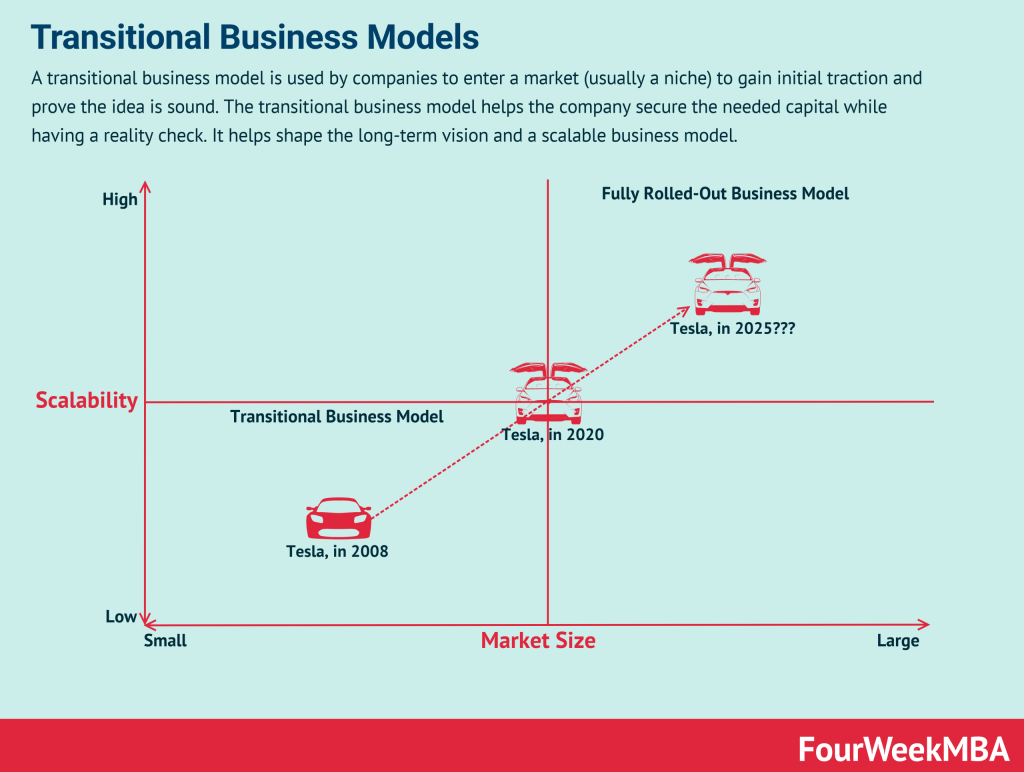
A transitional business model is used by companies to enter a market (usually a niche) to gain initial traction and prove the idea is sound. The transitional business model helps the company secure the needed capital while having a reality check. It helps shape the long-term vision and a scalable business model.
The minimum viable audience (MVA) represents the smallest possible audience that can sustain your business as you get it started from a microniche (the smallest subset of a market). The main aspect of the MVA is to zoom into existing markets to find those people which needs are unmet by existing players.
Business scaling is the process of transformation of a business as the product is validated by wider and wider market segments. Business scaling is about creating traction for a product that fits a small market segment. As the product is validated it becomes critical to build a viable business model. And as the product is offered at wider and wider market segments, it’s important to align product, business model, and organizational design, to enable wider and wider scale.
The market expansion consists in providing a product or service to a broader portion of an existing market or perhaps expanding that market. Or yet, market expansions can be about creating a whole new market. At each step, as a result, a company scales together with the market covered.
In the FourWeekMBA growth matrix, you can apply growth for existing customers by tackling the same problems (gain mode). Or by tackling existing problems, for new customers (expand mode). Or by tackling new problems for existing customers (extend mode). Or perhaps by tackling whole new problems for new customers (reinvent mode).
In the FourWeekMBA Revenue Streams Matrix, revenue streams are classified according to the kind of interactions the business has with its key customers. The first dimension is the “Frequency” of interaction with the key customer. As the second dimension, there is the “Ownership” of the interaction with the key customer.
Revenue model patterns are a way for companies to monetize their business models. A revenue model pattern is a crucial building block of a business model because it informs how the company will generate short-term financial resources to invest back into the business. Thus, the way a company makes money will also influence its overall business model.
A pricing strategy or model helps companies find the pricing formula in fit with their business models. Thus aligning the customer needs with the product type while trying to enable profitability for the company. A good pricing strategy aligns the customer with the company’s long term financial sustainability to build a solid business model.
Gennaro is the creator of FourWeekMBA, which reached about four million business people, comprising C-level executives, investors, analysts, product managers, and aspiring digital entrepreneurs in 2022 alone | He is also Director of Sales for a high-tech scaleup in the AI Industry | In 2012, Gennaro earned an International MBA with emphasis on Corporate Finance and Business Strategy.