Amazon’s organizational culture is characterized by four key ingredients: pride in operational excellence, an obsession with customers, long-term thinking, and an eagerness to invent.
Amazon’s success as a company has made its organizational culture the subject of much discussion.
In a 2009 interview with Slate.com, former CEO and founder Jeff Bezos was asked how he defined Amazon now that the company had transitioned from a book retailer to one that sold consumer electronics and cloud computing services.
“We start with the customer and we work backward”, Bezos replied. “We learn whatever skills we need to service the customer. We build whatever technology we need to service the customer. The second thing is, we are inventors, so you won’t see us focusing on “me too” areas. We like to go down unexplored alleys and see what’s at the end.. And then the third thing is, we’re willing to be long-term-oriented, which I think is one of the rarest characteristics.”
How is Amazon’s organizational culture supported?
Here are a few of the ways Amazon supports its organizational culture and the four key ingredients on which it is based.
Writing and record-keeping
During meetings, Amazon records opinions and ideas involved in making business decisions.
Employees discuss the contents page by page and evaluate the information before moving forward.
This ensures that individuals can have their queries addressed right away before they forget to mention them at the conclusion of the meeting.
Agility
Jeff Bezos’s famous two-pizza rule stipulates that each team must be small enough to be fed by two pizzas.
The rule was initially devised for technical teams to avoid information loss and foster smoother communication.
However, it has now permeated teams across the entire organization.
Innovation
Every Amazon employee is empowered to be an innovator.
While many companies claim they do the same, few would be able to match Amazon’s level of commitment.
To that end, any employee with an innovative idea can outline their vision in a “PRFAQ” document.
As the name suggests, the document must also include a mock press release and hypothetical FAQ that explains customer benefits.
Once submitted, a team of innovators assesses the idea and decides whether it will receive funding to go to market.
Several of Amazon’s most successful products have been found this way. Examples include Prime Now, Alexa, and Amazon Go.
Startup culture
Despite its title as the largest online marketplace in the world, Amazon maintains the sort of youthful exuberance more commonly seen in start-ups.
While similarly mature companies slow down or rest on their laurels, Amazon maintains a culture that supports the constant pursuit of excellence.
With employees working as if they’re trying to get a new company off the ground, Amazon has been able to silence critics who repeatedly suggest that its energy and innovation potential is not scalable.
Downsides of Amazon’s organizational culture
Despite its customer-centrism, innovation ability, and long-term focus, some former Amazon employees described its culture as one that promoted burnout and stress.
After speaking to over 100 former staff, The New York Times found that Amazon’s culture was characterized by:
Anonymous evaluations and annual culling of low performers – where employees made informal pacts to intentionally leave negative feedback for certain employees and have them fired.
Hostile work environments – with individuals encouraged to debate and criticize their co-workers to the point of mortification.
Poor or non-existent boundaries – some were also required to attend conference calls whilst on vacation or work weekends and nights at home. This also manifested in instances where the company was inconsiderate and demanding toward individuals who had recently experienced personal hardships.
Key takeaways:
Amazon’s organizational culture is characterized by four key ingredients: pride in operational excellence, an obsession with customers, long-term thinking, and an eagerness to invent.
Amazon supports its culture with various strategies. These include extensive writing and record keeping, agility, innovation, and the maintenance of a culture more commonly seen in start-ups.
Amazon’s constant pursuit of excellence can negatively impact some employees and create a toxic culture with poor or non-existent boundaries.
Key Highlights:
Four Key Ingredients: Amazon’s organizational culture is built on four key ingredients: pride in operational excellence, customer obsession, long-term thinking, and a strong desire to invent.
Writing and Record-Keeping: Amazon emphasizes writing and record-keeping during meetings. Opinions and ideas are documented, and discussions are thorough to address queries and concerns.
Agility: Amazon’s “two-pizza rule” ensures that teams are small enough to foster efficient communication. This practice originated with technical teams but has extended across the organization.
Innovation: Every Amazon employee is encouraged to be an innovator. Employees can propose innovative ideas through a structured process that involves creating a “PRFAQ” document with a mock press release and FAQ section.
Startup Culture: Despite its size, Amazon maintains a startup-like culture that encourages constant pursuit of excellence and innovation, contributing to its ongoing success.
Challenges: Amazon’s intense focus on operational excellence and innovation has led to some challenges, including reports of burnout, stress, and a toxic work culture. The company’s relentless pursuit of excellence can negatively impact work-life balance and boundaries for some employees.
Amazon has a diversified business model. In 2023, Amazon generated nearly $575 billion in revenues while it posted a net profit of over $30 billion. Online stores contributed over 40% of Amazon revenues. Third-party Seller Services and Physical Stores generated the remaining. Amazon AWS, Subscription Services, and Advertising revenues play a significant role within Amazon as fast-growing segments.
Amazon’s mission statement is to “serve consumers through online and physical stores and focus on selection, price, and convenience.” Amazon’s vision statement is “to be Earth’s most customer-centric company, where customers can find and discover anything they might want to buy online, and endeavors to offer its customers the lowest possible prices.”
In the Amazon Shareholders’ Letter for 2018, Jeff Bezos analyzed the Amazon business model, and it also focused on a few key lessons that Amazon as a company has learned over the years. These lessons are fundamental for any entrepreneur, of small or large organization to understand the pitfalls to avoid to run a successful company!
With 64,588,418 shares, Jeff Bezos is the primary individual investor. Owning 12.7% of the company. Other top individual investors include Amazon’s CEO Andy Jessy, who has 94,729 shares. Top institutional investors include mutual funds like The Vanguard Group (6.6% ownership) and BlackRock (5.7% ownership).
Amazon generated over half a trillion dollars in revenue in 2023, of which $231.87B from online stores, over $140.05B from third-party seller services, $90.76B from AWS, $46.9B from advertising, $40.21B from subscription services, $20.03B billion in physical stores, and $4.96B from other sources.
Amazon was profitable in 2023. On nearly $575 billion in revenue for 2023, Amazon generated a net profit of over $30 billion. Since 2014, Amazon hasn’t recorded a net loss, but it did record a net loss of over $2.7 billion in 2022, while it recouped that in 2023. Indeed, in 2014, Amazon reported a net loss of $241 million, and it would be profitable until 2021. In 2022, Amazon turned unprofitable again and highly profitable again in 2023.
Amazon AWS follows a platform business model that gains traction by tapping into network effects. Born as an infrastructure built on top of Amazon’s infrastructure, AWS has become a company offering cloud services to thousands of clients from the enterprise level, to startups. And its marketplace enables companies to connect to other service providers to build integrated solutions for their organizations.
Amazon subscription revenue in 2023 was over $40 billion, compared to over $35 billion in 2022 and nearly $32 billion in 2021. Amazon Prime grew from a $4.5 billion revenue segment in 2015 to an over $40 billion segment in 2023.
The Amazon Working Backwards Method is a product development methodology that advocates building a product based on customer needs. The Amazon Working Backwards Method gained traction after notable Amazon employee Ian McAllister shared the company’s product development approach on Quora. McAllister noted that the method seeks “to work backwards from the customer, rather than starting with an idea for a product and trying to bolt customers onto it.”
The Amazon Flywheel or Amazon Virtuous Cycle is a strategy that leverages on customer experience to drive traffic to the platform and third-party sellers. That improves the selections of goods, and Amazon further improves its cost structure so it can decrease prices which spins the flywheel.
In the letter to shareholders in 2016, Jeff Bezos addressed a topic he had been thinking quite profoundly in the last decades as he led Amazon: Day 1. As Jeff Bezos put it “Day 2 is stasis. Followed by irrelevance. Followed by excruciating, painful decline. Followed by death. And that is why it is always Day 1.”
A regret minimization framework is a business heuristic that enables you to make a decision, by projecting yourself in the future, at an old age, and visualize whether the regrets of missing an opportunity would hunt you down, vs. having taken the opportunity and failed. In short, if taking action and failing feels much better than regretting it, in the long run, that is when you’re ready to go!
A network effect is a phenomenon in which as more people or users join a platform, the more the value of the service offered by the platform improves for those joining afterward.
A platform business model generates value by enabling interactions between people, groups, and users by leveraging network effects. Platform business models usually comprise two sides: supply and demand. Kicking off the interactions between those two sides is one of the crucial elements for a platform business model’s success.
Jeff Bezos was best known for founding eCommerce giant Amazon in 1994. However, the entrepreneur owns companies in several industries, including health care, retail, robotics, real estate, and media. Many of these companies have been acquired by Amazon over the years, but some have been the result of direct investment from Bezos himself (through his investment arm is called Bezos Expeditions).
Amazon is a consumer e-commerce platform with a diversified business model spanning across e-commerce, cloud, advertising, streaming, and more. Over the years Amazon acquired several companies. Among its 12 subsidiaries, Amazon has AbeBooks.com, Audible, CamiXology, Fabric.com, IMDb, PillPack, Shopbop, Souq.com, Twitch, Whole Foods Market, Woot! and Zappos.
OpenAI is an artificial intelligence research laboratory that transitioned into a for-profit organization in 2019. The corporate structure is organized around two entities: OpenAI, Inc., which is a single-member Delaware LLC controlled by OpenAI non-profit, And OpenAI LP, which is a capped, for-profit organization. The OpenAI LP is governed by the board of OpenAI, Inc (the foundation), which acts as a General Partner. At the same time, Limited Partners comprise employees of the LP, some of the board members, and other investors like Reid Hoffman’s charitable foundation, Khosla Ventures, and Microsoft, the leading investor in the LP.
Airbnb follows a holacracy model, or a sort of flat organizational structure, where teams are organized for projects, to move quickly and iterate fast, thus keeping a lean and flexible approach. Airbnb also moved to a hybrid model where employees can work from anywhere and meet on a quarterly basis to plan ahead, and connect to each other.
The Amazon organizational structure is predominantly hierarchical with elements of function-based structure and geographic divisions. While Amazon started as a lean, flat organization in its early years, it transitioned into a hierarchical organization with its jobs and functions clearly defined as it scaled.
The Coca-Cola Company has a somewhat complex matrix organizational structure with geographic divisions, product divisions, business-type units, and functional groups.
Costco has a matrix organizational structure, which can simply be defined as any structure that combines two or more different types. In this case, a predominant functional structure exists with a more secondary divisional structure.
Costco’s geographic divisions reflect its strong presence in the United States combined with its expanding global presence. There are six divisions in the country alone to reflect its standing as the source of most company revenue.
Compared to competitor Walmart, for example, Costco takes more a decentralized approach to management, decision-making, and autonomy. This allows the company’s stores and divisions to more flexibly respond to local market conditions.
Dell has a functional organizational structure with some degree of decentralization. This means functional departments share information, contribute ideas to the success of the organization and have some degree of decision-making power.
eBay was until recently a multi-divisional (M-form) organization with semi-autonomous units grouped according to the services they provided. Today, eBay has a single division called Marketplace, which includes eBay and its international iterations.
Facebook is characterized by a multi-faceted matrix organizational structure. The company utilizes a flat organizational structure in combination with corporate function-based teams and product-based or geographic divisions. The flat organization structure is organized around the leadership of Mark Zuckerberg, and the key executives around him. On the other hand, the function-based teams are based on the main corporate functions (like HR, product management, investor relations, and so on).
Goldman Sachs has a hierarchical structure with a clear chain of command and defined career advancement process. The structure is also underpinned by business-type divisions and function-based groups.
Google (Alphabet) has a cross-functional (team-based) organizational structure known as a matrix structure with some degree of flatness. Over the years, as the company scaled and it became a tech giant, its organizational structure is morphing more into a centralized organization.
IBM has an organizational structure characterized by product-based divisions, enabling its strategy to develop innovative and competitive products in multiple markets. IBM is also characterized by function-based segments that support product development and innovation for each product-based division, which include Global Markets, Integrated Supply Chain, Research, Development, and Intellectual Property.
McDonald’s has a divisional organizational structure where each division – based on geographical location – is assigned operational responsibilities and strategic objectives. The main geographical divisions are the US, internationally operated markets, and international developmental licensed markets. And on the other hand, the hierarchical leadership structure is organized around regional and functional divisions.
McKinsey & Company has a decentralized organizational structure with mostly self-managing offices, committees, and employees. There are also functional groups and geographic divisions with proprietary names.
Microsoft has a product-type divisional organizational structure based on functions and engineering groups. As the company scaled over time it also became more hierarchical, however still keeping its hybrid approach between functions, engineering groups, and management.
Nestlé has a geographical divisional structure with operations segmented into five key regions. For many years, Swiss multinational food and drink company Nestlé had a complex and decentralized matrix organizational structure where its numerous brands and subsidiaries were free to operate autonomously.
Nike has a matrix organizational structure incorporating geographic divisions. Nike’s matrix structure is also present at the regional and sub-regional levels. Managerial responsibility is segmented according to business unit (apparel, footwear, and equipment) and function (human resources, finance, marketing, sales, and operations).
Patagonia has a particular organizational structure, where its founder, Chouinard, disposed of the company’s ownership in the hands of two non-profits. The Patagonia Purpose Trust, holding 100% of the voting stocks, is in charge of defining the company’s strategic direction. And the Holdfast Collective, a non-profit, holds 100% of non-voting stocks, aiming to re-invest the brand’s dividends into environmental causes.
Samsung has a product-type divisional organizational structure where products determine how resources and business operations are categorized. The main resources around which Samsung’s corporate structure is organized are consumer electronics, IT, and device solutions. In addition, Samsung leadership functions are organized around a few career levels grades, based on experience (assistant, professional, senior professional, and principal professional).
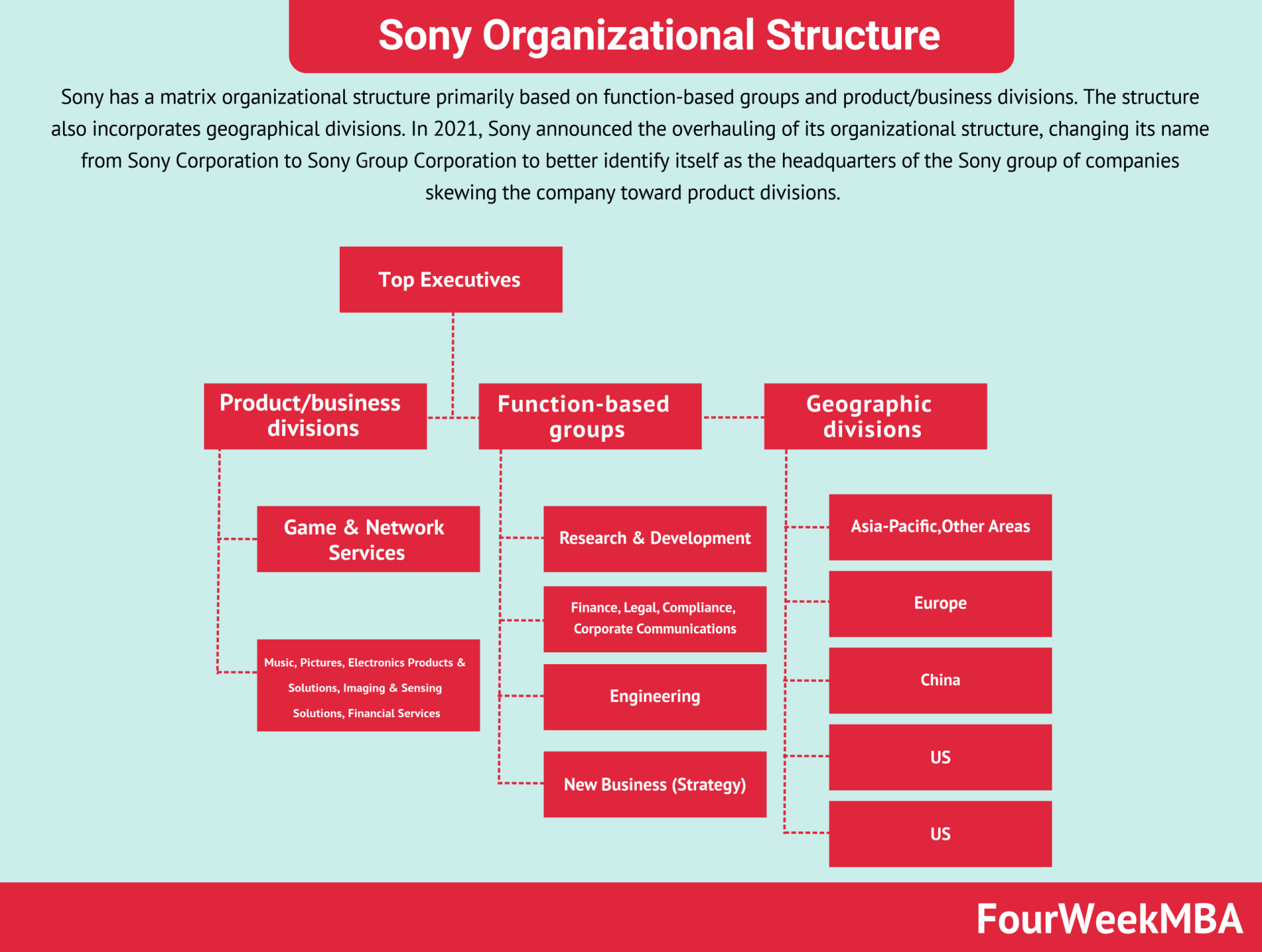
Sony has a matrix organizational structure primarily based on function-based groups and product/business divisions. The structure also incorporates geographical divisions. In 2021, Sony announced the overhauling of its organizational structure, changing its name from Sony Corporation to Sony Group Corporation to better identify itself as the headquarters of the Sony group of companies skewing the company toward product divisions.
Starbucks follows a matrix organizational structure with a combination of vertical and horizontal structures. It is characterized by multiple, overlapping chains of command and divisions.
Tesla is characterized by a functional organizational structure with aspects of a hierarchical structure. Tesla does employ functional centers that cover all business activities, including finance, sales, marketing, technology, engineering, design, and the offices of the CEO and chairperson. Tesla’s headquarters in Austin, Texas, decide the strategic direction of the company, with international operations given little autonomy.
Toyota has a divisional organizational structure where business operations are centered around the market, product, and geographic groups. Therefore, Toyota organizes its corporate structure around global hierarchies (most strategic decisions come from Japan’s headquarter), product-based divisions (where the organization is broken down, based on each product line), and geographical divisions (according to the geographical areas under management).
Walmart has a hybrid hierarchical-functional organizational structure, otherwise referred to as a matrix structure that combines multiple approaches. On the one hand, Walmart follows a hierarchical structure, where the current CEO Doug McMillon is the only employee without a direct superior, and directives are sent from top-level management. On the other hand, the function-based structure of Walmart is used to categorize employees according to their particular skills and experience.
Gennaro is the creator of FourWeekMBA, which reached about four million business people, comprising C-level executives, investors, analysts, product managers, and aspiring digital entrepreneurs in 2022 alone | He is also Director of Sales for a high-tech scaleup in the AI Industry | In 2012, Gennaro earned an International MBA with emphasis on Corporate Finance and Business Strategy.