Ticker: PrivateMarket Cap: ~$300B (latest valuation)CEO: Sam AltmanHQ: San Francisco, CAEmployees: ~3,500Founded: 2015
49.0%Microsoft
5.0%Thrive Capital
4.0%Khosla Ventures
3.0%SoftBank
15.0%Employees & Others
24.0%Others
Shareholder
Stake
Type
Microsoft
49.0%
Institution
Thrive Capital
5.0%
Institution
Khosla Ventures
4.0%
Institution
SoftBank
3.0%
Institution
Employees & Others
15.0%
Insider
OpenAI is private and transitioning from a capped-profit to a for-profit structure. Microsoft invested $13B for ~49% of the for-profit entity. Other investors include Thrive Capital, Khosla Ventures, and SoftBank.
OpenAI is an artificial intelligence research laboratory that transitioned into a for-profit organization in 2019, which comprised an entity called OpenAI LP and the non-profit parent foundation OpenAI.
The lab, which was founded in 2015 by Elon Musk, Sam Altman, and various others, has a core focus on the development of friendly AI that benefits society as a whole.
Yet now has primarily evolved as a capped-for-profit entity with an exclusive commercial license to Microsoft.
As we saw, the OpenAI non-profit was founded in 2015 with around $1 billion in capital.
In addition to Musk and Altman, prominent Silicon Valley identities such as Peter Thiel, Reid Hoffman, and Greg Brockman were also involved.
So too were Y Combinator founder Jessica Livingston, Indian IT multinational company Infosys, and computer scientists Ilya Sutskever and Wojciech Zaremba.
While initially, OpenAI was a non-profit organization and declared that it would publish its research and patents to collaborate with others in the industry, now it has turned to a hybrid organizational structure.
OpenAI Gym and Universe
To facilitate this collaboration and enable researchers to develop and compare reinforcement learning (RL) systems, the company launched OpenAI Gym in April 2016.
Gym was followed later that year by OpenAI Universe, a software platform used to measure and train an AI’s general intelligence across websites, games, and other applications.
In essence, Universe is a way to train a single agent to perform any task a human can complete with a computer.
Musk resignation
Musk resigned from the company’s board of directors in 2018. In a February announcement, OpenAI explained the rationale behind the decision: “Elon Musk will depart the OpenAI Board but will continue to donate and advise the organization. As Tesla continues to become more focused on AI, this will eliminate a potential future conflict for Elon.”
However, in 2019, Musk admitted he quit because he was not in favor of aspects of what the OpenAI team wanted to accomplish.
He also noted on Twitter that since OpenAI and Tesla competed to recruit similarly skilled talent, it was better to part ways on amicable terms.
Who owns OpenAI today?
OpenAI transformed from a non-profit to a “capped” for-profit in 2019 such that profits were limited to 100x on any investment.
Two years later in a sale of OpenAI stock from existing shareholders to investors, the company became part-owned by the likes of Sequoia Capital, Tiger Global Management, Andreesen Horowitz, and Bedrock Capital.
In January 2023, Forbes reported that Microsoft was in discussions to invest a further $10 billion in OpenAI to have it valued at $29 billion.
If successful, the deal would have a unique structure, where Microsoft would get a 75% share of profits that OpenAI will generate, in the future, until it recoups the $10 billion investments.
Once the $10 billion investment has been recouped, Microsoft would start getting a 49% stake in the company‘s future profits until reaching its cap, which might be fixed and determined according to the deal.
Indeed, as a for-profit, capped organization, OpenAI will enable limited partners to gain a maximum of 100x on their investment (the cap is determined from time to time, according to each limited partner agreement).
Once the limited partner reaches the cap, ownership will be preserved in the OpenAI LP, which will retain all its future profits, once the capped for its limited partners has been achieved.
This structure was picked up based on the belief that OpenAI can achieve or get close to AGI (artificial general intelligence), which might create.
As a result, trillions of dollars of wealth might need to be redistributed to the public via the non-profit foundation.
How does OpenAI corporate and organizational structure work?
OpenAI is an artificial intelligence research laboratory that transitioned into a for-profit organization in 2019. The corporate structure is organized around two entities: OpenAI, Inc., which is a single-member Delaware LLC controlled by OpenAI non-profit, And OpenAI LP, which is a capped, for-profit organization. The OpenAI LP is governed by the board of OpenAI, Inc (the foundation), which acts as a General Partner. At the same time, Limited Partners comprise employees of the LP, some of the board members, and other investors like Reid Hoffman’s charitable foundation, Khosla Ventures, and Microsoft, the leading investor in the LP.
OpenAI is organized around two entities: OpenAI Inc. (the foundation), which is the general partner, and in charge of OpenAI LP, that instead is a capped-profit organization.
The OpenAI board manages the OpenAI LP; this board is comprised of employees like Greg Brockman (Chairman & President), Ilya Sutskever (Chief Scientist), and Sam Altman (CEO), and non-employees like Adam D’Angelo, Reid Hoffman, Will Hurd, Tasha McCauley, Helen Toner, and Shivon Zilis.
The Microsoft-OpenAI Deal
After a couple of months of talks, which started in December 2022, Microsoft and OpenAI confirmed a multi-year, multi-billion dollars partnership, where Microsoft (through Azure) will continue to provide the infrastructure needed for OpenAI to improve its products further while having a solid cloud infrastructure underneath.
On the other hand, Microsoft will get an exclusive commercial partnership to integrate, distribute and develop new products on top of OpenAI’s technology.
In the meantime, OpenAI will maintain its current corporate governance structure.
From the partnership, Microsoft started to integrate OpenAI’s technology into its core products quickly.
Starting with Bing.
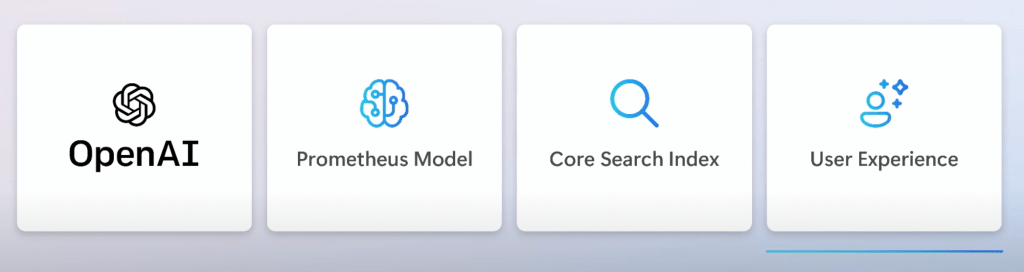
The new AI-powered Bing leverages a layer that Microsoft has created, called Prometheus, which interacts with OpenAI, to make it viable within search.
Indeed, Prometheus, while using OpenAI as the core and foundational for the new conversational interface of Bing (called Bing Chat), also added various features to smooth out some of the drawbacks of OpenAI’s GPT.
Thus, Prometheus tries to make GPT more factual (by preventing it from giving answers when some context might be missing), grounded (by leveraging the indexing technology Bing has), and authoritative (by enabling it to provide sources on the fly).
The interesting thing is that Microsoft started to integrate OpenAI into search first, thus hitting the core of Google’s business model.
ChatGPT leverages a freemium model, with a free version with limited capability and a premium version (starting at $20/mo), which also comprises access in peak times, faster response times, and early access to new features and improvements. In addition, ChatGPT might also make money via API access.
Key takeaways
OpenAI is an artificial intelligence research laboratory comprised of the for-profit company OpenAI LP and the non-profit parent company OpenAI Inc.
OpenAI Gym is a platform for the comparison of reinforcement learning (RL) systems, while Universe is used to train AI agents across websites, games, and applications. Both were launched in 2016.
When OpenAI became a for-profit company in 2019, equity was distributed to employees. Some of this equity has been sold to VC firms, while other interest parties, such as Microsoft, have made sizeable investments.
By January 2023, Microsoft and OpenAI announced the further development of their partnership, with a multi-year and multi-billion commercial partnership, giving OpenAI the infrastructure needed to run its products. And Microsoft the ability to commercialize them.
Timeline
2015: OpenAI is founded as a non-profit artificial intelligence research laboratory by Elon Musk, Sam Altman, and others, with a focus on developing friendly AI.
April 2016: OpenAI launches OpenAI Gym, a platform for comparing reinforcement learning systems.
Later in 2016: OpenAI launches OpenAI Universe, a software platform to train AI agents across various applications.
2018: Elon Musk resigns from OpenAI’s board of directors to avoid potential conflicts of interest with Tesla’s AI endeavors.
2019: OpenAI transitions from a non-profit to a for-profit entity with a capped profit structure limiting profits to 100x on investments.
2019: Microsoft invests $1 billion in OpenAI, becoming the exclusive cloud provider.
2023: OpenAI raises funding from various investors, including Sequoia Capital, Tiger Global Management, Andreesen Horowitz, and Bedrock Capital.
January 2023: Microsoft announces discussions to invest an additional $10 billion in OpenAI, valuing the company at $29 billion, with a unique profit-sharing structure.
Microsoft and OpenAI confirm a multi-year, multi-billion-dollar partnership, allowing Microsoft to integrate, distribute, and develop new products using OpenAI’s technology.
ChatGPT, a product of OpenAI, adopts a freemium model, offering limited capabilities for free and a premium version with added features for a subscription fee.
Large language models (LLMs) are AI tools that can read, summarize, and translate text. This enables them to predict words and craft sentences that reflect how humans write and speak.
Prompt engineering is a natural language processing (NLP) concept that involves discovering inputs that yield desirable or useful results.
Like most processes, the quality of the inputs determines the quality of the outputs in prompt engineering. Designing effective prompts increases the likelihood that the model will return a response that is both favorable and contextual.
Developed by OpenAI, the CLIP (Contrastive Language-Image Pre-training) model is an example of a model that utilizes prompts to classify images and captions from over 400 million image-caption pairs.
OpenAI has built the foundational layer of the AI industry. With large generative models like GPT-3 and DALL-E, OpenAI offers API access to businesses that want to develop applications on top of its foundational models while being able to plug these models into their products and customize these models with proprietary data and additional AI features. On the other hand, OpenAI also released ChatGPT, developing around a freemium model. Microsoft also commercializes opener products through its commercial partnership.
OpenAI and Microsoft partnered up from a commercial standpoint. The history of the partnership started in 2016 and consolidated in 2019, with Microsoft investing a billion dollars into the partnership. It’s now taking a leap forward, with Microsoft in talks to put $10 billion into this partnership. Microsoft, through OpenAI, is developing its Azure AI Supercomputer while enhancing its Azure Enterprise Platform and integrating OpenAI’s models into its business and consumer products (GitHub, Office, Bing).
Stability AI is the entity behind Stable Diffusion. Stability makes money from our AI products and from providing AI consulting services to businesses. Stability AI monetizes Stable Diffusion via DreamStudio’s APIs. While it also releases it open-source for anyone to download and use. Stability AI also makes money via enterprise services, where its core development team offers the chance to enterprise customers to service, scale, and customize Stable Diffusion or other large generative models to their needs.
OpenAI is an artificial intelligence research laboratory that transitioned into a for-profit organization in 2019, which comprised an entity called OpenAI LP and the non-profit parent foundation OpenAI. The lab, which was founded in 2015 by Elon Musk, Sam Altman, and various others, has a core focus on the development of friendly AI that benefits society as a whole. Yet now has primarily evolved as a capped-for-profit entity with an exclusive commercial license to Microsoft.
Its co-founders primarily own Airbnb: Brian Chesky, with 76,407,686 Class B shares, which gives him 29.1% of ownership; Nathan Blecharczyk, with 232,306 Class A and 64,646,713 Class B, which give him 25.3%; and Joe Gebbia, which has 5,113,865 Class A and 58,023,452 Class B, which give him 22.9% ownership.
Google is primarily owned by its founders, Larry Page and Sergey Brin, who have more than 51% voting power. Other individual shareholders comprise John Doerr (1.5%), a venture capitalist and early investor in Google, and CEO, Sundar Pichai. Former Google CEO Eric Schmidt has 4.2% voting power. The most prominent institutional shareholders are mutual funds BlackRock and The Vanguard Group, with 2.7% and 3.1%, respectively.
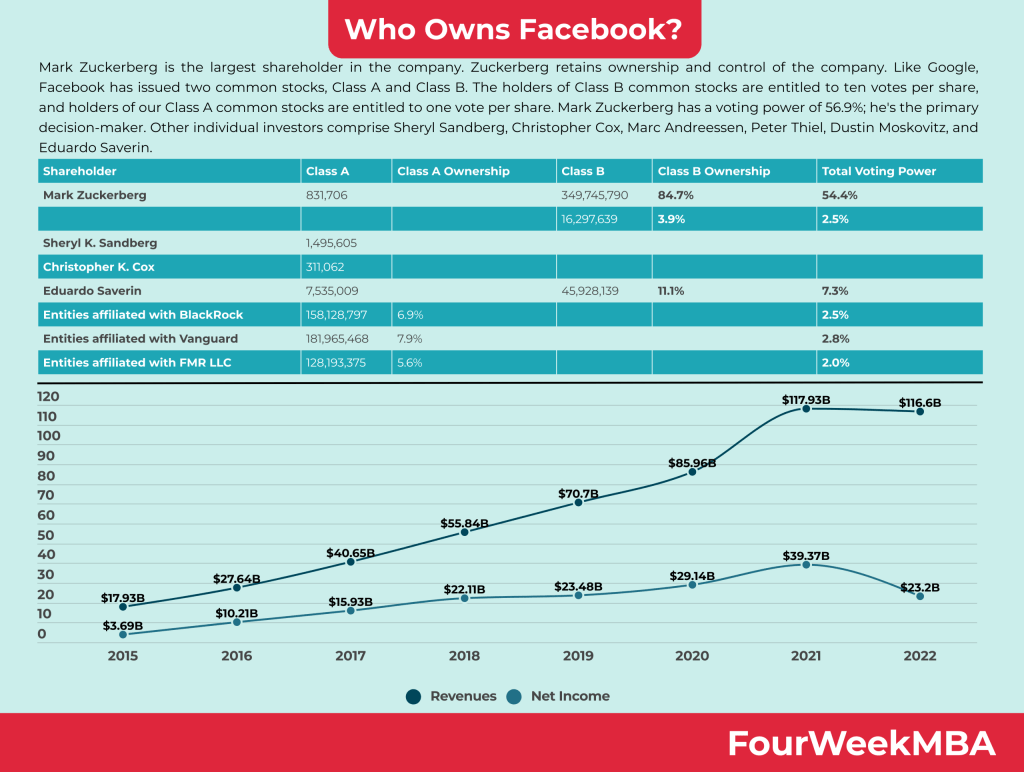
Mark Zuckerberg is the largest shareholder in the company. Zuckerberg retains ownership and control of the company. Like Google, Facebook has issued two common stocks, Class A and Class B. The holders of Class B common stocks are entitled to ten votes per share, and holders of our Class A common stocks are entitled to one vote per share. Mark Zuckerberg has a voting power of 56.9%; he’s the primary decision-maker. Other individual investors comprise Sheryl Sandberg, Christopher Cox, Marc Andreessen, Peter Thiel, Dustin Moskovitz, and Eduardo Saverin.
As of 2023, major Apple shareholders comprised Warren Buffet’s Berkshire Hathaway with 5.73% of the company’s stock (valued at over $130 billion). Followed by other individual shareholders like Tim Cook, CEO of Apple, with about 3.3 million shares, Artur Levinson, chairman of Apple, with over 4.5 million shares, and others.
With 64,588,418 shares, Jeff Bezos is the major individual investor. Owning 12.7% of the company. Other top individual investors comprise Amazon’s CEO Andy Jessy, with 94,729 shares. Top institutional investors include mutual funds like The Vanguard Group (6.6% ownership) and BlackRock (5.7% ownership).
Major shareholders comprise co-founder Bill Gates, who stepped down from the company’s board in 2020, which is why these shares are no longer publicly reported. In 2019, Gates still owned a stake of 103 million stocks, which accounted for 1.34% of the company’s ownership (worth over $23 billion in January 2023). Other individual shareholders comprise Satya Nadella, the company’s CEO, Brad Smith (former president), Jean-Philippe Courtois (EVP), and Amy Hood (former CFO).
By 2022, most of Tesla’s shares are still owned by Elon Musk, among the company’s co-founders and the CEO. Elon Musk is the top individual investor, with a 23.5% stake in the company, equivalent to over 244 million shares. Musk is followed by Lawrence Ellison (founder of Oracle), with a 1.5% company stake. Ellison also sits on Tesla’s board. And Antonio Gracias, among the company’s first investors, has over 1.6 million shares. Other institutional investors and mutual funds like The Vanguard Group (6%), Blackrock (5.1%), and Capital Ventures International also have a good chunk of the company’s stocks.
PayPal was first founded in 1998; it was called Confinity (among its founders was Peter Thiel); later, it merged with X.com, its major competitor, founded by Elon Musk (which would become known for other companies like Tesla and SpaceX). From this merger, PayPal was born. In 2002, PayPal was bought by eBay for $1.5 billion. eBay spun off PayPal in 2015, which would be listed as an independent entity. Today PayPal owns brands like Braintree, Venmo, Xoom, and iZettle.
Netflix’s largest individual shareholder is Reed Hastings, co-founder, and former CEO of the company, now Chairperson of Netflix, with a 1.7% stake, valued at over $2.4 billion in February 2023. Other significant individual shareholders comprise Jay C. Hoag, the company’s directors since 1999, and Ted Sarandos, former chief content officer and now Chief Executive Officer of Netflix. Major institutional shareholders comprise The Vanguard Group (7.55% ownership), BlackRock (6.58% ownership), and Capital Research Global Investments (5.84% ownership).
TikTok is owned by ByteDance, a Chinese internet technology company owning several content platforms worldwide (Douyin, Toutiao, Xigua Video, Helo, Lark, Babe). Bytedance passed the $300 billion private market valuation by 2022, making around $58 billion in revenue in 2022, over $4 billion from TikTok.
Acquired by Google, in 2006, for $1.65 billion, YouTube is now worth many times over. In 2022, YouTube generated over $29 billion in revenue from advertising alone. YouTube is part of Google (now named Alphabet), and as such, it is owned by main Google’s Alphabet shareholders and is one of the fastest-growing segments for the company.
As of April 25th, 2022, Elon Musk tried to take over Twitter. Musk tried to purchase the company at $54.20 per share, or about $44 billion. The deal finally closed by October 27th, 2022, and Elon Musk became the largest shareholder.
The multi-billion music streaming company Spotify is primarily owned by its founders, Daniel Ek and Martin Lorentzon. As of 2023, Daniel Ek has 16.5% ownership of ordinary shares and 31.7% of the voting power. Martin Lorentzon has 10.9% of ordinary shares and 42.6% of the voting power. Another key shareholder is Baillie Gifford & Co, a Scottish-based money management firm, followed by Morgan Stanley, T. Rowe Price, and Tencent.
The top individual shareholder of NVIDIA is Jen-Hsun Huang, founder, and CEO of the company, with 87,521,722 shares giving him 3.50% ownership. Followed by Mark A. Stevens, venture capitalist and a partner at S-Cubed Capital, who was part of the NVIDIA board in 2008 and previously served as a director from 1993 to 2006, with 6,258,803 shares. Institutional investors comprise The Vanguard Group, Inc, with 196,015,550, owning 7.83%. BlackRock, Inc., with 177,858,484, owns 7.10%. And FMR LLC (Fidelity Institutional Asset Management) with 158,039,922, owning 6.31%.
Uber’s principal individual shareholders comprise Yasir Al-Rumayyan (3.73%), the Governor of the Public Investment Fund, the sovereign wealth fund of the Kingdom of Saudi Arabia, and Dara Khosrowshahi, the founder and CEO of Uber. There is Morgan Stanley, with 5.12% ownership among the top institutional investors.
The founder and CEO of Shopify, Tobias Lütke, owned or controlled 7,891,852 Class B multiple voting shares and 5,250 Class A subordinate voting shares, representing approximately 33.8% of the aggregate voting power attached to all of the Company’s outstanding voting shares. Another key stakeholder is John H. Phillips, an angel investor who placed an early bet on Shopify.
Roblox is owned by David Baszucki and Gregory Baszucki, with a 2.3% and 2.6% stake, respectively. Anthony lee, managing partner at Altos Ventures, with a 15.3% stake.
In 2014, Twitch was bought by Amazon for $970 million. Therefore Twitch is part of Amazon, comprising other subsidiaries bought over the years, like Audible, Whole Foods, and Zappos (in total, Amazon has 12 subsidiaries). Therefore, as of 2020, Twitch is a multi-billion dollar company, making money primarily via advertising through its video streaming platform (creators use Twitch today across many other verticals).
Zoom’s principal private shareholders comprise Eric S. Yuan, a Chinese-American billionaire businessman that founded Zoom. Dan Scheinman, board member and angel investor in Zoom since the start, and Santiago Subotovsky, also an early investor in Zoom. Zoom follows a freeterprise business model where free accounts are channeled into enterprise customers.
In one of the largest deals in the business world, Microsoft acquired Activision Blizzard in a $68.7 billion transaction. Making Microsoft the world’s third-largest gaming company by revenue, behind Tencent and Sony. However, given the size of the deal, this is still under the scrutiny of regulators who need to approve it. If the deal goes through, Microsoft will become among the largest gaming companies in the world.
Pixar is owned by The Walt Disney Company, which acquired it in 2006 in a $7.4 billion deal. Today Pixar is part of the Disney Empire. The principal shareholders of Disney comprise Robert Iger, CEO of the company, and institutional investors like The Vanguard Group and Blackrock.
Marc Benioff, Co-CEO of Salesforce, is the primary individual shareholder, with 3% of the company’s stock. Other main individual shareholders comprise Parker Harris, Co-Founder and Chief Technology Officer, and Bret Taylor, former co-CEO. Major institutional shareholders include The Vanguard Group, Fidelity, and BlackRock.
In a $27.7 billion deal in 2021, Salesforce’s finalized the acquisition of Slack, which was integrated into Salesforce. Today Slack is still a product mostly independently managed by Salesforce, which incorporated some of its features within its platform. Entrepreneur Marc Benioff primarily owns salesforce.
Evan Spiegel and Robert Cornelius Murphy are the co-founders and, respectively, CEO and CTO of Snapchat. Evan Spiegel owns 3% of Class A stocks, 25.7% of Class B stocks, and 53.4% of Class C stocks for a 53.2% voting power, whereas Robert Murphy owns 6% of Class A stocks, 25.7% of Class B stocks, and 46.6% of Class C stocks for a 46.6% voting power. Snapchat runs an advertising-based businessmodel.
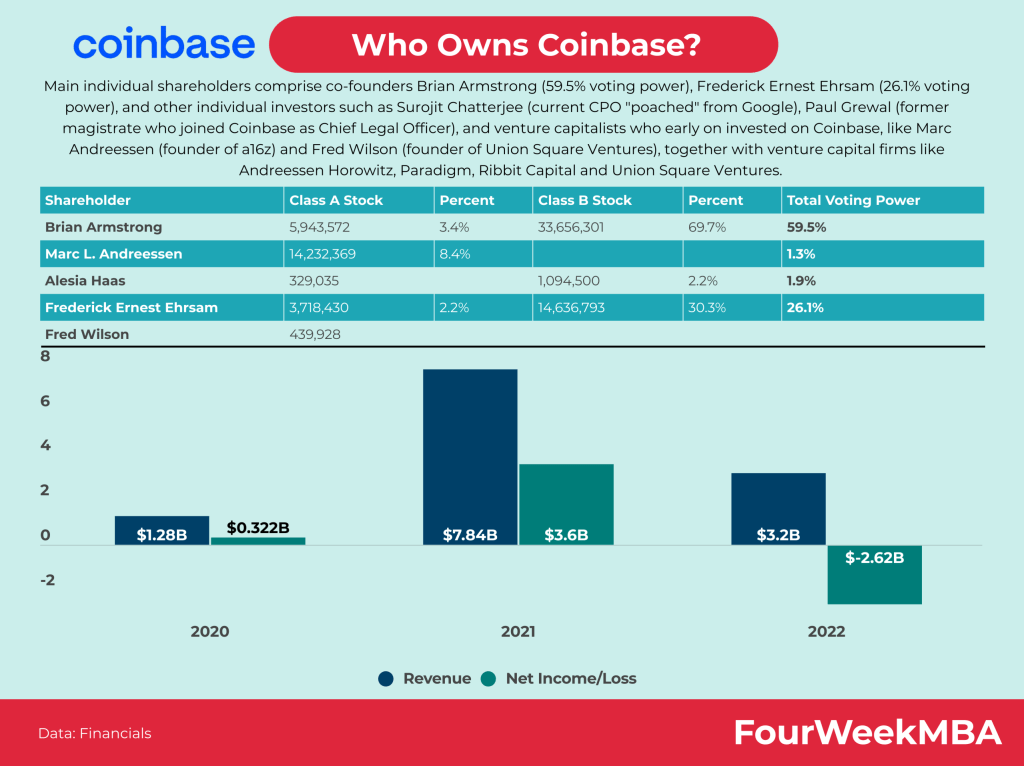
Main individual shareholders comprise co-founders Brian Armstrong (59.5% voting power), Frederick Ernest Ehrsam (26.1% voting power), and other individual investors such as Surojit Chatterjee (current CPO “poached” from Google), Paul Grewal (former magistrate who joined Coinbase as Chief Legal Officer), and venture capitalists who early on invested on Coinbase, like Marc Andreessen (founder of a16z) and Fred Wilson (founder of Union Square Ventures), together with venture capital firms like Andreessen Horowitz, Paradigm, Ribbit Capital and Union Square Ventures.
Gennaro is the creator of FourWeekMBA, which reached about four million business people, comprising C-level executives, investors, analysts, product managers, and aspiring digital entrepreneurs in 2022 alone | He is also Director of Sales for a high-tech scaleup in the AI Industry | In 2012, Gennaro earned an International MBA with emphasis on Corporate Finance and Business Strategy.