

A multisided platform business model is a company that leverages multisided network effects (coming from two or more sides of the network). Therefore, when one side of the network grows, this makes the overall platform more valuable for the other side of the network and vice-versa, triggering exponential growth for the platform business.
| Aspect | Explanation |
|---|---|
| Definition | The Multisided Platform Business Model is a business approach that brings together multiple distinct groups of users and facilitates interactions or transactions between them. It creates value by connecting two or more user groups, enabling them to exchange goods, services, or information. This model often relies on network effects, where the more users participate, the more valuable the platform becomes for everyone. Multisided platforms can take various forms, such as marketplaces, social networks, payment systems, and more. They play a pivotal role in today’s digital economy by fostering interactions and transactions between different user segments. |
| Key Concepts | – Multiple User Segments: The core concept is the existence of multiple distinct user groups. – Network Effects: The value of the platform increases as more users join and interact. – Cross-Subsidization: Often, one user group is subsidized by another, e.g., advertisers subsidizing users. – Interactions: The platform facilitates interactions, transactions, or exchanges between user segments. – Value Proposition: Providing value to each user group is essential for success. |
| Characteristics | – User Diversity: Multisided platforms involve diverse user segments, each with its own needs and interests. – Interconnectedness: Users from different segments interact on the platform. – Cross-Subsidization: Revenue from one user group may fund services for another. – Scaling Impact: As more users join, the platform becomes more valuable for all participants. – Data-Driven: These platforms often collect and leverage data to enhance user experiences and offerings. |
| Implications | – Network Effects: The success of the platform relies on attracting and retaining users from different segments. – Competition: Competing in this space can be challenging due to network effects and the need to balance the interests of multiple user groups. – Data Privacy: Data collection and management require careful consideration of privacy concerns. – Monetization: Strategies for generating revenue often involve subsidizing one user group while charging another. – Regulatory Considerations: Multisided platforms may face regulatory scrutiny, especially regarding antitrust and data privacy. |
| Advantages | – Scalability: The potential for exponential growth through network effects. – Economies of Scale: Efficiencies can be achieved as the platform grows. – Diverse Revenue Streams: Multiple user segments can provide various revenue sources. – Enhanced User Experiences: The platform can offer richer experiences through interactions with different user groups. – Market Power: Successful platforms can become dominant players in their respective markets. |
| Drawbacks | – Challenges in Balancing Interests: Meeting the needs and expectations of multiple user segments can be complex. – Regulatory Scrutiny: Multisided platforms may face regulatory challenges, especially as they grow and gain market power. – Data Privacy Concerns: Collecting and handling user data can raise privacy issues and regulatory compliance challenges. – Dependence on Network Effects: The success of the platform relies heavily on the growth and engagement of users. – Competition: The competitive landscape can be intense, with rivals vying for the same user segments. |
| Applications | The Multisided Platform Business Model is applied in various industries and sectors, including e-commerce, social networking, payment systems, transportation, and more. It has become increasingly prevalent in the digital age, where connecting users and fostering interactions is a key driver of value. |
| Use Cases | – Amazon: Amazon serves as a multisided platform connecting buyers and sellers on its marketplace. – Uber: Uber connects riders with drivers, creating value for both sides of the platform. – Facebook: As a social media platform, Facebook brings together users and advertisers. – Airbnb: Airbnb connects hosts with travelers, enabling short-term rentals. – App Stores: Platforms like Apple’s App Store connect app developers with users. |
Understanding platform business models

In short, there are a few elements that define a platform business model:
Interactions vs. sales
A platform business model focuses on enabling an underlying ecosystem of third-party players that can build their own companies on top of the platform.
In short, the platform business is more concerned about the health of the overall entrepreneurial ecosystem, underlying it, that the sales of its own products.
In fact, oftentimes, for platform business models, most products and services sold, on top of it, are by third parties.
And if the platform enables the sales of physical products, those might be primarily sold by third-party stores (see Amazon business model).
While, if the platform enables services, then it will collect a tax from one side, both sides, or multiple sides of the transactions (see Uber business model or Uber Eats business model, and Airbnb business model).
Transactions between the main parties of the network
Usually, a platform business model measures its financial success according to the gross value of the overall transactions happening on the platform.

Take the Airbnb business model economics. The company enables a gross booking value of almost $47 billion in 2021.
As a consequence of that, it generated an almost $6 billion tax, in service revenues.
One user type network improvement, also exponentially improves the other sides of the network
A platform’s network is highly interconnected. This means that by improving a side of the network, you also improve the other side.
However, often, when platform business models kick off their operations, they need to figure out which side of the network, they need to kick off first.
For instance, in the case of Uber Eats, the choice was simple. Since the company had already millions of drivers and users, it only needed to add restaurants/partners to kick off the whole network.
Instead, if you take the case of Uber, initially, to make its network valuable in the first place, it had to pick one side of the network: drivers.
In fact, as drivers became available, the company could kick off its network effects, by offering rides across various neighborhoods, cities, and countries, at competitive rates, and low wait times.
Flywheel vs. funnel

Where the sales funnel is used with a linear logic (and more in line with traditional organizations). When it comes to platform businesses, it’s all about feedback loops.
Those feedback loops move in all directions, as they help the network solidify.
Thus, as a platform, it’s critical to think in terms of flywheels rather than funnels.
This leads us to another key point.
Growth engines, vs. business development

Business development is extremely important for any platform business, especially in the early days.
Indeed, think of the case of Uber Eats which needs to go out and find a restaurant network and partners willing to join the platform.
This is a complex deal, which requires experienced business people, able to navigate the deal and unlock it.
Once these deals are closed, while business development (especially for platform leveraging enterprise customers) will be an integrated part of the overall business model, growth engines become critical.
A growth engine is simply an integration between product, marketing, and distribution. Where within the platform there are built-in incentives to distribute the network.
Take the case of the Amazon e-commerce platform, with millions of freely accessible product pages, which prompt billion of users to see them. The underlying platform is both a technical platform, supporting thousands and thousands of third-party stores and a distribution engine!
Understanding network effects

In the table below, we structured how network effects are kicked off:
| Definition Network Effects: The value of a service/platform increases for each additional user, as more users, join in. | Sub-type | Description – Example |
| Direct, Same Side, or One-Sided | As more users join, the platform’s value increases for each additional user. Take the case of a social media platform, like Facebook, Instagram, TikTok, LinkedIn, Twitter. The more users join, the more the platform will be valuable for each additional user, as the new user might find exponentially richer and broader content (provided the platform can prevent congestion or pollution). | |
| Indirect or Cross-Side | In this case, a user type joining the platform makes it more valuable for other user types. Take the case of LinkedIn. While LinkedIn enjoys the same-side network effects, the platform becomes more valuable to users looking to enhance their careers as more users join in. At the same time, LinkedIn enjoys indirect or cross-side network effects. More users who join the platform to grow their career make it more valuable for recruiters (so a different user type) as they can find more qualified candidates on top of the platform. | |
| Two-Sided | Take the case of LinkedIn. While LinkedIn enjoys the same-side network effects, the platform becomes more valuable to users looking to enhance their careers as more users join in. At the same time, LinkedIn enjoys indirect or cross-side network effects. In this case, a user type joining the platform makes it more valuable for other user types. More users who join the platform to grow their career make it more valuable for recruiters (so a different user type) as they can find more qualified candidates on top of the platform. | |
| Multi-Sided | In this case, more than two user types are driven by the network dynamics. Take the case of Uber Eats; the more restaurants join the platform, the more the platform becomes valuable for eaters. While at the same time, by leveraging its existing platform, Uber drivers have additional riding options. So they can earn extra income by delivering food instead of giving rides. That makes the overall platform much more valuable for the three main user types: eaters, restaurants, and riders. |

Below, instead we explain the curse of platform business models: negative network effects:
| Definition Negative Network Effects: The Value of the service/platform decreases for each additional user, as more users join in. This might be due to congestion (when increased usage can’t be handled by the platform) or pollution (when the increased size of the network makes it hard to incrementally add value, and instead its value shrinks). | Description – Example |
| Congestion (Increased Usage) | In this case, there is a reduced quality of the service when certain parts of the networks carry way more data than they can handle. That usually happens because of scale limitations and noise due to curation limitations. Since this is a technological issue, it manifests as service slowdown or perhaps the platform crashing. Take the case of services like YouTube crashing for too much traffic. Or, if you’re a professional, a service like Slack crashes as it cannot handle the traffic spikes. That becomes a disservice with potential negative network effects because you suddenly prevent a whole team from functioning properly. Therefore, a negative network effect can have exponential negative consequences. For instance, users would switch to alternatives en masse if this was repeatedly happening, thus creating structural damage to the network. |
| Network Pollution (Increased Size) | The case of pollution is more tied to the ability of the platform to keep its service relevant at scale. Thus, imagine the case of a platform like Twitter, in which the principal asset is the feed. As Twitter becomes more and more popular, it needs to make sure that the user-generated content is qualitatively on target. Otherwise, the risk is for the user’s Twitter feed to become less relevant and lose value. Or imagine the case that many user-generated platforms face today, where spambots take over. Here, suppose the platform cannot handle this automatically generated content. In that case, it can quickly lose value, as the service becomes worthless for users (take the case of a user who has to spend an hour a day cleaning up the feed because of spamming). |
The multi-sided platform DNA
Let’s see two case studies and examples of multi-sided platform business models.
LinkedIn Case Study
Take the example of LinkedIn, a platform for job seekers and recruiters.
Here the network effects dynamics are multi-sided, meaning that for more job seekers join LinkedIn, and enrich their profiles, the more the platform becomes valuable to recruiters.
And the more recruiters/companies join, the more the platform is valuable to job seekers.

Uber Eats Case Study
Another example is Uber Eats, in which complex dynamics between eaters, drivers, and restaurants/partners, enable the company to leverage multi-sied network effects to grow the company.

Case Studies
1. Facebook:
- Platform: Facebook is a social media platform that connects individuals, businesses, and advertisers.
- Multisided Network Effects: As more users join Facebook, it becomes more valuable for individuals to connect with friends, family, and communities. Simultaneously, it becomes more appealing for businesses and advertisers to reach a wider audience, driving revenue through ads.
2. Google (Google Ads):
- Platform: Google Ads is an advertising platform that connects advertisers with users through targeted ads on Google search results and partner websites.
- Multisided Network Effects: When more advertisers use Google Ads, it offers a broader range of advertising options to users, improving the relevance of ads. As users click on ads and generate revenue for advertisers, Google benefits from increased advertising spend.
3. Airbnb:
- Platform: Airbnb is a platform that connects hosts (property owners) with travelers seeking accommodation.
- Multisided Network Effects: As more hosts list their properties on Airbnb, the platform becomes more attractive to travelers, offering a wider variety of lodging options. Conversely, as more travelers use Airbnb, hosts benefit from increased bookings and revenue opportunities.
4. Uber:
- Platform: Uber is a ride-sharing platform connecting riders with drivers.
- Multisided Network Effects: As more riders use Uber, it becomes easier for them to find available drivers quickly, and drivers benefit from increased ride requests. The growth of drivers also leads to shorter wait times for riders, enhancing the overall experience.
5. YouTube:
- Platform: YouTube is a video-sharing platform that hosts user-generated content and allows content creators to reach a global audience.
- Multisided Network Effects: As more content creators upload videos, YouTube becomes a richer source of diverse content, attracting more viewers. Viewers, in turn, generate ad revenue for content creators and YouTube itself, creating a self-reinforcing cycle.
6. PayPal:
- Platform: PayPal is a digital payment platform that connects buyers and sellers for online transactions.
- Multisided Network Effects: As more users and businesses adopt PayPal, it becomes a more widely accepted payment method. This, in turn, attracts more users and businesses to use PayPal for online transactions, further expanding its reach.
7. Amazon Marketplace:
- Platform: Amazon Marketplace connects third-party sellers with online shoppers.
- Multisided Network Effects: As more sellers join Amazon Marketplace, the platform offers a broader selection of products to shoppers, making it more appealing. As shoppers purchase products from various sellers, both Amazon and the sellers benefit from increased sales and revenue.
8. LinkedIn:
- Platform: LinkedIn connects professionals, job seekers, and recruiters.
- Multisided Network Effects: As more professionals create profiles and engage on LinkedIn, the platform becomes a more valuable resource for job seekers and recruiters. Job seekers benefit from improved job opportunities, while recruiters gain access to a larger pool of potential candidates.
9. App Store (Apple):
- Platform: Apple’s App Store connects app developers with iOS device users.
- Multisided Network Effects: As more developers create apps for the App Store, it provides users with a wider selection of applications, improving the overall user experience. Simultaneously, as more users join the iOS ecosystem, developers have a larger customer base to target, increasing their potential reach and revenue.
10. Google Play Store:
- Platform: Google Play Store serves as the primary app distribution platform for Android devices.
- Multisided Network Effects: As more developers publish apps on the Google Play Store, Android users have access to a broader range of applications, making Android devices more appealing. Increased adoption of Android devices, in turn, incentivizes developers to create more apps for the platform.
11. Microsoft Azure:
- Platform: Microsoft Azure is a cloud computing platform that connects businesses with cloud services and resources.
- Multisided Network Effects: As more businesses and developers adopt Microsoft Azure, it becomes a more attractive platform with a broader ecosystem of services. This encourages more businesses to use Azure for cloud infrastructure and services, creating a positive feedback loop.
12. eBay:
- Platform: eBay is an online marketplace connecting buyers and sellers of various products.
- Multisided Network Effects: The more sellers list items on eBay, the more attractive it becomes for buyers searching for a wide range of products. Conversely, as more buyers frequent the platform, sellers have a larger audience for their listings, increasing the likelihood of sales.
13. GitHub:
- Platform: GitHub is a platform for software developers to collaborate on and share code.
- Multisided Network Effects: As more developers and organizations host their projects on GitHub, it becomes a central hub for collaboration and code sharing. This attracts more developers, contributors, and organizations to join, leading to a richer and more active developer community.
14. Spotify:
- Platform: Spotify is a music streaming platform connecting music artists, record labels, and listeners.
- Multisided Network Effects: When more music artists and record labels publish their music on Spotify, it offers a vast library of songs to listeners, making it a compelling choice for music consumption. As more listeners subscribe and listen to music on the platform, artists and labels benefit from increased royalties and exposure.
15. Etsy:
- Platform: Etsy is an online marketplace connecting artisans, crafters, and vintage sellers with shoppers.
- Multisided Network Effects: As more sellers offer unique handmade and vintage items on Etsy, it becomes a go-to destination for shoppers seeking one-of-a-kind products. Increased shopper traffic benefits sellers as they gain exposure and make sales.
Key Highlights
- Definition: A multisided platform business model harnesses multisided network effects from different sides of the network. As one side grows, the overall platform becomes more valuable for the other sides, leading to exponential growth.
- Platform Value Generation: This model generates value by enabling interactions between various users, leveraging network effects. Typically, these platforms consist of two sides – supply and demand – and sparking interactions between these sides is crucial for success.
- Key Elements:
- Interactions vs. Sales: Focuses on fostering an ecosystem of third-party players who build businesses on the platform. It prioritizes the health of the ecosystem over selling its own products.
- Transactions and Financial Metrics: Measures success by the total transaction value occurring on the platform. For instance, Airbnb’s Gross Booking Value and service fee revenues.
- One User Type Improves All: Improving one side of the network enhances the value for the other sides, creating interconnected growth.
- Flywheel vs. Funnel: Unlike linear sales funnels, multisided platforms operate through feedback loops and interconnected growth mechanisms.
- Growth Engines vs. Business Development: Growth engines integrate product, marketing, and distribution to distribute the network value. Business development is vital initially, while growth engines become critical for sustainable expansion.
- Network Effects: As more users join the platform, its value increases for both existing and new users.
- Negative Network Effects: Platform value can decrease due to congestion (increased usage beyond capacity) or pollution (diminished relevance as the network grows).
| Multisided Platform Business | Description | Key User Groups |
|---|---|---|
| Uber | Ride-hailing platform connecting riders with drivers | Riders, Drivers |
| Airbnb | Lodging platform connecting travelers with hosts | Travelers, Hosts |
| Amazon | E-commerce platform connecting buyers with sellers | Buyers, Sellers |
| Social media platform connecting users and businesses | Users, Advertisers | |
| Search engine platform connecting users with advertisers | Users, Advertisers | |
| Professional networking platform connecting job seekers with employers | Job Seekers, Employers | |
| eBay | Online marketplace connecting individual sellers with buyers | Sellers, Buyers |
| Apple App Store | App distribution platform connecting developers with Apple device users | Developers, Users |
| Alibaba | E-commerce and B2B platform connecting businesses with suppliers and consumers | Businesses, Suppliers, Consumers |
| Grubhub | Food delivery platform connecting diners with local restaurants | Diners, Restaurants |
| PayPal | Online payment platform connecting buyers and sellers, facilitating online transactions | Buyers, Sellers |
| Etsy | E-commerce platform connecting independent artisans and crafters with shoppers | Sellers, Shoppers |
| TripAdvisor | Travel platform connecting travelers with reviews, recommendations, and accommodations | Travelers, Hotels/Restaurants |
| Upwork | Freelance platform connecting businesses with freelancers and contractors | Clients, Freelancers |
| YouTube | Video-sharing platform connecting content creators with viewers and advertisers | Creators, Viewers, Advertisers |
| Twitch | Livestreaming platform connecting gamers and content creators with audiences | Streamers, Viewers, Advertisers |
| Chinese multipurpose app connecting users with messaging, social networking, and services | Users, Businesses | |
| Patreon | Crowdfunding platform connecting creators with patrons who provide ongoing support | Creators, Patrons |
| Slack | Collaboration platform connecting teams and organizations for communication and productivity | Teams, Organizations |
| Microsoft Azure Marketplace | Cloud services platform connecting developers with solutions and services | Developers, Solution Providers |
| TaskRabbit | Online platform connecting individuals with various tasks and services | Task Posters, Taskers |
| OpenTable | Restaurant reservation platform connecting diners with restaurant availability | Diners, Restaurants |
| Eventbrite | Event management platform connecting event organizers with attendees | Organizers, Attendees |
| Duolingo | Language learning platform connecting learners with interactive courses | Learners, Educators |
| Coursera | Online education platform connecting students with courses from top universities | Students, Instructors |
| LinkedIn Recruiter | Talent acquisition platform connecting recruiters with job candidates | Recruiters, Job Seekers |
| Zillow | Real estate platform connecting homebuyers, sellers, and renters with property listings | Homebuyers, Sellers, Renters |
| Fiverr | Freelance services platform connecting businesses with freelancers and gig workers | Clients, Freelancers |
| Airbnb Experiences | Activity booking platform connecting travelers with local experiences | Travelers, Experience Hosts |
| DoorDash | Food delivery platform connecting diners with local restaurants for delivery | Diners, Restaurants, Dashers |
| Shopify | E-commerce platform connecting businesses with tools to create online stores | Merchants, Customers |
| Related Frameworks, Concepts, Models | Description | When to Apply |
|---|---|---|
| Platform Business Model | – A business model that creates value by facilitating exchanges between two or more interdependent groups, usually consumers and producers. | – Apply when looking to create or operate a marketplace or digital platform. – Ideal for leveraging network effects and scaling rapidly. |
| Two-Sided Market | – A type of platform business model where the platform serves two distinct user groups that provide each other with network benefits. | – Use when needing to connect two distinct groups (e.g., buyers and sellers, service providers and users). – Essential for marketplaces and match-making services. |
| Multi-Sided Platform (MSP) | – Extends the two-sided market to more than two distinct user groups that interact with each other through the platform. | – Apply to create a complex ecosystem involving multiple user groups. – Useful for large-scale platforms with diverse user interactions. |
| Network Effects | – The phenomenon where a product or service becomes more valuable as more people use it. – Includes direct (same-side) and indirect (cross-side) network effects. | – Leverage when building products or services that benefit from increased user base. – Essential for scaling platforms quickly. |
| Platform Ecosystem | – A network of interconnected companies, products, and services that enhance the platform’s value. | – Use to expand platform offerings and create synergies between different products and services. – Ideal for creating comprehensive solutions for users. |
| Data-Driven Platforms | – Platforms that leverage large amounts of data to provide personalized experiences, optimize operations, and improve decision-making. | – Apply when data is a key asset and personalization or optimization can drive value. – Essential for digital platforms and AI-driven services. |
| Freemium Model | – A business model where the platform offers basic services for free while charging for premium features. | – Use to attract a large user base quickly and convert a portion of users to paying customers. – Ideal for software and digital services. |
| Subscription Model | – A business model where users pay a recurring fee to access the platform’s services. | – Apply to generate steady revenue and build long-term customer relationships. – Useful for content and service-based platforms. |
| Transaction Fee Model | – A revenue model where the platform charges a fee per transaction made between users on the platform. | – Use to monetize transactions facilitated by the platform. – Essential for marketplaces and financial service platforms. |
| Advertising Model | – A revenue model where the platform provides free services to users and generates revenue through advertising. | – Apply to monetize a large user base by selling ad space. – Useful for social media, search engines, and content platforms. |
| Platform Governance | – The rules and standards that regulate interactions and behaviors on the platform to ensure trust and quality. | – Use to maintain a healthy ecosystem and prevent abuse or fraud. – Essential for sustaining user trust and engagement. |
Complimentary Resources:
Complimentary Case Studies:
- Amazon Business Model
- Uber Business Model
- Uber Eats Business Model
- Airbnb Business Model
- LinkedIn Business Model
Connected Business Model Types And Frameworks


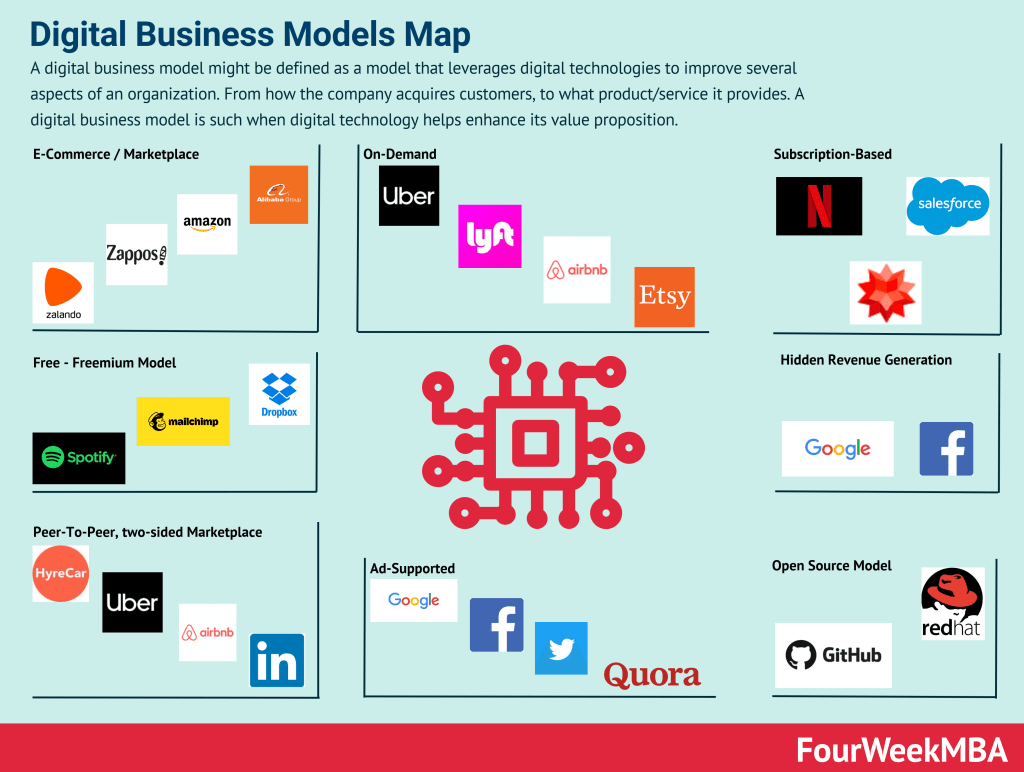


Attention Merchant Business Model


Main Free Guides:
- Business Models
- Business Strategy
- Business Development
- Digital Business Models
- Distribution Channels
- Marketing Strategy
- Platform Business Models
- Revenue Models
- Tech Business Models
- Blockchain Business Models Framework


