Headquartered in San Francisco, California, Uber started as a peer-to-peer ridesharing platform. In more recent times, the company has moved into food delivery, rental cars, and bike-sharing. In one form or another, Uber now has a presence in over 900 cities worldwide.
In 2023, Uber generated nearly $20 billion from its core platform (mobility), followed by delivery (Uber Eats) with $12.2 billion and freight, with $5.24 billion in revenue.
Market position – Uber dominates the ride-sharing market because they invented it. They enjoy a 77% market share in the US, completing approximately 40 million trips per month. Lyft, who is Uber’s main competitor, has just 10% of the market.
Convenience – a large part of Uber’s success has been due to its ability to make ride-sharing more convenient and cost-effective than hailing a taxi. A low-cost ride can be hailed with the simple push of a button in their app.
Diversification – although quick to find success in ride-sharing, Uber has not wasted any time diversifying its services. Food delivery (Uber Eats), rental cars (Uber Rent), and bikes (Uber Bikes) are some examples. Uber has also managed to effectively bundle many of these services together, increasing market share, revenue, and profits.
Technology – without a well-functioning app, Uber’s core business model would fail. Thus, the company boasts a strong technology department who work relentlessly to improve the Uber app experience for consumers.
Weaknesses
Dependency on drivers – in the past few years, more than 100 Uber drivers have been accused of sexual harassment. A driver in India was also charged with rape in 2015 which led to the company being temporarily banned. To some extent, Uber is at the mercy of the unpredictable behavior of their drivers. But their reputation has been tarnished nonetheless and they have lost market share to competitors.
Poor company culture – Uber’s culture of sexism and unethical practices have also damaged its brand, perhaps permanently in some cases. Then CEO and Uber co-founder Travis Kalanick had to resign because of public backlash to this culture, culminating in the #DeleteUber campaign where over 500,000 users deleted their accounts.
Consistent losses – although revenue has increased, Uber has a history of reporting billion-dollar losses. Its aggressive strategy of providing bonuses to drivers and discounts to consumers to beat the competition is the reason for their lack of profitability thus far.
Opportunities
Uber Eats is a three-sided marketplace connecting a driver, a restaurant owner and a customer with Uber Eats platform at the center. The three-sided marketplace moves around three players: Restaurants pay commission on the orders to Uber Eats; Customers pay the small delivery charges, and at times, cancellation fee; Drivers earn through making reliable deliveries on time.
Changes in consumer preferences – Uber is perfectly placed to take advantage of the fluid transportation market. For example, car ownership continues to decline in western society – particularly among millennials. Autonomous vehicle use is also gaining momentum and the aging US population also necessitates that more consumers will need ride services well into the future.
Doubling down on core strategy – Uber has become popular because it offers shorter wait times than traditional taxis. By increasing driver recruitment, Uber could reduce wait times further and increase market share.
Expansion – in developing countries where high-speed internet is becoming established, there is an opportunity for Uber to expand its services. Countries with emerging middle-class consumers such as China also represents a growth market.
Threats
Uber is a is two-sided marketplace, a platform business model that connects drivers and riders, with an interface that has elements of gamification, that makes it easy for two sides to connect and transact. Uber makes money by collecting fees from the platform’s gross bookings.
Changes in legislation – the introduction of Uber in a new city or country is often met with resistance, especially from the taxi industry. Changes in legislation have prohibited the company from operating in certain circumstances. For example, Uber was taken to court in Germany by Taxi Deutschland for violating competition rules and lacking the necessary licenses. Uber was consequently banned from operating in the country
Dissatisfied drivers – in 2016, over 300,000 drivers initiated a class action against Uber for low wages, hurting its brand image and reducing its profitability by losing drivers to rival platforms. Uber is not immune from further actions in the future as it strives to undercut the taxi industry.
Low profit margins – since Uber takes only 5 to 20% of each ride, its viability as a company will remain vulnerable until it can expand market share, reach, and revenue.
Uber’s principal individual shareholders comprise Yasir Al-Rumayyan (3.64%), the Governor of the Public Investment Fund, the sovereign wealth fund of the Kingdom of Saudi Arabia, and Dara Khosrowshahi, CEO of Uber. Institutional investors comprise Morgan Stanley, with 7.32% ownership, Fidelity, with 6.34%, and The Vanguard Group, with 5.85% ownership.
Uber is a two-sided marketplace, a platform business model that connects drivers and riders, with an interface with gamification elements that make it easy for two sides to connect and transact. Uber makes money by collecting fees from the platform’s gross bookings.
For the first time in its history, in 2023, Uber became profitable, with nearly $1.9 billion in net profits. Indeed on net revenues of over $37 billion, Uber posted a net profit of $1.88 billion, compared with a net loss of $9.14 billion in 2022. In 2021, Uber posted a lower net loss ($496 million), primarily thanks to the business divestitures of various assets. Throughout its history, on an annual basis, Uber has never made a profit except for 2023, when it finally reached profitability, thanks to a shifted focus toward operational efficiency.
Uber Mobility, which is the core platform of Uber, had a 28.8% take rate in 2023, and a 19.15% take rate for the delivery platform (Uber Eats) in the same period. In 2022, Uber mobility took 27% of each booking on the platform. At the same time, Uber Eats took 20% of each booking on the delivery platform. The take rate varies according to demand and supply but also market dynamics. In short, in periods of increased competition, the service might charge lower take rates to keep up with it. In 2022, Uber pushed on efficiency, thus raising its take rates, to move toward profitability.
Uber Platform Users
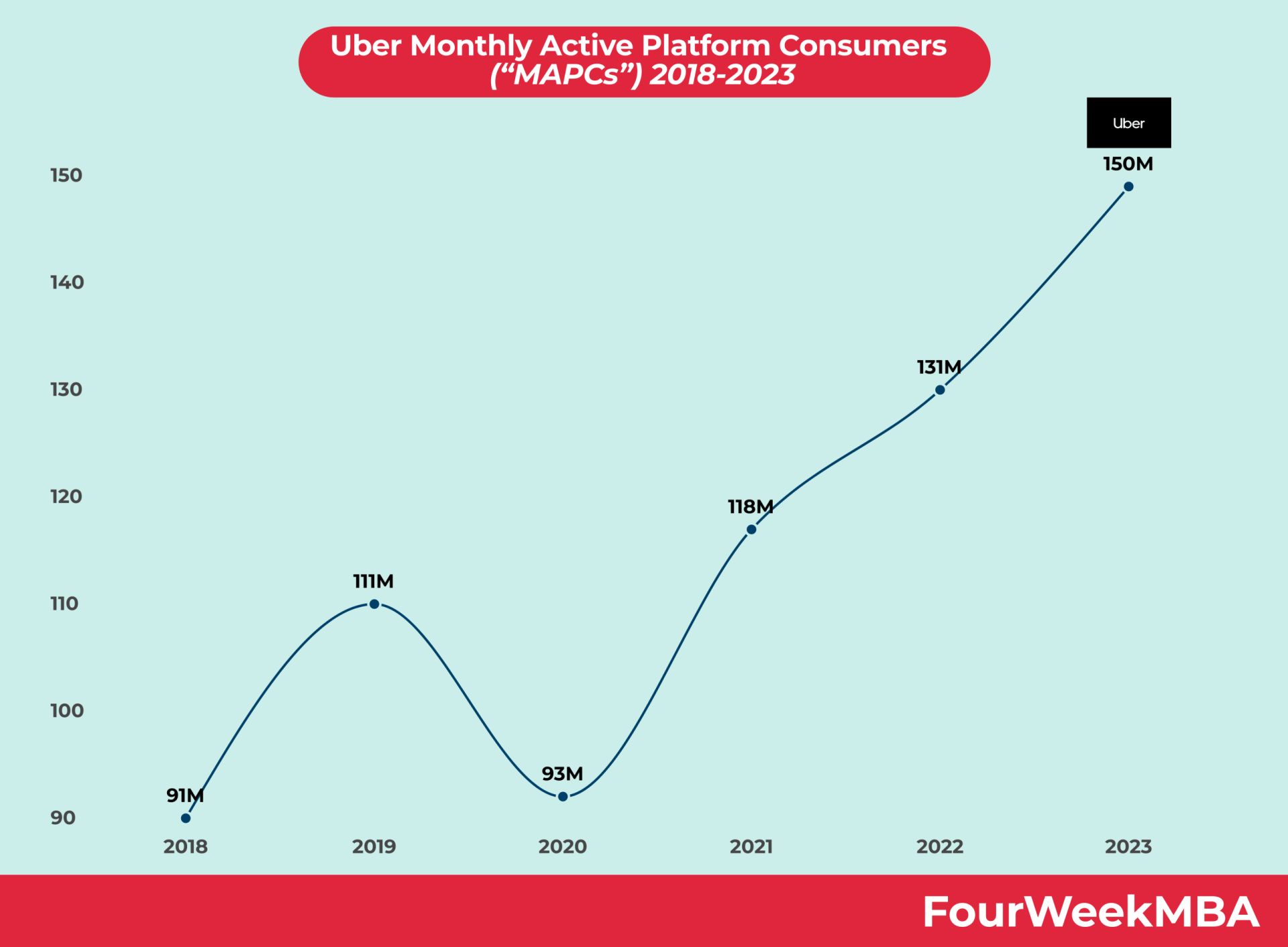
Uber had 150 million Monthly Active Platform Consumers in 2023. In 2022, Uber had 131 million Monthly Active Platform Consumers, compared to 118 million in 2021, and 93 million in 2020.
Uber Eats is a three-sided marketplace connecting a driver, a restaurant owner, and a customer with the Uber Eats platform at the center. The three-sided marketplace moves around three players: Restaurants pay commission on the orders to Uber Eats; Customers pay small delivery charges, and at times, cancellation fees; Drivers earn through making reliable deliveries on time.
In 2023 Uber Eats generated $12.2 billion in revenue, compared to nearly $11 billion in 2022, $8.3 billion in revenue in 2021, and $3.9 billion in revenue in 2020.
If we look at EBITDA, Uber Eats was a profitable segment, generating $1.5 billion in EBITDA in 2023. For the first time since its inception, Uber Eats’ EBITDA (Earnings Before Interest, Taxes, Depreciation, and Amortization) – which measures a company’s operational efficiency – turned positive for $551 million in 2022, compared to negative $348 million in 2021; negative $870 million in negative EBIDTA in 2020; and over $1.3 billion negative EBIDTA in 2019.
Uber Freight is a platform that connects carriers with shippers, which generated $5.24 billion in revenue in 2023, slowing down from $6.95 billion in revenue in 2022, and it’s now one of the three core segments (Mobility, Delivery, and Freight) within the Uber Business Model.
In 2023, Uber generated nearly $20 billion from its core platform (mobility), followed by delivery (Uber Eats) with $12.2 billion and freight, with $5.24 billion in revenue.
In 2022 Uber launched its advertising segment, which comprises revenue from sponsored listing fees paid by merchants and brands in exchange for advertising on the platform. By the end of the year, Uber advertising had generated $500 million in revenue from 315K merchants. By 2023, the advertising business of Uber generated a billion dollars in revenue!
Uber and Lyft are both mobility ride-sharing apps. Uber generated $37.28 billion in revenue in 2023, compared with Lyft, which generated $4.4B billion in the same year. A key difference is that while Lyft has primarily stayed in the mobility industry, Uber’s business model today spans various categories beyond mobility, such as delivery (Uber Eats) and freight.
In the food delivery business model companies leverage technology to build platforms that enable users to have the food delivered at home. This business model usually is set up as a platform and multi-sided marketplace, where the food delivery company makes money by charging commissions to the restaurant and to the customer.
DoorDash is a platform business model that enables restaurants to set up no-cost delivery operations. At the same time, customers get their food at home, and dashers (delivery people) earn some extra money. DoorDash makes money by markup prices through delivery fees, memberships, and advertising for restaurants on the marketplace.
Glovo is a Spanish on-demand courier service that purchases and delivers products ordered through a mobile app. Founded in 2015 by Oscar Pierre and Sacha Michaud as a way to “uberize” local services. Glovo makes money via delivery fees, mini-supermarkets (fulfillment centers that Glovo operates in partnership with grocery store chains), and dark kitchens (enabling restaurants to increase their capacity).
Instacart’s business model relies on enabling an easy set up for grocery stores, the comfort for customers to get their shopping delivered at home, and an additional income stream for personal shoppers. Instacart makes money by charging service fees, via memberships, and by running performance advertising on its platform.
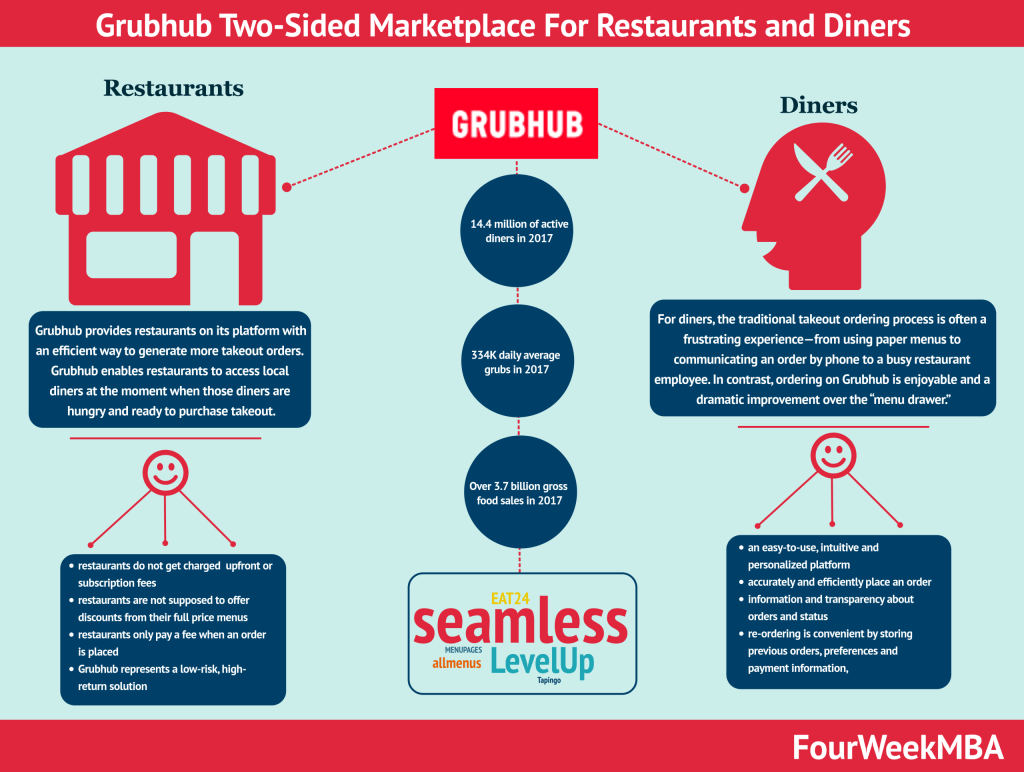
Grubhub is an online and mobile platform for restaurant pick-up and delivery orders. In 2018 the company connected 95,000 takeout restaurants in over 1,700 U.S. cities and London. The Grubhub portfolio of brands like Seamless, LevelUp, Eat24, AllMenus, MenuPages, andTapingo. The company makes money primarily by charging restaurants a pre-order commission and it generates revenues when diners place an order on its platform. Also, it charges restaurants that use Grubhub delivery services and when diners pay for those services.
Shipt is a North American integrated delivery service for groceries, home products, and electronics initially funded by Bill Smith, a highly experienced entrepreneur with a history of creating successful start-ups; in 2014, Smith used $3 million of his own money to create the first iteration of Shipt, the company was acquired by Target in 2017 in a cash deal worth $550 million. Membership fees predominantly drive Shipt revenue generation.
Samsung was founded in South Korea in 1938 by Lee Byung-Chul. Originally a trading company, it took Samsung 22 years to become the fully-fledged electronics company that most people recognize today. Indeed, the company is a leader in technological innovation through telecommunications, electronics, and home appliances.
Costco is a large American multinational corporation with a focus on low-cost, membership-only retail warehouse clubs. Costco is the 4th largest retail operator in the world, operating 785 warehouses in 10 different countries. Indeed, it has enjoyed rapid success growing from zero to $3 billion in sales within six years.
From humble beginnings just over 50 years ago, Walmart has grown to become the world’s largest retail company. A single small discount store in Arkansas has now expanded to over 11,000 stores in 28 countries. Some reports suggest that the company now makes $1.8 million of profit every hour.
Headquartered in San Francisco, California, Uber started as a peer-to-peer ridesharing platform. In more recent times, the company has moved into food delivery, rental cars, and bike-sharing. In one form or another, Uber now has a presence in over 900 cities worldwide.
It would be hard to argue the case for a more recognizable entertainment brand than Disney. Disney is of course synonymous with Walt Disney, but it was Walt and his brother Roy who started the company in 1923 in Burbank, California. Disney content is now broadcast on over 100 channels in 34 different languages across the globe.
Coca-Cola is the market leader of the soft drink industry. It is also the most widely recognized brand, with a Business Insider study revealing that a staggering 94% of the world population recognizes the red and white logo. However, Coca-Cola faces significant challenges with increasingly health-conscious consumers and less access to water resources.
Founded in 1903 by Henry Ford and is the fifth-largest family-owned company in the world. Ford is a globally recognized brand in the automotive industry for a couple of reasons. First, Henry Ford is well-known as the inventor of the production line and thus the modern automobile industry. Today, Ford has also maintained relevance as the seventh-largest car manufacturer worldwide, selling a range of passenger cars, trucks, and vans.
Tesco was founded in 1919 by Jack Cohen, as a small group of market stalls. After rapid expansion in the following years, the company became the largest retailer in the UK and is now the second-largest in the world. To put their dominance into perspective, consider that Tesco serves around 66 shoppers per second across 7000 retails stores, delivering approximately $180,000 worth of sales every minute.
Nestlé is a large multinational food and beverage manufacturer with more than 2000 brands spread across 197 countries. Some of Nestlé’s well-known brands include Nescafe, Kit-Kat, Purina, Aero, Butterfinger, Maggi, and Haagen-Dazs. Originally a producer of infant food in 1867, it is now considered to be the world’s largest food manufacturer.
Amazon is among the most diversified business model in the tech industry. The company is well-positioned to dominate e-commerce further. And while its online stores have tight profit margins, Amazon still unlocks cash for growth, while consolidating its dominance in the cloud and grabbing new opportunities like voice.
Facebook, with its products, with its strong appeal, and consumer brand has a solid business model, threatened in the last years by privacy concerns, which open up the way to potential regulation to break up the company. If that will not happen, Facebook will have the chance to expand to define other markets like VR.
Starbucks is a global consumer brand with direct distribution, recognized brands, and products that make it a viable business. Its reliance on the Americas as a primary operating segment makes it a weakness. At the same time, Starbucks faces risks related to coffee beans price volatility. Yet the company still has global expansion opportunities.
Among the most recognized car manufacturers, Tesla is valued more than the combined market capitalization of GM and Ford. While the company’s direct distribution is a strength, its lack of financial viability is a weakness. Competition is a future threat. However, if Tesla defines a new market for car manufacturing its potential growth will be massive.
Netflix is among the most popular streaming platforms, with a subscription-based business model. The brand, platform, and content are strengths. The volatility of content licensing and production are weaknesses. The streaming market is a potential blue ocean. Inability to attract and retain premium members, and its fixed long-term costs are threats to its business model.
Apple can leverage a strong consumer brand and set of successful products as a strength. Yet the company is still too reliant on the iPhone as a primary revenue stream. Though Apple is working to open up new markets as an opportunity, it has to make sure to sustain its stores’ sales.
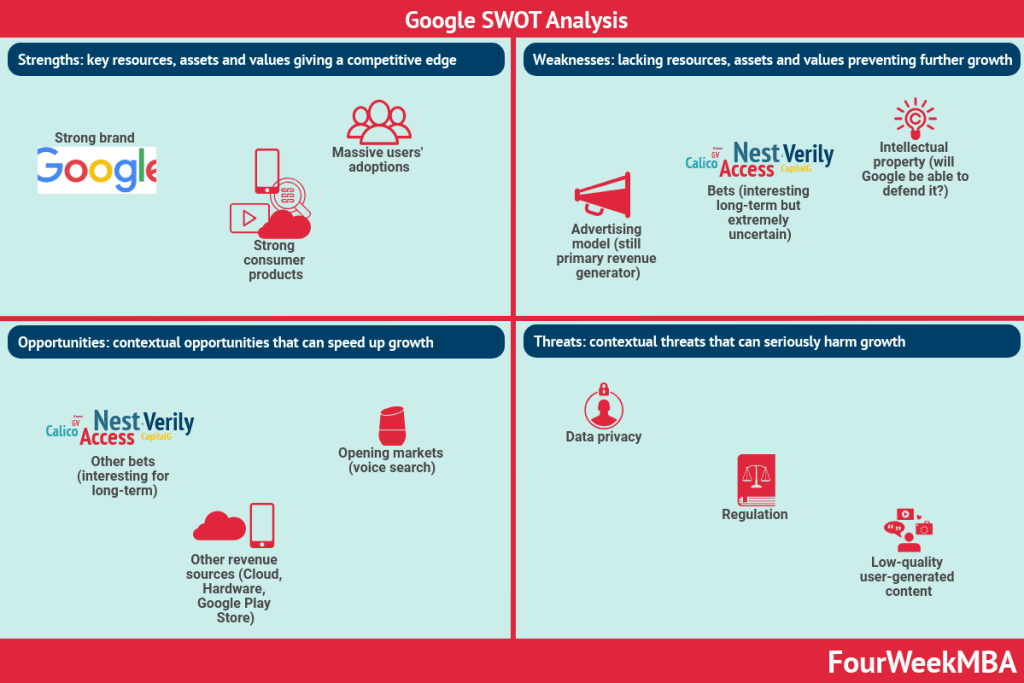
Google’s strength is its strong consumer brand. The company is grabbing new opportunities by opening up industries like voice search and consolidating in industries like the cloud. As a weakness, its revenues primarily come from advertising. A primary threat is the quick change of search and potential intervention by regulators.
Gennaro is the creator of FourWeekMBA, which reached about four million business people, comprising C-level executives, investors, analysts, product managers, and aspiring digital entrepreneurs in 2022 alone | He is also Director of Sales for a high-tech scaleup in the AI Industry | In 2012, Gennaro earned an International MBA with emphasis on Corporate Finance and Business Strategy.