Square's value proposition centers on providing businesses with a comprehensive suite of financial services and payment solutions. It offers easy-to-use tools f
Customer Segments
Square serves a diverse range of customer segments, including small businesses, individual entrepreneurs, freelancers, and consumers. It caters to businesses in
Distribution Strategy
Square distributes its products and services primarily through its website, mobile apps, and partnerships with retailers and financial institutions. It also off
Revenue Streams
Square generates revenue from multiple sources, including transaction fees, subscription fees for premium services (e.g., Square for Restaurants), hardware sale
Marketing Strategy
Square's marketingstrategy includes digital advertising, content marketing, referral programs, and partnerships with financial institutions. It emphasizes the
Organization Structure
Square operates as a technology company with centralized functions overseeing product development, marketing, sales, and customer support. It maintains a custom
Competitive Advantage
Square's competitive advantage lies in its user-friendly payment solutions, accessibility to businesses and consumers, diverse revenue streams, and the integrat
Square is a merchant service company providing sellers with hardware and software tools to run their businesses. The company’s CashApp enables money transfers and investments in stocks, ETFs and Bitcoins. The company makes money based on transactions via its payment products and through subscription services. Square also makes money via its Cash App.
Business Model Element
Analysis
Implications
Examples
Value Proposition
Square’s value proposition centers on providing businesses with a comprehensive suite of financial services and payment solutions. It offers easy-to-use tools for payment processing, point-of-sale (POS) systems, and financial management. Square emphasizes accessibility, affordability, and user-friendliness to empower businesses of all sizes.
Provides businesses with accessible and affordable financial services. Enhances efficiency with user-friendly payment and POS solutions. Attracts small businesses seeking technology-driven financial tools. Simplifies financial management for merchants. Supports various payment methods to cater to diverse customer preferences.
– Square’s mobile card reader allows businesses to accept card payments with a smartphone or tablet. – Square’s POS system offers features like inventory management, analytics, and employee management. – Square Invoices streamlines billing and invoicing for freelancers and small businesses. – Cash App, owned by Square, allows individuals to send and receive money easily.
Customer Segments
Square serves a diverse range of customer segments, including small businesses, individual entrepreneurs, freelancers, and consumers. It caters to businesses in various industries, such as retail, food service, healthcare, and more. Square also targets individuals looking for personal financial tools and peer-to-peer payment services through Cash App.
Addresses the needs of businesses of all sizes and types. Attracts entrepreneurs and freelancers seeking financial tools. Supports various industries, including retail and food service. Targets individuals seeking personal financial management and peer-to-peer payments. Provides solutions for both businesses and consumers.
– Small businesses, including retailers and restaurants, use Square for payment processing and POS systems. – Individual entrepreneurs and freelancers leverage Square for invoicing and financial management. – Consumers use Cash App for peer-to-peer payments, investing, and personal finance.
Distribution Strategy
Square distributes its products and services primarily through its website, mobile apps, and partnerships with retailers and financial institutions. It also offers Square hardware, such as card readers and POS systems, through its online store. Square’s ecosystem is designed for ease of use, with a focus on digital accessibility and convenience.
Ensures accessibility and convenience through digital platforms. Collaborates with retailers and financial institutions to expand reach. Provides hardware options for in-person payment processing. Offers an integrated ecosystem to support seamless financial management. Attracts users seeking both digital and physical payment solutions.
– Businesses and individuals can sign up for Square’s services through its website or mobile apps. – Square’s card readers and POS hardware are available for purchase online and through select retailers. – Partnerships with banks and financial institutions may offer Square services to their customers. – The Cash App can be downloaded and used directly from mobile devices.
Revenue Streams
Square generates revenue from multiple sources, including transaction fees, subscription fees for premium services (e.g., Square for Restaurants), hardware sales, and the facilitation of Bitcoin transactions through Cash App. It also earns interest income on stored funds in Cash App accounts. Square Capital provides small business loans, contributing to its revenue streams.
Relies on transaction fees as a primary source of revenue. Diversifies income through premium services and hardware sales. Facilitates Bitcoin transactions for added revenue. Earns interest income on Cash App balances. Provides small business loans through Square Capital. Attracts businesses seeking payment processing and financial solutions.
– Square charges businesses a fee for each payment processed through its platform. – Premium services like Square for Restaurants have subscription fees. – Hardware sales include card readers and POS systems. – Bitcoin transactions through Cash App incur fees. – Square Capital provides loans to eligible small businesses.
Marketing Strategy
Square’s marketing strategy includes digital advertising, content marketing, referral programs, and partnerships with financial institutions. It emphasizes the benefits of easy and secure payment processing, financial management, and accessibility to a wide range of businesses. Square also promotes Cash App as a convenient and user-friendly peer-to-peer payment solution.
Utilizes digital advertising and content to reach businesses and consumers. Encourages word-of-mouth marketing through referral programs. Collaborates with banks and financial institutions for credibility. Emphasizes ease of use and accessibility as key selling points. Promotes Cash App as a convenient and user-friendly financial tool. Attracts customers seeking financial solutions and payment processing.
– Square runs online ads and content campaigns to educate businesses about its payment solutions. – Referral programs reward users who refer others to Square’s services. – Partnerships with banks and financial institutions may include co-branded marketing efforts. – Marketing materials emphasize simplicity and accessibility. – Cash App’s marketing focuses on its ease of use and peer-to-peer payment capabilities.
Organization Structure
Square operates as a technology company with centralized functions overseeing product development, marketing, sales, and customer support. It maintains a customer-centric approach to design user-friendly solutions. Square’s organization is structured to foster innovation, with a focus on agility and adaptability in the rapidly evolving financial technology industry.
Operates with a centralized structure to streamline functions and innovation. Maintains a customer-centric approach to product development. Focuses on agility and adaptability in the dynamic fintech industry. Employs specialized teams for marketing, sales, and customer support. Collaborates with financial institutions and partners for product enhancements.
– Square’s product development teams work on software and hardware solutions. – Marketing teams create campaigns and promotions to attract and retain customers. – Sales teams engage with businesses and individuals to onboard new users. – Customer support assists users with inquiries, account management, and technical issues. – Collaborations with banks and financial institutions result in product enhancements and co-branded initiatives.
Competitive Advantage
Square’s competitive advantage lies in its user-friendly payment solutions, accessibility to businesses and consumers, diverse revenue streams, and the integration of cryptocurrency capabilities through Cash App. It also benefits from strong partnerships with financial institutions and a focus on innovation and adaptability in the fintech sector.
Offers user-friendly payment solutions and financial tools to businesses. Attracts a wide range of customers through accessibility and convenience. Diversifies income through multiple revenue streams. Integrates cryptocurrency capabilities through Cash App. Collaborates with financial institutions for credibility and innovation. Focuses on agility and adaptability in the dynamic fintech industry.
– Square’s payment solutions are known for their simplicity and ease of use, attracting businesses of all sizes. – Accessibility through digital platforms and partnerships expands its reach to diverse customer segments. – Multiple revenue streams provide stability and growth opportunities. – Cash App’s Bitcoin integration appeals to users interested in cryptocurrency. – Collaborations with banks and financial institutions enhance product offerings and credibility. – Innovation and adaptability enable Square to stay competitive in the rapidly evolving fintech landscape.
Origin story
Square is an American financial and merchant services company based in San Francisco, California.
The company was founded in 2009 by Jack Dorsey and Jim McKelvey. The idea for Square came after McKelvey – a seller of glass bathroom fittings – could not finalize a $2,000 sale because of his inability to accept credit cards as a form of payment.
From a small office in St. Louis, the company was then named Square after its signature square-shaped card readers.
Square’s vision is to enable “everyone to participate and thrive in the economy.”
And the mission is to let “no one to be left out of the economy because the cost is too great or the technology too complex.”
As Square further explains:
So we’re building easy tools to empower and enrich people. Tools that shorten the distance between having an idea and making a living from it—because we believe in fair and square.
Which articulates in:
We’re here to help sellers of all sizes start, run, and grow their business—and helping them grow their business is good business for everyone.
Square was established to give every aspiring business owner an easier way to take credit cards. We’ve built a lot more tools since. From side gigs to sports stadiums, we’re helping power businesses of all sizes and types to help them succeed—no matter what success means to them.
Sellers: who adopt the tools created by Square to run their businesses.
Developers: who instead build, deploy, maintain and grow part of the tools provided via Square.
Therefore, the value proposition is articulated around those two key players.
Value Proposition for Sellers
Image Source: Square Investor Relations – Q3 2020
A set of tools to enable commerce: from managing payments to PoS, payroll, invoices, and promotion.
No-lock-in: third-party tools are easily integrated within the Square ecosystem.
A simple and compelling set of tools: the Square platform is also relatively simple for sellers to set up, run, and its payment tools are also well integrated within the seller’s premises.
As with any development community, the more those developers are given the opportunity to build products that can be monetized for a large audience, the more it will be easier to keep the community alive.
Therefore, developing tools for the Square App Marketplace is indeed interesting for developers because they can:
Acquire new customers by building up tools for the marketplace.
Keep all the revenues from the app’s sales (the seller retains 100% of the revenues generated via the Square marketplace).
Cash App Value Proposition
Another key value to take into account is related to the Square Cash App, which enables users to transact, invest and deposit Bitcoin through the platform.
While the Cash App integrates also within Square’s seller and developer ecosystem, in part, that has a life of its own.
Indeed, some of the value propositions intrinsic to the Cash App are:
Easily send over the money.
Easily invest in Bitcoin and other assets.
Square technological model
Image Source: Square Investor Relations – Q3 2020
Square’s technological model moves along its two main core products/ecosystems:
The sellers/developers ecosystem makes up the tools, apps, and services provided for sellers.
And the Cash App ecosystem is made of customers looking to transfer money, and invest in Bitcoin and stocks.
Value Proposition for Developers
Image Source: Square Investor Relations – Q3 2020
Image Source: developer.squareup.com
As with any development community, the more those developers are given the opportunity to build products that can be monetized for a large audience, the more it will be easier to keep the community alive.
Therefore, developing tools for the Square App Marketplace is indeed interesting for developers because they can:
Acquire new customers by building up tools for the marketplace.
Keep all the revenues from the app’s sales (the seller retains 100% of the revenues generated via the Square marketplace).
Cash App Value Proposition
Another key value to take into account is related to the Square Cash App, which enables users to transact, invest and deposit Bitcoin through the platform.
While the Cash App integrates also within Square’s seller and developer ecosystem, in part, that has a life of its own.
Indeed, some of the value propositions intrinsic to the Cash App are:
Easily send over the money.
Easily invest in Bitcoin and other assets.
Value Propositions:
Payment Processing Simplified: Square offers seamless payment processing solutions that allow merchants to accept credit card payments, debit card transactions, and mobile payments quickly and securely. With user-friendly hardware and software options, Square enables businesses to streamline their checkout process and offer convenient payment methods to customers, enhancing the overall shopping experience.
Business Management Tools: Square provides a range of business management tools and services, including point-of-sale systems, inventory management software, employee management solutions, and customer relationship management (CRM) tools. By centralizing key business functions and data, Square helps merchants optimize operations, track sales performance, manage inventory levels, and build customer relationships more effectively.
Accessible Financial Services: Square offers accessible financial services to individuals and businesses, including small business loans, merchant cash advances, and business banking solutions. By providing flexible financing options and banking services tailored to the needs of entrepreneurs and small businesses, Square empowers users to access capital, manage cash flow, and grow their businesses with confidence.
Integrated Ecosystem: Square offers an integrated ecosystem of hardware and software products that seamlessly work together to meet the diverse needs of merchants. From point-of-sale terminals and card readers to invoicing tools and online payment gateways, Square provides a comprehensive suite of solutions designed to simplify payment acceptance, optimize business operations, and drive growth for businesses of all sizes.
Data-driven Insights: Square offers robust analytics and reporting tools that provide merchants with valuable insights into their sales performance, customer behavior, and business trends. By leveraging data-driven insights, merchants can make informed decisions, identify growth opportunities, and optimize their strategies for success, driving efficiency and profitability in their operations.
Square technological model
Image Source: Square Investor Relations – Q3 2020
Square’s technological model moves along its two main core products/ecosystems:
The sellers/developers ecosystem makes up the tools, apps, and services provided for sellers.
And the Cash App ecosystem is made of customers looking to transfer money, and invest in Bitcoin and stocks.
Technology for sellers
Image Source: Square Investor Relations – Q3 2020
Square provides a suite of cloud-based software solutions to help sellers operate, run and manage their businesses.
The whole software architecture is designed with a simple-to-use interface, which is mostly self-serving.
Employees within seller organizations can quickly learn how to use the Square interface for managing transactions and much more.
The suite of tools comprises the Online, Point of Sale, Developer Platform, Customer Relationship Management, and Team Management products.
Therefore, the products can be broken down into:
Point of Sales Solutions
A set of tools enabling digital receipts, payments, tracks sales, inventory, customers’ purchase histories, and more.
These products are monetized either via a subscription fee or on a transaction basis:
Square Point of Sale: a general-purpose point-of-sale.
Square Appointments include support for booking, retail sales, invoicing, and payments.
Square for Retail includes barcode scanning, advanced inventory management, support for thousands of items, cost of goods sold reporting, purchase orders, and vendor management.
Square for Restaurants is primarily a more advanced version of the service specifically thought for the food and beverage industry. This includes table, order, and course management.
Products to facilitate sales online and via social media
A suite of tools to make it easy for sellers to business online (and via social media).
Square Online is a tool making it easy to build a website and online store and to sell on Instagram and Facebook.
Square Online Checkout enables businesses to sell online without a website by creating a checkout link.
Square Invoice is a digital invoicing solution with secure online payment acceptance.
Square Virtual Terminal enables sellers to use a computer as a card terminal.
Business and customer relationship management products
This set of tools enables sellers digital tools to streamline their operations:
Square Team Management to schedule staff, view team performance and sales analytics in real-time and used Square Payroll to pay employees.
Square Contracts provides template-based digital contracts with e-signature support for uses.
Square Loyalty, Marketing, Gift Cards, and Feedback enable sellers to engage with their buyers in-store and online.
Square Dashboard provides real-time data and insights about orders, items, inventory, customers, employees, payments, marketing, and loyalty performance.
Hardware/physical products for the shop
Image Source: squareup.com
Square provides a set of hardware products, custom-designed allowing sellers to accept cards by Visa, MasterCard, American Express, Discover, JCB, Interac Flash (in Canada), e-Money (in Japan), and eftpos (in Australia).
Some of the hardware products Square offers comprise:
Magstripe reader for swiped transactions of magnetic stripe cards.
Square Stand transforming an iPad into a payment terminal or full point of sale solution.
Square Register is an all-in-one combining hardware, point-of-sale software, and payments technology.
Square Terminal is a portable, all-in-one payments device and receipt printer.
Financial services for sellers
When it comes to payments Square acts as both the merchant of record for the transaction as well as the payment service provider offering the following services:
Managed Payments comprising next-day settlements, payment dispute management, data security, and PCI (payment card industry) compliance.
Risk Manager provides insight into online payment fraud patterns and enables them to set custom rules and alerts to manage risk.
Square Card is a free business prepaid debit card that provides a way for sellers to spend and manage their funds, enabling sellers to spend their proceeds as soon as they make a sale.
Square Capital makes it easy to loan to qualified Square sellers.
Square Payroll facilitates sellers in hiring and onboarding employees pay wages and associated employee taxes and offers employee benefits.
Technology for Developers – Developers Platform
The developer’s community is a key part of the success of Square business model.
The developer platform consists of two main parts: APIs and development kits. These empower developers in easily building tools on top of the Square ecosystem and marketplace.
These comprise:
Payment APIs support in-person, online, and mobile payments. Square Reader SDK for developers to customize checkout experiences for sellers (e.g. self-ordering kiosks powered by Square).
Commerce APIs with more than 30 commerce APIs, to create and manage orders, subscriptions, product catalogs, inventory, and more, so that developers can build applications for the Square marketplace.
Technology for Investors
Image Source: Cash App – Apple Store
With Cash App, individuals/retail investors can manage their money either by:
Storing, Sending, and Receiving Funds: individuals can receive money from another Cash App customer. Or they can send funds, or keep them in storage via the app.
Spending Cash Card which consists of a debit card linked directly to a customer’s Cash App balance.
Investing retail investors can use the app to invest in US-listed stocks, exchange-traded funds, or bitcoin.
Square distribution model
Image Source: Square Investor Relations – Q3 2020
Some of the go-to-market and distribution/marketing strategies comprise:
Brand affinity: over the years Square has built a strong brand, over a claimed superior service with a 63 Net Promoter Score, which as the company explains is much higher compared to traditional payment services.
Direct marketing: especially in the form of email marketing, in-product notifications, and messaging
Peer-to-peer (P2P) transactions as the primary acquisition channel for Cash App.
Cash App also leverages paid marketing, referrals, advertising spend, partnerships, and social media campaigns.
Square revenue model
Source: Square Inc. Financial Statements 2020
As the company highlights the seller ecosystem is composed of “30 distinct software, hardware, and financial services products” monetized through a combination of transaction, subscription, and service fees.
Since 2019 the company has also made a substantial chunk of its money via the Cash App Bitcoin investing activities, that due to the massive price increase of Bitcoin also became the major revenue stream for the company.
Seller ecosystem revenue model
On the seller revenue model, Square uses a sort of razor and blade strategy. In this case, the razor is the hardware sold mostly at cost or even a loss, while the company generates revenues at much higher margins on the transaction and subscription services side.
Transaction-based revenues: here Square charges its sellers a transaction fee for managed payments solutions, in most cases as a percentage of the total transaction.
Subscription and services-based revenues: this comprises the revenues from Cash App, Square Capital, and Instant Transfers.
Hardware revenues include revenues from sales of contactless and chip readers, Square Stand, Square Register, Square Terminal, and third-party peripherals.
Cash App revenue model
Image Source: Square Investor Relations – Q3 2020
Business charges
Whenever a business accepts a Cash App payment, Square charges a 2.75% fee. This occurs in one of two ways:
When an individual makes an in-app P2P payment to a business.
When an individual uses the Square Cash Card to make a payment to a business. The Cash Card is a prepaid Visa debit card linked to each user’s account.
Expedited transfer and credit card payments
Consumers can expedite fund transfers from the Cash App account to a nominated bank account for a 1.5% fee.
This enables the consumer to have the funds land in their account immediately and not after the standard two or three days.
Personal payments can also be made via a linked credit card. For this service, Square charges a 3% transaction fee.
Bitcoin exchange
In late 2017, Square added bitcoin functionality to Cash App accounts. This enabled users to buy and sell bitcoin using the funds in their accounts. For approximately two years, this service was free.
Then, in 2019, Square began charging fees as high as 1.76% for every purchase of bitcoin. Cryptocurrency has now become so popular that the service is one of Square’s most profitable revenue streams.
The company also charges a premium for facilitating the exchange – mostly between 1 and 4%.
For example, Square may purchase $5,000 worth of Bitcoin from one customer and then sell the same amount to another customer for $5,200.
Generally speaking, the precise fee varies according to fluctuations in bitcoin value.
Marketing Strategy:
Online Advertising: Square invests in online advertising channels, including search engine marketing (SEM), display advertising, and social media advertising, to increase brand awareness, drive website traffic, and attract new merchants to its platform. By targeting relevant keywords, demographics, and audience segments, Square reaches potential customers actively searching for payment processing solutions and business management tools online.
Content Marketing: Square engages in content marketing initiatives to educate, inform, and inspire merchants about the benefits of its products and services. Through blog posts, articles, case studies, and video content, Square provides valuable insights, tips, and best practices for running a successful business, showcasing real-life success stories and customer testimonials to demonstrate the value of its solutions.
Email Marketing: Square utilizes email marketing campaigns and newsletters to nurture leads, onboard new merchants, and engage existing customers. By sending targeted emails with product updates, feature announcements, and promotional offers, Square keeps merchants informed, engaged, and connected, driving user retention, cross-selling, and upselling opportunities through email communication.
Affiliate Partnerships: Square operates an affiliate program that incentivizes affiliates, influencers, and partners to promote its products and services to their respective audiences. Affiliates earn commissions or rewards for referring new merchants to Square or driving successful conversions through affiliate links, banners, and promotional content, expanding Square’s reach and driving user acquisition through affiliate marketing channels.
Referral Programs: Square offers referral programs that incentivize existing merchants to refer new businesses to its platform in exchange for rewards, discounts, or account credits. By leveraging word-of-mouth referrals and incentivizing customer advocacy, Square encourages merchants to spread awareness and generate leads, fueling organic growth and user acquisition through referral marketing initiatives.
Business Model Highlights
The Square business model is developed around two business ecosystems (seller/developer ecosystem and Cash App Ecosystem).
Square is an American financial and merchant services company. The company’s idea was born after founder Jim McKelvey could not accept a credit card as payment for a $2,000 piece of tapware.
Square drives most of its revenue through its P2P Cash App service. For consumers, transferring funds using the basic version of the app is free. For businesses, Square charges a flat 2.75% fee for every eligible transaction.
Square makes money by charging consumers 1.5% for expedited fund transfers. The company has also seen significant growth in its bitcoin exchange service. For a 1-4% fee, Square customers can buy and sell bitcoin using account funds.
On the seller revenues side, Square follows a razor and blade strategy where the hardware is sold at cost or loss, while the company makes money based on transaction revenues and all the other services developed on top of it.
Square leverages a set of marketing and distribution strategies, moving along a strong brand built over the years and direct and online marketing channels.
Key Highlights
Origin Story: Square was founded in 2009 by Jack Dorsey and Jim McKelvey. The idea was born when McKelvey, a seller, couldn’t accept credit cards for a sale. It was named after its square-shaped card readers.
Vision and Mission: Square’s vision is to enable everyone to thrive in the economy, while its mission is to ensure no one is excluded due to cost or complexity. They believe in fair and square empowerment.
Value Proposition for Sellers: Square provides tools for commerce management, from payments to PoS, payroll, invoices, and promotion. Sellers benefit from a no-lock-in policy, third-party integration, and simple yet effective tools.
Value Proposition for Developers: Developers can build tools for the Square App Marketplace, acquire new customers, and retain 100% of the app’s sales revenues.
Cash App: Square’s Cash App allows users to transact, invest in stocks, ETFs, and Bitcoins. It’s a separate ecosystem with value propositions like easy money transfers and investments.
Technological Model: Square’s technology is centered around its two ecosystems: the sellers/developers ecosystem and the Cash App ecosystem. It offers a range of tools for commerce, payments, and financial services.
Hardware Solutions: Square provides hardware products like card readers, stands, registers, and terminals, enabling sellers to accept various forms of payments.
Financial Services: Square offers payment solutions, risk management, Square Card, Square Capital loans, and payroll services for sellers.
Developer Platform: Square’s developer platform empowers developers to build tools on top of the ecosystem, utilizing APIs and development kits.
Cash App Revenue Model: Square generates revenue through Cash App via business charges, expedited transfers, credit card payments, and its Bitcoin exchange service.
Seller Ecosystem Revenue Model: Square follows a razor and blade strategy, selling hardware at cost while making money through transaction-based revenues, subscription and service fees.
Distribution Strategies: Square leverages brand affinity, direct marketing, online search optimization, display advertising, mobile advertising, partnerships, referrals, and public relations for marketing.
Key Revenues: Square’s major revenue sources include transaction fees, subscription fees for services like Square Capital, and Cash App activities like Bitcoin trading.
Overall Impact: Square aims to empower sellers, individuals, and investors through its user-friendly tools, financial services, and payment solutions.
Growth Areas: Square’s Cash App, which offers P2P payments and cryptocurrency trading, has become a significant revenue driver for the company.
Acorns is a fintech platform providing services related to Robo-investing and micro-investing. The company makes money primarily through three subscription tiers: Lite – ($1/month), which gives users access to Acorns Invest, Personal ($3/month) that includes Invest plus the Later (retirement) and Spend (personal checking account) suite of products, Family ($5/month) with features from both the Lite and Personal plans with the addition of Early.
Started as a pay-later solution integrated to merchants’ checkouts, Affirm makes money from merchants’ fees as consumers pick up the pay-later solution. Affirm also makes money through interests earned from the consumer loans, when those are repurchased from the originating bank. In 2020 Affirm made 50% of its revenues from merchants’ fees, about 37% from interests, and the remaining from virtual cards and servicing fees.
Alipay is a Chinese mobile and online payment platform created in 2004 by entrepreneur Jack Ma as the payment arm of Taobao, a major Chinese eCommerce site. Alipay, therefore, is the B2C component of Alibaba Group. Alipay makes money via escrows transaction fees, a range of value-added ancillary services, and through its Credit Pay Instalment fees.
Betterment is an American financial advisory company founded in 2008 by MBA graduate Jon Stein and lawyer Eli Broverman. Betterment makes money via investment plans, financial advice packages, betterment for advisors, betterment for business, cash reserve, and checking accounts.
Braintree
Venmo is a peer-to-peer payments app enabling users to share and make payments with friends for a variety of services. The service is free, but a 3% fee applies to credit cards. Venmo also launched a debit card in partnership with Mastercard. Venmo got acquired in 2012 by Braintree, and Braintree got acquired in 2013 by PayPal.
Chime is an American neobank (internet-only bank) company, providing fee-free financial services through its mobile banking app, thus providing personal finance services free of charge while making the majority of its money via interchange fees (paid by merchants when consumers use their debit cards) and ATM fees.
Coinbase is among the most popular platforms for trading and storing crypto-assets, whose mission is “to create an open financial system for the world” by enabling customers to trade cryptocurrencies. Its platform serves both as a search and discovery engine for crypto assets. The company makes money primarily through fees earned for the transactions processed through the platform, custodial services offered, interest, and subscriptions.
Compass is a licensed American real-estate broker incorporating online real estate technology as a marketing medium. The company makes money via sales commissions (collected whenever a sale is facilitated or tenants are found for a rental property) and bridge loans (a service allowing the seller to purchase a home before the revenue from the sale of their previous home is available).
Dosh is a Fintech platform that enables automatic cash backs for consumers. Its business model connects major card providers with online and offline local businesses to develop automatic cash back programs. The company makes money by earning an affiliate commission on each eligible sale from consumers.
E-Trade is a trading platform, allowing investors to trade common and preferred stocks, exchange-traded funds (ETFs), options, bonds, mutual funds, and futures contracts, acquired by Morgan Stanley in 2020 for $13 billion. E-Trade makes money through interest income, order flow, margin interests, options, future and bonds trading, and through other fees and service charges.
Klarna is a financial technology company allowing consumers to shop with a temporary Visa card. Thus it then performs a soft credit check and pays the merchant. Klarna makes money by charging merchants. Klarna also earns a percentage of interchange fees as a commission and for interests earned on customers’ accounts.
Lemonade is an insurance tech company using behavioral economics and artificial intelligence to process claims efficiently. The company leverages technology to streamline onboarding customers while also applying a financialmodel to reduce conflicts of interest with customers (perhaps by donating the variable premiums to charity). The company makes money by selling its core insurance products, and via its tech platform, it tries to enhance its sales.
Monzo is an English neobank offering a mobile app and a prepaid debit card for consumers and businesses. It was one of the first app-based banks to enter the UK market, founded by Gary Dolman, Jason Bates, Jonas Huckestein, Paul Rippon, and Tom Blomfield in 2015. All were employees of Starling Bank, a similar neobank challenging the dominance of established financial institutions in England. The company enjoys many revenue streams: business and consumer subscriptions, interchange and overdraft fees, personal loans, and more.
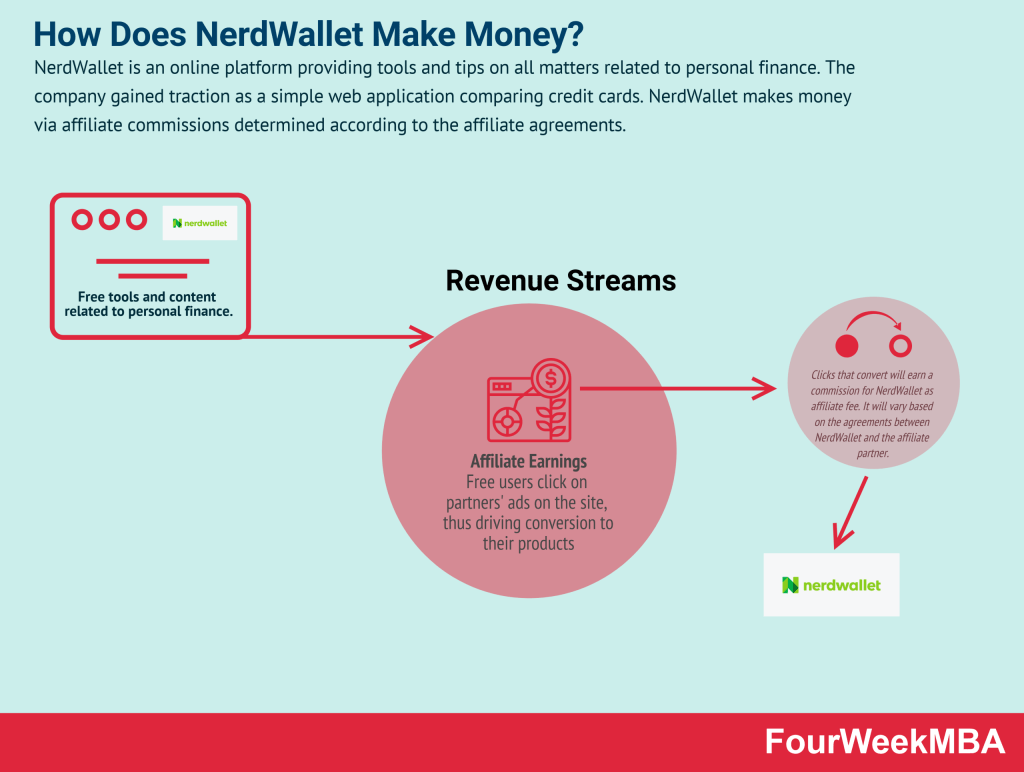
NerdWallet is an online platform providing tools and tips on all matters related to personal finance. The company gained traction as a simple web application comparing credit cards. NerdWallet makes money via affiliate commissions determined according to the affiliate agreements.
Quadpay was an American fintech company founded by Adam Ezra and Brad Lindenberg in 2017. Ezra and Lindenberg witnessed the rising popularity of buy-now-pay-later service Afterpay in Australia and similar service Klarna in Europe. Quadpay collects a range of fees from both the merchant and the consumer via merchandise fees, convenience fees, late payment, and interchange fees.
Revolut an English fintech company offering banking and investment services to consumers. Founded in 2015 by Nikolay Storonsky and Vlad Yatsenko, the company initially produced a low-rate travel card. Storonsky in particular was an avid traveler who became tired of spending hundreds of pounds on currency exchange and foreign transaction fees. The Revolut app and core banking account are free to use. Instead, money is made through a combination of subscription fees, transaction fees, perks, and ancillary services.
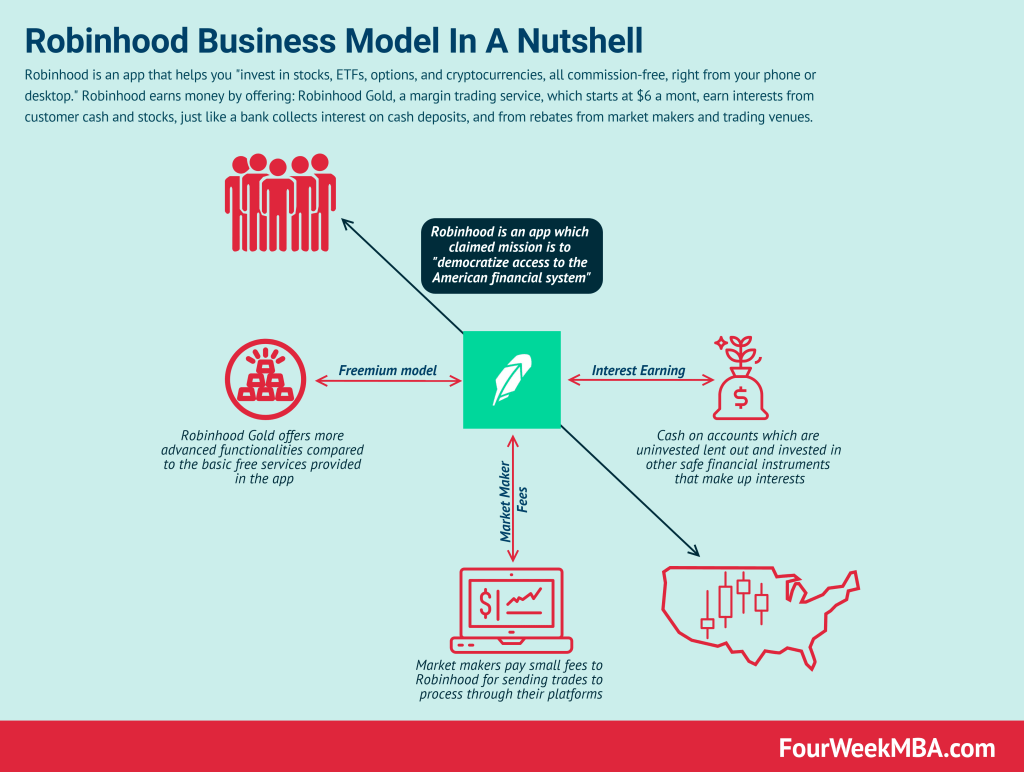
Robinhood is an app that helps to invest in stocks, ETFs, options, and cryptocurrencies, all commission-free. Robinhood earns money by offering: Robinhood Gold, a margin trading service, which starts at $6 a month, earn interests from customer cash and stocks, and rebates from market makers and trading venues.
SoFi is an online lending platform that provides affordable education loans to students, and it expanded into financial services, including loans, credit cards, investment services, and insurance. It makes money primarily via payment processing fees and loan securitization.
Squarespace is a North American hosting and website building company. Founded in 2004 by college student Anthony Casalena as a blog hosting service, it grew to become among the most successful website building companies. The company mostly makes money via its subscription plans. It also makes money via customizations on top of its subscription plans. And in part also as transaction fees for the website where it processes the sales.
Stash is a FinTech platform offering a suite of financial tools for young investors, coupled with personalized investment advice and life insurance. The company primarily makes money via subscriptions, cashback, payment for order flows, and interest for cash sitting on members’ accounts.
Venmo is a peer-to-peer payments app enabling users to share and make payments with friends for a variety of services. The service is free, but a 3% fee applies to credit cards. Venmo also launched a debit card in partnership with Mastercard. Venmo got acquired in 2012 by Braintree, and Braintree got acquired in 2013 by PayPal.
Wealthfront is an automated Fintech investment platform providing investment, retirement, and cashmanagement products to retail investors, mostly making money on the annual 0.25% advisory fee the company charges for assets under management. It also makes money via a line of credits and interests on the cash accounts.
Zelle is a peer-to-peer payment network that indirectly benefits the banks’ consortium that backs it. Zelle also enables users to pay businesses for goods and services, free for users. Merchants pay a 1% fee to Visa or Mastercard, who share it with the bank that issued the card.
Gennaro is the creator of FourWeekMBA, which reached about four million business people, comprising C-level executives, investors, analysts, product managers, and aspiring digital entrepreneurs in 2022 alone | He is also Director of Sales for a high-tech scaleup in the AI Industry | In 2012, Gennaro earned an International MBA with emphasis on Corporate Finance and Business Strategy.



 Image Source: developer.squareup.com