In the business world, a Blue Sea is a space/ market easier to navigate as it’s not crowded like the classic red ocean. However, the Blue Ocean focuses on creating uncontested markets . The Blue Sea strategy looks at zooming as much as possible within existing markets to find your minimum viable audience. The core premise of a Blue Ocean Strategy is to break down the trade off between value and cost, by creating uncontested markets .
Key Components
Blue Sea vs. Blue Ocean
The core premise of a Blue Ocean Strategy is to break down the trade off between value and cost, by creating uncontested markets .
Zooming in to find your MVA
Where Blue Oceans create an uncontested market by looking beyond the boundaries of existing ones (it zooms way out to understand how a whole market might look different a decade from now).
Redefine value by going from "a product for everyone" to a "product made for a few"
In a Blue Ocean Strategy, competition is made irrelevant by changing the business playground.
In a Blue Sea, there is space for all
In a Blue Ocean Strategy, the new demand is captured by being the first mover or among the first movers in a new market .
In a Blue Sea, price sensitivity is flipped upside-down
Where the Blue Ocean Strategy breaks the cost-value trade-off (offer more at a lower cost).
Look at the present and change it for a few
A Blue Ocean Strategy looks at the future, envisions it, and builds it.
A Blue Sea strategy does start from a minimum viable audience, but it creates options to scale. Those options can be exercised from time to time.
Case Studies
Read Next: Business Model Innovation , Business Models .
Real-World Examples
AdobeAirbnbAmazonAppleLululemonNetflix
Quick Answers
What is Blue Sea vs. Blue Ocean?
The core premise of a Blue Ocean Strategy is to break down the trade off between value and cost, by creating uncontested markets .
What is Zooming in to find your MVA?
Where Blue Oceans create an uncontested market by looking beyond the boundaries of existing ones (it zooms way out to understand how a whole market might look different a decade from now).
What is Redefine value by going from "a product for everyone" to a "product made for a few"?
In a Blue Ocean Strategy, competition is made irrelevant by changing the business playground.
Key Insight
In the business world, a Blue Sea is a space/ market easier to navigate as it’s not crowded like the classic red ocean. However, the Blue Ocean focuses on creating uncontested markets . The Blue Sea strategy looks at zooming as much as possible within existing markets to find your minimum viable audience.
Exec Package + Claude OS Master Skill | Business Engineer Founding Plan
FourWeekMBA x Business Engineer | Updated 2026
In the business world, a Blue Sea is a space/market easier to navigate as it’s not crowded like the classic red ocean. However, the Blue Ocean focuses on creating uncontested markets. The Blue Sea strategy looks at zooming as much as possible within existing markets to find your minimum viable audience.
Blue Sea vs. Blue Ocean
The core premise of a Blue Ocean Strategy is to break down the trade off between value and cost, by creating uncontested markets.
This is all very interesting, and we all would like to create those incredible uncontested markets where we can redefine the whole business playbook.
However, in a few cases, companies manage to transition toward uncontested markets. And even when that happens, followers come quickly, to steal as much market share as possible.
Thus a blue ocean is oftentimes, more the result of a bloody war, rather than space exploration.
A Blue Sea strategy instead tries to redefine value, not for a whole market, but only for a small group of people craving for that value to be provided.
Let’s see what really makes up a Blue Sea.
Zooming in to find your MVA
Where Blue Oceans create an uncontested market by looking beyond the boundaries of existing ones (it zooms way out to understand how a whole market might look different a decade from now).
The Blue Sea Strategy instead looks at existing markets, and it zooms in as much as possible to find a minimum viable audience.
The minimum viable audience (MVA) represents the smallest possible audience that can sustain your business as you get it started from a microniche (the smallest subset of a market). The main aspect of the MVA is to zoom into existing markets to find those people which needs are unmet by existing players.
Redefine value by going from “a product for everyone” to a “product made for a few”
In a Blue Ocean Strategy, competition is made irrelevant by changing the business playground.
As a whole new market is created, the Blue Ocean player will be able to capture most of that market opportunity.
In a Blue Sea Strategy, competition is made irrelevant by redefining value for the minimum viable audience, that is not satisfied in full by existing products available on the market.
You go where existing players can’t, won’t, or are not able to go.
In a Blue Sea, there is space for all
In a Blue Ocean Strategy, the new demand is captured by being the first mover or among the first movers in a new market.
In a Blue Sea Strategy, you can be very late and still build a valuable business.
That’s because the Blue Sea player will redefine value by going where the existing, established players can’t, perhaps because it would be too expensive for them or not scalable at all.
An audience is so small that it is not threatening to existing players, and yet fascinating to get the business off the ground.
In a Blue Sea, price sensitivity is flipped upside-down
Where the Blue Ocean Strategy breaks the cost-value trade-off (offer more at a lower cost).
In a Blue Sea Scenario, your smallest viable audience will be so keen to support your business, to be happy to pay you a premium price for your product, as soon as you keep it tailored to them.
Look at the present and change it for a few
A Blue Ocean Strategy looks at the future, envisions it, and builds it.
A Blue Sea Strategy, instead, looks at the past, and it redefines it for the smallest audience that didn’t like how that future turned out to be.
Is the Blue Sea strategy only for niche players?
Not really.
A Blue Sea strategy does start from a minimum viable audience, but it creates options to scale. Those options can be exercised from time to time.
However, when a company scales up, it might bring to the end of value for its minimum viable audience.
Therefore, as in a classic Crossing The Chasm scenario, the Blue Sea player will need to think through this option.
Key Insights
Zooming in to Find Minimum Viable Audience (MVA): Unlike Blue Ocean Strategy, which looks at creating uncontested markets by expanding beyond existing boundaries, the Blue Sea Strategy focuses on finding the smallest possible audience that has unmet needs within existing markets.
Redefining Value for a Small Group: The Blue Sea Strategy aims to redefine value for this minimum viable audience rather than the entire market. It targets specific individuals or groups who are craving a unique value proposition not adequately provided by existing players.
Competition Irrelevance through Unique Value: Instead of capturing new demand by being the first mover in a new market (as in Blue Ocean), the Blue Sea player makes competition irrelevant by offering unique value to the minimum viable audience, which existing players can’t or won’t provide.
Late Entry Can Still Succeed: In a Blue Sea Strategy, you can enter the market late and still succeed because the focus is on catering to a small, non-threatening audience with distinct needs and preferences.
Price Sensitivity is Flipped: The minimum viable audience in a Blue Sea is so eager to support your business that they are willing to pay a premium price for a product tailored to their specific needs.
Looking at the Past and Redefining: While Blue Ocean Strategy envisions and builds the future, the Blue Sea Strategy looks at the past and redefines it for the smallest audience that didn’t like how the future turned out.
Potential for Scale: Though the Blue Sea Strategy starts with a minimum viable audience, it allows for options to scale up the business. However, scaling might require careful consideration to avoid compromising value for the original audience.
Case Studies
Company
Aspect Addressed
Description
Example
Apple
Zooming in to Find MVA
Apple focuses on creating products and experiences for a specific audience that values design, simplicity, and premium quality.
Apple’s emphasis on user experience and design appeals to its minimum viable audience of loyal customers.
Tesla
Redefining Value for a Small Group
Tesla caters to electric vehicle enthusiasts and environmentally conscious consumers with high-performance electric cars.
Tesla’s electric vehicles target a specific audience concerned about sustainability and innovation.
Airbnb
Competition Irrelevance through Unique Value
Airbnb redefined the lodging industry by offering unique accommodations and experiences tailored to individual preferences.
Airbnb made competition irrelevant by addressing the unmet needs of travelers seeking distinctive stays.
Netflix
Late Entry Can Still Succeed
Netflix entered the streaming market later than some competitors but differentiated itself by producing original content.
Netflix’s success came from catering to a global audience’s demand for personalized content choices.
Peloton
Price Sensitivity is Flipped
Peloton offers premium home fitness equipment and content subscriptions. Its audience is willing to pay a premium for convenience and quality.
Peloton’s pricing model capitalizes on a dedicated customer base willing to invest in fitness.
Warby Parker
Looking at the Past and Redefining
Warby Parker reimagined the eyewear industry by offering affordable, stylish glasses online, disrupting traditional retail models.
Warby Parker’s approach addressed dissatisfaction with high prices and limited options in eyewear.
Spotify
Zooming in to Find MVA
Spotify initially targeted music enthusiasts by offering a vast music library with free and premium tiers.
Spotify focused on music lovers and tailored its streaming service to cater to their diverse music preferences.
Dollar Shave Club
Redefining Value for a Small Group
Dollar Shave Club disrupted the shaving industry by offering affordable, high-quality razors and grooming products through a subscription model.
Dollar Shave Club’s value proposition appealed to budget-conscious consumers seeking convenience.
Blue Apron
Competition Irrelevance through Unique Value
Blue Apron created a meal kit delivery service that provides fresh ingredients and recipes, appealing to consumers seeking convenient cooking solutions.
Blue Apron addressed the unmet needs of busy individuals who wanted to cook at home without the hassle of grocery shopping.
Red Bull
Late Entry Can Still Succeed
Red Bull entered the energy drink market relatively late but positioned itself as a lifestyle brand, sponsoring extreme sports and events.
Red Bull’s marketing strategy and unique brand identity attracted consumers looking for energy and excitement.
Fitbit
Price Sensitivity is Flipped
Fitbit introduced wearable fitness trackers and positioned them as affordable health and fitness companions.
Fitbit’s pricing made fitness tracking accessible to a broader audience, appealing to those interested in monitoring their health.
Spanx
Looking at the Past and Redefining
Spanx revolutionized the shapewear industry by offering comfortable, body-enhancing undergarments, challenging traditional designs.
Spanx addressed the discomfort associated with traditional shapewear, making it appealing to women seeking both style and comfort.
Toms
Zooming in to Find MVA
Toms adopted a “One for One” business model, donating a pair of shoes for every pair sold, attracting socially conscious consumers.
Toms’ focus on social impact resonated with consumers who wanted to contribute to a charitable cause with their purchases.
Slack
Redefining Value for a Small Group
Slack transformed workplace communication with its team collaboration platform, catering to businesses seeking efficient communication tools.
Slack’s platform improved workplace productivity, making it valuable to organizations seeking streamlined communication.
Beyond Meat
Competition Irrelevance through Unique Value
Beyond Meat introduced plant-based meat alternatives, appealing to environmentally conscious consumers and those seeking plant-based diets.
Beyond Meat’s products offered a unique and sustainable alternative to traditional meat.
Lululemon
Late Entry Can Still Succeed
Lululemon entered the athletic apparel market later but created a premium brand with high-quality activewear, targeting fitness enthusiasts.
Lululemon’s focus on quality and innovation attracted a dedicated customer base in the competitive athleisure industry.
HelloFresh
Price Sensitivity is Flipped
HelloFresh entered the meal kit delivery market by offering affordable and convenient meal solutions, making cooking at home accessible.
HelloFresh’s pricing and convenience attracted customers seeking an alternative to dining out.
Patagonia
Looking at the Past and Redefining
Patagonia redefined outdoor apparel by emphasizing sustainability, encouraging consumers to buy fewer high-quality items.
Patagonia’s commitment to environmental responsibility resonated with environmentally conscious consumers.
Airbnb
Zooming in to Find MVA
Airbnb introduced Airbnb Experiences, offering unique activities led by locals, attracting travelers seeking authentic and immersive experiences.
Airbnb expanded its offerings to cater to travelers interested in personalized and cultural experiences.
SpaceX
Redefining Value for a Small Group
SpaceX focuses on space exploration and satellite deployment, targeting government contracts, commercial launches, and space enthusiasts.
SpaceX’s mission appeals to government agencies, companies, and individuals interested in space-related services.
Zara
Competition Irrelevance through Unique Value
Zara revolutionized fast fashion by optimizing its supply chain, offering affordable, trendy clothing, and reducing lead times.
Zara differentiated itself by rapidly delivering the latest fashion trends, attracting fashion-conscious consumers.
Slack
Late Entry Can Still Succeed
Slack entered the team collaboration market later but gained traction by providing a user-friendly and integrative platform.
Slack’s user-centric approach attracted businesses looking for efficient and flexible communication tools.
Snapchat
Price Sensitivity is Flipped
Snapchat introduced ephemeral messaging and content sharing, targeting younger users seeking a more private and authentic social media experience.
Snapchat’s unique features and privacy-focused approach appealed to a younger audience.
HelloFresh
Looking at the Past and Redefining
HelloFresh expanded its offerings to include wine delivery, offering a complete meal experience, targeting customers seeking convenient dining solutions.
HelloFresh extended its services to address the evolving preferences of its customer base.
Beyond Meat
Zooming in to Find MVA
Beyond Meat launched plant-based breakfast sausages, catering to consumers seeking meat alternatives for breakfast.
Beyond Meat’s product expansion addressed a specific need within its existing market by offering breakfast options.
Adobe
Redefining Value for a Small Group
Adobe introduced the Creative Cloud subscription model, providing software tools and services for creative professionals and enthusiasts.
Adobe’s subscription-based approach offered greater accessibility to its software, benefiting creative users.
Business model innovation is about increasing the success of an organization with existing products and technologies by crafting a compelling value proposition able to propel a new business model to scale up customers and create a lasting competitive advantage. And it all starts by mastering the key customers.
The innovation loop is a methodology/framework derived from the Bell Labs, which produced innovation at scale throughout the 20th century. They learned how to leverage a hybrid innovation management model based on science, invention, engineering, and manufacturing at scale. By leveraging individual genius, creativity, and small/large groups.
According to how well defined is the problem and how well defined the domain, we have four main types of innovations: basic research (problem and domain or not well defined); breakthrough innovation (domain is not well defined, the problem is well defined); sustaining innovation (both problem and domain are well defined); and disruptive innovation (domain is well defined, the problem is not well defined).
That is a process that requires a continuous feedback loop to develop a valuable product and build a viable business model. Continuous innovation is a mindset where products and services are designed and delivered to tune them around the customers’ problem and not the technical solution of its founders.
Disruptive innovation as a term was first described by Clayton M. Christensen, an American academic and business consultant whom The Economist called “the most influential management thinker of his time.” Disruptive innovation describes the process by which a product or service takes hold at the bottom of a market and eventually displaces established competitors, products, firms, or alliances.
In a business world driven by technology and digitalization, competition is much more fluid, as innovation becomes a bottom-up approach that can come from anywhere. Thus, making it much harder to define the boundaries of existing markets. Therefore, a proper business competition analysis looks at customer, technology, distribution, and financial model overlaps. While at the same time looking at future potential intersections among industries that in the short-term seem unrelated.
Technological modeling is a discipline to provide the basis for companies to sustain innovation, thus developing incremental products. While also looking at breakthrough innovative products that can pave the way for long-term success. In a sort of Barbell Strategy, technological modeling suggests having a two-sided approach, on the one hand, to keep sustaining continuous innovation as a core part of the business model. On the other hand, it places bets on future developments that have the potential to break through and take a leap forward.
Sociologist E.M Rogers developed the Diffusion of Innovation Theory in 1962 with the premise that with enough time, tech products are adopted by wider society as a whole. People adopting those technologies are divided according to their psychologic profiles in five groups: innovators, early adopters, early majority, late majority, and laggards.
In the TED talk entitled “creative problem-solving in the face of extreme limits” Navi Radjou defined frugal innovation as “the ability to create more economic and social value using fewer resources. Frugal innovation is not about making do; it’s about making things better.” Indian people call it Jugaad, a Hindi word that means finding inexpensive solutions based on existing scarce resources to solve problems smartly.
A consumer brand company like Procter & Gamble (P&G) defines “Constructive Disruption” as: a willingness to change, adapt, and create new trends and technologies that will shape our industry for the future. According to P&G, it moves around four pillars: lean innovation, brand building, supply chain, and digitalization & data analytics.
In the FourWeekMBA growth matrix, you can apply growth for existing customers by tackling the same problems (gain mode). Or by tackling existing problems, for new customers (expand mode). Or by tackling new problems for existing customers (extend mode). Or perhaps by tackling whole new problems for new customers (reinvent mode).
An innovation funnel is a tool or process ensuring only the best ideas are executed. In a metaphorical sense, the funnel screens innovative ideas for viability so that only the best products, processes, or business models are launched to the market. An innovation funnel provides a framework for the screening and testing of innovative ideas for viability.
Tim Brown, Executive Chair of IDEO, defined design thinking as “a human-centered approach to innovation that draws from the designer’s toolkit to integrate the needs of people, the possibilities of technology, and the requirements for business success.” Therefore, desirability, feasibility, and viability are balanced to solve critical problems.
The ADKAR model is a management tool designed to assist employees and businesses in transitioning through organizational change. To maximize the chances of employees embracing change, the ADKAR model was developed by author and engineer Jeff Hiatt in 2003. The model seeks to guide people through the change process and importantly, ensure that people do not revert to habitual ways of operating after some time has passed.
You can use the Ansoff Matrix as a strategic framework to understand what growthstrategy is more suited based on the market context. Developed by mathematician and business manager Igor Ansoff, it assumes a growthstrategy can be derived from whether the market is new or existing, and whether the product is new or existing.
The business model canvas is a framework proposed by Alexander Osterwalder and Yves Pigneur in Busines Model Generation enabling the design of business models through nine building blocks comprising: key partners, key activities, value propositions, customer relationships, customer segments, critical resources, channels, cost structure, and revenue streams.
The lean startup canvas is an adaptation by Ash Maurya of the business model canvas by Alexander Osterwalder, which adds a layer that focuses on problems, solutions, key metrics, unfair advantage based, and a unique value proposition. Thus, starting from mastering the problem rather than the solution.
The Blitzscaling business model canvas is a model based on the concept of Blitzscaling, which is a particular process of massive growth under uncertainty, and that prioritizes speed over efficiency and focuses on market domination to create a first-scaler advantage in a scenario of uncertainty.
A blue ocean is a strategy where the boundaries of existing markets are redefined, and new uncontested markets are created. At its core, there is valueinnovation, for which uncontested markets are created, where competition is made irrelevant. And the cost-value trade-off is broken. Thus, companies following a blue ocean strategy offer much more value at a lower cost for the end customers.
Business analysis is a research discipline that helps driving change within an organization by identifying the key elements and processes that drive value. Business analysis can also be used in Identifying new business opportunities or how to take advantage of existing business opportunities to grow your business in the marketplace.
In the 1970s, Bruce D. Henderson, founder of the Boston Consulting Group, came up with The Product Portfolio (aka BCG Matrix, or Growth-share Matrix), which would look at a successful business product portfolio based on potential growth and market shares. It divided products into four main categories: cash cows, pets (dogs), question marks, and stars.
First proposed by accounting academic Robert Kaplan, the balanced scorecard is a management system that allows an organization to focus on big-picture strategic goals. The four perspectives of the balanced scorecard include financial, customer, business process, and organizational capacity. From there, according to the balanced scorecard, it’s possible to have a holistic view of the business.
A blue ocean is a strategy where the boundaries of existing markets are redefined, and new uncontested markets are created. At its core, there is valueinnovation, for which uncontested markets are created, where competition is made irrelevant. And the cost-value trade-off is broken. Thus, companies following a blue ocean strategy offer much more value at a lower cost for the end customers.
A gap analysis helps an organization assess its alignment with strategic objectives to determine whether the current execution is in line with the company’s mission and long-term vision. Gap analyses then help reach a target performance by assisting organizations to use their resources better. A good gap analysis is a powerful tool to improve execution.
The GE McKinsey Matrix was developed in the 1970s after General Electric asked its consultant McKinsey to develop a portfolio management model. This matrix is a strategy tool that provides guidance on how a corporation should prioritize its investments among its business units, leading to three possible scenarios: invest, protect, harvest, and divest.
The McKinsey 7-S Model was developed in the late 1970s by Robert Waterman and Thomas Peters, who were consultants at McKinsey & Company. Waterman and Peters created seven key internal elements that inform a business of how well positioned it is to achieve its goals, based on three hard elements and four soft elements.
McKinsey’s Seven Degrees of Freedom for Growth is a strategy tool. Developed by partners at McKinsey and Company, the tool helps businesses understand which opportunities will contribute to expansion, and therefore it helps to prioritize those initiatives.
The McKinsey Horizon Model helps a business focus on innovation and growth. The model is a strategy framework divided into three broad categories, otherwise known as horizons. Thus, the framework is sometimes referred to as McKinsey’s Three Horizons of Growth.
Porter’s Five Forces is a model that helps organizations to gain a better understanding of their industries and competition. Published for the first time by Professor Michael Porter in his book “Competitive Strategy” in the 1980s. The model breaks down industries and markets by analyzing them through five forces.
According to Michael Porter, a competitive advantage, in a given industry could be pursued in two key ways: low cost (cost leadership), or differentiation. A third generic strategy is focus. According to Porter a failure to do so would end up stuck in the middle scenario, where the company will not retain a long-term competitive advantage.
In his 1985 book Competitive Advantage, Porter explains that a value chain is a collection of processes that a company performs to create value for its consumers. As a result, he asserts that value chain analysis is directly linked to competitive advantage. Porter’s Value Chain Model is a strategic management tool developed by Harvard Business School professor Michael Porter. The tool analyses a company’s value chain – defined as the combination of processes that the company uses to make money.
Porter’s Diamond Model is a diamond-shaped framework that explains why specific industries in a nation become internationally competitive while those in other nations do not. The model was first published in Michael Porter’s 1990 book The Competitive Advantage of Nations. This framework looks at the firm strategy, structure/rivalry, factor conditions, demand conditions, related and supporting industries.
A SWOT Analysis is a framework used for evaluating the business‘s Strengths, Weaknesses, Opportunities, and Threats. It can aid in identifying the problematic areas of your business so that you can maximize your opportunities. It will also alert you to the challenges your organization might face in the future.
Businesses use scenario planning to make assumptions on future events and how their respective business environments may change in response to those future events. Therefore, scenario planning identifies specific uncertainties – or different realities and how they might affect future business operations. Scenario planning attempts at better strategic decision making by avoiding two pitfalls: underprediction, and overprediction.
The STEEPLE analysis is a variation of the STEEP analysis. Where the step analysis comprises socio-cultural, technological, economic, environmental/ecological, and political factors as the base of the analysis. The STEEPLE analysis adds other two factors such as Legal and Ethical.
A SWOT Analysis is a framework used for evaluating the business’s Strengths, Weaknesses, Opportunities, and Threats. It can aid in identifying the problematic areas of your business so that you can maximize your opportunities. It will also alert you to the challenges your organization might face in the future.
A Blockchain Business Model according to the FourWeekMBA framework is made of four main components: Value Model (Core Philosophy, Core Values and Value Propositions for the key stakeholders), Blockchain Model (Protocol Rules, Network Shape and Applications Layer/Ecosystem), Distribution Model (the key channels amplifying the protocol and its communities), and the Economic Model (the dynamics/incentives through which protocol players make money). Those elements coming together can serve as the basis to build and analyze a solid Blockchain Business Model.
In a business world driven by technology and digitalization, competition is much more fluid, as innovation becomes a bottom-up approach that can come from anywhere. Thus, making it much harder to define the boundaries of existing markets. Therefore, a proper business competition analysis looks at customer, technology, distribution, and financial model overlaps. While at the same time looking at future potential intersections among industries that in the short-term seem unrelated.
Technological modeling is a discipline to provide the basis for companies to sustain innovation, thus developing incremental products. While also looking at breakthrough innovative products that can pave the way for long-term success. In a sort of Barbell Strategy, technological modeling suggests having a two-sided approach, on the one hand, to keep sustaining continuous innovation as a core part of the business model. On the other hand, it places bets on future developments that have the potential to break through and take a leap forward.
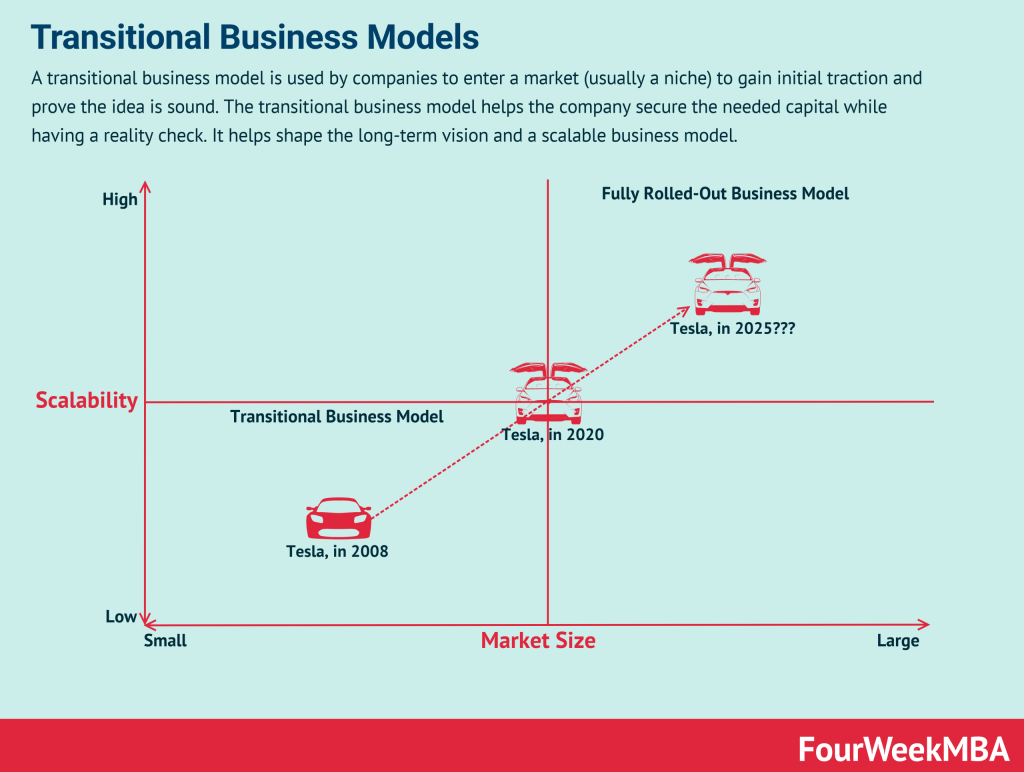
A transitional business model is used by companies to enter a market (usually a niche) to gain initial traction and prove the idea is sound. The transitional business model helps the company secure the needed capital while having a reality check. It helps shape the long-term vision and a scalable business model.
The minimum viable audience (MVA) represents the smallest possible audience that can sustain your business as you get it started from a microniche (the smallest subset of a market). The main aspect of the MVA is to zoom into existing markets to find those people which needs are unmet by existing players.
Business scaling is the process of transformation of a business as the product is validated by wider and wider market segments. Business scaling is about creating traction for a product that fits a small market segment. As the product is validated it becomes critical to build a viable business model. And as the product is offered at wider and wider market segments, it’s important to align product, business model, and organizational design, to enable wider and wider scale.
The market expansion consists in providing a product or service to a broader portion of an existing market or perhaps expanding that market. Or yet, market expansions can be about creating a whole new market. At each step, as a result, a company scales together with the market covered.
In the FourWeekMBA growth matrix, you can apply growth for existing customers by tackling the same problems (gain mode). Or by tackling existing problems, for new customers (expand mode). Or by tackling new problems for existing customers (extend mode). Or perhaps by tackling whole new problems for new customers (reinvent mode).
In the FourWeekMBA Revenue Streams Matrix, revenue streams are classified according to the kind of interactions the business has with its key customers. The first dimension is the “Frequency” of interaction with the key customer. As the second dimension, there is the “Ownership” of the interaction with the key customer.
Revenue model patterns are a way for companies to monetize their business models. A revenue model pattern is a crucial building block of a business model because it informs how the company will generate short-term financial resources to invest back into the business. Thus, the way a company makes money will also influence its overall business model.
The core premise of a Blue Ocean Strategy is to break down the trade off between value and cost, by creating uncontested markets .
What is Zooming in to find your MVA?
Where Blue Oceans create an uncontested market by looking beyond the boundaries of existing ones (it zooms way out to understand how a whole market might look different a decade from now).
What is Redefine value by going from "a product for everyone" to a "product made for a few"?
In a Blue Ocean Strategy, competition is made irrelevant by changing the business playground.
What is In a Blue Sea, there is space for all?
In a Blue Ocean Strategy, the new demand is captured by being the first mover or among the first movers in a new market .
What is In a Blue Sea, price sensitivity is flipped upside-down?
Where the Blue Ocean Strategy breaks the cost-value trade-off (offer more at a lower cost).
What is Look at the present and change it for a few?
A Blue Ocean Strategy looks at the future, envisions it, and builds it.
What is Blue Sea vs. Blue Ocean?
The core premise of a Blue Ocean Strategy is to break down the trade off between value and cost, by creating uncontested markets .
What is Zooming in to find your MVA?
Where Blue Oceans create an uncontested market by looking beyond the boundaries of existing ones (it zooms way out to understand how a whole market might look different a decade from now).
What is Redefine value by going from "a product for everyone" to a "product made for a few"?
In a Blue Ocean Strategy, competition is made irrelevant by changing the business playground.
What is In a Blue Sea, there is space for all?
In a Blue Ocean Strategy, the new demand is captured by being the first mover or among the first movers in a new market .
What is In a Blue Sea, price sensitivity is flipped upside-down?
Where the Blue Ocean Strategy breaks the cost-value trade-off (offer more at a lower cost).
What is Look at the present and change it for a few?
A Blue Ocean Strategy looks at the future, envisions it, and builds it.
Frequently Asked Questions
What is The Blue Sea Strategy?
In the business world, a Blue Sea is a space/ market easier to navigate as it’s not crowded like the classic red ocean. However, the Blue Ocean focuses on creating uncontested markets . The Blue Sea strategy looks at zooming as much as possible within existing markets to find your minimum viable audience. The core premise of a Blue Ocean Strategy is to break down the trade off between value and cost, by creating uncontested markets .
What is Blue Sea vs. Blue Ocean?
The core premise of a Blue Ocean Strategy is to break down the trade off between value and cost, by creating uncontested markets .
What is Zooming in to find your MVA?
Where Blue Oceans create an uncontested market by looking beyond the boundaries of existing ones (it zooms way out to understand how a whole market might look different a decade from now).
What is Redefine value by going from "a product for everyone" to a "product made for a few"?
In a Blue Ocean Strategy, competition is made irrelevant by changing the business playground.
What is In a Blue Sea, there is space for all?
In a Blue Ocean Strategy, the new demand is captured by being the first mover or among the first movers in a new market .
What is In a Blue Sea, price sensitivity is flipped upside-down?
Where the Blue Ocean Strategy breaks the cost-value trade-off (offer more at a lower cost).
What is Look at the present and change it for a few?
A Blue Ocean Strategy looks at the future, envisions it, and builds it.
A Blue Sea strategy does start from a minimum viable audience, but it creates options to scale. Those options can be exercised from time to time.
What are the key insights?
Zooming in to Find Minimum Viable Audience (MVA): Unlike Blue Ocean Strategy, which looks at creating uncontested markets by expanding beyond existing boundaries, the Blue Sea Strategy focuses on finding the smallest possible audience that has unmet needs within existing markets.. Redefining Value for a Small Group: The Blue Sea Strategy aims to redefine value for this minimum viable audience rather than the entire market.
Gennaro is the creator of FourWeekMBA, which reached about four million business people, comprising C-level executives, investors, analysts, product managers, and aspiring digital entrepreneurs in 2022 alone | He is also Director of Sales for a high-tech scaleup in the AI Industry | In 2012, Gennaro earned an International MBA with emphasis on Corporate Finance and Business Strategy.