Facebook, rebranded as Meta in 2021, is primarily owned by Mark Zuckerberg, founder, and CEO. Zuckerberg keeps tight control over the ownership and decision-making of the company. Other large individual shareholders comprise former COO Sheryl Sandberg and co-founder Eduardo Saverin. Large institutional investors include BlackRock, Vanguard, and Fidelity.
Detail
Description
Company
Meta Platforms, Inc. (formerly Facebook, Inc.)
Ownership Structure
Publicly traded company with dual-class share structure
Major Shareholders
Mark Zuckerberg (co-founder and CEO), institutional investors such as Vanguard Group, BlackRock, and Fidelity Investments
Founding Date
February 4, 2004
Founders
Mark Zuckerberg, Eduardo Saverin, Andrew McCollum, Dustin Moskovitz, and Chris Hughes
Headquarters
Menlo Park, California, USA
Primary Business
Social media and technology company, operating platforms such as Facebook, Instagram, WhatsApp, and Oculus
Strategic Goals
Expanding into the metaverse, enhancing AI and AR capabilities, growing global user base, increasing ad revenue, and improving user privacy and security
Corporate Structure and Ownership: Meta Platforms, Inc. is a publicly traded company listed on the NASDAQ under the ticker symbol META. The company employs a dual-class share structure consisting of Class A and Class B shares. Class A shares are publicly traded and provide one vote per share, while Class B shares are primarily held by insiders and provide ten votes per share. This structure gives Mark Zuckerberg, who holds a significant portion of Class B shares, substantial voting control over the company, allowing him to influence strategic decisions.
History and Evolution: Meta was originally founded as Facebook in 2004 by Mark Zuckerberg and his Harvard College roommates. The platform began as a social networking site for college students and quickly expanded its reach to the general public. Over the years, Facebook evolved into Meta Platforms, Inc., reflecting its broader ambitions beyond social media, including advancements in virtual reality, augmented reality, and the development of the metaverse. The rebranding to Meta in October 2021 marked a strategic pivot toward building immersive digital experiences and connecting people through new technologies.
Business Model and Revenue Streams: Meta Platforms generates the majority of its revenue through advertising on its social media platforms, including Facebook, Instagram, and Messenger. The company leverages user data to provide targeted advertising solutions for businesses, resulting in highly effective campaigns. Meta also earns revenue from its virtual reality division, Oculus, and recently, its initiatives in developing the metaverse. The company is expanding its offerings in e-commerce, digital payments, and other areas to diversify its revenue streams further.
Major Acquisitions and Investments: Meta has made several high-profile acquisitions to bolster its portfolio and expand its technological capabilities. Key acquisitions include Instagram (2012), WhatsApp (2014), and Oculus VR (2014). These strategic acquisitions have allowed Meta to diversify its offerings, tap into new user bases, and strengthen its position in the social media, messaging, and virtual reality markets. The company continues to invest in emerging technologies and startups to enhance its core platforms and explore new growth opportunities.
Metaverse Ambitions and Technology Innovation: Meta’s strategic focus is on developing the metaverse, an interconnected digital world that combines virtual reality, augmented reality, and the internet. The company aims to create immersive experiences that allow users to interact, socialize, and conduct business in virtual environments. Meta’s investments in AI, AR, and VR technologies support this vision, with initiatives like Horizon Workrooms, Horizon Worlds, and Project Aria driving innovation in this space. The company’s dedication to technology development positions it as a leader in shaping the future of digital interactions.
Privacy and Security Challenges: Meta faces ongoing challenges related to user privacy and data security. The company has been scrutinized for its handling of user data and its role in spreading misinformation. In response, Meta has implemented stricter privacy controls, transparency measures, and content moderation policies to address these issues. The company aims to balance innovation with user protection, ensuring a safe and secure environment across its platforms.
Global Market Expansion: Meta has a significant global presence, with billions of active users across its platforms. The company focuses on expanding its reach in emerging markets, where internet penetration and smartphone adoption are growing rapidly. Meta invests in infrastructure and partnerships to enhance connectivity in underserved regions, aiming to bring more users online and support local businesses. The company’s global strategy emphasizes localization, adapting its products and services to meet the unique needs of different markets.
Brand Positioning and Marketing: Meta positions itself as a technology leader committed to connecting people and building communities. The company’s marketing efforts highlight its role in empowering users to share experiences, engage with content, and interact with brands. Meta’s focus on the metaverse reflects its ambition to redefine digital engagement, emphasizing innovation and technological advancement. The brand’s messaging underscores its commitment to creating meaningful connections and enhancing the quality of online interactions.
Leadership and Governance: Meta is led by Mark Zuckerberg, who serves as Chairman and CEO. Zuckerberg’s vision and leadership have been instrumental in the company’s growth and evolution. The board of directors includes experienced executives from various industries, providing strategic oversight and guidance. Meta’s governance structure supports its dual-class share system, enabling Zuckerberg and other insiders to maintain control while balancing shareholder interests.
Aspect
Description
Analysis
Examples
Products and Services
Meta offers a wide range of products and services in the fields of social networking, augmented and virtual reality, and technology innovation. Key products include the Facebook platform (including Facebook, Instagram, WhatsApp, and Messenger), Oculus VR headsets for virtual reality experiences, the Workplace by Facebook platform for enterprise collaboration, and the development of the metaverse, a virtual shared space for immersive experiences.
Meta’s product portfolio encompasses social networking platforms like Facebook, Instagram, WhatsApp, and Messenger, which connect billions of users globally. Oculus VR headsets provide immersive virtual reality experiences. Workplace by Facebook targets enterprise collaboration. The company’s vision extends to the development of the metaverse, a virtual shared space for immersive and interconnected experiences. Meta’s products and services cater to individual users, businesses, and future metaverse initiatives.
Social networking platforms (e.g., Facebook, Instagram, WhatsApp, Messenger), Oculus VR headsets for immersive virtual reality, Workplace by Facebook for enterprise collaboration, development of the metaverse for immersive interconnected experiences.
Revenue Streams
Meta generates revenue primarily through advertising. Advertisers pay to display ads on its social networking platforms, targeting users based on demographics and interests. The company also earns income from virtual reality hardware sales (Oculus), subscription fees (e.g., Oculus Quest Store), and e-commerce on its platforms. Additionally, Meta may explore future revenue streams within the metaverse, such as virtual goods, services, and digital real estate.
The main revenue source is advertising, where businesses pay to advertise on Meta’s social networking platforms, utilizing user data for targeted marketing. Sales of Oculus VR hardware, subscription fees (e.g., Oculus Quest Store), and e-commerce transactions on the platforms contribute to revenue. Future metaverse initiatives may introduce revenue streams like virtual goods, services, and digital real estate. Diverse revenue streams support Meta’s financial stability.
Revenue from advertising (e.g., Facebook Ads, Instagram Ads), sales of Oculus VR hardware (e.g., Oculus Quest), subscription fees (e.g., Oculus Quest Store), e-commerce transactions on platforms, potential future revenue streams from the metaverse (e.g., virtual goods, services, digital real estate).
Customer Segments
Meta serves a diverse customer base, including individual users of its social networking platforms (Facebook, Instagram, WhatsApp, Messenger), businesses and advertisers seeking to promote products and services, enterprises using Workplace by Facebook for collaboration, virtual reality enthusiasts and gamers interested in Oculus VR hardware and experiences, and future participants in the metaverse ecosystem. The company aims to connect people, businesses, and communities in various digital realms.
Meta’s customer segments encompass individual users of its social networking platforms, businesses and advertisers leveraging its advertising solutions, enterprises using Workplace by Facebook for collaboration and communication, virtual reality enthusiasts and gamers interested in Oculus VR hardware and content, and future participants in the metaverse ecosystem. The company’s mission is to connect people, businesses, and communities across diverse digital realms, fostering social interactions, innovation, and immersive experiences.
Individual users of social networking platforms (e.g., Facebook, Instagram, WhatsApp, Messenger), businesses and advertisers utilizing advertising solutions, enterprises using Workplace by Facebook for collaboration, virtual reality enthusiasts and gamers interested in Oculus VR hardware and content, future participants in the metaverse ecosystem, Meta’s mission to connect people, businesses, and communities across digital realms.
Distribution Channels
Meta’s primary distribution channels include its social networking platforms (accessible via websites and mobile apps), app stores (e.g., Apple App Store, Google Play Store) for mobile apps, and Oculus VR hardware sales through its official website and retail partners. The company also leverages partnerships with content creators, developers, and advertisers to expand its ecosystem.
Distribution channels focus on Meta’s social networking platforms, which are accessible through websites and mobile apps. Mobile app stores, including the Apple App Store and Google Play Store, serve as distribution channels for Meta’s mobile apps. Oculus VR hardware is sold through the company’s official website and retail partners. Collaborations with content creators, developers, and advertisers expand the company’s ecosystem and reach.
Distribution through social networking platforms (websites, mobile apps), app stores for mobile apps (e.g., Apple App Store, Google Play Store), Oculus VR hardware sales via the official website and retail partners, partnerships with content creators, developers, and advertisers for ecosystem expansion.
Key Partnerships
Meta collaborates with various partners to enhance its offerings and ecosystem. Partnerships include content creators, developers, and businesses that create and promote content on its platforms. Advertisers form partnerships for targeted marketing campaigns. Additionally, Meta may seek collaborations with technology companies, content creators, and real estate developers to develop the metaverse and related experiences.
Collaborations with content creators and developers enrich Meta’s platforms with user-generated content and applications. Partnerships with businesses and advertisers drive advertising campaigns and sponsored content. Potential collaborations with technology companies, content creators, and real estate developers in the metaverse space aim to develop immersive and interconnected experiences. Meta’s partnerships are instrumental in expanding its ecosystem and offerings.
Collaborations with content creators and developers for user-generated content and applications, partnerships with businesses and advertisers for advertising campaigns and sponsored content, potential collaborations with technology companies, content creators, and real estate developers for metaverse development and immersive experiences.
Key Resources
Meta’s key resources include its social networking platforms with billions of users, a vast and engaged online community, partnerships with businesses and advertisers, technology infrastructure for data processing and content delivery, Oculus VR hardware and software, a strong brand identity associated with social connection and innovation, a global network of content creators, developers, and users, and a vision for the future of the metaverse.
Social networking platforms form the core resource, connecting billions of users and fostering a vast online community. Partnerships with businesses and advertisers contribute to the advertising ecosystem. Technology infrastructure ensures data processing and content delivery. Oculus VR hardware and software enhance immersive experiences. A strong brand identity fosters social connection and innovation. A global network of content creators, developers, and users enriches the ecosystem. Meta’s vision for the metaverse guides future development and innovation.
Social networking platforms connecting billions of users and fostering a vast online community, partnerships with businesses and advertisers contributing to the advertising ecosystem, technology infrastructure for data processing and content delivery, Oculus VR hardware and software enhancing immersive experiences, a strong brand identity associated with social connection and innovation, a global network of content creators, developers, and users enriching the ecosystem, a vision for the future of the metaverse guiding development and innovation.
Cost Structure
Meta incurs costs related to data centers and infrastructure for content hosting and delivery, research and development (R&D) for platform innovation, marketing and advertising expenses to attract and engage users, employee salaries and benefits for a diverse workforce, acquisitions and investments in technology companies, and potential regulatory and compliance costs.
Costs related to data centers and infrastructure ensure reliable content hosting and delivery. R&D investments drive platform innovation and development. Marketing and advertising expenses promote user acquisition and engagement. Employee salaries and benefits cover staff in various roles. Acquisitions and investments in technology companies foster innovation and ecosystem growth. Regulatory and compliance costs may arise to address legal and industry requirements.
Costs related to data centers and infrastructure for content hosting and delivery, research and development (R&D) investments for platform innovation, marketing and advertising expenses for user acquisition and engagement, employee salaries and benefits covering diverse roles, acquisitions and investments in technology companies for innovation and ecosystem growth, potential regulatory and compliance costs to address legal and industry requirements.
Competitive Advantage
Meta’s competitive advantage lies in its vast and engaged user base across social networking platforms, a network effect that attracts users and advertisers, a strong brand identity associated with social connection and innovation, partnerships with content creators, developers, and businesses, diversified revenue streams from advertising, hardware sales, and potential metaverse initiatives, and a vision for the metaverse that positions the company as a leader in shaping the future of immersive digital experiences.
A vast and engaged user base contributes to the network effect, attracting users and advertisers to Meta’s platforms. A strong brand identity fosters trust and loyalty among users. Collaborations with content creators, developers, and businesses enrich the ecosystem. Diverse revenue streams from advertising, hardware sales, and potential metaverse initiatives ensure financial stability. Meta’s vision for the metaverse positions it as a leader in shaping the future of immersive digital experiences. The company’s competitive advantage lies in its ability to connect people, businesses, and communities across various digital realms.
Vast and engaged user base across social networking platforms, network effect attracting users and advertisers, strong brand identity fostering trust and loyalty, collaborations with content creators, developers, and businesses enriching the ecosystem, diverse revenue streams from advertising, hardware sales, and potential metaverse initiatives ensuring financial stability, a vision for the metaverse positioning Meta as a leader in shaping the future of immersive digital experiences and connecting people, businesses, and communities across digital realms.
Key Highlights
Major Shareholders:
Mark Zuckerberg, the founder and CEO of Facebook, holds significant control over the company’s ownership and decision-making.
Other large individual shareholders include Sheryl Sandberg, former COO of Facebook, and Eduardo Saverin, co-founder of the company.
Institutional Investors:
BlackRock, one of the world’s largest investment management companies, is a major institutional investor in Meta (formerly Facebook).
Vanguard, another prominent investment management company, also holds a substantial stake in the company.
Fidelity, a well-known financial services firm, is among the significant institutional investors in Meta.
Facebook’s Rebranding as Meta:
In 2021, Facebook underwent a major rebranding, changing its corporate name to Meta.
The rebranding was part of the company’s effort to expand beyond its core social media platform and venture into the metaverse and virtual reality technologies.
Mark Zuckerberg’s Control and Ownership:
Mark Zuckerberg, as the founder and CEO, has retained tight control over Facebook/Meta’s ownership and decision-making.
His significant ownership stake allows him to influence the company’s direction and strategic decisions.
Sheryl Sandberg’s Role:
Sheryl Sandberg, former Chief Operating Officer (COO) of Facebook, is a notable individual shareholder.
Sandberg played a crucial role in the company’s growth and operations during her tenure as COO.
Eduardo Saverin’s Stake:
Eduardo Saverin, one of the co-founders of Facebook, also holds a substantial ownership stake in the company.
Saverin’s involvement in the early stages of Facebook’s development contributed to the company’s success.
Facebook’s Shareholders and Governance:
The ownership structure of Facebook/Meta reflects the influence and control of its key executives and co-founders.
Mark Zuckerberg’s significant ownership enables him to maintain a considerable say in the company’s decisions.
Institutional Investors’ Influence:
Large institutional investors like BlackRock, Vanguard, and Fidelity have notable stakes in Meta, which can influence the company’s governance and direction.
Focus on the Metaverse:
Meta’s rebranding indicates its strategic shift towards focusing on the metaverse and virtual reality technologies.
The company aims to explore and develop opportunities beyond its traditional social media platform.
Shift to Generative AI
With losses mounting for the Reality Lab segment, Meta had to refocus on what could produce a short-term impact on the company. That is why the company shifted its focus to Generative AI.
Indeed, Meta shifted its whole core strategy to Generative AI through the launch of various open-source LLMs to try to garner market shares quickly.
ARPU, or average revenue per user, is a key metric for attention merchants like Facebook. It assesses the ability of the platform to monetize its users. For instance, by the end of 2022, Meta’s ARPU worldwide was $10.86. While in US & Canada, it was $58.77; in Europe, it was $17.29; in Asia, $4.61 and in the rest of the world, it was $3.52.
OpenAI is an artificial intelligence research laboratory that transitioned into a for-profit organization in 2019, which comprised an entity called OpenAI LP and the non-profit parent foundation OpenAI. The lab, which was founded in 2015 by Elon Musk, Sam Altman, and various others, has a core focus on the development of friendly AI that benefits society as a whole. Yet now has primarily evolved as a capped-for-profit entity with an exclusive commercial license to Microsoft.
Its co-founders primarily own Airbnb: Brian Chesky, with 76,407,686 Class B shares, which gives him 29.1% of ownership; Nathan Blecharczyk, with 232,306 Class A and 64,646,713 Class B, which give him 25.3%; and Joe Gebbia, which has 5,113,865 Class A and 58,023,452 Class B, which give him 22.9% ownership.
Google is primarily owned by its founders, Larry Page and Sergey Brin, who have more than 51% voting power. Other individual shareholders comprise John Doerr (1.5%), a venture capitalist and early investor in Google, and CEO, Sundar Pichai. Former Google CEO Eric Schmidt has 4.2% voting power. The most prominent institutional shareholders are mutual funds BlackRock and The Vanguard Group, with 2.7% and 3.1%, respectively.
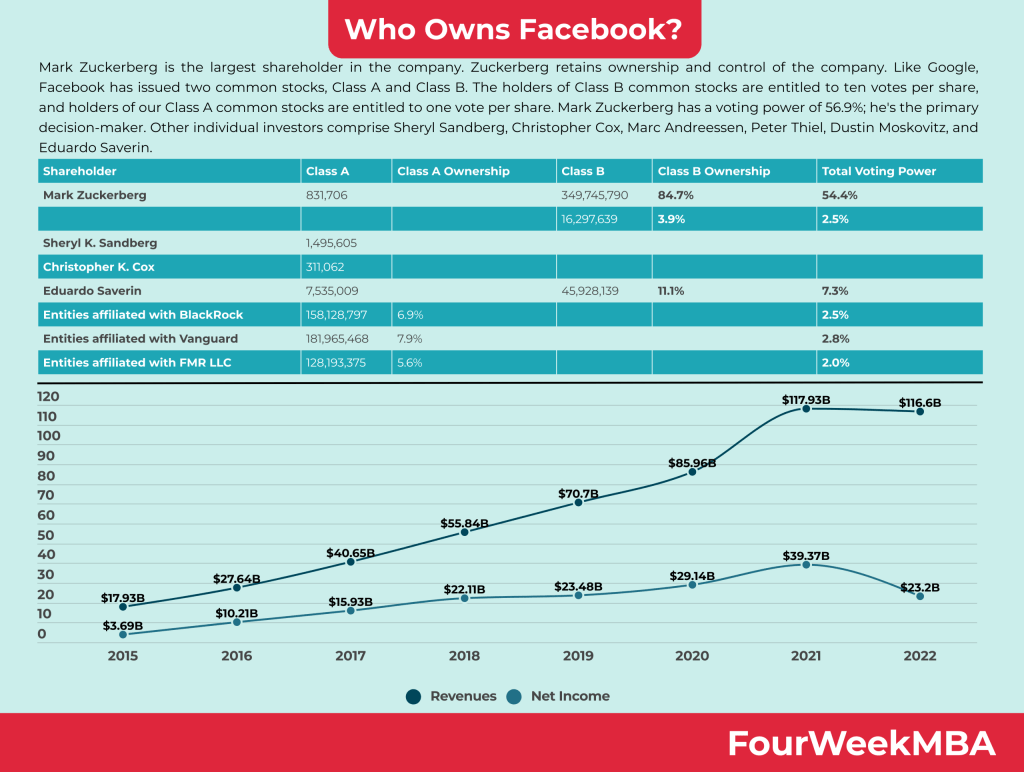
Mark Zuckerberg is the largest shareholder in the company. Zuckerberg retains ownership and control of the company. Like Google, Facebook has issued two common stocks, Class A and Class B. The holders of Class B common stocks are entitled to ten votes per share, and holders of our Class A common stocks are entitled to one vote per share. Mark Zuckerberg has a voting power of 56.9%; he’s the primary decision-maker. Other individual investors comprise Sheryl Sandberg, Christopher Cox, Marc Andreessen, Peter Thiel, Dustin Moskovitz, and Eduardo Saverin.
As of 2023, major Apple shareholders comprised Warren Buffet’s Berkshire Hathaway with 5.73% of the company’s stock (valued at over $130 billion). Followed by other individual shareholders like Tim Cook, CEO of Apple, with about 3.3 million shares, Artur Levinson, chairman of Apple, with over 4.5 million shares, and others.
With 64,588,418 shares, Jeff Bezos is the major individual investor. Owning 12.7% of the company. Other top individual investors comprise Amazon’s CEO Andy Jessy, with 94,729 shares. Top institutional investors include mutual funds like The Vanguard Group (6.6% ownership) and BlackRock (5.7% ownership).
Major shareholders comprise co-founder Bill Gates, who stepped down from the company’s board in 2020, which is why these shares are no longer publicly reported. In 2019, Gates still owned a stake of 103 million stocks, which accounted for 1.34% of the company’s ownership (worth over $23 billion in January 2023). Other individual shareholders comprise Satya Nadella, the company’s CEO, Brad Smith (former president), Jean-Philippe Courtois (EVP), and Amy Hood (former CFO).
By 2022, most of Tesla’s shares are still owned by Elon Musk, among the company’s co-founders and the CEO. Elon Musk is the top individual investor, with a 23.5% stake in the company, equivalent to over 244 million shares. Musk is followed by Lawrence Ellison (founder of Oracle), with a 1.5% company stake. Ellison also sits on Tesla’s board. And Antonio Gracias, among the company’s first investors, has over 1.6 million shares. Other institutional investors and mutual funds like The Vanguard Group (6%), Blackrock (5.1%), and Capital Ventures International also have a good chunk of the company’s stocks.
PayPal was first founded in 1998; it was called Confinity (among its founders was Peter Thiel); later, it merged with X.com, its major competitor, founded by Elon Musk (which would become known for other companies like Tesla and SpaceX). From this merger, PayPal was born. In 2002, PayPal was bought by eBay for $1.5 billion. eBay spun off PayPal in 2015, which would be listed as an independent entity. Today PayPal owns brands like Braintree, Venmo, Xoom, and iZettle.
Netflix’s largest individual shareholder is Reed Hastings, co-founder, and former CEO of the company, now Chairperson of Netflix, with a 1.7% stake, valued at over $2.4 billion in February 2023. Other significant individual shareholders comprise Jay C. Hoag, the company’s directors since 1999, and Ted Sarandos, former chief content officer and now Chief Executive Officer of Netflix. Major institutional shareholders comprise The Vanguard Group (7.55% ownership), BlackRock (6.58% ownership), and Capital Research Global Investments (5.84% ownership).
TikTok is owned by ByteDance, a Chinese internet technology company owning several content platforms worldwide (Douyin, Toutiao, Xigua Video, Helo, Lark, Babe). Bytedance passed the $300 billion private market valuation by 2022, making around $58 billion in revenue in 2022, over $4 billion from TikTok.
Acquired by Google, in 2006, for $1.65 billion, YouTube is now worth many times over. In 2022, YouTube generated over $29 billion in revenue from advertising alone. YouTube is part of Google (now named Alphabet), and as such, it is owned by main Google’s Alphabet shareholders and is one of the fastest-growing segments for the company.
As of April 25th, 2022, Elon Musk tried to take over Twitter. Musk tried to purchase the company at $54.20 per share, or about $44 billion. The deal finally closed by October 27th, 2022, and Elon Musk became the largest shareholder.
The multi-billion music streaming company Spotify is primarily owned by its founders, Daniel Ek and Martin Lorentzon. As of 2023, Daniel Ek has 16.5% ownership of ordinary shares and 31.7% of the voting power. Martin Lorentzon has 10.9% of ordinary shares and 42.6% of the voting power. Another key shareholder is Baillie Gifford & Co, a Scottish-based money management firm, followed by Morgan Stanley, T. Rowe Price, and Tencent.
The top individual shareholder of NVIDIA is Jen-Hsun Huang, founder, and CEO of the company, with 87,521,722 shares giving him 3.50% ownership. Followed by Mark A. Stevens, venture capitalist and a partner at S-Cubed Capital, who was part of the NVIDIA board in 2008 and previously served as a director from 1993 to 2006, with 6,258,803 shares. Institutional investors comprise The Vanguard Group, Inc, with 196,015,550, owning 7.83%. BlackRock, Inc., with 177,858,484, owns 7.10%. And FMR LLC (Fidelity Institutional Asset Management) with 158,039,922, owning 6.31%.
Uber’s principal individual shareholders comprise Yasir Al-Rumayyan (3.73%), the Governor of the Public Investment Fund, the sovereign wealth fund of the Kingdom of Saudi Arabia, and Dara Khosrowshahi, the founder and CEO of Uber. There is Morgan Stanley, with 5.12% ownership among the top institutional investors.
The founder and CEO of Shopify, Tobias Lütke, owned or controlled 7,891,852 Class B multiple voting shares and 5,250 Class A subordinate voting shares, representing approximately 33.8% of the aggregate voting power attached to all of the Company’s outstanding voting shares. Another key stakeholder is John H. Phillips, an angel investor who placed an early bet on Shopify.
Roblox is owned by David Baszucki and Gregory Baszucki, with a 2.3% and 2.6% stake, respectively. Anthony lee, managing partner at Altos Ventures, with a 15.3% stake.
In 2014, Twitch was bought by Amazon for $970 million. Therefore Twitch is part of Amazon, comprising other subsidiaries bought over the years, like Audible, Whole Foods, and Zappos (in total, Amazon has 12 subsidiaries). Therefore, as of 2020, Twitch is a multi-billion dollar company, making money primarily via advertising through its video streaming platform (creators use Twitch today across many other verticals).
Zoom’s principal private shareholders comprise Eric S. Yuan, a Chinese-American billionaire businessman that founded Zoom. Dan Scheinman, board member and angel investor in Zoom since the start, and Santiago Subotovsky, also an early investor in Zoom. Zoom follows a freeterprise business model where free accounts are channeled into enterprise customers.
In one of the largest deals in the business world, Microsoft acquired Activision Blizzard in a $68.7 billion transaction. Making Microsoft the world’s third-largest gaming company by revenue, behind Tencent and Sony. However, given the size of the deal, this is still under the scrutiny of regulators who need to approve it. If the deal goes through, Microsoft will become among the largest gaming companies in the world.
Pixar is owned by The Walt Disney Company, which acquired it in 2006 in a $7.4 billion deal. Today Pixar is part of the Disney Empire. The principal shareholders of Disney comprise Robert Iger, CEO of the company, and institutional investors like The Vanguard Group and Blackrock.
Marc Benioff, Co-CEO of Salesforce, is the primary individual shareholder, with 3% of the company’s stock. Other main individual shareholders comprise Parker Harris, Co-Founder and Chief Technology Officer, and Bret Taylor, former co-CEO. Major institutional shareholders include The Vanguard Group, Fidelity, and BlackRock.
In a $27.7 billion deal in 2021, Salesforce’s finalized the acquisition of Slack, which was integrated into Salesforce. Today Slack is still a product mostly independently managed by Salesforce, which incorporated some of its features within its platform. Entrepreneur Marc Benioff primarily owns salesforce.
Evan Spiegel and Robert Cornelius Murphy are the co-founders and, respectively, CEO and CTO of Snapchat. Evan Spiegel owns 3% of Class A stocks, 25.7% of Class B stocks, and 53.4% of Class C stocks for a 53.2% voting power, whereas Robert Murphy owns 6% of Class A stocks, 25.7% of Class B stocks, and 46.6% of Class C stocks for a 46.6% voting power. Snapchat runs an advertising-based businessmodel.
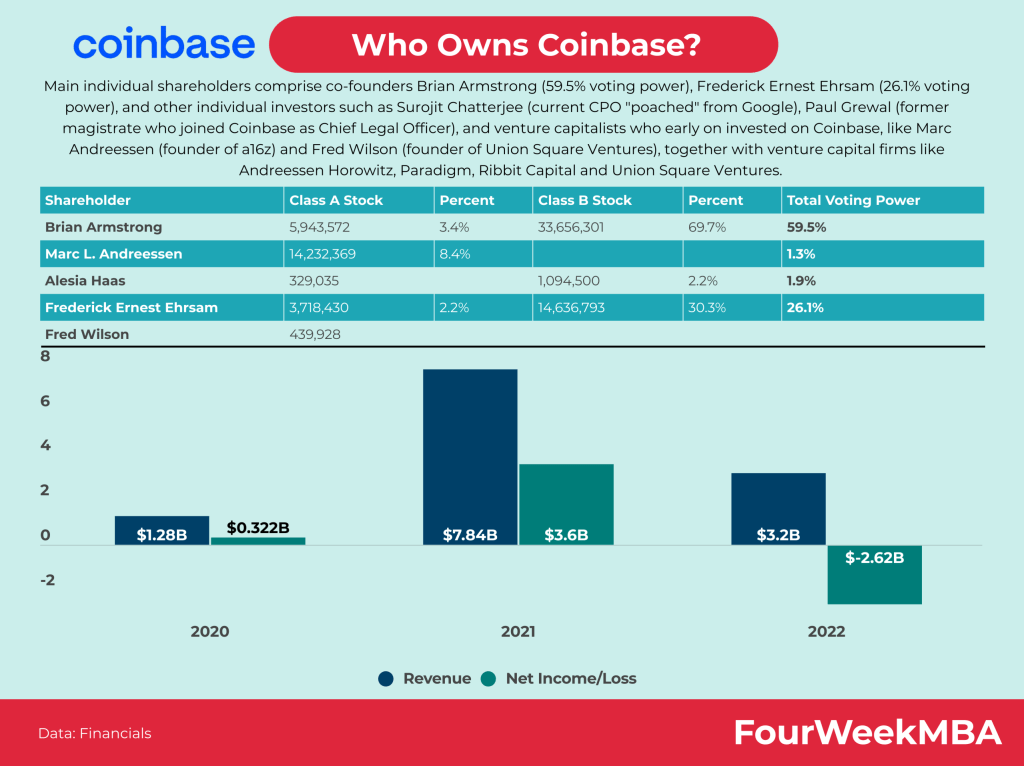
Main individual shareholders comprise co-founders Brian Armstrong (59.5% voting power), Frederick Ernest Ehrsam (26.1% voting power), and other individual investors such as Surojit Chatterjee (current CPO “poached” from Google), Paul Grewal (former magistrate who joined Coinbase as Chief Legal Officer), and venture capitalists who early on invested on Coinbase, like Marc Andreessen (founder of a16z) and Fred Wilson (founder of Union Square Ventures), together with venture capital firms like Andreessen Horowitz, Paradigm, Ribbit Capital and Union Square Ventures.
Gennaro is the creator of FourWeekMBA, which reached about four million business people, comprising C-level executives, investors, analysts, product managers, and aspiring digital entrepreneurs in 2022 alone | He is also Director of Sales for a high-tech scaleup in the AI Industry | In 2012, Gennaro earned an International MBA with emphasis on Corporate Finance and Business Strategy.