Disney’s main shareholders include Robert A. Iger, chief executive officer (CEO) of The Walt Disney Company between 2005-2020, and he returned as CEO by 2022. Other significant individual shareholders, as of 2022, comprise Susan E. Arnold, Christine M. McCarthy, and Alan N. Braverman. Main institutional investors include Blackrock Inc. with 6.4% and The Vanguard Group with 8%, respectively.
Aspect
Description
Analysis
Examples
Products and Services
Disney offers a wide range of products and services, including film and television content production, theme parks and resorts, consumer products, interactive media, and more. Its content portfolio encompasses animated and live-action films, TV shows, and streaming services like Disney+. Disney’s products are known for their storytelling and family-friendly appeal.
Disney generates revenue from various sources, with content production and licensing, theme parks, and consumer products being significant contributors. Disney’s acquisition of 21st Century Fox expanded its content library and strengthened its position in the media industry. Disney+ has emerged as a key player in the streaming service market, providing a direct-to-consumer avenue for its content.
Film and television content, theme parks, consumer products, interactive media, Disney+, content production, licensing, family-friendly appeal, 21st Century Fox acquisition, streaming service market, direct-to-consumer platform.
Revenue Streams
Disney’s revenue streams come from several segments, including Media Networks, Parks, Experiences and Products, Studio Entertainment, and Direct-to-Consumer & International. Media Networks, comprising cable and broadcasting, generate revenue through advertising, affiliate fees, and content licensing. Parks, Experiences and Products generate income from theme park admissions, merchandise sales, and resort stays. Studio Entertainment earns revenue through film and TV content production, distribution, and licensing. Direct-to-Consumer & International includes revenue from streaming services like Disney+.
Disney’s diversified revenue streams provide stability and resilience. While traditional media networks and studio entertainment have been core revenue sources, the company’s expansion into streaming services like Disney+ reflects its adaptation to changing consumer preferences. Theme parks and consumer products contribute to the brand’s overall appeal and monetization.
Revenue from Media Networks, Parks, Experiences and Products, Studio Entertainment, Direct-to-Consumer & International, advertising, affiliate fees, content licensing, theme park admissions, merchandise sales, resort stays, film production, distribution, streaming services, diversified income sources.
Customer Segments
Disney’s customer base spans a broad demographic, including families, children, adults, and enthusiasts of various entertainment genres. Its content appeals to fans of animation, fantasy, sci-fi, and classic storytelling. Disney’s theme parks cater to tourists, vacationing families, and Disney enthusiasts. Streaming services like Disney+ target a global audience of all ages.
Disney serves a diverse customer base, from families and children to adults and entertainment enthusiasts. Its content offerings span multiple genres and eras, ensuring appeal to a wide audience. Theme parks attract tourists, vacationers, and Disney fans, while streaming services like Disney+ aim to reach a global viewership.
Families, children, adults, entertainment enthusiasts, animation fans, fantasy and sci-fi enthusiasts, storytelling aficionados, tourists, vacationers, Disney fans, global viewership.
Distribution Channels
Disney distributes its content through various channels, including traditional television networks (ABC, ESPN, Disney Channel), theaters, DVD/Blu-ray, merchandise stores, and digital platforms like Disney+. Theme parks and resorts offer in-person experiences. The acquisition of 21st Century Fox expanded Disney’s content distribution channels and library.
Disney leverages a combination of traditional and digital distribution channels to reach its audience. The launch of Disney+ enhances its direct-to-consumer reach, reducing reliance on third-party distributors. Theme parks and resorts provide immersive experiences that complement its content offerings. The acquisition of 21st Century Fox broadened Disney’s content distribution capabilities.
Television networks, theaters, physical media, merchandise stores, digital platforms, Disney+, direct-to-consumer reach, theme parks, immersive experiences, content distribution capabilities, 21st Century Fox acquisition.
Key Partnerships
Disney partners with content creators, filmmakers, and studios to produce and distribute films and TV shows. Collaborations with brands and licensors expand its consumer product offerings. In the streaming space, Disney collaborates with technology providers and studios to license content. Licensing agreements with companies like Hasbro and Mattel extend its brand into the toy industry. Disney also forms alliances with theme park operators for international expansions.
Collaborations with content creators, filmmakers, studios, brands, and licensors are integral to Disney’s content production and consumer product lines. Licensing agreements with technology providers and studios enhance its streaming offerings. Partnerships with toy companies like Hasbro and Mattel expand Disney’s presence in the merchandise market. Alliances with international theme park operators drive global expansion.
Content creator collaborations, brand partnerships, licensing agreements, streaming collaborations, toy industry partnerships, merchandise market expansion, international theme park alliances, global expansion initiatives.
Key Resources
Key resources for Disney include its extensive content library, creative talent (animators, filmmakers), theme parks and resorts, a global network of retail stores, streaming platforms like Disney+, and a strong brand reputation. Disney’s ability to create compelling stories and iconic characters is a critical asset. Investments in technology and infrastructure support its digital ventures.
Disney’s resources encompass an extensive content library, a creative workforce of animators and filmmakers, theme parks and resorts worldwide, a network of retail stores, digital platforms like Disney+, and a powerful brand reputation. The company’s storytelling ability and iconic characters form the foundation of its success. Investments in technology and infrastructure underpin its digital endeavors and streaming services.
Content library, creative talent, theme parks and resorts, retail store network, digital platforms, brand reputation, storytelling expertise, iconic characters, technology investments, infrastructure support, digital ventures.
Cost Structure
Disney incurs various costs, including content production expenses, marketing and advertising costs, employee salaries and benefits, theme park maintenance and operation costs, licensing fees, technology investments, and administrative overhead. High-quality content creation represents a significant but necessary cost.
Costs associated with Disney’s operations encompass content production, marketing and advertising expenditures, employee compensation, theme park maintenance and operation, licensing fees, technology investments, and administrative expenses. The creation of high-quality content is a substantial but essential cost, as it fuels Disney’s brand and revenue streams. Investments in technology and theme park maintenance ensure a high standard of customer experience.
Content production costs, marketing and advertising expenses, employee compensation, theme park operation and maintenance costs, licensing fees, technology investments, administrative overhead, high-quality content creation, customer experience maintenance, operational investments.
Competitive Advantage
Disney’s competitive advantage is built on its exceptional storytelling, iconic characters, and extensive content library, which spans generations. The company’s ability to create compelling, family-friendly content sets it apart. Disney’s theme parks provide unique and immersive experiences, while streaming services like Disney+ bolster its direct-to-consumer reach. The brand’s reputation for quality and its global presence enhance its competitive edge.
Disney excels in storytelling, boasts iconic characters, and possesses a vast content library with cross-generational appeal. Its ability to create captivating and family-friendly content is a distinct advantage. Disney’s theme parks offer unmatched immersive experiences, and its streaming services expand direct-to-consumer reach. The brand’s global reputation and presence reinforce its competitive edge.
As of 2022, based on the official, Disney’s major shareholders comprise:
Disney’s top institutional investors comprise The Vanguard Group, with 8% shares, and Blackrock, with 6.4% ownership. These mutual funds own a good chunk of most public companies with large market caps.
Thus, they also have a good chunk of ownership in Disney.
What about the past? Let’s revisit the history of Disney stock ownership over the years.
Why did Steve Jobs use to own Disney stocks?
As The Walt Disney Company was founded in 1923, it also had a long history of stock ownership.
Everyone knows Steve Jobs’ story. For those who don’t recall it. In 1985 Steve Jobs was ousted from Apple.
That was mainly due to the lack of success of his last product and the fact the company needed to take action to avoid consequences on the bottom line.
When Jobs was ousted, he didn’t take it “sportingly,” and he sold all of his stocks Apple back then.
I covered in “Who Owns Apple” how Jobs used those stocks to purchase Pixar.
And with his genius, Steve Jobs made Pixar among the most innovative companies in the world until Disney acquired it.
That is the conventional story that praises the genius Jobs.
I’d like to report the story told by Alvy Ray Smith on his blog. This is his perspective on those years as founder of Lucasfilm, the company that would presumably sell Pixar to Steve Jobs.
In reality, Alvy Ray Smith seems to tell us another story, which doesn’t picture Steve Jobs as the visionary we all know.
Pixar History revisited by Alvy Ray Smith
It is important to remark this is another side of the story that can hardly be confirmed or refuted.
“A new spinout corporation from Lucasfilm, called Pixar, was capitalized with $10 million from Steve Jobs. Pixar paid $5 million of this to Lucasfilm for exclusive rights to the technology developed by the team while at Lucasfilm (exclusive except that Lucasfilm could continue to use it too). That was not a “buy” for Pixar. It was a “buy” of technology rights, and it was a “buy” by Pixar, not Steve. The other $5 million was used to actually run the new company. Steve Jobs was the investor, pure and simple.“
In short, he is arguing that Steve Jobs is an “investor,” not the “buyer” thus the one who runs the company.
In fact, in the same article, Alvy Ray Smith continues
“Ed Catmull, and Alvy Ray Smith were the management of Pixar. Steve owned 70% of the new company, the management and employees the other 30%. Ed, Alvy, and Steve were the board of the corporation. Again, this was not a “buy” by any stretch of the definition. The implication of “buy” is to “own and run.” The implication of “invest” is to own an interest in and let managers (ultimately responsible to the board) run. Pixar was of the second type. Use of the term “buy” is a marketing ploy to make it seem that Steve was the single inspired genius who had all the ideas of Pixar and made it work. That’s not how it worked. Not even close.“
He also makes another strong point when it comes to Jobs saving Pixar because he had a grand vision for its future:
“No, it didn’t. Jobs did not come along and pour money into a dying company and save it, as is sometimes depicted. Pixar was failing despite his money which was the only money the company had. That is, the company built from scratch with Jobs’s investment was the company that was in trouble, DESPITE Job’s financial involvement. It was failing as a hardware company. What saved Pixar was Disney’s asking it to make a movie. That wasn’t Jobs’s idea at all. In fact, the idea all along (Ed and Alvy’s idea) was to keep the company alive with hardware manufacturing as long as necessary to reach the next stage in Moore’s Law, when computing a movie would become feasible, then make movies. Jobs invested in that initial hardware company. He ran another hardware company, Next, at this time. Hardware was what he knew, not animation.“
And he continued:
“The company ran out of money several times in the initial hardware days. Jobs poured more money in to cover the losses each time. It’s sometimes construed that he did this because he saw the long-term potential of the movie business and held on to “his vision” with further investments. This wasn’t the case at all, however. Jobs kept pouring money into the company so that he wouldn’t have to sustain the embarrassment that his first company – after being booted from Apple – was a failure. The result is the same: His money kept the company afloat, but the idea that it was his grand vision is not right. In fact, he would have sold the company to ANYBODY for $50 million (to cover his total investment) during that pre-movie period. The company (Ed and Alvy, in particular) wrote several business plans during those years for just that purpose. They all failed to attract a buyer. Jobs would have bolted if he could have without embarrassment.“
And he further highlighted:
“What Jobs WAS good at was seeing the grand opportunity when it appeared, and moving fast to take advantage of it. That opportunity wasn’t Disney’s approach in 1991 to the company to make the movie. It was when the completed movie, over three years later (late 1994), was taken to New York City and the critics went wild, saying it was going to be a smash. THEN Jobs quickly stepped forward, pushed Ed Catmull aside as apparent head of the company, and took brilliant advantage of the opportunity to take the company public, cover his investment finally, and make it appear that it had been his idea all along to do it this way. He was a marketing genius, including self-marketing.“
Closing his statement with:
“It was Disney’s money that saved Pixar. They paid for the production of Toy Story, which went on to great success for the company. Animated movies were Pixar’s vision, from its earliest days at NYIT on Long Island, not Jobs’s vision.“
“Jack Dorsey is a talented entrepreneur who has helped create groundbreaking new businesses in the social media and commerce spaces,”
Said Bob Iger, Disney’s chief executive:
“The perspective he brings to Disney and its Board is extremely valuable, given our strategic priorities, which include utilizing the latest technologies and platforms to reach more people and to enhance the relationship we have with our customers.“
However, as Twitter has become over the years a media company, Jack Dorse won’t probably be re-elected as a board member as conflicts of interest loom ahead.
Why Twitter had Sheryl Sandberg as a Disney board member?
Sheryl Sandberg was appointed as a Disney board member back in 2010.
Just like Jack Dorsey, she might not be for re-election as Facebook, now considered a media company, puts her position in a conflict of interest with the company.
“Sheryl is an outstanding executive who can add incredible value to what is already a diverse and highly experienced group of directors,”
Said John E. Pepper Jr., Disney’s chairman:
“She brings great expertise in the online world, considerable international experience, and a deep understanding of consumer behavior.”
When Disney served as inspiration for designing the Airbnb customer experience
A storyboard is a linear sequence of illustrations used in animation to develop a broader story. A storyboard process is now used also in business to understand and map customers’ experiences and enable the growth of the company using that process.
Back in 2011, Brian Chesky, co-founder of Airbnb, picked up a biography of Walt Disney over the Christmas vacation.
In there, he found a technique that Walt Disney used.
As the story goes, during a passage of Walt Disney’s biography, Chesky noticed how, during the production of the movie “Snow White and the Seven Dwarfs” in the 1930s, Disney used storyboards, a technique invented by a Disney’s animator, a few years earlier.
Chesky felt that when Disney used this technique, he was in a similar situation that Airbnb was facing at the time.
Thus, Chesky, with the other co-founders, had an animator from Pixar design the storyboard for the three key processes:
The host process.
The guest process.
And the hiring process.
Those storyboards brought in the Airbnb headquarters aimed to align everyone in the organization around the critical elements of the customers’ experiences.
In 2022, Airbnb enabled $63.2 Billion in Gross Booking Value, generating $8.4 Billion in service fee revenues. In 2022, there were $393.7 Million Nights and Experiences Booked, ad an average service fee of 13.3%, at an Average Value per Booking of $161.
It would be hard to argue for a more recognizable entertainment brand than Disney. Disney is, of course, synonymous with Walt Disney, but it was Walt and his brother Roy who started the company in 1923 in Burbank, California. Disney content is now broadcast on over 100 channels in 34 different languages across the globe.
OpenAI is an artificial intelligence research laboratory that transitioned into a for-profit organization in 2019, which comprised an entity called OpenAI LP and the non-profit parent foundation OpenAI. The lab, which was founded in 2015 by Elon Musk, Sam Altman, and various others, has a core focus on the development of friendly AI that benefits society as a whole. Yet now has primarily evolved as a capped-for-profit entity with an exclusive commercial license to Microsoft.
Its co-founders primarily own Airbnb: Brian Chesky, with 76,407,686 Class B shares, which gives him 29.1% of ownership; Nathan Blecharczyk, with 232,306 Class A and 64,646,713 Class B, which give him 25.3%; and Joe Gebbia, which has 5,113,865 Class A and 58,023,452 Class B, which give him 22.9% ownership.
Google is primarily owned by its founders, Larry Page and Sergey Brin, who have more than 51% voting power. Other individual shareholders comprise John Doerr (1.5%), a venture capitalist and early investor in Google, and CEO, Sundar Pichai. Former Google CEO Eric Schmidt has 4.2% voting power. The most prominent institutional shareholders are mutual funds BlackRock and The Vanguard Group, with 2.7% and 3.1%, respectively.
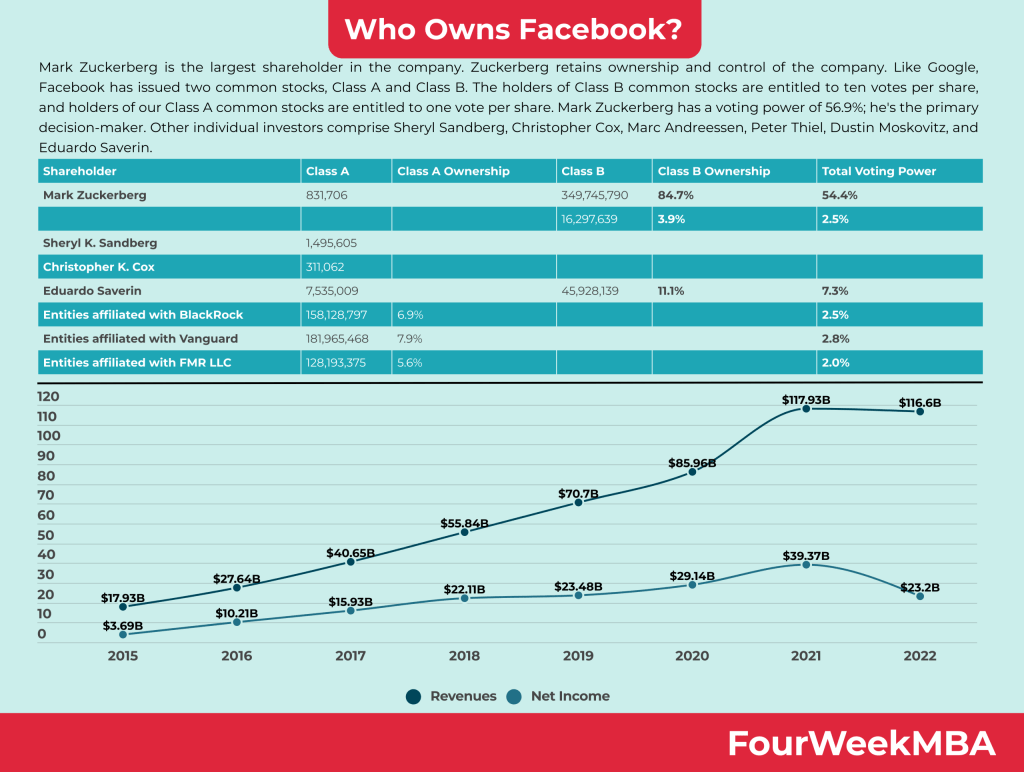
Mark Zuckerberg is the largest shareholder in the company. Zuckerberg retains ownership and control of the company. Like Google, Facebook has issued two common stocks, Class A and Class B. The holders of Class B common stocks are entitled to ten votes per share, and holders of our Class A common stocks are entitled to one vote per share. Mark Zuckerberg has a voting power of 56.9%; he’s the primary decision-maker. Other individual investors comprise Sheryl Sandberg, Christopher Cox, Marc Andreessen, Peter Thiel, Dustin Moskovitz, and Eduardo Saverin.
As of 2023, major Apple shareholders comprised Warren Buffet’s Berkshire Hathaway with 5.73% of the company’s stock (valued at over $130 billion). Followed by other individual shareholders like Tim Cook, CEO of Apple, with about 3.3 million shares, Artur Levinson, chairman of Apple, with over 4.5 million shares, and others.
With 64,588,418 shares, Jeff Bezos is the major individual investor. Owning 12.7% of the company. Other top individual investors comprise Amazon’s CEO Andy Jessy, with 94,729 shares. Top institutional investors include mutual funds like The Vanguard Group (6.6% ownership) and BlackRock (5.7% ownership).
Major shareholders comprise co-founder Bill Gates, who stepped down from the company’s board in 2020, which is why these shares are no longer publicly reported. In 2019, Gates still owned a stake of 103 million stocks, which accounted for 1.34% of the company’s ownership (worth over $23 billion in January 2023). Other individual shareholders comprise Satya Nadella, the company’s CEO, Brad Smith (former president), Jean-Philippe Courtois (EVP), and Amy Hood (former CFO).
By 2022, most of Tesla’s shares are still owned by Elon Musk, among the company’s co-founders and the CEO. Elon Musk is the top individual investor, with a 23.5% stake in the company, equivalent to over 244 million shares. Musk is followed by Lawrence Ellison (founder of Oracle), with a 1.5% company stake. Ellison also sits on Tesla’s board. And Antonio Gracias, among the company’s first investors, has over 1.6 million shares. Other institutional investors and mutual funds like The Vanguard Group (6%), Blackrock (5.1%), and Capital Ventures International also have a good chunk of the company’s stocks.
PayPal was first founded in 1998; it was called Confinity (among its founders was Peter Thiel); later, it merged with X.com, its major competitor, founded by Elon Musk (which would become known for other companies like Tesla and SpaceX). From this merger, PayPal was born. In 2002, PayPal was bought by eBay for $1.5 billion. eBay spun off PayPal in 2015, which would be listed as an independent entity. Today PayPal owns brands like Braintree, Venmo, Xoom, and iZettle.
Netflix’s largest individual shareholder is Reed Hastings, co-founder, and former CEO of the company, now Chairperson of Netflix, with a 1.7% stake, valued at over $2.4 billion in February 2023. Other significant individual shareholders comprise Jay C. Hoag, the company’s directors since 1999, and Ted Sarandos, former chief content officer and now Chief Executive Officer of Netflix. Major institutional shareholders comprise The Vanguard Group (7.55% ownership), BlackRock (6.58% ownership), and Capital Research Global Investments (5.84% ownership).
TikTok is owned by ByteDance, a Chinese internet technology company owning several content platforms worldwide (Douyin, Toutiao, Xigua Video, Helo, Lark, Babe). Bytedance passed the $300 billion private market valuation by 2022, making around $58 billion in revenue in 2022, over $4 billion from TikTok.
Acquired by Google, in 2006, for $1.65 billion, YouTube is now worth many times over. In 2022, YouTube generated over $29 billion in revenue from advertising alone. YouTube is part of Google (now named Alphabet), and as such, it is owned by main Google’s Alphabet shareholders and is one of the fastest-growing segments for the company.
As of April 25th, 2022, Elon Musk tried to take over Twitter. Musk tried to purchase the company at $54.20 per share, or about $44 billion. The deal finally closed by October 27th, 2022, and Elon Musk became the largest shareholder.
The multi-billion music streaming company Spotify is primarily owned by its founders, Daniel Ek and Martin Lorentzon. As of 2023, Daniel Ek has 16.5% ownership of ordinary shares and 31.7% of the voting power. Martin Lorentzon has 10.9% of ordinary shares and 42.6% of the voting power. Another key shareholder is Baillie Gifford & Co, a Scottish-based money management firm, followed by Morgan Stanley, T. Rowe Price, and Tencent.
The top individual shareholder of NVIDIA is Jen-Hsun Huang, founder, and CEO of the company, with 87,521,722 shares giving him 3.50% ownership. Followed by Mark A. Stevens, venture capitalist and a partner at S-Cubed Capital, who was part of the NVIDIA board in 2008 and previously served as a director from 1993 to 2006, with 6,258,803 shares. Institutional investors comprise The Vanguard Group, Inc, with 196,015,550, owning 7.83%. BlackRock, Inc., with 177,858,484, owns 7.10%. And FMR LLC (Fidelity Institutional Asset Management) with 158,039,922, owning 6.31%.
Uber’s principal individual shareholders comprise Yasir Al-Rumayyan (3.73%), the Governor of the Public Investment Fund, the sovereign wealth fund of the Kingdom of Saudi Arabia, and Dara Khosrowshahi, the founder and CEO of Uber. There is Morgan Stanley, with 5.12% ownership among the top institutional investors.
The founder and CEO of Shopify, Tobias Lütke, owned or controlled 7,891,852 Class B multiple voting shares and 5,250 Class A subordinate voting shares, representing approximately 33.8% of the aggregate voting power attached to all of the Company’s outstanding voting shares. Another key stakeholder is John H. Phillips, an angel investor who placed an early bet on Shopify.
Roblox is owned by David Baszucki and Gregory Baszucki, with a 2.3% and 2.6% stake, respectively. Anthony lee, managing partner at Altos Ventures, with a 15.3% stake.
In 2014, Twitch was bought by Amazon for $970 million. Therefore Twitch is part of Amazon, comprising other subsidiaries bought over the years, like Audible, Whole Foods, and Zappos (in total, Amazon has 12 subsidiaries). Therefore, as of 2020, Twitch is a multi-billion dollar company, making money primarily via advertising through its video streaming platform (creators use Twitch today across many other verticals).
Zoom’s principal private shareholders comprise Eric S. Yuan, a Chinese-American billionaire businessman that founded Zoom. Dan Scheinman, board member and angel investor in Zoom since the start, and Santiago Subotovsky, also an early investor in Zoom. Zoom follows a freeterprise business model where free accounts are channeled into enterprise customers.
In one of the largest deals in the business world, Microsoft acquired Activision Blizzard in a $68.7 billion transaction. Making Microsoft the world’s third-largest gaming company by revenue, behind Tencent and Sony. However, given the size of the deal, this is still under the scrutiny of regulators who need to approve it. If the deal goes through, Microsoft will become among the largest gaming companies in the world.
Pixar is owned by The Walt Disney Company, which acquired it in 2006 in a $7.4 billion deal. Today Pixar is part of the Disney Empire. The principal shareholders of Disney comprise Robert Iger, CEO of the company, and institutional investors like The Vanguard Group and Blackrock.
Marc Benioff, Co-CEO of Salesforce, is the primary individual shareholder, with 3% of the company’s stock. Other main individual shareholders comprise Parker Harris, Co-Founder and Chief Technology Officer, and Bret Taylor, former co-CEO. Major institutional shareholders include The Vanguard Group, Fidelity, and BlackRock.
In a $27.7 billion deal in 2021, Salesforce’s finalized the acquisition of Slack, which was integrated into Salesforce. Today Slack is still a product mostly independently managed by Salesforce, which incorporated some of its features within its platform. Entrepreneur Marc Benioff primarily owns salesforce.
Evan Spiegel and Robert Cornelius Murphy are the co-founders and, respectively, CEO and CTO of Snapchat. Evan Spiegel owns 3% of Class A stocks, 25.7% of Class B stocks, and 53.4% of Class C stocks for a 53.2% voting power, whereas Robert Murphy owns 6% of Class A stocks, 25.7% of Class B stocks, and 46.6% of Class C stocks for a 46.6% voting power. Snapchat runs an advertising-based businessmodel.
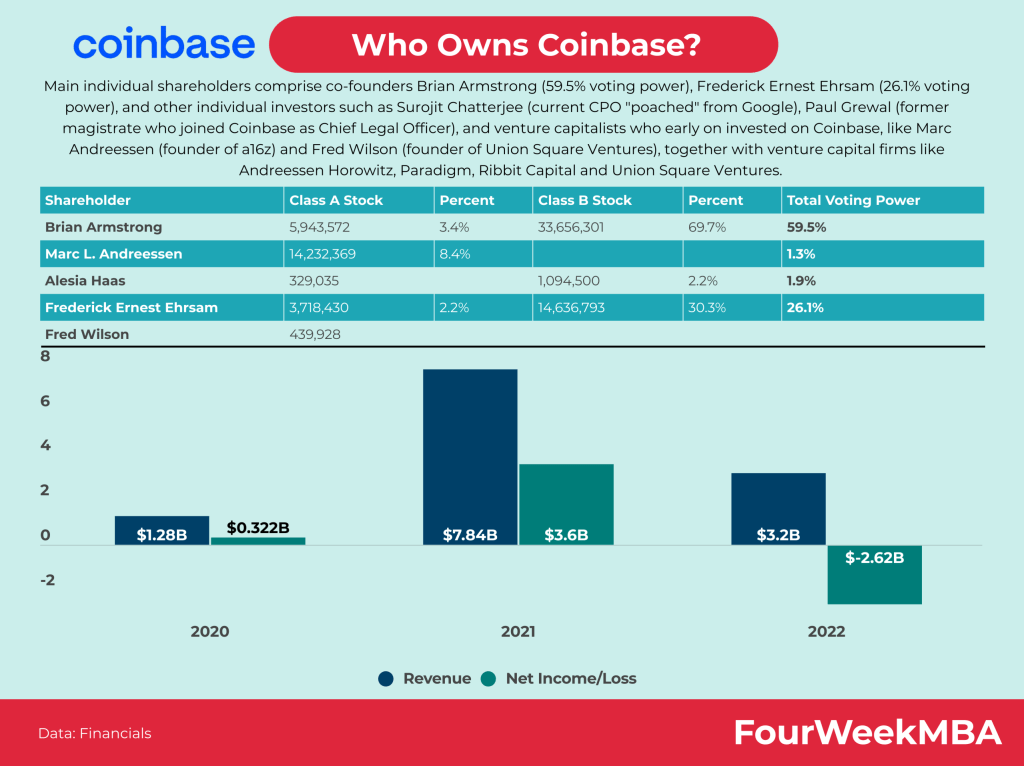
Main individual shareholders comprise co-founders Brian Armstrong (59.5% voting power), Frederick Ernest Ehrsam (26.1% voting power), and other individual investors such as Surojit Chatterjee (current CPO “poached” from Google), Paul Grewal (former magistrate who joined Coinbase as Chief Legal Officer), and venture capitalists who early on invested on Coinbase, like Marc Andreessen (founder of a16z) and Fred Wilson (founder of Union Square Ventures), together with venture capital firms like Andreessen Horowitz, Paradigm, Ribbit Capital and Union Square Ventures.
Gennaro is the creator of FourWeekMBA, which reached about four million business people, comprising C-level executives, investors, analysts, product managers, and aspiring digital entrepreneurs in 2022 alone | He is also Director of Sales for a high-tech scaleup in the AI Industry | In 2012, Gennaro earned an International MBA with emphasis on Corporate Finance and Business Strategy.