Another dimension of asymmetric betting is given by how impactful the idea can be to the business. When we have asymmetric bets that can have a high impact and are easy to reverse, we get to the “Jackpot” and go into an “All-In-Mode” of action! And how easy to reverse.
Divergent thinking is a thought process or method used to generate creative ideas by exploring multiple possible solutions to a problem. Divergent thinking is an unstructured problem-solving method where participants are encouraged to develop many innovative ideas or solutions to a given problem. These ideas are generated and explored in a relatively short space of time.
Vertical thinking, on the other hand, is a problem-solving approach that favors a selective, analytical, structured, and sequential mindset. The focus of vertical thinking is to arrive at a reasoned, defined solution.
Convergent thinking occurs when the solution to a problem can be found by applying established rules and logical reasoning. The term convergent thinking was first described by American psychologist Joy Paul Guilford in 1950. The process of convergent thinking involves finding the single best solution to a problem or question amongst many possibilities.
Brand association is one of the most significant psychological influences on a consumer’s purchase intent. Although it is often the difference between a consumer choosing one product over a competitor’s product, it is a relatively complex topic that few businesses understand well. Brand association describes the mental connection between a brand and a concept. Put another way, it is the thoughts that enter a consumer’s mind whenever they think about a brand.
Metaphorical thinking describes a mental process in which comparisons are made between qualities of objects usually considered to be separate classifications. Metaphorical thinking is a mental process connecting two different universes of meaning and is the result of the mind looking for similarities.
Affirmations, sometimes called positive affirmations, are the statements or phrases we repeat to ourselves to enforce positive thinking. In the process, they can be used to boost self-esteem, overcome anxiety, and defeat negative thought patterns.
Cognitive restructuring describes the process of bringing awareness and change to negative thought patterns. Cognitive restructuring is integral to the principle of cognitive mediation. This principle states that the emotional reaction an individual has to a situation is not caused by the situation itself. Instead, it is largely governed by what the individual thinks about the situation. Using the power of cognitive mediation, cognitive restructuring helps the individual change their life by empowering them to change the way they think. This form of empowerment is a fundamental aspect of cognitive-behavioral therapy (CBT).
Second-order thinking is a means of assessing the implications of our decisions by considering future consequences. Second-order thinking is a mental model that considers all future possibilities. It encourages individuals to think outside of the box so that they can prepare for every and any eventuality. It also discourages the tendency for individuals to default to the most obvious choice.
Choice overload is a phenomenon where consumers are overwhelmed by too many choices. Modern consumers have access to a bewildering array of products and services. Simply buying the ingredients for a morning cup of coffee involves choosing from a long and varied list of milk, sugar, coffee, and coffee machines. Indeed, connoisseurs who prefer 1% milk over 2% milk or coffee beans from a remote Ethiopian plantation are well catered for.
Business valuations involve a formal analysis of the key operational aspects of a business. A business valuation is an analysis used to determine the economic value of a business or company unit. It’s important to note that valuations are one part science and one part art. Analysts use professional judgment to consider the financial performance of a business with respect to local, national, or global economic conditions. They will also consider the total value of assets and liabilities, in addition to patented or proprietary technology.
The scaled agile framework (SAFe) helps larger organizations manage the challenges they face when practicing agile. The scaled agile framework was first introduced in 2011 by software industry guru Dean Leffingwell in his book Agile Software Requirements. The framework details a set of workflow patterns for implementing agile practices at an enterprise scale. This is achieved by guiding roles and responsibilities, planning and managing work, and establishing certain values that large organizations must uphold.
The Nadler-Tushman Congruence Model was created by David Nadler and Michael Tushman at Columbia University. The Nadler-Tushman Congruence Model is a diagnostic tool that identifies problem areas within a company. In the context of business, congruence occurs when the goals of different people or interest groups coincide.
The Toulmin model is a system of argumentation that is used to develop, analyze, and categorize arguments. The Toulmin model was created by British philosopher Stephen Toulmin in his 1958 book The Uses of Argument. In the model, an argument is separated into its constituent parts and each part is evaluated in terms of how well it contributes to the whole. In other words, how valid or effective is the argument?
RevOps – short for Revenue Operations – is a framework that aims to maximize the revenue potential of an organization. RevOps seeks to align these departments by giving them access to the same data and tools. With shared information, each then understands their role in the sales funnel and can work collaboratively to increase revenue.
The OODA loop was popularized by U.S. Air Force fighter pilot Colonel John Boyd to describe maneuver warfare during the Korean War. The OODA loop is a four-step approach to decision making where strategies must be adjusted quickly. Those four steps comprise observe, orient, decide, and act.
Prioritization plays a crucial role in every business. In an ideal world, businesses have enough time and resources to complete every task within a project satisfactorily. The MoSCoW method is a task prioritization framework. It is most effective in situations where many tasks must be prioritized into an actionable to-do list. The framework is based on four main categories that give it the name: Must have (M), Should have (S), Could have (C), and Won’t have (W).
In a SIPOC diagram, high-level process maps are used as simple yet effective illustration tools. Project leaders use them to quickly explain expectations and provide common reference points to all project team members. SIPOC diagrams are also helpful in identifying problem areas offering little value.
The Six Thinking Hats model was created by psychologist Edward de Bono in 1986, who noted that personality type was a key driver of how people approached problem-solving. For example, optimists view situations differently from pessimists. Analytical individuals may generate ideas that a more emotional person would not, and vice versa.
The straw man fallacy describes an argument that misrepresents an opponent’s stance to make rebuttal more convenient. The straw man fallacy is a type of informal logical fallacy, defined as a flaw in the structure of an argument that renders it invalid.
The operating model is a visual representation and mapping of the processes and how the organization delivers value and, therefore, how it executes its business model. Therefore, the operating model is how the whole organization is structured around the value chain to build a viable business model.
The Lightning Decision Jam (LDJ) is a means of making fast decisions that provide quick direction. The Lightning Decision Jam was developed by design agency AJ&Smart in response to the inefficiency of business meetings. Borrowing ideas from the core principles of design sprints, AJ&Smart created the Lightning Decision Jam.
The jobs-to-be-done (JTBD) framework defines, categorizes, captures, and organizes consumer needs. The jobs-to-be-done framework is based on the premise that consumers buy products and services to get jobs done. While products tend to come and go, the consumer need to get jobs done endures indefinitely. This theory was popularized by Tony Ulwick, who also detailed his book Jobs To Be Done: Theory to Practice.
Empathy mapping is a visual representation of knowledge regarding user behavior and attitudes. An empathy map can be built by defining the scope, purpose to gain user insights, and for each action, add a sticky note, summarize the findings. Expand the plan and revise.
The business model canvas aims to provide a keen understanding of your business model to provide strategic insights about your customers, product/service, and financial structure;
In this article, I’ll focus on the Blitzscaling business model canvas. This is a model based on the concept of Blitzscaling.
That is a particular process of massive growth under uncertainty, and that prioritizes speed over efficiency. It focuses on market domination to create a first-scaler advantage in a scenario of uncertainty.
Pretotyping is a mixture of the words “pretend” and “prototype,” and it is a methodology used to validate business ideas to improve the chances of building a product or service that people want.
The pretotyping methodology comes from Alberto Savoia’s work summarized in the book “The Right It: Why So Many Ideas Fail and How to Make Sure Yours Succeed.”
This framework is a mixture of the words “pretend” and “prototype,” and it helps to answer such questions (about the product or service to build) as: Would I use it? How, how often, and when would I use it? Would other people buy it? How much would they be willing to pay for it? How, how often, and when would they use it?
A blue ocean is a strategy where the boundaries of existing markets are redefined, and new uncontested markets are created.
At its core, there is value innovation, for which uncontested markets are created, where competition is made irrelevant. And the cost-value trade-off is broken.
Thus, companies following a blue ocean strategy offer much more value at a lower cost for the end customers.
Growth hacking is a process of rapid experimentation, coupled with the understanding of the whole funnel, where marketing, product, data analysis, and engineering work together to achieve rapid growth.
The growth hacking process goes through four key stages of analyzing, ideating, prioritizing, and testing.
Venture capitalist, Dave McClure, coined the acronym AARRR which is a simplified model that enables us to understand what metrics and channels to look at. At each stage for the users’ path toward becoming customers and referrers of a brand.
In the Lean Startup, Eric Ries defined the engine of growth as “the mechanism that startups use to achieve sustainable growth.”
He described sustainable growth as following a simple rule, “new customers come from the actions of past customers.”
The three engines of growth are the sticky engine, the viral engine, and the paid engine. Each of those can be measured and tracked by a few key metrics, and it helps plan your strategic moves.
The RTVN model is a straightforward framework that can help you design a business model when you’re at the very early stage of figuring out what you need to make it succeed.
A comparable company analysis is a process that enables the identification of similar organizations to be used as a comparison to understand the business and financial performance of the target company.
To find comparables, you can look at two key profiles: the business and economic profile. From the comparable company analysis, it is possible to understand the competitive landscape of the target organization.
Porter’s Five Forces is a model that helps organizations to gain a better understanding of their industries and competition.
It was published for the first time by Professor Michael Porter in his book “Competitive Strategy” in the 1980s.
The model breaks down industries and markets by analyzing them through five forces which you can use to have a first assessment of the market you’re in.
In his book, “Competitive Advantage,” in 1985, Porter conceptualized the concept of competitive advantage, by looking at two key aspects. Industry attractiveness, and the company’s strategic positioning. The latter, according to Porter, can be achieved either via cost leadership, differentiation, or focus.
In his 1985 book Competitive Advantage, Porter explains that a value chain is a collection of processes that a company performs to create value for its consumers. As a result, he asserts that value chain analysis is directly linked to competitive advantage. Porter’s Value Chain Model is a strategic management tool developed by Harvard Business School professor Michael Porter. The tool analyses a company’s value chain – defined as the combination of processes that the company uses to make money.
Porter’s Diamond Model is a diamond-shaped framework that explains why specific industries in a nation become internationally competitive while those in other nations do not. The model was first published in Michael Porter’s 1990 book The Competitive Advantage of Nations. This framework looks at the firm strategy, structure/rivalry, factor conditions, demand conditions, related and supporting industries.
Bowman’s Strategy Clock is a marketing model concerned with strategic positioning. The model was developed by economists Cliff Bowman and David Faulkner, who argued that a company or brand had several ways of positioning a product based on price and perceived value. Bowman’s Strategy Clock seeks to illustrate graphically that product positioning is based on the dimensions of price and perceived value.
The VMOST Analysis is a tool that allows a business to evaluate its core strategies in terms of whether the supporting activities of that strategy are being carried out. The VMOST analysis tries to answer that by looking at five core elements: vision, mission, objectives, strategies, and tactics.
The Fishbone Diagram is a diagram-based technique used in brainstorming to identify potential causes for a problem, thus it is a visual representation of cause and effect. The problem or effect serves as the head of the fish. Possible causes of the problem are listed on the individual “bones” of the fish. This encourages problem-solving teams to consider a wide range of alternatives.
The GE McKinsey Matrix was developed in the 1970s after General Electric asked its consultant McKinsey to develop a portfolio management model. This matrix is a strategy tool that provides guidance on how a corporation should prioritize its investments among its business units, leading to three possible scenarios: invest, protect, harvest, and divest.
The VRIO framework is a tool that businesses can use to identify and then protect the factors that give them a long-term competitive advantage. The VRIO framework will help assess reality based on four key elements that make up its name (VRIO): value, rarity, imitability, and organization. VRIO is a holistic framework to assess the business.
The 3C Analysis Business Model was developed by Japanese business strategist Kenichi Ohmae. The 3C Model is a marketing tool that focuses on customers, competitors, and the company. At the intersection of these three variables lies an effective marketing strategy to gain a potential competitive advantage and build a lasting company.
AIDA stands for attention, interest, desire, and action. This is a model that is used in marketing to describe the potential journey a customer might go through, before purchasing a product or service. The variation of the AIDA model is the CAB model and the AIDCAS model.
The PESTEL analysis is a framework that can help marketers assess whether macro-economic factors are affecting an organization.
This is a critical step that helps organizations identify potential threats and weaknesses. That can be used in other frameworks such as SWOT or to gain a broader and better understanding of the overall marketing environment.
The technology adoption curve is a model that goes through five stages. Each of those stages (innovators, early adopters, early majority, late majority, and laggard) has a specific psychographic that makes that group of people ready to adopt a tech product.
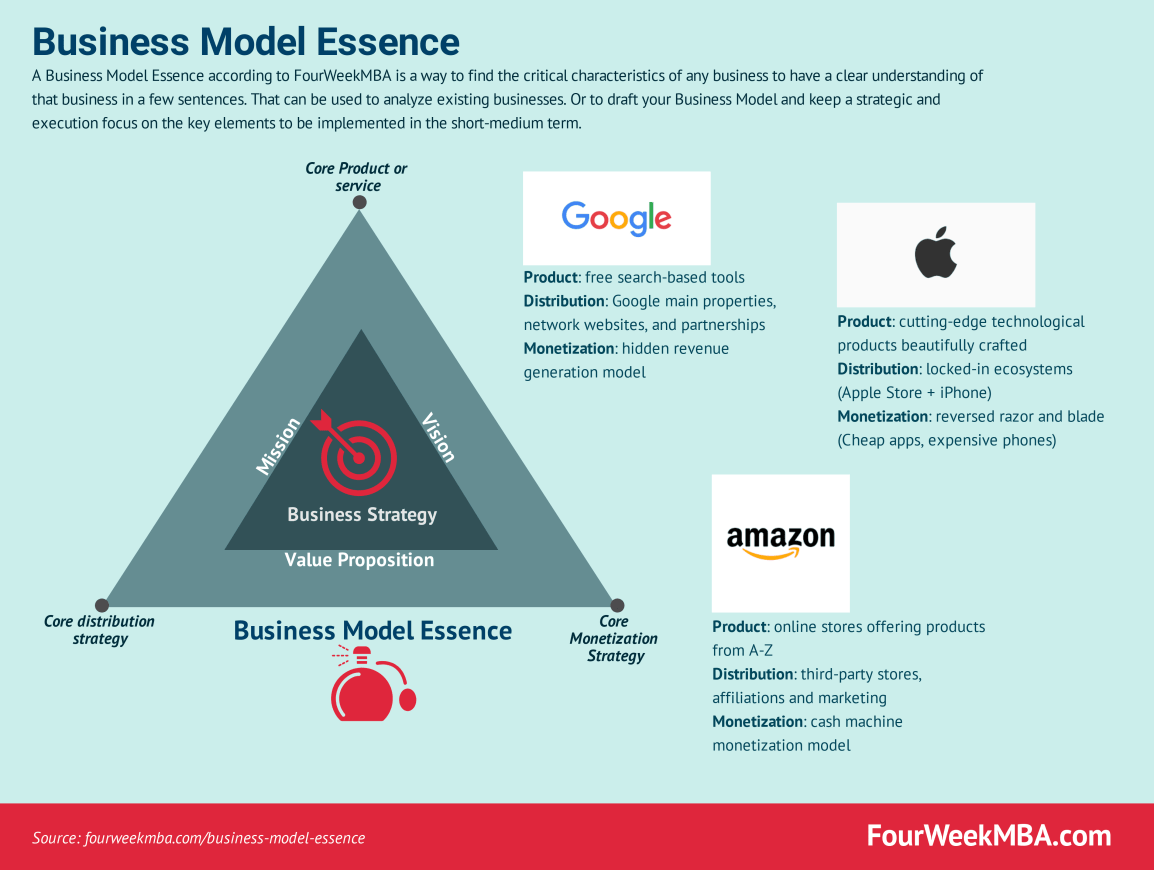
A Business Model Essence, according to FourWeekMBA, is a way to find the critical characteristics of any business to have a clear understanding of that business in a few sentences.
That can be used to analyze existing businesses. Or to draft your Business Model and keep a strategic and execution focus on the key elements to be implemented in the short-medium term.
An effective business model has to focus on two dimensions: the people dimension and the financial dimension. The people dimension will allow you to build a product or service that is 10X better than existing ones and a solid brand.
The financial dimension will help you develop proper distribution channels by identifying the people that are willing to pay for your product or service and make it financially sustainable in the long run.
Understanding your TAM, SAM and SOM can help you navigate the market you’re in and to have a laser focus on the market you can reach with your product and service.
Brand building is the set of activities that help companies to build an identity that can be recognized by its audience. Thus, it works as a mechanism of identification through core values that signal trust and that help build long-term relationships between the brand and its key stakeholders.
A value proposition is about how you create value for customers. While many entrepreneurial theories draw from customers’ problems and pain points, a value can also be created via demand generation, which is about enabling people to identify with your brand, thus generating demand for your products and services.
Marc Andreessen defined Product/market fit as “being in a good market with a product that can satisfy that market.” According to Andreessen, that is a moment when a product or service has its place in the market, thus enabling traction for the company offering that product or service.
An organizational structure allows companies to shape their business model according to several criteria (like products, segments, geography and so on) that would enable information to flow through the organizational layers for better decision-making, cultural development, and goals alignment across employees, managers, and executives.
As pointed out by Eric Ries a minimum viable product is that version of a new product which allows a team to collect the maximum amount of validated learning about customers with the least effort.
A SWOT Analysis is a framework used for evaluating the business’s Strengths, Weaknesses, Opportunities, and Threats. It can aid in identifying the problematic areas of your business so that you can maximize your opportunities. It will also alert you to the challenges your organization might face in the future.
Revenue modeling is a process of incorporating a sustainable financial model for revenue generation within a business model design. Revenue modeling can help to understand what options make more sense in creating a digital business from scratch; alternatively, it can help in analyzing existing digital businesses and reverse engineer them.
Business experiments help entrepreneurs test their hypotheses. Rather than define the problem by making too many hypotheses, a digital entrepreneur can formulate a few assumptions, design experiments, and check them against the actions of potential customers. Once measured, the impact, the entrepreneur, will be closer to define the problem.
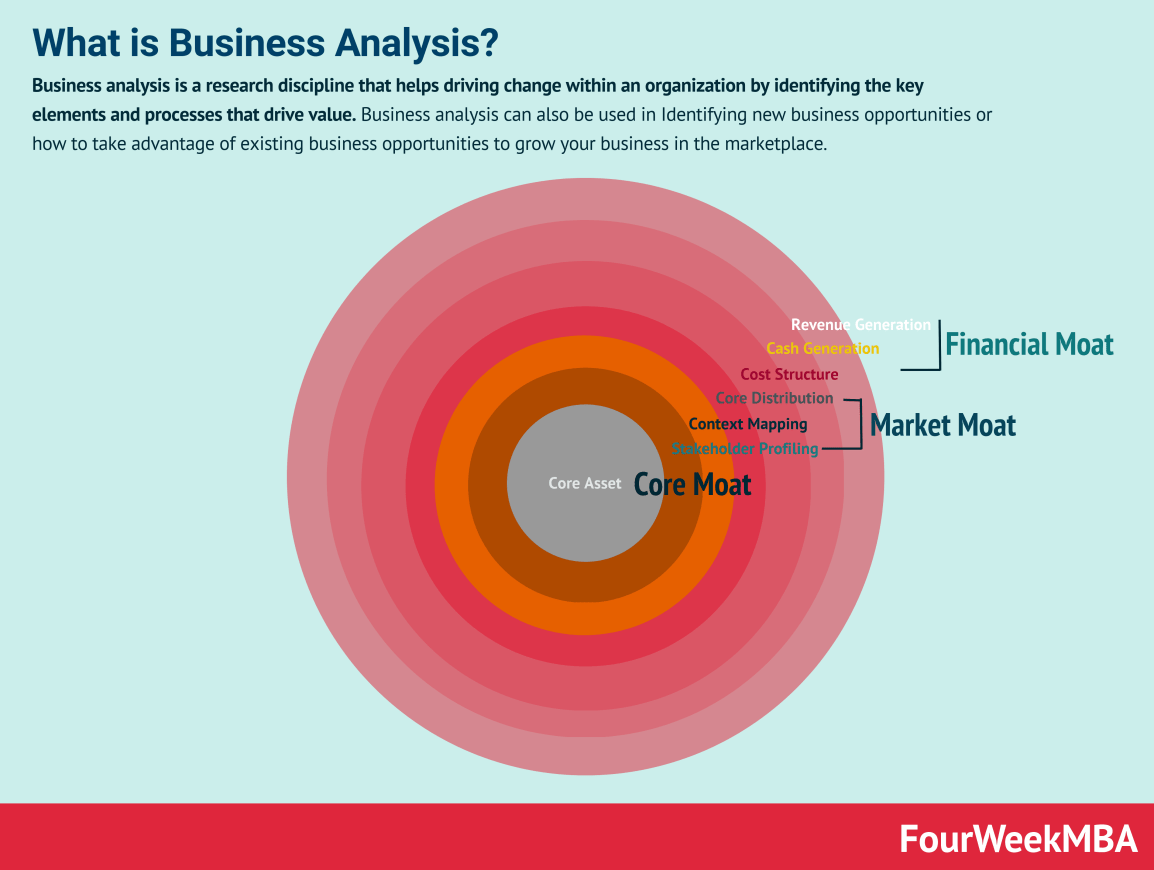
Business analysis is a research discipline that helps driving change within an organization by identifying the key elements and processes that drive value. Business analysis can also be used in Identifying new business opportunities or how to take advantage of existing business opportunities to grow your business in the marketplace.
In the 1970s, Bruce D. Henderson, founder of the Boston Consulting Group, came up with The Product Portfolio (aka BCG Matrix, or Growth-share Matrix), which would look at a successful business product portfolio based on potential growth and market shares. It divided products into four main categories: cash cows, pets (dogs), question marks, and stars.
You can use the Ansoff Matrix as a strategic framework to understand what growthstrategy is more suited based on the market context. Developed by mathematician and business manager Igor Ansoff, it assumes a growthstrategy can be derived by whether the market is new or existing, and the product is new or existing.
Key Highlights On Top 30 Frameworks
Asymmetric Betting: Asymmetric betting refers to making high-impact bets that are easy to reverse, often associated with “Jackpot” and “All-In-Mode” actions.
Critical Thinking: Critical thinking involves analyzing observations, facts, evidence, and arguments to form a judgment about what someone reads, hears, says, or writes.
Divergent Thinking: Divergent thinking is a thought process used to generate creative ideas by exploring multiple possible solutions to a problem in a short amount of time.
Vertical Thinking: Vertical thinking is a structured and analytical problem-solving approach, aiming to arrive at a defined solution.
Convergent Thinking: Convergent thinking occurs when a problem’s solution can be found by applying established rules and logical reasoning to narrow down the possibilities to the best solution.
Brand Association: Brand association is the mental connection between a brand and a concept in a consumer’s mind.
Metaphorical Thinking: Metaphorical thinking involves making comparisons between qualities of objects from different classifications.
Affirmations: Affirmations are positive statements or phrases repeated to reinforce positive thinking and boost self-esteem.
Cognitive Restructuring: Cognitive restructuring is the process of changing negative thought patterns to bring about a positive change in behavior and emotions.
Second-Order Thinking: Second-order thinking involves considering future consequences and implications of decisions beyond the immediate outcomes.
Choice Overload: Choice overload occurs when consumers are overwhelmed by too many options, leading to decision-making difficulties.
Scaled Agile Framework (SAFe): SAFe is a framework used by larger organizations to manage the challenges of practicing agile at an enterprise scale.
Nadler-Tushman Congruence Model: The Nadler-Tushman Congruence Model is a diagnostic tool used to identify problem areas within a company.
Toulmin Model: The Toulmin model is a system of argumentation used to analyze and categorize arguments based on their structure and effectiveness.
RevOps (Revenue Operations): RevOps is a framework that aims to maximize revenue potential by aligning sales, marketing, and customer success departments.
OODA Loop: The OODA Loop is a decision-making process that involves observing, orienting, deciding, and acting quickly to adjust strategies.
MoSCoW Method: The MoSCoW method is a task prioritization framework that categorizes tasks as Must have, Should have, Could have, and Won’t have.
SIPOC Diagram: SIPOC diagrams are used for high-level process mapping to provide a common reference point for project teams and identify problem areas.
Six Thinking Hats Model: The Six Thinking Hats model is a problem-solving approach that considers different perspectives and personalities to generate ideas.
Straw Man Fallacy: The straw man fallacy involves misrepresenting an opponent’s argument to make rebuttal easier.
Porter Operational Model: The Porter Operational Model is a visual representation of a business’s value chain to build a viable business model.
Lightning Decision Jam (LDJ): LDJ is a fast decision-making process designed to provide quick direction in business meetings.
Jobs-To-Be-Done (JTBD): JTBD framework identifies and organizes consumer needs based on the premise that consumers buy products to get specific jobs done.
Empathy Mapping: Empathy mapping is a visual representation of user behavior and attitudes to gain insights into user needs.
Business Model Canvas: The business model canvas is a strategic tool that provides a comprehensive understanding of a business model, enabling better decision-making.
Blitzscaling Canvas: Blitzscaling canvas is a model based on the concept of blitzscaling, which involves rapid growth under uncertainty.
Pretotyping: Pretotyping is a methodology to validate business ideas and improve the chances of building a product or service that people want.
Value Innovation and Blue Ocean Strategy: Blue ocean strategy involves creating new uncontested markets where competition becomes irrelevant by offering much more value at a lower cost.
Growth Hacking Process: Growth hacking is a process of rapid experimentation and collaboration among marketing, product, data analysis, and engineering teams to achieve rapid growth.
Pirate Metrics (AARRR): Pirate metrics represent a simplified model that enables businesses to understand metrics and channels in each stage of a user’s path towards becoming a customer and referrer.
Engines of Growth: The engines of growth are sticky, viral, and paid engines that help startups achieve sustainable growth.
Table Summary
Framework Name
Description
When to Use
Advantages
Drawbacks
Asymmetric Betting
Involves high-impact bets that are easy to reverse.
When you have asymmetric bets with high impact.
Potential for high returns, easy reversibility.
High risk involved.
Critical Thinking
Analyzing observations, facts, evidence, and arguments for forming judgments.
In decision-making and problem-solving processes.
Better decision-making, problem-solving skills.
Requires time and practice to develop.
Divergent Thinking
Generates creative ideas by exploring multiple solutions to a problem.
A methodology to validate business ideas by pretending to have a product or service before building it.
When testing the viability of a product or service concept.
Minimizes development costs, validates concepts early.
Limited to concept validation, not full development.
Value Innovation and Blue Ocean Strategy
Focuses on creating uncontested markets with value innovation, offering more value at a lower cost.
When seeking to redefine markets and create new value propositions.
Breaks away from competition, maximizes value.
Requires innovative thinking and execution.
Growth Hacking Process
Rapid experimentation and data-driven approach to achieve fast growth by aligning marketing, product, data analysis, and engineering.
In startups and companies aiming for rapid growth.
Accelerates growth, data-focused decision-making.
May not suit all business models or industries.
Pirate Metrics
A framework for tracking user behavior through Acquisition, Activation, Retention, Revenue, and Referral stages.
In assessing and improving user engagement and conversion.
Provides a clear view of user journey and conversions.
May require complex tracking and analytics tools.
Engines of Growth
Identifies the mechanisms startups use for sustainable growth, including the sticky engine, viral engine, and paid engine.
In understanding and optimizing growth strategies.
Guides growth strategy, measures effectiveness.
Strategies may require ongoing adjustments.
RTVN Model
A simple framework to design a business model by focusing on vision, target, value, and network.
In the early stages of defining a business model.
Provides a structured approach to model development.
May lack depth for complex business models.
Sales Cycle
The process a company follows to sell its products or services, involving a series of steps with prospects leading to a closed sale.
In sales and revenue generation processes.
Guides sales teams, improves revenue generation.
May vary in complexity depending on industry.
Comparable Analysis
Analyzes similar organizations to understand the business and financial performance of a target company.
In assessing competitive landscapes and target organizations.
Provides valuable insights for strategic decision-making.
Requires access to relevant data and thorough analysis.
Porter’s Five Forces
A model to understand industry dynamics by analyzing competitive forces: rivalry, supplier power, buyer power, threat of substitutes, and threat of new entrants.
In evaluating market competitiveness and strategic positioning.
Helps identify competitive advantages and threats.
May not cover all relevant industry factors.
Porter’s Generic Strategies
Defines competitive advantage through cost leadership, differentiation, or focus on a narrow market segment.
In developing competitive strategies for a business.
Provides clear strategic directions for businesses.
May not address unique strategic challenges.
Porter’s Value Chain
Analyzes a company’s value chain, consisting of processes that create value for consumers, to identify areas for optimization.
In improving operational efficiency and competitive advantage.
Enhances understanding of value creation and optimization.
Requires thorough analysis and process mapping.
Porter’s Diamond Model
Explains why some industries in a nation become internationally competitive, considering factors like firm strategy, structure, factor conditions, demand conditions, and related industries.
In analyzing factors influencing international competitiveness.
Offers insights into industry competitiveness and strategies.
May not apply to all industries or regions.
Bowman’s Strategy Clock
A model for strategic positioning based on price and perceived value, categorizing products or services into different market positions.
In assessing and choosing market positioning strategies.
Analyzes core strategies by assessing vision, mission, objectives, strategies, and tactics, providing clarity on strategic alignment.
In evaluating and aligning strategic elements within an organization.
Promotes strategic alignment and clarity.
Requires a clear understanding of strategic elements.
Fishbone Diagram
A visual tool for identifying potential causes of a problem by mapping out various factors contributing to an issue.
In root cause analysis and problem-solving efforts.
Visualizes complex problems, aids in identifying root causes.
Interpretation of factors may vary.
GE McKinsey Matrix
A portfolio management tool that helps prioritize investments among business units based on market attractiveness and competitive position.
In evaluating and managing a diverse portfolio of business units.
Guides investment decisions, optimizes portfolio.
Requires data and ongoing assessment.
VRIO Framework
Evaluates factors that give a company a long-term competitive advantage: value, rarity, imitability, and organization.
In assessing and protecting competitive advantages.
Identifies and protects key competitive factors.
Requires thorough analysis and ongoing monitoring.
3C Analysis
Focuses on Customers, Competitors, and the Company to develop a marketing strategy and gain a competitive advantage.
In formulating marketing strategies and assessing market dynamics.
Provides a comprehensive view of market and competition.
Requires accurate market research and analysis.
AIDA Model
Describes the stages of the customer journey: Attention, Interest, Desire, and Action, to guide marketing and sales efforts.
In planning marketing and sales campaigns.
Maps the customer journey, aids in conversion strategies.
May oversimplify the complexity of customer behavior.
PESTEL Analysis
Analyzes macro-economic factors (Political, Economic, Social, Technological, Environmental, Legal) to assess their impact on an organization.
In evaluating external factors affecting a business.
Provides insights into external factors and risks.
May not cover all relevant external factors.
Technology Adoption Curve
Describes stages of technology adoption: Innovators, Early Adopters, Early Majority, Late Majority, and Laggards.
In targeting specific user segments based on technology adoption.
Helps identify target user groups and market timing.
Assumes homogeneous behavior within segments.
Business Model Essence
Distills the critical characteristics of a business model into a concise description for strategic focus.
In summarizing and communicating essential elements of a business model.
Provides a clear and focused understanding of the business.
May oversimplify complex business models.
FourWeekMBA Framework
Focuses on people and financial dimensions for building effective business models and sustainable value.
In designing and evaluating business models for sustainable growth.
Emphasizes both product/service and financial aspects.
Requires a holistic understanding of business dynamics.
TAM, SAM, and SOM
Identifies Total Addressable Market (TAM), Serviceable Addressable Market (SAM), and Share of Market (SOM) to target specific market segments effectively.
In market sizing and targeting strategies.
Provides insights into market potential and target segments.
Accuracy depends on market research and data sources.
Brand Building
Activities aimed at creating a recognizable brand identity through core values, trust, and long-term relationships.
In establishing and nurturing brand recognition and loyalty.
Builds brand equity and trust with stakeholders.
Requires consistent and long-term efforts.
Value Proposition Design
Focuses on creating value for customers through product/service design, aligning with customer needs and generating demand.
In product/service development and market positioning.
Enhances value creation and demand generation.
Requires a deep understanding of customer needs.
Product-Market Fit
A state where a product/service fits well with the market’s needs, leading to customer traction and success.
In evaluating and adjusting product-market alignment.
Gennaro is the creator of FourWeekMBA, which reached about four million business people, comprising C-level executives, investors, analysts, product managers, and aspiring digital entrepreneurs in 2022 alone | He is also Director of Sales for a high-tech scaleup in the AI Industry | In 2012, Gennaro earned an International MBA with emphasis on Corporate Finance and Business Strategy.