While the term has been coined by Andrew Lampitt, open-core is an evolution of open-source. Where a core part of the software/platform is offered for free, while on top of it are built premium features or add-ons, which get monetized by the corporation who developed the software/platform. An example of the GitLab open core model, where the hosted service is free and open, while the software is closed.
Aspect
Explanation
Definition
The Open-Core Model is a software business strategy where a company offers a core product or platform as open-source software while complementing it with proprietary or premium features that are available under a commercial license. This approach allows businesses to balance the advantages of open-source collaboration and community development with revenue generation through the sale of proprietary add-ons or advanced features. The core open-source offering typically serves as a foundation for a wide user base and fosters community contributions, while the proprietary features cater to enterprise customers’ specific needs and generate revenue. The Open-Core Model is commonly used in the software industry and is characterized by its ability to monetize open-source software while maintaining a vibrant developer community.
Key Concepts
– Open Source: The foundation of the Open-Core Model is an open-source, community-driven core product that is freely accessible and modifiable by anyone. – Commercial Licensing: Proprietary or premium features are available under a commercial license, typically requiring payment for access. – Dual Licensing: Dual licensing involves offering the software under both open-source and commercial licenses, providing users with a choice. – Community Contributions: Open-source projects encourage community contributions, such as bug fixes and feature enhancements. – Monetization: The model seeks to monetize the value-added proprietary features while maintaining a free, open-source core.
Characteristics
– Hybrid Approach: The Open-Core Model combines open-source principles with commercial software practices. – Core Open Source: The core product is open source and free to use, making it accessible to a wide user base. – Proprietary Add-Ons: Proprietary or premium features are offered as add-ons or extensions to the open-source core. – Community Engagement: The model fosters community engagement, including contributions, bug reporting, and collaboration. – Revenue Generation: The primary revenue source comes from selling licenses for proprietary features to enterprise customers.
Implications
– Community Development: The open-source core benefits from community-driven development, which can lead to innovation and rapid improvement. – Revenue Stream: The model generates revenue through the sale of commercial licenses for proprietary features. – Enterprise Adoption: Proprietary features attract enterprise customers seeking advanced functionality and support. – Balancing Act: Companies must balance open-source principles with the need for revenue generation, which can be challenging. – Competitive Advantage: The Open-Core Model can provide a competitive advantage by offering a combination of free and premium features.
Advantages
– Community Growth: Open-source cores can attract a large and active user and developer community. – Monetization: Proprietary features offer a sustainable revenue stream for the company. – Flexibility: Users can choose between free open-source features and premium ones based on their needs. – Enterprise Adoption: The availability of advanced features can attract enterprise customers and support contracts. – Innovation: The open-source community fosters innovation and rapid development.
Drawbacks
– Community Tensions: Balancing the interests of the open-source community and enterprise customers can lead to tensions. – Complexity: Managing dual licensing and proprietary add-ons can be complex and require careful planning. – Dependency: Enterprise customers may become dependent on proprietary features, creating vendor lock-in. – Licensing Challenges: License compliance and enforcement can be challenging for the company. – Competition: The company may face competition from fully open-source alternatives or proprietary solutions.
Applications
– Database Management: Database management systems like MongoDB offer open-source versions with proprietary features for enterprise use. – Content Management: Content management systems like WordPress offer open-source cores with premium plugins and themes. – Cloud Services: Some cloud service providers offer open-source platforms with premium managed services and support. – Monitoring and Analytics: Monitoring and analytics tools may provide open-source agents with premium reporting and analysis features. – Development Tools: Development tools and frameworks often use the Open-Core Model to monetize advanced features.
Use Cases
– MySQL: MySQL offers an open-source database system while providing enterprise customers with advanced features and support through MySQL Enterprise. – Elasticsearch: Elasticsearch provides an open-source search and analytics engine with additional security and management features in its commercial offering. – Red Hat: Red Hat offers a similar model by providing open-source Linux distributions with enterprise support and management tools. – GitLab: GitLab’s open-source platform for DevOps is supplemented by premium features and services for businesses. – WordPress: WordPress offers a free, open-source content management system with premium plugins and themes available for purchase to enhance functionality.
Open source is licensed and usually developed and maintained by a community of independent developers. While the freemium is developed in-house. Thus the freemium give the company that developed it, full control over its distribution. In an open-source model, the for-profit company has to distribute its premium version per its open-source licensing model.The Open Core Strategy was explained by Andrew Lampitt (Image Source: Slideshare, credit: Andrew Lampitt).
The central value proposition of open source core vendors has been freedom from vendor lock-in. After all, the core elements of the product are open source, developed by a global community. The core product isn’t owned by a single company, but, in almost every meaningful instance, by the Apache Software Foundation (ASF). If the worst happens and we go out of business, the code will live on in the ASF. You’re safe. If you don’t like us, it’s open-source. You’re protected. I don’t know what happens next but hey open source.
In an open-core model, like Elastic, some portion of the product is free, but the premium version or add-ons are licensed with a commercial license. (Think community edition vs. enterprise edition.) “Here an open-source vendor’s biggest competitor is usually its free version,” said Kellogg.
Participation Is Constrained. Open Core companies may limit participation to keep premium features from being contributed. – We actively work to grow participation since our missions is that Everyone can Contribute. Also, we do not say no by-default to having existing paid features contributed to our open source project.
GitLab was created in 2013 by Ukrainian developers Dmitriy Zaporozhets, Valery Sizov, and Sytse Sijbrandij as a source code management solution for collaborative software teams. GitLab is a web-based, open-source DevOps tool providing issue-tracking and continuous integration and deployment pipeline features. It makes money via its main two paid plans (Premium & Ultimate) and via its subscription add-ons.
Case Studies of Open-Core Model
GitLab:
GitLab, a popular DevOps platform, operates on an open-core model.
The core functionality, including source code management and basic issue tracking, is offered as open-source software.
GitLab monetizes its platform by offering premium features and services through paid plans (Premium & Ultimate) and subscription add-ons.
This approach allows GitLab to balance the benefits of open-source collaboration with revenue generation from enterprise customers.
Elastic:
Elastic, known for its search and analytics engine Elasticsearch, also follows an open-core model.
The core components of Elasticsearch are open-source and freely available.
Elastic offers additional premium features, such as security and management tools, through licensed versions or add-ons.
By leveraging the open-core model, Elastic attracts a wide user base with the open-source core while catering to enterprise customers’ advanced needs.
MySQL:
MySQL, a popular database management system, adopts the open-core strategy.
The core database functionality is available as open-source software, allowing for widespread adoption and community contributions.
MySQL offers enterprise customers advanced features, support, and management tools through its commercial offering, MySQL Enterprise.
This hybrid approach enables MySQL to serve both individual users and large enterprises effectively.
WordPress:
WordPress, the widely-used content management system, implements elements of the open-core model.
The core WordPress software is open-source and powers millions of websites worldwide.
WordPress ecosystem includes premium plugins and themes, developed by third-party developers or the WordPress team, offering additional functionality and customization options for users.
By combining open-source principles with premium add-ons, WordPress caters to diverse user needs while fostering a vibrant developer community.
Red Hat:
Red Hat, a leading provider of open-source solutions, employs an open-core approach in its business model.
Red Hat offers open-source Linux distributions, such as Red Hat Enterprise Linux (RHEL), as the core product.
The company monetizes its offerings by providing enterprise-grade support, management tools, and services for RHEL through subscription-based models.
Red Hat’s open-core strategy enables it to deliver reliable, secure, and scalable solutions to enterprise customers while promoting collaboration within the open-source community.
Key Highlights
Open-Core Model Overview:
Coined by Andrew Lampitt, open-core is an evolution of open-source software.
A core part of the software/platform is offered for free, while premium features or add-ons are built on top and monetized.
Example: GitLab open-core model where the hosted service is free and open, while the software itself is closed.
Open Source vs. Open Core:
Open source is developed by a community of independent developers and usually has open distribution.
Open core’s core product is developed in-house and allows the company control over distribution.
In open source, premium versions need to be distributed according to open-source licensing.
Value Proposition of Open Core:
Open-core vendors provide freedom from vendor lock-in.
Core elements are open source, developed by a global community, often owned by organizations like the Apache Software Foundation (ASF).
Other Examples of Open-Core:
Elastic follows an open-core model, with a free portion of the product and licensed premium versions or add-ons.
The competition for open-core vendors is often their own free version.
Criticisms of Open Core:
Participation might be constrained as companies may limit contributions of premium features.
Some argue that open-core models limit the true spirit of open source and collaboration.
GitLab and its Revenue Generation:
GitLab, founded in 2013, is a web-based, open-source DevOps tool.
It provides source code management, issue-tracking, continuous integration, and deployment pipeline features.
GitLab makes money through paid plans (Premium & Ultimate) and subscription add-ons.
Wikipedia is sustained by the Wikimedia Foundation, which is supported mostly by donations and contributions, which in 2021 amounted to over $153 million. Wikipedia is among the most popular websites on earth, and it is, as of these days, an open, non-profit project, on which other twelve projects have been developed.
WordPress.org became the most popular CMS and blogging platform in which the Foundation owns the trademark, and revenues come from donations. The Foundation holds a public-benefit-corporation who manages the revenues coming from WordPress events and conferences. Automaticc – the business arm – monetizes premium tools built on top of WordPress.com (a premium platform) through freemiums.
Fastly follows an enterprise business model, which offers an edge cloud platform. Fastly business model leverages an active community of developers. A good chunk of its revenues got spent on sales and marketing processes as an enterprise business. The company has dozens of field sales representatives and sales managers. For a monthly fee, enterprise customers get access to the platform, account management, and enhanced customer support. In 2021 the company generated over $354 million in revenues, of which over $313 came from 445 enterprise customers.
An effective business model has to focus on two dimensions: the people dimension and the financial dimension. The people dimension will allow you to build a product or service that is 10X better than existing ones and a solid brand. The financial dimension will help you develop proper distribution channels by identifying the people that are willing to pay for your product or service and make it financially sustainable in the long run.
Business model innovation is about increasing the success of an organization with existing products and technologies by crafting a compelling value proposition able to propel a new business model to scale up customers and create a lasting competitive advantage. And it all starts by mastering the key customers.
Digital and tech business models can be classified according to four levels of transformation into digitally-enabled, digitally-enhanced, tech or platform business models, and business platforms/ecosystems.
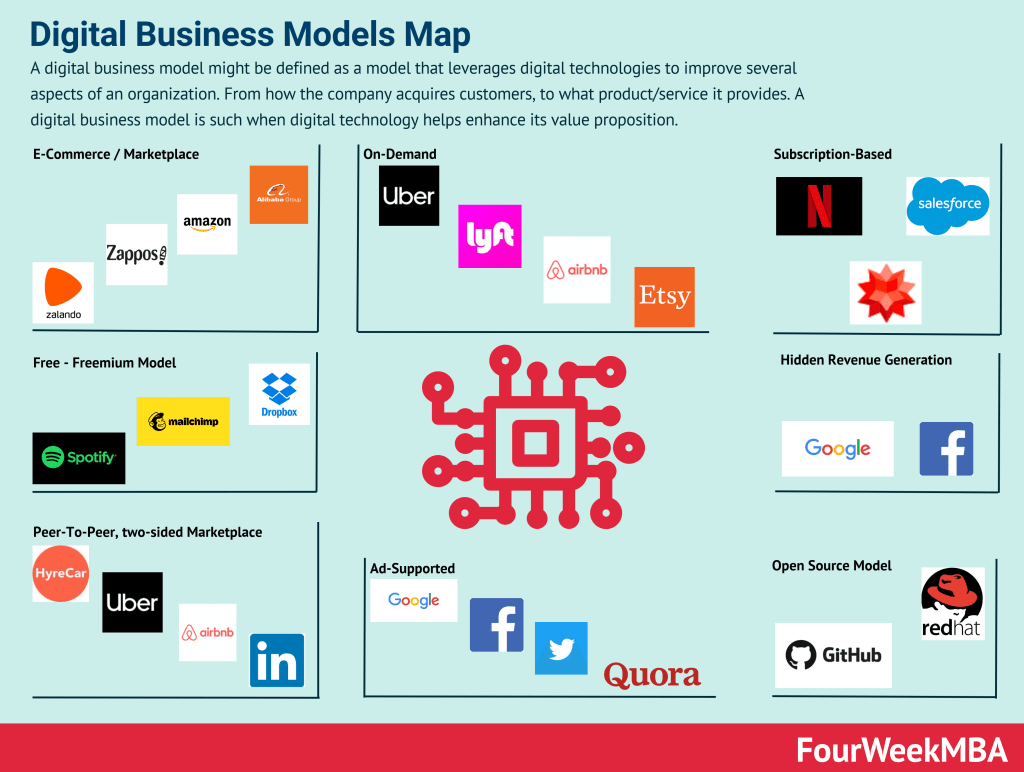
A digital business model might be defined as a model that leverages digital technologies to improve several aspects of an organization. From how the company acquires customers, to what product/service it provides. A digital business model is such when digital technology helps enhance its value proposition.
A tech business model is made of four main components: value model (value propositions, mission, vision), technological model (R&D management), distribution model (sales and marketing organizational structure), and financial model (revenue modeling, cost structure, profitability and cash generation/management). Those elements coming together can serve as the basis to build a solid tech business model.
A platform business model generates value by enabling interactions between people, groups, and users by leveraging network effects. Platform business models usually comprise two sides: supply and demand. Kicking off the interactions between those two sides is one of the crucial elements for a platform business model success.
A Blockchain Business Model is made of four main components: Value Model (Core Philosophy, Core Value and Value Propositions for the key stakeholders), Blockchain Model (Protocol Rules, Network Shape and Applications Layer/Ecosystem), Distribution Model (the key channels amplifying the protocol and its communities), and the Economic Model (the dynamics through which protocol players make money). Those elements coming together can serve as the basis to build and analyze a solid Blockchain Business Model.
In an asymmetric businessmodel, the organization doesn’t monetize the user directly, but it leverages the data users provide coupled with technology, thus have a key customer pay to sustain the core asset. For example, Google makes money by leveraging users’ data, combined with its algorithms sold to advertisers for visibility.
In an asymmetric businessmodel, the organization doesn’t monetize the user directly, but it leverages the data users provide coupled with technology, thus having a key customer pay to sustain the core asset. For example, Google makes money by leveraging users’ data, combined with its algorithms sold to advertisers for visibility. This is how attention merchants make monetize their business models.
While the term has been coined by Andrew Lampitt, open-core is an evolution of open-source. Where a core part of the software/platform is offered for free, while on top of it are built premium features or add-ons, which get monetized by the corporation who developed the software/platform. An example of the GitLab open core model, where the hosted service is free and open, while the software is closed.
Cloud business models are all built on top of cloud computing, a concept that took over around 2006 when former Google’s CEO Eric Schmit mentioned it. Most cloud-based business models can be classified as IaaS (Infrastructure as a Service), PaaS (Platform as a Service), or SaaS (Software as a Service). While those models are primarily monetized via subscriptions, they are monetized via pay-as-you-go revenue models and hybrid models (subscriptions + pay-as-you-go).
Open source is licensed and usually developed and maintained by a community of independent developers. While the freemium is developed in-house. Thus the freemium give the company that developed it, full control over its distribution. In an open-source model, the for-profit company has to distribute its premium version per its open-source licensing model.
The freemium – unless the whole organization is aligned around it – is a growth strategy rather than a business model. A free service is provided to a majority of users, while a small percentage of those users convert into paying customers through the sales funnel. Free users will help spread the brand through word of mouth.
A freeterprise is a combination of free and enterprise where free professional accounts are driven into the funnel through the free product. As the opportunity is identified the company assigns the free account to a salesperson within the organization (inside sales or fields sales) to convert that into a B2B/enterprise account.
A marketplace is a platform where buyers and sellers interact and transact. The platform acts as a marketplace that will generate revenues in fees from one or all the parties involved in the transaction. Usually, marketplaces can be classified in several ways, like those selling services vs. products or those connecting buyers and sellers at B2B, B2C, or C2C level. And those marketplaces connecting two core players, or more.
B2B, which stands for business-to-business, is a process for selling products or services to other businesses. On the other hand, a B2C sells directly to its consumers.
A B2B2C is a particular kind of business model where a company, rather than accessing the consumer market directly, it does that via another business. Yet the final consumers will recognize the brand or the service provided by the B2B2C. The company offering the service might gain direct access to consumers over time.
Direct-to-consumer (D2C) is a business model where companies sell their products directly to the consumer without the assistance of a third-party wholesaler or retailer. In this way, the company can cut through intermediaries and increase its margins. However, to be successful the direct-to-consumers company needs to build its own distribution, which in the short term can be more expensive. Yet in the long-term creates a competitive advantage.
The C2C business model describes a market environment where one customer purchases from another on a third-party platform that may also handle the transaction. Under the C2C model, both the seller and the buyer are considered consumers. Customer to customer (C2C) is, therefore, a business model where consumers buy and sell directly between themselves. Consumer-to-consumer has become a prevalent business model especially as the web helped disintermediate various industries.
A retail business model follows a direct-to-consumer approach, also called B2C, where the company sells directly to final customers a processed/finished product. This implies a business model that is mostly local-based, it carries higher margins, but also higher costs and distribution risks.
The wholesale model is a selling model where wholesalers sell their products in bulk to a retailer at a discounted price. The retailer then on-sells the products to consumers at a higher price. In the wholesale model, a wholesaler sells products in bulk to retail outlets for onward sale. Occasionally, the wholesaler sells direct to the consumer, with supermarket giant Costco the most obvious example.
The term “crowdsourcing” was first coined by Wired Magazine editor Jeff Howe in a 2006 article titled Rise of Crowdsourcing. Though the practice has existed in some form or another for centuries, it rose to prominence when eCommerce, social media, and smartphone culture began to emerge. Crowdsourcing is the act of obtaining knowledge, goods, services, or opinions from a group of people. These people submit information via social media, smartphone apps, or dedicated crowdsourcing platforms.
In a franchained business model (a short-term chain, long-term franchise) model, the company deliberately launched its operations by keeping tight ownership on the main assets, while those are established, thus choosing a chain model. Once operations are running and established, the company divests its ownership and opts instead for a franchising model.
Businesses employing the brokerage business model make money via brokerage services. This means they are involved with the facilitation, negotiation, or arbitration of a transaction between a buyer and a seller. The brokerage business model involves a business connecting buyers with sellers to collect a commission on the resultant transaction. Therefore, acting as a middleman within a transaction.
Dropshipping is a retail business model where the dropshipper externalizes the manufacturing and logistics and focuses only on distribution and customer acquisition. Therefore, the dropshipper collects final customers’ sales orders, sending them over to third-party suppliers, who ship directly to those customers. In this way, through dropshipping, it is possible to run a business without operational costs and logistics management.
Gennaro is the creator of FourWeekMBA, which reached about four million business people, comprising C-level executives, investors, analysts, product managers, and aspiring digital entrepreneurs in 2022 alone | He is also Director of Sales for a high-tech scaleup in the AI Industry | In 2012, Gennaro earned an International MBA with emphasis on Corporate Finance and Business Strategy.