Wealthfront is an automated Fintech investment platform providing investment, retirement, and cashmanagement products to retail investors, mostly making money on the annual 0.25% advisory fee the company charges for assets under management. It also makes money via a line of credits and interests on the cash accounts.
Business Model Element
Analysis
Implications
Examples
Value Proposition
Wealthfront’s value proposition centers on automated, low-cost, and diversified investment and financial planning services. For Investors, Wealthfront offers: – Automated Investing: Algorithms manage and optimize portfolios. – Diversification: Broad exposure to various asset classes. – Low Fees: Competitive management fees. – Financial Planning: Access to personalized financial planning tools. For High-Net-Worth Investors, Wealthfront provides: – Advanced Planning: Customized strategies for complex financial goals. Wealthfront aims to simplify investing and financial planning, making it accessible to all.
Offers automated, low-cost, and diversified investment services. Attracts investors seeking professional portfolio management without high fees. Provides personalized financial planning tools for a comprehensive financial picture. Offers advanced planning for high-net-worth individuals. Simplifies investing and financial planning for a wide audience.
– Automated investing streamlines portfolio management. – Diversification reduces risk. – Low fees make investing more cost-effective. – Personalized financial planning tools enhance user experience. – Advanced planning caters to high-net-worth clients.
Customer Segments
Wealthfront serves various customer segments, including: 1. Retail Investors: Individuals looking for automated investment solutions. 2. High-Net-Worth Individuals: Wealthier clients seeking advanced financial planning. 3. Tech-Savvy Investors: Users comfortable with technology-driven investment platforms. Wealthfront caters to a diverse user base, from retail investors to high-net-worth individuals.
Focuses on diverse customer segments, including retail investors, high-net-worth individuals, and tech-savvy investors. Customizes services to meet the unique needs and preferences of each group. Provides a versatile platform for automated investing and financial planning.
– Serving diverse customer segments broadens Wealthfront’s user base. – Tailoring services enhances customer satisfaction and engagement.
Distribution Strategy
Wealthfront’s distribution strategy primarily relies on its website and mobile app. Users can sign up and access the platform online, making it convenient and accessible. The platform also emphasizes online marketing and referrals to acquire new users. Wealthfront utilizes partnerships with other financial institutions for integration and service expansion.
Primarily utilizes distribution through its website and mobile app. Offers online access for user convenience. Focuses on online marketing and referrals for user acquisition. Collaborates with financial institutions for integration and service expansion. Ensures easy access to its platform.
– Website and mobile app access align with user preferences. – Online marketing and referrals drive user growth. – Partnerships expand the service ecosystem.
Revenue Streams
Wealthfront generates revenue through management fees charged on assets under management (AUM). The fees are typically a percentage of AUM, varying based on the total investment. Wealthfront also earns interest on cash holdings in user accounts and may explore additional premium services or features in the future. The primary revenue source is AUM-based fees.
Relies on revenue streams from: 1. Management fees based on AUM. 2. Interest earned on cash holdings. Considers potential future revenue streams like premium services. Emphasizes revenue generation through AUM-based fees.
– Management fees provide a consistent revenue source. – Interest earnings contribute to profitability. – Exploring premium services can diversify income.
Marketing Strategy
Wealthfront’s marketing strategy includes online advertising, content marketing, referrals, and partnerships. The platform uses digital advertising channels, including social media and search engines, to reach potential investors. Wealthfront also provides educational content to attract and engage users. Referral programs incentivize existing users to refer new clients. Partnerships with other fintech firms expand its reach.
Utilizes online advertising, content marketing, referrals, and partnerships for marketing. Targets potential users through digital advertising channels. Provides educational content to attract and engage users. Incentivizes referrals through referral programs. Collaborates with fintech firms for broader reach. Effectively promotes services through digital channels and educational content.
– Online advertising reaches potential users effectively. – Educational content adds value and attracts users. – Referral programs drive user acquisition. – Partnerships with fintech firms extend the user base.
Organization Structure
Wealthfront’s organizational structure includes teams dedicated to technology development, customer support, marketing, partnerships, and financial planning. Technology development teams focus on platform enhancements. Customer support teams assist users with inquiries and issues. Marketing teams promote Wealthfront’s services, while partnerships and financial planning teams collaborate with other institutions and provide advanced planning support. This structure supports innovation, user satisfaction, and financial planning expertise.
Employs specialized teams for technology development, customer support, marketing, partnerships, and financial planning. Enhances the platform through technology development teams. Assists users with inquiries and issues through customer support teams. Promotes services through marketing teams. Collaborates with institutions through partnerships. Provides advanced planning support through financial planning teams. Supports innovation, user satisfaction, and financial planning expertise.
– Specialized teams drive platform innovation and improvement. – Customer support builds trust and addresses user needs. – Marketing promotes services effectively. – Partnerships extend the service ecosystem. – Financial planning supports users in complex financial goals.
Competitive Advantage
Wealthfront’s competitive advantage comes from its automated investing, low fees, diversified portfolios, financial planning tools, and tech-driven approach. Automated investing simplifies portfolio management. Low fees make it cost-effective. Diversified portfolios reduce risk. Financial planning tools offer comprehensive insights. A tech-driven approach attracts tech-savvy investors seeking convenience and efficiency.
Derives a competitive advantage from: – Automated investing for simplified portfolio management. – Low fees for cost-effective investment. – Diversified portfolios to reduce risk. – Financial planning tools for comprehensive insights. – A tech-driven approach that appeals to tech-savvy investors. Sets itself apart in the robo-advisory sector by offering an efficient, low-cost, and tech-driven investment and planning platform.
– Automated investing streamlines portfolio management. – Low fees make it accessible to a wider audience. – Diversification reduces risk for investors. – Financial planning tools enhance the user experience. – Tech-driven approach caters to tech-savvy investors.
Based in California, Wealthfront is an automated investment service providing investment, retirement, and cashmanagement products to retail investors.
It was founded in 2008 by Benchmark co-founder Andy Rachleff and Dan Carroll as a mutual fund analysis company. The company quickly pivoted into wealth management, growing its assets under management in the following years.
In 2020, Wealthfront made the Business Insider Top 10 Best Robo Advisors. Shortly thereafter, the company updated its mission statement to position itself as a company that favored people and not institutions.
Wealthfront now targets tech-savvy Millennials offering them an automated, data-driven investment service with significantly lower fees.
Wealthfront business model
The Wealthfront revenue model is mostly based on the annual 0.25% advisory fee the company charges for assets under management. For example, an individual with $7000 under management would be charged $1.46 per month.
Although this fee is less than a quarter of the industry average, Wealthfront trusts that their lower fee model will attract larger investor balances. This is particularly important for the company when one considers that they do not charge a management fee for any balance under $5000.
The company also passes on a 0.07-0.13% fund fee to the consumer. This is a fee charged by the companies that manage the index funds Wealthfront ultimately invests in.
College savings plan
Wealthfront also offers a 529 college savings plan, allowing parents to put away money for the future tuition of their children.
The plan is a regular investment strategy using low-risk index funds to minimize capital gains tax. For this service, Wealthfront charges the same 0.25% advisory fee plus an administration fee of 0.01-0.05%. Exchange-traded fund (ETF) managers also pass on a fee of 0.11-0.15%.
Portfolio line of credit
Wealthfront also offers a line of credit, allowing consumers to borrow money directly from the company.
Depending on the amount borrowed, Wealthfront charges interest fees of between 2.40 to 3.65%.
Cash accounts
For consumers wanting a banking solution, Wealthfront has them covered with a range of various account types suited to individual needs.
The company earns revenue on the cash in customer accounts by lending it out to other institutions. It also makes money whenever the customer makes a purchase using their debit card.
In this scenario, merchants typically pay a 1% fee to Visa which is then shared with Wealthfront.
Key takeaways:
Wealthfront is a financial services platform aimed at Millennial consumers who desire a low-fee investment and banking platform.
Wealthfront drives the majority of its revenue through a low-cost management fee model. Although it makes less money in management fees than some other platforms, it hopes to attract larger portfolio balances in the growing retail investor market.
Wealthfront also makes money by offering a direct line of credit to eligible consumers, charging interest according to the amount borrowed. The company also gives young parents the ability to invest in their children’s college tuition, helping them minimize capital gains tax in the process.
Key Highlights
Wealthfront and its Fintech Services: Wealthfront is an automated Fintech investment platform that offers a range of financial services, including investment, retirement, and cash management products tailored to retail investors.
Founders and Background: The platform was founded in 2008 by Andy Rachleff (Benchmark co-founder) and Dan Carroll. Originally focusing on mutual fund analysis, the company shifted its focus to wealth management, eventually expanding its assets under management.
Recognition and Mission: Wealthfront gained recognition, making it to the Business Insider Top 10 Best Robo Advisors in 2020. The company updated its mission statement to highlight its focus on individuals over institutions.
Target Audience and Value Proposition: Wealthfront primarily targets tech-savvy Millennials, offering them an automated, data-driven investment service with lower fees compared to traditional options.
Revenue Generation Strategies: Wealthfront’s revenue model primarily revolves around the 0.25% annual advisory fee it charges for managing assets. This fee is aimed at larger investor balances, as the company does not charge a management fee for balances under $5000.
Fund Fee and College Savings Plan: Wealthfront also passes on a 0.07-0.13% fund fee to consumers, charged by the index fund managers. Additionally, the company offers a 529 college savings plan that lets parents save for their children’s tuition. The plan incurs an administration fee of 0.01-0.05%, along with a fee from ETF managers of 0.11-0.15%.
Portfolio Line of Credit: Wealthfront provides a portfolio line of credit that allows eligible consumers to borrow money directly from the company. Interest fees, ranging from 2.40% to 3.65%, are charged based on the borrowed amount.
Cash Accounts and Banking Solutions: Wealthfront offers a variety of cash accounts tailored to individual needs. The platform earns revenue from the cash in customer accounts by lending it out to other institutions. Additionally, it earns money when customers use their debit cards for purchases, with merchants paying a 1% fee to Visa, shared with Wealthfront.
Acorns is a fintech platform providing services related to Robo-investing and micro-investing. The company makes money primarily through three subscription tiers: Lite – ($1/month), which gives users access to Acorns Invest, Personal ($3/month) that includes Invest plus the Later (retirement) and Spend (personal checking account) suite of products, Family ($5/month) with features from both the Lite and Personal plans with the addition of Early.
Starting as a pay-later solution integrated into merchants’ checkouts, Affirm makes money from merchants’ fees as consumers pick up the pay-later solution. Affirm also makes money through interest earned from the consumer loans when those are repurchased from the originating bank. In 2020 Affirm made 50% of its revenues from merchants’ fees, about 37% from interests, and the remaining from virtual cards and servicing fees.
Alipay is a Chinese mobile and online payment platform created in 2004 by entrepreneur Jack Ma as the payment arm of Taobao, a major Chinese eCommerce site. Alipay, therefore, is the B2C component of Alibaba Group. Alipay makes money via escrow transaction fees, various value-added ancillary services, and its Credit Pay Instalment fees.
Betterment is an American financial advisory company founded in 2008 by MBA graduate Jon Stein and lawyer Eli Broverman. Betterment makes money via investment plans, financial advice packages, betterment for advisors, betterment for business, cash reserve, and checking accounts.
Chime is an American neobank (internet-only bank) company, providing fee-free financial services through its mobile banking app, thus providing personal finance services free of charge while making the majority of its money via interchange fees (paid by merchants when consumers use their debit cards) and ATM fees.
Coinbase is among the most popular platforms for trading and storing crypto-assets, whose mission is “to create an open financial system for the world” by enabling customers to trade cryptocurrencies. Its platform serves both as a search and discovery engine for crypto assets. The company makes money primarily through fees earned for the transactions processed through the platform, custodial services offered, interest, and subscriptions.
Compass is a licensed American real-estate broker incorporating online real estate technology as a marketing medium. The company makes money via sales commissions (collected whenever a sale is facilitated or tenants are found for a rental property) and bridge loans (a service allowing the seller to purchase a home before the revenue from the sale of their previous home is available).
Dosh is a Fintech platform that enables automatic cash backs for consumers. Its business model connects major card providers with online and offline local businesses to develop automatic cash back programs. The company makes money by earning an affiliate commission on each eligible sale from consumers.
E-Trade is a trading platform allowing investors to trade common and preferred stocks, exchange-traded funds (ETFs), options, bonds, mutual funds, and futures contracts; acquired by Morgan Stanley in 2020 for $13 billion. E-Trade makes money through interest income, order flow, margin interests, options, future and bonds trading, and other fees and service charges.
Klarna is a financial technology company allowing consumers to shop with a temporary Visa card. Thus it then performs a soft credit check and pays the merchant. Klarna makes money by charging merchants. Klarna also earns a percentage of interchange fees as a commission and for interests earned on customers’ accounts.
Lemonade is an insurance tech company using behavioral economics and artificial intelligence to process claims efficiently. The company leverages technology to streamline onboarding customers while also applying a financial model to reduce conflicts of interest with customers (perhaps by donating the variable premiums to charity). The company makes money by selling its core insurance products, and via its tech platform, it tries to enhance its sales.
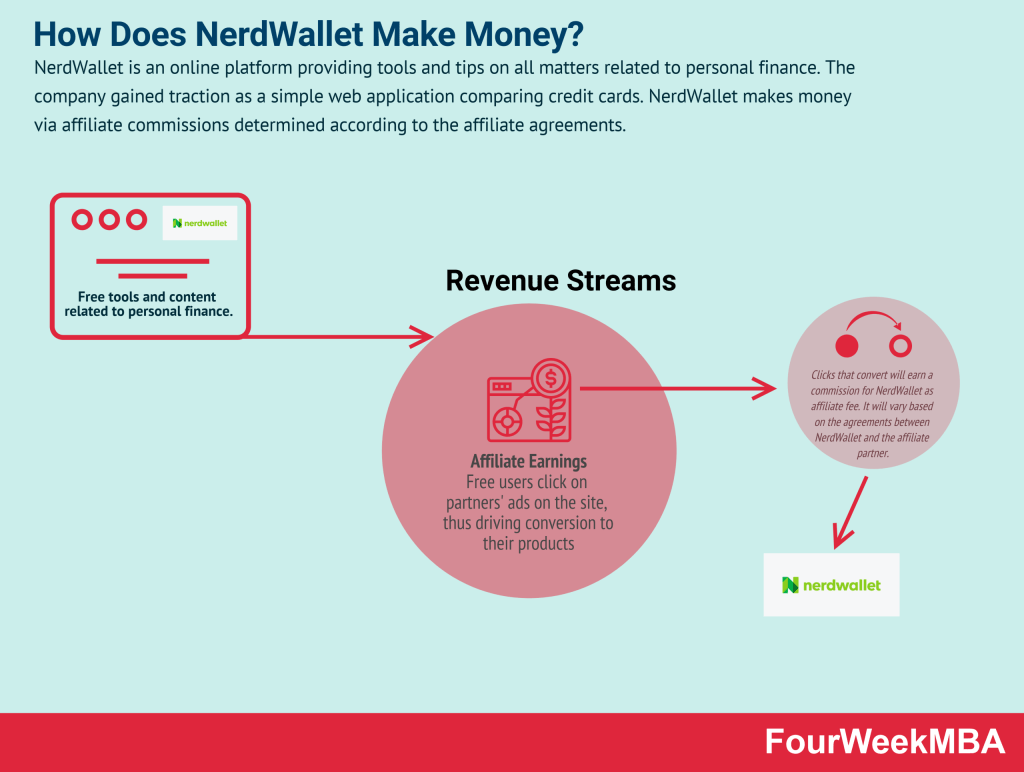
NerdWallet is an online platform providing tools and tips on all matters related to personal finance. The company gained traction as a simple web application comparing credit cards. NerdWallet makes money via affiliate commissions determined according to the affiliate agreements.
Robinhood is an app that helps to invest in stocks, ETFs, options, and cryptocurrencies, all commission-free. Robinhood earns money by offering: Robinhood Gold, a margin trading service, which starts at $6 a month, earns interests from customer cash and stocks, and rebates from market makers and trading venues.
SoFi is an online lending platform that provides affordable education loans to students, and it expanded into financial services, including loans, credit cards, investment services, and insurance. It makes money primarily via payment processing fees and loan securitization.
Stash is a FinTech platform offering a suite of financial tools for young investors, personalized investment advice, and life insurance. The company primarily makes money via subscriptions, cashback, payment for order flows, and interest for cash sitting on members’ accounts.
Wealthfront is an automated Fintech investment platform providing investment, retirement, and cash management products to retail investors, mostly making money on the annual 0.25% advisory fee the company charges for assets under management. It also makes money via a line of credits and interests on the cash accounts.
Zelle is a peer-to-peer payment network that indirectly benefits the banks’ consortium that backs it. Zelle also enables users to pay businesses for goods and services free for users. Merchants pay a 1% fee to Visa or Mastercard, who share it with the bank that issued the card.
Gennaro is the creator of FourWeekMBA, which reached about four million business people, comprising C-level executives, investors, analysts, product managers, and aspiring digital entrepreneurs in 2022 alone | He is also Director of Sales for a high-tech scaleup in the AI Industry | In 2012, Gennaro earned an International MBA with emphasis on Corporate Finance and Business Strategy.