Function-as-a-service (FaaS) is a cloud solution that allows clients to execute modular pieces of code on the edge.
Aspect
Explanation
Definition
Function-as-a-Service (FaaS): FaaS is a serverless cloud computing model that enables developers to write and deploy individual functions or code snippets. These functions are executed in response to events or triggers, such as HTTP requests, database changes, or timers, without the need for managing underlying infrastructure.
Key Concepts
1. Serverless: FaaS abstracts server management entirely from developers, allowing them to focus solely on writing code and defining triggers.
2. Event-Driven: FaaS functions are triggered by specific events, like HTTP requests, file uploads, or database changes. Each function performs a specific task in response to an event.
3. Stateless: FaaS functions are stateless, meaning they do not maintain persistent server sessions or store data between invocations. They operate in isolated, ephemeral containers.
4. Pay-Per-Use: FaaS platforms charge users based on the actual compute resources consumed during function execution, making it cost-efficient for sporadic workloads.
Components
1. Function Code: Developers write the code for individual functions, defining their logic and behavior.
2. Event Sources: Event sources are triggers that invoke functions. These can include HTTP requests, message queues, file uploads, or scheduled timers.
3. Function Execution Environment: FaaS platforms provide execution environments (containers) for running functions in response to events.
4. Auto-Scaling: FaaS platforms automatically manage the scaling of function instances to handle changes in demand.
Benefits
1. Simplified Development: FaaS abstracts infrastructure management, allowing developers to focus on writing code and creating functions.
2. Scalability: Functions can automatically scale to handle increased workloads, ensuring consistent performance and responsiveness.
Cost Efficiency: With pay-per-use pricing, organizations only pay for the compute resources consumed during function execution, reducing costs for idle resources.
Event-Driven: FaaS is well-suited for event-driven architectures, making it suitable for applications that respond to various triggers and events.
Fast Deployment: Developers can quickly deploy and update functions, reducing time-to-market for applications and updates.
Challenges
1. Cold Start Latency: FaaS functions may experience initial latency, known as “cold starts,” when a new instance of a function is created.
Resource Limitations: Functions are designed to be small and stateless, making them less suitable for applications that require persistent state or resource-intensive processes.
Vendor Lock-In: Adopting a specific FaaS platform may lead to vendor lock-in, making it challenging to migrate functions to another provider.
Debugging and Testing: Debugging and testing functions in a serverless environment can be more challenging due to limited visibility into the underlying infrastructure.
Complexity Management: Coordinating multiple functions in a complex application can lead to management challenges.
Use Cases
1. Web Applications: FaaS is commonly used to handle backend logic for web applications, such as processing user registrations, managing sessions, or serving dynamic content.
IoT (Internet of Things): FaaS can process data generated by IoT devices in real-time, making it suitable for IoT applications and analytics.
Data Processing: Organizations can use FaaS for data processing tasks, such as image and video analysis, text extraction, and data transformation.
Automation: FaaS can automate repetitive tasks, such as sending notifications, processing files, or managing cloud resources.
Microservices: FaaS can be part of a microservices architecture, enabling the creation of fine-grained, independently deployable functions.
Conclusion
Function-as-a-Service (FaaS) is a serverless computing model that simplifies application development and infrastructure management. Its event-driven nature, scalability, and cost-efficiency make it suitable for various use cases, including web applications, IoT, data processing, and automation. Organizations should consider factors like cold start latency, resource limitations, and vendor lock-in when adopting FaaS for their applications. Properly designed and orchestrated, FaaS can significantly improve application agility and reduce operational overhead.
Function-as-a-service enables clients to execute small, modular pieces of code known as functions without having to maintain their own infrastructure.
FaaS is a relatively new cloud computing model that was pioneered in the early 2010s by companies such as PiCloud.
The model is based on serverless technology that allows software developers to deploy cloud applications without the hassle of server management.
To better understand how the FaaS model can benefit these individuals, we feel it is worth explaining serverless architecture and functions in more detail.
What is serverless architecture?
Serverless architecture does not mean the application runs without a server in the literal sense. Indeed, it is well understood that some kind of hardware host is necessary for application deployment.
Fundamental to serverless architecture is that a cloud service provider allocates storage space and manages the application servers on behalf of the developer.
What is a function?
Think of a function as an operation or task that can be written as a small piece of code and executed independently within an application.
Functions are extensions of the microservice architecture, itself an evolution of monolithic architecture.
Central to microservice architecture is the idea that applications are comprised of a modular collection of microservices that are deployed individually and, as a result, are easier to test and maintain.
How does function-as-a-service work?
Under the function-as-a-service model, developers do not maintain application servers and are instead hosted by the FaaS provider who allocates resources based on user needs.
When a software developer wants to deploy a function, the FaaS provider executes the function by spinning up a server and then shutting it down.
Since the architecture is only active when the function is being used, the function is shut down and the same resources can be allocated somewhere else.
To that end, FaaS is provided on-demand and based on the event-driven execution model. Unlike platform-as-a-service, for example, it does not require that server processes be constantly running in the background.
This makes FaaS ideal for simple, repetitive functions such as web request processing and routine task scheduling.
Benefits of function-as-a-service
Here are some of the benefits of function-as-a-service:
Scalability – as a cloud-based service, FaaS is eminently scalable. Specific functions can be scaled in isolation based on their usage, which is a more efficient use of computing resources when compared to scaling the entire application.
Lower costs – function-as-a-service is also more cost-effective since companies need to invest less in operating systems, hardware, and other infrastructure. The on-demand, event-driven nature of FaaS also means developers only pay for the resources they actually consume.
Streamlined logistics – development teams enjoy FaaS because it streamlines the update and code release process. With the service provider doing the heavy lifting, so to speak, developers can devote more time to ensuring updates are more rapid and responsive to customer needs.
Case studies
AWS Lambda: Offered by Amazon Web Services, Lambda is one of the most well-known FaaS solutions. Developers can run their code without provisioning or managing servers, and they pay only for the compute time they consume.
Google Cloud Functions: This is Google’s event-driven serverless compute platform. It allows developers to create small single-purpose functions that respond to cloud events without the need to manage a server or runtime environment.
Azure Functions: A solution by Microsoft’s Azure platform, Azure Functions supports a variety of programming languages and integrates with various Azure and third-party services.
Alibaba Cloud Function Compute: Alibaba’s serverless computing service. It allows developers to run their code without managing servers, automatically scales resources, and is event-driven.
IBM Cloud Functions: Based on Apache OpenWhisk, IBM’s FaaS offering allows developers to execute code in response to events or direct API calls.
Twilio Functions: While Twilio is primarily known for communications services, they also offer a serverless environment where developers can build and run Twilio applications.
Netlify Functions: Alongside its web hosting services, Netlify offers a FaaS solution that integrates seamlessly with its platform, enabling developers to build and deploy serverless Lambda functions without leaving the Netlify ecosystem.
Vercel: Known for its deployment and hosting solutions, Vercel also provides serverless functions that allow developers to deploy code without managing the underlying infrastructure.
Cloudflare Workers: While Cloudflare is primarily a content delivery network, it also offers a serverless computing platform called Workers, allowing developers to run their code closer to the end-users at the edge.
Oracle Cloud Functions: Oracle’s FaaS service allows developers to write, deploy, and manage applications composed of discrete functions.
Key takeaways:
Function-as-a-service (Faas) is a cloud-computing solution that allows clients to execute modular pieces of code on the edge. It is based on serverless technology that allows developers to deploy applications without having to worry about server management
Function-as-a-service is based on the event-driven execution model and is provided on-demand. When a function is deployed, the FaaS provider executes the function by spinning up a server and then shutting it down so that resources can be directed elsewhere.
Function-as-a-service has several benefits. These include streamlined logistics, lower costs, and scalability.
Key Highlights
Serverless Architecture: Serverless architecture does not mean there are no servers involved. Instead, it means that cloud service providers allocate storage space and manage application servers for developers. This frees developers from server maintenance tasks.
Functions: Functions are small pieces of code that perform specific operations or tasks within an application. They are an extension of the microservice architecture, allowing applications to be composed of modular microservices that are deployed individually for easier testing and maintenance.
How FaaS Works: Under the function-as-a-service model, developers do not maintain application servers. When a function needs to be executed, the FaaS provider spins up a server to execute the function and shuts it down afterward. This event-driven execution model ensures that resources are used efficiently.
Benefits of FaaS:
Scalability: FaaS is highly scalable, allowing specific functions to be scaled independently based on their usage, optimizing resource utilization.
Lower Costs: FaaS is cost-effective because companies need to invest less in operating systems, hardware, and infrastructure. Developers only pay for the resources they actually consume.
Streamlined Logistics: FaaS streamlines the update and code release process, as the service provider handles much of the heavy lifting, enabling developers to focus on rapid and responsive updates for customers.
Related Concepts
Description
When to Apply
Function-as-a-Service (FaaS)
Function-as-a-Service (FaaS) is a cloud computing model where cloud providers manage the infrastructure and execution environment for running code in response to events or triggers. FaaS platforms enable developers to deploy and execute functions or snippets of code without managing servers, scaling resources dynamically based on demand. FaaS abstracts away infrastructure complexities, allowing developers to focus on writing and deploying code, reducing development time and operational overhead. It offers scalability, cost-efficiency, and agility for building event-driven and serverless applications, leveraging pay-as-you-go pricing models and auto-scaling capabilities to optimize resource utilization and performance.
– When developing event-driven applications or scalable microservices architectures in cloud computing projects. – Particularly in understanding the principles and benefits of FaaS, such as serverless computing, event-driven architecture, and pay-as-you-go pricing, and in exploring techniques to leverage FaaS platforms, such as function design, deployment automation, and performance monitoring, to accelerate development cycles, improve resource utilization, and enhance scalability in cloud-native application development or digital transformation initiatives.
Serverless Computing
Serverless Computing is a cloud computing paradigm where cloud providers manage the infrastructure and execution environment, allowing developers to focus on writing and deploying code without provisioning or managing servers. Serverless platforms abstract away server management tasks, automatically scaling resources based on demand and charging users only for actual resource consumption. Serverless computing offers agility, scalability, and cost-efficiency for building and deploying applications, enabling rapid development, seamless scaling, and reduced operational overhead. It promotes event-driven architectures, microservices, and distributed computing models, leveraging functions or services as building blocks for modular and loosely coupled applications.
– When adopting cloud-native architectures or accelerating application development in digital transformation projects. – Particularly in understanding the principles and practices of serverless computing, such as event-driven architecture, microservices, and auto-scaling, and in exploring techniques to leverage serverless platforms, such as function composition, event-driven design, and resource optimization, to streamline development workflows, improve resource utilization, and achieve cost savings in cloud migration or application modernization initiatives.
Cloud Computing
Cloud Computing is a computing model where resources, such as servers, storage, and applications, are delivered over the internet as on-demand services, providing scalability, flexibility, and cost-efficiency. Cloud computing encompasses various service models, including Infrastructure-as-a-Service (IaaS), Platform-as-a-Service (PaaS), and Software-as-a-Service (SaaS), catering to different levels of abstraction and management responsibilities. It enables organizations to access computing resources on a pay-as-you-go basis, scale infrastructure dynamically, and deploy applications globally with minimal upfront investment and operational complexity. Cloud computing accelerates innovation, improves collaboration, and enhances agility, empowering businesses to adapt to changing market demands and drive digital transformation initiatives.
– When migrating workloads or leveraging digital services for business agility and innovation. – Particularly in understanding the fundamentals and benefits of cloud computing, such as scalability, elasticity, and cost savings, and in exploring techniques to adopt cloud technologies, such as cloud migration strategies, workload optimization, and cloud-native development practices, to modernize IT infrastructure, enhance operational efficiency, and unlock new opportunities for growth and innovation in cloud adoption or digital transformation journeys.
Microservices Architecture
Microservices Architecture is an architectural style where applications are composed of small, independently deployable services, each responsible for specific business capabilities. Microservices promote modularity, flexibility, and scalability, allowing teams to develop, deploy, and scale services independently, leveraging diverse technologies and programming languages. Microservices communicate via lightweight protocols, such as HTTP or messaging queues, and are often deployed in containers or serverless environments for agility and resource efficiency. Microservices architecture enables rapid iteration, fault isolation, and continuous delivery, facilitating faster time-to-market and better alignment with evolving business requirements. It supports distributed computing patterns, such as event-driven communication, service discovery, and decentralized data management, to optimize performance and resilience in complex and evolving ecosystems.
– When designing scalable and resilient applications or implementing agile development practices in software engineering projects. – Particularly in understanding the principles and patterns of microservices architecture, such as service decomposition, bounded contexts, and API gateways, and in exploring techniques to adopt microservices, such as domain-driven design, containerization, and service mesh, to enhance agility, scalability, and maintainability in application development or modernization initiatives.
Event-Driven Architecture
Event-Driven Architecture is an architectural paradigm where systems communicate and react to events or messages asynchronously, enabling decoupled and scalable interactions among components. Event-driven architecture facilitates loose coupling, fault tolerance, and scalability, allowing systems to evolve independently and handle unpredictable workloads effectively. It involves producers generating events, consumers reacting to events, and event brokers mediating event delivery and consumption. Event-driven systems leverage event-driven patterns, such as event sourcing, pub/sub messaging, and stream processing, to orchestrate complex workflows, trigger actions, and propagate changes across distributed environments. Event-driven architecture enables real-time processing, event-driven scaling, and seamless integration with external systems, enhancing responsiveness, adaptability, and extensibility in modern applications and distributed systems.
– When building real-time and scalable systems or integrating disparate services in distributed computing projects. – Particularly in understanding the principles and patterns of event-driven architecture, such as event sourcing, message brokers, and stream processing, and in exploring techniques to implement event-driven systems, such as event-driven design, message queueing, and event-driven orchestration, to improve agility, responsiveness, and scalability in application development or system integration initiatives.
Distributed Computing
Distributed Computing is a computing paradigm where computation, storage, and communication tasks are distributed across multiple nodes or machines in a network, enabling parallel processing, fault tolerance, and scalability. Distributed computing systems coordinate and synchronize activities among distributed components, leveraging distributed algorithms, communication protocols, and consensus mechanisms to achieve coordinated outcomes. Distributed computing encompasses various architectures, such as client-server, peer-to-peer, and grid computing, each offering different degrees of decentralization, scalability, and fault tolerance. It enables distributed data processing, parallel computation, and decentralized decision making, supporting diverse applications in fields such as big data analytics, IoT, and cloud computing.
– When processing large-scale data or deploying resilient applications in distributed computing environments. – Particularly in understanding the principles and challenges of distributed computing, such as data consistency, network latency, and fault tolerance, and in exploring techniques to implement distributed systems, such as replication, sharding, and consensus algorithms, to optimize performance, reliability, and scalability in distributed computing or big data processing initiatives.
Containerization
Containerization is a virtualization technology where applications and their dependencies are packaged as lightweight, portable containers, allowing consistent deployment across diverse computing environments. Containers encapsulate software components, libraries, and configurations, ensuring reproducibility and isolation of application dependencies. Containerization platforms, such as Docker and Kubernetes, provide tools for building, deploying, and managing containerized applications at scale, enabling rapid deployment, resource efficiency, and workload portability. Containerization simplifies application deployment, facilitates microservices architecture, and accelerates DevOps practices, streamlining development workflows and infrastructure management.
– When standardizing application deployment or orchestrating containerized workloads in cloud-native environments. – Particularly in understanding the principles and benefits of containerization, such as environment consistency, resource isolation, and scalability, and in exploring techniques to adopt containerization, such as container orchestration, image management, and infrastructure as code, to streamline development processes, improve resource utilization, and enhance scalability in application modernization or cloud migration initiatives.
Cloud-Native Development
Cloud-Native Development is an approach to software development that leverages cloud computing principles, architectures, and services to build and deploy applications that are designed for the cloud from the ground up. Cloud-native applications are scalable, resilient, and agile, leveraging microservices, containers, and serverless computing to optimize performance, efficiency, and cost-effectiveness. Cloud-native development embraces DevOps practices, continuous integration/continuous deployment (CI/CD) pipelines, and infrastructure automation to accelerate software delivery and enhance operational efficiency. It fosters a culture of innovation, collaboration, and experimentation, enabling teams to iterate rapidly, respond to customer feedback, and deliver value to market faster.
– When modernizing application architectures or adopting agile development practices in digital transformation initiatives. – Particularly in understanding the principles and practices of cloud-native development, such as microservices, containers, and CI/CD, and in exploring techniques to implement cloud-native applications, such as cloud-native design patterns, infrastructure as code, and automated testing, to increase agility, scalability, and reliability in application development or cloud migration projects.
API Economy
API Economy refers to the ecosystem of APIs (Application Programming Interfaces) that enable organizations to expose and consume digital assets, services, and functionalities, fostering innovation, collaboration, and monetization opportunities. The API Economy encompasses API providers offering APIs as products or services, API consumers integrating APIs into applications or workflows, and API platforms facilitating API discovery, management, and monetization. APIs enable seamless integration, interoperability, and extensibility across diverse systems, applications, and devices, driving digital transformation, ecosystem expansion, and revenue generation. The API Economy fuels innovation in industries such as fintech, e-commerce, and IoT, enabling organizations to unlock data, leverage partner ecosystems, and deliver value-added services to customers and stakeholders.
– When facilitating integration or enabling ecosystem partnerships in digital business ecosystems. – Particularly in understanding the dynamics and opportunities of the API Economy, such as API monetization, ecosystem platforms, and developer communities, and in exploring techniques to participate in the API Economy, such as API design, API management, and API analytics, to accelerate innovation, expand market reach, and create new revenue streams in digital platform or ecosystem development initiatives.
Continuous Integration/Continuous Deployment (CI/CD) is a set of DevOps practices and automation workflows for building, testing, and deploying software changes rapidly and reliably. CI/CD pipelines automate the software delivery process, from code commit to production deployment, enabling teams to release software updates frequently and with confidence. Continuous Integration (CI) involves automatically integrating code changes into a shared repository and running automated tests to detect integration errors early. Continuous Deployment (CD) automates the deployment of code changes to production environments, ensuring consistency and minimizing manual intervention. CI/CD pipelines promote collaboration, feedback loops, and agility, enabling teams to deliver high-quality software faster and respond to market changes promptly.
– When streamlining software delivery or enhancing release management in agile development environments. – Particularly in understanding the principles and practices of CI/CD, such as automated testing, deployment pipelines, and infrastructure as code, and in exploring techniques to implement CI/CD pipelines, such as version control, automated builds, and deployment automation, to accelerate time-to-market, improve software quality, and foster collaboration in software development or DevOps transformation initiatives.
An effective business model has to focus on two dimensions: the people dimension and the financial dimension. The people dimension will allow you to build a product or service that is 10X better than existing ones and a solid brand. The financial dimension will help you develop proper distribution channels by identifying the people that are willing to pay for your product or service and make it financially sustainable in the long run.
Business modelinnovation is about increasing the success of an organization with existing products and technologies by crafting a compelling value proposition able to propel a new business model to scale up customers and create a lasting competitive advantage. And it all starts by mastering the key customers.
Digital and tech business models can be classified according to four levels of transformation into digitally-enabled, digitally-enhanced, tech or platform business models, and business platforms/ecosystems.
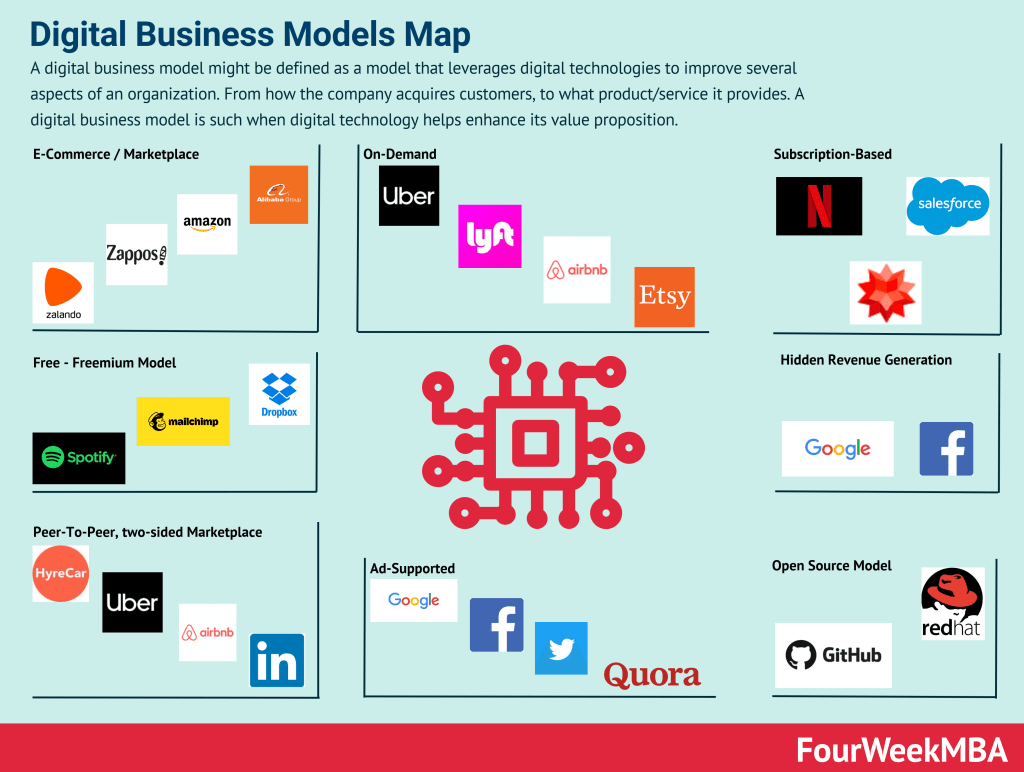
A digital business model might be defined as a model that leverages digital technologies to improve several aspects of an organization. From how the company acquires customers, to what product/service it provides. A digital business model is such when digital technology helps enhance its value proposition.
A tech business model is made of four main components: value model (value propositions, mission, vision), technological model (R&D management), distribution model (sales and marketingorganizational structure), and financial model (revenue modeling, cost structure, profitability and cash generation/management). Those elements coming together can serve as the basis to build a solid tech business model.
A platform business model generates value by enabling interactions between people, groups, and users by leveraging network effects. Platform business models usually comprise two sides: supply and demand. Kicking off the interactions between those two sides is one of the crucial elements for a platform business model success.
A Blockchain Business Model is made of four main components: Value Model (Core Philosophy, Core Value and Value Propositions for the key stakeholders), Blockchain Model (Protocol Rules, Network Shape and Applications Layer/Ecosystem), Distribution Model (the key channels amplifying the protocol and its communities), and the Economic Model (the dynamics through which protocol players make money). Those elements coming together can serve as the basis to build and analyze a solid Blockchain Business Model.
In an asymmetric businessmodel, the organization doesn’t monetize the user directly, but it leverages the data users provide coupled with technology, thus have a key customer pay to sustain the core asset. For example, Google makes money by leveraging users’ data, combined with its algorithms sold to advertisers for visibility.
In an asymmetric businessmodel, the organization doesn’t monetize the user directly, but it leverages the data users provide coupled with technology, thus having a key customer pay to sustain the core asset. For example, Google makes money by leveraging users’ data, combined with its algorithms sold to advertisers for visibility. This is how attention merchants make monetize their business models.
While the term has been coined by Andrew Lampitt, open-core is an evolution of open-source. Where a core part of the software/platform is offered for free, while on top of it are built premium features or add-ons, which get monetized by the corporation who developed the software/platform. An example of the GitLab open core model, where the hosted service is free and open, while the software is closed.
Cloud business models are all built on top of cloud computing, a concept that took over around 2006 when former Google’s CEO Eric Schmit mentioned it. Most cloud-based business models can be classified as IaaS (Infrastructure as a Service), PaaS (Platform as a Service), or SaaS (Software as a Service). While those models are primarily monetized via subscriptions, they are monetized via pay-as-you-go revenue models and hybrid models (subscriptions + pay-as-you-go).
Open source is licensed and usually developed and maintained by a community of independent developers. While the freemium is developed in-house. Thus the freemium give the company that developed it, full control over its distribution. In an open-source model, the for-profit company has to distribute its premium version per its open-source licensing model.
The freemium – unless the whole organization is aligned around it – is a growth strategy rather than a business model. A free service is provided to a majority of users, while a small percentage of those users convert into paying customers through the sales funnel. Free users will help spread the brand through word of mouth.
A freeterprise is a combination of free and enterprise where free professional accounts are driven into the funnel through the free product. As the opportunity is identified the company assigns the free account to a salesperson within the organization (inside sales or fields sales) to convert that into a B2B/enterprise account.
A marketplace is a platform where buyers and sellers interact and transact. The platform acts as a marketplace that will generate revenues in fees from one or all the parties involved in the transaction. Usually, marketplaces can be classified in several ways, like those selling services vs. products or those connecting buyers and sellers at B2B, B2C, or C2C level. And those marketplaces connecting two core players, or more.
B2B, which stands for business-to-business, is a process for selling products or services to other businesses. On the other hand, a B2C sells directly to its consumers.
A B2B2C is a particular kind of business model where a company, rather than accessing the consumer market directly, it does that via another business. Yet the final consumers will recognize the brand or the service provided by the B2B2C. The company offering the service might gain direct access to consumers over time.
Direct-to-consumer (D2C) is a business model where companies sell their products directly to the consumer without the assistance of a third-party wholesaler or retailer. In this way, the company can cut through intermediaries and increase its margins. However, to be successful the direct-to-consumers company needs to build its own distribution, which in the short term can be more expensive. Yet in the long-term creates a competitive advantage.
The C2C business model describes a market environment where one customer purchases from another on a third-party platform that may also handle the transaction. Under the C2C model, both the seller and the buyer are considered consumers. Customer to customer (C2C) is, therefore, a business model where consumers buy and sell directly between themselves. Consumer-to-consumer has become a prevalent business model especially as the web helped disintermediate various industries.
A retail business model follows a direct-to-consumer approach, also called B2C, where the company sells directly to final customers a processed/finished product. This implies a business model that is mostly local-based, it carries higher margins, but also higher costs and distribution risks.
The wholesale model is a selling model where wholesalers sell their products in bulk to a retailer at a discounted price. The retailer then on-sells the products to consumers at a higher price. In the wholesale model, a wholesaler sells products in bulk to retail outlets for onward sale. Occasionally, the wholesaler sells direct to the consumer, with supermarket giant Costco the most obvious example.
The term “crowdsourcing” was first coined by Wired Magazine editor Jeff Howe in a 2006 article titled Rise of Crowdsourcing. Though the practice has existed in some form or another for centuries, it rose to prominence when eCommerce, social media, and smartphone culture began to emerge. Crowdsourcing is the act of obtaining knowledge, goods, services, or opinions from a group of people. These people submit information via social media, smartphone apps, or dedicated crowdsourcing platforms.
In a franchained business model (a short-term chain, long-term franchise) model, the company deliberately launched its operations by keeping tight ownership on the main assets, while those are established, thus choosing a chain model. Once operations are running and established, the company divests its ownership and opts instead for a franchising model.
Businesses employing the brokerage business model make money via brokerage services. This means they are involved with the facilitation, negotiation, or arbitration of a transaction between a buyer and a seller. The brokerage business model involves a business connecting buyers with sellers to collect a commission on the resultant transaction. Therefore, acting as a middleman within a transaction.
Dropshipping is a retail business model where the dropshipper externalizes the manufacturing and logistics and focuses only on distribution and customer acquisition. Therefore, the dropshipper collects final customers’ sales orders, sending them over to third-party suppliers, who ship directly to those customers. In this way, through dropshipping, it is possible to run a business without operational costs and logistics management.
Gennaro is the creator of FourWeekMBA, which reached about four million business people, comprising C-level executives, investors, analysts, product managers, and aspiring digital entrepreneurs in 2022 alone | He is also Director of Sales for a high-tech scaleup in the AI Industry | In 2012, Gennaro earned an International MBA with emphasis on Corporate Finance and Business Strategy.