

eBay’s main shareholder is its founder, the billionaire Omidyar, who stepped down from the board of eBay. By 2020, he owned (and might still own 4.69% of the company’s stock) followed by other institutional investors, such as Vanguard (11.41%) and Blackrock (8.51%).
| Detail | Description |
|---|---|
| Company | eBay Inc. |
| Ownership Structure | Publicly traded company with major shareholders |
| Major Shareholders | Institutional investors like Vanguard Group, BlackRock, State Street Corporation, and individual shareholders |
| Founding Date | September 3, 1995 |
| Founder | Pierre Omidyar |
| Headquarters | San Jose, California, USA |
| Stock Symbol | EBAY (NASDAQ) |
| Primary Business | Operating an online marketplace that connects buyers and sellers, offering a wide range of products and services |
| Strategic Goals | Enhancing the platform’s technology, expanding global reach, improving user experience, and supporting small and medium-sized businesses |
Additional Ownership Details
- Institutional Shareholders: Major institutional investors such as Vanguard Group, BlackRock, and State Street Corporation hold significant stakes in eBay, providing financial stability and strategic guidance.
- Public Trading: eBay is publicly traded on the NASDAQ under the ticker symbol EBAY, allowing for ownership by a diverse range of institutional and individual investors.
- Corporate Strategy: eBay focuses on enhancing its marketplace platform to provide a seamless buying and selling experience. The company aims to support small and medium-sized businesses by offering tools and services that help them reach a global audience.
- Innovation and Technology: eBay invests heavily in technology to improve search algorithms, payment solutions, and user interface. The company seeks to enhance personalization and security to attract more buyers and sellers to its platform.
- Global Reach: eBay operates in over 190 markets worldwide, offering localized platforms tailored to regional preferences and needs. The company aims to expand its global footprint by reaching more international consumers and sellers.
| Aspect | Description | Analysis | Examples |
|---|---|---|---|
| Products and Services | eBay Inc. is an e-commerce platform that facilitates online buying and selling of various products and services. The core offering is the eBay website and mobile app, where users can list items for sale, browse and purchase products, and participate in auctions. eBay provides various formats for selling, including fixed-price listings, auction-style listings, and Buy It Now options. Additionally, eBay offers additional services such as eBay Motors for automotive sales, eBay Classifieds for local listings, and managed payments for secure transactions. | eBay’s primary product is its online marketplace, connecting buyers and sellers. Various listing formats cater to different selling preferences. eBay’s services like eBay Motors and eBay Classifieds expand its reach. Managed payments ensure secure transactions. | eBay website and mobile app, online marketplace, fixed-price listings, auction-style listings, Buy It Now options, additional services (e.g., eBay Motors, eBay Classifieds), managed payments for secure transactions. |
| Revenue Streams | eBay generates revenue primarily through transaction fees, including listing fees, final value fees, and promoted listing fees, charged to sellers when items are sold. The company also earns income from advertising fees and subscription fees for premium seller tools, such as eBay Stores. Additionally, eBay may generate revenue from other services like managed payments and international sales fees. | Transaction fees are a core income source, collected when items are sold on the platform. Advertising and promoted listing fees provide additional revenue streams. Subscription fees for premium seller tools offer recurring income. Other services like managed payments contribute to earnings. | Revenue from transaction fees (e.g., listing fees, final value fees), income from advertising fees (e.g., promoted listing fees), subscription fees for premium seller tools (e.g., eBay Stores), revenue from other services (e.g., managed payments, international sales fees). |
| Customer Segments | eBay serves a diverse customer base that includes individual consumers, small and medium-sized businesses, and professional sellers. The platform appeals to buyers and sellers looking for a wide range of products, from collectibles and vintage items to new merchandise and electronics. | eBay’s target demographic encompasses consumers, individual sellers, SMBs, and professional sellers seeking a marketplace for buying and selling products and services. The platform’s variety of categories caters to diverse interests and preferences. | Individual consumers, small and medium-sized businesses (SMBs), professional sellers, buyers, sellers, users interested in a wide range of product categories and services. |
| Distribution Channels | eBay distributes its products and services primarily through its website and mobile app, which users access to browse, list items, and complete transactions. The company also utilizes email notifications and promotional campaigns to engage users. Additionally, eBay may partner with third-party platforms for cross-promotions. | The website and mobile app serve as the primary distribution channels, providing access to listings and transactions. Email notifications and promotional campaigns encourage user activity. Partnerships with third-party platforms extend market reach. | Distribution through the eBay website (ebay.com) and mobile app, email notifications, promotional campaigns, partnerships with third-party platforms for cross-promotions. |
| Key Partnerships | eBay partners with third-party payment processors and financial institutions to facilitate secure transactions, especially through managed payments. The company may collaborate with shipping and logistics providers to offer shipping solutions for sellers. Additionally, eBay forms partnerships with brands, retailers, and influencers for exclusive promotions and collaborations. | Collaborations with payment processors and financial institutions ensure secure payment processing, particularly through managed payments. Partnerships with shipping and logistics providers support sellers in shipping items. Collaborations with brands, retailers, and influencers create exclusive promotions and brand collaborations. | Collaborations with payment processors (e.g., PayPal, Adyen) and financial institutions, partnerships with shipping and logistics providers (e.g., USPS, FedEx), collaborations with brands (e.g., partnerships with fashion brands for exclusive collections), partnerships with retailers (e.g., exclusive promotions with major retailers), collaborations with influencers for marketing and promotions. |
| Key Resources | eBay’s key resources include its e-commerce platform, website and mobile app, a vast user base of buyers and sellers, a wide range of product categories, seller tools and analytics, payment processing infrastructure (for managed payments), a global network of shipping and logistics partners, customer support, and a commitment to trust and security. | The e-commerce platform is the core resource, enabling online buying and selling. The website and mobile app provide user access and convenience. A vast user base ensures market activity. Diverse product categories cater to varied interests. Seller tools and analytics empower sellers. Payment processing infrastructure supports secure transactions. Shipping and logistics partners facilitate order fulfillment. Customer support provides assistance. A commitment to trust and security builds user confidence. | E-commerce platform, website and mobile app, vast user base of buyers and sellers, diverse product categories, seller tools and analytics, payment processing infrastructure (for managed payments), global network of shipping and logistics partners, customer support, commitment to trust and security. |
| Cost Structure | eBay incurs costs in platform maintenance and development, marketing and advertising campaigns, employee salaries (including engineers, customer support, and marketing teams), payment processing fees (for managed payments), shipping and fulfillment expenses (for eBay-branded shipping solutions), customer support operations, and investments in trust and security measures. | Platform maintenance and development costs ensure functionality and improvements. Marketing campaigns promote user engagement. Employee salaries, including engineers, customer support staff, and marketing teams, represent a significant portion of costs. Payment processing fees are associated with managed payments. Shipping and fulfillment expenses cover eBay-branded shipping solutions. Customer support operations are essential for user assistance. Investments in trust and security require resources. | Costs related to platform maintenance and development, marketing and advertising campaigns (e.g., eBay marketing efforts), employee salaries (e.g., engineers, customer support, marketing teams), payment processing fees (e.g., managed payments), shipping and fulfillment expenses (e.g., eBay-branded shipping solutions), customer support operations, investments in trust and security measures. |
| Competitive Advantage | eBay’s competitive advantage lies in its vast user base of buyers and sellers, the wide range of product categories, seller tools and analytics, payment processing options (including managed payments), global shipping solutions, commitment to trust and security, and the auction-style listings format. The platform’s variety and flexibility attract users and sellers worldwide. | A vast user base ensures a thriving marketplace. Diverse product categories cater to varied interests. Seller tools and analytics empower sellers. Payment processing options, including managed payments, offer convenience. Global shipping solutions facilitate order fulfillment. A commitment to trust and security builds user confidence. The auction-style listings format adds excitement and engagement. | eBay’s vast user base of buyers and sellers, diverse product categories, seller tools and analytics, payment processing options (e.g., managed payments), global shipping solutions, commitment to trust and security, auction-style listings format. |
| Value Proposition | eBay provides users with an online marketplace for buying and selling a wide range of products and services. The platform offers convenience, choice, and flexibility, with various listing formats. Seller tools and analytics empower sellers. Payment processing options ensure secure transactions. Global shipping solutions simplify order fulfillment. A commitment to trust and security builds user confidence. | eBay’s value proposition centers on providing a diverse and convenient online marketplace. Users benefit from a wide range of product categories, flexible listing formats, and seller tools. Payment processing options and global shipping solutions enhance the user experience. A commitment to trust and security fosters user confidence. | An online marketplace for buying and selling a wide range of products and services, convenience, choice, flexibility in listing formats, seller tools and analytics, payment processing options for secure transactions, global shipping solutions, a commitment to trust and security. |

Origin Story
eBay is an online marketplace that was founded in 1995 by Pierre Omidyar, an Iranian-American software engineer.
Initially known as AuctionWeb, Omidyar created the platform as a hobby project where people could buy and sell items online.
eBay’s story is often told in the context of the dot-com bubble, but in this article, we’ll strive to add some extra context to what has transpired at the company over the years.
AuctionWeb
AuctionWeb was founded in 1995, with the first version hosted on Omidyar’s personal website.
According to the eBay website, Omidyar wrote the code for AuctionWeb over the Labor Day weekend and wanted it to be “dedicated to bringing together buyers and sellers in an honest and open marketplace.”
Many believe Omidyar created the platform to sell his wife’s substantial Pez candy dispenser collection. However, this is a myth.
AuctionWeb was actually started because Omidyar was interested in the emerging potential of eCommerce.
The first-ever transaction on AuctionWeb was the result of Omidyar selling a broken laser pointer to Canadian Mark Fraser. The product was listed for $1 and bidders drove the price up to $14.83 before it was sold.
Omidyar had intended to list the laser pointer as a test run and was astonished when someone was willing to pay money for it. When he contacted Fraser to verify whether he knew the product was broken, the latter replied “I’m a collector of broken laser pointers.”
Growth
After the first successful sale, traffic increased on the platform to the point where Omidyar’s ISP insist he switch from a personal to a business account.
When his monthly internet bill increased from $30 to $250, he decided to start collecting a fee from users to use the platform.
Omidyar hired Chris Agarpao (the first employee) to process mailed check payments and help coordinate the company’s operations in June 1996. In July, he hired Jeffrey Skoll as the company’s first president and quit his day job to devote himself to AuctionWeb full-time.
In 1997, AuctionWeb benefitted from the Beanie Babies trend after selling more than $500 million worth of the stuffed toys on its platform.
At the time, this represented more than 6% of the total volume. In the second quarter of 1997, Omidyar introduced seller feedback and the platform sold its millionth item.
AuctionWeb becomes eBay and IPO
In September, AuctionWeb was renamed eBay after Omidyar’s consulting firm Echo Bay Technology Group.
Since echobay.com was already owned by a mining company, ebay.com was registered instead and the name of the platform was shortened.
In what would prove to be one of the best venture investments of all time, Benchmark Capital invested $5 million to take a 22% stake in eBay.
After eBay’s successful IPO in 1998, Benchmark’s stake would grow to be worth $5 billion by 1999. Both Omidyar and Skoll also become billionaires after the company went public.
Around this time, the eBay board also hired Meg Whitman as president and CEO.
Expansion
Fresh off the success of Beanie Babies, eBay rapidly expanded beyond toys to nearly every product category imaginable. There were 12 million users on the platform by 2000 with the company’s acquisition of PayPal occurring in 2002.
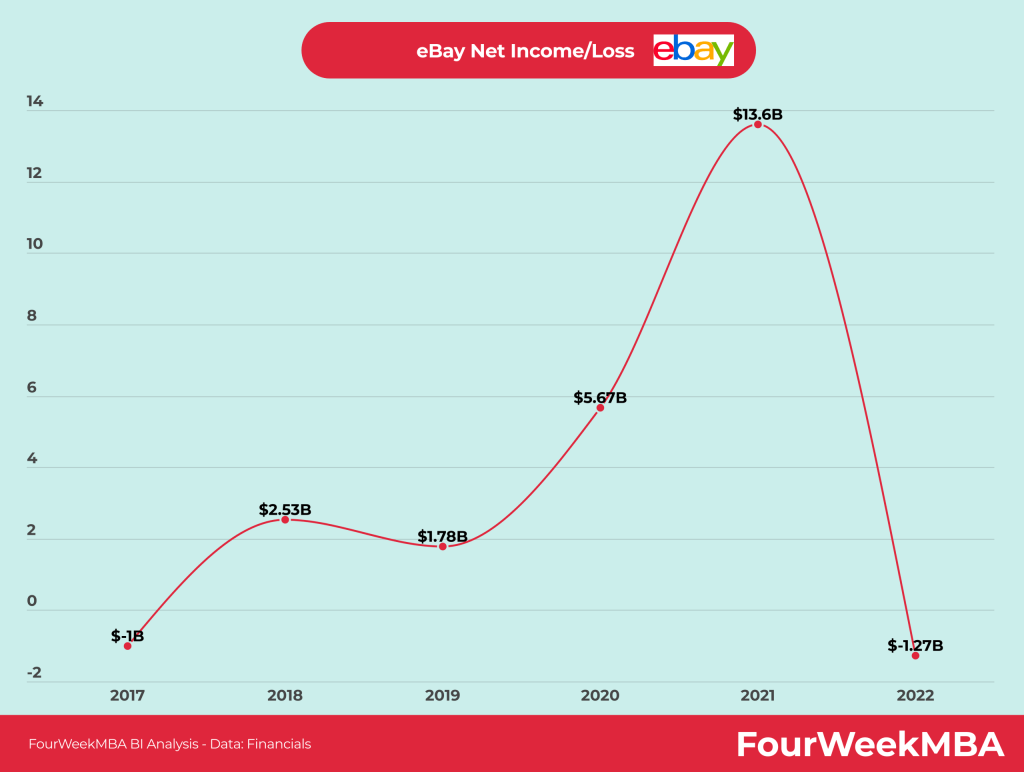
By 2008, eBay was available worldwide with around 15,000 employees and revenue of $7.7 billion. Revenue has remained stable over subsequent years, with $10.42 billion in 2021 and $9.79 billion in 2022.
Key takeaways:
- eBay is an online marketplace that was founded in 1995 by Pierre Omidyar, an Iranian-American software engineer. Initially known as AuctionWeb, Omidyar created the platform as a hobby project where people could buy and sell items online.
- AuctionWeb was founded in 1995, with the first version hosted on Omidyar’s personal website. According to the eBay website, Omidyar wrote the code for AuctionWeb over the Labor Day weekend and wanted it to be “dedicated to bringing together buyers and sellers in an honest and open marketplace.”
- In September, AuctionWeb was renamed eBay after Omidyar’s consulting firm Echo Bay Technology Group. Since echobay.com was already registered with a mining company, ebay.com was registered and the name of the platform was shortened. Much of the platform’s early success can be attributed to the Beanie Babies stuffed toy trend.
Key Highlights
- eBay’s Ownership and Shareholders: As of 2020, eBay’s main shareholder is its founder, Pierre Omidyar, who still owned around 4.69% of the company’s stock before stepping down from the board. Other major institutional investors include Vanguard, Blackrock, and Fidelity Investments.
- Pierre Omidyar’s Ownership: Pierre Omidyar is the technology entrepreneur and founder of eBay. He initially owned 4.69% of the company’s stocks, valued at over a billion dollars. He sold a significant portion of his stocks over the years, contributing to his billionaire status.
- Origin Story: eBay was founded in 1995 by Pierre Omidyar, an Iranian-American software engineer. Originally named AuctionWeb, Omidyar created it as a hobby project to facilitate online buying and selling.
- AuctionWeb’s Creation: AuctionWeb was launched in 1995 on Omidyar’s personal website. Omidyar wrote the code over a Labor Day weekend, with the aim of creating an honest and open marketplace to connect buyers and sellers.
- First Transaction and Growth: The platform’s first transaction involved Omidyar selling a broken laser pointer. This unexpected success prompted him to switch to a business account due to increased traffic. Omidyar eventually introduced fees for platform usage.
- Expansion and Hires: eBay’s growth led Omidyar to hire Chris Agarpao and Jeffrey Skoll, the company’s first employee and president, respectively. The platform saw significant growth, including selling over $500 million worth of Beanie Babies.
- Renaming to eBay and IPO: AuctionWeb was renamed eBay in September, inspired by Omidyar’s consulting firm Echo Bay Technology Group. Benchmark Capital invested $5 million for a 22% stake, which proved to be a highly successful venture investment. eBay went public in 1998, turning Omidyar and Skoll into billionaires.
- Meg Whitman’s Leadership and Expansion: Meg Whitman became president and CEO of eBay after its successful IPO. The platform rapidly expanded beyond toys, acquiring PayPal in 2002 and eventually becoming a worldwide presence with substantial revenue.
- Revenue and Stability: Over the years, eBay’s revenue remained stable, with billions in revenue, such as $10.42 billion in 2021 and $9.79 billion in 2022.
Related Visual Stories




Related Tech Ownership Case Studies




Read More:


