How we source: figures on this page come from the company’s own filings (SEC 10-K, 10-Q and earnings releases, or its annual report), with the period stated next to each number. Last refreshed October 2026. Our methodology.
In short
Wayfair makes money by selling home goods on its own sites and booking each sale at full price. In fiscal 2025 it had net revenue of $12.46 billion, with the U.S. providing 88%. Its 21 million active customers spent an average of $312 per order. Suppliers also pay it for logistics and media, but Wayfair books those fees as cost reductions, not as revenue.
Wayfair is a furniture and household item eCommerce company founded in 2002 by Niraj Shah and Steve Conine. Wayfair initially operated as a simple drop shipping business but has since diversified its revenue generation strategy, and it makes money via product sales, installation services, advertising, and interchange fees.
How Wayfair Inc. (NYSE: W) makes money, FY2025: the income statement as a flow, to scale. U.S. product sales bring 88% of revenue; International's EBITDA is negative. Source: Wayfair Inc. (NYSE: W) Form 10-K for fiscal 2025 (filed 2026-02-19). Gross profit, margins and shares calculated.
Wayfair says it generates net revenue primarily through product sales on its family of sites. It records the full sale price because it controls the product before it reaches the customer. It does this even though, by its own account, most products ship directly from suppliers.
Wayfair revenue by fiscal year, FY2021 to FY2025, from the company's filings. Chart: The Business Engineer.
In fiscal 2025, net revenue was $12,457 million. That was 40 million orders at an average order value of $312. Revenue per active customer over the last twelve months was $586. Repeat buyers placed 80.3% of orders.
Advertising is the main lever for winning customers. It cost $1,425 million in fiscal 2025, or 11.4% of net revenue. Suppliers pay for CastleGate logistics services and for media and merchandising. Wayfair books these fees against shipping and product costs, so they do not appear as revenue.
How Wayfair compares
Against its own history, Wayfair is smaller than at its peak. Net revenue was $13,708 million in fiscal 2021 and $12,457 million in fiscal 2025. Active customers fell from 27 million to 21 million over the same period, while average order value rose from $265 to $312.
Between segments, the U.S. made $10,973 million of revenue and $762 million of segment Adjusted EBITDA. International made $1,484 million of revenue and a $19 million segment Adjusted EBITDA loss.
What changed in FY2025
Revenue grew 5.1%, after falling in each of fiscal 2022, 2023 and 2024. Wayfair attributes the growth mainly to higher average order value, plus more orders. U.S. revenue rose 5.8%. International rose 0.4% despite the exit from Germany, which was announced on 10 January 2025.
Wayfair revenue by line, prior year against FY2025, as reported. Chart: The Business Engineer.
Wayfair posted operating income of $17 million, compared with a $461 million loss a year earlier. Advertising fell to 11.4% of revenue from 12.4%. Selling, operations, technology, general and administrative costs fell to 14.3% from 16.7% after workforce reductions. The company still made a net loss of $313 million. The main reasons were a $233 million loss on repurchasing convertible notes and interest expense of $119 million.
What to watch
Wayfair names changes to U.S. trade policy, including tariffs, as a risk to itself and its suppliers. It also says its results are sensitive to consumer discretionary spending.
Other figures to watch are whether active customers, flat at 21 million, start growing again; whether International moves out of its Adjusted EBITDA loss; and how much higher interest costs on the new secured notes take from operating profit.
Frequently asked questions
How does Wayfair make money?
Mainly by selling home goods through its own sites, which brought in net revenue of $12,457 million in fiscal 2025. It also earns fees from suppliers for logistics and media, which it books as cost reductions, and revenue from its credit card program.
How much of Wayfair's revenue comes from the U.S.?
In fiscal 2025, U.S. net revenue was $10,973 million, or 88% of the total. International, which covers Canada, the UK and Ireland, made $1,484 million.
Is Wayfair profitable?
On an operating basis, just about: it reported $17 million of operating income in fiscal 2025. It made a net loss of $313 million, after a $233 million loss on debt extinguishment and $119 million of net interest expense. Adjusted EBITDA (non-GAAP) was $743 million, a 6.0% margin.
How much does Wayfair spend on advertising?
$1,425 million in fiscal 2025, which was 11.4% of net revenue, down from 12.4% in fiscal 2024.
Inspired by Conine’s mother – who owned two furniture stores – the pair sought to move furniture shopping online and give consumers more choice in the process.
Racksandstands.com was launched in August 2002, an early eCommerce site selling storage furniture and media stands. The site became very popular, thanks in part to a diverse product range and good SEO.
To increase the legitimacy of their venture, Conine and Shah created holding company CSN Stores. Eventually, CSN Stores would encapsulate more than 200 different websites selling everything from bar stools to aviaries.
Expansion into the Canadian, British, and German markets soon followed as the company built a logistics network specially designed to ship large items quickly.
Wide Product Selection: Wayfair offers a vast selection of furniture, home goods, decor, appliances, lighting, and outdoor products from thousands of brands and suppliers, providing customers with a comprehensive range of options to suit their individual style, budget, and needs.
Competitive Prices: Wayfair provides competitive prices and value-oriented deals on its products, leveraging its scale, supplier relationships, and operational efficiency to offer affordable pricing and discounts to customers, ensuring cost-effective shopping and value for money.
Convenience and Accessibility: Wayfair offers a convenient and accessible shopping experience through its user-friendly website and mobile app, allowing customers to browse, search, and purchase products anytime, anywhere, with easy navigation, intuitive filters, and secure payment options.
Inspiration and Guidance: Wayfair provides inspiration and guidance to customers through curated collections, style guides, room ideas, and design tips, helping shoppers visualize and plan their home decor projects, discover new trends, and make informed purchasing decisions.
Personalized Recommendations: Wayfair offers personalized product recommendations, suggestions, and alerts based on customers’ browsing history, preferences, and past purchases, tailoring the shopping experience to each individual user and enhancing engagement and satisfaction.
FourWeekMBABusiness EngineerTimeline, as stated in the article
2002
Racksandstands.com was launched in August 2002, an early eCommerce site selling storage furniture and media stands.
2011
In 2011, the CSN Stores group of sites was consolidated and rebranded as Wayfair, Inc.
2020
Total net revenue for Wayfair was $3.7 billion in 2020, representing a 44.9% year-over-year increase.
Wayfair revenue generation
Wayfair initially operated as a simple drop shipping business but has since diversified its revenue generation strategy.
The company now makes money in the following ways.
Product sales
As an eCommerce giant, Wayfair purchases goods in bulk and then attempts to sell them for a profit.
The company still engages in drop shopping to some extent. When Wayfair receives a customer order, it forwards the order to a partner to fulfill.
The company does not charge partners for sending business their way and even covers shipping costs.
Installation services
Wayfair has partnered with Handy to take the stress out of furniture assembly by connecting consumers with certified installation experts.
The fee for this service varies by product and is split between Handy and Wayfair.
Advertising
Furniture retailers can also buy sponsored ad placements on the Wayfair website.
Ads may be placed preferentially in product search results. They may also be placed in Wayfair video content or via sponsored brand posts.
Wayfair collects advertising revenue based on the number of clicks ads receive. Sponsored posts may attract a fixed fee or a percentage of each subsequent sale.
Interchange fees
Wayfair recently started offering credit cards to consumers with access to perks including cash back rewards, discounts, and no annual fees.
The company makes money whenever a customer purchases with a Wayfair branded Mastercard. This so-called interchange fee is collected by Mastercard from the merchant and is shared with Wayfair.
Credit card interest is also collected if users fail to pay for their orders in full before a designated period. The annual percentage rate (APR) in such a scenario is 26.99%.
Marketing Strategy
Digital Advertising: Wayfair invests in digital advertising campaigns across various online channels, including search engines, social media platforms, display networks, and affiliate marketing channels, to promote its brand, products, and special offers, targeting relevant audiences and driving traffic to its website.
Content Marketing: Wayfair produces and distributes content marketing materials, including blog posts, articles, videos, and social media content, that showcase home decor ideas, design inspiration, DIY projects, and product recommendations, engaging and educating customers and driving organic traffic and brand awareness.
Email Marketing: Wayfair utilizes email marketing campaigns to communicate with customers, deliver personalized recommendations, and promote sales, discounts, and exclusive offers to subscribers, sending targeted email newsletters, alerts, and promotions to drive conversions and repeat purchases.
Affiliate Partnerships: Wayfair partners with affiliate marketers, influencers, bloggers, and content creators to promote its products and brand through affiliate marketing programs, offering commissions, referral incentives, and co-branded marketing opportunities to affiliates who drive traffic and sales to Wayfair’s website.
Social Media Engagement: Wayfair engages with customers and followers on social media platforms such as Facebook, Instagram, Pinterest, and Twitter, sharing visual content, user-generated posts, product showcases, and lifestyle inspiration to build community, foster engagement, and increase brand visibility and loyalty.
Distribution Channels
Website and Mobile App: Wayfair distributes its products and services through its official website and mobile applications for iOS and Android devices, providing customers with a seamless and convenient shopping experience across desktop computers, smartphones, and tablets.
Third-Party Marketplaces: Wayfair partners with third-party online marketplaces and e-commerce platforms such as Amazon, eBay, Walmart, and Google Shopping to expand its reach and distribution, listing its products for sale on external marketplaces and reaching new customers through additional sales channels.
Retail Partnerships: Wayfair collaborates with brick-and-mortar retailers, department stores, and home improvement chains to sell its products through physical retail locations, showroom displays, and store-in-store partnerships, extending its reach and brand presence into offline retail channels.
Direct-to-Consumer Shipping: Wayfair ships products directly to customers’ homes and addresses through its logistics and fulfillment network, offering fast and reliable shipping services, order tracking, and delivery options, ensuring a seamless and efficient shopping experience for online shoppers.
Global Expansion: Wayfair expands its presence and distribution globally through international shipping, cross-border commerce, and localized websites and platforms, serving customers in key international markets and regions with localized product offerings, pricing, and customer support services.
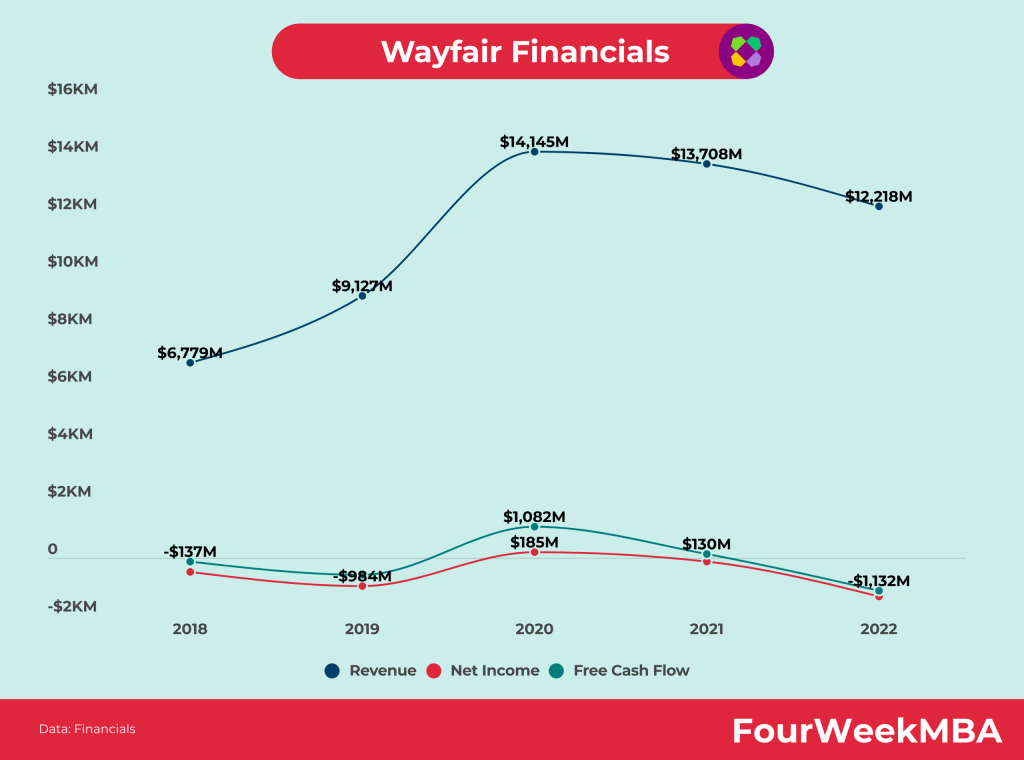
Wayfair’s revenue experienced significant growth from 2018 to 2020, increasing from $6.78 billion in 2018 to $14.14 billion in 2020.
In 2019, the revenue saw a considerable increase of $2.35 billion, reaching $9.13 billion.
The highest revenue was recorded in 2020, at $14.14 billion.
However, revenues began to decline in 2021, dropping to $13.7 billion and continued to decrease in 2022, reaching $12.21 billion.
Wayfair’s net income showed significant fluctuations between 2018 and 2022, with three years of losses and one year of profit.
In 2018, the company recorded a net loss of $504 million, which increased to a larger loss of $984 million in 2019.
A turnaround occurred in 2020, with Wayfair posting a net income of $185 million.
However, the net income turned negative again in 2021, with a loss of $131 million, and significantly worsened in 2022, recording a substantial loss of $1,331 million.
Between 2018 and 2020, Wayfair experienced significant revenue growth, increasing from $6,779 million in 2018 to $14,145 million in 2020.
During the same period, net income fluctuated, with losses of $504 million in 2018 and $984 million in 2019, followed by a profit of $185 million in 2020.
Free cash flow also showed inconsistency, with negative figures in 2018 (-$137 million) and 2019 (-$597 million), before turning positive in 2020 ($1,082 million).
In 2021, revenue declined to $13,708 million, while net income returned to a loss of $131 million, and free cash flow reduced to $130 million.
The downward trend continued in 2022, with revenue at $12,218 million, a substantial net loss of $1,331 million, and negative free cash flow of $1,132 million.
Wayfair’s active customer base experienced growth from 2018 to 2020, increasing from 15 million in 2018 to 31 million in 2020.
In 2019, the number of active customers rose by 5 million, reaching 20 million.
The most significant growth occurred in 2020, when active customers jumped to 31 million.
However, the number of active customers began to decline in 2021, dropping to 27 million, and continued to decrease in 2022, reaching 22 million.
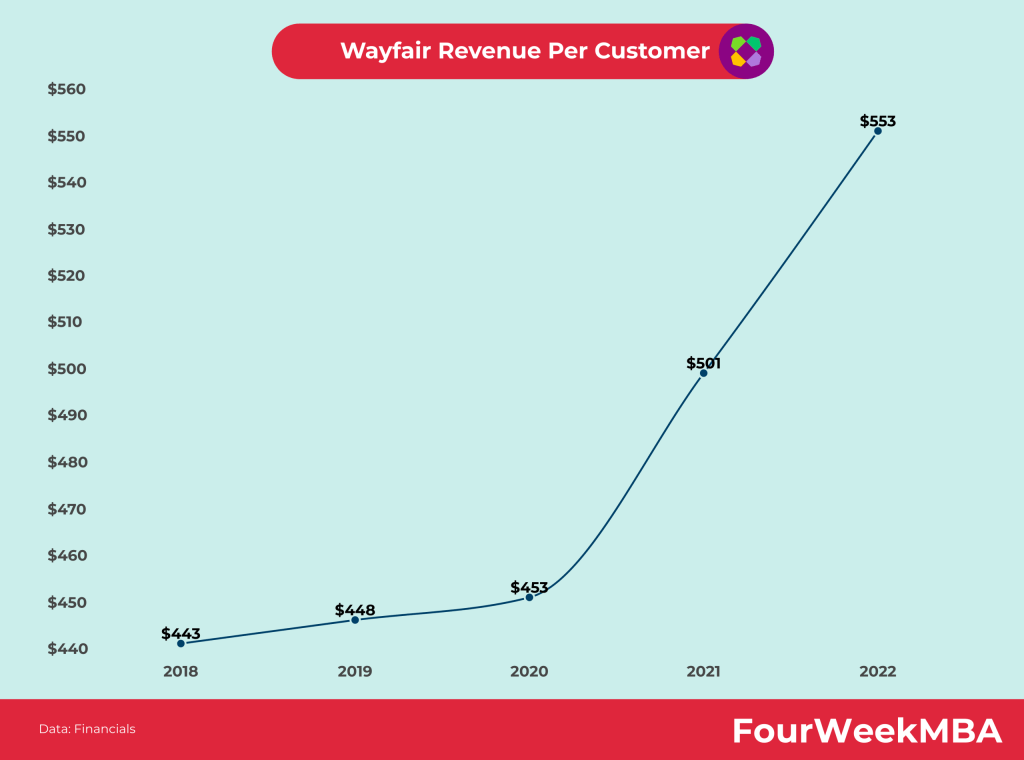
Wayfair’s last twelve months’ revenue per active customer consistently increased from 2018 to 2022.
In 2018, the revenue per active customer was $443, slightly rising to $448 in 2019.
The upward trend continued in 2020, with the revenue per active customer reaching $453.
A more significant increase occurred in 2021, as the revenue per active customer jumped to $501.
The highest revenue per active customer was recorded in 2022, at $553, indicating an improvement in customer spending despite declining active customers.
Wayfair’s orders delivered experienced growth from 2018 to 2020, increasing from 28 million in 2018 to 61 million in 2020.
In 2019, the number of orders delivered rose by 9 million, reaching 37 million.
The most significant growth occurred in 2020 when orders delivered jumped to 61 million.
However, the number of orders delivered began to decline in 2021, dropping to 52 million and continued to decrease in 2022, reaching 40 million.
Wayfair’s average order value experienced fluctuations between 2018 and 2022, with an overall upward trend.
In 2018, the average order value was $239, which slightly rose to $241 in 2019.
The average order value decreased in 2020 to $232.
However, the average order value increased significantly in 2021, reaching $265, and continued to rise in 2022, reaching its highest point at $305.
Wayfair’s employee count experienced fluctuations between 2018 and 2022, with an overall upward trend until 2021, followed by a slight decrease in 2022.
In 2018, the company had 12,124 employees, which increased substantially to 16,985 employees in 2019.
The employee count decreased in 2020 to 16,122.
The number of employees slightly increased in 2021, reaching 16,681.
However, the employee count experienced a small decline in 2022, dropping to 15,745.
Gennaro Cuofano is a CRO and tech executive who has worked in AI since late 2015, starting with bringing NLP, natural-language generation, voice and chatbot products to the marketing industry. His background is in law and finance: he holds a Master's degree in Law and an International MBA with an emphasis on corporate finance (LUISS Business School and the University of San Diego, 2012), and worked as a financial analyst at a real-estate investment firm in San Diego and as an assistant controller. His work focuses on business model strategy, business engineering and, more broadly, structural analysis: how companies make money, read from their own filings. He created FourWeekMBA and leads research there and at The Business Engineer, his newsletter on AI and business strategy, with over 95,000 subscribers and more than 1,000 published analyses. His writing has also appeared on Entrepreneur, HackerNoon and Search Engine People. Find him on LinkedIn and Substack. See how we source.
Scroll to Top
Discover more from FourWeekMBA
Subscribe now to keep reading and get access to the full archive.