Security as a Service (SECaaS) is a cloud-based delivery model that provides organizations with a comprehensive suite of security solutions and capabilities to protect their digital assets, data, and infrastructure.
By outsourcing security functions to third-party providers, businesses can leverage advanced technologies, expertise, and resources to strengthen their security posture, detect and respond to threats, and ensure regulatory compliance. SECaaS encompasses a wide range of security offerings, including network security, endpoint protection, identity and access management, and threat intelligence.
Analysis via VTDF Framework, developed by Gennaro Cuofano
Description
Value Proposition
– Comprehensive security solutions accessible on-demand. – Cost-effective services with pay-as-you-go pricing. – Enhanced security posture with expert monitoring and management.
Technological Advantage
– Advanced security technologies including firewalls, intrusion detection/prevention systems, and antivirus software. – 24/7 security monitoring and incident response by skilled security professionals. – Scalable security solutions to adapt to changing threat landscapes and business needs.
Distribution Channels
– Online platform for browsing SECaaS offerings, accessing resources, and managing security configurations. – Partnerships with IT service providers, managed security service providers (MSSPs), and cybersecurity firms. – Direct sales team targeting enterprises, SMBs, and government agencies.
Financial Model
– Revenue: Subscription-based model with pricing tiers based on services offered, level of protection, and number of users/devices. – Cost: Operational expenses including security infrastructure, personnel, and software licenses. – Investment in customer support, marketing, and sales for business growth and customer satisfaction.
SECaaS offers a comprehensive suite of security solutions and services, including firewall management, intrusion detection and prevention, data encryption, and security information and event management (SIEM).
Organizations can select and customize security services based on their specific needs, risk profile, and compliance requirements.
Cloud-Based Delivery Model:
SECaaS solutions are delivered via the cloud, allowing organizations to access security capabilities remotely over the internet.
Cloud-based deployment offers scalability, flexibility, and cost efficiency, eliminating the need for on-premises hardware and software installations.
Continuous Monitoring and Management:
SECaaS providers offer continuous monitoring, threat detection, and incident response services to proactively identify and mitigate security threats.
Security operations centers (SOCs) leverage advanced analytics, machine learning, and automation to monitor and manage security events in real-time.
Regulatory Compliance and Reporting:
SECaaS solutions help organizations achieve and maintain regulatory compliance by providing audit trails, reporting capabilities, and compliance frameworks.
Providers offer compliance monitoring, risk assessment, and remediation services to ensure adherence to industry standards and regulations.
Implications of SECaaS
Enhanced Threat Detection and Response: SECaaS enables organizations to detect and respond to security threats more effectively by leveraging advanced analytics, threat intelligence, and automated incident response capabilities.
Cost Savings and Efficiency: By outsourcing security functions to third-party providers, organizations can reduce the costs associated with managing and maintaining on-premises security infrastructure and resources.
Scalability and Flexibility: SECaaS offers scalability and flexibility, allowing organizations to scale security services up or down based on changing business needs, workloads, and threat landscapes.
Focus on Core Competencies: By offloading security responsibilities to SECaaS providers, organizations can focus on their core business activities and strategic initiatives, rather than allocating resources to security management.
Use Cases and Examples
Managed Security Services:
Managed security service providers (MSSPs) offer a wide range of SECaaS offerings, including managed firewall, antivirus, intrusion detection, and vulnerability management services.
Organizations leverage MSSPs to augment their internal security capabilities, enhance threat detection and response, and achieve regulatory compliance.
Cloud Security Platforms:
Cloud security platforms, such as Amazon Web Services (AWS) Security Hub, Microsoft Azure Security Center, and Google Cloud Security Command Center, provide integrated security management and monitoring capabilities for cloud environments.
These platforms offer centralized visibility, compliance reporting, and automated remediation across multi-cloud and hybrid cloud deployments.
Strategies for Implementing SECaaS
Risk Assessment and Gap Analysis:
Conduct a comprehensive risk assessment and gap analysis to identify security vulnerabilities, compliance requirements, and business priorities.
Prioritize security initiatives and investments based on risk severity, impact on business operations, and regulatory requirements.
Vendor Selection and Due Diligence:
Evaluate SECaaS providers based on their expertise, track record, service offerings, and industry certifications.
Perform due diligence to assess the provider’s security controls, data protection measures, and compliance with relevant regulations.
Integration and Orchestration:
Integrate SECaaS solutions with existing security tools, systems, and processes to ensure seamless interoperability and centralized management.
Implement security orchestration and automation to streamline incident response, remediation, and workflow automation.
Benefits of SECaaS
Improved Security Posture: SECaaS enhances organizations’ security posture by providing access to advanced security technologies, expertise, and resources.
Cost-Effective Scalability: SECaaS offers cost-effective scalability, allowing organizations to scale security services up or down based on evolving business needs and threat landscapes.
Enhanced Compliance: SECaaS helps organizations achieve and maintain regulatory compliance by providing audit trails, reporting capabilities, and compliance frameworks.
Focus on Innovation: By outsourcing security functions to SECaaS providers, organizations can focus on innovation, agility, and growth initiatives, rather than dedicating resources to security management.
Challenges of SECaaS
Data Privacy and Sovereignty: Concerns about data privacy, sovereignty, and regulatory compliance may hinder organizations’ adoption of SECaaS solutions, particularly in regulated industries or regions.
Security Risks and Threats: Entrusting security functions to third-party providers introduces risks related to data breaches, insider threats, and supply chain vulnerabilities.
Vendor Lock-In: Organizations may face vendor lock-in when relying heavily on specific SECaaS providers, limiting their ability to switch or migrate to alternative solutions.
Integration Complexity: Integrating SECaaS solutions with existing IT systems and processes can be complex, requiring careful planning and execution to ensure compatibility and interoperability.
Conclusion
SECaaS represents a paradigm shift in the way organizations approach cybersecurity, offering comprehensive, scalable, and cost-effective security solutions in the cloud. By understanding the key elements, implications, use cases, strategies, benefits, and challenges of SECaaS, organizations can leverage its transformative potential to strengthen their security posture, mitigate risks, and achieve regulatory compliance. Embracing SECaaS enables organizations to focus on innovation, agility, and growth initiatives, while outsourcing security functions to trusted providers with the expertise and resources to safeguard their digital assets and infrastructure effectively. As cybersecurity threats continue to evolve, SECaaS will play an increasingly vital role in helping organizations adapt and thrive in an ever-changing threat landscape.
As-A-Service Business Model Types
Description
Examples
Software as a Service (SaaS)
Cloud-based software applications accessible via subscription.
Salesforce, Adobe, Microsoft 365
Platform as a Service (PaaS)
Provides cloud-based platform services, enabling developers to build and deploy applications.
Heroku, Google App Engine
Infrastructure as a Service (IaaS)
Online services that provide APIs for managing network infrastructure like servers and storage.
Amazon Web Services, Microsoft Azure
Hardware as a Service (HaaS)
Physical devices and equipment offered as a service, including maintenance and upgrades.
Dell Device as a Service, HP Device as a Service
Database as a Service (DBaaS)
Cloud-managed database systems that handle all hardware and software management tasks.
Amazon RDS, Google Cloud SQL
Network as a Service (NaaS)
Network infrastructure and services provided over the internet, like bandwidth and virtual networks.
Cisco Meraki, Cloudflare
Storage as a Service (STaaS)
Providing data storage as a service, accessible through the internet.
Dropbox, Google Drive
Container as a Service (CaaS)
Cloud service allowing software developers to upload, run, and manage containers.
Google Kubernetes Engine, Docker
Function as a Service (FaaS)
A form of serverless computing where applications are broken into individual functions that run when triggered.
AWS Lambda, Azure Functions
Desktop as a Service (DaaS)
Virtual desktop infrastructure hosted in the cloud, with backend responsibilities managed by the provider.
VMware Horizon Cloud, Citrix Cloud
Communications as a Service (CaaS)
Cloud-based solutions for communication software, like VoIP or unified communications.
RingCentral, 8×8
Security as a Service (SECaaS)
Security management provided by a third-party service provider via the cloud.
Symantec Cloud Security, McAfee Cloud Security
Management as a Service (MaaS)
Management functions delivered as cloud services which help manage other cloud services.
Microsoft Managed Desktop
Backend as a Service (BaaS)
Cloud solutions to automate backend side operations and cloud storage for web and mobile apps.
Firebase, Parse
Disaster Recovery as a Service (DRaaS)
Cloud services providing data backup, security, and recovery to help businesses recover from a disaster.
Zerto, Veeam Cloud Connect
Compliance as a Service (CaaS)
Helps businesses meet compliance requirements through cloud services.
TrustArc, ComplianceQuest
Analytics as a Service (AaaS)
Offers analytics tools and insights as a service.
IBM Cognos Analytics, Google Analytics 360
Artificial Intelligence as a Service (AIaaS)
Provides AI capabilities, including machine learning models, as a service.
IBM Watson, Google AI
Robotics as a Service (RaaS)
Cloud robotics where robots and automation solutions are provided as a service.
Rapyuta Robotics, InOrbit
Testing as a Service (TaaS)
Offers testing environments and frameworks in the cloud for software testing.
Sauce Labs, BlazeMeter
Integration as a Service (IaaS)
Cloud-based integration services that help businesses combine different systems and applications.
MuleSoft, Dell Boomi
Marketing as a Service (MaaS)
Provides comprehensive marketing solutions including campaign management, analytics, and content creation.
HubSpot, Marketo
Learning as a Service (LaaS)
Educational and training resources accessible via the internet.
LinkedIn Learning, Pluralsight
Blockchain as a Service (BaaS)
Facilitates the deployment of blockchain technology via the cloud.
IBM Blockchain, Azure Blockchain Service
Connected Business Frameworks, Models And Concepts
One of the first mentions of customer lifetime value was in the 1988 book Database Marketing: Strategy and Implementation written by Robert Shaw and Merlin Stone. Customer lifetime value (CLV) represents the value of a customer to a company over a period of time. It represents a critical business metric, especially for SaaS or recurring revenue-based businesses.
AIOps is the application of artificial intelligence to IT operations. It has become particularly useful for modern IT management in hybridized, distributed, and dynamic environments. AIOps has become a key operational component of modern digital-based organizations, built around software and algorithms.
Machine Learning Ops (MLOps) describes a suite of best practices that successfully help a business run artificial intelligence. It consists of the skills, workflows, and processes to create, run, and maintain machine learning models to help various operational processes within organizations.
The business intelligence models have transitioned to continuous intelligence, where dynamic technology infrastructure is coupled with continuous deployment and delivery to provide continuous intelligence. In short, the software offered in the cloud will integrate with the company’s data, leveraging on AI/ML to provide answers in real-time to current issues the organization might be experiencing.
That is a process that requires a continuous feedback loop to develop a valuable product and build a viable business model. Continuous innovation is a mindset where products and services are designed and delivered to tune them around the customers’ problems and not the technical solution of its founders.
Technological modeling is a discipline to provide the basis for companies to sustain innovation, thus developing incremental products. While also looking at breakthrough innovative products that can pave the way for long-term success. In a sort of Barbell Strategy, technological modeling suggests having a two-sided approach, on the one hand, to keep sustaining continuous innovation as a core part of the business model. On the other hand, it places bets on future developments that have the potential to break through and take a leap forward.
An effective business model has to focus on two dimensions: the people dimension and the financial dimension. The people dimension will allow you to build a product or service that is 10X better than existing ones and a solid brand. The financial dimension will help you develop proper distribution channels by identifying the people that are willing to pay for your product or service and make it financially sustainable in the long run.
Business model innovation is about increasing the success of an organization with existing products and technologies by crafting a compelling value proposition able to propel a new business model to scale up customers and create a lasting competitive advantage. And it all starts by mastering the key customers.
Digital and tech business models can be classified according to four levels of transformation into digitally-enabled, digitally-enhanced, tech or platform business models, and business platforms/ecosystems.
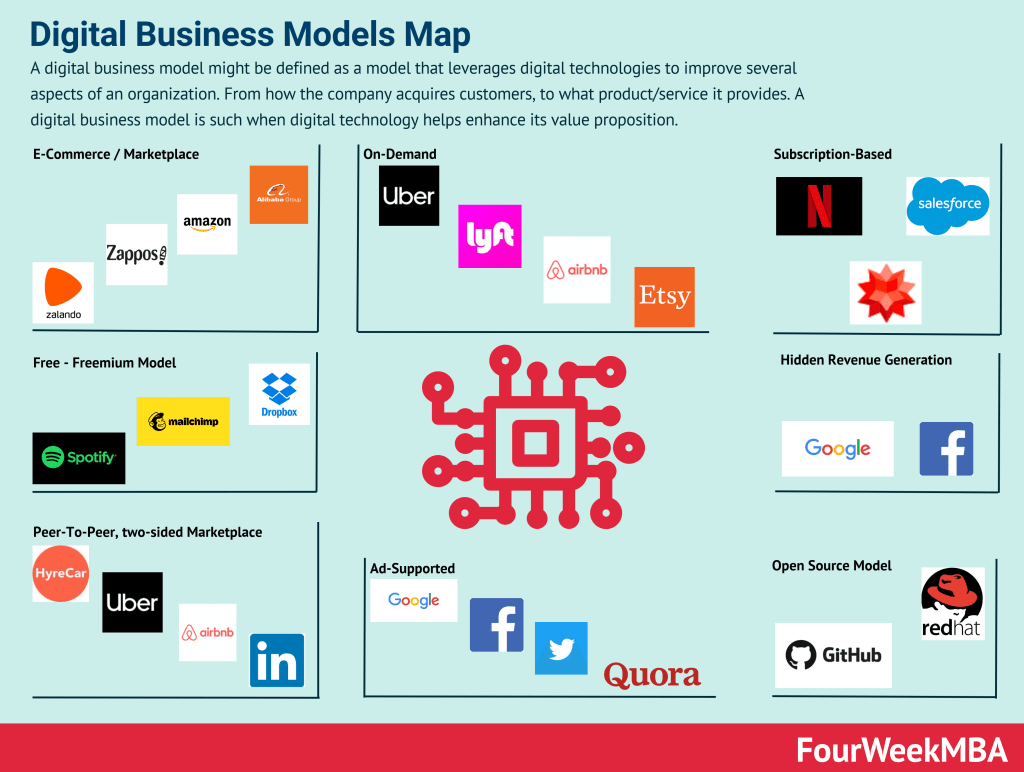
A digital business model might be defined as a model that leverages digital technologies to improve several aspects of an organization. From how the company acquires customers, to what product/service it provides. A digital business model is such when digital technology helps enhance its value proposition.
A tech business model is made of four main components: value model (value propositions, mission, vision), technological model (R&D management), distribution model (sales and marketingorganizational structure), and financial model (revenue modeling, cost structure, profitability and cash generation/management). Those elements coming together can serve as the basis to build a solid tech business model.
A platform business model generates value by enabling interactions between people, groups, and users by leveraging network effects. Platform business models usually comprise two sides: supply and demand. Kicking off the interactions between those two sides is one of the crucial elements for a platform business model success.
A Blockchain Business Model is made of four main components: Value Model (Core Philosophy, Core Value and Value Propositions for the key stakeholders), Blockchain Model (Protocol Rules, Network Shape and Applications Layer/Ecosystem), Distribution Model (the key channels amplifying the protocol and its communities), and the Economic Model (the dynamics through which protocol players make money). Those elements coming together can serve as the basis to build and analyze a solid Blockchain Business Model.
In an asymmetric businessmodel, the organization doesn’t monetize the user directly, but it leverages the data users provide coupled with technology, thus have a key customer pay to sustain the core asset. For example, Google makes money by leveraging users’ data, combined with its algorithms sold to advertisers for visibility.
In an asymmetric businessmodel, the organization doesn’t monetize the user directly, but it leverages the data users provide coupled with technology, thus having a key customer pay to sustain the core asset. For example, Google makes money by leveraging users’ data, combined with its algorithms sold to advertisers for visibility. This is how attention merchants make monetize their business models.
While the term has been coined by Andrew Lampitt, open-core is an evolution of open-source. Where a core part of the software/platform is offered for free, while on top of it are built premium features or add-ons, which get monetized by the corporation who developed the software/platform. An example of the GitLab open core model, where the hosted service is free and open, while the software is closed.
Cloud business models are all built on top of cloud computing, a concept that took over around 2006 when former Google’s CEO Eric Schmit mentioned it. Most cloud-based business models can be classified as IaaS (Infrastructure as a Service), PaaS (Platform as a Service), or SaaS (Software as a Service). While those models are primarily monetized via subscriptions, they are monetized via pay-as-you-go revenue models and hybrid models (subscriptions + pay-as-you-go).
Open source is licensed and usually developed and maintained by a community of independent developers. While the freemium is developed in-house. Thus the freemium give the company that developed it, full control over its distribution. In an open-source model, the for-profit company has to distribute its premium version per its open-source licensing model.
The freemium – unless the whole organization is aligned around it – is a growth strategy rather than a business model. A free service is provided to a majority of users, while a small percentage of those users convert into paying customers through the sales funnel. Free users will help spread the brand through word of mouth.
A freeterprise is a combination of free and enterprise where free professional accounts are driven into the funnel through the free product. As the opportunity is identified the company assigns the free account to a salesperson within the organization (inside sales or fields sales) to convert that into a B2B/enterprise account.
A marketplace is a platform where buyers and sellers interact and transact. The platform acts as a marketplace that will generate revenues in fees from one or all the parties involved in the transaction. Usually, marketplaces can be classified in several ways, like those selling services vs. products or those connecting buyers and sellers at B2B, B2C, or C2C level. And those marketplaces connecting two core players, or more.
B2B, which stands for business-to-business, is a process for selling products or services to other businesses. On the other hand, a B2C sells directly to its consumers.
A B2B2C is a particular kind of business model where a company, rather than accessing the consumer market directly, it does that via another business. Yet the final consumers will recognize the brand or the service provided by the B2B2C. The company offering the service might gain direct access to consumers over time.
Direct-to-consumer (D2C) is a business model where companies sell their products directly to the consumer without the assistance of a third-party wholesaler or retailer. In this way, the company can cut through intermediaries and increase its margins. However, to be successful the direct-to-consumers company needs to build its own distribution, which in the short term can be more expensive. Yet in the long-term creates a competitive advantage.
The C2C business model describes a market environment where one customer purchases from another on a third-party platform that may also handle the transaction. Under the C2C model, both the seller and the buyer are considered consumers. Customer to customer (C2C) is, therefore, a business model where consumers buy and sell directly between themselves. Consumer-to-consumer has become a prevalent business model especially as the web helped disintermediate various industries.
A retail business model follows a direct-to-consumer approach, also called B2C, where the company sells directly to final customers a processed/finished product. This implies a business model that is mostly local-based, it carries higher margins, but also higher costs and distribution risks.
The wholesale model is a selling model where wholesalers sell their products in bulk to a retailer at a discounted price. The retailer then on-sells the products to consumers at a higher price. In the wholesale model, a wholesaler sells products in bulk to retail outlets for onward sale. Occasionally, the wholesaler sells direct to the consumer, with supermarket giant Costco the most obvious example.
The term “crowdsourcing” was first coined by Wired Magazine editor Jeff Howe in a 2006 article titled Rise of Crowdsourcing. Though the practice has existed in some form or another for centuries, it rose to prominence when eCommerce, social media, and smartphone culture began to emerge. Crowdsourcing is the act of obtaining knowledge, goods, services, or opinions from a group of people. These people submit information via social media, smartphone apps, or dedicated crowdsourcing platforms.
In a franchained business model (a short-term chain, long-term franchise) model, the company deliberately launched its operations by keeping tight ownership on the main assets, while those are established, thus choosing a chain model. Once operations are running and established, the company divests its ownership and opts instead for a franchising model.
Businesses employing the brokerage business model make money via brokerage services. This means they are involved with the facilitation, negotiation, or arbitration of a transaction between a buyer and a seller. The brokerage business model involves a business connecting buyers with sellers to collect a commission on the resultant transaction. Therefore, acting as a middleman within a transaction.
Dropshipping is a retail business model where the dropshipper externalizes the manufacturing and logistics and focuses only on distribution and customer acquisition. Therefore, the dropshipper collects final customers’ sales orders, sending them over to third-party suppliers, who ship directly to those customers. In this way, through dropshipping, it is possible to run a business without operational costs and logistics management.
Gennaro is the creator of FourWeekMBA, which reached about four million business people, comprising C-level executives, investors, analysts, product managers, and aspiring digital entrepreneurs in 2022 alone | He is also Director of Sales for a high-tech scaleup in the AI Industry | In 2012, Gennaro earned an International MBA with emphasis on Corporate Finance and Business Strategy.