Netflix is among the most popular streaming platforms, with a subscription-based business model. The brand, platform, and content are strengths. The volatility of content licensing and production are weaknesses. The streaming market is a potential blue ocean. The inability to attract and retain premium members and its fixed long-term costs are threats to its business model.
Binge-watching is the practice of watching TV series all at once. In a speech at the Edinburgh Television Festival in 2013, Kevin Spacey said: “If they want to binge then we should let them binge.” This new content format would be popularized by Netflix, launching its TV series all at once.
Brand: Netflix has become one of the stranger consumers brands of our times, and one of the digital business models, who reached the status of a tech giant. This is a crucial ingredient for Netflix’s success, as Hollywood moved to Silicon Valley.
Platform: The content on the platform, combined with Netflix algorithms for content recommendation makes it among the stickiest tech platforms, where members spend hours binge-watching.
Content: Netflix’s selection and production of content also make it among the platforms with a wide variety. The content is both licensed and produced by Netflix.
Netflix is a profitable company, with over $5.4 billion in net profits in 2023, an increase compared to nearly $4.5 billion in 2022.
Content licensing:
Netflix runs a subscription-based business model where, in the past, content got licensed to make it available on the platform. The licensing agreement makes Netflix pay in advance for content that will be available on the platform for the millions of premium members to watch. This means that Netflix has to make sure to have at each time a wide variety of content to make its value proposition compelling for the premium members. This also results in a cash-flow negative financial model, where the company has to anticipate content licensing fees to make the platform running in the first place.
Content production
For a few years, Netflix also started to invest in producing its own content. While in the long-term this will make Netflix business model less reliant on licensed content, in the short-term (3-5 years) it still poses substantial strains on the company’s liquidity and ability to expand.
Blue ocean: the streaming market is still in its infancy, and the next wave might open up to new formats, and therefore larger and less competitive markets, for those able to grab them. Netflix is well-positioned for that.
Threats
Inability to attract and retain members: if Netflix will not effectively attract new users. And retained existing premium members, the negative cash-flow platform might incur substantial losses and shrink its business.
Piracy-based video offerings: piracy services, even though illegal, still represent a big threat as it becomes hard to track and keep up with them. This poses a serious threat to the overall Netflix business model.
Fixed cost of content commitments: as already highlighted, content licensing is key to the Netflix business model, yet it also represents a weakness. In the long-term, that also represents a threat- That’s because Netflix has to enter multi-year commitments with content providers, part of which are noncancelable. So if part of that content will end up unused on the platform, Netflix will still pay for it.
Key Highlights:
Strengths:
Pioneered binge-watching culture and TV series release strategy.
Netflix is a subscription-based business model making money with three simple plans: basic, standard, and premium, giving access to stream series, movies, and shows. Leveraging on a streaming platform, Netflix generated over $33.7 billion in 2023, with an operating income of over $6.95 billion and a net income of over $5.4 billion. Starting in 2013, Netflix started to develop its content under the Netflix Originals brand, which today represents the most important strategic asset for the company that, in 2023, counted over 260 million paying members worldwide.
Binge-watching is the practice of watching TV series all at once. In a speech at the Edinburgh Television Festival in 2013, Kevin Spacey said: “If they want to binge then we should let them binge.” This new content format would be popularized by Netflix, launching its TV series all at once.
Coopetition describes a recently modern phenomenon where organizations both compete and cooperate, which is also known as cooperative competition. A recent example is how the Netflix streaming platform has been among the major customers of Amazon AWS cloud infrastructure, while Amazon Prime has been among the competitors of the Netflix Prime content platform.
Netflix is among the most popular streaming platforms, with a subscription-based business model. The brand, platform, and content are strengths. The volatility of content licensing and production are weaknesses. The streaming market is a potential blue ocean. The inability to attract and retain premium members and its fixed long-term costs threaten its business model.
Netflix’s largest individual shareholder is Reed Hastings, co-founder, and former CEO of the company, now Chairperson of Netflix, with a 1.76% stake, valued at over $4.5 billion as of January 2024. Other significant individual shareholders comprise Jay C. Hoag, the company’s directors since 1999, and Ted Sarandos, former chief content officer and now Chief Executive Officer of Netflix. Major institutional shareholders comprise The Vanguard Group (7.99% ownership), BlackRock (6.24% ownership), and FMR (5.35% ownership).
In 2023 Netflix had over 260 million paid subscribers. In 2022, Netflix had 230 million paid subscribers and almost 222 million paid subscribers in 2021.
Netflix reported an average yearly revenue per subscriber of $139.68 in 2023, compared to $141.12 in 2022. Thus, Netflix had an average revenue per subscriber of $120 in 2019 (pre-COVID) and $139.68 by 2023.
In 2023, Netflix reported an average monthly revenue per subscriber of $16.28 in the US & Canada, $10.87 in EMEA, $7.64 in APAC, and $8.66 in the LATAM region. Thus, the US & Canada reported the highest average monthly revenue per subscriber of $16.28.
Netflix had over 260 million subscribers in 2023, with over $33.7 billion in revenue, of which $14.87 billion came from the USA & Canada; $10.55 billion from EMEA, $4.44 billion from LATAM, and $3.76 billion from APAC.
In 2022, The Walt Disney Company’s total paid subscriber base was larger than Netlfix, with over 235 million paid members, compared with Netflix’s over 230 million members. However, Disney’s offering is fragmented among Disney+, ESPN+, and Hulu, compared with Netflix, which has a single offering.
Samsung was founded in South Korea in 1938 by Lee Byung-Chul. Originally a trading company, it took Samsung 22 years to become the fully-fledged electronics company that most people recognize today. Indeed, the company is a leader in technological innovation through telecommunications, electronics, and home appliances.
Costco is a large American multinational corporation with a focus on low-cost, membership-only retail warehouse clubs. Costco is the 4th largest retail operator in the world, operating 785 warehouses in 10 different countries. Indeed, it has enjoyed rapid success growing from zero to $3 billion in sales within six years.
From humble beginnings just over 50 years ago, Walmart has grown to become the world’s largest retail company. A single small discount store in Arkansas has now expanded to over 11,000 stores in 28 countries. Some reports suggest that the company now makes $1.8 million of profit every hour.
Headquartered in San Francisco, California, Uber started as a peer-to-peer ridesharing platform. In more recent times, the company has moved into food delivery, rental cars, and bike-sharing. In one form or another, Uber now has a presence in over 900 cities worldwide.
It would be hard to argue the case for a more recognizable entertainment brand than Disney. Disney is of course synonymous with Walt Disney, but it was Walt and his brother Roy who started the company in 1923 in Burbank, California. Disney content is now broadcast on over 100 channels in 34 different languages across the globe.
Coca-Cola is the market leader of the soft drink industry. It is also the most widely recognized brand, with a Business Insider study revealing that a staggering 94% of the world population recognizes the red and white logo. However, Coca-Cola faces significant challenges with increasingly health-conscious consumers and less access to water resources.
Founded in 1903 by Henry Ford and is the fifth-largest family-owned company in the world. Ford is a globally recognized brand in the automotive industry for a couple of reasons. First, Henry Ford is well-known as the inventor of the production line and thus the modern automobile industry. Today, Ford has also maintained relevance as the seventh-largest car manufacturer worldwide, selling a range of passenger cars, trucks, and vans.
Tesco was founded in 1919 by Jack Cohen, as a small group of market stalls. After rapid expansion in the following years, the company became the largest retailer in the UK and is now the second-largest in the world. To put their dominance into perspective, consider that Tesco serves around 66 shoppers per second across 7000 retails stores, delivering approximately $180,000 worth of sales every minute.
Nestlé is a large multinational food and beverage manufacturer with more than 2000 brands spread across 197 countries. Some of Nestlé’s well-known brands include Nescafe, Kit-Kat, Purina, Aero, Butterfinger, Maggi, and Haagen-Dazs. Originally a producer of infant food in 1867, it is now considered to be the world’s largest food manufacturer.
Amazon is among the most diversified business model in the tech industry. The company is well-positioned to dominate e-commerce further. And while its online stores have tight profit margins, Amazon still unlocks cash for growth, while consolidating its dominance in the cloud and grabbing new opportunities like voice.
Facebook, with its products, with its strong appeal, and consumer brand has a solid business model, threatened in the last years by privacy concerns, which open up the way to potential regulation to break up the company. If that will not happen, Facebook will have the chance to expand to define other markets like VR.
Starbucks is a global consumer brand with direct distribution, recognized brands, and products that make it a viable business. Its reliance on the Americas as a primary operating segment makes it a weakness. At the same time, Starbucks faces risks related to coffee beans price volatility. Yet the company still has global expansion opportunities.
Among the most recognized car manufacturers, Tesla is valued more than the combined market capitalization of GM and Ford. While the company’s direct distribution is a strength, its lack of financial viability is a weakness. Competition is a future threat. However, if Tesla defines a new market for car manufacturing its potential growth will be massive.
Netflix is among the most popular streaming platforms, with a subscription-based business model. The brand, platform, and content are strengths. The volatility of content licensing and production are weaknesses. The streaming market is a potential blue ocean. Inability to attract and retain premium members, and its fixed long-term costs are threats to its business model.
Apple can leverage a strong consumer brand and set of successful products as a strength. Yet the company is still too reliant on the iPhone as a primary revenue stream. Though Apple is working to open up new markets as an opportunity, it has to make sure to sustain its stores’ sales.
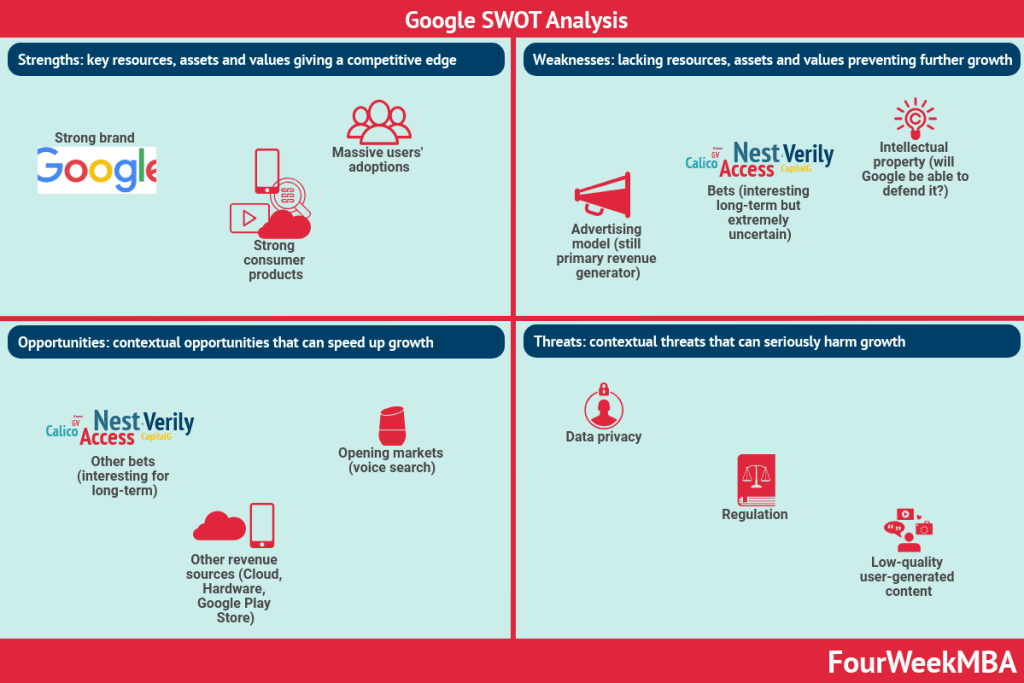
Google’s strength is its strong consumer brand. The company is grabbing new opportunities by opening up industries like voice search and consolidating in industries like the cloud. As a weakness, its revenues primarily come from advertising. A primary threat is the quick change of search and potential intervention by regulators.
Gennaro is the creator of FourWeekMBA, which reached about four million business people, comprising C-level executives, investors, analysts, product managers, and aspiring digital entrepreneurs in 2022 alone | He is also Director of Sales for a high-tech scaleup in the AI Industry | In 2012, Gennaro earned an International MBA with emphasis on Corporate Finance and Business Strategy.