Move-to-earn (M2E) is a market economy that combines physical exercise with NFTs and geo-location technology. M2E platforms use a combination of GPS, NFTs, blockchain, and GameFi technology to track user movements and rewards.
Some M2E platforms equate real-world physical activity with progression through a digital world, while others are more focused on 1-on-1 competitions or the minting, trading, and staking of NFTs.
Three move-to-earn platforms with somewhat different approaches to the model include STEPN, The Dustland, and Genopets.
Aspect
Explanation
Definition of Move-to-Earn Business Model
The Move-to-Earn Business Model is an emerging business strategy and economic concept in which individuals, users, or participants can earn rewards, incentives, or cryptocurrency tokens by engaging in specific actions or movements, often within a digital ecosystem. This model leverages technology, blockchain, and gamification to incentivize and monetize user activities, such as physical fitness, gameplay, or participation in virtual worlds. Participants accumulate rewards by “moving” or taking desired actions, which can be exchanged for real-world value or digital assets.
Key Concepts
Several key concepts define the Move-to-Earn Business Model:
– Blockchain and Cryptocurrency
Move-to-Earn platforms often utilize blockchain technology and cryptocurrencies to facilitate transparent, secure, and verifiable reward systems. Participants earn tokens or digital assets, which can have real-world value and utility.
– Incentivization
Incentivization is at the core of this model. Users are motivated to engage in specific actions, such as physical activities, gameplay, or virtual world participation, to earn rewards. Incentives can take the form of tokens, digital collectibles, discounts, or access to exclusive content.
– User Engagement
Move-to-Earn platforms prioritize user engagement and participation. They often incorporate gamification elements, challenges, and competitions to keep users motivated and entertained while encouraging continued interaction with the platform.
– Digital Ecosystems
These business models typically exist within digital ecosystems or platforms, whether they involve fitness apps, blockchain-based games, or virtual reality environments. Users become part of these ecosystems, contributing to their growth and vibrancy.
Characteristics
The Move-to-Earn Business Model exhibits the following characteristics:
– Rewards for Actions
Users receive rewards, often in the form of cryptocurrency tokens, digital assets, or other incentives, for performing specific actions or completing tasks. These actions can range from physical exercises and gameplay achievements to virtual world interactions.
– Blockchain Transparency
Transparency is a key feature, with blockchain technology ensuring that the issuance and distribution of rewards are verifiable and tamper-resistant. Participants can track their earnings and transactions on the blockchain ledger.
– Community and Social Interaction
Move-to-Earn platforms often foster communities of users who share common interests or goals. Social interaction, collaboration, and competition among participants are encouraged, enhancing the overall user experience and engagement.
– Monetization and Value Exchange
Participants can convert the rewards they earn within the platform into real-world value, trade them in secondary markets, or use them for in-platform purchases. This concept of value exchange blurs the line between virtual and physical economies.
Examples of Move-to-Earn Business Models
Move-to-Earn models are found in various domains and industries:
– Crypto Fitness Apps
Fitness apps that reward users with cryptocurrency tokens for achieving exercise goals and maintaining healthy habits. Users can earn tokens based on the number of steps taken, calories burned, or fitness challenges completed. These tokens can be used for fitness-related purchases or exchanged for other cryptocurrencies.
– Blockchain-Based Games
Blockchain-based games, also known as play-to-earn games, allow players to earn digital assets or tokens by participating in gameplay, completing quests, or owning in-game assets. Players can sell, trade, or use these assets within the game or in secondary markets.
– Virtual Real Estate Platforms
Virtual worlds and metaverse platforms offer users opportunities to acquire, develop, and monetize virtual real estate. Users can buy, sell, and trade virtual properties and earn income based on activities within the virtual environment, such as hosting events, creating content, or attracting visitors.
Benefits and Considerations
Implementing a Move-to-Earn Business Model offers several benefits and considerations:
– User Engagement and Retention
The model enhances user engagement and retention, as participants are motivated to interact regularly with the platform to earn rewards. Users become more loyal and active members of the community.
– Monetization Potential
Move-to-Earn models create opportunities for businesses to monetize user actions and data. This can generate revenue through various channels, including token sales, transaction fees, advertising, and partnerships.
– User Data and Privacy
Managing user data and privacy is critical. Platforms must handle personal and behavioral data responsibly and securely. Compliance with data protection regulations is essential to maintain trust and legal compliance.
– Token Valuation and Liquidity
The value of tokens or digital assets earned can fluctuate. Participants should be aware of the volatility and liquidity of these assets. Additionally, token economics and mechanisms for exchange should be well-designed to ensure a balanced ecosystem.
Move-to-earn is a derivative of the popular play-to-earn system where users are paid in cryptocurrency for playing certain games such as Axie Infinity and Splinterlands.
Move-to-earn is not a new idea, with early platforms such as Lympo awarding users with LYM tokens for embodying a healthy lifestyle.
In essence, move-to-earn is a system that rewards individuals for moving their bodies with cryptocurrency.
Most move-to-earn platforms use a combination of GPS, NFTs, blockchain, and GameFi technology to track user movements and rewards.
Principles of the Move-to-Earn Business Model:
Incentivization: Users are motivated to participate through the promise of rewards or earnings.
Blockchain Technology: The model often relies on blockchain technology to record and distribute rewards securely.
Community Building: Move-to-earn platforms aim to build engaged and active user communities.
Gamification: Gamification elements are used to make activities more engaging and enjoyable.
Advantages of the Move-to-Earn Business Model:
User Engagement: It fosters high levels of user engagement and participation.
Community Growth: Move-to-earn platforms can rapidly grow their user communities.
Data Generation: Users contribute data or perform tasks that can be valuable to the platform.
Monetization: The model provides opportunities for monetization through tokenization and digital assets.
Challenges of the Move-to-Earn Business Model:
Sustainability: Maintaining rewards and incentives can be challenging in the long term.
Regulatory Compliance: Compliance with evolving regulations, especially in the cryptocurrency space, can be complex.
User Privacy: Balancing data collection with user privacy concerns is essential.
Competition: As the model gains popularity, competition among move-to-earn platforms increases.
When to Use the Move-to-Earn Business Model:
Digital Ecosystems: When building or expanding a digital ecosystem where user engagement is crucial.
Blockchain Integration: When leveraging blockchain technology is beneficial for transparency and security.
Data Generation: When users’ actions can generate valuable data or insights.
Monetization Strategy: As part of a monetization strategy that offers rewards or incentives.
What to Expect from Using the Move-to-Earn Business Model:
High Engagement: Expect high levels of user engagement and participation.
Community Growth: Anticipate the growth of an active and enthusiastic user community.
Data Accumulation: Prepare for the accumulation of user-generated data that can be valuable for analysis and insights.
Tokenization: Implementation of tokenization and digital assets as part of the platform’s ecosystem.
Long-Term Impact of the Move-to-Earn Business Model:
Ecosystem Expansion: Over time, the move-to-earn model can lead to the expansion of the digital ecosystem.
User Loyalty: Engaged users are likely to become loyal participants in the platform’s community.
Monetization Opportunities: The model offers long-term monetization opportunities through token economies and value creation.
Regulatory Evolution: Long-term success may require adaptation to evolving regulatory requirements.
Move-to-earn applications
While the central premise of move-to-earn is to collect rewards from moving around, there are several ways this system can be set up.
Some platforms incorporate exercise into RPGs so that real-world fitness has implications for adventures in virtual worlds. Players can also level up their battle avatars in these worlds by remaining active.
Other platforms allow users to enter into competitions against family, friends, or randoms from around the world.
Players enter into 1-on-1 contests to complete a predetermined task with each player placing a stake in the winner’s pot. The winner, who is adjudicated by an AI tracking tool, then collects the prize.
More traditional move-to-earn apps focus exclusively on exercise. The more one moves around in the real world, the more in-game tokens they collect. Some of these apps also allow for NFT minting, trading, and staking.
Move-to-earn games
Let’s conclude this article by taking a look at three move-to-earn games.
STEPN
Built on the Solana blockchain, STEPN is a Web 3 lifestyle app that incorporates elements of game-fi and social-fi.
To play, users must purchase an NFT sneaker that best suits their fitness level before they can start earning crypto from walking, jogging, or running.
STEPN is backed by investors such as Binance, Sequoia Capital, and Folius Ventures.
The Dustland
The Dustland is the world’s first move-to-earn audio fitness blockchain game.
Players move through the fictional post-apocalyptic Dustland narrative by running in the real world and are rewarded for mission completion with Ethereum-based token DOSE and NFTs.
Collected items and resources can be used to upgrade a player’s avatar to improve their stats and undertake more risky missions that attract more significant rewards.
Genopets
Genopets is one of the more interesting takes on move-to-earn.
The Solana blockchain-based game requires players to move around in real life to level up a digital spirit animal known as a Genopet.
Players are rewarded for exercising their mind, body, and spirit which translates to in-game progression across the so-called “Genoverse”.
As users become fitter and more physically evolved in the real world, their Genopet NFT also becomes more evolved, rare, and valuable.
Players can also battle others through turn-based mini-games that test an individual’s memory, reaction time, and cognition skills.
Is it sustainable?
With the collapse of cryptocurrencies, in 2022, in what has already been labeled as crypto winter, some argue whether models like play-to-earn or move-to-earn sustainable.
In short, the key question here is whether people joining in these platforms are doing it only for speculative reasons (see the value of their token go up) or whether to built-in economics of these platforms make users hooked in the long-run.
The answer between the former and the latter is the difference between a ponzi scheme (a scheme that feeds itself based on the new entrants in the scheme) or a new commercial use case for Web3, able to scale.
For that matter, in order to assess whether a project is sustainable, it’s critical to keep an eye on the adoption metric of the platform over time.
In short, if, when the price of the token drops, most users leave, you know that they were there, primarily for speculative reasons.
Key Highlights
Concept: Move-to-Earn (M2E) is a market economy that incentivizes physical exercise with cryptocurrency rewards, integrating NFTs and geo-location technology into the experience.
Origin: M2E is an evolution of the play-to-earn system popularized in gaming, where users earn cryptocurrency by playing specific games. Early examples, like Lympo, rewarded users with tokens for maintaining a healthy lifestyle.
Emergence: M2E gained significant traction in 2022, with platforms like STEPN attracting over 200,000 individuals on their waiting lists.
Technology Stack: M2E platforms utilize a combination of technologies, including GPS, NFTs, blockchain, and GameFi (Game Finance) to track user movements and distribute rewards.
Implementation Models: M2E platforms can be implemented in various ways. Some incorporate exercise into role-playing games (RPGs), where real-world fitness affects progress in virtual adventures. Others focus on 1-on-1 competitions or reward users based on their physical activity alone.
Prominent M2E Games:
STEPN: This Web 3 lifestyle app, built on the Solana blockchain, requires users to purchase an NFT sneaker suited to their fitness level. Users can earn cryptocurrency by walking, jogging, or running. STEPN is backed by investors like Binance, Sequoia Capital, and Folius Ventures.
The Dustland: The Dustland is the world’s first audio fitness blockchain game, where players advance through a post-apocalyptic narrative by running in the real world and earn Ethereum-based tokens (DOSE) and NFTs for completing missions.
Genopets: Genopets, based on the Solana blockchain, rewards players for physical activity, enhancing a digital spirit animal known as a Genopet. As users become fitter in real life, their Genopet NFT becomes rarer and more valuable. Players can also engage in turn-based mini-games that test various skills.
Sustainability: The sustainability of M2E models hinges on whether users are primarily motivated by speculative reasons (token value) or long-term engagement with the platform. A successful M2E project should demonstrate user adoption and engagement over time to avoid being seen as a speculative scheme.
An effective business model has to focus on two dimensions: the people dimension and the financial dimension. The people dimension will allow you to build a product or service that is 10X better than existing ones and a solid brand. The financial dimension will help you develop proper distribution channels by identifying the people that are willing to pay for your product or service and make it financially sustainable in the long run.
Business model innovation is about increasing the success of an organization with existing products and technologies by crafting a compelling value proposition able to propel a new business model to scale up customers and create a lasting competitive advantage. And it all starts by mastering the key customers.
Digital and tech business models can be classified according to four levels of transformation into digitally-enabled, digitally-enhanced, tech or platform business models, and business platforms/ecosystems.
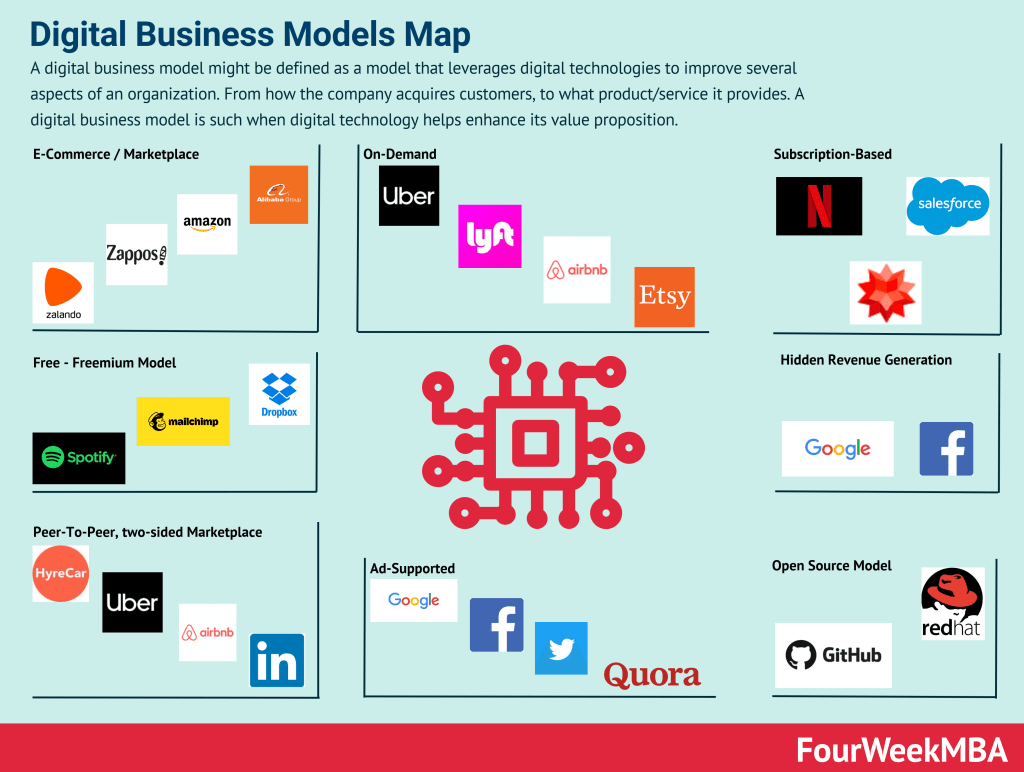
A digital business model might be defined as a model that leverages digital technologies to improve several aspects of an organization. From how the company acquires customers, to what product/service it provides. A digital business model is such when digital technology helps enhance its value proposition.
A tech business model is made of four main components: value model (value propositions, mission, vision), technological model (R&D management), distribution model (sales and marketingorganizational structure), and financial model (revenue modeling, cost structure, profitability and cash generation/management). Those elements coming together can serve as the basis to build a solid tech business model.
A platform business model generates value by enabling interactions between people, groups, and users by leveraging network effects. Platform business models usually comprise two sides: supply and demand. Kicking off the interactions between those two sides is one of the crucial elements for a platform business model success.
A Blockchain Business Model is made of four main components: Value Model (Core Philosophy, Core Value and Value Propositions for the key stakeholders), Blockchain Model (Protocol Rules, Network Shape and Applications Layer/Ecosystem), Distribution Model (the key channels amplifying the protocol and its communities), and the Economic Model (the dynamics through which protocol players make money). Those elements coming together can serve as the basis to build and analyze a solid Blockchain Business Model.
In an asymmetric businessmodel, the organization doesn’t monetize the user directly, but it leverages the data users provide coupled with technology, thus have a key customer pay to sustain the core asset. For example, Google makes money by leveraging users’ data, combined with its algorithms sold to advertisers for visibility.
In an asymmetric businessmodel, the organization doesn’t monetize the user directly, but it leverages the data users provide coupled with technology, thus having a key customer pay to sustain the core asset. For example, Google makes money by leveraging users’ data, combined with its algorithms sold to advertisers for visibility. This is how attention merchants make monetize their business models.
While the term has been coined by Andrew Lampitt, open-core is an evolution of open-source. Where a core part of the software/platform is offered for free, while on top of it are built premium features or add-ons, which get monetized by the corporation who developed the software/platform. An example of the GitLab open core model, where the hosted service is free and open, while the software is closed.
Cloud business models are all built on top of cloud computing, a concept that took over around 2006 when former Google’s CEO Eric Schmit mentioned it. Most cloud-based business models can be classified as IaaS (Infrastructure as a Service), PaaS (Platform as a Service), or SaaS (Software as a Service). While those models are primarily monetized via subscriptions, they are monetized via pay-as-you-go revenue models and hybrid models (subscriptions + pay-as-you-go).
Open source is licensed and usually developed and maintained by a community of independent developers. While the freemium is developed in-house. Thus the freemium give the company that developed it, full control over its distribution. In an open-source model, the for-profit company has to distribute its premium version per its open-source licensing model.
The freemium – unless the whole organization is aligned around it – is a growth strategy rather than a business model. A free service is provided to a majority of users, while a small percentage of those users convert into paying customers through the sales funnel. Free users will help spread the brand through word of mouth.
A freeterprise is a combination of free and enterprise where free professional accounts are driven into the funnel through the free product. As the opportunity is identified the company assigns the free account to a salesperson within the organization (inside sales or fields sales) to convert that into a B2B/enterprise account.
A marketplace is a platform where buyers and sellers interact and transact. The platform acts as a marketplace that will generate revenues in fees from one or all the parties involved in the transaction. Usually, marketplaces can be classified in several ways, like those selling services vs. products or those connecting buyers and sellers at B2B, B2C, or C2C level. And those marketplaces connecting two core players, or more.
B2B, which stands for business-to-business, is a process for selling products or services to other businesses. On the other hand, a B2C sells directly to its consumers.
A B2B2C is a particular kind of business model where a company, rather than accessing the consumer market directly, it does that via another business. Yet the final consumers will recognize the brand or the service provided by the B2B2C. The company offering the service might gain direct access to consumers over time.
Direct-to-consumer (D2C) is a business model where companies sell their products directly to the consumer without the assistance of a third-party wholesaler or retailer. In this way, the company can cut through intermediaries and increase its margins. However, to be successful the direct-to-consumers company needs to build its own distribution, which in the short term can be more expensive. Yet in the long-term creates a competitive advantage.
The C2C business model describes a market environment where one customer purchases from another on a third-party platform that may also handle the transaction. Under the C2C model, both the seller and the buyer are considered consumers. Customer to customer (C2C) is, therefore, a business model where consumers buy and sell directly between themselves. Consumer-to-consumer has become a prevalent business model especially as the web helped disintermediate various industries.
A retail business model follows a direct-to-consumer approach, also called B2C, where the company sells directly to final customers a processed/finished product. This implies a business model that is mostly local-based, it carries higher margins, but also higher costs and distribution risks.
The wholesale model is a selling model where wholesalers sell their products in bulk to a retailer at a discounted price. The retailer then on-sells the products to consumers at a higher price. In the wholesale model, a wholesaler sells products in bulk to retail outlets for onward sale. Occasionally, the wholesaler sells direct to the consumer, with supermarket giant Costco the most obvious example.
The term “crowdsourcing” was first coined by Wired Magazine editor Jeff Howe in a 2006 article titled Rise of Crowdsourcing. Though the practice has existed in some form or another for centuries, it rose to prominence when eCommerce, social media, and smartphone culture began to emerge. Crowdsourcing is the act of obtaining knowledge, goods, services, or opinions from a group of people. These people submit information via social media, smartphone apps, or dedicated crowdsourcing platforms.
In a franchained business model (a short-term chain, long-term franchise) model, the company deliberately launched its operations by keeping tight ownership on the main assets, while those are established, thus choosing a chain model. Once operations are running and established, the company divests its ownership and opts instead for a franchising model.
Businesses employing the brokerage business model make money via brokerage services. This means they are involved with the facilitation, negotiation, or arbitration of a transaction between a buyer and a seller. The brokerage business model involves a business connecting buyers with sellers to collect a commission on the resultant transaction. Therefore, acting as a middleman within a transaction.
Dropshipping is a retail business model where the dropshipper externalizes the manufacturing and logistics and focuses only on distribution and customer acquisition. Therefore, the dropshipper collects final customers’ sales orders, sending them over to third-party suppliers, who ship directly to those customers. In this way, through dropshipping, it is possible to run a business without operational costs and logistics management.
Gennaro is the creator of FourWeekMBA, which reached about four million business people, comprising C-level executives, investors, analysts, product managers, and aspiring digital entrepreneurs in 2022 alone | He is also Director of Sales for a high-tech scaleup in the AI Industry | In 2012, Gennaro earned an International MBA with emphasis on Corporate Finance and Business Strategy.