Zuckerberg’s net worth recovered dramatically from a 2022 low of ~$38B to over $210B, fueled by Meta’s ‘Year of Efficiency’ restructuring, massive AI investments, and the stock’s 500%+ recovery from its trough.
Mark Zuckerberg is Facebook’s co-founder and principal shareholder (now Meta), and he owns a controlling stake worth over $165.78 billion as of July 2024. Thus, Mark Zuckerberg’s net worth is around $165.78 billion in 2024.
Category
Details
Full Name
Mark Elliot Zuckerberg
Date of Birth
May 14, 1984
Place of Birth
White Plains, New York, USA
Nationality
American
Education
Attended Harvard University (did not graduate)
Early Career
Developed several software programs and projects during high school and college, including “ZuckNet” and “Facemash”
Major Companies Founded
Facebook (now Meta Platforms Inc.)
Positions
Co-founder, Chairman, and CEO of Meta Platforms Inc. (formerly Facebook Inc.)
Net Worth
Estimated around $165.78 billion (as of July 2024)
Business Milestones
– 2004: Launched Facebook from his Harvard dorm room, initially limited to Harvard students. – 2006: Expanded Facebook access to anyone aged 13 and over with a valid email address. – 2007: Launched Facebook Ads, transforming the platform into a major advertising network. – 2012: Facebook went public with its initial public offering (IPO), raising $16 billion. – 2012: Acquired Instagram for approximately $1 billion. – 2014: Acquired WhatsApp for $19 billion, significantly expanding the company’s messaging services. – 2014: Acquired Oculus VR for $2 billion, marking the company’s entry into virtual reality. – 2016: Reached 1.65 billion monthly active users, solidifying Facebook’s position as the leading social media platform. – 2021: Rebranded Facebook Inc. to Meta Platforms Inc., signaling a new focus on building the metaverse. – 2021: Announced plans to hire 10,000 employees in the EU to work on the metaverse. – 2022: Introduced Horizon Worlds, a virtual reality social platform for the metaverse.
Around half of these were using the platform daily.
The story of how Facebook came to become the behemoth it is today has been told many times over, with much of it immortalized in the 2010 movie The Social Network.
Believe it or not, the company is now more than 18 years old and has recently started a new chapter in its life under the name Meta.
Let’s tell the story of the history of Facebook with a particular focus on its earliest years.
Facemash
While CEO Mark Zuckerberg was a second-year student at Harvard, he created a website called Facemash.
After hacking into Harvard’s security network, he populated Facemash with the identification photo of every student on campus.
The site, which asked students to rate others based on how attractive they were, was launched on October 28, 2003, and almost immediately shut down three days later by the university.
Zuckerberg came close to expulsion for his efforts, but the charges laid against him were eventually dropped.
TheFacebook
In early February of 2004, Zuckerberg launched TheFacebook, a site named after directories that were handed out to new Harvard students to facilitate introductions.
TheFacebook was funded by fellow student Eduardo Saverin, with Saverin and Zuckerberg pitching in $1,000.
Zuckerberg once again attracted the ire of Harvard University, with some classmates claiming he stole their idea to build a similar social network known as HarvardConnection.com.
In any case, membership to TheFacebook was initially restricted to any student at Harvard College. Within a month, more than 50% of all undergraduates had signed up.
In March 2004, membership eligibility extended to students at Columbia, Yale, Stanford, all Ivy League Colleges, and, eventually, most universities in the United States and Canada.
Facebook
Sean Parker became the company president in June 2004 as the headquarters moved to Palo Alto, California. Parker was one of the co-founders of Napster and was instrumental in securing Facebook’s first round of investment funding from PayPal co-founder Peter Thiel.
More funding was secured in May, and the company expanded once more to become available for high school students and Apple and Microsoft employees, among other companies.
Finally, in September 2006, the platform was opened to anyone and everyone above the age of 13 with a valid email address.
Around this time, Zuckerberg turned down a $1 billion offer from Yahoo to purchase Facebook, feeling that the company had undervalued his social network.
He also introduced the News Feed, which is a mainstay of the social network today.
In February 2009, the iconic Like button was introduced.
From this point onward, the company would never be headed.
The Four Stages of Facebook’s History
Move fast and break things (2004-2014)
In this time period, Facebook has acted as a continuous blitzscaler, trying to gain market shares as quickly as possible, killing competition, with an aggressive iterative strategy, coupled with aggressive acquisitions and a fight to optimize every single user engagement metric.
In this period, Facebook managed to go from a small startup, in a Harvard dormitory, to a scale-up, able to compete against Google!
Move fast with stable infrastructure (2014-2022)
By 2014-15 Facebook had passed a billion users worldwide, becoming a de facto monopoly in the social media space. Given the incredible influence of the company, the motto changed from “move fast and break things” to “move fast with a stable infrastructure.”
This was a key change, as it signaled to the world, that while Facebook’s priority was still to move fast, it could not afford to do that by risking breaking its own infrastructure.
For a scaled company, providing services to billions of users, the underlying infrastructure stability became critical.
From Facebook to Meta (2022-2023)
Zuckerberg has had the conviction that VR would have become the next platform since 2014, when Facebook acquired VR maker, Oculus (which still today represents the main product in the Reality Labs segment).
It was correct directionally but completely missed the way it would have evolved in the short term.
The same goes for the Metaverse. Zuckerberg might be right about VR becoming an important business platform, in the future, but not in the way he envisioned it in the short term!
Yet, with mounting losses of Reality Labs, and slowed down revenue for its VR headsets, Meta had to re-change its strategy.
In fact, the company’s cost structure completely collapsed under the weight of a Metaverse that never materialized.
The spiked expenses into the Metaverse also crashed Facebook’s profitability.
Again, that doesn’t mean the Metaverse is not happening, but not in the way Zuckerberg envisioned, and not on Meta!
Today, the Metaverse is happening on other platforms like Roblox.
Roblox it’s so sticky that it has seen its daily active users move from 49.5 million by 2021 to almost 59 million in 2022, collectively spending engaging on the platform 12.8 billion hours!
Meta, from hierarchical, slow, and bureaucratic to flatter, leaner, and more efficient! (2023-forward)
How is the new Meta looking like today? The company is getting reorganized around a few core principles. And a massively reduced headcount, which is going back to pre-pandemic levels.
The key pillars are:
Flatter is better
Leaner is better
Keep technology the main thing
Invest in tools to get more efficient
In-person time to build relationships and get more done
Key takeaways:
While eventual CEO Mark Zuckerberg was a second-year student at Harvard, he created a website called Facemash featuring the identification photos of every student on campus. Since Zuckerberg had hacked his way into Harvard’s systems, Facemash was shut down after three days.
An iteration of Facemash called TheFacebook was launched in early 2004, named after the Harvard directories handed out to students to help them become acquainted. Several of his classmates sued Zuckerberg, who claimed he stole the idea for TheFacebook from a similar platform they were creating at the time.
TheFacebook became Facebook in 2005 as the platform was progressively opened up to all university students in North America, various companies, and then anyone over the age of thirteen with an email address. Three years after it was open to the general public, Facebook had already amassed 500 million users.
Key Highlights
Mark Zuckerberg’s Net Worth: Mark Zuckerberg is the co-founder and principal shareholder of Facebook (now Meta), and he owns a controlling stake in the company. Based on calculations using the total outstanding shares and market cap as of March 2023, his net worth is estimated to be around $68.28 billion.
Early Days of Facebook:
Facebook (now Meta) became the largest social media site in the world by 2021, amassing nearly 3 billion users with about half of them using the platform daily.
The company’s growth story, including its founding and rise, has been well-documented, even inspiring the movie “The Social Network.”
Facebook was founded in 2004 and has since evolved into the global tech giant known today as Meta.
Facemash and TheFacebook:
As a second-year student at Harvard, Mark Zuckerberg created “Facemash,” a website displaying identification photos of students for rating based on attractiveness. Facemash was quickly shut down by the university.
In 2004, Zuckerberg launched “TheFacebook,” named after Harvard’s student directories. The site initially focused on connecting Harvard students and was funded by fellow student Eduardo Saverin.
Expansion and Evolution:
TheFacebook’s membership quickly expanded beyond Harvard to other universities and colleges, gaining significant popularity.
The company’s name was shortened to “Facebook” after purchasing the domain name “Facebook.com.”
Sean Parker, a co-founder of Napster, joined as president, and the company headquarters moved to Palo Alto, California.
Facebook expanded to high school students and employees of various companies, eventually opening up to anyone over 13 years old with a valid email address.
Strategic Moves and Growth:
Facebook’s growth trajectory was remarkable, surpassing 300 million members in 2009 and 500 million in 2010.
Mark Zuckerberg turned down a $1 billion acquisition offer from Yahoo, believing the company undervalued Facebook.
Key features like the News Feed and the iconic Like button were introduced, shaping the platform’s user experience.
Four Stages of Facebook’s History:
Facebook’s history is divided into stages, including:
“Move fast and break things” (2004-2014) – Rapid growth, competition, and acquisitions.
“Move fast with stable infrastructure” (2014-2022) – Focus on stability and scaling to accommodate billions of users.
“From Facebook to Meta” (2022-2023) – Transition to the concept of the Metaverse, including investments in VR, but with financial challenges.
“Meta’s Reorganization” (2023-forward) – A new focus on a flatter, leaner structure, prioritizing technology and efficiency.
Mark Zuckerberg is the largest shareholder in the company. Zuckerberg retains ownership and control of the company. Like Google, Facebook has issued two common stocks, Class A and Class B. The holders of Class B common stocks are entitled to ten votes per share, and holders of our Class A common stocks are entitled to one vote per share. Mark Zuckerberg has a voting power of 61.1%; he’s the primary decision-maker. Other individual investors comprise Sheryl Sandberg, Christopher Cox, Marc Andreessen, Peter Thiel, Dustin Moskovitz, and Eduardo Saverin.
Facebook, the main product of Meta is an attention merchant. As such, its algorithms condense the attention of over 2.91 billion monthly active users as of June 2021. Meta generated $117.9 billion in revenues, in 2021, of which $114.9 billion from advertising (97.4% of the total revenues) and over $2.2 billion from Reality Labs (the augmented and virtual reality products arm).
Facebook generated most of its revenue from advertising in 2023. Indeed, the company generated $131.95B from advertising, $1.89B billion from its reality labs segment, and over a billion in other revenue.
By September 2022, Facebook’s (Meta) employee count had peaked at 87,314. Yet, as revenue slew down for the first time in years, the company announced a layoff of 13% of its workforce, bringing the headcount to 75,964. By March 2023, Meta announced another round of layoffs, dubbed “The Year of Efficiency,” which brought the headcount down to less than 66 thousand employees. By the end of 2023, Facebook reported 67,317 employees.
In 2022, post layoffs, Facebook generated $1,535,056 per employee, compared to $1,638,586 in 2021. In 2023, as Facebook (now Meta) completed its mass layoffs, the company reported nearly $135 billion in revenue and 67,317 employees, with a $2,003,981 revenue per employee.
Facebook (Meta) gained users in 2023. In fact, in 2023, Facebook had over three billion users worldwide, of which 272 million were in Canada, 408 million were in Europe, over 1.3 billion were in Asia, and over a billion were in the rest of the world.
ARPU, or average revenue per user, is a crucial metric for attention merchants like Facebook. It assesses the ability of the platform to monetize its users. For instance, by the end of 2023, Meta’s ARPU worldwide was $13.12. In the US & Canada, it was $68.44; in Europe, it was $23.14; in Asia-Pacific, $5.52; and in the rest of the world, it was $4.50.
ARPU, or average revenue per user, is a crucial metric for attention merchants like Facebook. It assesses the ability of the platform to monetize its users. For instance, by the end of 2023, Meta’s ARPU worldwide was $13.12. In the US & Canada, it was $68.44; in Europe, it was $23.14; in Asia-Pacific, $5.52; and in the rest of the world, it was $4.50.
Facebook (Meta) revenue in 2023 increased to $134.9B, compared to $116.6B in 2022. Its profitability increased to $39.1B in 2023, compared to $23.2B in 2022 and $39.37B in 2021.
Facebook is characterized by a multi-faceted matrix organizational structure. The company utilizes a flat organizational structure in combination with corporate function-based teams and product-based or geographic divisions. The flat organization structure is organized around the leadership of Mark Zuckerberg, and the key executives around him. On the other hand, the function-based teams based on the main corporate functions (like HR, product management, investor relations, and so on).
Instagram makes money via visual advertising. Acquired by Facebook for a billion-dollar in 2012, today, Instagram is integrated into the overall Facebook (now rebranded as Meta) business strategy. In 2018, Instagram founders Kevin Systrom and Mike Krieger left the company as Facebook pushed toward tighter integration of the two platforms. In 2022, Instagram is the most successful product still, in Meta’s portfolio.
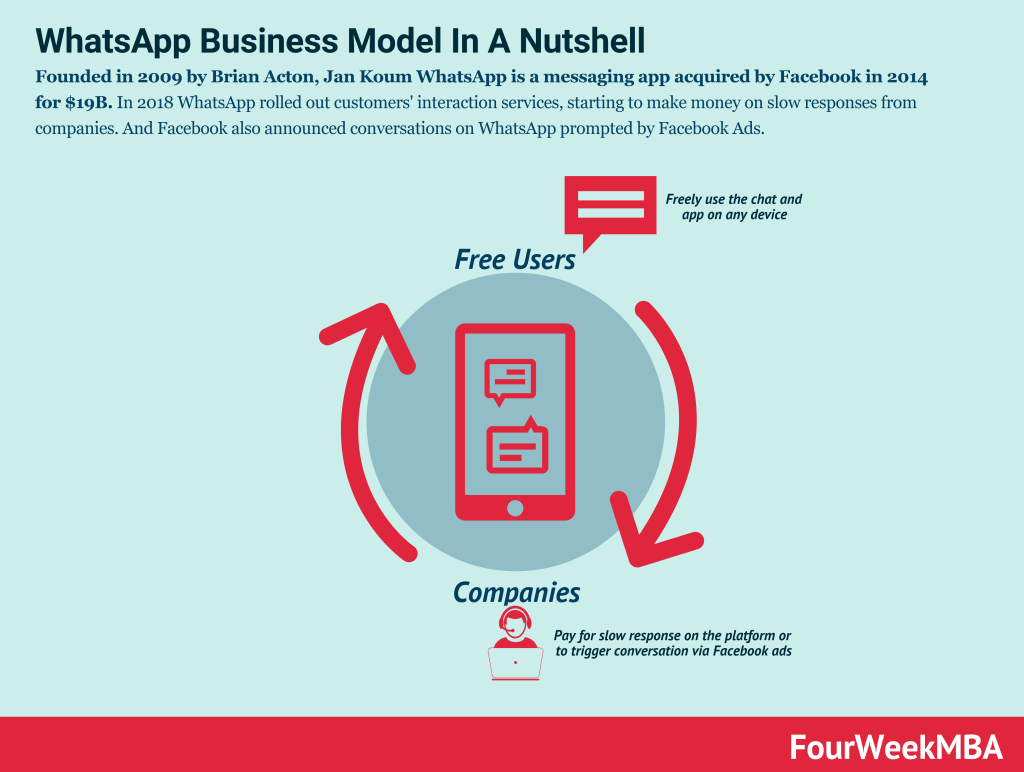
Founded in 2009 by Brian Acton, Jan Koum WhatsApp is a messaging app acquired by Facebook in 2014 for $19B. In 2018 WhatsApp rolled out customers’ interaction services, starting to make money on slow responses from companies. And Facebook also announced conversations on WhatsApp prompted by Facebook Ads.
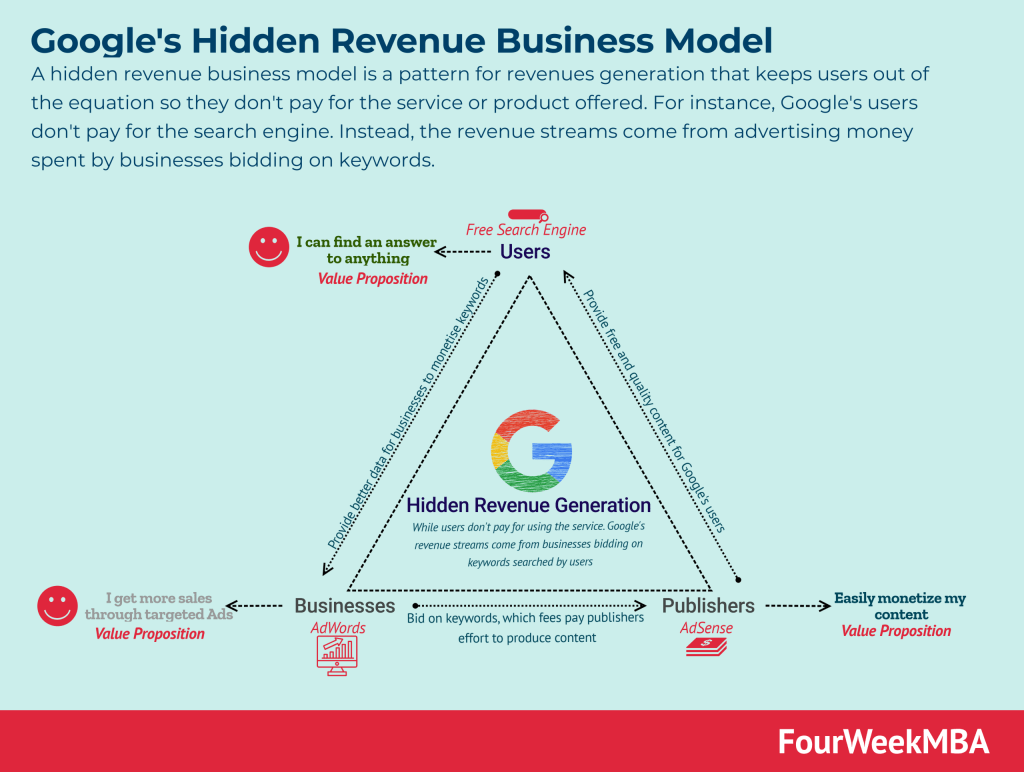
A hidden revenue business model is a pattern for revenue generation that keeps users out of the equation, so they don’t pay for the service or product offered. For instance, Google’s users don’t pay for the search engine. Instead, the revenue streams come from advertising money spent by businesses bidding on keywords.
TikTok is a Chinese creative social media platform driven by short-form video content enabling users to interact and generate content at scale. TikTok primarily makes money through advertising, and it generated $4.6 billion in advertising revenues in 2021, thus making it among the most popular attention-based business models or attention merchants.
Instagram makes money via visual advertising. As part of Facebook products, the company generates revenues for Facebook Inc.’s overall businessmodel. Acquired by Facebook for a billion dollars in 2012, today Instagram is integrated into the overall Facebook business strategy. In 2018, Instagram founders, Kevin Systrom and Mike Krieger left the company, as Facebook pushed toward tighter integration of the two platforms.
YouTube was acquired for almost $1.7 billion in 2006 by Google. It makes money through advertising and subscription revenues. YouTube advertising network is part of Google Ads, and it generated more than $28B in revenue by 2021. YouTube also makes money with its paid memberships and premium content.
Twitter makes money in two ways: advertising and data licensing. In 2021, Twitter generated $4.5 billion from advertising and $570 million from data licensing. While Twitter generated $5 billion in total revenues, it lost 221 million.
By 2022, most of Tesla’s shares are still owned by Elon Musk, among the company’s co-founders and the CEO. Elon Musk is the top individual investor, with a 23.5% stake in the company. At current rates, this is valued at around $145-50 billion, making Elon Musk one of the wealthiest men on earth. In addition, Musk also holds a significant stake in Twitter and SpaceX, which makes him worth anywhere between $180-90 billion.
Bernard Arnault’s wealth is around $203 billion. Indeed Arnault is the CEO and chairman of the luxury goods conglomerate LVMH Moët Hennessy Louis Vuitton, a massive luxury group that generated over €79 billion in revenue ($83 billion) in 2022, spanning across wines, fashion, cosmetics, and retail. The Arnault family group owns 48.18% of the capital for LVMH with 63.9% voting power, making Bernard Arnault the principal owner and decision-maker. His stake is worth over $203 billion.
Warren Buffett is an American investor, business tycoon, and philanthropist. Known as the “Oracle of Omaha,” Buffett is best known for his strict adherence to value investing and frugality despite his immense wealth. Warren Buffet owns an investment firm, Berkshire Hathaway. He owns 238,624 Class A shares which gives him control over the company. His stake in the company is valued at over $100 billion.
Jeff Bezos’ net worth is primarily based on his ownership stake in Amazon. Indeed, as of 2023, Bezos owned a 12.7% stake in Amazon, worth over $120 billion.
Tim Cook’s net worth is primarily comprised of his Apple stocks. As of 2023, he owned 3,279,898 worth about $480 million at the current rate. However, Tim Cook has sold part of his Apple stocks over the years for hundreds of millions of dollars, making him a billionaire.
Bill Gates was the co-founder and former CEO of Microsoft until 2000, and he was on the board of Microsoft until 2020. However, over the years, Gates sold various stakes in Microsoft and diversified away from it. As of 2019, Gates had a 1.34% stake in Microsoft, which he might still own, valued at about $25 billion.
As of 2022, Satya Nadella had 763,518, valued at $190 million at Microsoft’s current market value. Nadella also got a $2.5 million base salary in 2022, plus $42.27 million in stock awards and over $10 million in non-stock incentives. Nadella sold hundreds of millions of dollars of Microsoft stocks in the last ten years, making him a centi-millionaire. In 2022, 96% of Nadella’s salary was performance-based, whereas only 4% comprised a base salary.
Larry Page co-founded Google (now Alphabet) and Sergey Brin. He controls the company tightly via a dual share ownership structure (made of Class A and B stocks). Alphabet is worth over a trillion dollars, valuing Larry Page’s stake in the company at around $70 billion.
Sergey Brin co-founded Google (now Alphabet) together with Larry Page. He controls the company tightly via a dual share ownership structure (made of Class A and B stocks). Alphabet is worth over a trillion dollars, valuing Sergey Brin’s stake at around $66 billion.
Mark Zuckerberg is the co-founder and principal shareholder of Facebook (now Meta), in which he owns a controlling stake worth over $68 billion. Thus Mark Zucberkerbs’ net worth is around $68 billion in 2023.
Eduardo Luiz Saverin is a billionaire entrepreneur and angel investor. He co-founded Facebook with Mark Zuckerberg; he was later ousted. Yet later on, Facebook settled a lawsuit with Saverin giving him a good chunk of the company’s stock, now worth over ten billion dollars. Thus, Eduardo Saverin’s net worth is around $10.45 billion in 2023.
While Larry Ellison is a shareholder in various tech companies (such as Tesla), his primary wealth comes from his ownership stake in the company he founded, Oracle. He owns almost 43% of the company’s stock, valued at over $100 billion, making him among the wealthiest people on earth.
Howard Schultz’s net worth is over $2.2 billion. Indeed, he is the founder of Starbucks and a major institutional shareholder, with 1.88% ownership of the company, valued at over $2.2 billion at the current market value, making him a billionaire.
Daniel Ek is one of the founders and one of the principal shareholders of Spotify. Indeed, in 2023 with 16.5% of Spotify’s shares, he’s worth around $3.7 billion.
The Pinault family is the main shareholder behind the Kering Group luxury empire, with a stake of 41.7%, valued around €30 billion, thus $32-33 billion. The Kering Group owns iconic brands like Gucci, Yves Saint Laurent and Bottega Veneta.
Pierre Omidyar is a technology entrepreneur andPierre Omidyar is a technology entrepreneur and founder of eBay. As of 2020, before he stepped down from the company’s board of directors, he still owned 4.69% of the company’s stocks, valued at over one billion dollars. Yet, over the years, he sold a good chunk of his stocks, making him a billionaire. founder of eBay. As of 2020, before he stepped down from the company’s board of directors, he still owned 4.69% of the company’s stocks, valued at over one billion dollars. Yet, over the years, he sold a good chunk of his stocks, making him a billionaire.
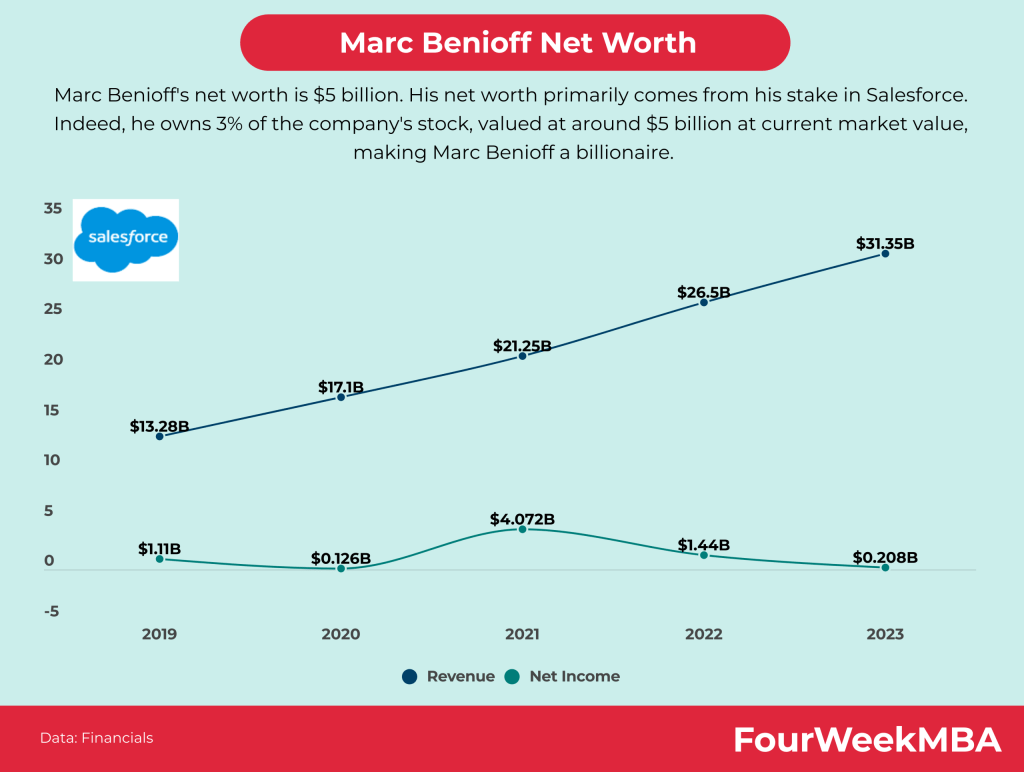
Marc Benioff’s net worth is $5 billion. His net worth primarily comes from his stake in Salesforce. Indeed, he owns 3% of the company’s stock, valued at around $5 billion at current market value, making Marc Benioff a billionaire.
Reed Hastings is the co-founder, former CEO, and now executive chairman of Netflix. He’s also one of the major shareholders, with 1.7% ownership in the company, valued at $2.4 billion at the current rate.
Evan Thomas Spiegel is the co-founder and CEO of Snapchat. He’s also the main shareholder. Indeed, he both owns and controls Snapchat, and his stake in the company is currently valued at around $3 billion.
Brian Chesky is an industrial designer and businessman who is also Airbnb’s co-founder and current CEO. Since the company was founded in 2007, Chesky has been in charge of it, amassing a net worth of about $10 billion, thanks to his shares in the company.
Phil Knight, the founder of Nike, controls the company via a personal stake of shares for 7% ownership, plus the shares held via the family’s owned Swoosh, LLC, in addition to the shares in possession of his son’s Trust. Phil Knight directly controls a significant stake in Nike’s Class A and B shares, valued at over $40 billion.
Michale Jordan is a billionaire but doesn’t own the Jordan brand, which is part of Nike. Yet, he gets 5% royalties on the sales of Jordan. For instance, as of May 31, 2022, Nike had endorsement contract obligations of $7.6 billion, of which over $250 million were to be paid out to Michael Jordan as royalties on the sales of Jordan in 2022 (the company made over 5$ billion in sales in that year). We estimated that between 2018-2022 alone, Nike paid (or is paying) Michael Jordan almost one billion dollars in royalties for Jordan’s brand sales.
Kevin Plank is Under Armour’s primary owner and founder, of which he’s also chairman. His stake in the company is worth over a billion dollars at current market value, making him a billionaire.
Gennaro is the creator of FourWeekMBA, which reached about four million business people, comprising C-level executives, investors, analysts, product managers, and aspiring digital entrepreneurs in 2022 alone | He is also Director of Sales for a high-tech scaleup in the AI Industry | In 2012, Gennaro earned an International MBA with emphasis on Corporate Finance and Business Strategy.