Wikipedia is sustained by the Wikimedia Foundation, which is supported mostly by donations and contributions, which in 2021 amounted to over $153 million. Wikipedia is among the most popular websites on earth, and it is, as of these days, an open, non-profit project, on which other twelve projects have been developed.
Business Model Element
Analysis
Implications
Examples
Value Proposition
Wikipedia’s value proposition revolves around providing free and open access to a vast repository of knowledge. Key elements of its value proposition include: – Free Access: No cost to access and use the platform’s content. – Collaborative Editing: Anyone can contribute, edit, and improve articles. – Global Reach: A diverse range of topics and languages covered. – Reference Source: Reliable and well-referenced information. Wikipedia aims to democratize knowledge and make it freely available to everyone.
Offers free and open access to a vast knowledge base, democratizing information. Encourages collaborative editing and contributions from a global community. Attracts users seeking diverse and well-referenced information on a wide range of topics. Serves as a trusted reference source for research and learning. Empowers individuals to contribute to the collective knowledge of humanity.
– Free access to a vast knowledge repository. – Collaborative editing and contributions from a global community. – Diverse range of topics and languages covered. – Reliable and well-referenced information. – Trusted reference source for research and learning. – Empowers individuals to contribute to collective knowledge.
Customer Segments
Wikipedia serves a wide range of customer segments, including: 1. General Users: Individuals seeking information on various topics. 2. Students: Students and researchers looking for reference materials. 3. Educators: Teachers and educators who use Wikipedia in the classroom. 4. Institutions: Libraries, universities, and schools that reference Wikipedia. Wikipedia caters to a broad audience looking for free and reliable information.
Focuses on a diverse customer base with varying information needs. Customizes content to suit the requirements of general users, students, educators, and institutions. Provides a versatile platform for different stages of research and learning. Serves as a reference source for a wide range of users and institutions. Encourages contributions from individuals with expertise in various fields.
– Serving diverse customer segments broadens the user base. – Customizes content for different information needs. – Provides a versatile platform for research and learning. – Serves as a reference source for various users and institutions. – Encourages contributions from individuals with expertise.
Distribution Strategy
Wikipedia’s distribution strategy relies on its website and partnerships with search engines. Users can access Wikipedia directly through its website or indirectly through search engine results, where Wikipedia articles often appear prominently. The platform also collaborates with Wikimedia Foundation and other organizations to expand its reach and support its mission. Additionally, Wikipedia encourages offline access through downloadable versions of its content.
Utilizes its website as a primary access point to its knowledge base, ensuring accessibility. Benefits from partnerships with search engines, which drive traffic to Wikipedia articles. Collaborates with Wikimedia Foundation and other organizations to expand its reach and support its mission. Promotes offline access through downloadable versions of its content. Prioritizes broad accessibility to knowledge.
– Website serves as a primary access point. – Partnerships with search engines drive traffic. – Collaborates with organizations to expand reach and support the mission. – Promotes offline access to knowledge through downloadable content. – Prioritizes broad accessibility to knowledge.
Revenue Streams
Wikipedia does not generate revenue directly from its content. It operates as a nonprofit organization and relies on donations and grants as its primary source of funding. It runs annual fundraising campaigns to support its operational costs and expansion. Donations come from individual users, foundations, and philanthropic organizations that believe in Wikipedia’s mission of providing free knowledge to the world.
Does not generate revenue directly from content or users. Relies on donations and grants as the primary sources of funding. Runs annual fundraising campaigns to support operational costs and expansion. Receives donations from individuals, foundations, and philanthropic organizations supporting Wikipedia’s mission. Prioritizes free access to knowledge over commercialization.
– Does not generate revenue directly from content or users. – Relies on donations and grants for funding. – Runs annual fundraising campaigns to support operations. – Receives donations from individuals, foundations, and philanthropic organizations. – Prioritizes free access to knowledge over commercialization.
Marketing Strategy
Wikipedia’s marketing strategy is based on word-of-mouth, community engagement, and its strong online presence. The platform does not engage in traditional marketing or advertising. Instead, it relies on satisfied users to promote Wikipedia to others and encourage contributions. Wikipedia fosters a sense of community among its editors and volunteers, who contribute voluntarily to improve its content. It maintains a strong online presence through search engine optimization (SEO) and active social media engagement.
Leverages word-of-mouth marketing from satisfied users to promote the platform. Fosters a sense of community among editors and volunteers, encouraging contributions. Maintains a strong online presence through effective SEO and active social media engagement. Prioritizes community-driven growth and content improvement.
– Relies on word-of-mouth marketing from satisfied users. – Fosters a sense of community among editors and volunteers. – Maintains a strong online presence through SEO and social media. – Prioritizes community-driven growth and content improvement.
Organization Structure
Wikipedia’s organizational structure includes the Wikimedia Foundation, a nonprofit entity responsible for the platform’s governance and support. It operates with a decentralized model, with thousands of volunteers and editors worldwide contributing to content creation and management. The Wikimedia Foundation oversees legal, technical, and financial aspects of Wikipedia and its sister projects. This structure supports Wikipedia’s mission of providing free knowledge while maintaining a global network of volunteers.
Operates under the Wikimedia Foundation, a nonprofit entity responsible for governance and support. Adopts a decentralized model with a global network of volunteers and editors contributing to content. Oversees legal, technical, and financial aspects of Wikipedia and sister projects. Supports Wikipedia’s mission of providing free knowledge to the world. Prioritizes volunteer-driven content creation and management.
– Operates under the nonprofit Wikimedia Foundation. – Adopts a decentralized model with global volunteers. – Oversees legal, technical, and financial aspects. – Supports the mission of providing free knowledge. – Prioritizes volunteer-driven content creation and management.
Competitive Advantage
Wikipedia’s competitive advantage lies in its vast and diverse content, open editing model, global community, reliability, and strong brand as a trusted reference source. Vast and Diverse Content: Offers a vast repository of knowledge covering a wide range of topics and languages. Open Editing Model: Allows anyone to contribute and improve articles, ensuring continuous updates. Global Community: Benefits from a global community of volunteers who maintain and enhance content. Reliability: Maintains rigorous referencing and quality standards for content. Strong Brand: Is recognized worldwide as a trusted and free reference source. Wikipedia stands out as a comprehensive, continuously updated, and reliable source of knowledge.
Derives a competitive advantage from: – Offering a vast and diverse knowledge repository. – Allowing open contributions and continuous updates. – Engaging a global community of volunteers. – Maintaining rigorous referencing and quality standards. – Building a strong and trusted brand as a reference source. Stands out as a comprehensive, reliable, and free knowledge platform.
– Offers a vast and diverse knowledge repository. – Allows open contributions and continuous updates. – Engages a global community of volunteers. – Maintains rigorous referencing and quality standards. – Builds a strong and trusted brand as a reference source. – Stands out as a comprehensive, reliable, and free knowledge platform.
However, it later changed the name to Wikipedia, to recall the Hawaiian term “wiki” which stands for “quick” or “super-fast” – “wiki wiki.”
A few years before, Jimmy Wales had retired from his options trading career, and having made some money, he had started another website called Bomis, which would aggregate erotic photographs materials. While Bomis would eventually close, from its resources, Nupedia was created. Thus, bringing to life Wikipedia.
Today Wikipedia is among the most popular sites on earth and for sure the most known encyclopedia.
As Jimmy Wales – founder of Wikipedia, recounted, in a TED talk, in 2007:
Charles Van Doren, who was later a senior editor of Britannica, said the ideal encyclopaedia should be radical it should stop being safe.
But if you know anything about the history of Britannica since 1962, it was anything but radical.
Still a very completely safe, stodgy type of encyclopaedia.
Wikipedia, on the other hand, begins with a very radical idea, and that’s for all of us to imagine a world in which every single person on the planet is given free access to the sum of all human knowledge.
And that’s what we’re doing.
So Wikipedia it’s a freely licensed encyclopedia. It’s written by thousands of volunteers all over the world in many, many languages.
It’s written using wiki software so anyone can quickly edit and save,
And it goes live on the Internet immediately.
And everything about Wikipedia is managed by virtually an all-volunteer staff.
Wikimedia family
The Wikimedia Foundation is a non-profit that hosts Wikipedia and other free knowledge projects brought on by the Wikimedia family. The Foundation was established as a nonprofit in 2003.
In 2012, asked how he decided the best way to go, Jimmy Wales said: “Thinking about how do we sustain it? How do we make this work? Putting it into a non-profit (referring to Wikipedia) seemed a reasonable way to go.”
13 projects are part of this family and are divided into five main categories:
Reference.
Collections.
Technology.
Guides.
Collaboration.
Reference
Wikipedia “All the world’s knowledge” is an encyclopedia written in 300 languages.
Wikibooks or a collection of free e-book resources including textbooks, annotated texts, instructional guides, and manuals.
Wiktionary is a dictionary for over 170 languages.
Wikiquote is an online collection of sourced quotations.
Collections
WikimediaCommons, is the world’s largest free-to-use library of illustrations, photos, drawings, videos, and music.
Wikisource, a library of freely-licensed source texts and historical documents.
Wikiversity, learning resources, learning projects, and research for use in all levels, types, and styles of education.
Wikispecies, a database for taxonomy that covers living and fossil representatives of Animalia, Plantae, Fungi, Bacteria, Archaea, Protista, and all other forms of life.
Technology
Wikidata, central storage of structured data for Wikimedia projects.
MediaWiki is free and open-source wiki software that anyone can use and develop. The platform on which Wikimedia projects are built.
Guides
Wikivoyage which aim is to provide the world’s largest free, complete and up-to-date worldwide travel guide.
Wikinews is a free content alternative to commercial news sites with articles that are fact-checked and peer-reviewed.
Collaboration
Meta-WikiProject is a project used as a central hub for various coordination and organization tasks.
How does Wikimedia spend money?
The Wikimedia foundation expenses comprise four main categories:
Direct support to websites: servers + ongoing engineering improvements, product development, design and research, and legal support.
Direct support to communities through grants, programs, events, training, partnerships, tools to augment contributor capacity, and support for the legal defense of editors.
Fundraising.
Administration and governance with 350+ staff and contractors to support a wide variety of projects.
How does Wikimedia make money?
As Jimmy Wales, himself explained: “As a business, it’s pretty terrible, It exists based on donations.”
Open source is licensed and usually developed and maintained by a community of independent developers. While the freemium is developed in-house. Thus the freemium give the company that developed it, full control over its distribution. In an open-source model, the for-profit company has to distribute its premium version per its open-source licensing model.
While the term has been coined by Andrew Lampitt, open-core is an evolution of open-source. Where a core part of the software/platform is offered for free, while on top of it are built premium features or add-ons, which get monetized by the corporation who developed the software/platform. An example of the GitLab open core model, where the hosted service is free and open, while the software is closed.
The freemium – unless the whole organization is aligned around it – is a growth strategy rather than a businessmodel. A free service is provided to a majority of users, while a small percentage of those users convert into paying customers through the sales funnel. Free users will help spread the brand through word of mouth.
Subscription-based business models are built on a recurring customer base, where customers rather than own, usually have access to the product or service. The customer can have the upside of the service, without owning the good underlying it, which is maintained by the company running the subscription-based business.
Cloud as a service is a business model that combines the cloud infrastructure delivered to customers as a subscription-based service, where the customer can access a cloud infrastructure without running it on-premise. Therefore, the whole premise of the cloud as a service business model is to offer a more agile cloud infrastructure at a fraction of the costs compared to on-premise software, and that can be scaled up according to the need of the business.
WordPress.org became the most popular CMS and blogging platform in which the Foundation owns the trademark, and revenues come from donations. The Foundation holds a public-benefit-corporation who manages the revenues coming from WordPress events and conferences. Automaticc – the business arm – monetizes premium tools built on top of WordPress.com (a premium platform) through freemiums.
Wikipedia is sustained by the Wikimedia Foundation, which is supported mostly by donations and contributions, which in 2018 amounted to almost $98 million. Wikipedia is among the most popular websites on earth, and it is, as of these days, an open, non-profit project, on which other twelve projects have been developed.
Most of Mozilla Corporation’s revenues come from royalties earned through Firefox web browser search partnerships and distribution deals. According to StatCounter back in 2008 Mozilla Firefox controlled over 26% of the browser market. Today, due to the market dominance of Google Chrome and Safari, Mozilla has less than 5% in market share.
GitHub provides web-based hosting for software development and version control using Git, which facilitates collaborative source code development among programmers. GitHub was founded by Chris Wanstrath, P. J. Hyett, Tom Preston-Werner, and Scott Chacon in 2008. Microsoft acquired the company for $7.5 billion in 2018, and it was integrated as part of Microsoft’s enterprise offering. On top of its free repository, GitHub also offers plans for teams and enterprise customers. And the GitHub marketplace also monetizes on some of the apps developed on top of it.
While the term has been coined by Andrew Lampitt, open-core is an evolution of open-source. Where a core part of the software/platform is offered for free, while on top of it are built premium features or add-ons, which get monetized by the corporation who developed the software/platform. An example of the GitLab open core model, where the hosted service is free and open, while the software is closed.
Slack follows a freemium model, where a free version is offered, and users can convert in paying customers if they want more usage or advanced functionalities. Slack combines the free model with a direct sales force to acquire enterprise customers with yearly recurring revenue of over 100K. Those customers were 575 in 2019, and they accounted for 40% of its revenues.
Grammarly leverages on a freemium service, where free users are prompted to switch to a paid subscription. Grammarly makes money by selling premium plans starting at $11.66 to $29.95 per month. The company also makes money by selling human proofreading services to its paid users.
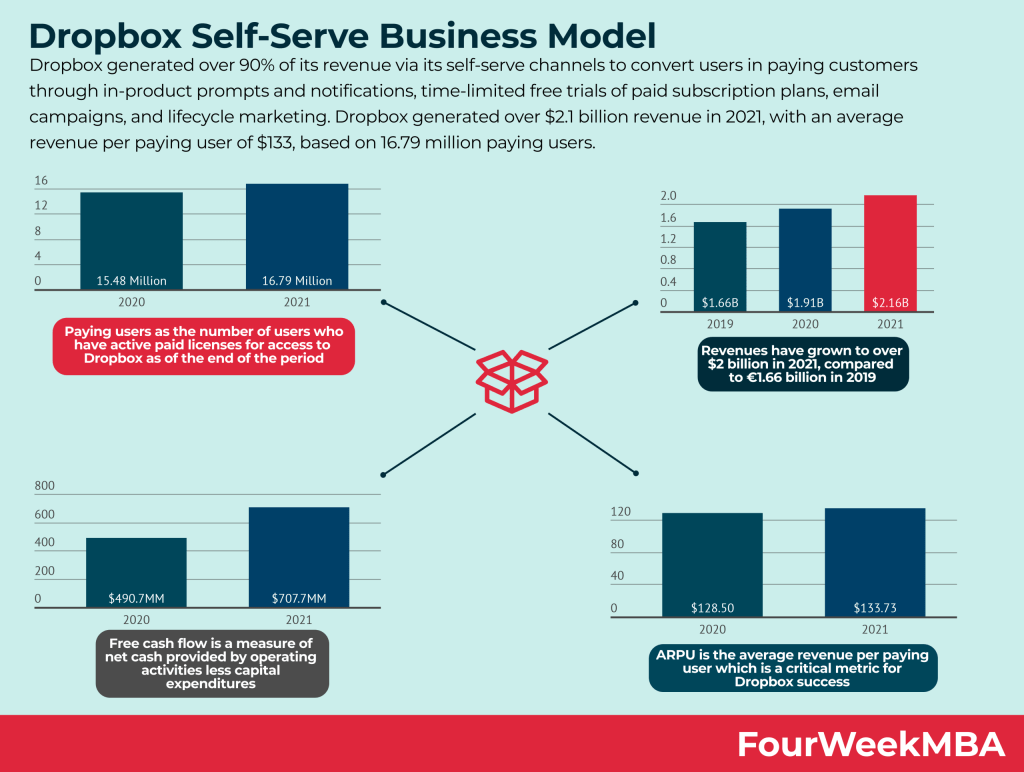
Dropbox generated over 90% of its revenue via its self-serve channels to convert users in paying customers through in-product prompts and notifications, time-limited free trials of paid subscription plans, email campaigns, and lifecycle marketing. Dropbox generated over $2.1 billion in revenue in 2021, with an average revenue per paying user of $133, based on 16.79 million paying users.
Zoom is a video communication platform, which mission is to “make video communications frictionless.” Leveraging on the viral growth from its freemium model, Zoom then uses its direct sales force to identify the opportunity and channel those in B2B and enterprise accounts.
Gennaro is the creator of FourWeekMBA, which reached about four million business people, comprising C-level executives, investors, analysts, product managers, and aspiring digital entrepreneurs in 2022 alone | He is also Director of Sales for a high-tech scaleup in the AI Industry | In 2012, Gennaro earned an International MBA with emphasis on Corporate Finance and Business Strategy.