WeChat is a “super app” or an app that can do many things, from messaging to mobile payments and social media. Developed by Tencent, WeChat is among the most popular Super Apps in China. WeChat makes money via value-added services (with services like Moments, Public Accounts, and Gaming), advertising, and payments on the transaction processed through it.
Developed by Chinese conglomerate Tencent in 2011, WeChat is a messaging, mobile payment, and social media app. The platform was originally called Weixin by creator Allen Zhang and only became WeChat after it passed 100 million users in 2012.
WeChat is often described as the Chinese “app for everything” because of its high level of functionality. Far from being a simple messaging app, users can play video games, hold video conferences, and share photographs or their location if desired.
As part of the Chinese government initiative to support eCommerce in China, the platform also incorporates digital payment services under the name WeChat Pay. This allows users to pay bills, transfer money to others, and order goods or services.
In 2018, WeChat became the world’s largest standalone app with over 1 billion active users.
Value Proposition:
Multi-Functional Super App: WeChat offers a wide range of features within a single app, including messaging, mobile payments, social media, gaming, and more. This convenience and versatility make it a valuable tool for users in various aspects of their daily lives.
Customer Segments:
Individual Users: WeChat caters to individual users who benefit from its messaging, social media, and payment features.
Businesses and Organizations: WeChat provides value to businesses and organizations through its Public Accounts, advertising opportunities, and the ability to interact with customers and offer services.
Distribution Strategy:
App Stores: WeChat is distributed through various app stores, making it easily accessible to users.
Marketing Strategy:
All-In-One Convenience: WeChat’s marketingstrategy emphasizes its status as a comprehensive “super app” that simplifies users’ lives by offering multiple services in one platform.
Monetization of Value-Added Services: The platform promotes its value-added services such as Moments, Public Accounts, and gaming enhancements. It encourages users to explore and purchase these services, contributing to its revenue.
Advertising Opportunities: WeChat promotes advertising as a means for businesses to reach their target audience. It highlights the effectiveness of advertising on platforms like Moments and within public accounts.
WeChat Pay: The convenience and security of WeChat Pay are marketed to encourage users to adopt mobile payments, driving transaction fees for the company.
WeChat revenue generation
Traditional instant messaging apps have proven difficult to monetize, but WeChat has developed several revenue streams by becoming an essential part of daily life. WeChat average revenue per user (ARPU) is $7, or seven times that of similar service WhatsApp.
WeChat sells many value-added services to consumers:
Moments – this is the name given to the WeChat social feed, giving users an interactive platform to post images and messages and share articles and music. So-called stickers (emoticons) can also be used while messaging, with an average price of $0.99 for a set.
Public accounts – WeChat users or businesses can create a public account to interact socially with subscribers or provide them with services. Official organizations must be verified beforehand for approximately US $45, with many using public accounts to offer hospital pre-registration, credit card services, or visa renewals. Users can opt to receive tips from readers who deem their content valuable, and it is safe to assume WeChat takes a percentage of this amount.
Gaming – mobile gaming is extremely popular in China, with most citizens never having grown up with desktop gaming. Once they became addicted to a particular game, WeChat offers value-added services that enhance gameplay. These include better weapons, avatar costumes, and virtual VIP rooms.
Advertising
WeChat also makes money by advertising, which has been progressively added to most WeChat functions over the years.
Advertising has been particularly successful on the WeChat Moments platform. Small and large businesses can target a user based on their physical location.
WeChat also makes advertising revenue from the blogs associated with public accounts. Recent figures suggest there are over 15 million individual and business blogs inside the WeChat app.
WeChat payments
As a digital payment provider, WeChat charges users a 0.01% fee to withdraw funds from their WeChat Wallet when the transfer sum exceeds 1,000 yuan. Transfers within the app ecosystem are free of charge.
Key takeaways
WeChat is a messaging, mobile payment, and social media app developed by Chinese conglomerate Tencent. With high functionality, it is often called the Chinese “app for everything”.
WeChat makes money by selling a range of value-added services. These include stickers to enhance the instant messaging experience, video game upgrades, and public account verification for organizations.
WeChat also drives revenue through advertising, with implementation most successful on the Moments platform. As a digital payment provider, the platform also charges a small fee to withdraw funds from a digital wallet.
Element
Description
Value Proposition
WeChat offers a compelling value proposition for its users, including: – Messaging: Instant messaging and multimedia sharing with friends and contacts. – Social Networking: Connecting with friends and family through social features. – Voice and Video Calls: Making voice and video calls within the app. – Mini Programs: Access to a wide range of third-party apps and services. – Payments and Transactions: Convenient mobile payments and financial services. – Content Sharing: Sharing moments, photos, articles, and updates with contacts. – News and Updates: Access to news, articles, and updates from official accounts. – Stickers and Emojis: Fun and expressive stickers and emojis for messaging. – Location Sharing: Real-time location sharing with friends. – Business Services: Interacting with businesses for customer support and transactions.
Core Products/Services
WeChat’s core products and services encompass: – Messaging: Offering text, voice, and video messaging with multimedia sharing. – WeChat Pay: Providing a digital payment platform for mobile transactions. – Moments: A social feed where users can share updates and photos with friends. – Mini Programs: Third-party apps and services integrated within WeChat for various functions. – Official Accounts: Accounts for businesses, celebrities, and organizations to share content and interact with users. – WeChat Wallet: A digital wallet for managing payments and financial services. – Voice Assistant: Voice-activated features and AI-powered assistant services. – Games: In-app games and gaming features. – Stickers and Emojis: A wide selection of stickers and emojis for messaging. – Red Packets: Digital gift-giving and money transfers.
Customer Segments
WeChat serves a diverse range of customer segments, including: – Individual Users: People using the app for personal communication and social networking. – Businesses: Companies leveraging WeChat for marketing, customer engagement, and e-commerce. – E-commerce Sellers: Online merchants and retailers using WeChat for sales and promotion. – Content Creators: Individuals and organizations sharing content through Official Accounts. – Developers: App developers creating Mini Programs and integrations. – Financial Institutions: Banks and financial service providers using WeChat Pay. – Advertisers: Businesses running targeted ads on the platform. – Government and Organizations: Public entities using WeChat for communication and services. – International Users: Non-Chinese users with access to WeChat’s international version. – Travelers: Tourists and travelers using WeChat for payments and communication abroad.
Revenue Streams
WeChat generates revenue through various revenue streams: – WeChat Pay Fees: Charging transaction fees for payments and financial transactions. – Mini Programs Advertising: Earning revenue from advertisements within Mini Programs. – Official Account Promotion: Charging businesses and content creators for promotional services. – Stickers and Emojis Sales: Selling premium stickers and emojis in the Sticker Gallery. – In-App Purchases: Revenue from in-app game purchases and virtual items. – Advertising: Earning revenue from ads displayed in Moments and official accounts. – E-commerce Commissions: Receiving commissions from e-commerce transactions. – Financial Services: Earning interest and fees from financial products offered through WeChat Wallet. – Enterprise Services: Providing premium business and enterprise communication solutions. – Internationalization: Expanding WeChat Pay and services for international markets.
Distribution Strategy
WeChat employs a strategic distribution strategy to reach and engage users: – App Stores: Distributing the WeChat app on major app stores for easy download. – Word of Mouth: Leveraging user recommendations and referrals for app adoption. – Social Networks: Integrating social networking features to keep users engaged. – Partnerships: Collaborating with businesses, banks, and third-party developers for Mini Programs. – Localized Content: Providing localized content, languages, and services for global users. – Cross-Platform Integration: Integrating with other Tencent products like QQ and Qzone. – User Engagement: Offering engaging features like Red Packets and gaming to retain users. – QR Codes: Using QR codes for easy user-to-user and user-to-business interactions. – Content Sharing: Encouraging users to share content and updates on Moments. – Official Account Discovery: Enabling users to discover and follow official accounts of interest.
Founded in 2009 by Brian Acton, Jan Koum WhatsApp is a messaging app acquired by Facebook in 2014 for $19B. In 2018 WhatsApp rolled out customers’ interaction services. WhatsApp might be transitioning toward a set of features from video chats to social commerce that might transform WhatsApp into a Super App.
Signal is a non-profit organization founded by Moxie Marlinspike and former WhatsApp co-founder Brian Acton. The organization runs a messaging app that is safe, secure, and private.
Signal revenue generation is dependent on donations and grants. To become a larger player among messaging apps, Signal has also relied on a zero-interest loan from Acton with a long repayment period.
Many Signal donors are undisclosed. However, some of the known donors include Open Technology Fund, Freedom of the Press Foundation, and Elon Musk.
In an asymmetric businessmodel, the organization doesn’t monetize the user directly. Still, it leverages the data users provide and technology, thus having a key customer pay to sustain the core asset. For example, Google makes money by leveraging users’ data and its algorithms sold to advertisers for visibility. This is how attention merchants make monetize their business models.
In an asymmetric businessmodel, the organization doesn’t monetize the user directly. Still, it leverages the data users provide and technology, thus having a key customer pay to sustain the core asset. For example, Google makes money by leveraging users’ data and its algorithms sold to advertisers for visibility.
Facebook, the main product of Meta, is an attention merchant. As such, its algorithms condense the attention of over 2.91 billion monthly active users as of June 2021. Meta generated $117.9 billion in revenues, in 2021, of which $114.9 billion was from advertising (97.4% of the total revenues) and over $2.2 billion from Reality Labs (the augmented and virtual reality products arm).
The ARPU, or average revenue per user, is a key metric to track the success of Facebook – now Meta – family of products. For instance, by the end of 2021, Meta’s ARPU worldwide was $11.57. While in US & Canada, it was $60.57, in Europe, it was $19.68, in Asia $4.89, and in the rest of the world, it was $3.43.
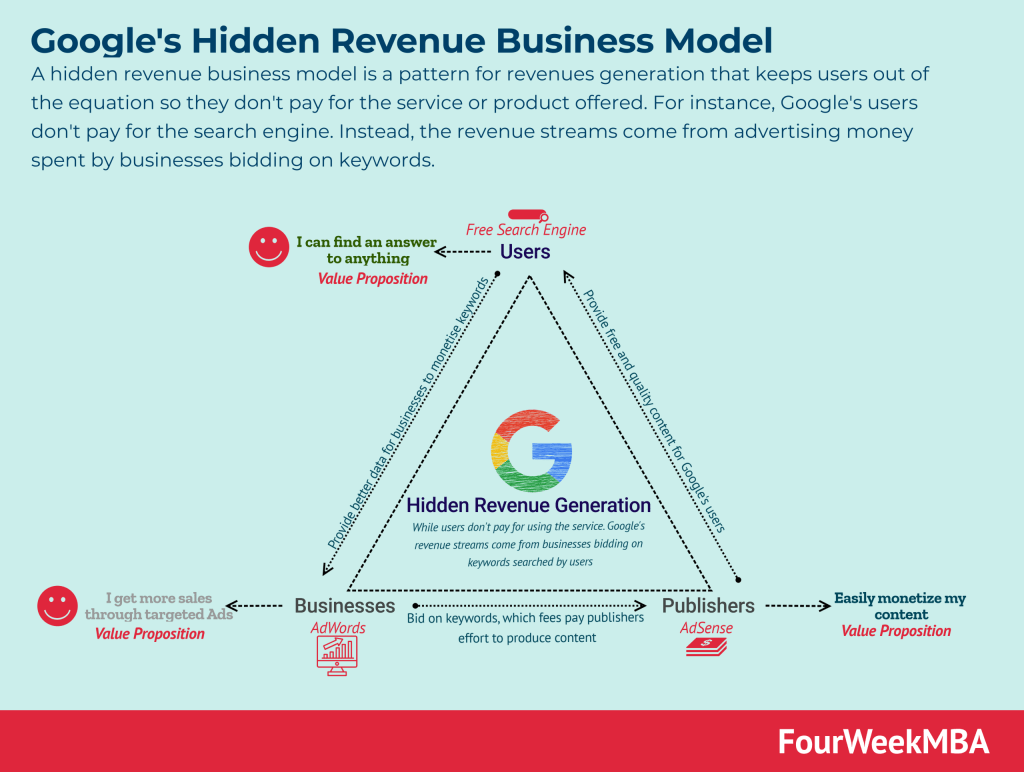
A hidden revenuebusiness model is a pattern for revenue generation that keeps users out of the equation, so they don’t pay for the service or product offered. For instance, Google’s users don’t pay for the search engine. Instead, the revenue streams come from advertising money spent by businesses bidding on keywords.
TikTok is a Chinese creative social media platform driven by short-form video content enabling users to interact and generate content at scale. TikTok primarily makes money through advertising, and it generated $4.6 billion in advertising revenues in 2021, thus making it among the most popular attention-based business models or attention merchants.
Instagram makes money via visual advertising. As part of Facebook products, the company generates revenues for Facebook Inc.’s overall businessmodel. Acquired by Facebook for a billion dollars in 2012, today Instagram is integrated into the overall Facebook business strategy. In 2018, Instagram founders, Kevin Systrom and Mike Krieger left the company, as Facebook pushed toward tighter integration of the two platforms.
YouTube was acquired for almost $1.7 billion in 2006 by Google. It makes money through advertising and subscription revenues. YouTube advertising network is part of Google Ads, and it generated more than $28B in revenue by 2021. YouTube also makes money with its paid memberships and premium content.
Twitter makes money in two ways: advertising and data licensing. In 2021, Twitter generated $4.5 billion from advertising and $570 million from data licensing. While Twitter generated $5 billion in total revenues, it lost 221 million.
Gennaro is the creator of FourWeekMBA, which reached about four million business people, comprising C-level executives, investors, analysts, product managers, and aspiring digital entrepreneurs in 2022 alone | He is also Director of Sales for a high-tech scaleup in the AI Industry | In 2012, Gennaro earned an International MBA with emphasis on Corporate Finance and Business Strategy.