A compelling value proposition: How do you want your people to think about your brand?
A unique brand positioning: What do you offer to your people that make them want more?
A 10x goal setting: Can you offer a 10X better product or service? (compared to existing solutions)
Customer segments: Who is your customer? (to notice here we’re not talking anymore about people but customers, those willing to pay for your product or service)
Distribution channels: How do you get your product or service to your customer?
Profit formula: Is the business financially sustainable?
With FourWeekMBA I’ve been researching into over a hundred business models at the time of this writing. From tech to luxury, from innovative to more traditional.
I’ve been in search of a framework, recipe or something that could help me dissect any company. As I came from a financial background the most logical thing for me was to look at these companies by analyzing their numbers.
However, I soon realized that approach was too reductive. So I started to look at other frameworks that could be used to find the simplest parts of a business model and its key components.
In this article, I’ll show you a few approaches and how they come down to similar vital components.
A recap of key components according to several business model tools and frameworks
A business model is a representation of a company in the real world (this is a definition that works for practitioners, not necessarily for academics).
Business modeling for entrepreneurs might be a useful tool to gain insights about competitors, better understand your organization or design toolbox to grow your business.
From that standpoint, over the years a few tools came handy. Some of them have been discussed at great length on this blog:
While a lean startup canvas tells you there are still nine key elements, but it substitutes key partners, key activities, key resources, and customer relationships, with a problem, solution, key metrics, and unfair advantage. Therefore, the lean startup canvas will look like that:
problem
solution
key metrics
value proposition
unfair advantage
channels
customer segments
cost structure
revenue streams
The lean startup canvas as an adaptation from the business model canvas might be better suited for startup organizations, which need to scale quickly while gathering feedback from customers.
Those elements come together when a business owner answers to a few key questions, such as, “what do you offer to the customer?” or “how is the value proposition created?” or yet “why is it profitable?”
Each of those elements feeds into each other to create a feedback loop of business model innovation. Those tools are quite useful, and it tackles how you can assess your business at each stage.
The FourWeekMBA business model framework
After looking at the key components of a business model based on a few toolboxes; based on the analyses performed over the years, for the business model boils down to three key elements, those are tied up by another ingredient.
This framework by FourWeekMBA has three aims:
simplicity
noise reduction
branding
and profitability
In short, I believe that a great business model toolbox has to have a super simple set up. It has to be based on very few elements. And it needs to focus on its long term financial sustainability.
However, what the toolboxes I’ve been looking at mostly miss is the branding of each business model success.
In short, for me there are two dimensions of a business:
The people dimension
The financial dimension
These two dimensions walk hand in hand. Yet the people side is what also makes the business thick from the economic standpoint.
The people side comprises the following elements:
A compelling value proposition: How do you want your people to think about your brand?
A unique brand positioning: What do you offer to your people that make them want more?
A 10x goal setting: Can you offer a 10X better product or service? (compared to existing solutions)
This people dimension will help you build a solid brand. A solid brand builds up a tribe, a group of people that can follow you anywhere. Once you have a solid brand, you can focus on the second dimension: the financial dimension.
The three elements of the financial dimensions are:
Customer segments: Who is your customer? (to notice here we’re not talking anymore about people but customers, those willing to pay for your product or service)
Distribution channels: How do you get your product or service to your customer?
Profit formula: Is the business financially sustainable?
Key takeaway
To recap an effective business model has to focus on two dimensions: the people dimension and the financial dimension. The people dimension will allow you to build a product or service that is 10X better than existing ones and a solid brand.
The financial dimension will help you build proper distribution channels by identifying the people that are willing to pay for your product or service.
Compelling Value Proposition: This is how you want your audience to perceive your brand. It’s the unique value or benefit your product or service offers to your customers.
Unique Brand Positioning: This involves identifying what sets your brand apart from competitors. It’s about defining the aspects that make customers want more from your brand.
10x Goal Setting: This principle suggests aiming to offer a product or service that is significantly better (10 times better) than existing solutions. This drives innovation and differentiation.
Customer Segments: Identifying who your paying customers are, which segments of the population are interested in and willing to pay for your product or service.
Distribution Channels: Determining how you will deliver your product or service to your customers. This could include online platforms, retail stores, partnerships, etc.
Profit Formula: Ensuring the financial sustainability of your business. This involves analyzing costs, revenue streams, and ensuring that your business model is economically viable.
Lean Startup Canvas: Adapted from the Business Model Canvas, this framework focuses on problem-solution fit, key metrics, and unfair advantage, among other elements.
Blitzscaling Canvas: Geared towards rapid growth, this framework emphasizes key growth factors like market size, distribution, and network effects, along with growth limiters such as lack of product/market fit.
Sales Navigator Framework: Simplifies the business model into three elements: value proposition, value chain, and revenue model. It emphasizes creating value and understanding profitability.
Four Box Business Model Framework: This framework highlights customer value proposition, key resources and processes, and the profit formula as key components that interact to drive business model innovation.
FourWeekMBA Framework: This framework focuses on simplicity, noise reduction, branding, and profitability. It divides the business model into the people dimension (value proposition, brand positioning, 10x goal) and the financial dimension (customer segments, distribution channels, profit formula).
People Dimension and Financial Dimension Highlights:
People Dimension: This aspect focuses on building a compelling value proposition that resonates with customers, creating a unique brand positioning to attract a loyal following, and setting ambitious 10x goals to drive innovation.
Financial Dimension: In this dimension, identifying customer segments willing to pay for your product or service becomes crucial. Additionally, determining effective distribution channels and ensuring a sustainable profit formula are vital for business success.
Key Takeaway:
An effective business model incorporates both the people dimension (value proposition, brand, goals) and the financial dimension (customer segments, distribution, profitability). Balancing these dimensions helps create a strong brand, innovative product or service, and a viable economic structure for long-term success.
Related Frameworks, Models, or Concepts
Description
When to Apply
Business Model Canvas
The Business Model Canvas is a strategic management tool that provides a visual framework for describing, analyzing, and designing business models. It consists of nine building blocks that represent key elements of a business model, including customer segments, value proposition, channels, customer relationships, revenue streams, key resources, key activities, key partnerships, and cost structure. The Business Model Canvas enables entrepreneurs and managers to map out and assess the components of their business model, identify opportunities for innovation and improvement, and communicate their business strategy and value proposition effectively.
Apply the Business Model Canvas to conceptualize, analyze, and refine business models. Use it to map out the key components of a business model, explore relationships and dependencies between different elements, identify strengths, weaknesses, and gaps in the business model, and iterate on business model design to align with market needs and opportunities. Implement the Business Model Canvas as a tool for strategic planning, business development, and innovation to drive sustainable growth and competitive advantage in dynamic and evolving markets.
Value Proposition Canvas
The Value Proposition Canvas is a tool for designing and analyzing value propositions that address the needs, pains, and gains of target customer segments. It complements the Business Model Canvas by focusing specifically on the value creation and delivery aspects of a business model. The Value Proposition Canvas consists of two main sections: the customer profile, which describes the characteristics, needs, and aspirations of target customers, and the value map, which outlines the products, services, and benefits that address customer needs and provide solutions to their problems. The Value Proposition Canvas helps businesses understand customer preferences and tailor value propositions to meet customer needs effectively.
Apply the Value Proposition Canvas to develop and refine value propositions that resonate with target customer segments. Use it to gain insights into customer needs, pains, and gains, identify opportunities to create unique value and differentiation, and design products, services, and solutions that address customer priorities and preferences. Implement the Value Proposition Canvas as a tool for customer-centric innovation, product development, and marketing to enhance customer satisfaction, loyalty, and engagement and drive revenue growth and profitability.
Lean Startup Methodology
The Lean Startup Methodology is an approach to building and launching new ventures that emphasizes rapid experimentation, iterative product development, and validated learning. Developed by Eric Ries, the Lean Startup Methodology advocates for a hypothesis-driven approach to entrepreneurship, where entrepreneurs test assumptions and hypotheses about their business model through small-scale experiments and feedback loops with customers. The Lean Startup Methodology aims to reduce the time and cost of bringing new products to market, minimize risk and uncertainty, and increase the likelihood of success by focusing on creating value for customers and responding to market feedback iteratively.
Apply the Lean Startup Methodology to validate business ideas and test assumptions quickly and cost-effectively. Use it to develop minimum viable products (MVPs) and prototypes to gather feedback from early adopters, conduct lean experiments to validate product-market fit and key business hypotheses, and pivot or persevere based on validated learning and customer insights. Implement the Lean Startup Methodology as a framework for entrepreneurial innovation, agility, and resilience to navigate uncertainty and complexity in startup and corporate environments and increase the chances of building successful and sustainable businesses.
Platform Business Model
The Platform Business Model is a business model that facilitates the exchange of value between two or more distinct groups of users, typically producers and consumers, through a digital or physical platform. Platform businesses create and curate ecosystems where participants can interact, transact, and create value for each other. Platforms generate revenue through various monetization strategies, such as transaction fees, subscription fees, advertising, or licensing. Platform business models enable scalable and network effects-driven growth, where the value of the platform increases as more users join and participate in the ecosystem.
Apply the Platform Business Model to build and scale businesses that facilitate value exchange and interactions between multiple user groups. Use it to create digital or physical platforms that connect producers and consumers, providers and users, or creators and audiences, and enable them to transact, collaborate, or interact with each other. Implement the Platform Business Model as a framework for building multi-sided marketplaces, social networks, content platforms, and other digital platforms that leverage network effects and economies of scale to drive growth, engagement, and monetization opportunities.
Disruptive Innovation
Disruptive Innovation is a concept introduced by Clayton Christensen that describes the process by which new technologies or business models disrupt existing markets and create new value networks, often displacing established incumbents. Disruptive innovations typically start in niche markets or lower-end segments where they offer simpler, cheaper, or more accessible solutions to underserved customer needs. Over time, disruptive innovations may evolve and improve, eventually challenging incumbents and reshaping entire industries.
Apply Disruptive Innovation principles to identify emerging trends and opportunities for disruptive change in markets and industries. Use it to anticipate and respond to disruptive threats and opportunities, explore new business models and technologies that have the potential to disrupt existing markets or create new value networks, and adapt organizational strategies and capabilities to embrace disruptive change and drive innovation and growth in dynamic and uncertain environments. Implement Disruptive Innovation strategies to stay ahead of competitors, capitalize on new market opportunities, and create sustainable competitive advantages in rapidly evolving industries.
Blue Ocean Strategy
Blue Ocean Strategy is a strategic framework that encourages companies to create uncontested market space and make competition irrelevant by innovating and creating new market categories or value propositions. Blue ocean strategy focuses on finding new opportunities for growth and differentiation by offering unique value to customers, rather than competing in crowded and competitive market spaces. Blue ocean strategy advocates for creating “blue oceans” of uncontested market space where companies can capture new demand, generate higher margins, and create sustainable competitive advantages.
Apply Blue Ocean Strategy to identify new market opportunities and drive innovation and growth. Use it to explore untapped customer needs and pain points, develop unique value propositions and business models that differentiate from competitors, and create new market categories or product niches that offer significant value to customers. Implement Blue Ocean Strategy principles to shift focus from competition to value creation, drive industry innovation, and achieve market leadership and profitability in uncontested market spaces.
Open Innovation
Open Innovation is a collaborative approach to innovation that involves leveraging external ideas, technologies, and partnerships to complement and enhance internal capabilities. Open innovation encourages companies to collaborate with customers, suppliers, partners, and external stakeholders to co-create value and drive innovation across the value chain. Open innovation enables companies to tap into a broader ecosystem of expertise and resources, accelerate product development cycles, and bring innovative solutions to market more efficiently.
Apply Open Innovation principles to leverage external expertise and resources in product development and innovation processes. Use it to engage with customers, partners, and stakeholders to co-create value, source innovative ideas and technologies from external sources, and collaborate on joint R&D projects and initiatives. Implement Open Innovation strategies to foster collaboration, creativity, and knowledge sharing across organizational boundaries, and accelerate innovation and time-to-market for new products and services.
Porter’s Five Forces
Porter’s Five Forces is a framework developed by Michael Porter that analyzes the competitive forces within an industry and their impact on industry profitability and attractiveness. The five forces include the threat of new entrants, the bargaining power of buyers, the bargaining power of suppliers, the threat of substitute products or services, and the intensity of competitive rivalry. Porter’s Five Forces framework helps companies assess the competitive dynamics and attractiveness of an industry and develop strategies to position themselves effectively within the market.
Apply Porter’s Five Forces analysis to evaluate the competitive dynamics and attractiveness of an industry. Use it to assess the threats and opportunities posed by competitive forces, identify sources of competitive advantage and differentiation, and develop strategies to mitigate competitive threats and capitalize on market opportunities. Implement Porter’s Five Forces analysis as a tool for industry analysis, strategic planning, and decision-making to inform market entry strategies, competitive positioning, and resource allocation decisions in dynamic and competitive markets.
SWOT Analysis
SWOT Analysis is a strategic planning tool that helps companies identify their strengths, weaknesses, opportunities, and threats. SWOT analysis involves assessing internal factors, such as organizational capabilities and resources (strengths and weaknesses), and external factors, such as market trends and competitive dynamics (opportunities and threats). SWOT analysis enables companies to gain insights into their strategic position and environment, identify strategic priorities and challenges, and develop strategies to leverage strengths, mitigate weaknesses, capitalize on opportunities, and address threats.
Apply SWOT Analysis to assess internal capabilities and external market conditions. Use it to identify key strengths and weaknesses of the organization, opportunities for growth and expansion, and threats to business sustainability and competitiveness. Implement SWOT Analysis as a framework for strategic planning, business development, and decision-making to align organizational strategies and resources with market opportunities and challenges and drive sustainable growth and performance in dynamic and uncertain environments.
A Blockchain Business Model according to the FourWeekMBA framework is made of four main components: Value Model (Core Philosophy, Core Values and Value Propositions for the key stakeholders), Blockchain Model (Protocol Rules, Network Shape and Applications Layer/Ecosystem), Distribution Model (the key channels amplifying the protocol and its communities), and the Economic Model (the dynamics/incentives through which protocol players make money). Those elements coming together can serve as the basis to build and analyze a solid Blockchain Business Model.
In an asymmetric business model, the organization doesn’t monetize the user directly, but it leverages the data users provide coupled with technology, thus have a key customer pay to sustain the core asset. For example, Google makes money by leveraging users’ data, combined with its algorithms sold to advertisers for visibility.
In a business world driven by technology and digitalization, competition is much more fluid, as innovation becomes a bottom-up approach that can come from anywhere. Thus, making it much harder to define the boundaries of existing markets. Therefore, a proper business competition analysis looks at customer, technology, distribution, and financial model overlaps. While at the same time looking at future potential intersections among industries that in the short-term seem unrelated.
Technological modeling is a discipline to provide the basis for companies to sustain innovation, thus developing incremental products. While also looking at breakthrough innovative products that can pave the way for long-term success. In a sort of Barbell Strategy, technological modeling suggests having a two-sided approach, on the one hand, to keep sustaining continuous innovation as a core part of the business model. On the other hand, it places bets on future developments that have the potential to break through and take a leap forward.
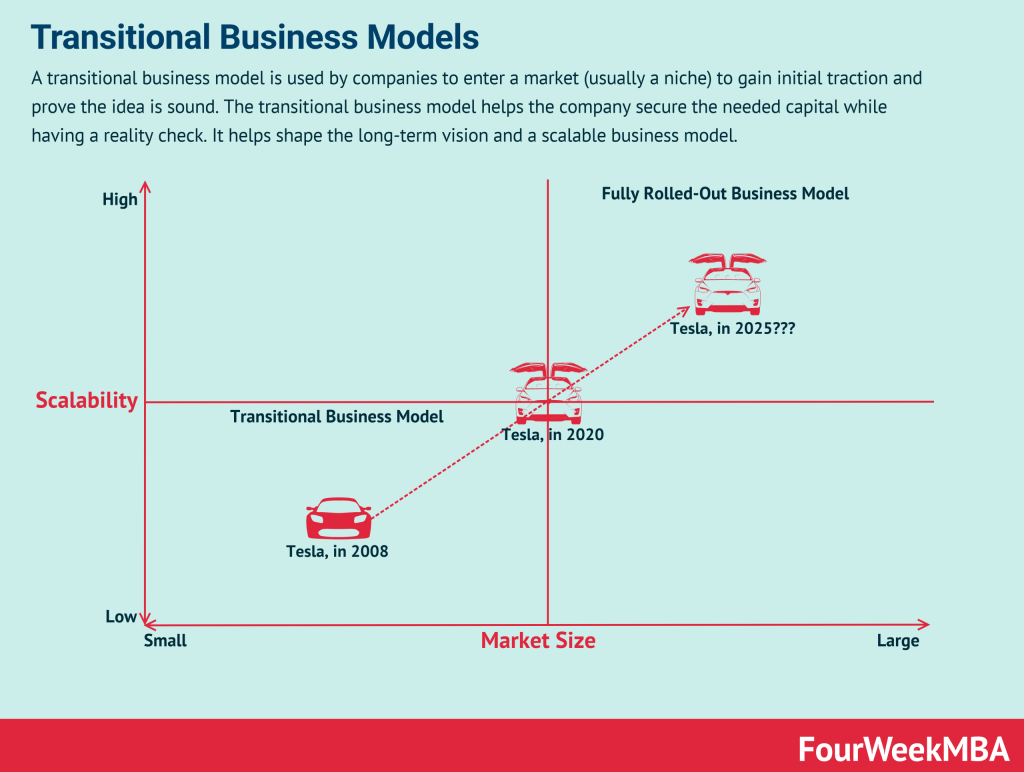
A transitional business model is used by companies to enter a market (usually a niche) to gain initial traction and prove the idea is sound. The transitional business model helps the company secure the needed capital while having a reality check. It helps shape the long-term vision and a scalable business model.
The minimum viable audience (MVA) represents the smallest possible audience that can sustain your business as you get it started from a microniche (the smallest subset of a market). The main aspect of the MVA is to zoom into existing markets to find those people which needs are unmet by existing players.
Business scaling is the process of transformation of a business as the product is validated by wider and wider market segments. Business scaling is about creating traction for a product that fits a small market segment. As the product is validated it becomes critical to build a viable business model. And as the product is offered at wider and wider market segments, it’s important to align product, business model, and organizational design, to enable wider and wider scale.
The market expansion consists in providing a product or service to a broader portion of an existing market or perhaps expanding that market. Or yet, market expansions can be about creating a whole new market. At each step, as a result, a company scales together with the market covered.
In the FourWeekMBA growth matrix, you can apply growth for existing customers by tackling the same problems (gain mode). Or by tackling existing problems, for new customers (expand mode). Or by tackling new problems for existing customers (extend mode). Or perhaps by tackling whole new problems for new customers (reinvent mode).
In the FourWeekMBA Revenue Streams Matrix, revenue streams are classified according to the kind of interactions the business has with its key customers. The first dimension is the “Frequency” of interaction with the key customer. As the second dimension, there is the “Ownership” of the interaction with the key customer.
Revenue model patterns are a way for companies to monetize their business models. A revenue model pattern is a crucial building block of a business model because it informs how the company will generate short-term financial resources to invest back into the business. Thus, the way a company makes money will also influence its overall business model.
A pricing strategy or model helps companies find the pricing formula in fit with their business models. Thus aligning the customer needs with the product type while trying to enable profitability for the company. A good pricing strategy aligns the customer with the company’s long term financial sustainability to build a solid business model.
In an asymmetric businessmodel, the organization doesn’t monetize the user directly, but it leverages the data users provide coupled with technology, thus have a key customer pay to sustain the core asset. For example, Google makes money by leveraging users’ data, combined with its algorithms sold to advertisers for visibility.
In an asymmetric businessmodel, the organization doesn’t monetize the user directly, but it leverages the data users provide coupled with technology, thus having a key customer pay to sustain the core asset. For example, Google makes money by leveraging users’ data, combined with its algorithms sold to advertisers for visibility. This is how attention merchants make monetize their business models.
A marketplace is a platform where buyers and sellers interact and transact. The platform acts as a marketplace that will generate revenues in fees from one or all the parties involved in the transaction. Usually, marketplaces can be classified in several ways, like those selling services vs. products or those connecting buyers and sellers at B2B, B2C, or C2C level. And those marketplaces connecting two core players, or more.
The wholesale model is a selling model where wholesalers sell their products in bulk to a retailer at a discounted price. The retailer then on-sells the products to consumers at a higher price. In the wholesale model, a wholesaler sells products in bulk to retail outlets for onward sale. Occasionally, the wholesaler sells direct to the consumer, with supermarket giant Costco the most obvious example.
A retail business model follows a direct-to-consumer approach, also called B2C, where the company sells directly to final customers a processed/finished product. This implies a business model that is mostly local-based, it carries higher margins, but also higher costs and distribution risks.
A B2B2C is a particular kind of business model where a company, rather than accessing the consumer market directly, it does that via another business. Yet the final consumers will recognize the brand or the service provided by the B2B2C. The company offering the service might gain direct access to consumers over time.
The term “crowdsourcing” was first coined by Wired Magazine editor Jeff Howe in a 2006 article titled Rise of Crowdsourcing. Though the practice has existed in some form or another for centuries, it rose to prominence when eCommerce, social media, and smartphone culture began to emerge. Crowdsourcing is the act of obtaining knowledge, goods, services, or opinions from a group of people. These people submit information via social media, smartphone apps, or dedicated crowdsourcing platforms.
While the term has been coined by Andrew Lampitt, open-core is an evolution of open-source. Where a core part of the software/platform is offered for free, while on top of it are built premium features or add-ons, which get monetized by the corporation who developed the software/platform. An example of the GitLab open core model, where the hosted service is free and open, while the software is closed.
Open source is licensed and usually developed and maintained by a community of independent developers. While the freemium is developed in-house. Thus the freemium give the company that developed it, full control over its distribution. In an open-source model, the for-profit company has to distribute its premium version per its open-source licensing model.
The freemium – unless the whole organization is aligned around it – is a growth strategy rather than a business model. A free service is provided to a majority of users, while a small percentage of those users convert into paying customers through the sales funnel. Free users will help spread the brand through word of mouth.
A freeterprise is a combination of free and enterprise where free professional accounts are driven into the funnel through the free product. As the opportunity is identified the company assigns the free account to a salesperson within the organization (inside sales or fields sales) to convert that into a B2B/enterprise account.
In a franchained business model (a short-term chain, long-term franchise) model, the company deliberately launched its operations by keeping tight ownership on the main assets, while those are established, thus choosing a chain model. Once operations are running and established, the company divests its ownership and opts instead for a franchising model.
Gennaro is the creator of FourWeekMBA, which reached about four million business people, comprising C-level executives, investors, analysts, product managers, and aspiring digital entrepreneurs in 2022 alone | He is also Director of Sales for a high-tech scaleup in the AI Industry | In 2012, Gennaro earned an International MBA with emphasis on Corporate Finance and Business Strategy.