A B2B2C is a particular kind of business model where a company, rather than accessing the consumer market directly, it does that via another business. Yet the final consumers will recognize the brand or the service provided by the B2B2C. The company offering the service might gain direct access to consumers over time.
Aspect
Explanation
Definition
B2B2C, short for “Business-to-Business-to-Consumer,” is a business model where a company sells its products or services to other businesses (B2B) with the ultimate goal of reaching and serving end consumers (B2C). In this model, a business collaborates or partners with another business to deliver products or services to consumers, often through a distribution network or intermediary. B2B2C combines elements of both B2B and B2C models, allowing companies to leverage the strengths of both sectors to expand their market reach and deliver value to end-users. It is commonly seen in industries such as e-commerce, healthcare, insurance, and financial services, where intermediaries or distributors play a crucial role in connecting businesses with consumers.
Key Concepts
– Intermediaries: B2B2C often involves intermediaries, such as wholesalers, retailers, or online marketplaces, that facilitate the connection between businesses and consumers. – Value Chain: It considers the entire value chain, from the manufacturer or service provider to the end consumer, with each stage adding value. – Distribution Channels: Multiple distribution channels may be utilized to reach the end consumer effectively. – Customer Experience: B2B2C models focus on optimizing the customer experience throughout the supply chain. – Collaborative Ecosystem: Collaboration and partnerships between businesses are key elements of this model.
Characteristics
– Partnerships: Collaboration between businesses to deliver products or services to consumers is a defining characteristic. – Multi-Channel Approach: B2B2C companies often employ multiple distribution channels, such as online marketplaces, retailers, and direct sales. – Customer-Centric: It places a strong emphasis on meeting the needs and preferences of end consumers. – Supply Chain Management: Effective supply chain management is crucial to ensure a seamless flow of products or services. – Scalability: The model allows for scalability by reaching a larger consumer base through B2B partnerships.
Implications
– Expanded Market Reach: B2B2C allows businesses to tap into new consumer markets and demographics through strategic partnerships. – Improved Customer Experience: By considering the entire value chain, companies can enhance the customer experience, from product availability to after-sales support. – Efficient Distribution: Utilizing multiple distribution channels can lead to efficient and widespread product distribution. – Supply Chain Optimization: Managing the supply chain effectively becomes essential to ensure product availability and timely delivery. – Partnership Management: Building and maintaining collaborative relationships with B2B partners is critical for success.
Advantages
– Market Expansion: B2B2C enables businesses to enter new markets and reach a broader consumer audience. – Leveraging Expertise: Collaborating with B2B partners allows companies to leverage the expertise and resources of those partners. – Cost Efficiency: By sharing distribution and marketing costs with partners, companies can achieve cost efficiencies. – Customer-Centric: The model places a strong focus on meeting consumer needs and preferences. – Scalability: It offers scalability potential by tapping into existing B2B networks.
Drawbacks
– Complexity: Managing relationships with multiple partners and distribution channels can be complex. – Loss of Control: Companies may have limited control over the customer experience when intermediaries are involved. – Competition: Intense competition in both B2B and B2C markets can make it challenging to stand out. – Dependency: Businesses may become dependent on their B2B partners for market access. – Risk Sharing: Risks and challenges are shared among the involved parties, which can lead to disputes or disagreements.
Applications
– E-commerce: Online marketplaces often use the B2B2C model, where businesses sell their products through the platform to reach consumers. – Insurance: Insurance companies collaborate with various agents and brokers to sell policies to end consumers. – Pharmaceuticals: Pharmaceutical companies may sell their products to healthcare providers and pharmacies, who then distribute to patients. – Financial Services: Banks and financial institutions partner with fintech companies to offer consumer-facing financial products and services. – Consumer Electronics: Manufacturers may sell their products through retailers and e-commerce platforms to reach consumers.
Use Cases
– Online Marketplace: A manufacturer partners with an online marketplace to sell its products to a wide consumer audience. – Insurance Brokerage: An insurance company collaborates with independent agents and brokers to sell insurance policies to individuals and businesses. – Pharmacy Distribution: Pharmaceutical manufacturers supply their products to pharmacies, which in turn dispense them to patients. – Bank-Fintech Partnership: A traditional bank partners with a fintech company to offer mobile banking services and financial products to consumers. – Retail Collaboration: A consumer electronics manufacturer distributes its products through various retailers and e-commerce platforms.
B2B, which stands for business-to-business, is a process for selling products or services to other businesses. On the other hand, a B2C sells directly to its consumers.
In the business world, the difference between B2B vs. B2C businesses often seems clear and straightforward.
However, there is a third kind of business model, primarily based on what might seem like a B2B strategy.
However, the final aim is to build a B2C company over time.
This model is called B2B2C or business to business to consumer.
The logic is the following. If a business can’t have direct access to consumers, it will gain it via a second business.
That second business will allow the first business to gain access to its consumers, have its brand recognized, and over time expands the overall consumer base.
Now the question is why an intermediary business would become the link with its consumers for the B2B2C business?
At the time, AOL was a tech giant, while Google was still in its infancy.
While the search engine from Mountain View was snowballing, it still missed the first-scaler advantage that would have given it the dominance of the search industry.
Google was already a consumer product.
However, it needed to pass first through a set of bottlenecks to gain access to consumers.
In addition, the more data Google gained over time, the more it got better.
And the more consumers knew about it; the more Google would be less reliant on distribution channels like AOL.
This is not to say that Google took advantage of AOL.
Quite the opposite, Google offered AOL a minimum guaranteed revenues, and it bought a stake in the company.
Indeed, a B2B2C business model relies on a closely tied relationship which makes the intermediary business (which connects to end consumers) position quite good.
Let’s analyze the basis of this B2B relationship, which will then trigger the B2C opportunities.
For the sake of this discussion we’ll call:
B1: the business trying to enter the consumer market via another business
B2: as the intermediary between B1 and consumers
C: as the consumers in that industry
Why not go directly to consumers?
One of the first questions that come to mind in designing this kind of business model might be why not go directly after the consumers?
In reality, going after the consumers is the dream of many, but a few make it.
The consumer market seems to be biased more than any other toward the winner-take-all effect.
Direct-to-consumer (D2C) is a business model where companies sell their products directly to the consumer without the assistance of a third-party wholesaler or retailer. In this way, the company can cut through intermediaries and increase its margins. However, to be successful the direct-to-consumers company needs to build its own distribution, which in the short term can be more expensive. Yet in the long-term creates a competitive advantage.
In short, building a successful consumer business is way harder, than building an enterprise business.
And as an entrepreneur, building a consumer business might be appealing.
You need to weigh your options. Thus, understand where the market it’s headed.
Also, in many cases, building a successful consumer business is a matter of timing and proper funding and distribution.
Factors which you can relatively control.
That is why many businesses, that in the early days, looked at consumers, eventually turn into enterprise businesses:
Source: Sapphire Ventures
In a study by Sapphire Ventures on the exits in the consumer vs. enterprise since 1995, the latter seems to have generated $825B compared to $582B in the tech consumer space.
An exit is a strategy where the venture capitalist or investor liquidates its funds in a previously invested startup, and it usually measures the ROI for the investor.
In short, from 1995-2016 there were 4,600 exits in enterprise tech and over 2,600 exits in consumer tech.
A little caveat: the numbers above are in no way to be interpreted as investment advice, instead this is just a strategic analysis of the business landscape.
This means that starting from a B2B, an enterprise business allows at least three advantages:
Risk reduction (provided that you do not depend on one or two enterprise customers only, and therefore, your enterprise customer base is spread across various clients, none of which, makes up most of your turnover).
A more predictable growth path.
Easier financing as more investors can liquidate their position via an exit.
One drawback, of course,e is the lack of scalability, unless you design a B2B2C business model.
What does a B2B2C relationship look like?
A B2B2C business model relies on a tight relationship between the B1 that wants to access consumers and B2, which instead has already access to the consumer market.
As it might not make sense for B1 to enter the consumer market, it will make sense to find the key players that can help it open it.
A partnership between B1 and B2 has – I argue – three main features:
It is not a white label
If it were a white label, final consumers would not recognize the product and brand over time.
The white label business model is a business-to-business (B2B) approach involving a manufacturer and a reseller. The white label business model involves a company selling products with its own branding that were manufactured by others. In this case, the manufacturer provides the product in white-label to the reseller/retailer, who can customize it and present it with its own brand/logo to final customers.
It has direct access to consumers’ data
Many software as a service and digital tools, in general, benefit from network effects.
In short, the more data they have about the people using it, the better those tools will get for each new user.
If the business entering the consumer market via another business didn’t have access to their data, it wouldn’t be possible to benefit from network effects and scale up over time.
As it gains brand recognition
Not only the B2B2C business will have access to consumers’ data, but its brand will be pretty visible to them.
Thinking back to the Google deal with AOL, where it got powered by Google searches, more and more people could recognize Google over time, to the point that it became a verb
What are the premises of a B2B2C relationship?
A B2B2C business starts with a few key partners, which are other businesses that can help it gain access to consumers.
This relationship has to be highly beneficial to the business that has access to the consumer market.
It might look like a joint venture in practice, with a tight-knit that makes the incentives in favor of the business partner to distribute the product of the other business which doesn’t have access to consumers.
Indeed, I argue – this kind of partnership has to have a few key elements:
Willingness to offer a wider portfolio of products or services
Often customers might ask B1 for products or services that are not in its portfolio.
B1 can make its customers happy by having your product or service featured.
Going back to the Google deal with AOL, at the time, search was seen as a secondary service, yet it was nice to have features for consumers.
Google worked 10x better than its competitors, and it made sense to offer searches powered by Google through AOL.
Price convenience
Another key element is the convenience of distributing the product or service of B1.
An economic opportunity
A very important element is economic opportunities created for the business, which help access the consumer market.
Indeed, if the product or service of B1 makes B2 able to expand its offerings to consumers.
That opportunity is too good to be given up, putting B1 in a position to seal that relationship.
Also, if B2 is driven by an economic opportunity, the chances that it will distribute the service provided by B1 will be higher.
Indeed, one of the most significant pitfalls of a B2B2C business might be the lack of push and distribution from its partners.
Not interested in entering directly that industry
Another reason why B2 might want to use B1 service to its consumers it’s because it doesn’t have any interest in entering that industry.
Going back to the AOL deal example, the company didn’t have any interest in entering the search industry.
A very good deal
The last and most important ingredient is about offering a deal that is too good to refuse.
This deal is a marketing expense on the side of B1 to acquire consumers’ market share.
On the other hand, it is for B2 a great opportunity to grow the business with no costs and risks.
On the one hand, you want a structured sales force to perform account management for those businesses acting as intermediaries to the consumer market.
On the other hand, you need to invest resources in branding and marketing efforts.
This will allow your business to be recognized by consumers over time.
This way, consumers will act as a push that will make your entrance into the B2B space easier.
While this process might seem simple in theory, it is quite complex.
But in this article, we analyzed a few key ingredients, which should give you enough information to get started.
B2B2C examples
The business-to-business-to-consumer (B2B2C) manifests itself in several ways.
However, it most commonly involves a manufacturer or service provider that sells to consumers via a retailer or distributor.
In more succinct terms, B2B2C businesses sell to consumers and other businesses simultaneously.
To better understand this concept, let’s take a look at a few variations of the B2B2C model with some included examples.
Manufacturer to distributor to customer
Manufacturer-to-consumer is sometimes referred to as factory-to-consumer (F2C) because the manufacturer sells direct to the consumer. In essence, the company that produces the item takes the place of the retailer and any other third-party such as a wholesaler or supplier.
The most common online form of the B2B2C business model is where a product manufacturer operates an eCommerce store but outsources order fulfillment to a distributor.
When an order is placed in the store, the distributor receives a notification and ships the product to the consumer from inventory stored in its own warehouse.
The distributor may take inventory from the manufacturer on consignment instead of purchasing it from them directly.
Once the product has shipped, the distributor generates an invoice which is sent to the manufacturer who, after receiving payment from the consumer, compensates the distributor with a commission.
Any food business that uses Instacart for grocery deliveries and pick-up orders operates under this variation.
Manufacturer to Amazon to B2B/B2C customer
No article on B2B and B2C would be complete without mentioning Amazon.
In this variation, the manufacturer ships a product to Amazon that then sells and ships it to an end-user.
Note that distributors also sell the same products on the Amazon platform itself.
In either case, however, the product manufacturer loses control over their brand.
To combat this issue, many brands use omnichannel eCommerce which is also SAP-enabled and integrated with Amazon.
This allows the brand to maintain a harmonious relationship with distributors since both companies sell directly to the end-user.
The manufacturer can sell to B2B and B2C customers and when an order is made, the company can choose to ship the product itself or use Amazon’s fulfillment service.
Manufacturer to bricks-and-mortar dealer to B2C customer
In this variation, the manufacturer sells a product to a bricks-and-mortar business that then sells it to the consumer face-to-face.
This is the most simple variation to understand and is common in supermarkets and most other retail businesses.
Some businesses will also create a B2B2C eCommerce platform to enable the bricks-and-mortar dealer to sell products to consumers.
When an individual visits a physical store, the dealer completes the sale in person but on the manufacturer’s website.
This enables the dealer to take a commission from the sale and the manufacturer to collect the buyer’s information.
In the event the dealer files for bankruptcy or otherwise ceases trading, the manufacturer still has access to its customers.
Manufacturer sales representatives to distributor to B2B customer
This variation is another B2B2C eCommerce model where a manufacturer with its own sales team also sells to other businesses via distributors.
Consider the example of a manufacturer that sells magnetic resonance imaging (MRI) machines to healthcare providers.
The company creates an eCommerce store that sales teams and healthcare providers can access on any device and in any location to close deals.
Members of the sales team can place orders on behalf of the customer, or the customer can place the order themselves.
Whatever the scenario, it is important to note that both do so from the same platform that is customized to their needs.
Here, the distributor plays much the same role as the distributor in the first B2B2C business model.
In other words, the distributor sells the MRI machine on consignment and receives a commission from the manufacturer.
It also has access to a specific area of the eCommerce platform where it can access the required information to fulfill the order.
Key Highlights
Definition: B2B2C (Business to Business to Consumer) is a business model where a company accesses the consumer market indirectly through another business, while the end consumers recognize the brand/service.
Intermediary Role: B2B2C involves an intermediary business (B2) connecting B1 (company seeking consumer access) to end consumers, expanding the consumer base over time.
Data Access: B1 gains direct access to consumer data through B2, enabling scaling and improvement based on user insights.
Brand Recognition: The B1 brand becomes familiar to consumers over time due to the partnership with B2.
Advantages:
Risk Reduction: B2B2C models often have more predictable growth and lower risk compared to pure B2C approaches.
Predictable Growth: The involvement of an intermediary contributes to steady growth.
Easier Financing: The presence of multiple parties enhances financing opportunities.
Variations of Relationships:
Manufacturer to Distributor to Customer: Manufacturers sell via eCommerce and outsource fulfillment to distributors.
Manufacturer to Amazon to B2B/B2C Customer: Manufacturers sell to Amazon, which sells to consumers, also available to distributors.
Manufacturer to Bricks-and-Mortar Dealer to B2C Customer: Manufacturers supply physical stores that sell to consumers, sometimes via eCommerce.
Manufacturer Sales Reps to Distributor to B2B Customer: Manufacturers offer products through an eCommerce platform accessed by sales teams and B2B clients.
Examples of B2B2C Models:
Affirm: Offers pay-later solutions through merchants, earning from fees and consumer loans.
Instacart: Facilitates grocery delivery with service fees, memberships, and ads.
OpenTable: Reservations platform with subscription plans and referral fees.
LinkedIn: Two-sided platform connecting businesses and professionals.
Udemy: E-learning platform with both B2C and B2B offerings.
Related Frameworks
Description
When to Apply
Platform Business Model
– A business model where a company creates value by facilitating interactions and transactions between multiple groups, often acting as an intermediary or matchmaker. Platform businesses enable B2B2C relationships by connecting businesses with end consumers or other businesses through a digital or physical platform.
– When creating digital marketplaces or ecosystems. – Implementing a Platform Business Model to facilitate interactions and transactions between multiple parties, enabling B2B2C relationships and fostering network effects, scalability, and value creation within digital marketplaces or ecosystems effectively.
Ecosystem Strategy
– A strategic approach where a company collaborates with partners, suppliers, customers, and other stakeholders to create a mutually beneficial ecosystem. Ecosystem Strategy enables B2B2C relationships by fostering cooperation, innovation, and value co-creation across interconnected entities.
– When fostering collaboration and innovation across value chains. – Adopting an Ecosystem Strategy to cultivate partnerships and alliances, leverage complementary capabilities, and create value-added services or solutions that benefit multiple stakeholders, facilitating B2B2C relationships and ecosystem growth effectively.
Value Chain Integration
– A business strategy that involves vertically integrating or collaborating with partners along the value chain to streamline operations, reduce costs, and enhance value delivery. Value Chain Integration enables companies to offer end-to-end solutions or services to B2B2C customers.
– When optimizing supply chain efficiency or enhancing customer value. – Pursuing Value Chain Integration strategies to vertically integrate or partner with suppliers, distributors, or service providers, offering seamless end-to-end solutions or services to B2B2C customers, improving efficiency, and enhancing value delivery effectively.
Channel Partner Management
– A strategic approach to managing relationships with intermediaries, distributors, or resellers who sell products or services to end consumers on behalf of a company. Channel Partner Management facilitates B2B2C relationships by optimizing distribution channels and maximizing reach.
– When expanding market reach or managing indirect sales channels. – Employing Channel Partner Management strategies to recruit, train, and support channel partners effectively, aligning incentives, and ensuring consistent branding and customer experience across channels, optimizing distribution and maximizing market penetration in B2B2C markets.
Customer Journey Mapping
– A process of visualizing and understanding the steps, touchpoints, and interactions that customers experience while engaging with a company or its products/services. Customer Journey Mapping helps identify opportunities to enhance the customer experience and drive value in B2B2C contexts.
– When improving customer experience or identifying pain points. – Utilizing Customer Journey Mapping techniques to visualize and analyze customer interactions across touchpoints, identify pain points, bottlenecks, or opportunities for improvement, and optimize the end-to-end customer experience in B2B2C relationships effectively.
Digital Transformation
– The process of leveraging digital technologies to fundamentally change business operations, processes, and customer experiences. Digital Transformation enables companies to adapt to changing market dynamics, enhance agility, and deliver value in B2B2C environments.
– When modernizing operations or enhancing digital capabilities. – Embarking on a Digital Transformation journey to digitize processes, leverage data analytics, and implement innovative technologies that enable seamless interactions, personalized experiences, and value creation across B2B2C ecosystems effectively.
Customer Relationship Management (CRM)
– A strategy and technology system used to manage interactions and relationships with customers throughout the customer lifecycle. Customer Relationship Management (CRM) enables companies to track customer interactions, analyze data, and personalize engagements in B2B2C settings.
– When nurturing customer relationships or driving sales growth. – Implementing a Customer Relationship Management (CRM) system to centralize customer data, track interactions, and deliver personalized experiences or offerings tailored to B2B2C customers’ needs and preferences, fostering loyalty and driving sales effectively.
Data-driven Decision Making
– A decision-making approach that relies on data analysis and insights to inform strategic choices and operational improvements. Data-driven Decision Making enables companies to identify trends, patterns, and opportunities in B2B2C markets.
– When optimizing marketing strategies or product offerings. – Embracing Data-driven Decision Making practices to analyze customer data, market trends, and performance metrics, derive actionable insights, and make informed decisions that drive growth, innovation, and value creation in B2B2C environments effectively.
Agile Methodology
– A project management approach that emphasizes iterative development, collaboration, and rapid adaptation to change. Agile Methodology enables companies to respond quickly to evolving customer needs and market dynamics in B2B2C contexts.
– When developing new products or services or launching marketing campaigns. – Adopting an Agile Methodology to foster cross-functional collaboration, prioritize customer feedback, and deliver incremental value through iterative development cycles, accelerating innovation and time-to-market in B2B2C initiatives effectively.
Value Proposition Design
– A methodology for creating, testing, and iterating on value propositions that address customer needs and deliver unique benefits. Value Proposition Design helps companies articulate compelling value propositions for B2B2C customers and validate market fit.
– When developing new products, services, or business models. – Applying Value Proposition Design principles to identify customer pain points, articulate value propositions, and validate market demand through customer feedback, iterating and refining offerings to meet B2B2C customers’ needs effectively.
Started as a pay-later solution integrated to merchants’ checkouts, Affirm makes money from merchants’ fees as consumers pick up the pay-later solution. Affirm also makes money through interests earned from the consumer loans, when those are repurchased from the originating bank. In 2020 Affirm made 50% of its revenues from merchants’ fees, about 37% from interests, and the remaining from virtual cards and servicing fees.
Instacart’s business model relies on enabling an easy set up for grocery stores, the comfort for customers to get their shopping delivered at home, and an additional income stream for personal shoppers. Instacart makes money by charging service fees, via memberships, and by running performance advertising on its platform.
OpenTable is an American online restaurant reservation system founded by Chuck Templeton. During the late 90s, it provided one of the first automated, real-time reservation systems. The company was acquired by Booking Holding back in 2014, for $2.6 billion. Today OpenTable makes money via subscription plans, referral fees, and in-dining with its first restaurant, as an experiment in Miami, Florida.
Key takeaways:
The business-to-business-to-consumer (B2B2C) manifests itself in several ways. However, it most commonly involves a manufacturer or service provider that sells to consumers via a retailer or distributor.
The most common online form of the B2B2C business model is where a product manufacturer operates an eCommerce store but outsources order fulfillment to a distributor who holds inventory on consignment and collects a commission.
Another example of the B2B2C model involves a manufacturer, brick-and-mortar dealer, and B2C customer. The most simple form of this variation is a traditional supermarket, but in some cases, the brick-and-mortar dealer will complete the sale in a physical retail store but on the manufacturer’s website.
LinkedIn is a two-sided platform running on a freemium model, where to unlock unlimited search and other features, you need to switch to a paid account. Acquired by Microsoft for $27 billion in 2016, LinkedIn made $5.2 billion in revenues in 2018 and nearly 630M members by October 2019.
Udemy is an e-learning platform with two primary parts: the consumer-facing platform (B2C). And the enterprise platform (B2B). Udemy sells courses to anyone on its core marketplace, while it sells Udemy for Business only to B2B/Enterprise accounts. As such, Udemy has two key players: instructors on the marketplace, and business instructors for the B2B platform.
Zoom is a video communication platform, which mission is to “make video communications frictionless.” Leveraging on the viral growth from its freemium model, Zoom then uses its direct sales force to identify the opportunity and channel those in B2B and enterprise accounts.
A freeterprise is a combination of free and enterprise where free professional accounts are driven into the funnel through the free product. As the opportunity is identified the company assigns the free account to a salesperson within the organization (inside sales or fields sales) to convert that into a B2B/enterprise account.
What is the difference between B2B B2C and B2B2C?
The key stands in the profile of the key customers and how they make the purchasing decision. Opposed to a B2C, in a B2B, the customer is usually an organization. Thus, a group of people makes the purchasing decision. In a B2B2C model, the product is delivered by another company.
What is B2C2B?
In a B2B2B model, a company will target employees within the desired organization, as an alternative to existing products. In some cases, the basic service is offered for free, so that those corporates within the desired business will promote the service within the company. Think of how Slack offers a free basic version that can be upgraded for morse users. In this case, Slack provides a valid alternative to the internal company’s chats.
What is a B2C example?
In a B2C model, a business deals with consumers. Examples of B2C include companies like Apple and Amazon, which usually sell to consumers. The B2C model offers a product or service which is wired toward a broader market compared to B2B, and it has different structures and characteristics.
What is a B2B example?
In a B2C model, a business deals with other companies. Examples of B2B include companies like Salesforce and Dropbox, which usually sell to other businesses. The B2B model offers a product or service which is wired toward a smaller set of customers compared to B2B which has different features.
Is Amazon a B2B or B2C or B2B2C?
Amazon’s business model is a great example of B2B2C. On the one hand, with its e-commerce store, Amazon is one of the most known consumer brands in the world. On the other hand, Amazon is also a B2B platform, as it enables third-party stores to be built on top of Amazon’s infrastructure. Amazon’s B2B hosting platform comprises thousand of third-party e-commerce companies. Other companies like Thras.io have built a small empire on the Amazon B2B e-commerce platforms.
What is a B2B2C strategy?
A B2B2C strategy entails that a business leverage the distribution of another business while, at the same time, it has wide access to consumers. The main difference between B2B2C and simply white labeling is the ability of the B2B2C player to get privileged access to a distribution network and have its product recognized at the consumer level. Thus, the B2B2C player has a strong business distribution while building brand awareness with consumers.
An effective business model has to focus on two dimensions: the people dimension and the financial dimension. The people dimension will allow you to build a product or service that is 10X better than existing ones and a solid brand. The financial dimension will help you develop proper distribution channels by identifying the people that are willing to pay for your product or service and make it financially sustainable in the long run.
Business model innovation is about increasing the success of an organization with existing products and technologies by crafting a compelling value proposition able to propel a new business model to scale up customers and create a lasting competitive advantage. And it all starts by mastering the key customers.
Digital and tech business models can be classified according to four levels of transformation into digitally-enabled, digitally-enhanced, tech or platform business models, and business platforms/ecosystems.
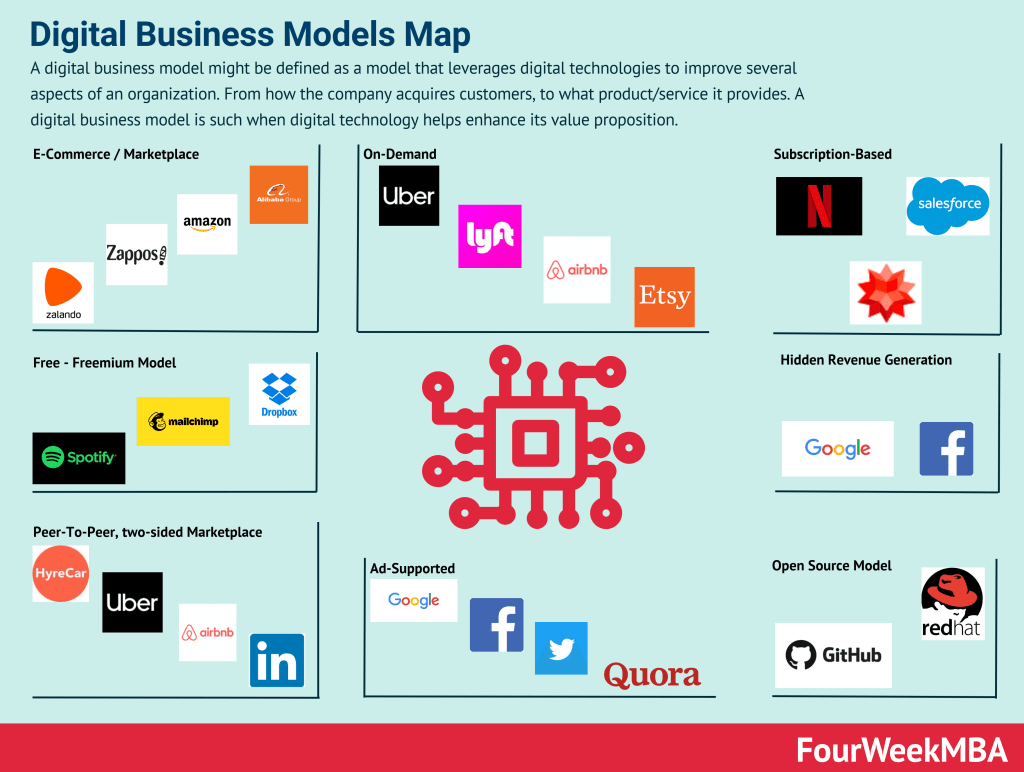
A digital business model might be defined as a model that leverages digital technologies to improve several aspects of an organization. From how the company acquires customers, to what product/service it provides. A digital business model is such when digital technology helps enhance its value proposition.
A tech business model is made of four main components: value model (value propositions, mission, vision), technological model (R&D management), distribution model (sales and marketing organizational structure), and financial model (revenue modeling, cost structure, profitability and cash generation/management). Those elements coming together can serve as the basis to build a solid tech business model.
A platform business model generates value by enabling interactions between people, groups, and users by leveraging network effects. Platform business models usually comprise two sides: supply and demand. Kicking off the interactions between those two sides is one of the crucial elements for a platform business model success.
A Blockchain Business Model is made of four main components: Value Model (Core Philosophy, Core Value and Value Propositions for the key stakeholders), Blockchain Model (Protocol Rules, Network Shape and Applications Layer/Ecosystem), Distribution Model (the key channels amplifying the protocol and its communities), and the Economic Model (the dynamics through which protocol players make money). Those elements coming together can serve as the basis to build and analyze a solid Blockchain Business Model.
In an asymmetric businessmodel, the organization doesn’t monetize the user directly, but it leverages the data users provide coupled with technology, thus have a key customer pay to sustain the core asset. For example, Google makes money by leveraging users’ data, combined with its algorithms sold to advertisers for visibility.
In an asymmetric businessmodel, the organization doesn’t monetize the user directly, but it leverages the data users provide coupled with technology, thus having a key customer pay to sustain the core asset. For example, Google makes money by leveraging users’ data, combined with its algorithms sold to advertisers for visibility. This is how attention merchants make monetize their business models.
While the term has been coined by Andrew Lampitt, open-core is an evolution of open-source. Where a core part of the software/platform is offered for free, while on top of it are built premium features or add-ons, which get monetized by the corporation who developed the software/platform. An example of the GitLab open core model, where the hosted service is free and open, while the software is closed.
Cloud business models are all built on top of cloud computing, a concept that took over around 2006 when former Google’s CEO Eric Schmit mentioned it. Most cloud-based business models can be classified as IaaS (Infrastructure as a Service), PaaS (Platform as a Service), or SaaS (Software as a Service). While those models are primarily monetized via subscriptions, they are monetized via pay-as-you-go revenue models and hybrid models (subscriptions + pay-as-you-go).
Open source is licensed and usually developed and maintained by a community of independent developers. While the freemium is developed in-house. Thus the freemium give the company that developed it, full control over its distribution. In an open-source model, the for-profit company has to distribute its premium version per its open-source licensing model.
The freemium – unless the whole organization is aligned around it – is a growth strategy rather than a business model. A free service is provided to a majority of users, while a small percentage of those users convert into paying customers through the sales funnel. Free users will help spread the brand through word of mouth.
A freeterprise is a combination of free and enterprise where free professional accounts are driven into the funnel through the free product. As the opportunity is identified the company assigns the free account to a salesperson within the organization (inside sales or fields sales) to convert that into a B2B/enterprise account.
A marketplace is a platform where buyers and sellers interact and transact. The platform acts as a marketplace that will generate revenues in fees from one or all the parties involved in the transaction. Usually, marketplaces can be classified in several ways, like those selling services vs. products or those connecting buyers and sellers at B2B, B2C, or C2C level. And those marketplaces connecting two core players, or more.
B2B, which stands for business-to-business, is a process for selling products or services to other businesses. On the other hand, a B2C sells directly to its consumers.
A B2B2C is a particular kind of business model where a company, rather than accessing the consumer market directly, it does that via another business. Yet the final consumers will recognize the brand or the service provided by the B2B2C. The company offering the service might gain direct access to consumers over time.
Direct-to-consumer (D2C) is a business model where companies sell their products directly to the consumer without the assistance of a third-party wholesaler or retailer. In this way, the company can cut through intermediaries and increase its margins. However, to be successful the direct-to-consumers company needs to build its own distribution, which in the short term can be more expensive. Yet in the long-term creates a competitive advantage.
The C2C business model describes a market environment where one customer purchases from another on a third-party platform that may also handle the transaction. Under the C2C model, both the seller and the buyer are considered consumers. Customer to customer (C2C) is, therefore, a business model where consumers buy and sell directly between themselves. Consumer-to-consumer has become a prevalent business model especially as the web helped disintermediate various industries.
A retail business model follows a direct-to-consumer approach, also called B2C, where the company sells directly to final customers a processed/finished product. This implies a business model that is mostly local-based, it carries higher margins, but also higher costs and distribution risks.
The wholesale model is a selling model where wholesalers sell their products in bulk to a retailer at a discounted price. The retailer then on-sells the products to consumers at a higher price. In the wholesale model, a wholesaler sells products in bulk to retail outlets for onward sale. Occasionally, the wholesaler sells direct to the consumer, with supermarket giant Costco the most obvious example.
The term “crowdsourcing” was first coined by Wired Magazine editor Jeff Howe in a 2006 article titled Rise of Crowdsourcing. Though the practice has existed in some form or another for centuries, it rose to prominence when eCommerce, social media, and smartphone culture began to emerge. Crowdsourcing is the act of obtaining knowledge, goods, services, or opinions from a group of people. These people submit information via social media, smartphone apps, or dedicated crowdsourcing platforms.
In a franchained business model (a short-term chain, long-term franchise) model, the company deliberately launched its operations by keeping tight ownership on the main assets, while those are established, thus choosing a chain model. Once operations are running and established, the company divests its ownership and opts instead for a franchising model.
Businesses employing the brokerage business model make money via brokerage services. This means they are involved with the facilitation, negotiation, or arbitration of a transaction between a buyer and a seller. The brokerage business model involves a business connecting buyers with sellers to collect a commission on the resultant transaction. Therefore, acting as a middleman within a transaction.
Dropshipping is a retail business model where the dropshipper externalizes the manufacturing and logistics and focuses only on distribution and customer acquisition. Therefore, the dropshipper collects final customers’ sales orders, sending them over to third-party suppliers, who ship directly to those customers. In this way, through dropshipping, it is possible to run a business without operational costs and logistics management.
Gennaro is the creator of FourWeekMBA, which reached about four million business people, comprising C-level executives, investors, analysts, product managers, and aspiring digital entrepreneurs in 2022 alone | He is also Director of Sales for a high-tech scaleup in the AI Industry | In 2012, Gennaro earned an International MBA with emphasis on Corporate Finance and Business Strategy.