The "Access" phase focuses on ensuring that students have the necessary resources, materials, and opportunities to engage in the learning process. It addresses
Analyze
In the "Analyze" phase, educators assess students' needs, abilities, and prior knowledge. This step involves collecting data, conducting assessments, and using
Achieve
The "Achieve" phase centers on the delivery of instruction and learning experiences tailored to meet students' diverse needs. Educators employ various teaching
Assess
The "Assess" phase involves evaluating students' progress, understanding, and mastery of the content. Educators use formative and summative assessments to measu
The 4A Model propels businessgrowth with Awareness, Acquisition, Activation, and Advocacy phases. It offers a structured approach, prioritizing customer needs, and fostering sustained expansion. Used in startups and product launches, it aids companies in expanding market presence. Examples include tech company expansions and e-commerce businesses.
4A Model in Education
Description
Implications
Examples
Applications
Access
The “Access” phase focuses on ensuring that students have the necessary resources, materials, and opportunities to engage in the learning process. It addresses issues related to equitable access to education, including technology, textbooks, facilities, and support.
– Ensures that all students have equal access to educational resources. – Addresses disparities in access to technology, materials, and facilities. – Promotes inclusivity and removes barriers to learning. – Recognizes the importance of providing a supportive learning environment.
– Providing students with access to digital devices and the internet for online learning. – Offering textbooks, reading materials, and resources in multiple formats to accommodate diverse needs. – Creating accessible facilities and classrooms for students with disabilities. – Offering tutoring or additional support for students who require it.
– Resource Allocation: Allocate resources to provide equitable access to materials and technology. – Inclusive Education: Ensure that learning environments are accessible to all students. – Technology Integration: Facilitate access to digital tools and platforms for learning. – Support Services: Offer support programs for students facing academic challenges.
Analyze
In the “Analyze” phase, educators assess students’ needs, abilities, and prior knowledge. This step involves collecting data, conducting assessments, and using diagnostic tools to understand each student’s starting point. It informs instructional decisions and personalized learning plans.
– Gathers data to understand individual student profiles. – Identifies learning gaps and areas of strength. – Tailors instruction based on assessment results. – Supports differentiated and personalized learning.
– Conducting pre-assessments to gauge students’ prior knowledge. – Analyzing standardized test scores to identify areas where students may need additional support. – Reviewing student work and assignments to assess individual progress. – Using diagnostic tools and observations to understand student learning styles.
– Individualized Learning Plans: Develop personalized learning plans based on student assessments. – Differentiated Instruction: Adapt teaching strategies to address varying student needs. – Data-Informed Teaching: Use assessment data to guide instructional decisions. – Targeted Support: Provide additional help or enrichment based on individual student profiles.
Achieve
The “Achieve” phase centers on the delivery of instruction and learning experiences tailored to meet students’ diverse needs. Educators employ various teaching strategies, methods, and resources to help students achieve their learning goals. It emphasizes active engagement and skill development.
– Customizes instruction to match individual learning styles and abilities. – Utilizes a variety of teaching strategies and resources. – Encourages active participation and hands-on learning. – Supports skill development and knowledge acquisition.
– Using differentiated instruction to address varying learning styles and paces. – Incorporating hands-on activities, group projects, and discussions to engage students actively. – Providing opportunities for self-directed learning and exploration. – Offering a range of instructional materials, such as videos, simulations, and interactive content.
– Flexible Teaching Approaches: Adapt teaching methods to cater to diverse student preferences. – Active Learning Strategies: Engage students through interactive and participatory activities. – Skill Development: Foster the acquisition of critical skills and knowledge. – Varied Instructional Resources: Utilize a mix of resources to enhance learning experiences.
Assess
The “Assess” phase involves evaluating students’ progress, understanding, and mastery of the content. Educators use formative and summative assessments to measure learning outcomes. It provides valuable feedback to both students and teachers, guiding future instruction and learning adjustments.
– Measures learning outcomes and understanding. – Provides feedback for improvement and adjustment. – Informs instructional decisions and curriculum refinement. – Ensures alignment with learning objectives and standards.
– Conducting quizzes, tests, or exams to evaluate subject knowledge. – Reviewing class assignments and projects to assess critical thinking and problem-solving skills. – Observing and documenting student participation and engagement in class discussions and activities. – Using rubrics and criteria-based assessments to evaluate project submissions.
– Formative Assessment: Use ongoing assessments to monitor and adjust instruction as needed. – Summative Assessment: Assess overall learning outcomes at key points. – Feedback and Improvement: Provide constructive feedback to students and use assessment data to refine teaching. – Curriculum Alignment: Ensure that assessments align with curriculum standards and learning objectives.
Understanding the 4A Model:
What is the 4A Model?
The 4A Model is a contemporary framework that guides the design and implementation of effective learning experiences in the digital age. It consists of four key components: Access, Analyze, Apply, and Assess. These components emphasize the importance of active and meaningful engagement with information and technology in the learning process.
Key Components of the 4A Model:
Access: Providing learners with opportunities to access a wide range of digital resources, including information, media, and online tools.
Analyze: Encouraging learners to critically evaluate and make sense of the information they encounter, fostering digital literacy and information literacy skills.
Apply: Promoting the application of knowledge and skills in real-world contexts, encouraging problem-solving and practical competence.
Assess: Implementing effective assessment strategies to measure learning outcomes and provide feedback for improvement.
Why the 4A Model Matters:
Understanding the significance of the 4A Model is essential for educators, instructional designers, and learners as it offers a structured approach to harnessing the power of digital tools and information for effective learning.
The Impact of the 4A Model:
Active Learning: The 4A Model promotes active learning, where learners are engaged in meaningful activities rather than passive consumption of content.
Critical Thinking: It fosters critical thinking skills by encouraging learners to analyze, synthesize, and apply information.
Digital Literacy: The model enhances digital literacy by equipping learners with the skills to navigate, evaluate, and create digital content.
Benefits of Using the 4A Model:
Effective Learning: It enhances the effectiveness of learning experiences by guiding the integration of technology and information.
Engagement: The 4A Model promotes learner engagement through interactive and participatory activities.
Challenges of Using the 4A Model:
Technology Integration: Implementing the 4A Model may require technical infrastructure and support, posing challenges for institutions with limited resources.
Assessment Complexity: Developing meaningful assessments aligned with the model can be complex and time-consuming.
Challenges in Using the 4A Model:
Understanding the challenges and limitations associated with the 4A Model is crucial for educators and institutions aiming to leverage its potential effectively.
Technology Integration:
Resource Constraints: Limited access to digital devices and reliable internet connectivity can hinder the successful implementation of the model.
Solution: Schools and organizations may need to invest in technology infrastructure and provide equitable access to devices and connectivity.
Assessment Complexity:
Time and Effort: Designing assessments that effectively measure the 4A components can be time-consuming for educators.
Solution: Professional development and collaboration among educators can help streamline the assessment process.
The 4A Model in Action:
To better understand the 4A Model, let’s explore how it functions in various educational scenarios and what it reveals about the effectiveness of modern learning experiences.
Blended Learning in K-12 Education:
Scenario: A middle school teacher implements blended learning, combining in-person and online instruction.
The 4A Model in Action:
Access: Students access online resources, including interactive simulations and educational videos.
Analyze: In class, students critically analyze data from the simulations and discuss their findings.
Apply: Students work in groups to design real-world solutions based on their analysis.
Assess: The teacher uses rubrics and peer evaluations to assess both individual and group performance.
Online Professional Development for Educators:
Scenario: A school district offers online professional development courses for its teachers.
The 4A Model in Action:
Access: Teachers access course materials, including readings, videos, and discussion forums, through an online platform.
Analyze: Teachers critically evaluate research articles related to their teaching practices and engage in online discussions.
Apply: Teachers implement new strategies and techniques in their classrooms, documenting their experiences.
Assess: The district uses online quizzes, self-assessments, and classroom observations to assess teacher growth.
Examples and Applications:
Flipped Classroom Approach:
In a flipped classroom, teachers use the 4A Model by providing video lectures and readings (Access), guiding students in discussions and analysis (Analyze), encouraging students to apply concepts through group projects (Apply), and assessing their understanding through quizzes and presentations (Assess).
Corporate Training Programs:
Companies use the 4A Model to design employee training programs. Employees access online modules (Access), analyze case studies and scenarios (Analyze), apply new skills in their roles (Apply), and are assessed through performance evaluations and assessments (Assess).
Online Learning Platforms:
Online learning platforms, such as MOOCs (Massive Open Online Courses), incorporate the 4A Model by providing learners with access to course content (Access), encouraging critical thinking and discussion (Analyze), facilitating peer projects and real-world applications (Apply), and using quizzes and assignments for assessment (Assess).
Applications and Use Cases:
K-12 Education:
The 4A Model guides the development of digital curriculum and online learning platforms, enhancing students’ engagement and learning outcomes.
Higher Education:
Universities and colleges use the 4A Model to create blended and online courses that foster active learning and digital literacy.
Professional Development:
The 4A Model is applied in corporate training, continuing education, and teacher professional development programs.
Informal Learning:
Informal learning environments, such as museums and libraries, utilize the 4A Model to design interactive exhibits and digital resources.
Conclusion:
In conclusion, the 4A Model is a versatile and effective framework for designing and delivering learning experiences in the digital age.
The applications of the 4A Model extend across various educational settings and contexts, offering educators and institutions a structured approach to leverage the power of technology and information for enhanced learning outcomes. While it presents challenges related to technology integration and assessment complexity, its emphasis on active learning, critical thinking, and digital literacy positions it as a valuable tool for modern education. By acknowledging the significance of the 4A Model and addressing its challenges proactively, educational stakeholders can create engaging and effective learning experiences that prepare learners for success in the digital era.
Key Highlights
Growth Framework: The 4A Model is designed to guide business growth through four distinct phases.
Phases: It focuses on creating Awareness, acquiring customers through Acquisition, engaging them through Activation, and turning them into Advocates.
Benefits: Offers a structured approach, prioritizes customer engagement, and supports sustainable growth.
Challenges: Addresses resource allocation and customer retention challenges.
Applications: Useful for startups, product launches, and business expansion strategies.
Use Cases: Demonstrated in tech company expansions and e-commerce business growth.
A Blockchain Business Model according to the FourWeekMBA framework is made of four main components: Value Model (Core Philosophy, Core Values and Value Propositions for the key stakeholders), Blockchain Model (Protocol Rules, Network Shape and Applications Layer/Ecosystem), Distribution Model (the key channels amplifying the protocol and its communities), and the Economic Model (the dynamics/incentives through which protocol players make money). Those elements coming together can serve as the basis to build and analyze a solid Blockchain Business Model.
In a business world driven by technology and digitalization, competition is much more fluid, as innovation becomes a bottom-up approach that can come from anywhere. Thus, making it much harder to define the boundaries of existing markets. Therefore, a proper business competition analysis looks at customer, technology, distribution, and financial model overlaps. While at the same time looking at future potential intersections among industries that in the short-term seem unrelated.
Technological modeling is a discipline to provide the basis for companies to sustain innovation, thus developing incremental products. While also looking at breakthrough innovative products that can pave the way for long-term success. In a sort of Barbell Strategy, technological modeling suggests having a two-sided approach, on the one hand, to keep sustaining continuous innovation as a core part of the business model. On the other hand, it places bets on future developments that have the potential to break through and take a leap forward.
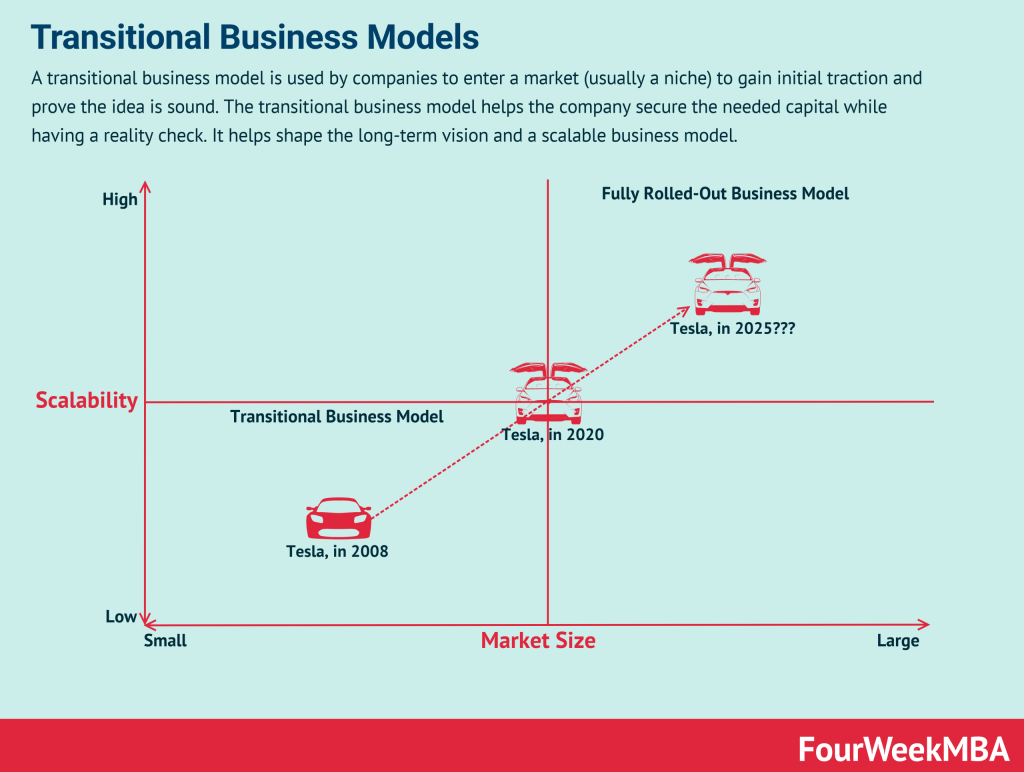
A transitional business model is used by companies to enter a market (usually a niche) to gain initial traction and prove the idea is sound. The transitional business model helps the company secure the needed capital while having a reality check. It helps shape the long-term vision and a scalable business model.
The minimum viable audience (MVA) represents the smallest possible audience that can sustain your business as you get it started from a microniche (the smallest subset of a market). The main aspect of the MVA is to zoom into existing markets to find those people which needs are unmet by existing players.
Business scaling is the process of transformation of a business as the product is validated by wider and wider market segments. Business scaling is about creating traction for a product that fits a small market segment. As the product is validated it becomes critical to build a viable business model. And as the product is offered at wider and wider market segments, it’s important to align product, business model, and organizational design, to enable wider and wider scale.
The market expansion consists in providing a product or service to a broader portion of an existing market or perhaps expanding that market. Or yet, market expansions can be about creating a whole new market. At each step, as a result, a company scales together with the market covered.
In the FourWeekMBA growth matrix, you can apply growth for existing customers by tackling the same problems (gain mode). Or by tackling existing problems, for new customers (expand mode). Or by tackling new problems for existing customers (extend mode). Or perhaps by tackling whole new problems for new customers (reinvent mode).
In the FourWeekMBA Revenue Streams Matrix, revenue streams are classified according to the kind of interactions the business has with its key customers. The first dimension is the “Frequency” of interaction with the key customer. As the second dimension, there is the “Ownership” of the interaction with the key customer.
Revenue model patterns are a way for companies to monetize their business models. A revenue model pattern is a crucial building block of a business model because it informs how the company will generate short-term financial resources to invest back into the business. Thus, the way a company makes money will also influence its overall business model.
The Cynefin Framework gives context to decision making and problem-solving by providing context and guiding an appropriate response. The five domains of the Cynefin Framework comprise obvious, complicated, complex, chaotic domains and disorder if a domain has not been determined at all.
A SWOT Analysis is a framework used for evaluating the business’s Strengths, Weaknesses, Opportunities, and Threats. It can aid in identifying the problematic areas of your business so that you can maximize your opportunities. It will also alert you to the challenges your organization might face in the future.
The SWOT analysis is commonly used as a strategic planning tool in business. However, it is also well suited for personal use in addressing a specific goal or problem. A personal SWOT analysis helps individuals identify their strengths, weaknesses, opportunities, and threats.
The Pareto Analysis is a statistical analysis used in business decision making that identifies a certain number of input factors that have the greatest impact on income. It is based on the similarly named Pareto Principle, which states that 80% of the effect of something can be attributed to just 20% of the drivers.
A failure mode and effects analysis (FMEA) is a structured approach to identifying design failures in a product or process. Developed in the 1950s, the failure mode and effects analysis is one the earliest methodologies of its kind. It enables organizations to anticipate a range of potential failures during the design stage.
A Blindspot Analysis is a means of unearthing incorrect or outdated assumptions that can harm decision making in an organization. The term “blindspot analysis” was first coined by American economist Michael Porter. Porter argued that in business, outdated ideas or strategies had the potential to stifle modern ideas and prevent them from succeeding. Furthermore, decisions a business thought were made with care caused projects to fail because major factors had not been duly considered.
A comparable company analysis is a process that enables the identification of similar organizations to be used as a comparison to understand the business and financial performance of the target company. To find comparables you can look at two key profiles: the business and financial profile. From the comparable company analysis it is possible to understand the competitive landscape of the target organization.
A cost-benefit analysis is a process a business can use to analyze decisions according to the costs associated with making that decision. For a cost analysis to be effective it’s important to articulate the project in the simplest terms possible, identify the costs, determine the benefits of project implementation, assess the alternatives.
Agile Business Analysis (AgileBA) is certification in the form of guidance and training for business analysts seeking to work in agile environments. To support this shift, AgileBA also helps the business analyst relate Agile projects to a wider organizational mission or strategy. To ensure that analysts have the necessary skills and expertise, AgileBA certification was developed.
A SOAR analysis is a technique that helps businesses at a strategic planning level to:
Focus on what they are doing right.
Determine which skills could be enhanced.
Understand the desires and motivations of their stakeholders.
The STEEPLE analysis is a variation of the STEEP analysis. Where the step analysis comprises socio-cultural, technological, economic, environmental/ecological, and political factors as the base of the analysis. The STEEPLE analysis adds other two factors such as Legal and Ethical.
The PESTEL analysis is a framework that can help marketers assess whether macro-economic factors are affecting an organization. This is a critical step that helps organizations identify potential threats and weaknesses that can be used in other frameworks such as SWOT or to gain a broader and better understanding of the overall marketing environment.
A DESTEP analysis is a framework used by businesses to understand their external environment and the issues which may impact them. The DESTEP analysis is an extension of the popular PEST analysis created by Harvard Business School professor Francis J. Aguilar. The DESTEP analysis groups external factors into six categories: demographic, economic, socio-cultural, technological, ecological, and political.
A paired comparison analysis is used to rate or rank options where evaluation criteria are subjective by nature. The analysis is particularly useful when there is a lack of clear priorities or objective data to base decisions on. A paired comparison analysis evaluates a range of options by comparing them against each other.
Gennaro is the creator of FourWeekMBA, which reached about four million business people, comprising C-level executives, investors, analysts, product managers, and aspiring digital entrepreneurs in 2022 alone | He is also Director of Sales for a high-tech scaleup in the AI Industry | In 2012, Gennaro earned an International MBA with emphasis on Corporate Finance and Business Strategy.