Video on Demand (VOD) is a digital media distribution model that allows users to access and watch video content whenever they want, rather than adhering to traditional broadcast schedules. VOD platforms offer a wide range of content, including movies, TV shows, documentaries, and original series, available for streaming over the internet on various devices.
VOD relies on streaming technology to deliver video content over the internet in real-time, enabling users to watch videos without downloading or storing them locally.
Streaming platforms utilize adaptive bitrate streaming algorithms to optimize video quality and playback performance based on users’ internet connection speeds.
Content Libraries:
VOD platforms curate extensive content libraries comprising movies, TV shows, documentaries, and other video content from various sources, including studios, networks, and independent creators.
Content libraries are organized into categories, genres, and curated playlists to facilitate content discovery and personalized recommendations.
Subscription and Transactional Models:
VOD platforms offer subscription-based and transactional models for accessing video content.
Subscription services provide unlimited access to a catalog of content for a monthly or annual fee, while transactional services allow users to rent or purchase individual titles on a pay-per-view basis.
Multi-Device Accessibility:
VOD platforms are accessible on a wide range of devices, including smartphones, tablets, smart TVs, and computers.
Users can stream video content anytime, anywhere, across multiple devices, allowing for a seamless viewing experience across different screen sizes and platforms.
Implications of Video on Demand (VOD)
Shift in Consumer Behavior: VOD has transformed how audiences consume video content, moving away from traditional linear TV viewing towards on-demand and personalized streaming experiences.
Disruption of Traditional Distribution Channels: VOD platforms have disrupted traditional media distribution channels, challenging the dominance of broadcast networks, cable providers, and movie theaters.
Global Reach and Accessibility: VOD enables global distribution and accessibility of video content, transcending geographic boundaries and reaching diverse audiences worldwide.
Use Cases and Examples
Subscription Video on Demand (SVOD):
Platforms like Netflix, Amazon Prime Video, and Disney+ offer subscription-based VOD services, providing subscribers with unlimited access to a vast library of movies, TV shows, and original content for a monthly fee.
SVOD platforms produce original series and films, competing with traditional TV networks and studios for viewership and awards recognition.
Transactional Video on Demand (TVOD):
TVOD services like Apple iTunes, Google Play Movies, and Vudu allow users to rent or purchase individual titles on a pay-per-view basis, offering a la carte access to new releases and premium content.
TVOD platforms cater to audiences seeking on-demand access to specific movies or shows without committing to a subscription.
Strategies for VOD Platforms
Content Acquisition and Licensing:
Invest in acquiring and licensing high-quality and exclusive content to differentiate the platform and attract subscribers.
Negotiate content deals with studios, networks, and independent creators to secure rights to popular titles and original productions.
Personalization and Recommendation Engines:
Implement algorithms and machine learning models to analyze user preferences and viewing habits and generate personalized recommendations.
Enhance content discovery and user engagement by surfacing relevant and tailored recommendations based on past viewing behavior.
Global Expansion and Localization:
Expand the platform’s reach and user base by launching in new international markets and offering localized content and language options.
Adapt content catalog and marketing strategies to cater to diverse cultural preferences and regional tastes.
Benefits of Video on Demand (VOD)
Convenience and Flexibility: VOD offers users the convenience of accessing video content anytime, anywhere, and on any device, providing flexibility and control over their viewing experience.
Content Variety and Diversity: VOD platforms offer a diverse range of content, spanning different genres, languages, and formats, catering to a wide range of interests and preferences.
Monetization Opportunities: VOD platforms generate revenue through subscription fees, advertising, and transactional sales, providing monetization opportunities for content creators, distributors, and platform operators.
Challenges of Video on Demand (VOD)
Content Licensing Costs: Acquiring and licensing premium content for VOD platforms can be costly, especially for exclusive or original productions, impacting profitability and pricing strategies.
Content Discovery and Curation: With vast content libraries, ensuring effective content discovery and curation presents challenges in surfacing relevant and engaging titles to users.
Competition and Market Saturation: The proliferation of VOD platforms has intensified competition for subscribers and market share, leading to saturation and fragmentation in the streaming landscape.
Conclusion
Video on Demand (VOD) has revolutionized the entertainment industry, offering audiences unprecedented access to a vast array of video content on their terms. By leveraging streaming technology, diverse content libraries, and personalized experiences, VOD platforms have reshaped how people consume movies, TV shows, and other video content. While VOD presents challenges in content licensing, discovery, and market competition, its benefits in terms of convenience, variety, and monetization opportunities make it a compelling and influential force in the evolving media landscape. As the VOD market continues to evolve, innovation, differentiation, and user-centric strategies will be key to sustaining growth and relevance in the digital era.
Connected Business Frameworks, Models And Concepts
One of the first mentions of customer lifetime value was in the 1988 book Database Marketing: Strategy and Implementation written by Robert Shaw and Merlin Stone. Customer lifetime value (CLV) represents the value of a customer to a company over a period of time. It represents a critical business metric, especially for SaaS or recurring revenue-based businesses.
AIOps is the application of artificial intelligence to IT operations. It has become particularly useful for modern IT management in hybridized, distributed, and dynamic environments. AIOps has become a key operational component of modern digital-based organizations, built around software and algorithms.
Machine Learning Ops (MLOps) describes a suite of best practices that successfully help a business run artificial intelligence. It consists of the skills, workflows, and processes to create, run, and maintain machine learning models to help various operational processes within organizations.
The business intelligence models have transitioned to continuous intelligence, where dynamic technology infrastructure is coupled with continuous deployment and delivery to provide continuous intelligence. In short, the software offered in the cloud will integrate with the company’s data, leveraging on AI/ML to provide answers in real-time to current issues the organization might be experiencing.
That is a process that requires a continuous feedback loop to develop a valuable product and build a viable business model. Continuous innovation is a mindset where products and services are designed and delivered to tune them around the customers’ problems and not the technical solution of its founders.
Technological modeling is a discipline to provide the basis for companies to sustain innovation, thus developing incremental products. While also looking at breakthrough innovative products that can pave the way for long-term success. In a sort of Barbell Strategy, technological modeling suggests having a two-sided approach, on the one hand, to keep sustaining continuous innovation as a core part of the business model. On the other hand, it places bets on future developments that have the potential to break through and take a leap forward.
An effective business model has to focus on two dimensions: the people dimension and the financial dimension. The people dimension will allow you to build a product or service that is 10X better than existing ones and a solid brand. The financial dimension will help you develop proper distribution channels by identifying the people that are willing to pay for your product or service and make it financially sustainable in the long run.
Business model innovation is about increasing the success of an organization with existing products and technologies by crafting a compelling value proposition able to propel a new business model to scale up customers and create a lasting competitive advantage. And it all starts by mastering the key customers.
Digital and tech business models can be classified according to four levels of transformation into digitally-enabled, digitally-enhanced, tech or platform business models, and business platforms/ecosystems.
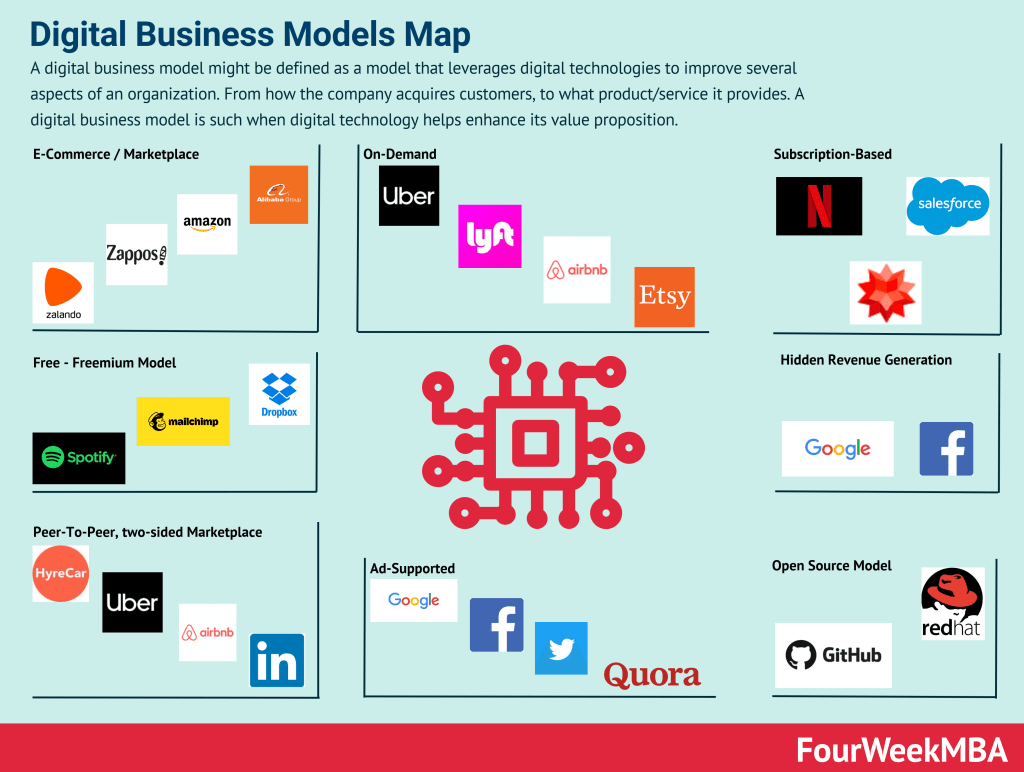
A digital business model might be defined as a model that leverages digital technologies to improve several aspects of an organization. From how the company acquires customers, to what product/service it provides. A digital business model is such when digital technology helps enhance its value proposition.
A tech business model is made of four main components: value model (value propositions, mission, vision), technological model (R&D management), distribution model (sales and marketingorganizational structure), and financial model (revenue modeling, cost structure, profitability and cash generation/management). Those elements coming together can serve as the basis to build a solid tech business model.
A platform business model generates value by enabling interactions between people, groups, and users by leveraging network effects. Platform business models usually comprise two sides: supply and demand. Kicking off the interactions between those two sides is one of the crucial elements for a platform business model success.
A Blockchain Business Model is made of four main components: Value Model (Core Philosophy, Core Value and Value Propositions for the key stakeholders), Blockchain Model (Protocol Rules, Network Shape and Applications Layer/Ecosystem), Distribution Model (the key channels amplifying the protocol and its communities), and the Economic Model (the dynamics through which protocol players make money). Those elements coming together can serve as the basis to build and analyze a solid Blockchain Business Model.
In an asymmetric businessmodel, the organization doesn’t monetize the user directly, but it leverages the data users provide coupled with technology, thus have a key customer pay to sustain the core asset. For example, Google makes money by leveraging users’ data, combined with its algorithms sold to advertisers for visibility.
In an asymmetric businessmodel, the organization doesn’t monetize the user directly, but it leverages the data users provide coupled with technology, thus having a key customer pay to sustain the core asset. For example, Google makes money by leveraging users’ data, combined with its algorithms sold to advertisers for visibility. This is how attention merchants make monetize their business models.
While the term has been coined by Andrew Lampitt, open-core is an evolution of open-source. Where a core part of the software/platform is offered for free, while on top of it are built premium features or add-ons, which get monetized by the corporation who developed the software/platform. An example of the GitLab open core model, where the hosted service is free and open, while the software is closed.
Cloud business models are all built on top of cloud computing, a concept that took over around 2006 when former Google’s CEO Eric Schmit mentioned it. Most cloud-based business models can be classified as IaaS (Infrastructure as a Service), PaaS (Platform as a Service), or SaaS (Software as a Service). While those models are primarily monetized via subscriptions, they are monetized via pay-as-you-go revenue models and hybrid models (subscriptions + pay-as-you-go).
Open source is licensed and usually developed and maintained by a community of independent developers. While the freemium is developed in-house. Thus the freemium give the company that developed it, full control over its distribution. In an open-source model, the for-profit company has to distribute its premium version per its open-source licensing model.
The freemium – unless the whole organization is aligned around it – is a growth strategy rather than a business model. A free service is provided to a majority of users, while a small percentage of those users convert into paying customers through the sales funnel. Free users will help spread the brand through word of mouth.
A freeterprise is a combination of free and enterprise where free professional accounts are driven into the funnel through the free product. As the opportunity is identified the company assigns the free account to a salesperson within the organization (inside sales or fields sales) to convert that into a B2B/enterprise account.
A marketplace is a platform where buyers and sellers interact and transact. The platform acts as a marketplace that will generate revenues in fees from one or all the parties involved in the transaction. Usually, marketplaces can be classified in several ways, like those selling services vs. products or those connecting buyers and sellers at B2B, B2C, or C2C level. And those marketplaces connecting two core players, or more.
B2B, which stands for business-to-business, is a process for selling products or services to other businesses. On the other hand, a B2C sells directly to its consumers.
A B2B2C is a particular kind of business model where a company, rather than accessing the consumer market directly, it does that via another business. Yet the final consumers will recognize the brand or the service provided by the B2B2C. The company offering the service might gain direct access to consumers over time.
Direct-to-consumer (D2C) is a business model where companies sell their products directly to the consumer without the assistance of a third-party wholesaler or retailer. In this way, the company can cut through intermediaries and increase its margins. However, to be successful the direct-to-consumers company needs to build its own distribution, which in the short term can be more expensive. Yet in the long-term creates a competitive advantage.
The C2C business model describes a market environment where one customer purchases from another on a third-party platform that may also handle the transaction. Under the C2C model, both the seller and the buyer are considered consumers. Customer to customer (C2C) is, therefore, a business model where consumers buy and sell directly between themselves. Consumer-to-consumer has become a prevalent business model especially as the web helped disintermediate various industries.
A retail business model follows a direct-to-consumer approach, also called B2C, where the company sells directly to final customers a processed/finished product. This implies a business model that is mostly local-based, it carries higher margins, but also higher costs and distribution risks.
The wholesale model is a selling model where wholesalers sell their products in bulk to a retailer at a discounted price. The retailer then on-sells the products to consumers at a higher price. In the wholesale model, a wholesaler sells products in bulk to retail outlets for onward sale. Occasionally, the wholesaler sells direct to the consumer, with supermarket giant Costco the most obvious example.
The term “crowdsourcing” was first coined by Wired Magazine editor Jeff Howe in a 2006 article titled Rise of Crowdsourcing. Though the practice has existed in some form or another for centuries, it rose to prominence when eCommerce, social media, and smartphone culture began to emerge. Crowdsourcing is the act of obtaining knowledge, goods, services, or opinions from a group of people. These people submit information via social media, smartphone apps, or dedicated crowdsourcing platforms.
In a franchained business model (a short-term chain, long-term franchise) model, the company deliberately launched its operations by keeping tight ownership on the main assets, while those are established, thus choosing a chain model. Once operations are running and established, the company divests its ownership and opts instead for a franchising model.
Businesses employing the brokerage business model make money via brokerage services. This means they are involved with the facilitation, negotiation, or arbitration of a transaction between a buyer and a seller. The brokerage business model involves a business connecting buyers with sellers to collect a commission on the resultant transaction. Therefore, acting as a middleman within a transaction.
Dropshipping is a retail business model where the dropshipper externalizes the manufacturing and logistics and focuses only on distribution and customer acquisition. Therefore, the dropshipper collects final customers’ sales orders, sending them over to third-party suppliers, who ship directly to those customers. In this way, through dropshipping, it is possible to run a business without operational costs and logistics management.
Gennaro is the creator of FourWeekMBA, which reached about four million business people, comprising C-level executives, investors, analysts, product managers, and aspiring digital entrepreneurs in 2022 alone | He is also Director of Sales for a high-tech scaleup in the AI Industry | In 2012, Gennaro earned an International MBA with emphasis on Corporate Finance and Business Strategy.