

Where strategy focuses on where you want to be, with slightly longer-term emphasis. Execution focuses on the shorter-term, operational side, and how to get there, by making sure that you can achieve milestones. Strategy, together with execution, enable businesses to align short and long-term business goals.
| Aspect | Strategy | Execution |
|---|---|---|
| Definition | – Strategy refers to the long-term plan or approach that an organization develops to achieve its goals and objectives. It involves setting clear directions, making choices, and allocating resources effectively. | – Execution, also known as operational execution, is the process of implementing and carrying out the strategies and plans developed by the organization. It focuses on achieving specific short-term goals and objectives. |
| Primary Focus | – Strategy focuses on deciding what the organization should do to succeed in the long run. It involves setting goals, making choices, and defining the overall direction. | – Execution focuses on how the organization will carry out the strategy effectively. It involves translating plans into actions, monitoring progress, and achieving short-term results. |
| Roles and Responsibilities | – Strategists and senior leadership are responsible for creating and articulating the strategic vision. They make high-level decisions about resource allocation and priority areas. | – Execution often involves various teams and employees responsible for specific tasks and projects. It requires coordination, accountability, and timely delivery. |
| Importance | – Strategy is crucial for setting a clear direction, ensuring alignment with organizational goals, and making informed decisions about resource allocation. | – Execution is equally important because even the best strategy is ineffective without proper implementation. Execution ensures that plans are carried out successfully and that objectives are achieved. |
| Process | – Strategy development involves environmental analysis, goal setting, strategic planning, and decision-making. It often includes elements like SWOT analysis and market research. | – Execution involves project management, task assignments, performance monitoring, and adaptation to changing circumstances. It focuses on getting things done efficiently and effectively. |
| Outcome | – The outcome of strategy development is a well-defined strategic plan that provides direction and guidance for the organization’s activities over a longer period. | – The outcome of execution is the successful completion of projects, tasks, and actions that contribute to the realization of the strategic goals. |
| Measurement | – Strategy success is often measured using key performance indicators (KPIs) related to long-term goals, such as market share, revenue growth, or customer satisfaction. | – Execution success is measured using KPIs related to the completion of tasks and projects, such as project milestones, deadlines, and quality standards. |
| Risk Management | – Strategy development involves assessing potential risks and uncertainties and devising risk mitigation plans. | – Execution includes ongoing risk management to ensure that projects stay on track and any issues are addressed promptly. |
| Adaptability | – Strategies may need periodic reviews and adjustments in response to changing market conditions or shifts in organizational priorities. | – Execution requires adaptability to handle unexpected challenges and changes while staying aligned with the overarching strategy. |
| Similarities | – Both strategy and execution are essential for achieving organizational goals and long-term success. – Both require effective communication and alignment within the organization. | – Both strategy and execution are interconnected; a well-executed strategy is essential for successful execution, and effective execution is necessary to realize the strategy’s benefits. |
My experience with the strategy world
I still remember that day. I was sitting in class during my MBA, diving into an HBR case study.
We had 30 minutes to read and process it and understand what the best solution for the Barilla case study was.
The case (for what I recall now) was based on an issue Barilla (one of the largest Italian pasta manufacturers) was facing during the 1990s, caused by a huge demand fluctuation (what in supply chain management is called “bullwhip effect”).
In short, as you move up in the supply chain, it becomes harder and harder to predict the volume of demand.
Therefore, Barilla was trying to solve this issue, which caused considerable inefficiencies to its manufacturing capacity.
Several things make this happen, from asymmetric information throughout the supply chain to behavioral factors (such as incentives or disincentives within and outside the organization).
I’m not going to give you the solution here (I don’t want to kill the fun), but let’s say that it’s all about strategy!
Read: Business Strategy: Examples, And Case Studies, And Tools
Strategy in a vacuum
When I used to develop my business understanding through those “real world” cases, I felt I had learned universal strategic laws applicable to the business world.
This illusion stayed with me for a few years after business school; until I found myself trying to build a real business from scratch.
What I figured later was to forget most of the things I had learned.
Strategy, I learned it is something that gets developed after the fact (in most cases).
In short, in the real business world, you make hypotheses, you test them, they do not work, most of the time, and you go back and reconsider.
Therefore, a good strategic tool isn’t one that allows us to theorize much, but instead, it’s a tool that makes us test a lot.
As I’ve helped grow a startup from scratch and I’ve grown my own business from scratch in the last years, I noticed how those ideas that seem trivial (you give for granted they’ll work because they make sense) in reality won’t work at all!
You go back, tweak, re-test, it won’t work, try again, and after a continuous, painful (it becomes fun only when it starts to work) process things start to finally work.
Only at hindsight
That is when we go back and say “my strategy is working.”
But really, what does that mean?
After all, you got a process, a set of ideas that will turn out to be only in a very small percentage successful.
And only fewer of those successful ideas will really make a difference, until that one idea might be wildly successful, to pay off for all the others that just didn’t work!
So what’s strategy?
The way I learned to see it, strategy is the choice you make as a business person about the kind of business that you want to build in the long-term. This long-term vision is especially defined via negativa (the way you absolutely do not want your business to look like in a few years).
The rest is a set of tactics and short-term experiments that require tenacity, speed and the willingness to bet against your own initial ideas that made so much sense, that indeed didn’t work at all!
Key Highlights
- Aligning Business Goals: Strategy and execution enable businesses to align short and long-term business goals. Having a clear strategy in place helps in defining the direction the company wants to take, while effective execution ensures that the steps taken align with those goals.
- Learning from Real-world Experience: Real-world experiences often challenge the traditional strategic frameworks taught in business schools. The process of strategizing involves making hypotheses, testing them, and adjusting based on the results. This iterative approach allows businesses to adapt and refine their strategies based on practical outcomes.
- Continuous Testing and Experimentation: A good strategic approach involves testing multiple ideas and experimenting with different tactics. Embracing failure as part of the process and continuously iterating based on results allows businesses to uncover successful strategies and discard ineffective ones.
- Hindsight Perspective: Strategy often becomes evident only in hindsight. What may seem like a sound strategy in theory may not always work in practice. It is essential to recognize the successful elements of a strategy and leverage them to build future success.
- Long-term Vision via Negativa: Strategy is about making choices for the long-term vision of the business. This can involve defining what the business should not become, through the concept of “via negativa” – understanding what the business absolutely does not want to look like in the future.
- Tenacity and Willingness to Adapt: Successful strategy and execution require tenacity, speed, and a willingness to adapt and pivot when necessary. Being open to adjusting initial ideas based on results is crucial for achieving milestones.
- Importance of Execution: While strategy is essential, effective execution is equally critical. A well-defined strategy must be supported by an efficient and disciplined execution plan to achieve the desired milestones.
- Continuous Improvement: Strategy and execution should be viewed as an iterative and continuous process. Businesses must continually review and improve their approach to stay relevant in a dynamic market environment.
| Context | Strategy | Execution | Examples |
|---|---|---|---|
| Business | Long-term planning, setting goals, and defining the company’s direction. | Implementing strategies, including processes, actions, and resource allocation. | Developing a marketing strategy and then executing marketing campaigns to reach a target audience. |
| Military | Formulation of plans, tactics, and intelligence to achieve military objectives. | Carrying out military operations on the ground, involving troops, equipment, and coordination. | Planning a military campaign to capture a strategic location and executing the operation with precision. |
| Sports | Game plans, tactics, and plays designed to win matches or competitions. | The performance of athletes during the game, following planned strategies. | A basketball team devises offensive and defensive strategies and then executes them during a game. |
| Project Management | Defining project objectives, scope, timelines, and resource allocation. | Managing day-to-day tasks, resources, and activities to complete the project. | Developing a project plan, defining milestones, and then managing tasks to meet project deadlines. |
| Digital Marketing | Creating online marketing plans, content strategies, and SEO tactics. | Implementing digital marketing plans, creating content, running ads, and optimizing campaigns. | Designing an email marketing strategy to engage subscribers and executing email campaigns to nurture leads. |
| Software Development | Planning software architecture, features, and development approach. | Writing code, testing, debugging, and deploying software according to the plan. | Designing a software application, coding its functionalities, and conducting quality assurance testing. |
| Education | Curriculum design, lesson planning, and defining what students should learn. | Classroom teaching, using instructional methods to engage and educate students. | Developing a curriculum for a science course, teaching it in the classroom to facilitate student learning. |
| Healthcare | Developing treatment plans, diagnosis, and patient care strategies. | Providing medical care, treatment, and interventions based on established medical protocols. | Formulating a treatment strategy for a patient’s medical condition and then administering treatments accordingly. |
| Political Campaigns | Campaign platform development, messaging, and voter outreach strategy. | Conducting campaign rallies, canvassing, advertising, and get-out-the-vote efforts. | Developing a campaign strategy, focusing on key issues, and executing campaign events and advertising to gain voter support. |
| Manufacturing | Production plans, quality control, and supply chain strategies. | Operating production lines, managing inventory, and ensuring product quality and delivery. | Devising a production strategy to optimize efficiency and then executing the manufacturing process. |
| Financial Investments | Investment portfolio strategy, asset allocation, and risk management approach. | Buying and selling financial assets, monitoring market trends, and making investment decisions. | Creating an investment strategy, diversifying the portfolio, and executing trades to achieve financial goals. |
| Urban Planning | Urban development plans, zoning regulations, and infrastructure projects. | Building infrastructure, constructing roads, bridges, and implementing land-use policies. | Creating an urban development strategy, implementing construction projects, and updating zoning regulations. |
| Nonprofit Organizations | Mission definition, fundraising, and programmatic goals for addressing social issues. | Implementing programs, fundraising campaigns, and community outreach activities. | Formulating a strategy to combat homelessness, executing outreach and support services for affected individuals. |
| Environmental Conservation | Conservation plans, wildlife protection strategies, and habitat restoration projects. | Conducting fieldwork, habitat restoration, wildlife monitoring, and active conservation efforts. | Developing a conservation strategy to protect a species, executing habitat restoration and monitoring wildlife in the field. |
| Supply Chain Management | Supply chain strategies, including sourcing, inventory management, and logistics. | Procuring raw materials, managing inventory, and coordinating goods movement within the supply chain. | Developing a supply chain strategy for efficient inventory management and executing procurement and distribution processes. |
| Energy Production | Energy generation plans, infrastructure design, and sustainability strategies. | Operating power plants, managing energy grids, and ensuring consistent power supply. | Formulating an energy production strategy that emphasizes renewable sources and executing projects for sustainable energy generation. |
| Retail | Retail merchandising strategy, product assortment, and pricing strategies. | Managing store operations, visual merchandising, and customer service. | Creating a retail merchandising strategy, selecting product assortments, and executing visual merchandising in-store. |
| Agriculture | Farming plans, crop rotation strategies, and pest control measures. | Planting, harvesting, irrigation, and applying pest control methods in the fields. | Developing an agricultural strategy for sustainable crop production and executing planting and harvesting operations. |
| Space Exploration | Space mission planning, spacecraft design, and launch strategies. | Launching spacecraft, conducting space missions, and collecting scientific data. | Creating a mission plan to explore Mars, building spacecraft, and executing launch and mission operations. |
Connected Business Frameworks


Blockchain Business Model Framework






Failure Mode And Effects Analysis


Related Strategy Concepts: Go-To-Market Strategy, Marketing Strategy, Business Models, Tech Business Models, Jobs-To-Be Done, Design Thinking, Lean Startup Canvas, Value Chain, Value Proposition Canvas, Balanced Scorecard, Business Model Canvas, SWOT Analysis, Growth Hacking, Bundling, Unbundling, Bootstrapping, Venture Capital, Porter’s Five Forces, Porter’s Generic Strategies, Porter’s Five Forces, PESTEL Analysis, SWOT, Porter’s Diamond Model, Ansoff, Technology Adoption Curve, TOWS, SOAR, Balanced Scorecard, OKR, Agile Methodology, Value Proposition, VTDF
Belo some frameworks for quick experimentation:
- Business model canvas
- Blitzscaling canvas
- Pretotyping
- Value innovation and blue ocean strategy
- Growth hacking process
- Pirate metrics
- Engines of growth
- RTVN model
- Sales cycle
- Comparable analysis
- Porter’s five forces
- Aida model
- PESTEL analysis
- Technology adoption curve
- Business model essence
- FourWeekMBA business model framework
- TAM, SAM, and SOM
- Brand Building
- Value Proposition Design
- Product-Market Fit
- Freemium Decision Model
- Organizational Design And Structures
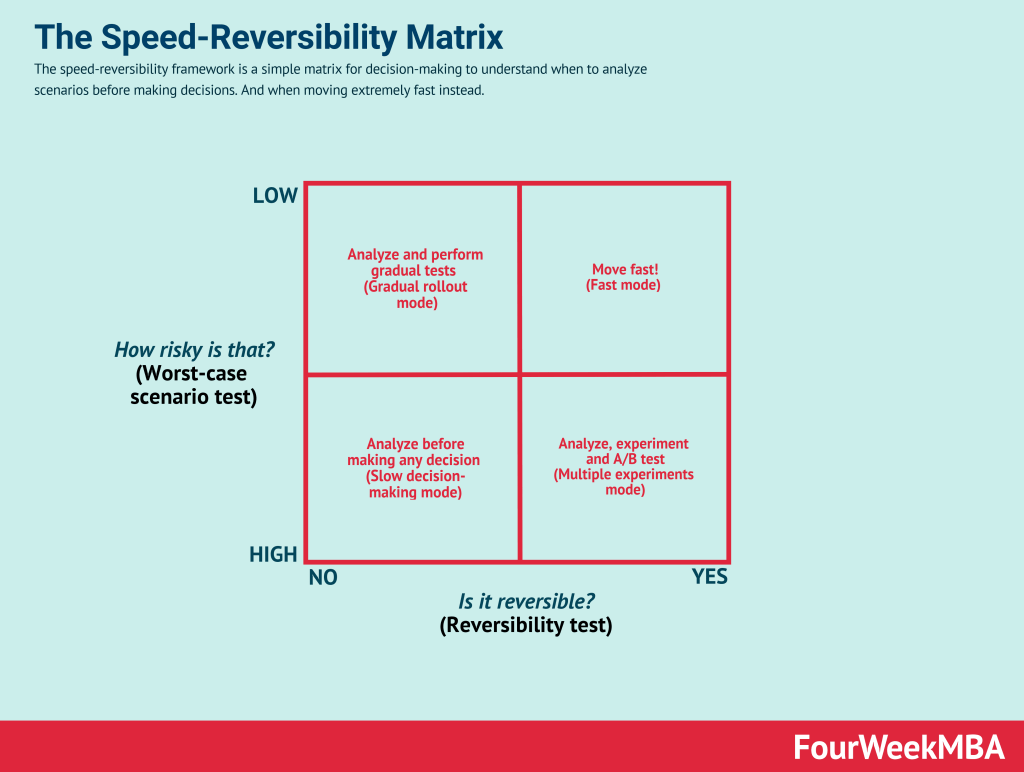
- Speed-Reversibility Matrix
- Minimum Viable Product
- SWOT Analysis
- Revenue Modeling
- Business Experimentation
- Business Analysis


