What Is Single-loop Learning? The Single-loop Learning
Single-loop learning was developed by Dr. Chris Argyris, a well-respected author and Harvard Business School professor in the area of metacognitive thinking. He defined…
Key Components
Origin
Developed by organizational theorist Chris Argyris in the 1970s.
Overview
Single-Loop Learning is a term used to describe the process of learning from mistakes or failures without challenging or changing underlying assumptions or ment
Key Elements
– Error Correction: Single-Loop Learning focuses on identifying and correcting errors or deviations from established norms or goals.
How It Works
In Single-Loop Learning, when a problem or mistake is identified, organizations or individuals typically seek to correct it within the existing framework. This
Applications
– Operational Improvements: Commonly used in organizations to enhance efficiency and effectiveness by addressing operational issues.
Whether we care to admit it, every person thinks in a certain way based on their current beliefs and assumptions about the world. This thinking guides their actions (what they do) and also influences their performance (what they get).
Exec Package + Claude OS Master Skill | Business Engineer Founding Plan
FourWeekMBA x Business Engineer | Updated 2026
Single-loop learning was developed by Dr. Chris Argyris, a well-respected author and Harvard Business School professor in the area of metacognitive thinking. He defined single-loop learning as “learning that changes strategies of action (i.e. the how) in ways that leave the values of a theory of action unchanged (i.e. the why).” Single-loop learning is a learning process where people, groups, or organizations modify their actions based on the difference between expected and actual outcomes.
Component
Description
Origin
Developed by organizational theorist Chris Argyris in the 1970s.
Overview
Single-Loop Learning is a term used to describe the process of learning from mistakes or failures without challenging or changing underlying assumptions or mental models. It involves making adjustments within the existing framework to improve performance.
Key Elements
– Error Correction: Single-Loop Learning focuses on identifying and correcting errors or deviations from established norms or goals.
– Preservation of Assumptions: It often maintains the underlying assumptions and mental models that led to the error.
– Incremental Improvement: The emphasis is on making incremental changes or adjustments to achieve better results.
How It Works
In Single-Loop Learning, when a problem or mistake is identified, organizations or individuals typically seek to correct it within the existing framework. This may involve refining processes, addressing specific issues, or adjusting actions to align better with predefined goals or norms. However, it does not involve questioning or challenging the fundamental assumptions or mental models that led to the problem.
Applications
– Operational Improvements: Commonly used in organizations to enhance efficiency and effectiveness by addressing operational issues.
– Project Management: Applied to project management to identify and rectify deviations from project plans.
– Focused Problem-Solving: Suitable for addressing specific issues without disrupting established processes.
Drawbacks
– Limited Innovation: It does not challenge underlying assumptions, limiting potential for innovation.
– Repetitive Errors: May result in recurring issues if root causes are not addressed.
Key Takeaway
Single-Loop Learning is a problem-solving approach focused on correcting errors or issues within existing frameworks. While it is efficient for addressing specific problems, it does not challenge underlying assumptions or mental models. This can limit its potential for innovation and may lead to repetitive errors if root causes are not addressed. It is most effective for operational improvements and addressing straightforward issues.
Understanding single-loop learning
Whether we care to admit it, every person thinks in a certain way based on their current beliefs and assumptions about the world. This thinking guides their actions (what they do) and also influences their performance (what they get).
As the individual experiences life, they continually assess outcomes to determine whether they occurred as expected or whether there were things that could have been done differently. This form of self-inquiry may be subconscious and unstructured, or more deliberate and formal.
Argyris defined this near-constant inquiry process as the detection of error. In single-loop learning, the error results when an individual isn’t where they want to be. Put simply, a difference exists between the expected outcome and the actual outcome.
Once an error has been detected, the individual must revisit their actions (and the strategies guiding them) to assess and develop new action strategies. Importantly, this must be done without altering an individual’s core beliefs or assumptions.
This process of developing new actions borne from the same thinking is the basis of single-loop learning. In an organizational context, single-loop learning encourages employees to consider alternative strategies that respect governing factors such as goals, values, plans, and rules.
The four steps of the single-loop learning cycle
There are four simple steps to a single-loop learning cycle:
Observe current outcomes – what happened, and how long has it been occurring?
Assess possible corrections – where did the individual, group, or organization deviate from the norm?
Develop action strategies based on the insights uncovered.
Implement the new action strategies and then observe current outcomes to repeat the process once more.
Limitations of single-loop learning
There are a couple of major limitations of single-loop learning.
For one, the approach only addresses the symptoms of a problem. By ignoring the problem’s root cause, it is likely to reoccur in the future.
This issue is exacerbated because the approach does not consider that core beliefs and assumptions may be contributing to the problem in the first place.
Many consider single-loop learning to be a band-aid solution at best, capable of producing nothing more than minor or short-term fixes.
Single-loop learning also assumes problems and their associated solutions to be close to each other in time and space. That is, the method does not consider any intangible factors that might be impacting events and processes.
This means single-loop learning will rarely encourage creative or innovative solutions, instead defaulting to ideas that address deviations from more tangible actions, processes, procedures, systems, and strategies.
When to Use Single-Loop Learning:
Single-loop learning is a valuable approach in various organizational scenarios:
1. Process Improvement:
Use single-loop learning to continually refine and optimize existing processes and workflows.
2. Quality Control:
Apply it in quality control efforts to identify and address deviations from quality standards.
3. Performance Evaluation:
Utilize single-loop learning in performance evaluation and feedback mechanisms for employees and teams.
4. Troubleshooting:
Apply it when identifying and resolving operational issues or problems within the organization.
5. Adaptation to Changes:
Use single-loop learning to adapt to changes in the external environment, such as shifts in customer preferences or market conditions.
How to Use Single-Loop Learning:
Applying single-loop learning effectively involves a structured approach:
1. Define Objectives:
Clearly define the desired outcomes or objectives that your organization wants to achieve.
2. Monitor and Measure:
Establish mechanisms for monitoring and measuring progress toward those objectives. This may involve collecting data, conducting assessments, or using performance indicators.
3. Detect Discrepancies:
Regularly review the data and feedback to detect discrepancies between the desired outcomes and actual results.
4. Take Corrective Action:
When discrepancies are identified, take corrective actions to address them. These actions may involve process adjustments, training, or changes in procedures.
5. Continuously Improve:
Emphasize a culture of continuous improvement by encouraging employees and teams to share feedback and suggestions for further enhancements.
Drawbacks and Limitations of Single-Loop Learning:
While single-loop learning is valuable, it has certain drawbacks and limitations:
1. Limited Innovation:
It primarily focuses on incremental improvements and may not lead to radical innovations or fundamental changes.
2. Resistance to Change:
Single-loop learning can reinforce existing mental models and resistance to questioning underlying assumptions.
3. Missed Opportunities:
By not challenging the status quo, organizations may miss opportunities for breakthrough improvements or innovative solutions.
4. Short-Term Focus:
It tends to prioritize short-term problem-solving over long-term strategic thinking.
5. Overemphasis on Efficiency:
Single-loop learning may overemphasize efficiency and effectiveness within current systems, potentially overlooking the need for transformational changes.
What to Expect from Using Single-Loop Learning:
Using single-loop learning can lead to several outcomes and benefits:
1. Continuous Improvement:
Organizations can expect to continually refine their processes and practices, leading to improved efficiency and effectiveness.
2. Enhanced Performance:
Through feedback and corrective actions, organizations can expect to achieve better performance and results.
3. Problem Resolution:
Single-loop learning helps organizations identify and resolve operational issues or discrepancies quickly.
4. Adaptation to Change:
It enables organizations to adapt to changing circumstances and external factors by making necessary adjustments.
5. Employee Engagement:
A culture of continuous improvement fosters employee engagement and involvement in organizational development.
Relationship with Double-Loop Learning and Other Concepts:
Single-loop learning is often contrasted with double-loop learning, which involves questioning and potentially changing underlying assumptions and mental models.
Both types of learning are part of the broader field of organizational learning, which encompasses concepts like learning organizations, organizational culture, and knowledge management.
Double-loop learning is considered a more profound and transformative form of learning, while single-loop learning focuses on incremental adjustments and improvements within existing frameworks.
Conclusion:
Single-loop learning is a valuable approach for organizations seeking to adapt, improve, and enhance their performance by making incremental changes in response to feedback and experiences.
While it may not lead to radical innovations or fundamental shifts in thinking, it plays a crucial role in continuous improvement and problem-solving within organizations.
By understanding the principles of single-loop learning and its limitations, organizations can effectively apply this concept to drive positive changes and adapt to evolving circumstances in their operational environments.
Examples of Single-Loop Learning
Performance Improvement: In a company, a team may notice that their sales numbers have been declining over the past few months. They observe the current outcomes, assess possible corrections, and develop action strategies to improve their sales performance. They may focus on refining their sales pitches, targeting new customer segments, or enhancing their marketing efforts while maintaining their core sales approach.
Fitness Goals: An individual aiming to lose weight sets a target of running five kilometers every day. After a few weeks, they realize that they haven’t achieved the desired weight loss. They observe their outcomes, assess their approach, and decide to add strength training to their routine while still maintaining their focus on running.
Academic Performance: A student who consistently gets low grades in math exams evaluates their study habits and approach. They identify areas of weakness, such as not seeking help when needed, and develop a plan to improve their math skills while keeping their overall study routine intact.
Case Studies
Restaurant Operations:
A restaurant notices a decline in weekday lunch sales. They implement a lunch special menu to attract more customers. They don’t evaluate the deeper reasons for the decline, such as possibly deteriorating food quality or slow service.
Customer Service:
A customer service department receives complaints about longer wait times on calls. To address this, they may introduce a callback feature. While this might reduce wait times, it doesn’t address the root cause, like why call volumes increased or if representatives are taking longer to resolve issues.
Software Development:
A software development team notices a spike in bug reports after releasing a new update. They quickly issue patches to address each reported bug without delving into why there was a surge in bugs in the first place, such as potential issues in the testing phase.
Retail Management:
A retail store identifies a particular product line that isn’t selling as expected. They run a promotional discount on that product line. While this might boost sales temporarily, they don’t investigate deeper issues, like if the product meets customer needs or if there’s a lack of awareness about the product.
Event Management:
An event management company receives feedback that their events often start late. They decide to push the start time of future events by 30 minutes. This might ensure punctuality, but it doesn’t address why events were starting late in the first place.
Healthcare:
In a clinic, patient wait times have increased. The management decides to hire more staff to handle the increased patient load. This might reduce wait times, but it doesn’t consider other factors, like if current staff is efficiently utilized or if there are bottlenecks in the patient processing system.
Banking:
A bank sees a decline in the use of their physical branches. They decide to renovate branches to make them more appealing. While this may attract some customers in the short term, it doesn’t consider the larger trend of customers preferring online banking.
E-commerce:
An online store identifies that many customers abandon their shopping carts before making a purchase. They introduce a discount for first-time buyers. This might increase sales but doesn’t address deeper issues like why customers abandon carts, such as complicated checkout processes or high shipping fees.
Public Transportation:
A city’s bus service receives complaints about overcrowding during peak hours. They decide to add more buses during these hours. While this may reduce overcrowding, it doesn’t explore other solutions like adjusting routes or considering alternate modes of transportation.
Manufacturing:
A manufacturing plant notices an increase in defective products. They increase quality checks at the end of the production line. This might reduce the number of defective products shipped, but it doesn’t investigate the root cause of the increase in defects, like potential issues with raw materials or machinery malfunctions.
Key Highlights of Single-Loop Learning
Modification Based on Outcome Differences: Single-loop learning involves making adjustments to actions based on the gap between expected and actual outcomes.
Preserving Core Beliefs and Assumptions: The learning process focuses on changing strategies and actions while maintaining underlying values and beliefs.
Continuous Improvement: The learning cycle is a continuous process of observation, assessment, strategy development, implementation, and observation again to refine actions and outcomes.
Addressing Symptoms: Single-loop learning tends to address immediate issues and deviations from expected outcomes, making it more suitable for short-term fixes rather than addressing root causes.
Limited Consideration of Intangible Factors: The approach may overlook underlying factors that impact events and processes, leading to solutions that focus on visible actions and strategies.
Not Ideal for Creative Solutions: Single-loop learning may not encourage innovative approaches since it primarily deals with deviations from existing processes and strategies.
Short-Term Results: While single-loop learning can lead to immediate improvements, it may not be sufficient for long-term and sustainable problem-solving.
Key takeaways:
Single-loop learning is a learning process where people, groups, or organizations modify their actions based on the difference between expected and actual outcomes. It was developed by the teacher and author Dr. Chris Argyris.
Single-loop learning can be described in simple terms via four steps. The individual observes the outcome, evaluates possible corrections, develops action strategies based on viable corrections, and then implements them. After implementation, the loop, or cycle, starts again as the impact of the new strategy is observed.
Single-loop learning has two major drawbacks. For one, it addresses the symptoms of a problem without paying any attention to the root cause. It also assumes problems and their associated solutions to be close to each other in and time and space.
Related Frameworks
Description
When to Apply
Single-loop Learning
A learning process where organizations or individuals seek solutions to problems within the existing mental models and frameworks without questioning their validity. It involves identifying errors and correcting actions within the established operational norms and procedures.
When addressing routine tasks or problems where existing solutions and procedures can be applied directly. It is used in day-to-day operations, quality control, and process optimization to identify deviations from standard practices and make adjustments to improve efficiency and performance.
Double-loop Learning
Expands on single-loop learning by questioning underlying assumptions and mental models. It involves reflecting on the effectiveness of existing strategies and considering alternative approaches to achieve desired outcomes.
When faced with complex problems or challenges that require critical evaluation of underlying assumptions and fundamental beliefs. It is applicable in strategic planning, change management, and organizational development to challenge conventional thinking and foster innovation by encouraging individuals and organizations to question established norms and explore new possibilities for problem-solving and decision-making.
Organizational Learning
The process through which organizations acquire, share, and utilize knowledge to improve performance and adapt to changes in the environment. It involves collecting feedback, analyzing data, and implementing changes to enhance organizational capabilities and effectiveness.
When organizations seek to institutionalize learning and improve adaptability in response to changing environments. It is applicable in knowledge management, continuous improvement, and strategic planning to promote a culture of learning, facilitate knowledge sharing, and drive innovation by leveraging collective insights and lessons learned from past experiences and current practices.
Action Learning
A problem-solving approach that combines learning and action to address real-world challenges. It involves small groups working collaboratively to identify problems, develop solutions, and implement action plans while reflecting on the learning process and outcomes.
When organizations seek to tackle complex problems and develop leadership skills in a practical context. It is applicable in management development, team building, and project management to cultivate problem-solving abilities and foster teamwork by engaging participants in real-life projects and experiential learning that encourage reflection, collaboration, and continuous improvement.
Reflective Practice
Involves deliberate reflection on experiences and actions to gain insights and improve performance. It encourages individuals to question assumptions, evaluate decisions, and identify areas for growth through self-assessment and feedback.
When individuals seek to enhance self-awareness and professional development through introspection and critical thinking. It is applicable in education, healthcare, and professional fields to promote lifelong learning and improve practice by encouraging reflection on past experiences, challenging assumptions, and identifying opportunities for personal and professional growth.
Kaizen
A philosophy of continuous improvement that emphasizes incremental changes and small, gradual steps towards efficiency and quality. It involves employee involvement, process optimization, and problem-solving to drive organizational excellence.
When organizations strive for continuous improvement and employee engagement to enhance productivity and quality. It is applicable in manufacturing, service industries, and business operations to streamline processes, eliminate waste, and **foster a culture of continuous learning and innovation by encouraging collaboration, experimentation, and empowerment at all levels of the organization.
Theory of Constraints (TOC)
Focuses on identifying and removing constraints that limit an organization’s ability to achieve its goals. It involves identifying bottlenecks, exploiting constraints, and subordinating other processes to the constraints to maximize throughput and optimize performance.
When organizations face bottlenecks or constraints that hinder productivity and performance. It is applicable in operations management, supply chain management, and project management to optimize processes, maximize efficiency, and improve overall effectiveness by systematically identifying and addressing constraints through problem-solving and continuous improvement initiatives.
Total Quality Management (TQM)
A management approach that emphasizes customer satisfaction, continuous improvement, and employee involvement to enhance product quality and organizational performance. It involves systematic problem-solving, quality control, and process optimization to meet or exceed customer expectations.
When organizations aim to improve product quality and customer satisfaction through systematic quality management practices. It is applicable in manufacturing, service industries, and business operations to reduce defects, minimize waste, and **promote a culture of continuous improvement by empowering employees and fostering collaboration across all functions of the organization.
Lean Six Sigma
Integrates lean manufacturing principles with Six Sigma methodologies to eliminate waste, reduce variation, and improve process efficiency and quality. It involves identifying and eliminating defects to optimize performance and customer satisfaction.
When organizations aim to optimize processes and reduce defects to improve efficiency and quality. It is applicable in manufacturing, healthcare, and service industries to streamline operations, minimize errors, and **enhance customer satisfaction by combining the strengths of lean management and Six Sigma to drive continuous improvement and sustain performance excellence.
Change Management
Involves planning, implementing, and monitoring changes in organizations to minimize resistance and maximize adoption. It focuses on communicating, training, and engaging stakeholders to facilitate successful transitions.
When organizations undergo significant changes in strategy, structure, or operations. It is applicable in mergers, acquisitions, technology implementations, and organizational restructuring to manage transitions, align stakeholders, and mitigate resistance by implementing effective change management strategies that promote communication, build support, and facilitate adaptation to new ways of working.
fixed mindset believes their intelligence and talents are fixed traits that cannot be developed. The two mindsets were developed by American psychologist Carol Dweck while studying human motivation.
Both mindsets are comprised of conscious and subconscious thought patterns established at a very young age. In adult life, they have profound implications for personal and professional success.
Individuals with a growth mindset devote more time and effort to achieving difficult goals and by extension, are less concerned with the opinions or abilities of others. Individuals with a fixed mindset are sensitive to criticism and may be preoccupied with proving their talents to others.
Constructive feedback is supportive in nature and designed to help employees improve or correct their performance or behavior. Note that the intention of such feedback is to achieve a positive outcome for the employee based on comments, advice, or suggestions.
High-performance coaches work with individuals in personal and professional contexts to enable them to reach their full potential. While these sorts of coaches are commonly associated with sports, it should be noted that the act of coaching is a specific type of behavior that is also useful in business and leadership.
The training of trainers model seeks to engage master instructors in coaching new, less experienced instructors with a particular topic or skill. The training of trainers (ToT) model is a framework used by master instructors to train new instructors, enabling them to subsequently train other people in their organization.
Active listening is the process of listening attentively while someone speaks and displaying understanding through verbal and non-verbal techniques. Active listening is a fundamental part of good communication, fostering a positive connection and building trust between individuals.
Active recall enables the practitioner to remember information by moving it from short-term to long-term memory, where it can be easily retrieved. The technique is also known as active retrieval or practice testing. With active recall, the process is reversed since learning occurs when the student retrieves information from the brain.
The phrase “baptism by fire” originates from the Bible in Matthew 3:11. In Christianity, the phrase was associated with personal trials and tribulations and was also used to describe the martyrdom of an individual. Many years later, it was associated with a soldier going to war for the first time. Here, the baptism was the battle itself. “Baptism by fire” is a phrase used to describe the process of an employee learning something the hard way with great difficulty.
The Dreyfus model of skill acquisition was developed by brothers Hubert and Stuart Dreyfus at the University of California, Berkeley, in 1980. The Dreyfus model of skill acquisition is a learning progression framework. It argues that as one learns a new skill via external instruction, they pass through five stages of development: novice, advanced beginner, competent, proficient, and expert.
The Kolb reflective cycle was created by American educational theorist David Kolb. In 1984, Kolb created the Experiential Learning Theory (ELT) based on the premise that learning is facilitated by direct experience. In other words, the individual learns through action. The Kolb reflective cycle is a holistic learning and development process based on the reflection of active experiences.
The Method of Loci is a mnemonic strategy for memorizing information. The Method of Loci gets its name from the word “loci”, which is the plural of locus – meaning location or place. It is a form of memorization where an individual places information they want to remember along with points of an imaginary journey. By retracing the same route through the journey, the individual can recall the information in a specific order. For this reason, many consider this memory tool a location-based mnemonic.
The Experience Curve argues that the more experience a business has in manufacturing a product, the more it can lower costs. As a company gains un know-how, it also gains in terms of labor efficiency, technology-driven learning, product efficiency, and shared experience, to reduce the cost per unit as the cumulative volume of production increases.
The Feynman Technique is a mental model and strategy for learning something new and committing it to memory. It is often used in exam preparation and for understanding difficult concepts. Physicist Richard Feynman elaborated this method, and it’s a powerful technique to explain anything.
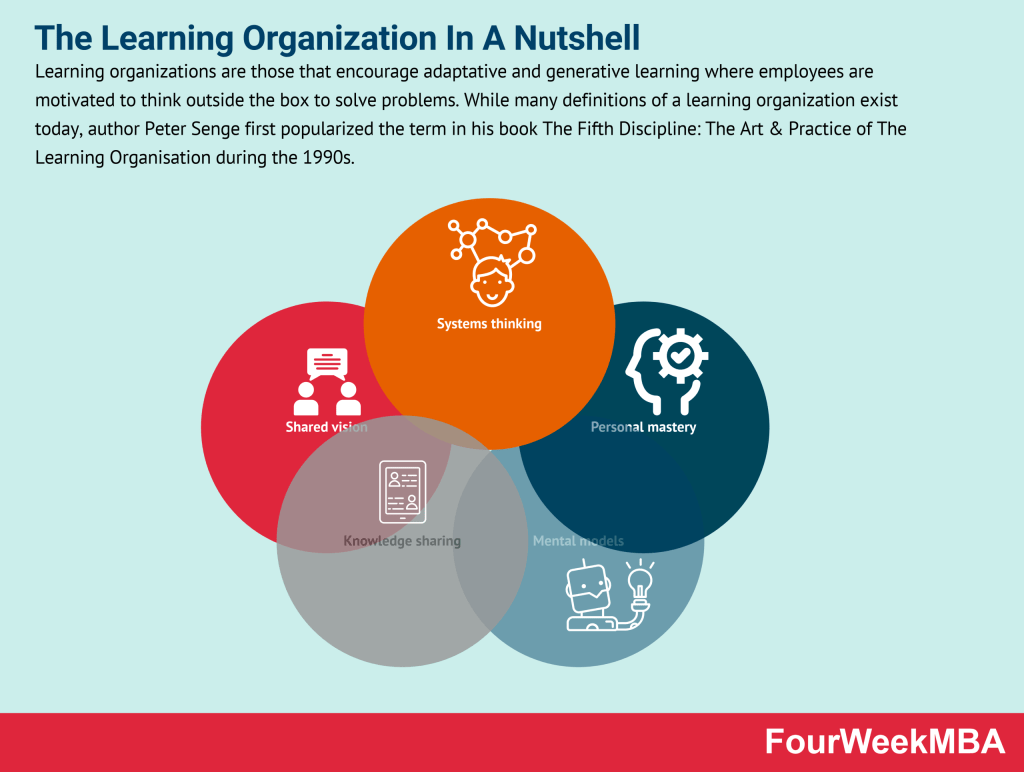
Learning organizations are those that encourage adaptative and generative learning where employees are motivated to think outside the box to solve problems. While many definitions of a learning organization exist today, author Peter Senge first popularized the term in his book The Fifth Discipline: The Art & Practice of The Learning Organisation during the 1990s.
The forgetting curve was first proposed in 1885 by Hermann Ebbinghaus, a German psychologist and pioneer of experimental research into memory. The forgetting curve illustrates the rate at which information is lost over time if the individual does not make effort to retain it.
Instructor-led training is a more traditional, top-down, teacher-oriented approach to learning that occurs in online or offline classroom environments. The approach connects instructors with students to encourage discussion and interaction in a group or individual context, with many enjoying ILT over other methods as they can seek direct clarification on a topic from the source. Instructor-led training (ILT), therefore, encompasses any form of training provided by an instructor in an online or offline classroom setting.
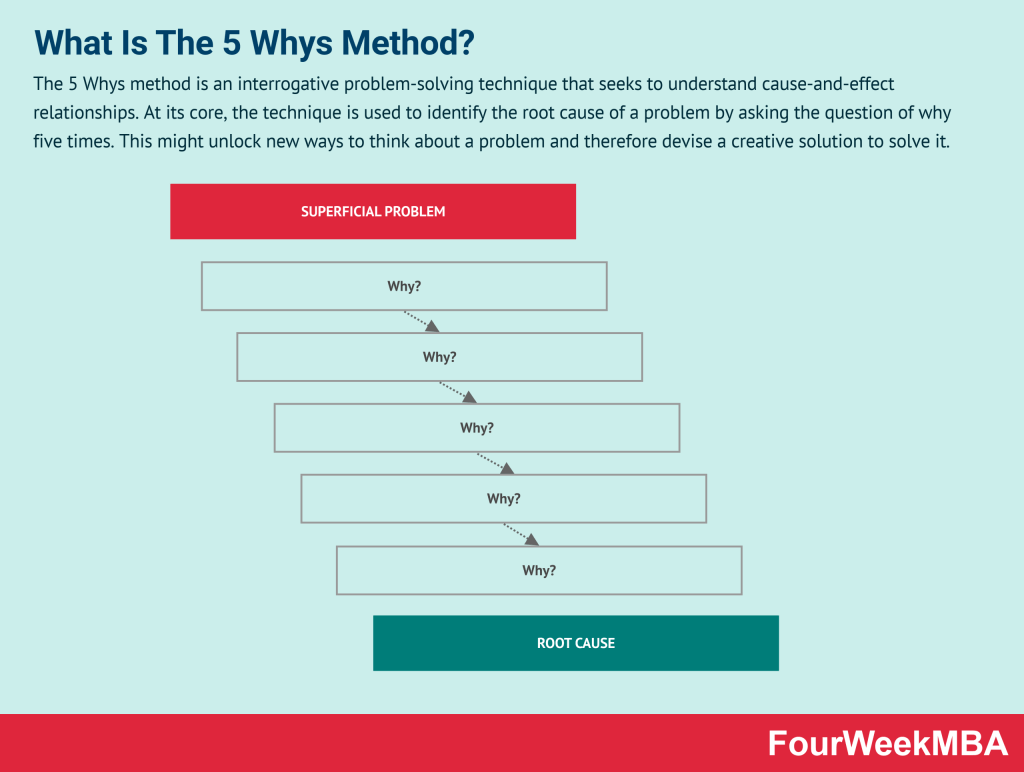
The 5 Whys method is an interrogative problem-solving technique that seeks to understand cause-and-effect relationships. At its core, the technique is used to identify the root cause of a problem by asking the question of why five times. This might unlock new ways to think about a problem and therefore devise a creative solution to solve it.
Single-loop learning was developed by Dr. Chris Argyris, a well-respected author and Harvard Business School professor in the area of metacognitive thinking. He defined single-loop learning as “learning that changes strategies of action (i.e. the how) in ways that leave the values of a theory of action unchanged (i.e. the why).” Single-loop learning is a learning process where people, groups, or organizations modify their actions based on the difference between expected and actual outcomes.
Spaced repetition is a technique where individuals review lessons at increasing intervals to memorize information. Spaced repetition is based on the premise that the brain learns more effectively when the individual “spaces out” the learning process. Thus, it can be used as a mnemonic technique to transform short-term memory into long-term memory.
Blended learning is a broad and imprecise field that makes it difficult to define. However, in most cases, it is considered to be a form of hybrid learning that combines online and offline instructional methods.
The term lessons learned refers to the various experiences project team members have while participating in a project. Lessons are shared in a review session which usually occurs once the project has been completed, with any improvements or best practices incorporated into subsequent projects.
Post-mortem analyses review projects from start to finish to determine process improvements and ensure that inefficiencies are not repeated in the future. In the Project Management Book of Knowledge (PMBOK), this process is referred to as “lessons learned”.
Instructor-led training is a more traditional, top-down, teacher-oriented approach to learning that occurs in online or offline classroom environments. The approach connects instructors with students to encourage discussion and interaction in a group or individual context, with many enjoying ILT over other methods as they can seek direct clarification on a topic from the source. Instructor-led training (ILT), therefore, encompasses any form of training provided by an instructor in an online or offline classroom setting.
The 5E Instructional Model is a framework for improving teaching practices through discussion, observation, critique, and reflection. Teachers and students move through each phase linearly, but some may need to be repeated or cycled through several times to ensure effective learning. This is a form of inquiry-based learning where students are encouraged to discover information and formulate new insights themselves.
What is What Is Single-loop Learning? The Single-loop Learning?
Single-loop learning was developed by Dr. Chris Argyris, a well-respected author and Harvard Business School professor in the area of metacognitive thinking. He defined single-loop learning as “ learning that changes strategies of action (i.e. the how) in ways that leave the values of a theory of action unchanged (i.e.
What are the key components of What Is Single-loop Learning? The Single-loop Learning?
The key components of What Is Single-loop Learning? The Single-loop Learning include Origin, Overview, Key Elements, How It Works, Applications. Origin: Developed by organizational theorist Chris Argyris in the 1970s. Overview: Single-Loop Learning is a term used to describe the process of learning from mistakes or failures without challenging…
Why is What Is Single-loop Learning? The Single-loop Learning important for business strategy?
Whether we care to admit it, every person thinks in a certain way based on their current beliefs and assumptions about the world. This thinking guides their actions (what they do) and also influences their performance (what they get).
How do you apply What Is Single-loop Learning? The Single-loop Learning in practice?
As the individual experiences life, they continually assess outcomes to determine whether they occurred as expected or whether there were things that could have been done differently. This form of self-inquiry may be subconscious and unstructured, or more deliberate and formal.
What are the advantages and limitations of What Is Single-loop Learning? The Single-loop Learning?
Argyris defined this near-constant inquiry process as the detection of error. In single-loop learning, the error results when an individual isn’t where they want to be. Put simply, a difference exists between the expected outcome and the actual outcome.
Gennaro is the creator of FourWeekMBA, which reached about four million business people, comprising C-level executives, investors, analysts, product managers, and aspiring digital entrepreneurs in 2022 alone | He is also Director of Sales for a high-tech scaleup in the AI Industry | In 2012, Gennaro earned an International MBA with emphasis on Corporate Finance and Business Strategy.