Performance-based contracting (PBC) is a procurement strategy where contracts are structured around the achievement of predefined performance metrics or outcomes rather than the mere completion of tasks or delivery of goods and services. This approach incentivizes contractors to focus on delivering measurable results that align with the objectives of the contracting agency or organization.
Key Components
Key Characteristics of Performance-Based Contracting
Performance-based contracting is a procurement strategy where contracts are structured around the achievement of predefined performance metrics or outcomes, incentivizing contractors to focus on delivering measurable results that align with the…
Conclusion
Performance-based contracting is a procurement strategy that emphasizes the achievement of predefined performance metrics or outcomes, incentivizing contractors to deliver measurable results that align with the objectives of the contracting agency…
When To Use
▶– Effective for intellectual property and digital products, where control over usage and distribution can be maintained while…
Real-World Examples
CostcoGoogle
Quick Answers
What are the key characteristics of performance-based contracting?
Performance-based contracting is a procurement strategy where contracts are structured around the achievement of predefined performance metrics or outcomes, incentivizing contractors to focus on delivering measurable results that align with the objectives of the contracting agency or organization.
What is Conclusion?
Performance-based contracting is a procurement strategy that emphasizes the achievement of predefined performance metrics or outcomes, incentivizing contractors to deliver measurable results that align with the objectives of the contracting agency or organization.
Key Insight
Performance-based contracting is a procurement strategy that emphasizes the achievement of predefined performance metrics or outcomes, incentivizing contractors to deliver measurable results that align with the objectives of the contracting agency or organization. Key characteristics of performance-based contracting include a focus on outcomes, clear performance metrics, incentive alignment, and flexibility.
Exec Package + Claude OS Master Skill | Business Engineer Founding Plan
FourWeekMBA x Business Engineer | Updated 2026
Performance-based contracting (PBC) is a procurement strategy where contracts are structured around the achievement of predefined performance metrics or outcomes rather than the mere completion of tasks or delivery of goods and services. This approach incentivizes contractors to focus on delivering measurable results that align with the objectives of the contracting agency or organization.
Performance-based contracts can be found in various industries, including government, healthcare, defense, and information technology. Understanding the dynamics, strategies, benefits, and challenges of performance-based contracting is essential for both contracting agencies and contractors to ensure successful contract execution and achievement of desired outcomes.
Key Characteristics of Performance-Based Contracting
Performance-based contracting is a procurement strategy where contracts are structured around the achievement of predefined performance metrics or outcomes, incentivizing contractors to focus on delivering measurable results that align with the objectives of the contracting agency or organization.
Focus on Outcomes:
Performance-based contracts emphasize the achievement of specific outcomes or performance metrics rather than the completion of tasks or delivery of inputs. Contractors are held accountable for delivering measurable results that contribute to the overall objectives of the contracting agency or organization.
Clear Performance Metrics:
Performance-based contracts define clear and measurable performance metrics or Key Performance Indicators (KPIs) that contractors are expected to meet or exceed. These metrics serve as benchmarks for evaluating contractor performance and determining contract compliance.
Incentive Alignment:
Performance-based contracting aligns incentives between the contracting agency and the contractor by linking contract payments or incentives to the achievement of predefined performance metrics. Contractors are incentivized to perform at their best to maximize their financial rewards and maintain a positive reputation.
Flexibility and Adaptability:
Performance-based contracts offer flexibility and adaptability to accommodate changing priorities, emerging needs, and evolving circumstances throughout the contract period. Contractors have the flexibility to adjust their approaches and strategies to meet performance targets effectively.
Strategies for Implementing Performance-Based Contracting
Clear Definition of Objectives:
Contracting agencies must clearly define their objectives, requirements, and expected outcomes before initiating the procurement process. Clear objectives provide a foundation for developing performance-based contracts and establishing measurable performance metrics.
Development of Performance Metrics:
Contracting agencies should develop clear and measurable performance metrics or KPIs that align with their objectives and reflect the desired outcomes of the contract. Performance metrics should be specific, relevant, achievable, and time-bound to effectively evaluate contractor performance.
Risk Allocation and Mitigation:
Contracting agencies and contractors should carefully allocate risks and responsibilities in performance-based contracts to ensure fair and equitable risk sharing. Provisions for risk mitigation strategies, dispute resolution mechanisms, and performance guarantees should be included in the contract to minimize potential risks and uncertainties.
Monitoring and Evaluation:
Contracting agencies must establish robust monitoring and evaluation mechanisms to track contractor performance against predefined performance metrics. Regular performance reviews, progress reports, and site visits help ensure transparency, accountability, and compliance throughout the contract period.
Benefits and Challenges of Performance-Based Contracting
Benefits
Improved Accountability:
Performance-based contracting enhances accountability by holding contractors accountable for delivering measurable results that align with the objectives of the contracting agency. Contractors are incentivized to perform at their best to meet or exceed performance metrics and earn financial rewards.
Enhanced Efficiency and Effectiveness:
Performance-based contracting promotes efficiency and effectiveness by focusing on outcomes rather than inputs. Contractors are encouraged to innovate, streamline processes, and adopt best practices to achieve performance targets and deliver value for money.
Greater Value for Money:
Performance-based contracting maximizes value for money by incentivizing contractors to deliver high-quality results at competitive prices. Contractors are motivated to optimize resource utilization, minimize costs, and maximize outcomes to maximize their financial returns.
Challenges
Complex Performance Measurement:
Performance-based contracting may involve complex performance measurement and evaluation processes, particularly for contracts with multiple performance metrics or objectives. Contracting agencies must invest in robust monitoring and evaluation systems to ensure accurate and reliable performance assessment.
Risk of Disputes and Litigation:
Performance-based contracts may increase the risk of disputes and litigation between contracting agencies and contractors, particularly if performance metrics are ambiguous or subjective. Clear communication, mutual understanding, and effective dispute resolution mechanisms are essential to mitigate potential conflicts.
Limited Applicability:
Performance-based contracting may not be suitable for all types of contracts or procurement projects, particularly those with highly subjective or intangible outcomes. Contracting agencies must carefully assess the feasibility and appropriateness of performance-based contracting for each specific context and project.
Conclusion
Performance-based contracting is a procurement strategy that emphasizes the achievement of predefined performance metrics or outcomes, incentivizing contractors to deliver measurable results that align with the objectives of the contracting agency or organization. Key characteristics of performance-based contracting include a focus on outcomes, clear performance metrics, incentive alignment, and flexibility. Strategies for implementing performance-based contracting include clear definition of objectives, development of performance metrics, risk allocation and mitigation, and monitoring and evaluation. While performance-based contracting offers benefits such as improved accountability, enhanced efficiency, and greater value for money, it also presents challenges such as complex performance measurement, risk of disputes and litigation, and limited applicability. Understanding these dynamics is essential for both contracting agencies and contractors to ensure successful contract execution and achievement of desired outcomes.
Related Frameworks, Models, Concepts
Description
When to Apply
Productized Services
– A business model where services are packaged and sold as products, with defined scopes and pricing. – Streamlines service delivery by standardizing offerings.
– Ideal for service providers looking to scale operations and simplify client engagements by offering clear, predefined packages.
Service Design
– The activity of planning and organizing people, infrastructure, communication, and material components of a service to improve its quality and the interaction between service provider and customers.
– Applied in services that require a systematic approach to making services more useful, usable, efficient, and customer-friendly.
Subscription Model
– A business model where customers pay a recurring price at regular intervals for access to a product or service.
– Suitable for businesses aiming for steady revenue streams and long-term customer engagement, like software as a service (SaaS) platforms.
Value-Based Pricing
– Pricing strategy where prices are based on the perceived or estimated value of a product or service to the customer rather than historical pricing or the cost of production.
– Used when services or products offer significant unique value or benefits to customers, emphasizing quality or outcome over cost.
Freemium Model
– A pricing strategy where a product or service (typically a digital offering) is provided free of charge, but money is charged for additional features, services, or virtual goods.
– Effective in markets where scaling at low cost is possible and where a premium could be charged for advanced features.
Consultative Selling
– A sales approach that prioritizes relationships and open dialogue to identify and provide solutions to a customer’s needs. It is less focused on pushing a product and more on creating value for the customer.
– Ideal for complex markets where customer needs are specific and evolving, requiring a deep understanding and tailored solutions.
Managed Services
– A model where a company outsources specific IT or business functions to a service provider who manages and assumes responsibility for providing a defined set of services to its clients proactively.
– Used by companies looking to reduce operational costs, improve efficiency, and gain access to specialized expertise in IT and business processes.
Bundling
– Offering several products or services together as a single combined package often at a lower price than they would cost individually.
– Suitable for businesses that want to increase the perceived value of their offerings and encourage customers to purchase more by combining related services or products.
Performance-Based Contracting
– A contractual arrangement where payment is contingent upon achieving specific results or milestones that are agreed upon by the buyer and seller.
– Applied in scenarios where the focus is on delivering results and aligning incentives between service providers and clients.
Licensing Model
– A business model where the owner of a product allows someone else to use the product under certain conditions, often generating a continuous revenue stream from the licensee.
– Effective for intellectual property and digital products, where control over usage and distribution can be maintained while broadening market reach.
An effective business model has to focus on two dimensions: the people dimension and the financial dimension. The people dimension will allow you to build a product or service that is 10X better than existing ones and a solid brand. The financial dimension will help you develop proper distribution channels by identifying the people that are willing to pay for your product or service and make it financially sustainable in the long run.
Business model innovation is about increasing the success of an organization with existing products and technologies by crafting a compelling value proposition able to propel a new business model to scale up customers and create a lasting competitive advantage. And it all starts by mastering the key customers.
Digital and tech business models can be classified according to four levels of transformation into digitally-enabled, digitally-enhanced, tech or platform business models, and business platforms/ecosystems.
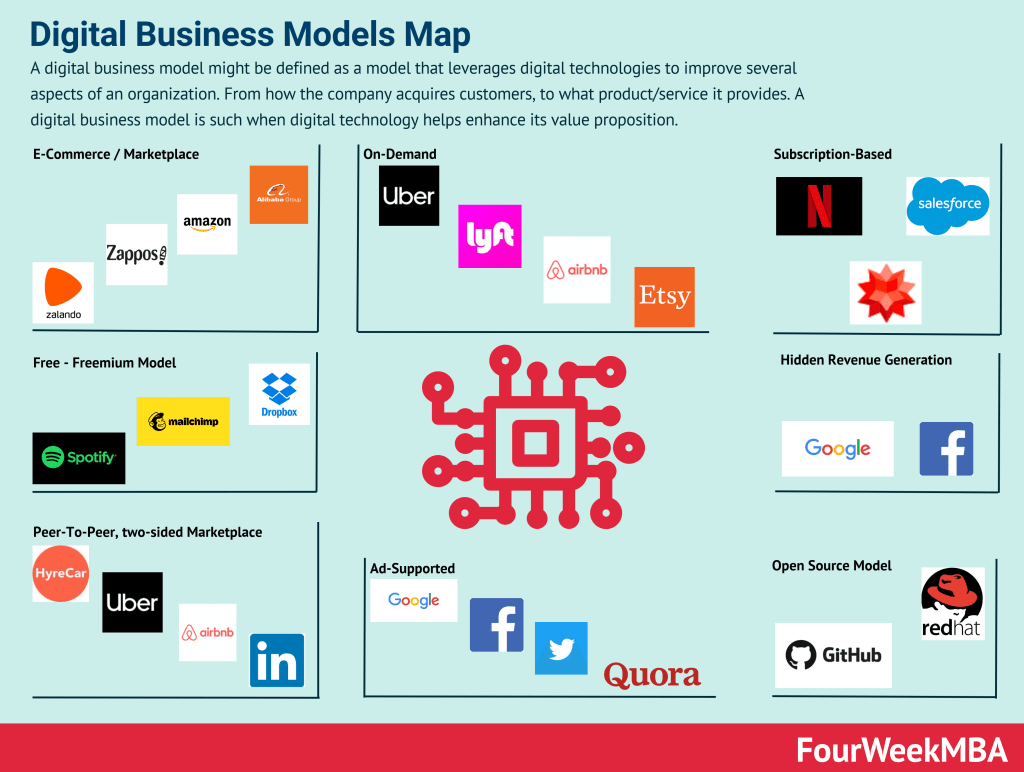
A digital business model might be defined as a model that leverages digital technologies to improve several aspects of an organization. From how the company acquires customers, to what product/service it provides. A digital business model is such when digital technology helps enhance its value proposition.
A tech business model is made of four main components: value model (value propositions, mission, vision), technological model (R&D management), distribution model (sales and marketing organizational structure), and financial model (revenue modeling, cost structure, profitability and cash generation/management). Those elements coming together can serve as the basis to build a solid tech business model.
A platform business model generates value by enabling interactions between people, groups, and users by leveraging network effects. Platform business models usually comprise two sides: supply and demand. Kicking off the interactions between those two sides is one of the crucial elements for a platform business model success.
A Blockchain Business Model is made of four main components: Value Model (Core Philosophy, Core Value and Value Propositions for the key stakeholders), Blockchain Model (Protocol Rules, Network Shape and Applications Layer/Ecosystem), Distribution Model (the key channels amplifying the protocol and its communities), and the Economic Model (the dynamics through which protocol players make money). Those elements coming together can serve as the basis to build and analyze a solid Blockchain Business Model.
In an asymmetric businessmodel, the organization doesn’t monetize the user directly, but it leverages the data users provide coupled with technology, thus have a key customer pay to sustain the core asset. For example, Google makes money by leveraging users’ data, combined with its algorithms sold to advertisers for visibility.
In an asymmetric businessmodel, the organization doesn’t monetize the user directly, but it leverages the data users provide coupled with technology, thus having a key customer pay to sustain the core asset. For example, Google makes money by leveraging users’ data, combined with its algorithms sold to advertisers for visibility. This is how attention merchants make monetize their business models.
While the term has been coined by Andrew Lampitt, open-core is an evolution of open-source. Where a core part of the software/platform is offered for free, while on top of it are built premium features or add-ons, which get monetized by the corporation who developed the software/platform. An example of the GitLab open core model, where the hosted service is free and open, while the software is closed.
Cloud business models are all built on top of cloud computing, a concept that took over around 2006 when former Google’s CEO Eric Schmit mentioned it. Most cloud-based business models can be classified as IaaS (Infrastructure as a Service), PaaS (Platform as a Service), or SaaS (Software as a Service). While those models are primarily monetized via subscriptions, they are monetized via pay-as-you-go revenue models and hybrid models (subscriptions + pay-as-you-go).
Open source is licensed and usually developed and maintained by a community of independent developers. While the freemium is developed in-house. Thus the freemium give the company that developed it, full control over its distribution. In an open-source model, the for-profit company has to distribute its premium version per its open-source licensing model.
The freemium – unless the whole organization is aligned around it – is a growth strategy rather than a business model. A free service is provided to a majority of users, while a small percentage of those users convert into paying customers through the sales funnel. Free users will help spread the brand through word of mouth.
A freeterprise is a combination of free and enterprise where free professional accounts are driven into the funnel through the free product. As the opportunity is identified the company assigns the free account to a salesperson within the organization (inside sales or fields sales) to convert that into a B2B/enterprise account.
A marketplace is a platform where buyers and sellers interact and transact. The platform acts as a marketplace that will generate revenues in fees from one or all the parties involved in the transaction. Usually, marketplaces can be classified in several ways, like those selling services vs. products or those connecting buyers and sellers at B2B, B2C, or C2C level. And those marketplaces connecting two core players, or more.
B2B, which stands for business-to-business, is a process for selling products or services to other businesses. On the other hand, a B2C sells directly to its consumers.
A B2B2C is a particular kind of business model where a company, rather than accessing the consumer market directly, it does that via another business. Yet the final consumers will recognize the brand or the service provided by the B2B2C. The company offering the service might gain direct access to consumers over time.
Direct-to-consumer (D2C) is a business model where companies sell their products directly to the consumer without the assistance of a third-party wholesaler or retailer. In this way, the company can cut through intermediaries and increase its margins. However, to be successful the direct-to-consumers company needs to build its own distribution, which in the short term can be more expensive. Yet in the long-term creates a competitive advantage.
The C2C business model describes a market environment where one customer purchases from another on a third-party platform that may also handle the transaction. Under the C2C model, both the seller and the buyer are considered consumers. Customer to customer (C2C) is, therefore, a business model where consumers buy and sell directly between themselves. Consumer-to-consumer has become a prevalent business model especially as the web helped disintermediate various industries.
A retail business model follows a direct-to-consumer approach, also called B2C, where the company sells directly to final customers a processed/finished product. This implies a business model that is mostly local-based, it carries higher margins, but also higher costs and distribution risks.
The wholesale model is a selling model where wholesalers sell their products in bulk to a retailer at a discounted price. The retailer then on-sells the products to consumers at a higher price. In the wholesale model, a wholesaler sells products in bulk to retail outlets for onward sale. Occasionally, the wholesaler sells direct to the consumer, with supermarket giant Costco the most obvious example.
The term “crowdsourcing” was first coined by Wired Magazine editor Jeff Howe in a 2006 article titled Rise of Crowdsourcing. Though the practice has existed in some form or another for centuries, it rose to prominence when eCommerce, social media, and smartphone culture began to emerge. Crowdsourcing is the act of obtaining knowledge, goods, services, or opinions from a group of people. These people submit information via social media, smartphone apps, or dedicated crowdsourcing platforms.
In a franchained business model (a short-term chain, long-term franchise) model, the company deliberately launched its operations by keeping tight ownership on the main assets, while those are established, thus choosing a chain model. Once operations are running and established, the company divests its ownership and opts instead for a franchising model.
Businesses employing the brokerage business model make money via brokerage services. This means they are involved with the facilitation, negotiation, or arbitration of a transaction between a buyer and a seller. The brokerage business model involves a business connecting buyers with sellers to collect a commission on the resultant transaction. Therefore, acting as a middleman within a transaction.
Dropshipping is a retail business model where the dropshipper externalizes the manufacturing and logistics and focuses only on distribution and customer acquisition. Therefore, the dropshipper collects final customers’ sales orders, sending them over to third-party suppliers, who ship directly to those customers. In this way, through dropshipping, it is possible to run a business without operational costs and logistics management.
What are the key components of Performance-Based Contracting?
The key components of Performance-Based Contracting include Productized Services, Service Design, Subscription Model, Value-Based Pricing, Freemium Model. Productized Services: – A business model where services are packaged and sold as products, with defined scopes and pricing. – Streamlines… Service Design: – The activity of planning and organizing people, infrastructure, communication, and material components of a service…
Why is Performance-Based Contracting important for business strategy?
Performance-based contracts can be found in various industries, including government, healthcare, defense, and information technology. Understanding the dynamics, strategies, benefits, and challenges of performance-based contracting is essential for both contracting agencies and contractors to ensure successful contract execution and achievement of desired outcomes.
How do you apply Performance-Based Contracting in practice?
Performance-based contracting is a procurement strategy where contracts are structured around the achievement of predefined performance metrics or outcomes, incentivizing contractors to focus on delivering measurable results that align with the objectives of the contracting agency or organization.
What are the advantages and limitations of Performance-Based Contracting?
Performance-based contracts emphasize the achievement of specific outcomes or performance metrics rather than the completion of tasks or delivery of inputs. Contractors are held accountable for delivering measurable results that contribute to the overall objectives of the contracting agency or organization.
What are the key characteristics of performance-based contracting?
Performance-based contracting is a procurement strategy where contracts are structured around the achievement of predefined performance metrics or outcomes, incentivizing contractors to focus on delivering measurable results that align with the objectives of the contracting agency or organization.
What are the key components of Performance-Based Contracting?
The key components of Performance-Based Contracting include Key Characteristics of Performance-Based Contracting. Key Characteristics of Performance-Based Contracting: Performance-based contracting is a procurement strategy where contracts are structured around the achievement of predefined performance metrics or…
Frequently Asked Questions
What is Performance-Based Contracting?
Performance-based contracting (PBC) is a procurement strategy where contracts are structured around the achievement of predefined performance metrics or outcomes rather than the mere completion of tasks or delivery of goods and services. This approach incentivizes contractors to focus on delivering measurable results that align with the objectives of the contracting agency or organization.
What are the key characteristics of performance-based contracting?
Performance-based contracting is a procurement strategy where contracts are structured around the achievement of predefined performance metrics or outcomes, incentivizing contractors to focus on delivering measurable results that align with the objectives of the contracting agency or organization.
What are the key components of Performance-Based Contracting?
The key components of Performance-Based Contracting include Key Characteristics of Performance-Based Contracting, Conclusion. Key Characteristics of Performance-Based Contracting: Performance-based contracting is a procurement strategy where contracts are structured around the achievement of predefined performance metrics or outcomes, incentivizing contractors to focus on…
Gennaro is the creator of FourWeekMBA, which reached about four million business people, comprising C-level executives, investors, analysts, product managers, and aspiring digital entrepreneurs in 2022 alone | He is also Director of Sales for a high-tech scaleup in the AI Industry | In 2012, Gennaro earned an International MBA with emphasis on Corporate Finance and Business Strategy.