Management by Objectives or MBO is a strategic management tool, and a goal-setting management framework to align the organization around specific objectives. The core principle of MBO is to clearly define organizational objective to align management with employees across the organization.
OKR is a goal-setting management system ideated by Andy Grove, during his tenance as CEO of Intel. As explained in the book “Measure What Matters” written by entrepreneur and venture capitalist, John Doerr, the OKR framework consists of four key elements: focus and commit on priorities, align and connect for teamwork, track for accountability and stretch for amazing.
Aspect
Management by Objectives (MBO)
Objectives and Key Results (OKR)
Definition
Management by Objectives (MBO) is a management framework that involves setting specific, measurable objectives collaboratively between managers and employees. It focuses on aligning individual and organizational goals.
Objectives and Key Results (OKR) is a performance management methodology that emphasizes setting clear objectives and measurable key results to track progress toward those objectives. OKRs are designed to promote focus, alignment, and agility.
Origin
MBO was developed by Peter Drucker in the 1950s and became a popular management approach in the mid-20th century.
OKRs were popularized by Andy Grove at Intel in the 1970s and later embraced by tech companies like Google. They gained broader adoption in the 21st century.
Components
MBO typically involves several components: – Setting clear objectives. – Defining specific key results or tasks to achieve the objectives. – Establishing a timeline for achievement. – Monitoring progress through regular reviews.
OKRs consist of two main components: – Objectives: Clear, concise descriptions of what needs to be achieved. – Key Results: Specific, measurable outcomes that indicate progress toward the objectives. OKRs are typically set on a quarterly basis.
Focus
MBO emphasizes the alignment of individual and departmental goals with the organization’s overall objectives. It focuses on cascading objectives throughout the organization.
OKR places a strong emphasis on focus and prioritization. It encourages teams and individuals to set a limited number of objectives and key results to ensure concentrated efforts on what matters most.
Alignment
MBO emphasizes vertical alignment, ensuring that individual objectives align with their respective departmental and organizational objectives.
OKR emphasizes horizontal alignment across teams and departments. It encourages collaboration and cross-functional alignment to achieve common organizational goals.
Measurement
MBO relies on quantitative measures to assess progress, but it may also include qualitative assessments of performance.
OKRs place a heavy emphasis on measurable key results, with the understanding that progress can be objectively tracked. Qualitative assessments may supplement key results.
Frequency of Review
MBO typically involves annual or semi-annual performance reviews, with objectives often set for longer timeframes.
OKRs are typically reviewed more frequently, often on a quarterly basis, allowing for quicker adaptability and course correction.
Flexibility
MBO can be more rigid due to its longer review cycles and may not adapt quickly to changing priorities.
OKRs are designed to be flexible and agile, allowing teams to adjust objectives and key results as circumstances change or new information emerges.
Ownership
In MBO, managers often play a significant role in setting objectives for their employees. There may be less employee autonomy in goal setting.
OKRs encourage employees to have ownership of their own objectives and key results. They are expected to define their OKRs, fostering a sense of autonomy and accountability.
Scoring
MBO typically uses a performance appraisal approach that may involve subjective evaluations and ratings.
OKRs often use a scoring system, such as a 0-1 scale, to assess achievement of key results objectively.
Reward Systems
MBO can be linked to reward systems, including salary increases and bonuses, based on performance evaluations.
OKRs can also be tied to rewards, but they emphasize intrinsic motivation and the satisfaction of achieving meaningful objectives.
Cascading
MBO involves cascading objectives from top-level management down through the organization, ensuring alignment.
OKRs also cascade, but they encourage lateral alignment across teams and departments in addition to vertical alignment.
Culture
MBO may be associated with a more traditional, hierarchical organizational culture.
OKRs are often associated with a more agile, collaborative, and results-oriented culture, commonly found in tech and startup environments.
MBO: MBO primarily centers around defining specific objectives that the organization aims to achieve. These objectives are usually communicated from top management to employees. The emphasis is on clarity and alignment regarding what needs to be accomplished.
OKR: OKR goes beyond just stating objectives. It also includes defining specific key results or metrics that indicate the progress and success of those objectives. This focus on both the “what” (objectives) and the “how” (key results) ensures a more comprehensive understanding of what it takes to achieve the desired outcomes.
Time Frame:
MBO: MBO typically operates on an annual basis, where objectives are set at the beginning of the year and reviewed at the end of the year. This longer time frame can sometimes make adjustments and adaptability challenging.
OKR: OKR operates on a shorter time frame, often spanning a quarter. This frequent review cycle allows for more agility and adaptability in response to changing circumstances, helping organizations stay focused and responsive to market dynamics.
Visibility and Transparency:
MBO: MBO objectives are often kept private within teams or departments. While this may create a sense of ownership, it can also lead to a lack of visibility and alignment across the organization.
OKR: OKRs are designed to be transparent and visible to everyone in the organization. This transparency fosters a sense of unity, shared purpose, and collaboration. Teams can see how their objectives contribute to the broader organizational goals.
Direction of Implementation:
MBO: MBO typically follows a top-down approach, with upper management setting objectives and cascading them down to lower levels. This approach may limit input and creativity from employees on the front lines.
OKR: OKR encourages a more inclusive approach. Teams and individuals contribute to goal-setting, allowing for a bottom-up or sideways approach. This inclusivity often leads to more innovative solutions and a sense of ownership.
Compensation Link:
MBO: MBO objectives are sometimes tied to compensation. Achieving or surpassing these objectives can directly impact an employee’s compensation package, which can motivate or demotivate individuals based on financial rewards.
OKR: OKRs are generally divorced from compensation. The focus is on driving performance, collaboration, and alignment rather than attaching financial rewards directly to goal achievement. This approach promotes a healthier work environment and prevents overly narrow focus on individual incentives.
Risk and Ambition:
MBO: MBO goals tend to be more conservative and achievable. The focus is on setting objectives that are realistic and within reach to avoid failure.
OKR: OKRs encourage setting stretch goals that are ambitious and might require pushing boundaries. The emphasis is on aiming higher, even if there’s a risk of not fully achieving the goals. This fosters innovation and growth mindset.
Key Takeaway
In summary, while both MBO and OKR aim to align organizations around objectives, OKR takes a more dynamic and agile approach by including key results, emphasizing transparency, involving employees in goal-setting, and encouraging aspirational goals. The OKR framework is well-suited for organizations looking to foster innovation, adaptability, and collaborative engagement across all levels.
Related Frameworks, Models, or Concepts
Description
When to Apply
Management by Objectives (MBO)
Management by Objectives (MBO) is a management philosophy that emphasizes setting clear, measurable objectives and aligning individual and team goals with organizational objectives. It involves defining specific objectives, cascading them down through organizational levels, and monitoring progress towards their achievement. MBO fosters employee engagement, accountability, and performance improvement by providing clarity of expectations and regular feedback on goal attainment.
Consider Management by Objectives (MBO) when seeking to align individual and team goals with organizational objectives. Use it to set clear, measurable objectives, establish accountability for goal attainment, and monitor progress through regular performance reviews. Implement MBO as a framework for driving alignment, motivation, and performance improvement within your organization.
Objectives and Key Results (OKR)
Objectives and Key Results (OKR) is a goal-setting framework popularized by companies like Google and Intel. It involves setting ambitious, outcome-oriented objectives and defining measurable key results to track progress towards their achievement. OKRs are typically set at the organizational, team, and individual levels, and they encourage transparency, alignment, and focus on results. OKRs are frequently reviewed and revised to adapt to changing priorities and market conditions.
Consider Objectives and Key Results (OKR) when seeking to set ambitious goals and track progress towards their achievement. Use it to define clear, measurable objectives and key results, cascade them throughout the organization, and foster transparency and alignment in goal-setting and execution. Implement OKRs as a framework for driving focus, accountability, and agility in goal-setting and performance management within your organization.
SMART Goals
SMART Goals is an acronym that stands for Specific, Measurable, Achievable, Relevant, and Time-bound. It is a framework for setting effective goals that are clear, actionable, and aligned with organizational objectives. SMART goals help ensure that goals are specific in what they aim to achieve, measurable in terms of progress and success criteria, achievable given available resources and constraints, relevant to organizational priorities, and time-bound with a defined deadline for completion.
Consider SMART Goals when setting individual and team objectives that are clear, actionable, and aligned with organizational priorities. Use it to ensure that goals are Specific, Measurable, Achievable, Relevant, and Time-bound, and that progress towards their achievement can be tracked and evaluated effectively. Implement SMART Goals as a framework for setting and managing goals that drive performance and accountability within your organization.
Balanced Scorecard (BSC)
Balanced Scorecard (BSC) is a strategic performance management framework that translates an organization’s vision and strategy into a comprehensive set of objectives and key performance indicators (KPIs). It consists of four perspectives: financial, customer, internal processes, and learning and growth, which are used to measure organizational performance across multiple dimensions. BSC provides a balanced view of organizational performance and helps align strategic objectives with operational activities and outcomes.
Consider Balanced Scorecard (BSC) when seeking to align organizational objectives with strategic priorities and measure performance across multiple dimensions. Use it to define objectives and KPIs for financial, customer, internal process, and learning and growth perspectives, and track progress towards strategic goals. Implement BSC as a framework for integrating strategic planning, performance measurement, and execution within your organization.
Management Dashboard
Management Dashboard is a visual tool used to track and monitor key performance indicators (KPIs) and metrics relevant to organizational objectives and goals. It provides a real-time snapshot of performance across various areas of the business and helps managers make informed decisions based on timely and accurate data. Management dashboards often use charts, graphs, and other visualizations to present KPIs in an intuitive and easy-to-understand format.
Consider Management Dashboard when seeking to monitor and manage performance against organizational objectives and goals. Use it to track key performance indicators (KPIs) and metrics in real-time, visualize trends and patterns, and make data-driven decisions to drive performance improvement. Implement Management Dashboard as a framework for enhancing visibility, transparency, and decision-making effectiveness within your organization.
Performance Management System
Performance Management System is a structured process for setting performance expectations, assessing employee performance, and providing feedback and coaching to drive continuous improvement. It involves defining performance criteria, setting goals and objectives, conducting regular performance reviews, and rewarding or recognizing high performers. A performance management system helps align individual and team goals with organizational objectives and fosters a culture of accountability and performance excellence.
Consider Performance Management System when seeking to establish a structured process for setting and managing employee performance. Use it to define performance expectations, set goals and objectives, conduct regular performance reviews, and provide feedback and coaching to drive continuous improvement and development. Implement Performance Management System as a framework for aligning individual and team performance with organizational goals and driving a culture of accountability and excellence within your organization.
Continuous Improvement (CI)
Continuous Improvement (CI) is a philosophy and set of practices focused on enhancing processes, products, or services incrementally over time. It involves identifying opportunities for improvement, implementing changes, measuring outcomes, and repeating the cycle to drive ongoing refinement and innovation. Continuous Improvement is driven by principles such as PDCA (Plan-Do-Check-Act), Kaizen, and Lean, which emphasize iterative problem-solving, waste reduction, and customer value creation.
Consider Continuous Improvement (CI) when seeking to optimize processes, products, or services over time. Use it to engage employees in identifying opportunities for improvement, implementing changes, and measuring outcomes to drive ongoing refinement and innovation. Implement Continuous Improvement as a framework for fostering a culture of innovation, agility, and excellence within your organization.
Performance Appraisal
Performance Appraisal is a formal assessment of an employee’s job performance against predetermined goals, objectives, or standards. It involves evaluating employee performance based on criteria such as productivity, quality of work, communication skills, and teamwork, and providing feedback and coaching to support professional development. Performance appraisals are typically conducted annually or semi-annually and serve as a basis for performance-related decisions, such as promotions, salary adjustments, or training needs.
Consider Performance Appraisal when seeking to assess and manage employee performance effectively. Use it to evaluate performance against predetermined goals and objectives, provide feedback and coaching to support professional development, and make informed decisions about rewards, promotions, or career development opportunities. Implement Performance Appraisal as a framework for aligning individual performance with organizational goals and driving continuous improvement and development within your organization.
Feedback and Coaching
Feedback and Coaching are essential components of performance management that help employees understand expectations, identify areas for improvement, and develop skills and competencies to achieve their goals. Feedback involves providing specific, timely, and constructive information about performance, while coaching focuses on guiding employees to set goals, overcome challenges, and maximize their potential. Feedback and coaching can be delivered through formal performance reviews, one-on-one meetings, or informal discussions to support continuous learning and development.
Consider Feedback and Coaching when seeking to support employee growth and development. Use them to provide specific, timely, and constructive feedback about performance, and to guide employees in setting goals, overcoming challenges, and developing skills and competencies to achieve their full potential. Implement Feedback and Coaching as frameworks for fostering a culture of learning, collaboration, and continuous improvement within your organization.
Andy Grove, helped Intel become among the most valuable companies by 1997. In his years at Intel, he conceived a management and goal-setting system, called OKR, standing for “objectives and key results.” Venture capitalist and early investor in Google, John Doerr, systematized in the book “Measure What Matters.”
First proposed by accounting academic Robert Kaplan, the balanced scorecard is a management system that allows an organization to focus on big-picture strategic goals. The four perspectives of the balanced scorecard include financial, customer, business process, and organizational capacity. From there, according to the balanced scorecard, it’s possible to have a holistic view of the business.
The theory was developed by psychologist Edwin Locke who also has a background in motivation and leadership research. Locke’s goal-setting theory of motivation provides a framework for setting effective and motivating goals. Locke was able to demonstrate that goal setting was linked to performance.A SMART goal is any goal with a carefully planned, concise, and trackable objective. To be such a goal needs to be specific, measurable, achievable, relevant, and time-based. Bringing structure and trackability to goal setting increases the chances goals will be achieved, and it helps align the organization around those goals.
Businesses use backcasting to plan for a desired future by determining the steps required to achieve that future. Backcasting is the opposite of forecasting, where a business sets future goals and works toward them by maintaining the status quo.
Moonshot thinking is an approach to innovation, and it can be applied to business or any other discipline where you target at least 10X goals. That shifts the mindset, and it empowers a team of people to look for unconventional solutions, thus starting from first principles, by leveraging on fast-paced experimentation.
AIOps is the application of artificial intelligence to IT operations. It has become particularly useful for modern IT management in hybridized, distributed, and dynamic environments. AIOps has become a key operational component of modern digital-based organizations, built around software and algorithms.
Agile started as a lightweight development method compared to heavyweight software development, which is the core paradigm of the previous decades of software development. By 2001 the Manifesto for Agile Software Development was born as a set of principles that defined the new paradigm for software development as a continuous iteration. This would also influence the way of doing business.
Agile project management (APM) is a strategy that breaks large projects into smaller, more manageable tasks. In the APM methodology, each project is completed in small sections – often referred to as iterations. Each iteration is completed according to its project life cycle, beginning with the initial design and progressing to testing and then quality assurance.
Agile Modeling (AM) is a methodology for modeling and documenting software-based systems. Agile Modeling is critical to the rapid and continuous delivery of software. It is a collection of values, principles, and practices that guide effective, lightweight software modeling.
Agile Business Analysis (AgileBA) is certification in the form of guidance and training for business analysts seeking to work in agile environments. To support this shift, AgileBA also helps the business analyst relate Agile projects to a wider organizational mission or strategy. To ensure that analysts have the necessary skills and expertise, AgileBA certification was developed.
Business modelinnovation is about increasing the success of an organization with existing products and technologies by crafting a compelling value proposition able to propel a new business model to scale up customers and create a lasting competitive advantage. And it all starts by mastering the key customers.
That is a process that requires a continuous feedback loop to develop a valuable product and build a viable businessmodel. Continuous innovation is a mindset where products and services are designed and delivered to tune them around the customers’ problem and not the technical solution of its founders.
A design sprint is a proven five-day process where critical business questions are answered through speedy design and prototyping, focusing on the end-user. A design sprint starts with a weekly challenge that should finish with a prototype, test at the end, and therefore a lesson learned to be iterated.
Tim Brown, Executive Chair of IDEO, defined design thinking as “a human-centered approach to innovation that draws from the designer’s toolkit to integrate the needs of people, the possibilities of technology, and the requirements for business success.” Therefore, desirability, feasibility, and viability are balanced to solve critical problems.
DevOps refers to a series of practices performed to perform automated software development processes. It is a conjugation of the term “development” and “operations” to emphasize how functions integrate across IT teams. DevOps strategies promote seamless building, testing, and deployment of products. It aims to bridge a gap between development and operations teams to streamline the development altogether.
Product discovery is a critical part of agile methodologies, as its aim is to ensure that products customers love are built. Product discovery involves learning through a raft of methods, including design thinking, lean start-up, and A/B testing to name a few. Dual Track Agile is an agile methodology containing two separate tracks: the “discovery” track and the “delivery” track.
Feature-Driven Development is a pragmatic software process that is client and architecture-centric. Feature-Driven Development (FDD) is an agile software development model that organizes workflow according to which features need to be developed next.
eXtreme Programming was developed in the late 1990s by Ken Beck, Ron Jeffries, and Ward Cunningham. During this time, the trio was working on the Chrysler Comprehensive Compensation System (C3) to help manage the company payroll system. eXtreme Programming (XP) is a software development methodology. It is designed to improve software quality and the ability of software to adapt to changing customer needs.
The Agile methodology has been primarily thought of for software development (and other business disciplines have also adopted it). Lean thinking is a process improvement technique where teams prioritize the value streams to improve it continuously. Both methodologies look at the customer as the key driver to improvement and waste reduction. Both methodologies look at improvement as something continuous.
A startup company is a high-tech business that tries to build a scalable business model in tech-driven industries. A startup company usually follows a lean methodology, where continuous innovation, driven by built-in viral loops is the rule. Thus, driving growth and building network effects as a consequence of this strategy.
Kanban is a lean manufacturing framework first developed by Toyota in the late 1940s. The Kanban framework is a means of visualizing work as it moves through identifying potential bottlenecks. It does that through a process called just-in-time (JIT) manufacturing to optimize engineering processes, speed up manufacturing products, and improve the go-to-market strategy.
RAD was first introduced by author and consultant James Martin in 1991. Martin recognized and then took advantage of the endless malleability of software in designing development models. Rapid Application Development (RAD) is a methodology focusing on delivering rapidly through continuous feedback and frequent iterations.
Scaled Agile Lean Development (ScALeD) helps businesses discover a balanced approach to agile transition and scaling questions. The ScALed approach helps businesses successfully respond to change. Inspired by a combination of lean and agile values, ScALed is practitioner-based and can be completed through various agile frameworks and practices.
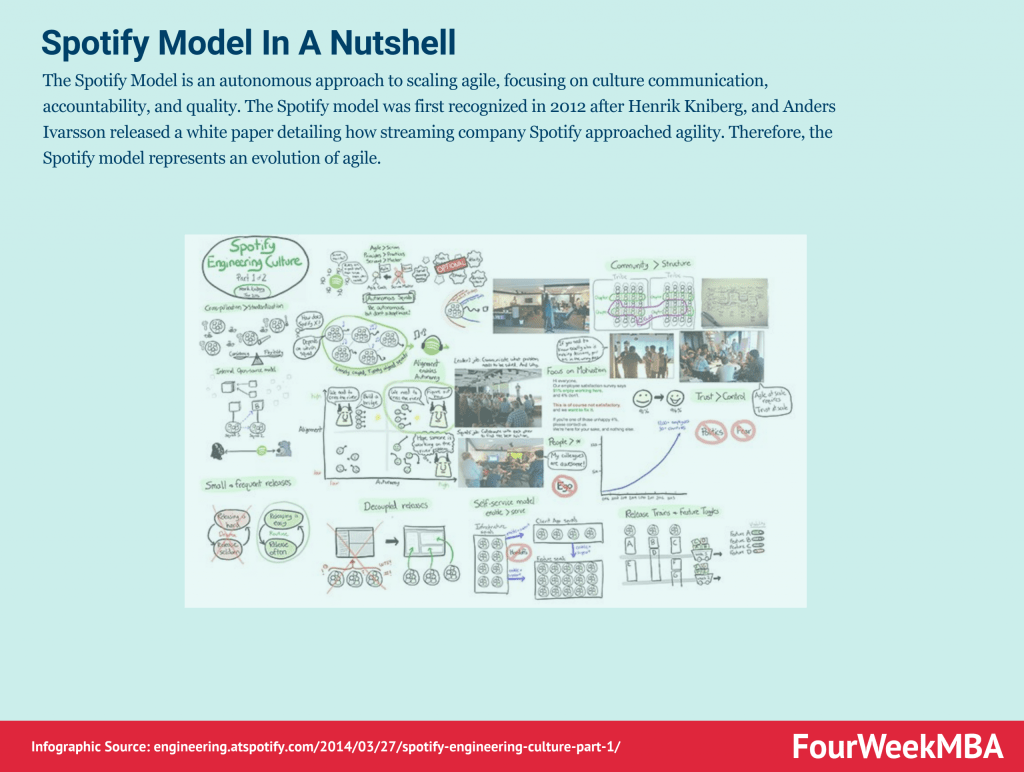
The Spotify Model is an autonomous approach to scaling agile, focusing on culture communication, accountability, and quality. The Spotify model was first recognized in 2012 after Henrik Kniberg, and Anders Ivarsson released a white paper detailing how streaming company Spotify approached agility. Therefore, the Spotify model represents an evolution of agile.
As the name suggests, TDD is a test-driven technique for delivering high-quality software rapidly and sustainably. It is an iterative approach based on the idea that a failing test should be written before any code for a feature or function is written. Test-Driven Development (TDD) is an approach to software development that relies on very short development cycles.
Timeboxing is a simple yet powerful time-management technique for improving productivity. Timeboxing describes the process of proactively scheduling a block of time to spend on a task in the future. It was first described by author James Martin in a book about agile software development.
Scrum is a methodology co-created by Ken Schwaber and Jeff Sutherland for effective team collaboration on complex products. Scrum was primarily thought for software development projects to deliver new software capability every 2-4 weeks. It is a sub-group of agile also used in project management to improve startups’ productivity.
Scrum anti-patterns describe any attractive, easy-to-implement solution that ultimately makes a problem worse. Therefore, these are the practice not to follow to prevent issues from emerging. Some classic examples of scrum anti-patterns comprise absent product owners, pre-assigned tickets (making individuals work in isolation), and discounting retrospectives (where review meetings are not useful to really make improvements).
Scrum at Scale (Scrum@Scale) is a framework that Scrum teams use to address complex problems and deliver high-value products. Scrum at Scale was created through a joint venture between the Scrum Alliance and Scrum Inc. The joint venture was overseen by Jeff Sutherland, a co-creator of Scrum and one of the principal authors of the Agile Manifesto.
Gennaro is the creator of FourWeekMBA, which reached about four million business people, comprising C-level executives, investors, analysts, product managers, and aspiring digital entrepreneurs in 2022 alone | He is also Director of Sales for a high-tech scaleup in the AI Industry | In 2012, Gennaro earned an International MBA with emphasis on Corporate Finance and Business Strategy.