Marqeta’s value proposition centers on offering modern card issuance and payment processing solutions that empower businesses to create innovative and customize
Customer Segments
Marqeta serves a range of customer segments, including: 1. Fintech Startups: Emerging financial technology companies seeking agile payment solutions. 2. Enterpr
Distribution Strategy
Marqeta’s distributionstrategy relies on digital channels, developer outreach, and partnerships. The company offers its services primarily through digital plat
Revenue Streams
Marqeta generates revenue through various streams: 1. Transaction Fees: Charges fees based on the volume and value of transactions processed through its platfor
Marketing Strategy
Marqeta’s marketingstrategy includes developer-focused marketing, educational content, and industry partnerships. The company actively targets developers and b
Organization Structure
Marqeta’s organizational structure includes teams dedicated to technology development, customer support, developer relations, marketing, and partnerships. Techn
Competitive Advantage
Marqeta’s competitive advantage lies in its developer-friendly approach, modern technology stack, real-time authorization, and extensive industry partnerships.
Marqeta is the world’s first modern card issuing platform and was founded in 2009 by Jason Gardner. Marqeta derives most of its revenue from interchange fees. The company works exclusively with banks not subject to regulation to maximize the interchange fee it collects.
History of Marqeta
Gardner created the company because he wanted to disrupt the outdated payment card issuing and processing industry with new technologies.
Specifically, he envisioned an industry where an open API would allow card issuers to design and build their own products.
This they could do more simply without having to follow the rules and regulations of larger, more established card and transaction processors.
Marqeta was officially introduced to the market in 2010 and was the first new payment processing platform for over twenty years.
The platform allows businesses to create physical, virtual, or tokenized single or multi-use debit and credit cards. Some of the company’s major clients include Instacart, DoorDash, Uber, Square, and Kabbage.
Today, the Marqeta platform enables developers to launch new card programs with speed and flexibility.
Importantly, the technology gives companies the opportunity to track real-time data and analytics as their needs evolve. It also allows them to detect potentially fraudulent transactions.
Marqeta currently employs more than 350 people in locations across the US, UK, Canada, and Europe, with a new headquarters opened in Melbourne for the Asia-Pacific region in April 2021.
Marqeta mission, vision and core values
Marqeta’s vision is “to be the global standard for modern card issuing.”
And its vision is “to empower builders to bring the most innovative products to the world.”
Marqeta addresses its vision and mission through seven core values above.
A glance at Marqeta business model
As the company explains in its prospectus:
When you order food using DoorDash or groceries using Instacart, modern card issuing works in the background as money moves from the app to the delivery driver’s payment card, allowing the driver to pay for exactly what you ordered, and nothing else.
The digital enterprise ecosystem that Marqeta sustains through its financial platform (Image Source: Marqeta prospectus).
Therefore, Marqeta is the intermediary layer, which enables players like Klarna, DoorDash, Square, and many others and it “provides a single, global, cloud-based, open API Platform for modern card issuing and transaction processing.”
How Marqeta integrates in the current payment infrastructure workflow to enable more complex payment options for consumers (Image Source: Marqeta prospectus).
More precisely, the Marqeta Platform offers three primary capabilities:
Marqeta Issuing: enabling customers to issue physical, virtual, and tokenized cards.
Marqeta Processing: enabling customers to process transactions with control and speed.
and Marqeta Applications: offering a set of appications covering the entire payments lifecycle, including development tools; program administration; and fraud, cases, and chargebacks.
These features are used to launch, scale, and manage card programs.
Since Marqeta’s business model is cloud-based, with an open API Platform that delivers cards, its main customers are developers, technical product managers, and entrepreneurs at innovative companies.
Marqeta revenue generation
Perhaps somewhat ironically, the Marqeta revenue generation strategy is similar to the strategies of the companies it is trying to disrupt.
These include payment processors such as Visa and Mastercard.
As such, the company generates most of its revenue from interchange fees. These are fees a merchant bank pays a card-issuing bank whenever a customer purchases with an eligible debit or credit card.
Where Marqeta differs from its peers lies in the total share of the interchange fee it collects.
In the company prospectus, it notes that:
“Our agreements with issuing banks provide that we receive 100% of the interchange fees for processing our customer’s card transactions.”
This gives the company a competitive edge in the debit card market.
Here, Marqeta has partnered with banks with less than $10 billion in deposits who are exempt from regulation on how much they can charge as an interchange fee.
By partnering with banks that are not subject to regulation, the company can earn higher interchange fee rates.
Interchange fees are likely to represent a lucrative source of income for the company. The company captured 1% of the $6.7 trillion transaction volume in the United States alone last year, representing about $60 billion.
Other fees
Though most income is derived from interchange fees, the company also generates revenue from processing services.
Revenue is earned by charging fees for services such as monthly platform access and ATM withdrawals.
The company also charges for its Tokenization as a Service (TaaS) functionality, enabling consumers to protect sensitive card data by replacing it with surrogate data in the form of a token.
Key takeaways:
Marqeta is the world’s first modern card issuing platform founded by Jason Gardner in 2009. The platform was created to revolutionize the outdated card payment and issuing industry.
Marqeta derives most of its revenue from interchange fees. The company works exclusively with banks not subject to regulation to maximize the interchange fee it collects.
Marqeta also collects fees on a variety of ancillary services, including tokenization and fraud monitoring. The company also charges a monthly fee for access to its API platform.
Key Highlights
Foundation and Purpose: Marqeta, established in 2009 by Jason Gardner, is the world’s pioneer in modern card issuing platforms. Founded with the intention of disrupting the conventional payment card industry using innovative technology, Marqeta aimed to empower card issuers to create their products.
Historical Evolution: Marqeta was introduced in 2010 as the first new payment processing platform in over two decades. This platform enabled businesses to design physical, virtual, or tokenized debit and credit cards. Major clients, including Instacart, DoorDash, Uber, Square, and Kabbage, have embraced Marqeta’s services.
API-Driven Innovation: At its core, Marqeta facilitates rapid innovation by providing an open API for creating card programs. The platform offers developers the speed, flexibility, and real-time data tracking necessary to respond to changing needs and detect potential fraud.
IPO and Growth: Through a recent Initial Public Offering (IPO), Marqeta achieved a substantial milestone, attaining a $16 billion market cap on the NASDAQ. Currently, Marqeta employs over 350 individuals across locations in the US, UK, Canada, Europe, and established a headquarters in Melbourne in April 2021 for the Asia-Pacific region.
Vision and Values: Marqeta’s overarching vision is to be the global standard for modern card issuing, accompanied by a mission to empower innovators to bring groundbreaking products to the world. These principles are supported by the company’s core values.
Business Model Overview: Acting as an intermediary layer, Marqeta facilitates transactions between various service providers like Klarna, DoorDash, and Square. The company enables seamless money transfers and empowers customers to pay exactly for the services they’ve received.
Key Platform Features: Marqeta’s platform boasts three primary capabilities: Issuing, Processing, and Applications, which together enable the launch, management, and scaling of card programs. These functionalities serve developers, technical product managers, and entrepreneurs.
Revenue Strategy: Marqeta’s revenue generation strategy is grounded in the concept of interchange fees, akin to established payment processors like Visa and Mastercard. Marqeta captures 100% of interchange fees due to partnerships with banks exempt from regulatory constraints, granting it a competitive edge.
Diverse Income Streams: Beyond interchange fees, Marqeta generates revenue through various ancillary services. These include processing services, charging fees for monthly platform access, ATM withdrawals, and the provision of Tokenization as a Service (TaaS), enhancing data security.
Business Model Element
Analysis
Implications
Examples
Value Proposition
Marqeta’s value proposition centers on offering modern card issuance and payment processing solutions that empower businesses to create innovative and customized payment experiences. For Businesses, Marqeta offers: – Developer-Friendly APIs: Easily integrable APIs for building tailored card programs. – Scalability: Solutions that grow with the business’s needs. – Real-Time Authorization: Instant transaction approvals for improved customer experience. Marqeta enables businesses to innovate and deliver unique payment solutions.
Provides businesses with modern card issuance and payment processing solutions. Offers developer-friendly APIs, scalability, and real-time authorization for tailored card programs. Attracts companies seeking to enhance their payment offerings and customer experiences.
– Developer-friendly APIs simplify integration and customization. – Scalability accommodates business growth and changing needs. – Real-time authorization improves transaction speed and customer satisfaction.
Customer Segments
Marqeta serves a range of customer segments, including: 1. Fintech Startups: Emerging financial technology companies seeking agile payment solutions. 2. Enterprise Businesses: Established corporations looking to modernize their payment systems. 3. E-commerce Platforms: Online retailers requiring flexible payment options. 4. Digital Banks: Digital-only banks aiming to offer innovative financial services. Marqeta tailors its solutions to meet the unique requirements of each segment.
Focuses on diverse customer segments, including fintech startups, enterprise businesses, e-commerce platforms, and digital banks. Customizes solutions to address the specific needs and objectives of each group. Provides a versatile platform for various payment innovations.
– Serving diverse customer segments expands Marqeta’s reach. – Tailoring solutions enhances customer satisfaction and engagement.
Distribution Strategy
Marqeta’s distribution strategy relies on digital channels, developer outreach, and partnerships. The company offers its services primarily through digital platforms, including its website and developer portal. Marqeta actively engages developers and businesses through documentation, support, and developer communities. It also forms partnerships with financial institutions, technology companies, and other industry players to expand its ecosystem.
Primarily utilizes digital channels, developer outreach, and partnerships for distribution. Offers services through its website and developer portal. Engages developers and businesses through comprehensive documentation, support, and communities. Forms strategic partnerships to extend its reach and ecosystem. Ensures accessibility and convenience for users.
– Digital channels provide easy access to services. – Developer outreach fosters collaboration and adoption. – Partnerships broaden the ecosystem and user base.
Revenue Streams
Marqeta generates revenue through various streams: 1. Transaction Fees: Charges fees based on the volume and value of transactions processed through its platform. 2. Subscription Fees: Offers subscription-based pricing for access to its solutions and APIs. 3. Licensing Fees: Charges licensing fees for the use of its technology. 4. Setup and Integration Fees: Collects fees for onboarding and integration services. Diversified revenue streams contribute to the company’s financial stability.
Relies on revenue streams from: 1. Transaction fees for processing payments. 2. Subscription fees for platform access and APIs. 3. Licensing fees for technology usage. 4. Setup and integration fees for onboarding services. Diversifies income sources through transaction fees, subscription fees, licensing fees, and setup/integration fees.
– Transaction fees provide revenue with each payment processed. – Subscription fees offer recurring income from platform access. – Licensing fees contribute to technology utilization revenue. – Setup and integration fees enhance overall revenue.
Marketing Strategy
Marqeta’s marketing strategy includes developer-focused marketing, educational content, and industry partnerships. The company actively targets developers and businesses through developer-focused marketing campaigns, hackathons, and community engagement. It provides educational content such as guides, webinars, and case studies to showcase its solutions. Marqeta also forms partnerships with fintechs, banks, and other financial institutions to expand its reach.
Utilizes developer-focused marketing, educational content, and industry partnerships for marketing. Targets developers and businesses through campaigns, hackathons, and community engagement. Provides educational resources like guides, webinars, and case studies. Forms strategic partnerships with fintechs, banks, and financial institutions. Attracts developers and businesses with a developer-centric approach.
– Developer-focused marketing engages key stakeholders effectively. – Educational content demonstrates the value of its solutions. – Industry partnerships extend the reach and ecosystem.
Organization Structure
Marqeta’s organizational structure includes teams dedicated to technology development, customer support, developer relations, marketing, and partnerships. Technology development teams focus on enhancing the platform’s features and capabilities. Customer support teams assist clients with inquiries and issues. Developer relations teams engage with the developer community. Marketing teams promote Marqeta’s solutions, while partnerships teams collaborate with other companies. This structure supports innovation, customer satisfaction, and ecosystem growth.
Employs specialized teams for technology development, customer support, developer relations, marketing, and partnerships. Enhances platform features and capabilities through technology development teams. Assists clients with inquiries and issues through customer support teams. Engages with the developer community via developer relations teams. Promotes solutions through marketing teams. Collaborates with other companies through partnerships teams. Supports innovation, customer satisfaction, and ecosystem growth.
– Specialized teams drive innovation and platform enhancement. – Customer support builds trust and addresses client needs. – Developer relations engage with the developer community effectively. – Marketing and partnerships teams expand the user base and ecosystem.
Competitive Advantage
Marqeta’s competitive advantage lies in its developer-friendly approach, modern technology stack, real-time authorization, and extensive industry partnerships. The company’s emphasis on developer engagement attracts businesses looking for flexible payment solutions. Its modern technology stack ensures scalability and reliability. Real-time authorization improves transaction speed and user experience. Marqeta’s strategic partnerships with fintechs and banks enhance its ecosystem and offerings, setting it apart in the fintech industry.
Derives a competitive advantage from: – A developer-friendly approach that fosters innovation. – A modern technology stack that enables scalability and reliability. – Real-time authorization for fast transaction approvals. – Extensive industry partnerships that enrich its ecosystem. Sets itself apart in the fintech industry by prioritizing flexibility, scalability, and industry collaboration.
– Developer engagement drives innovation and adoption. – Modern technology stack ensures efficiency and reliability. – Real-time authorization enhances user satisfaction. – Industry partnerships expand the ecosystem and offerings.
Acorns is a fintech platform providing services related to Robo-investing and micro-investing. The company makes money primarily through three subscription tiers: Lite – ($1/month), which gives users access to Acorns Invest, Personal ($3/month) that includes Invest plus the Later (retirement) and Spend (personal checking account) suite of products, Family ($5/month) with features from both the Lite and Personal plans with the addition of Early.
Starting as a pay-later solution integrated into merchants’ checkouts, Affirm makes money from merchants’ fees as consumers pick up the pay-later solution. Affirm also makes money through interest earned from the consumer loans when those are repurchased from the originating bank. In 2020 Affirm made 50% of its revenues from merchants’ fees, about 37% from interests, and the remaining from virtual cards and servicing fees.
Alipay is a Chinese mobile and online payment platform created in 2004 by entrepreneur Jack Ma as the payment arm of Taobao, a major Chinese eCommerce site. Alipay, therefore, is the B2C component of Alibaba Group. Alipay makes money via escrow transaction fees, various value-added ancillary services, and its Credit Pay Instalment fees.
Betterment is an American financial advisory company founded in 2008 by MBA graduate Jon Stein and lawyer Eli Broverman. Betterment makes money via investment plans, financial advice packages, betterment for advisors, betterment for business, cash reserve, and checking accounts.
Chime is an American neobank (internet-only bank) company, providing fee-free financial services through its mobile banking app, thus providing personal finance services free of charge while making the majority of its money via interchange fees (paid by merchants when consumers use their debit cards) and ATM fees.
Coinbase is among the most popular platforms for trading and storing crypto-assets, whose mission is “to create an open financial system for the world” by enabling customers to trade cryptocurrencies. Its platform serves both as a search and discovery engine for crypto assets. The company makes money primarily through fees earned for the transactions processed through the platform, custodial services offered, interest, and subscriptions.
Compass is a licensed American real-estate broker incorporating online real estate technology as a marketing medium. The company makes money via sales commissions (collected whenever a sale is facilitated or tenants are found for a rental property) and bridge loans (a service allowing the seller to purchase a home before the revenue from the sale of their previous home is available).
Dosh is a Fintech platform that enables automatic cash backs for consumers. Its business model connects major card providers with online and offline local businesses to develop automatic cash back programs. The company makes money by earning an affiliate commission on each eligible sale from consumers.
E-Trade is a trading platform allowing investors to trade common and preferred stocks, exchange-traded funds (ETFs), options, bonds, mutual funds, and futures contracts; acquired by Morgan Stanley in 2020 for $13 billion. E-Trade makes money through interest income, order flow, margin interests, options, future and bonds trading, and other fees and service charges.
Klarna is a financial technology company allowing consumers to shop with a temporary Visa card. Thus it then performs a soft credit check and pays the merchant. Klarna makes money by charging merchants. Klarna also earns a percentage of interchange fees as a commission and for interests earned on customers’ accounts.
Lemonade is an insurance tech company using behavioral economics and artificial intelligence to process claims efficiently. The company leverages technology to streamline onboarding customers while also applying a financial model to reduce conflicts of interest with customers (perhaps by donating the variable premiums to charity). The company makes money by selling its core insurance products, and via its tech platform, it tries to enhance its sales.
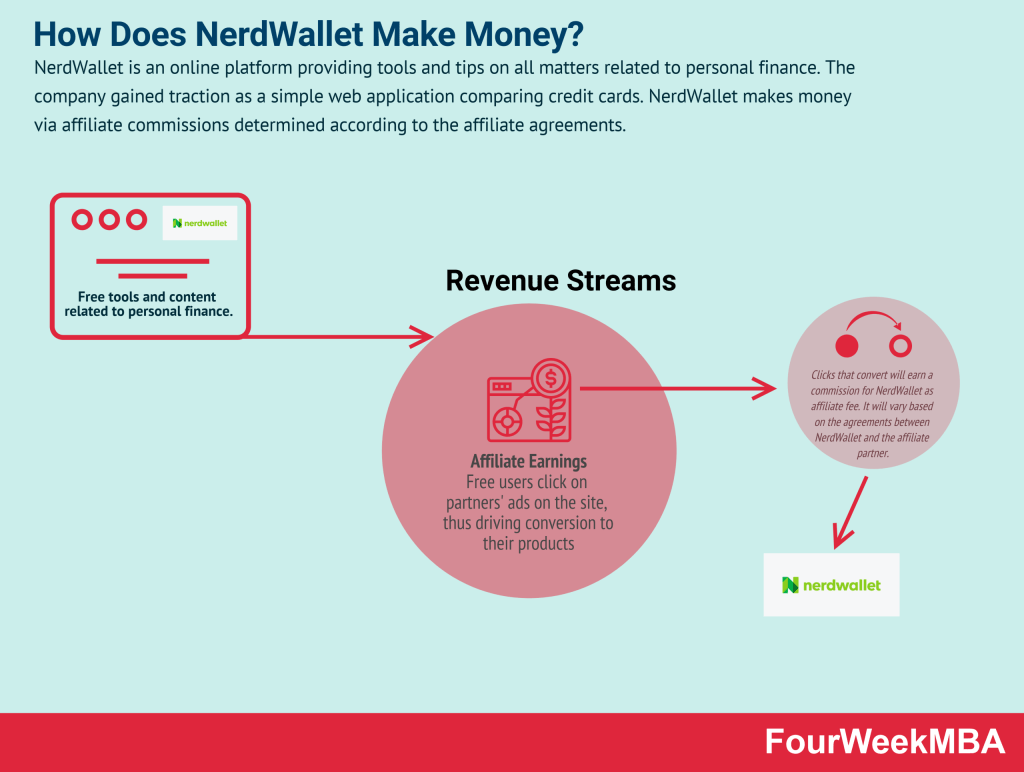
NerdWallet is an online platform providing tools and tips on all matters related to personal finance. The company gained traction as a simple web application comparing credit cards. NerdWallet makes money via affiliate commissions determined according to the affiliate agreements.
Robinhood is an app that helps to invest in stocks, ETFs, options, and cryptocurrencies, all commission-free. Robinhood earns money by offering: Robinhood Gold, a margin trading service, which starts at $6 a month, earns interests from customer cash and stocks, and rebates from market makers and trading venues.
SoFi is an online lending platform that provides affordable education loans to students, and it expanded into financial services, including loans, credit cards, investment services, and insurance. It makes money primarily via payment processing fees and loan securitization.
Stash is a FinTech platform offering a suite of financial tools for young investors, personalized investment advice, and life insurance. The company primarily makes money via subscriptions, cashback, payment for order flows, and interest for cash sitting on members’ accounts.
Wealthfront is an automated Fintech investment platform providing investment, retirement, and cash management products to retail investors, mostly making money on the annual 0.25% advisory fee the company charges for assets under management. It also makes money via a line of credits and interests on the cash accounts.
Zelle is a peer-to-peer payment network that indirectly benefits the banks’ consortium that backs it. Zelle also enables users to pay businesses for goods and services free for users. Merchants pay a 1% fee to Visa or Mastercard, who share it with the bank that issued the card.
Gennaro is the creator of FourWeekMBA, which reached about four million business people, comprising C-level executives, investors, analysts, product managers, and aspiring digital entrepreneurs in 2022 alone | He is also Director of Sales for a high-tech scaleup in the AI Industry | In 2012, Gennaro earned an International MBA with emphasis on Corporate Finance and Business Strategy.