Jackpocket is a North American third-party app enabling consumers to purchase official state lottery tickets, founded in 2013 by Peter Sullivan, Leo Shemesh, Eric Parker, and Matt Silber, with a mission to provide a convenient, fun, and responsible way to play the lottery. Jackpocket has a relatively simple revenue generation model, collecting service fees and commissions.
Business Model Element
Analysis
Implications
Examples
Value Proposition
Jackpocket’s value proposition revolves around convenience, security, and accessibility for lottery players. For Players, Jackpocket offers: – Convenience: The ability to play official lottery games using a mobile app without visiting a physical retailer. – Security: A secure and legal way to participate in lottery games. – Accessibility: Access to a variety of lottery games that may not be available locally. For State Lotteries, Jackpocket provides: – Increased Sales: A mobile platform that can drive ticket sales for state lotteries. – Modernization: A digital solution that complements traditional lottery sales channels. Jackpocket simplifies lottery participation and enhances player experiences.
Provides players with a convenient and secure way to play lottery games via mobile apps. Attracts individuals seeking easy access to lottery games. Provides state lotteries with a digital solution to boost ticket sales and modernize their offerings. Enhances player satisfaction and engagement.
– Convenient mobile app access eliminates the need for physical purchases. – Security measures provide a trusted platform for lottery participation. – Accessibility to a wider range of lottery games appeals to players. – State lotteries can increase sales and stay competitive with digital offerings.
Customer Segments
Jackpocket serves various customer segments, including: 1. Lottery Players: Individuals who enjoy playing official lottery games. 2. Mobile Users: People who prefer the convenience of mobile apps for various activities. 3. State Lotteries: Government agencies responsible for managing and promoting lottery games. Jackpocket tailors its platform to meet the specific needs of each segment.
Focuses on diverse customer segments, including lottery players, mobile app users, and state lotteries. Customizes the platform to address the unique requirements and preferences of each group. Provides a versatile platform for lottery participation and sales.
– Serving diverse customer segments broadens Jackpocket’s user base. – Tailoring the platform enhances customer satisfaction and engagement.
Distribution Strategy
Jackpocket’s distribution strategy relies on its mobile app, which users can download from app stores. The platform provides access to official state lottery games, and users can fund their accounts and purchase tickets through the app. Jackpocket complies with state regulations to operate legally and securely.
Primarily utilizes mobile app distribution through app stores. Offers easy access to official state lottery games. Allows users to fund accounts and purchase tickets via the app. Operates within state regulations to ensure legality and security. Ensures convenient and secure access to lottery games.
– Mobile app distribution caters to users’ preference for app-based convenience. – In-app funding and ticket purchases simplify the lottery experience. – Compliance with state regulations builds trust and legality.
Revenue Streams
Jackpocket generates revenue primarily through a convenience fee applied to each ticket purchase. The fee covers the cost of providing the service and ensures the platform remains free for state lotteries and players. Additionally, Jackpocket may earn interest on funds held in user accounts and receive commissions from state lotteries for increasing ticket sales. Diverse revenue streams contribute to the company’s income.
Relies on revenue streams from: 1. Convenience fees applied to ticket purchases. 2. Interest earned on funds held in user accounts. 3. Commissions from state lotteries for driving ticket sales. Diversifies income sources through convenience fees, interest earnings, and commissions.
– Convenience fees provide revenue with each ticket purchase. – Interest earnings contribute to overall profitability. – Commissions from state lotteries incentivize ticket sales growth.
Marketing Strategy
Jackpocket’s marketing strategy involves digital advertising, promotions, and partnerships. The company uses digital marketing channels like online advertising, social media, and email marketing to reach potential users. Jackpocket offers promotions, discounts, and referral programs to incentivize player engagement and acquisition. Partnerships with state lotteries enhance its product selection and geographic reach.
Utilizes digital advertising, promotions, and partnerships for marketing. Targets potential users through online advertising, social media, and email marketing. Offers promotions, discounts, and referral programs to stimulate player engagement and acquisition. Forms strategic partnerships with state lotteries to expand its product catalog and geographic reach. Creates a compelling presence in the lottery industry.
– Digital marketing effectively reaches potential users online. – Promotions and discounts encourage player engagement and loyalty. – Partnerships broaden the product catalog and geographic coverage. – A strong presence in the lottery sector attracts players.
Organization Structure
Jackpocket’s organizational structure includes teams dedicated to technology development, customer support, marketing, partnerships, and compliance. Technology development teams focus on maintaining and improving the mobile app and platform. Customer support teams assist users with inquiries and issues. Marketing teams promote Jackpocket’s services, while partnerships and compliance teams ensure adherence to state regulations. This structure supports innovation, customer satisfaction, and legal compliance.
Employs specialized teams for technology development, customer support, marketing, partnerships, and compliance. Maintains and enhances the mobile app and platform through technology development teams. Assists users with inquiries and issues through customer support teams. Promotes services through marketing teams. Collaborates with state lotteries and ensures legal compliance through partnerships and compliance teams. Supports innovation, customer satisfaction, and legal adherence.
– Specialized teams drive innovation and platform enhancement. – Customer support builds trust and addresses user needs. – Marketing promotes services effectively. – Partnerships and compliance teams expand the ecosystem and ensure legality.
Competitive Advantage
Jackpocket’s competitive advantage stems from its convenient mobile app, legal compliance, security measures, and partnerships with state lotteries. The mobile app provides a user-friendly and accessible way to play lottery games. Legal compliance ensures a secure and legitimate platform. Security measures build trust among players. Partnerships with state lotteries offer access to a wide variety of official games. Jackpocket’s focus on convenience, legality, and security differentiates it in the lottery industry.
Derives a competitive advantage from: – A user-friendly and convenient mobile app. – Legal compliance ensuring a secure and legitimate platform. – Security measures building trust among players. – Partnerships with state lotteries for a diverse game selection. Sets itself apart in the lottery industry by prioritizing convenience, legality, and security for players.
– A user-friendly app simplifies the lottery experience. – Legal compliance assures players of security and legality. – Security measures build trust among users. – Partnerships expand the range of available games.
Jackpocket is a North American third-party app enabling consumers to purchase official state lottery tickets.
The company was founded in 2013 by Peter Sullivan, Leo Shemesh, Eric Parker, and Matt Silber with a mission to provide a convenient, fun, and responsible way for consumers to play the lottery.
Tech freelancer Sullivan is the man credited with the idea behind Jackpocket. Growing up, Sullivan’s father was an avid lottery player.
But as an adult, he wondered why the lottery system had not gone paperless, with his father still forced to buy them in person.
Sullivan then observed that his computer-illiterate father was still able to play social casino games on his iPhone.
The co-founder wondered if the lottery system could finally adapt to modern technology and be accessible from a smartphone.
Jackpocket is born
In 2012, Sullivan ended his tenure at social platform Tripl and decided to get to work on Jackpocket.
As part of a Series A funding round, he managed to secure a major investor who was also a former CEO of one of the largest lottery companies in the world.
However, the investor pulled out at the last minute, with Jackpocket employees working for free to see the idea for the platform come to fruition.
In December 2013, the Jackpocket app was launched in New York. Leveraging the attraction of a $636 million jackpot, usage of the app grew quickly.
Publicity from the New York Post and Good Morning America no doubt contribute to the hype.
As the company expanded across the USA, its success was facilitated by an ability to build close relationships with state gaming regulators.
Stevenson, a casual lottery player from Minnesota, won the prize the day after he downloaded the app and had paid for his winning ticket using referral credits from a friend.
COVID-19 and lottery’s changing demographic
Jackpocket was another business to profit from the coronavirus pandemic, with states forced to modernize their gaming industries and allow locked-down consumers to purchase lottery tickets remotely.
There are now over 2 million Jackpocket users, with the company noting that it is “attracting a new demographic of lottery players who are tech savvy, affluent, and younger.” Indeed, the average age of a Jackpocket user is 36, with 58% between the ages of 18 and 40.
This put the app ahead of TikTok, Netflix, and Amazon Prime Video.
The download increase was due to a no-winner streak where the first prize in the Mega Millions lottery exceeded $1 billion.
That Jackpocket occupied the top spot is doubly impressive when one considers that it is only available in twelve of the 50 US states.
To celebrate over one million winners on Jackpocket a month later, the company added a new social sharing feature to make it easier for users to tell others their good news.
Those who share their wins can earn free plays and lotto credits.
Jackpocket revenue generation
Jackpocket has a simple revenue generation model, collecting service fees and commissions.
It should also be noted that there are no monthly subscription or sign-up fees.
The company also refrains from taking a cut of the jackpot winner’s prize money.
Service fees
Firstly, Jackpocket charges a service fee of around 7 to 10% for its courier service.
In the context of the lottery industry, a courier service simply describes the buying and storing lottery tickets on behalf of the entrant.
After receiving the required funds, Jackpocket places an order with a licensed lottery retailer and secures the tickets in a locked vault with restricted access.
For peace of mind, customers are given a scanned ticket copy available in-app. They are also sent an email including the ticket serial number.
The exact fee varies according to the state and the total purchase price of the tickets.
Commissions
Historically, a state-funded lottery system would pay a commission to retail partners such as gas stations and newsstands to distribute (sell) the tickets.
Jackpocket splits the commission from each in-app ticket sale with its partner stores in the more modern system.
The exact nature of the split is undisclosed and likely agreed upon contractually.
CEO Peter Sullivan noted that some of the capital would be used to add to Jackpocket’s core business of lottery ticket sales with mobile gaming.
Capital would also be invested in technology, enabling the company to invest in best practices from the eCommerce, subscription, and mobile wallet service industries.
Games that may be added to the Jackpocket platform include raffles, sweepstakes, social casino games, and bingo.
According to Sullivan, these would complement Jackpocket’s existing lottery system, where a portion of the money is donated to charity.
“What a lot of people don’t know about the lottery is that a percentage goes to good causes. We want to provide more fun gameplay and chances to win, and more ways to give back.”
Sullivan has also touted future partnerships with instant grocery delivery startups, considered to be digital extensions of the popular corner store, which, at one time, were the only place lottery tickets could be purchased.
Partnerships
In 2021 and 2022, Jackpocket entered into several partnerships with high-profile universities and sports organizations. Some of these are listed below.
Dallas Mavericks
In a multi-year partnership with NBA team Dallas Mavericks, Jackpocket will host sweepstakes across the season, allowing fans to win game tickets, merchandise, and VIP experiences.
The deal was undoubtedly helped by Dallas Mavericks owner and serial entrepreneur Mark Cuban, who was aware of Jackpocket’s momentum in the industry and believed mobile gaming was a natural evolution for lottery-based games.
New Jersey Devils
Jackpocket also announced a multi-year partnership with the National Hockey League team New Jersey Devils to become its official lottery courier partner.
Similar to the deal announced with the Mavericks, Devils fans will be able to participate in branded sweepstakes with many prizes such as:
Free Jackpocket lottery tickets.
Autographed merchandise that is one-of-a-kind, and
Private access to the ice at the team’s practice arena.
Announcing the deal, Senior Vice President of Corporate Partnerships Adam Cross said that:
“we are confident Jackpocket will be the preferred, digital lottery platform for Devils fans – who are already five times more likely to play the lottery than the national average.”
Rutgers Athletics
In January 2021, Jackpocket and Rutgers Athletics reached a multi-year agreement to become the school’s first-ever mobile lottery partner.
For Jackpocket, this enabled brand integration in two major sports stadiums and the school’s social media platforms.
The company would also receive significant exposure via print, radio, and other digital assets.
Rutgers was Peter Sullivan’s alma mater, with the CEO relishing the opportunity to enhance the viewing experience for basketball and football fans during games.
Jackpocket will offer free lottery tickets with special codes and host contests where participants can win tickets to sports matches like the other deals.
These are open to campus alumni, students, and general attendees.
“ESPN is an iconic brand, and their popularity in the tri-state area is something local fans always rely on for the best and most thorough coverage of New York’s famed sports teams,” explained Sullivan on the Jackpocket blog.
The partnership was seen as the company’s largest sports broadcasting promotion, with extra coverage across Major League Baseball added to other major sports competitions such as the NBA, NHL, and NFL.
Key takeaways:
Jackpocket is a North American third-party lottery app, the first such app of its kind in the United States. Co-founder Peter Sullivan got the idea for the app after noticing that lottery ticket purchasing systems were outdated.
Jackpocket has a simple revenue generation model. It does not charge a monthly subscription fee, nor does it take a cut from the winning entrant’s cash prize.
Instead, Jackpocket collects a service fee for buying and then storing the tickets in a secure vault on behalf of the entrant. It also splits a commission fee from each ticket sale with various retail partners.
Key Highlights
Origin Story and Mission: Jackpocket was founded in 2013 by Peter Sullivan, Leo Shemesh, Eric Parker, and Matt Silber. The mission was to offer a convenient, fun, and responsible way for consumers to play the lottery.
Tech-Driven Vision: Co-founder Peter Sullivan, a tech freelancer, conceived the idea for Jackpocket by realizing that the lottery system could benefit from modern technology, allowing lottery tickets to be purchased through smartphones.
Launch and Early Success: Jackpocket’s app was launched in 2013 in New York, leveraging a large jackpot to attract users. Publicity from media outlets like the New York Post and Good Morning America helped fuel its growth.
COVID-19 Boost: The pandemic led to increased demand for remote purchasing of lottery tickets, benefiting Jackpocket. The company’s user base expanded to over 2 million, attracting a younger and tech-savvy demographic.
App Store Achievement: In 2022, Jackpocket became the most popular entertainment app on the App Store, surpassing major apps like TikTok, Netflix, and Amazon Prime Video. This achievement was driven by a massive Mega Millions jackpot.
Revenue Model: Jackpocket’s revenue generation is through service fees and commissions. There are no monthly subscription fees, and the company doesn’t take a cut of the jackpot winnings.
Service Fees: Jackpocket charges a service fee of around 7 to 10% for its courier service, where it buys and stores lottery tickets on behalf of users. Customers receive scanned ticket copies and email notifications.
Commissions: Jackpocket shares commissions from in-app ticket sales with its partner retail stores, modernizing the distributionmodel compared to traditional lottery systems.
Product Expansion: The company announced a Series D funding round of $210 million in 2021. Jackpocket plans to expand into mobile gaming, offering games like raffles, sweepstakes, social casino games, and bingo, while contributing to charitable causes.
Partnerships: Jackpocket established partnerships with high-profile entities like the Dallas Mavericks, New Jersey Devils, Rutgers Athletics, and ESPN New York. These partnerships involve sweepstakes, branded experiences, and increased exposure.
Acorns is a fintech platform providing services related to Robo-investing and micro-investing. The company makes money primarily through three subscription tiers: Lite – ($1/month), which gives users access to Acorns Invest, Personal ($3/month) that includes Invest plus the Later (retirement) and Spend (personal checking account) suite of products, Family ($5/month) with features from both the Lite and Personal plans with the addition of Early.
Starting as a pay-later solution integrated into merchants’ checkouts, Affirm makes money from merchants’ fees as consumers pick up the pay-later solution. Affirm also makes money through interest earned from the consumer loans when those are repurchased from the originating bank. In 2020 Affirm made 50% of its revenues from merchants’ fees, about 37% from interests, and the remaining from virtual cards and servicing fees.
Alipay is a Chinese mobile and online payment platform created in 2004 by entrepreneur Jack Ma as the payment arm of Taobao, a major Chinese eCommerce site. Alipay, therefore, is the B2C component of Alibaba Group. Alipay makes money via escrow transaction fees, various value-added ancillary services, and its Credit Pay Instalment fees.
Betterment is an American financial advisory company founded in 2008 by MBA graduate Jon Stein and lawyer Eli Broverman. Betterment makes money via investment plans, financial advice packages, betterment for advisors, betterment for business, cash reserve, and checking accounts.
Chime is an American neobank (internet-only bank) company, providing fee-free financial services through its mobile banking app, thus providing personal finance services free of charge while making the majority of its money via interchange fees (paid by merchants when consumers use their debit cards) and ATM fees.
Coinbase is among the most popular platforms for trading and storing crypto-assets, whose mission is “to create an open financial system for the world” by enabling customers to trade cryptocurrencies. Its platform serves both as a search and discovery engine for crypto assets. The company makes money primarily through fees earned for the transactions processed through the platform, custodial services offered, interest, and subscriptions.
Compass is a licensed American real-estate broker incorporating online real estate technology as a marketing medium. The company makes money via sales commissions (collected whenever a sale is facilitated or tenants are found for a rental property) and bridge loans (a service allowing the seller to purchase a home before the revenue from the sale of their previous home is available).
Dosh is a Fintech platform that enables automatic cash backs for consumers. Its business model connects major card providers with online and offline local businesses to develop automatic cash back programs. The company makes money by earning an affiliate commission on each eligible sale from consumers.
E-Trade is a trading platform allowing investors to trade common and preferred stocks, exchange-traded funds (ETFs), options, bonds, mutual funds, and futures contracts; acquired by Morgan Stanley in 2020 for $13 billion. E-Trade makes money through interest income, order flow, margin interests, options, future and bonds trading, and other fees and service charges.
Klarna is a financial technology company allowing consumers to shop with a temporary Visa card. Thus it then performs a soft credit check and pays the merchant. Klarna makes money by charging merchants. Klarna also earns a percentage of interchange fees as a commission and for interests earned on customers’ accounts.
Lemonade is an insurance tech company using behavioral economics and artificial intelligence to process claims efficiently. The company leverages technology to streamline onboarding customers while also applying a financial model to reduce conflicts of interest with customers (perhaps by donating the variable premiums to charity). The company makes money by selling its core insurance products, and via its tech platform, it tries to enhance its sales.
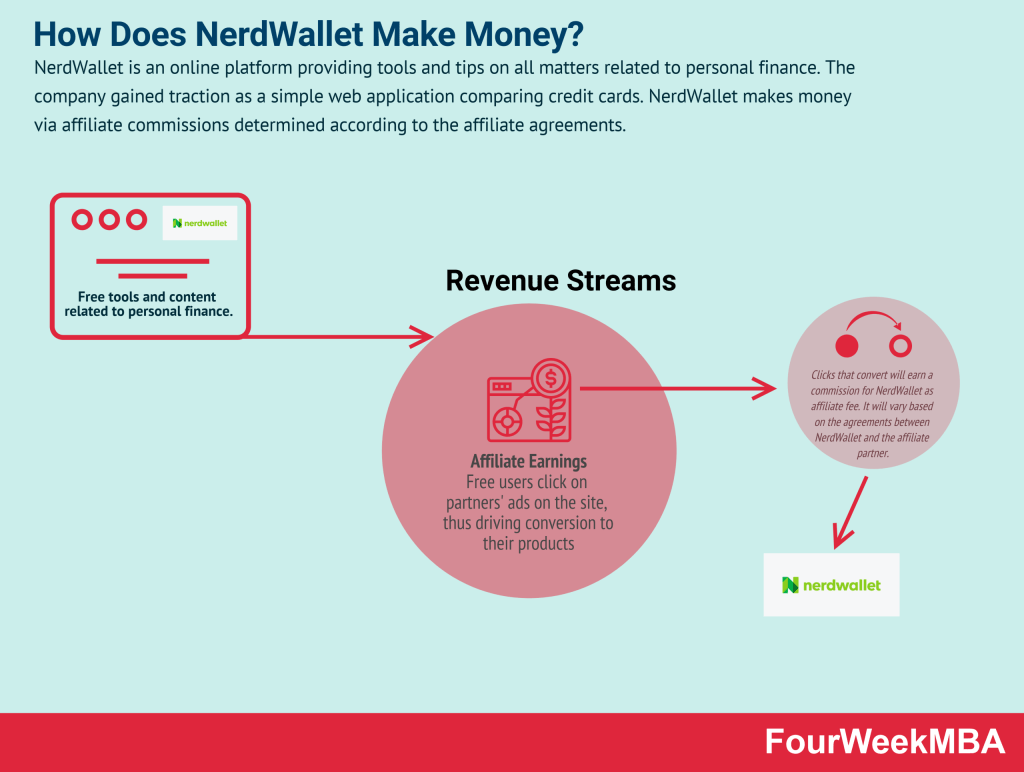
NerdWallet is an online platform providing tools and tips on all matters related to personal finance. The company gained traction as a simple web application comparing credit cards. NerdWallet makes money via affiliate commissions determined according to the affiliate agreements.
Robinhood is an app that helps to invest in stocks, ETFs, options, and cryptocurrencies, all commission-free. Robinhood earns money by offering: Robinhood Gold, a margin trading service, which starts at $6 a month, earns interests from customer cash and stocks, and rebates from market makers and trading venues.
SoFi is an online lending platform that provides affordable education loans to students, and it expanded into financial services, including loans, credit cards, investment services, and insurance. It makes money primarily via payment processing fees and loan securitization.
Squarespace is a North American hosting and website building company. Founded in 2004 by college student Anthony Casalena as a blog hosting service, it grew to become of the most successful website building companies. The company mostly makes money via its subscription plans. It also makes money via customizations on top of its subscription plans. And in part also transaction fees for the website where it processes the sales.
Stash is a FinTech platform offering a suite of financial tools for young investors, personalized investment advice, and life insurance. The company primarily makes money via subscriptions, cashback, payment for order flows, and interest for cash sitting on members’ accounts.
Wealthfront is an automated Fintech investment platform providing investment, retirement, and cash management products to retail investors, mostly making money on the annual 0.25% advisory fee the company charges for assets under management. It also makes money via a line of credits and interests on the cash accounts.
Zelle is a peer-to-peer payment network that indirectly benefits the banks’ consortium that backs it. Zelle also enables users to pay businesses for goods and services, free for users. Merchants pay a 1% fee to Visa or Mastercard, who share it with the bank that issued the card.
Gennaro is the creator of FourWeekMBA, which reached about four million business people, comprising C-level executives, investors, analysts, product managers, and aspiring digital entrepreneurs in 2022 alone | He is also Director of Sales for a high-tech scaleup in the AI Industry | In 2012, Gennaro earned an International MBA with emphasis on Corporate Finance and Business Strategy.